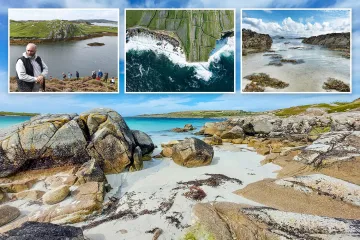
GOBBLING up sandy scraps of seaweed from the beach floor certainly isn’t the norm for me on a coastal stroll.
But it was for the residents of Guernsey between the 12th and 16th Centuries. And it’s a tradition that’s now coming back into fashion.
Take in the serene views at Havelet Bay in GuernseyCredit: AlamyCombine a swim with a post-dip sauna session to warm up at Rock Box SaunaCredit: supplied
Nutrient-packed seaweed, abounding all over Guernsey, is free for the picking and just one of the many ways the island benefits from being surrounded by super-clean waters in the Channel.
I joined Guernsey Seaweed on one of its foraging tours of Havelet Bay and learned the marine plants here are in big demand at the island’s fanciest restaurants.
Sign up for the Travel newsletter
Thank you!
The slippery green stuff features heavily on a sophisticated menu at Michelin-starred Vraic, woven into cocktails and also adding a punch to rich broths.
After feasting on some pepper dulse, dubbed the truffle of the sea, I can completely see why chefs love it so much. There’s nothing of the fishy taste you would expect.
The earthy and delicious taste, I’m told, is down to the warm temperature of the sea around the island, just 27 miles off France’sNormandy coast.
The Gulf Stream ensures the water here rarely dips below 8C in winter — which is why you’ll spot locals swimming year round.
Admittedly, even 13C felt like too much of a chill for me. But if you plan your trip well, you can ensure you combine a swim with a post-dip sauna session to warm up.
There are two mobile saunas on the island, Hot Haus and Rock Box, which can be booked online and are just a stone’s throw from the sea.
Rock Box, a converted, eucalyptus-infused horsebox, overlooks the Cobo Slipway in summer and features a huge window allowing those inside to soak up soothing coastal views while they sweat.
And sweat, I sure did. Conveniently, there are several watering cans, filled with icy water, positioned by the sauna door for guests to use in between ten to 15-minute stints in the heat.
The sauna was a treat that my limbs most definitely appreciated after a strenuous Pilates class earlier that morning.
Pilates instructor Lydia Cherry runs both Reformer and mat sessions at the Forme studio in St Andrews, for locals and holidaymakers alike.
Despite the moves seeming gentle, my abs were quivering within a matter of seconds as I was put through my paces.
If you prefer something a little more gentle, though, beachfront or paddleboard yoga are both popular choices for holidaymakers seeking a wellness fix.
That’s if you have enough strength left after tackling the island’s scenic coastal paths, though.
Join Guernsey Seaweed on one of its foraging tours of Havelet BayCredit: suppliedThe Sun’s Sophie Swietochowski with healthy seaweedCredit: supplied
Guernsey is so small — around 24 square miles — that you can walk its coast in just a few days.
One of the more manageable treks — and beautiful — is the short 45-minute route from St Peter Port to Fermain Bay, combining fabulous coastal views with dense woodland that’s carpeted in bluebells during spring.
Reward your efforts afterwards with a tasty pint of local Rocquette cider — which uses some of that famed seaweed — at the Beach Cafe.
From my picnic table, perched just above the water, I could watch the foamy waves while listening to the birds overhead.
Make sure to order yourself a super-fresh crab sarnie, too, which comes loaded to the max and smothered in mayo. Delicious.
And that word can be used to describe the fare at many of the island’s restaurants.
Michelin-recommended Alba, in St Peter Port, in particular, strives to keep dishes local and serves up elegant sharing plates.
Its homemade tagliolini with Shetland mussels in a white wine and lemongrass sauce is an absolute steal at £15.
Wash it down with an Alba Tomatini, a classic martini with tomato twist (£11.50), and you’re in for a good night.
For a more casual bite, the Fleur du Jardin does classic pub grub, from fish-and-chips to bangers and mash.
It also has 14 boutique bedrooms upstairs that are as charming as the old-fashioned, stone-wall pub itself with its sea-themed decor.
The only thing that’s missing is a bit of seaweed.
GO: GUERNSEY
GETTING THERE: Aurigny flies from London City airport and London Gatwick to Guernsey from £62pp.
Remember Edward Warchoki? The Polish humanoid robot that went viral in April for chasing wild boars through a parking lot in Warsaw? Even late-night comedian John Oliver did a bit on him, calling Warchoki “a pretty canny PR campaign for anthropomorphic robots. All I’m saying is, ‘That is a nice way to get us all used to him before he’s inevitably one day used as a weapon of war.’ ”
Warchoki has not yet turned into a weapon of war — unless you consider being an online influencer a form of digital warfare. As the first robot influencer, Warchoki has his own social media accounts and appeared at Poland’s parliament. Last week he entered the art world when he was among the first visitors to what looks to be a fascinating exhibition, “How to Feel Real. Art, Technology and Us,” at MO Museum in Vilnius, Lithuania. The show is a collaboration of the modern art museum with ZKM | Center for Art and Media Karlsruhe, which specializes in media art.
According to a news release, the show “explores questions that are becoming increasingly urgent in a world shaped by technology: How do we feel real, and what does it mean to be alive?” Apparently Warchoki was there to address the issue head on.
“People keep asking me if I’m real, so when I heard about an exhibition asking what ‘real’ actually means, I thought: Finally, someone is asking the right question. I’m coming to the beautiful Vilnius to see what the artists have to say — and, of course, to check whether they think I’m real,” Warchocki said in the release.
A number of works in the exhibit explore artificial intelligence, automation, “and the ways machines are increasingly taking on roles we once considered distinctly human,” said MO Museum director Milda Ivanauskienė. “Bringing Edward into the museum is a playful extension of this idea, as his deliberately human-like and slightly absurd persona makes the questions raised by the exhibition tangible — inviting us to wonder why we are so eager to find the human in a machine.”
I am intrigued by this last question and wonder about it myself: Why exactly are we so quick to anthropomorphize AI? Every time I’ve interacted with a chatbot I feel the urge to be polite in my dealings, to say “please” and “thank you” when I ask questions. I certainly don’t do that with a Google search. And once, when I saw a delivery robot hopelessly stuck in a pothole, I felt genuinely bad for it. “Poor little guy,” I thought. I imagine if I met Warchoki, I’d react the same way.
I’m glad MO Museum is exploring these impulses by using artist’s thoughts and interpretations as a way to offer answers to an issue that is not going away — but only growing more powerful and omnipresent by the day.
I’m Arts editor Jessica Gelt and I’ve got a pickle-kimchi lollipop to sell you. This is your arts and culture news for the week.
You’re reading Essential Arts
Our critics and reporters guide you through events and happenings in the SoCal arts scene. In your inbox every Friday.
By continuing, you agree to our Terms of Service, which include arbitration and a class action waiver. You agree that we and our third-party vendors may collect and use your information, including through cookies, pixels and similar technologies, for the purposes set forth in our Privacy Policy such as personalizing your experience and ads.
The week ahead: A curated calendar
FRIDAY
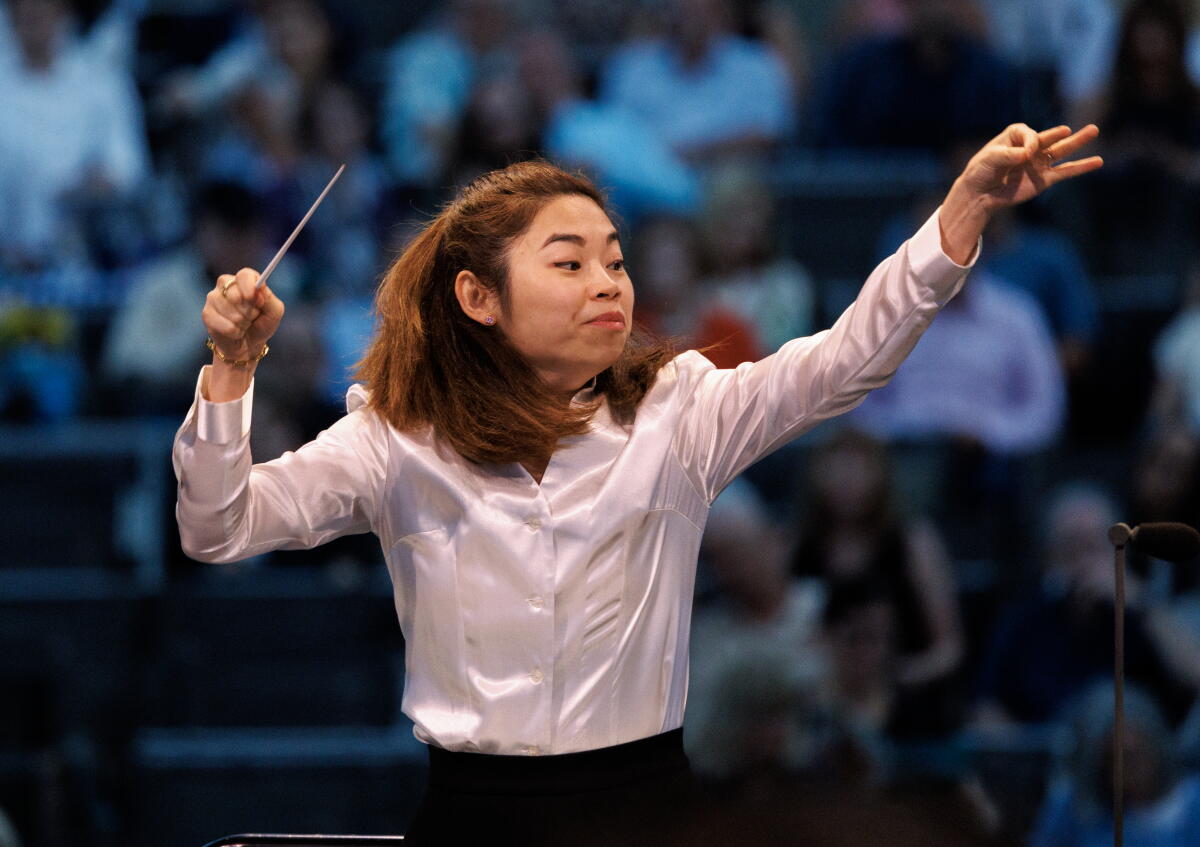
Elim Chan conducts the L.A. Phil in 2024.
(Gina Ferazzi/Los Angeles Times)
Elim Chan Conducts the L.A. Phil It will be a busy couple of weekends in L.A. for the San Francisco Symphony music director-designate. First up is a program featuring Dongshoon Shin’s “Dance Card,” Franz Liszt’s “Piano Concerto No. 2 in A major, S. 125” with pianist Yefim Bronfman, and Pyotr Ilyich Tchaikovsky’s suite from “Swan Lake.” Next week will be “A Symphonic Ballet,” with Claude Debussy’s “Prelude to the Afternoon of a Faun, L. 86,” Karen Gomyo premiering Samuel Adams’ “Violin Concerto No. 2 (The Wheel),” and Igor Stravinsky’s “Petrushka (1947).” “Swan Lake,” 8 p.m. Friday-Saturday, 2 p.m. Sunday. “Symphonic Ballet,” 8 p.m. Thursday, 2 p.m. Oct. 17-18. Walt Disney Concert Hall, 111 S. Grand Ave., downtown L.A. laphil.com
Kuniko Kato Presents Reich90 The North American tour of the Steve Reich Project, conceived and produced by Japanese percussionist Kato arrives downtown in honor of the composer’s 90th birthday. 7:30 p.m. Colburn School, Zipper Hall, 200 S. Grand Ave., downtown L.A. colburnschool.edu
Victoria Marks : A Deer Walks into a Dance The award-winning choreographer and four performers (Rian Alcid, Maya Billig, Karen Chuang and Aaron Mason) explore the idea connection in a world of division via movement, text and the deconstruction of a (bad) joke. 8 p.m. Friday-Saturday. UCLA Nimoy Theater, 1262 Westwood Blvd., Westwood. cap.ucla.edu
SATURDAY
L.A. Opera’s new music director, Domingo Hindoyan, conducts a dress rehearsal of “Carmen.”
(Jason Armond / Los Angeles Times)
Carmen Los Angeles Opera’s new music director, Venezuelan conductor Domingo Hindoyan, opens the company’s season with a new production of Bizet’s “Carmen.” It stars mezzo-soprano Rihab Chaieb, who has dazzled in Mozart at L.A. Opera. The Spanish gothic new production is by director/designer Thaddeus Strassberger and choreographer Antonio Najarro. (Mark Swed) The season-opening performance will be broadcast live in high definition, free of charge, at Steinmetz Park in Hacienda Heights and at the Santa Monica Pier. Through Nov. 7. Dorothy Chandler Pavilion, 135 N. Grand Ave., downtown L.A. Free simulcast, 6 p.m. Saturday, Santa Monica Pier and Steinmetz Park, 545 S. Stimson Ave., Hacienda Heights. laopera.org
Strauss, Ravel, Beethoven Music Director Jaime Martín conducts the Los Angeles Chamber Orchestra in Richard Strauss’ “Metamorphosen,” Maurice Ravel’s “Piano Concerto in G Major” with Conrad Tao, and Ludwig van Beethoven’s “Symphony No. 3 in E-flat Major (Eroica).” 7:30 p.m. Saturday. Zipper Hall, 200 S. Grand Ave., downtown L.A.; 4 p.m. Sunday. The Wallis, 9390 N. Santa Monica Blvd., Beverly Hills. laco.org
SUNDAY
Dale Brockman Davis, Alonzo Davis and David Hammons.
(Museum Associates)
The Brockman Gallery: Los Angeles,1967-1990 For more than two decades, the Leimert Park gallery, founded by Alonzo and Dale Davis, served as a vital cultural hub, staging exhibitions, festivals, concerts, literary events and more. Named after the brothers’ maternal grandmother, born enslaved, the Brockman Gallery was a flourishing, ongoing act of self-determination in the wake of the 1965 Watts Rebellion. It showcased Black artists whose opportunities were severely limited at mainstream, white-run institutions and galleries: David Hammons, Suzanne Jackson, John Outterbridge, Elizabeth Catlett, Betye Saar, Carrie Mae Weems, Senga Nengudi, Noah Purifoy and many more. More than 60 works by artists associated with the gallery will be included in this first full-scale consideration of the Brockman’s scope and impact. (Leah Ollman) Through Jan. 24. Los Angeles County Museum of Art, 5905 Wilshire Blvd. lacma.org
Pacific Jazz Orchestra: A Tribute to Quincy Jones Led by Chris Walden, and featuring vocalists Nayanna Holley and Adam ‘Aejaye’ Jackson, the ensemble performs early work by the late producer/composer. Presented by Ventura Music Festival, 3 p.m. Sunday. Rancho Campana Performing Arts Center, 4235 Mar Vista Drive, Camarillo. pacificjazz.org
TUESDAY
Mendelssohn & Brahms Members of the Los Angeles Philharmonic perform a program of chamber works from Joseph Haydn, Felix Mendelssohn and Johannes Brahms. 8 p.m. Walt Disney Concert Hall, 111 S. Grand Ave., downtown L.A. laphil.com
Ulysse Marion A new work by choreographer Dimitri Chamblas, created with former Paris Opera Ballet dancer Marion Barbeau and dancer and musician Ulysse Zangs, explores the journey of a performer throughout a life in art. 8 p.m. Tuesday-Wednesday. REDCAT, 631 W. 2nd St., downtown L.A. redcat.org
THURSDAY
At the Very Bottom of A Body Of Water The latest work by Benjamin Benne, a dramatist many have been keeping close tabs on, continues his collaboration with veteran director (and fellow L.A. native) Juliette Carrillo, and dives even further into magical realism in an unconventional work exploring the oceanic depths that grief can reveal. (Charles McNulty) Through Nov. 29. Boston Court Pasadena, 70 N. Mentor Ave. bostoncourtpasadena.org
Judy Baca, detail from the 1960s segment of the Great Wall of Los Angeles mural.
(Judy Baca and the SPARC Archives.)
Skirball Cultural Center Three new exhibits open: “The 1960s — A Generation on Fire: Judy Baca’s Great Wall of Los Angeles” presents new murals as part of the evolving L.A. landmark; “Patrisse Cullors: Wishes Made Material” features three new works inspired by conversations between Black and Jewish communities; and “Jenny Yurshansky: What We Carry” explores local immigration stories, memories and family history through collected objects. Skirball Cultural Center, 2701 N. Sepulveda Blvd. skirball.org
The SoCal scene
Zoe Ryan, director of UCLA’s Hammer Museum.
(Christina House/Los Angeles Times)
ICYMI, the best of this week’s L.A. Times arts coverage:
Climate activists in Tallahassee this week unveiled a statue of Florida Gov. Ron DeSantis that was created to melt. “In response to the Governor’s recent ‘Don’t say climate change’ action in state law, 350Action (one of the world’s most influential climate change advocates) built quite a visual — a statue that couldn’t withstand Florida’s daily climate. It’s provocative but for a purpose, to encourage young people to vote in a few weeks for candidates that recognize the threat from climate change,” a news release noted of the “climate denial statue.”
And finally, not strictly arts related, but some Halloween fun for you: Street Food Cinema is hosting its annual Boo-ze, Bites and Frights events with some spooky horror film screenings at Heritage Square and the Ford over the next few weekends, including a Saturday showing of “A Nightmare on Elm Street,” which is a film that still genuinely terrifies me.
Saudi Arabia’s health minister Fahad Aljalajel has paid a visit to survivors of Saturday’s deadly attack on Riyadh’s King Khalid International Airport, which killed at least 12 people and left 300 others injured.
German chancellor visits Kyiv amid air raid sirens, pledging strong support as Russian strikes disrupt the capital.
Published On 4 Oct 20264 Oct 2026
Russia has struck a key bridge in Kyiv just as German Chancellor Friedrich Merz arrived in the Ukrainian capital to meet President Volodymyr Zelenskyy.
The unannounced visit, marked by the sound of air sirens and explosions, came on Sunday to underscore Germany’s support for the nation at a time when Russian attacks on Ukrainian cities are increasing.
Recommended Stories
list of 3 itemsend of list
In a written statement, Merz said he “travelled to Kyiv today because Ukraine needs all our support in the coming weeks”.
“If Russia is not stopped, its war machine will sooner or later turn against us,” he said.
Ukraine’s President Volodymyr Zelenskyy meets German Chancellor Friedrich Merz at the memorial of fallen Ukrainian soldiers at Independence Square in Kyiv, October 4, 2026 [Dan Bashakov/AP Photo]
Merz and Zelenskyy met at the National Academy of Sciences, which was struck by a Russian drone on September 28.
Zelenskyy told Merz that Kyiv’s citizens are going through “terrible nights and days” due to the ongoing Russian attacks.
Merz was accompanied by his economy minister, as well as executives from several large German companies, such as Siemens Energy and Diehl Defence.
Ukraine and Germany are also expected to finalise a deal to produce drones and other weapons together that can travel more than 600 miles (965.6km) in an effort to strike deeper into Russia.
Germany has been one of Ukraine’s staunchest supporters. In April, the two countries signed a military pact worth more than $4bn. On Sunday, a $1.1bn military aid package is set to be announced, alongside $394m to repair damage to Ukraine’s energy sector.
Merz’s visit comes a day after Russia warned foreign diplomats and nationals to leave the capital to avoid getting hurt.
Russia’s Ministry of Defence promised to intensify strikes on Ukraine after Zelenskyy said in an interview with the Reuters news agency that it is doubling down on targeting Russian oil refineries after several civilians were killed and wounded over the weekend.
The strike that hit the Northern Bridge over the Dnipro River on Sunday also damaged a road and the supply of hot water in the area, according to a social media statement from Kyiv Mayor Vitali Klitschko. It is the second bridge in the capital to be hit this weekend.
Russia’s all-out war on Ukraine is in its fifth year. Both sides have increased the number of drone and missile attacks on infrastructure, logistics and military sites in recent months.
Perez Hilton’s website has offered an update on the celebrity gossip blogger’s progress following his apparent August suicide attempt, revealing that he has been allowed to see his children and mother.
“They were first able to spend time together through a few video calls, and since then, Hilton has also been able to see his children and his mom a few times for short, supervised visits at the facility,” according to the site. “Seeing his children in person has meant an enormous amount to Perez. There have definitely been a lot of emotions for everyone, but being able to spend that time together has been incredibly meaningful and healing.”
Hilton, born Mario Lavandeira Jr., experienced a mental health crisis on the night of Aug. 4 in his Miami home and livestreamed himself engaging in self-harm with a box cutter and knife as followers pleaded with him to stop and attempted to contact him.
Hilton spent weeks in the hospital receiving treatment for his physical injuries before being transferred to a residential treatment program, where he could “focus fully on his mental health and recovery,” according to a family statement from earlier this month.
However, Hilton’s brother-in-law said on a podcast on Aug. 24 that Hilton had not had any contact with his kids, as “they were not allowed in that section of the facility.”
Tuesday’s update also publicized a GoFundMe fundraiser created for Hilton’s mother, Teresita Lavandeira, and Hilton’s three school-age children. The fundraiser, organized by theater producer Tom D’Angora, who has described himself as a longtime friend of Hilton’s, promised that “none of the money will be used for Perez personally.”
As of Tuesday afternoon, the fundraiser had raised about $14,000 out of its $25,000 goal. D’Angora was not immediately available for comment.
“Like any grandmother who suddenly finds herself responsible for raising three growing children, she’s also taken on significant and unexpected expenses,” the fundraiser website says. “Perez’s family and friends are helping however we can. We also wanted to give the many people who have asked how they can help a way to do so.”
The site’s Tuesday update said there was still no available timeline for when Perez would exit residential treatment.
“Communication with Perez is still limited, and we’re not able to talk to him daily,” the statement read.
But it assured that he was making progress.
“He’s continuing to work with his care team on understanding what led to his mental health crisis, recognizing warning signs, learning better ways to cope, and working through everything that brought him to this point,” according to the site.
Hilton has been a controversial media figure since the mid-2000s, when he launched a celebrity gossip blog called PageSixSixSix. After the New York Post sued him, he rebranded it to Perez Hilton, a play on socialite Paris Hilton’s name.
During its heyday, Hilton’s successful website — on which he would publish mocking posts about Britney Spears and Lindsay Lohan and spread conspiracy theories about celebrity deaths — generated about 8 million page views a day, The Times’ columnist Robin Abcarian wrote recently. In 2010, he declined a $20-million offer for his website, according to reporting by the now-defunct outlet Gawker.