The White House is expanding its campaign against international workers, targeting elite study and work visa holders with restrictions and a new investigation.
On Thursday, the Trump administration announced a probe into whether Stanford, Caltech, UC Davis and other universities across the country have been abusing a special visa used by international scholars and students to do research and work in the U.S. It is also suspending Microsoft, Adobe and six other tech companies from how they sponsor employees who are in the country under a highly skilled worker visa program.
The White House’s concern is that schools and companies are too quick to bring in people from outside the U.S. The moves rattled Silicon Valley executives and California educators who see easy access to the smartest, hardest-working people in the world as one of America’s greatest competitive advantages.
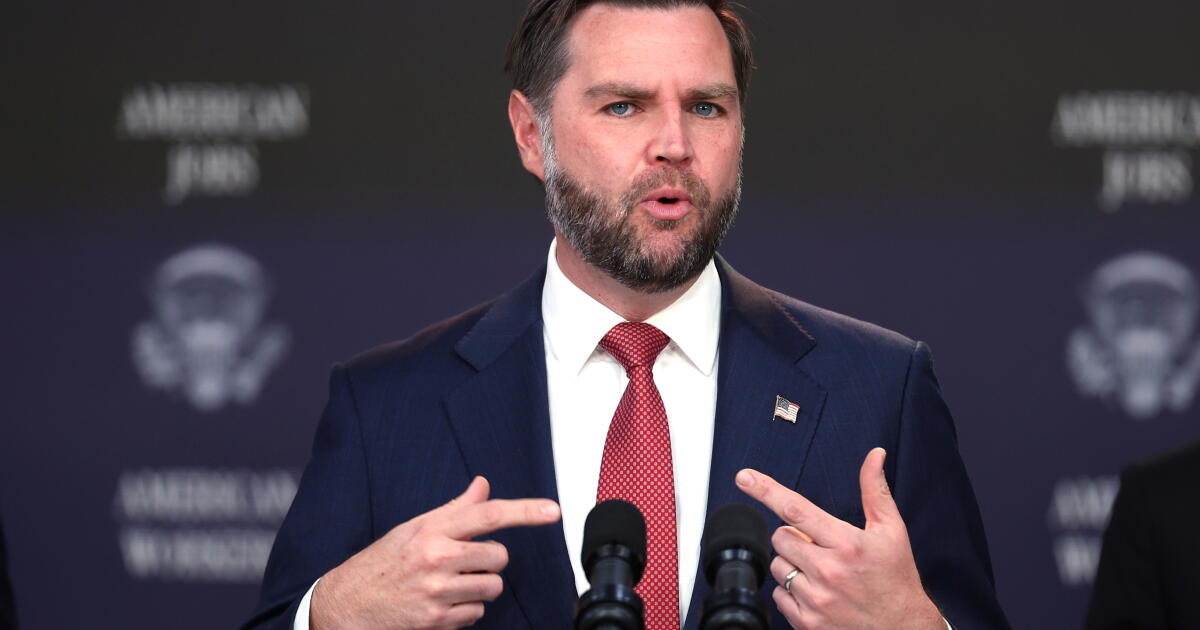
Vice President JD Vance said the universities being investigated are overusing J-1 visas to bring in students and researchers from abroad. The international scholars then take jobs and grants that could go to Americans.
“They are using these visas way too much,” he said. “They are using them to undercut the wages of American grad students and American researchers, and it simply has to stop.”
Harvard, Yale, Brown, the University of Pittsburgh, Arizona State and MIT will also be investigated.
Labor Department Inspector General Anthony D’Esposito said subpoenas have been served and “nobody will be getting a free pass because their name is carved into an expensive building.” Many universities have buildings named for foreign donors.
While most of the companies targeted for the tech visa restriction were Indian, Vance called out Microsoft.
“There’s been no company, unfortunately, in the United States that has abused this system more than Microsoft,” Vance told reporters at a White House news conference.
Vance said the company has abused the permanent labor certification program, which he argued has enabled Microsoft to hire international talent that is then paid less to replace American workers.
The new development suspends Microsoft from applying for green cards for workers who come to the U.S. on H-1B visas and later apply to become permanent residents.
American technology giants have relied on the H-1B visa program for decades to bring in thousands of skilled foreign workers they cannot find locally. Critics have accused the program of being riddled with fraud and abuse.
The administration’s power move came the same day President Trump awarded the National Medal of Technology and Innovation to two prime examples of international talent who came to the U.S. on student and work visas: Microsoft Chief Executive Satya Nadella and Tesla’s Elon Musk.
Cognizant, Infosys, Tata Consultancy Services, Wipro, HCL and Capgemini were also on the list of companies that will no longer be able to apply for permanent residence status for their H-1B employees.
Microsoft defended the use of H-1B and said in a statement that it looked forward to sharing additional information with the administration. In a post, it said that of the thousands of H-1B visa applications it submitted in the last fiscal year, 80% were to extend or change the status of existing Microsoft employees.
“They equal only 1% of our U.S. workforce. They are not new arrivals to our country,” the company said. “Microsoft only files H-1B petitions for those who meet the rigorous standards of this visa category.”
There’s a limit of 85,000 H-1B visas issued in a fiscal year, and they are selected through a lottery system. Last year, Microsoft was the third-largest beneficiary of the program, with 6,258 H-1B visas, according to data from U.S. Citizenship and Immigration Services. Amazon led the list, employing more than 13,000 H-1 B visa holders; Adobe had 777 approved applications.
The Thursday announcement has sparked confusion among technology workers and companies. Immigration lawyers point out that the action is not a blanket suspension of green card applications for all employers, but a targeted enforcement freeze on the Permanent Labor Certification program for the eight named corporations.
Proponents of H-1B note that Silicon Valley’s biggest tech companies are founded or run by immigrants, and the efforts to thwart H-1B have already started stifling talent flow and startup creation.
“It’s only going to probably hurt some companies and hurt the best and the brightest that are coming here,” said Devashish Mitra, professor of economics at Syracuse University. “It’s like throwing the baby with the bathwater.”
The J-1 investigations follow other actions, making it more difficult for international students to come to U.S. campuses. This year, the Department of Homeland Security said it wanted to end a “duration of status” visa policy that lets students stay in the U.S. through the completion of their programs and limit stays to four years. A federal judge blocked the change, and the government is appealing.
The Trump administration has also proposed charging colleges $70,000 per student for Optional Practical Training, which lets international students work in their fields of study for a limited number of years after graduation. Students now pay about $500.
In a statement, a Stanford spokesperson said the campus “complies with all applicable visa laws, including those relating to J-1 visas. We will cooperate with the investigation.”
A UC Davis spokesperson said the university “carefully complies with all federal laws and regulations for visas and looks forward to working with our federal partners to confirm compliance.”
A Caltech spokesperson did not respond to a request for comment.
About 275,000 people started J-1 programs in 2025, down from 301,694 in 2024, according to State Department data. Trainees and temporary summer workers, such as au pairs and summer camp counselors, also use the visa to enter the U.S.
Most were not at universities, with a majority working summer jobs.
The Trump administration’s crackdown has started to dissuade students from coming to the U.S., with experts expecting a drop in their registration when data for 2025 are released next month.
New research scholars fell 27% from 2024 to 17,622, about half the 2015 total. Most new research scholars in 2025 came from China, followed by South Korea and India.
California drew the most research scholars, 3,211. It ranked second behind New York for all new J-1s in 2025, with 23,167.
The State Department vets applicants and approves sponsors. Research scholars can stay up to five years
Sarah Spreitzer, vice president and chief of staff for government relations at the American Council on Education, said she had found little information about what the new probes would cover. But she said the federal government already has tools “to identify fraud, both in the granting of the visa and then also tracking the person through the Department of Homeland Security.”
“I think that all of these things are focused on bringing fewer international students into the United States, and we have been seeing that impact,” she said, expecting “a huge drop in our international enrollment this year, given everything going on.”