virginia

FBI searches Virginia Senate leader’s office as part of corruption probe, AP source says

The FBI searched the Virginia state Senate leader’s office on Wednesday as part of a corruption investigation, a person familiar with the matter said. Federal agents also were seen at the senator’s nearby cannabis business.

The search at Virginia Sen. L. Louise Lucas’s district office in Portsmouth comes after the Democrat helped lead the state’s recent redistricting effort.

The FBI said only that it was conducting a court-authorized search warrant in Portsmouth. The person who confirmed the FBI’s search was not authorized to discuss an ongoing investigation by name and spoke to the Associated Press on condition of anonymity.

Besides the search at Lucas’ office, agents in FBI T-shirts also went into the nearby Cannabis Outlet, which she opened in 2021. Several entrances to its cannabis store parking lot were blocked by unmarked vehicles with flashing blue lights.

Lucas — a prominent backer of legalizing marijuana — has said the store sells legal hemp and CBD products. It has drawn scrutiny from local media amid allegations that some products were mislabeled.

Virginia has legalized pot possession, but retail sales of recreational marijuana remain illegal in the state.

A message seeking comment was left Wednesday on a cellphone for Lucas, who has been a state senator for 34 years.

State House Speaker Don Scott said he was deeply concerned by the FBI search.

“Right now, there is far more theatrics and speculation than actual information available to the public,” Scott, a Democrat, said in a statement, adding that more facts were needed “before anyone rushes to political conclusions.”

Gov. Abigail Spanberger declined to comment. Some other Virginia Democrats were quick to note that the search comes as the FBI and Justice Department have opened a spate of politically charged investigations into perceived adversaries of President Trump.

The context “must be acknowledged,” U.S. Rep. Bobby Scott said in a social media post.

Last week, the Justice Department charged former FBI Director James Comey with making a threatening Instagram post against Trump, an accusation that Comey — who for nearly a decade has drawn the president’s ire — has denied. A separate mortgage fraud case, ultimately dismissed by a court, targeted Democratic New York Atty. Gen. Letitia James, who had brought a major civil fraud lawsuit against Trump and his business.

The FBI and Justice Department have also provoked concerns among Democrats about ongoing election-related investigations, including the seizure by agents of ballots and other information from Fulton County, Ga.

Lucas has been a vocal leader of Virginia’s redistricting effort, which voters approved last month. A sign urging people to “vote yes” to “stop the MAGA power grab” still hung Wednesday on a fence separating her office’s parking lot from the parking for the cannabis shop.

Amid a national, state-by-state partisan redistricting fight kicked off by Trump’s desire to aid his fellow Republicans, Virginia voters OK’d a Democrat-backed constitutional amendment authorizing new U.S. House districts. The plan could help the party win up to four additional seats.

“We are not going to let anyone tilt the system without a response,” Lucas said after the vote. Trump, meanwhile, denounced the results.

The state Supreme Court let the referendum proceed but has yet to rule whether the effort is legal. The court is considering an appeal of a lower-court judge’s ruling that the amendment is invalid because lawmakers violated procedural requirements.

Voting districts typically are redrawn once a decade, after each census. But Trump last year urged Texas Republicans to redraw House districts to give the GOP an edge in the midterms. California Democrats reciprocated, and redistricting efforts soon cascaded across states.

Lucas, 82, has been a figure in Virginia politics since the 1980s, when she became the first Black woman elected to a City Council seat in her native Portsmouth. She now is the first woman and first African American to serve as the body’s president pro tempore.

Earlier in life, she was the Norfolk Naval Shipyard’s first female shipfitter, according to her biography in the state library. The job entails making, installing and repairing sometimes enormous metal assemblies for vessels.

In recent years, she has been the chief executive of a Portsmouth business that runs residences, day programs and transportation for intellectually disabled adults.

Tucker, Breed and Peltz write for the Associated Press. AP writers Dylan Lovan in Louisville, Ky.; Jake Offenhartz in New York; and Claudia Lauder in Philadelphia contributed to this report.

Source link

FBI raids business of Virginia state Sen. L. Louise Lucas who led redistricting efforts

May 6 (UPI) — The FBI raided the offices of and a cannabis business co-owned by L. Louise Lucas on Wednesday in Portsmouth, Va.

Lucas is a Virginia state senator, president pro tempore of the state Senate and a vocal leader of Virginia redistricting efforts.

Officials told The Washington Post that the investigation has to do with corruption and bribery allegations involving the business. Lucas was not arrested, and an FBI spokesperson said the investigation was ongoing.

Democrats called in question the motivation behind the raid; Lucas has often criticized President Donald Trump and was instrumental in the successful Virginia referendum in April to redraw the state’s congressional maps. However, The Washington Post, NBC News and The New York Times reported that sources familiar with the case claimed the investigation was opened during the Biden administration and has to do with the marijuana dispensary.

Rep. Robert C. “Bobby” Scott, D-Va., said that the raid “occurs in the broader context of President Trump’s repeated abuse of the Department of Justice to target his perceived political opponents.”

Don Scott, speaker of the Virginia House of Delegates, emphasized that Lucas has not been charged with anything.

“I am deeply concerned by today’s raid,” he said, WAVY-TV reported. “Given the politicization of this administration — an FBI led by Kash Patel and a Justice Department led by President Donald Trump’s former personal attorney — I think people should take this with a grain of salt and allow the facts to come out before jumping to conclusions,” he said.

Scott said he spoke with Lucas after the search, The New York Times reported.

“She basically said, ‘They’re not going to find anything there and I didn’t do anything wrong,’ ” he said. “She’s very upset and she’s very angry and she won’t back down.”

Lucas was elected to the Virginia General Assembly in 1991.

Source link

Virginia Supreme Court considers whether to block voter-approved U.S. House map favoring Democrats

Virginia Supreme Court justices on Monday questioned whether the state’s Democrat-led legislature complied with constitutional requirements when it sent a congressional redistricting plan to voters, in a case that could help decide the balance of power in the U.S. House.

The new districts, which could net Democrats four additional seats, won narrow voter approval last week. But a Republican legal challenge contends the General Assembly violated procedural rules by placing the constitutional amendment before voters to authorize the mid-decade redistricting. If the court agrees that lawmakers broke the rules, it could invalidate the amendment and render last week’s statewide vote meaningless.

The Virginia court proceedings mark the latest twist in a national redistricting battle between Republicans and Democrats seeking an advantage in a November midterm election that will determine whether Republicans maintain their narrow majority in the U.S. House.

President Trump kicked off a tit-for-tat round of gerrymandering last summer when he urged Texas Republicans to redraw districts to their favor in an attempt to win several additional House seats. That set off a chain reaction of similar moves in other states, leading to the voter approval last week of Virginia’s new map.

Next up is Florida, where Republican Gov. Ron DeSantis has included congressional redistricting on the agenda for a special session of the GOP-controlled Legislature beginning Tuesday.

Virginia arguments focus on what counts as an `election’

During Monday’s arguments, the Virginia Supreme Court focused on whether the new congressional districts should be invalidated because of the process used by lawmakers. The justices issued no immediate ruling.

Because the state’s redistricting commission was established by a voter-approved constitutional amendment, lawmakers had to propose an amendment to redraw the districts. That required approval of a resolution in separate legislative sessions, with a state election sandwiched in between, to place the amendment on the ballot.

The legislature’s first vote occurred in October — while early voting was underway but before it concluded on the day of the general election. Judicial questioning focused on whether that was too late, because early voting already had begun.

Attorney Matthew Seligman, who defended the legislature, argued that the “election” should be defined narrowly to mean the Tuesday of the general election. In that case, the legislature’s first vote on the redistricting amendment occurred before the election and was constitutional, he told judges.

But an attorney arguing for the plaintiffs, Thomas McCarthy, said “election” means the entire period during which people can cast ballots, which lasts several weeks in Virginia. If that’s the case, then the legislature’s initial endorsement of the redistricting amendment came too late to comply with the state constitution, he said.

Attorneys argue over the rights of voters

The purpose of Virginia’s two-step amendment process, with an intervening election, is so voters can know whether legislative candidates support or oppose a proposed constitutional amendment, McCarthy said.

He pointed to the case of Democratic voter Camilla Simon, one of the plaintiffs in the lawsuit alongside Republican state lawmakers, who cast an early vote last fall for Democratic Del. Rodney Willett. After she voted, Willett sponsored the Democratic redistricting amendment, and Simon wished she could have undone her vote, McCarthy said.

“None of these voters had any idea this was coming, and that’s not how this process is supposed to work,” McCarthy told the justices.

Those defending the Democratic redistricting plan also contend that the voters’ will should be respected.

The people voted to ratify the constitutional amendment, “and the challengers are asking to overturn that democratic result,” Seligman told reporters after the arguments.

Nationwide redistricting battle has no clear winner so far

So far, the two major parties have battled to a near draw in the states that have redrawn their congressional maps for this year’s midterms.

Republicans think they could win up to nine more seats under revised districts in Texas, Missouri, North Carolina and Ohio. Democrats think they could win as many as 10 additional seats under new districts in California, Utah and Virginia. But legal challenges remain in both Virginia and Missouri.

Virginia currently is represented in the U.S. House by six Democrats and five Republicans who were elected from districts imposed by a court after a bipartisan redistricting commission failed to agree on a map after the 2020 census. The new districts, which narrowly won voter approval on April 21, could give Democrats an improved chance to win 10 districts.

Some candidates already have begun campaigning based on the new districts in advance of the state’s Aug. 4 primary election.

More court battles could remain in Virginia

In January, a judge in rural Tazewell County, in southwestern Virginia, ruled that lawmakers failed to follow their own rules for adding the redistricting amendment to a special session last fall. Circuit Judge Jack Hurley Jr. also ruled that lawmakers failed to initially approve the amendment before the public began voting in last year’s general election and that the state had failed to publish the amendment three months before the election, as required by law. As a result, he said, the amendment is invalid and void.

The Virginia Supreme Court placed Hurley’s order on hold and allowed the redistricting vote to proceed before hearing arguments on the case.

During Monday’s arguments, justices also raised questions about the ability of lawmakers to expand the agenda for their special session and whether the three-month public notice requirement was important enough to thwart a voter-approved amendment.

Republicans have filed at least two additional legal challenges, which also are winding their way through the courts.

Robertson and Lieb write for the Associated Press. Lieb reported from Jefferson City, Mo. AP writers Allen G. Breed in Richmond and Nicholas Riccardi in Denver contributed to this report.

Source link

Democrats win in Virginia but it won’t be the final say in a national redistricting competition

Democrats on Wednesday celebrated an election win in Virginia that could put them slightly ahead in the national redistricting competition that President Trump triggered in an attempt to preserve his party’s House majority in this year’s midterms, but it will not be the final round.

Now that it’s been approved by voters, the new Virginia map will have to clear additional legal hurdles. On Wednesday, the state attorney general’s office said it would immediately appeal a ruling earlier in the day from a judge in rural southern Virginia who ordered that the results of Tuesday’s vote not be certified.

Ultimately, the Virginia Supreme Court will decide whether Democratic lawmakers violated procedural rules when they referred a constitutional amendment to the ballot authorizing the new U.S. House districts that could help Democrats win as many as four additional seats in the state. If so, that could invalidate the map voters narrowly approved Tuesday.

What happens next in Florida also will matter.

The state’s Republican-controlled Legislature is to meet in a special session next week that GOP Gov. Ron DeSantis called in part to draw a new map to expand the party’s congressional majority there. The U.S. Supreme Court is scheduled to issue an opinion by the end of June in a Louisiana case that could overturn a key provision of the Voting Rights Act and lead to redrawn political maps across the South, though almost all of those could not happen until 2028.

After voters passed the Virginia amendment, Democrats could tentatively claim that they netted 10 seats nationally from the mid-decade redistricting, compared with the nine that Republicans claim. Even if things swing again in the GOP’s favor, the net result of Trump’s campaign would be at best an incremental increase in the number of GOP-leaning House seats at a time when his approval rating is dropping and Republican anxiety over losing control of Congress in November is rising.

“We have successfully blunted Trump’s attempt to completely hijack the midterms,” said John Bisognano, president of the National Democratic Redistricting Committee.

Many Republicans agreed.

“The GOP will now lose net seats across the country. If you’re going to pick a fight, at least win it,” Ari Fleischer, who was a spokesman for President George W. Bush, posted on the social media site X after the Virginia vote. “All this was foreseeable and avoidable. We should not have started this fight.”

Adam Kincaid, executive director of the National Republican Redistricting Trust, argued that it is too soon to declare one party a victor.

“It’s an ongoing process with many legal challenges pending, and it’s far too early for sweeping statements on the final outcome,” he said.

Trump on Wednesday tried to undermine the Virginia result by leveling groundless accusations of fraud similar to ones he made after losing the 2020 presidential election. He called the Virginia vote “RIGGED” and “Crooked” in a post on his social media site and added, “Let’s see if the Courts will fix this travesty of ‘Justice.’”

Redistricting spread from Texas to other states

Redistricting is typically done every 10 years after each census, unless ordered by a court. But last summer, Trump pushed a redrawing in Texas, prodding the state’s Republican-controlled Legislature to add up to five winnable House seats for his party. Trump then began pressuring other Republican-run states to follow. Missouri, North Carolina and Ohio have since created more GOP-leaning seats in addition to Texas.

Democrats began to fight back, even though they were more constrained because several Democratic-controlled states had maps drawn by independent commissions rather than lawmakers and governors.

To counter Texas, California’s Democratic governor, Gavin Newsom, pushed the Democratic-controlled Legislature to place a redistricting initiative on last fall’s ballot. After voters overwhelmingly approved it, the measure will replace a commission-approved map with one that could gain Democrats five seats.

Democrats reclaimed the Legislature and governor’s office in November in Virginia and swiftly moved to replicate California’s move with an even more aggressive redistricting plan. It replaces a congressional map imposed by a court after the last census that had resulted in a 6-5 edge for Democrats with one that could allow Democrats to win as many as 10 seats.

“We are not going to let anyone tilt the system without a response,” state Senate President L. Louise Lucas said at a news conference Wednesday.

Courts could still have a say on redistricting

In Washington, U.S. House Democratic leader Hakeem Jeffries of New York warned Florida Republicans, who have been openly nervous about redrawing their district boundaries and potentially spreading their core voters too thin before an election that appears to be trending against them.

“Our message to Florida Republicans right now is, ‘F around and find out,’” Jeffries said.

House Majority Forward, the nonprofit arm of the super political action committee aligned with House Democrats, has spent nearly $60 million to push back against Republicans’ redistricting efforts. Some $40 million of that was on the Virginia campaign.

Another obstacle in Florida is an anti-gerrymandering constitutional amendment that was approved by state voters in 2010. It is likely that any new Florida map would trigger significant litigation, although six of the state Supreme Court’s seven justices were appointed by Republicans.

Nicholas Stephanopolous, a Harvard law professor, said a challenge for DeSantis is that the Florida amendment forbids drawing lines for purely partisan purposes, so he has to find some other excuse for revising the map. “Even with that sort of acquiescent state supreme court, I don’t think it’s a done deal,” Stephanopolous said.

The Virginia move comes with its own legal issues. Republicans have challenged the process that Democrats used to place the measure on the ballot and the state Supreme Court opted to wait for the vote before even scheduling arguments in the case. It is unclear when a ruling could come.

Wednesday’s ruling stopping certification came from a separate case that Republicans filed with the same lower court judge, whose initial ruling against the initiative was put on hold by the state supreme court.

“The ballot box was never the final word here,” Terry Kilgore, the Virginia House Republican leader, said in a statement after Tuesday’s vote. “Serious legal questions remain about both the wording of this referendum and the process used to put it before voters.”

The biggest legal wild card is held by the U.S. Supreme Court. Its conservative majority could throw out a requirement under the Voting Rights Act that in areas with a large minority population, mapmakers draw districts that are more favorable to the election of minority candidates.

That provision has led to the creation of several majority-minority congressional seats, especially in the South. Without it, Republicans in conservative states could shrink the number of U.S. House seats winnable by Democrats even further.

But it’s unlikely that any state other than Louisiana, which brought the lawsuit the high court will rule on, would be able to adjust its congressional lines in time for November even if the court eliminates that provision, known as Section Two. That’s because the November election is already officially underway in most states and candidate filing deadlines — and, in some cases, primary elections — have already passed.

Riccardi and Lieb write for the Associated Press. AP writers Lisa Mascaro and Leah Askarinam in Washington contributed to this report.

Source link

Democrats up in Virginia, but US voters may pay price for redistricting war | US Midterm Elections 2026 News

Washington, DC – The latest battle in United States congressional redistricting has been decided, with voters in Virginia approving redrawing the state’s electoral map.

The result of Tuesday’s referendum on Virginia redistricting is widely expected to benefit Democrats in their fight to retake control of the slimly Republican-controlled US House of Representatives in the midterm vote in November.

Recommended Stories

list of 4 itemsend of list

While redistricting is typically conducted every 10 years, following the US Census count of the country’s population, the election season has seen an unprecedented flurry of states moving to redraw their legislative maps early, initially spurred by pressure on US President Donald Trump to urge his fellow Republicans in Texas to do the same.

Democrats may be up at the moment, but several scenarios – including a redistricting push in Florida – could soon spoil those gains.

Experts, meanwhile, warn of the long-term implications of the election season’s norm-busting political manoeuvres, which they say could transform how and when electoral maps are drawn for years to come.

“Virginia’s unorthodox redistricting isn’t just a map redraw, it’s a mid-decade power play in a national arms race,” Rina Shah, a political adviser and strategist, told Al Jazeera.

“In a cycle defined by retaliation over reform, this sets a precedent: when one side bends the rules, the other follows, until courts or voters draw the final line.”

Democrats gain – for now

Trump has not been timid about his desire to redraw state congressional maps to benefit his Republican Party.

In July 2025, he confirmed the plan to reporters: “Texas would be the biggest one,” he said. “Just a very simple redrawing, we pick up five seats.”

By August, Texas’s Republican-controlled State House had passed a new map favouring Republicans, setting the party on course to secure five more seats in the US House of Representatives compared to the earlier map.

The move was soon followed by changes in Missouri, whose new maps are expected to net Republicans one additional seat, while redistricting in North Carolina and Ohio is expected to give the party two to three new Republican-dominated districts.

Democrats in several states responded in kind, pushing for redistricting in California and Utah that resulted in about six new Democrat-dominated districts. Virginia’s victory largely neutralised Republican gains, adding between two and four seats for Democrats.

“This could shift Virginia from a 6-5 split to something like 10-1 Democratic,” political adviser Shah said, referring to Virginia’s 11 congressional districts and noting this would result in “delivering up to four net seats and dramatically tightening the fight for House control in the 2026 midterms”.

This comes as Republicans are already expected to face a punishing election season, with wariness over the US-Israeli war in Iran and the stubbornly high cost of living in the US.

Democratic control of either chamber of Congress – or of both – would give the party the ability to largely curtail Trump’s agenda in the final two years of his presidency.

As of Wednesday, Sabato’s Crystal Ball, a midterm predictor published by the University of Virginia’s Center for Politics, rated 217 Congressional districts across the country as leaning towards Democrats, with 205 leaning towards Republicans and 13 rated toss-ups.

Good for Democrats, ‘terrible’ for democracy

In the short term, Democrats are “winning” from the redistricting battle, according to Samuel Wang, a professor of neuroscience at Princeton University who runs the Princeton Gerrymandering Project.

“But from a non-partisan good government standpoint, it’s just a terrible event,” Wang told Al Jazeera.

He explained the “incredible” flurry of redistricting in recent months opens the possibility of a new age of heightened gerrymandering, the process by which congressional boundaries are drawn to benefit one political group.

Prior to this election cycle, there had been just three instances of mid-decade redistricting over the last five decades. Wang described the recent spurt as a “complete busting of norms”.

“It’s bad in the sense of reducing competition. Gerrymandering on both sides, basically, removes voters from the equation everywhere it happens,” he said.

Top Democrats have largely argued their hands were forced in mirroring the Republican strategy, rather than yield to the opposing party ahead of a consequential election.

“We fought back,” Hakeem Jeffries, the top Democrat in the House, told the Associated Press after Virginia’s vote. “When they go low, we hit back hard.”

But some Democrats have echoed concerns over the new precedent being set.

John Fetterman, a Democrat from Pennsylvania who has regularly sided with Republicans, told Newsmax on Wednesday, “Whether it’s a red state or whether it’s a blue state, our democracy is degraded.”

Attention turns to Florida

To be sure, while opportunities for further redistricting are diminishing following the vote in Virginia, the final congressional maps ahead of the midterms may not yet be set.

The Virginia vote now shifts pressure on Republicans in Florida, where Governor Ron DeSantis is set to hold a special legislative session on April 28 to discuss possible redistricting.

A new map could add up to five Republican-dominated congressional districts in the state, but could be scuttled by strict language in Florida’s constitution related to the process.

Democrat Jeffries, in a statement on Wednesday, vowed to surge resources to the state to take down Republican incumbents if the map is redrawn. “Maximum warfare, everywhere, all the time,” he pledged.

Several challenges to Virginia’s redistricting ballot measure are also currently being heard before the state’s Supreme Court, which could hinder the implementation of the new map.

Trump on Wednesday decried the Virginia vote as “rigged”, without providing any evidence to back up the claim.

Meanwhile, a case pending before the US Supreme Court could beckon in another slate of redistricting in the US South.

In Louisiana v Callais, the justices will determine whether the creation of two Black-majority congressional districts is in line with the Voting Rights Act, which seeks to assure minority representation in states with a history of racist election policies.

A ruling could open the door to redrawing maps in several states that would have previously been banned due to so-called “racial gerrymandering”, a process of drawing congressional lines based on racial makeup to dilute the electoral power of a minority group.

A pathway to reform?

A handful of states have created independent commissions to oversee redistricting, in an effort to assure the process remains non-partisan.

But the vast majority rely on their state legislatures to draw the maps, which can lead to outsized influence over the party in control, barring legal challenges. That largely remains true whether redistricting is conducted every decade or, as the current election season could portend, more frequently.

But amid the current cavalcade of congressional map changes, Princeton’s Wang, who is himself running in the Democratic primary for Congress in New Jersey’s 12th district, sees a rare opportunity for federal reform.

That could take the form of Congress creating independent commissions to oversee redistricting.

“Now that mid-decade redistricting is backfiring on Republicans, it creates the possibility that both parties can see clearly that gerrymandering is a zero-sum game,” Wang said.

“It opens a path for possible bipartisan action.”

Source link

2 killed, 1 critically injured following West Virginia chemical leak

April 23 (UPI) — A chemical leak at a decommissioning plant in West Virginia has killed two people and left a third in critical condition, according to officials.

More than 30 people required medical treatment because of the leak Wednesday at Catalyst Refiners, a silver recovery plant in Institute, an unincorporated community west of Charleston.

Kanawha County Commissioners President Ben Salango told reporters at a press conference that workers were cleaning and decontaminating the site ahead of its shutdown when at about 9:31 a.m. EDT Wednesday a chemical reaction occurred, creating hydrogen sulfide, a flammable, colorless gas that can be fatal to those who breathe it, according to the Environmental Protection Agency.

Twenty-one people at the site were initially reported by county officials to have either been transported to the hospital or sought medical attention, a number that West Virginia Gov. Patrick Morrisey told reporters during a second press conference held Wednesday night had increased to more than 30.

“To the families we lost today, our hearts are with you and our state grieves with you,” Morrisey said.

“We stand ready to support you in every possible way.”

Among the injured were seven emergency ambulance employees who had responded to the scene, Kanawha County Emergency Management Agency Director C.W. Sigman said.

“When I got there, firefighters and EMS were doing CPR on two of the patients, trying to revive them,” he said.

He said the hydrogen sulfide was the product of nitric acid and M2000A mixing while workers were decommissioning a tank on the site. Sigman explained he was told by the plant manager that it’s “not uncommon” for workers to mix the two together as part of the decommissioning work.

“But there was something going on that was different,” he said. “But that will be for the investigators to determine.”

Officials said an investigation is ongoing and will involve local, state and federal agencies.

A one-mile-radius shelter-in-place order around the plant that was issued has since been lifted and several roads that were closed have been reopened, officials said.

Source link

Judge blocks results of Virginia referendum on new congressional map

April 22 (UPI) — A judge in rural Virginia on Wednesday blocked the results of Tuesday’s state referendum, barring lawmakers, at least temporarily, from implementing a new congressional map that favored Democrats in November’s midterm elections.

The five-page ruling by Judge Jack Hurley of the Tazewell County Circuit Court sided with the Republican National Committee, which was challenging the results of Tuesday’s special election.

On Tuesday, 51.4% of the more than 3 million Virginians who voted approved amending the state’s Constitution to permit a mid-decade congressional district map redraw, according to unofficial results from the Virginia Department of Elections.

The new map is expected to favor Democrats to win 10 of the state’s 11 congressional districts. The Democrats currently hold six of the state’s 11 congressional seats and Republicans hold five.

Hurley agreed with each of the RNC’s claims, including that the legislation supporting the map redraw violated General Assembly rules and that the question voters were asked — “Should the Constitution of Virginia be amended to allow the General Assembly to temporarily adopt new congressional districts to restore fairness in the upcoming elections” — was “a flagrantly misleading question to the voters, and because the ballot language did not accurately describe the proposed amendment as it was passed by the General Assembly.”

The order declares that all votes from the referendum are “ineffective,” and the state is enjoined from certifying them and instituting the new congressional district map.

“This ruling is a major victory for Virginians,” RNC Chair Joe Gruters said in a statement.

“Democrats attempted to force an unconstitutional scheme to tilt congressional maps in their favor, but the court recognized it for what it is — a blatant power grab.”

Virginia said it will immediately appeal the ruling.

“As I said last night, Virginia voters have spoken, and an activist judge should not have veto power over the people’s vote,” Virginia’s Democratic attorney general, Jay Jones, said in a statement.

“We look forward to defending the outcome of last night’s election in court.”

Virginia Democrats first moved for a mid-decade congressional map redraw in the fall after Texas, under pressure from President Donald Trump, approved a map expected to favor Republicans, kicking off a gerrymandering arms race. Four Republican-led states have approved new maps compared with two Democratic-led states, though several other states under majority leadership of each party are seeking to do likewise.

Trump — who has repeatedly warned Republicans that losing the House in November could lead to his impeachment — has taken several executive actions, including tightening voting regulations, that could affect November’s midterms and that Democrats and critics argue are unlawful measures that could help Republicans maintain their narrow House majority.

He has also repeatedly cast doubt on election legitimacy.

On Wednesday, Trump made unfounded claims that the Virginia referendum was “RIGGED,” citing mail-in voting, a common voting practice that the president has targeted as a vehicle for election fraud, though Trump himself has voted by mail in Florida.

“The Democrats eked out another Crooked Victory,” he said in a statement on his Truth Social media platform before Hurley’s ruling. “Let’s see if the Courts will fix this travesty of ‘Justice.'”

Hurley previously ruled to block the Democrats’ redistricting plan twice, though the Supreme Court of Virginia allowed the referendum to move forward amid litigation.

Democratic-led states California and Virginia pursued their redraws through voter-approved ballot measures, while GOP-led Texas, Missouri, Ohio and North Carolina passed actions through their Republican-controlled state institutions, without voter-approved measures.

Source link

Virginia redistricting election results: Key takeaways from Democrats’ win | US Midterm Elections 2026 News

Virginia voters have narrowly approved a referendum to redraw the state’s congressional map, with about 51.5 percent voting yes and 48.6 percent voting no, and 97 percent of ballots counted, according to The Associated Press news agency.

The map redraws the boundaries of Virginia’s congressional districts, changes that can directly shape which party wins seats in the United States House of Representatives.

With most votes counted, the result remained close, but Democratic-leaning areas helped push it through.

The vote is part of a broader national fight over district lines – a battle that could decide who controls Congress.

Republicans in Florida, for instance, are planning a special session of the state legislature next Tuesday where they are expected to seek to redraw their state’s political map – a move that could help them gain as many as five seats, potentially wiping out any Democratic gain in Virginia.

Here are five key takeaways:

Democrats gain a major advantage in the House race

Currently, Virginia sends 11 members to the US House. At the moment, they comprise six Democrats and five Republicans.

The new map changes how those seats are drawn. By reshaping district boundaries, it makes most areas more favourable to Democrats by clumping together voters who lean towards the party strategically, while splintering communities that typically vote Republican.

  • Eight districts would be safely Democratic
  • Two would be competitive but lean Democratic
  • Only one would be safely Republican.

Because of this, Democrats could realistically win at least eight and possibly up to 10 of the 11 seats in the US house, instead of just six.

This shift follows a high-stakes political battle, with total spending estimated at $100m.

Democratic leaders, including Virginia Governor Abigail Spanberger, framed the new map as a direct response to efforts by US President Donald Trump and Republicans to redraw districts in their favour in other states.

However, even with this win, “there’s no guarantee they’ll send a delegation dominated by Democrats to Washington,” Al Jazeera’s Rosiland Jordan said, reporting from Virginia.

There are still six months until the midterm elections, and voter behaviour can shift. Even favourable maps can produce unexpected outcomes.

Virginia is one part of a bigger battle

Virginia is just one part of a bigger fight over who controls the US House.

After the 2024 election, Trump pushed Republican-led states to redraw congressional maps before the usual timeline to improve their chances in the 2026 midterms.

Republicans moved first in states like Texas, where new maps could give them up to five more seats.

Democrats responded with their own moves. In California, voters approved a plan backed by Governor Gavin Newsom that allowed lawmakers to draw a new, more partisan map. This is expected to give Democrats up to five extra seats.

The Virginia result fits into this bigger picture. If Democrats gain up to four seats there, it could help cancel out Republican gains in other states.

But the fight is not over. More changes could still happen, including in Florida, where Governor Ron DeSantis is looking at redrawing the map.

“Virginia just changed the trajectory of the 2026 midterms,” Democratic state House Speaker Don Scott said in a celebratory statement.

“At a moment when Trump and his allies are trying to lock in power before voters have a say, Virginians stepped up and levelled the playing field for the entire country.”

The measure has been approved by voters, but its future is still uncertain.

The Supreme Court of Virginia is expected to review ongoing legal challenges that could affect whether the new map takes effect. While the court allowed the vote to go ahead, it said it would examine the case in full if the measure passed.

The challenges focus on two key issues: Whether Democratic lawmakers followed the correct legal process when putting the proposal forward, and whether the wording on the ballot may have been misleading to voters.

A narrow win

Both parties were watching the vote closely.

Democrats were happy to win, even if it was close. Republicans, meanwhile, were relieved it wasn’t a big loss.

“Virginia Democrats can’t redraw reality,” said Republican Congressman Richard Hudson. “This close margin reinforces that Virginia is a purple state that shouldn’t be represented by a severe partisan gerrymander.”

Gerrymandering is the process of redrawing electoral maps in ways that can benefit one party over another.

Democrats said the tight result was partly down to voter confusion, which they blamed on Republican messaging. Democrats framed the effort as a response to Trump, promoting the plan with advertisements featuring former US President Barack Obama.

Opponents pushed back by pointing to past comments from Obama and Spanberger, both of whom have previously criticised gerrymandering, using that to question the Democrats’ position.

Gerrymandering is at the centre of the fight

The vote highlights the growing importance of partisan map-drawing in US politics.

Democrats say this balances Republican advantages elsewhere. Republicans call it a power grab in a competitive state.

Either way, redistricting is now a key tool shaping election outcomes, not just reflecting them.

Source link

Virginia voters deciding on redistricting plan that could boost Democrats’ seats in Congress

Virginia voters on Tuesday are deciding whether to ratify an unusual mid-decade redrawing of U.S. House districts that could boost Democrats’ chances of flipping control of the closely divided chamber, as the state becomes the latest front in a national redistricting battle.

A proposed constitutional amendment backed by Democratic officials would bypass the state’s bipartisan redistricting commission to allow use of new congressional districts approved by state lawmakers in this year’s midterm elections.

The referendum, which needs a simple majority to pass, tests Democrats’ ability to push back against President Trump, who started the gerrymandering competition between states after successfully urging Texas Republicans to redraw congressional districts in their favor last year. Virginia is the second state, after California last fall, to put the question to voters.

It also tests voters’ willingness to accept districts gerrymandered for political advantage — coming just six years after Virginia voters approved an amendment meant to diminish such partisan gamesmanship by shifting redistricting away from the legislature.

Even if Democrats are successful Tuesday, the public vote may not be the final word. The state Supreme Court is considering whether the redistricting plan is illegal in a case that could make the referendum results meaningless.

Virginia Democrats are following California’s lead

Congressional redistricting typically is done once a decade after each U.S. census. But Trump urged Texas Republicans to redistrict ahead of the November elections in hopes of winning several additional seats and maintaining the GOP’s narrow House majority in the face of political headwinds that typically favor the party that is out of power during midterms.

The Texas gambit led to a burst of redistricting nationwide. So far, Republicans believe they can win up to nine more House seats in newly redrawn districts in Texas, Missouri, North Carolina and Ohio.

Democrats think they can win up to five more seats in California, where voters approved a mid-decade redistricting effort last November, and one more seat under new court-imposed districts in Utah. Democrats hope to offset the rest of that gap in Virginia, where they decisively flipped 13 seats in the state House and won back the governor’s office last year.

Voters focus on fairness, with different perspectives

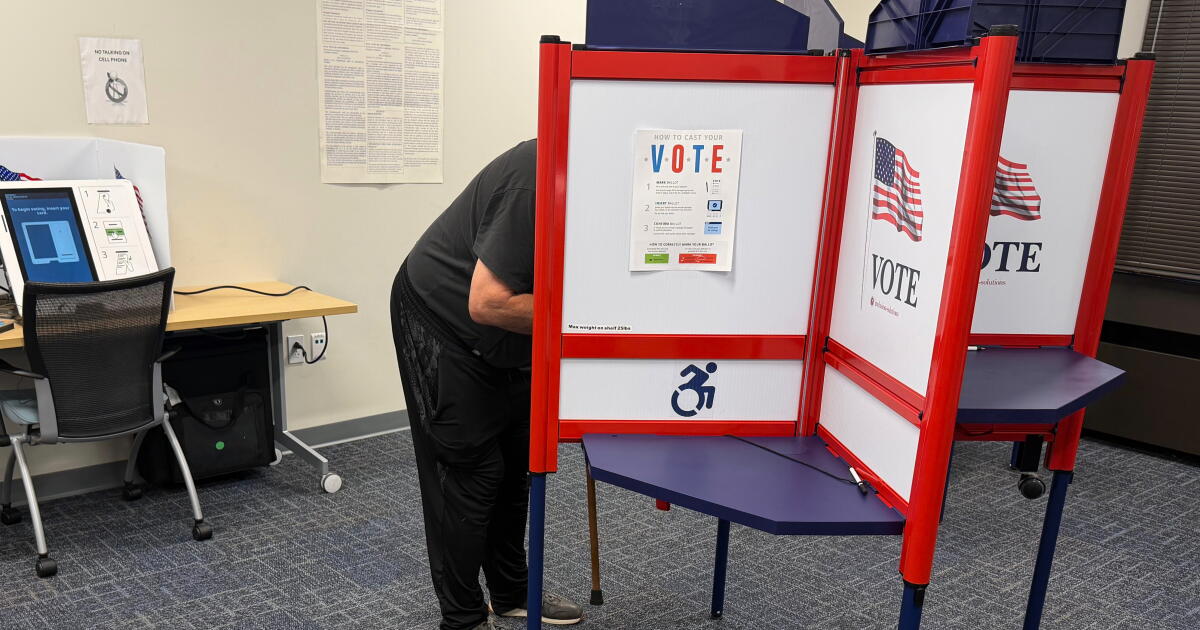
The stream of voters was steady Tuesday at a recreation center in the Old Town area of Alexandria, Virginia.

Matt Wallace, 31, said he votes regularly but this election has additional emphasis.

“I think the redistricting issue across the country is unfortunate, that we’ve had to resort to temporary redistricting in order to sort of alter our elections across the country,” Wallace said. He said he voted for the Democratic redistricting amendment “to help balance the scales a bit until things get back to normal.”

Joanna Miller, 29, said she voted against the redistricting measure, “because I want my vote to count in a fair way.” Miller said she was more concerned about representation in Virginia than trying to offset actions in other states.

“I want my vote and my representation to matter this fall,” she said.

Political parties made a big push in Virginia

Leaders of both major parties see Tuesday’s vote as crucial to their chances to win a House majority in the fall. Trump weighed in via social media Tuesday morning, telling Virginians to “vote ‘no’ to save your country!”

Former Virginia Gov. Glenn Youngkin, a Republican, rallied with opponents of the measure Monday night, calling the redistricting plan “dishonest” and “brazenly deceptive.” House Minority Leader Hakeem Jeffries told reporters at the Capitol earlier in the day that a vote to approve the redraw “will serve as a check and balance on this out-of-control Trump administration.”

A committee supporting the Democratic redistricting effort had raised more than $64 million — three times as much as the roughly $20 million raised by opponents, according to finance reports filed less than two weeks before the election.

The back-and-forth battle over congressional districts is expected to continue in Florida, where the Republican-led legislature is scheduled to convene April 28 for a special session that could result in a more favorable map for Republicans.

A lobster-like district could aid Democratic efforts

In Virginia, Democrats currently hold six of the 11 U.S. House seats under districts that were imposed by the state Supreme Court in 2021 after a bipartisan commission failed to agree on a map based on the latest census data.

The new plan could help Democrats win as many as 10 seats. Five are anchored in Democratic-heavy northern Virginia, including one shaped like a lobster that stretches into Republican-leaning rural areas.

Revisions to four other districts across Richmond, southern Virginia and Hampton Roads dilute the voting power of conservative blocs in those areas. And a reshaped district in parts of western Virginia lumps together three Democratic-leaning college towns to offset other Republican voters.

The Virginia redistricting plan is “pushing back against what other states have done in trying to stack the deck for Donald Trump in those congressional elections,” Democratic Gov. Abigail Spanberger said during an online rally last week.

Ads for the “yes to redistricting” campaign featuring former President Barack Obama have flooded the airwaves.

Opponents have distributed campaign materials citing past statements from Obama and Spanberger criticizing gerrymandering, but those were before Trump pushed Republican states to redraw their congressional maps in advance of this year’s midterms.

Democrats “were all against gerrymandering before they were for it,” Virginia Republican Party Chairman Jeff Ryer said.

Virginia court weighs whether lawmakers acted illegally

Virginia lawmakers endorsed a constitutional amendment allowing their mid-decade redistricting last fall, then passed it again in January as part of a two-step process that requires an intervening election for an amendment to be placed on the ballot. The measure allows lawmakers to redistrict until returning the task to a bipartisan commission after the 2030 census.

In February, they passed a new U.S. House map to take effect pending the outcome of the redistricting referendum. Republicans have filed multiple legal challenges against the effort.

A Tazewell County judge ruled that the redistricting push was illegal for several reasons. Circuit Court Judge Jack Hurley Jr. said lawmakers failed to follow their own rules for adding the redistricting amendment to a special session.

He ruled that their initial vote failed to occur before the public began casting ballots in last year’s general election and thus didn’t count toward the two-step process. He also ruled that the state failed to publish the amendment three months before that election, as required by law.

If the state Supreme Court agrees with the lower court, the results from Tuesday’s vote could be rendered moot.

Lieb writes for the Associated Press. AP writers Gary Fields in Virginia and Lisa Mascaro in Washington contributed to this report.

Source link

Virginia voting on new congressional map drawn by Democrats

April 21 (UPI) — Voters are heading to the polls in Virginia on Tuesday to vote on a new congressional map drawn by state lawmakers.

Polls are open until 7 p.m. EST., with nearly 1.4 million early ballots already cast on a constitutional amendment to change the congressional map. The result of Tuesday’s vote could have significant implications for the midterm elections in November.

If the map, drawn by Democratic lawmakers, is approved by voters, Democrats would be favored to win 10 of the state’s 11 congressional districts. Democrats currently hold six of the state’s 11 congressional seats and Republicans hold five.

Virginia is just the latest state to weigh redrawing its congressional map mid-decade after Texas approved a map that will favor Republicans last year. Four Republican-led states have approved new congressional maps.

Democrats and Republicans outside of the state have lent their voices to campaigns for and against Virginia’s redistricting plan. President Donald Trump and House Speaker Mike Johnson, R-La., voiced their opposition to the plan, with Trump calling it “unfair.”

House Minority Leader Hakeem Jeffries, D-N.Y., has joined Virginia lawmakers Sen. Mark Warner and Sen. Tim Kaine at rallies to support redistricting. Former President Barack Obama has also been involved, appearing in ad campaigns calling on voters to vote “yes.”

“We’re giving Virginians a chance to vote — which Republican states have not done — about whether they want to have a congressional delegation that will stand up against Donald Trump’s tyranny if he tries to interfere with our elections,” Kaine said in an appearance on Fox News on Sunday.

The Virginia Supreme Court allowed Tuesday’s election to move forward but may still weigh in on whether the new congressional map is legal or not.

Secretary of Health and Human Services Robert F. Kennedy, Jr. speaks during a House Appropriations Subcommittee on Labor, Health and Human Services, Education, and Related Agencies hearing on the budget for the Department of Health and Human Services in the Rayburn House Office Building near the U.S. Capitol on Thursday. Photo by Bonnie Cash/UPI | License Photo

Source link

Virginia redistricting vote: What polls suggest and what voters will decide | US Midterm Elections 2026 News

Voters in Virginia head to the polls on Tuesday to decide on a measure that could redraw the state’s congressional map and potentially shift the balance of power in Washington.

Major political figures, including former President Barack Obama and House of Representatives Speaker Mike Johnson, have weighed in on the high-stakes vote, with nearly $100m spent on campaigning around it.

Part of a broader redistricting battle that began in Texas and spread nationwide, the vote may be the Democrats’ last chance this year to gain seats by changing district maps. The vote comes about six months before the 2026 midterm elections.

Here is what we know:

What is Virginia voting on?

Virginia currently sends 11 members to the House. At the moment, six of them are Democrats, and five are Republicans, reflecting the state’s balance.

Democrats now want to redraw the map to favour them in a way that could help them win up to 10 of the 11 seats. Under the proposal, most districts would be safely Democratic or lean towards the party, with only one strongly Republican.

A breakdown would be:

  • Eight districts would be safely Democratic
  • Two would be competitive but lean Democratic
  • Only one would be safely Republican

If approved, this could give the Democrats several extra seats in Congress, helping them win back or strengthen control of the House in Washington, where majorities are often decided by just a few seats.

That would be a big political shift for the state, which was once closely contested but has become more Democratic-leaning in recent years.

Supporters depart a campaign rally against Virginia Democrats' proposed state redistricting constitutional amendment
Supporters depart a campaign rally against Virginia Democrats’ proposed state redistricting constitutional amendment [FILE: Ken Cedeno/Reuters]

How would the vote work?

Voters in Virginia can cast their ballots either early or on Election Day.

Polling stations will be open across the state on Tuesday:

  • Polls open at 10:00 GMT
  • Polls close at 23:00 GMT

Votes will be counted after polls close, with early results expected later that evening and fuller results overnight or the next day.

What are voters being asked to decide?

The proposed constitutional amendment is the only statewide contest on the ballot.

It reads:

“Should the Constitution of Virginia be amended to allow the General Assembly to temporarily adopt new congressional districts to restore fairness in the upcoming elections, while ensuring Virginia’s standard redistricting process resumes for all future redistricting after the 2030 census?”

A “yes” vote would support allowing the General Assembly to redraw congressional districts before the midterms.

A “no” vote would leave current boundaries unchanged until the next round of regularly scheduled redistricting after the 2030 census.

What do the latest polls suggest?

The result is expected to be close.

A recent poll by State Navigate, a nonpartisan research group, suggests a small lead for supporters, with about 53 percent in favour and 47 percent against.

Why do district lines matter so much?

District lines decide how voters are grouped, which can shape who wins elections.

Moving the lines can make a district more favourable to a Democratic or Republican win, by adding or removing neighbourhoods and communities that lean one way or the other.

It can turn a close race into a safe seat, or the other way around. It affects which communities are kept together and who represents them.

This process, often called gerrymandering, allows parties to draw maps that benefit them.

In a closely divided state like Virginia, even small changes to the map can shift several seats and influence who holds power in Congress.

A 2023 study by Harvard University researchers found that gerrymandering often creates “safe” seats for politicians, meaning their races are less competitive.

In turn, those politicians become less responsive to the needs of their constituents, who become discouraged about voting as a result.

Supporters pray during a campaign rally against Virginia Democrats' proposed state redistricting constitutional amendment
Supporters pray during a campaign rally against Virginia Democrats’ proposed state redistricting constitutional amendment [Ken Cedeno/Reuters]

When could new maps take effect?

If approved, the new map could be used as early as the next election cycle, including the upcoming midterms, depending on legal approval.

However, the plan could face legal challenges. Critics have questioned the ballot wording and the process used by lawmakers.

The Virginia Supreme Court has allowed the vote to go ahead while reviewing those concerns.

If it later finds that rules were broken, the results could be overturned, and the current maps would remain.

Why this vote could shape power in Washington?

A handful of seats could decide control of the US House.

Republicans currently hold a narrow 218–213 majority, but Democrats are seen as competitive heading into the midterms.

Political leaders have underscored the stakes.

Hakeem Jeffries, the Democratic Party’s leader in the House, has pointed to Virginia as a crucial battleground, while Mike Johnson has said the result will be closely watched across the country.

U.S. House Speaker Mike Johnson (R-LA) speaks during a campaign rally
US House Speaker Mike Johnson (R-LA) speaks during a campaign rally [Reuters]

What it means to control the US House

The party with the majority (more seats) in Congress can:

  • Set the agenda, deciding which bills are brought up for debate
  • Control committees, including investigations and hearings
  • Pass legislation more easily (if they stay united)
  • Block bills from the minority party.

The majority party also chooses the speaker of the House, who has major influence over what reaches the floor.

Where else has this happened?

Virginia’s redistricting vote is part of a larger political battle playing out in the US. Republicans in Texas, encouraged by Donald Trump, have redrawn district maps to strengthen their advantage, prompting similar efforts in other states.

In rare cases, voters have been asked to decide directly, including in California last year and now in Virginia.

In California, voters backed the changes despite concerns about fairness. Now it’s Virginia’s turn to decide.

What Democrats are saying, and why?

Democrats argue the plan is a response to Republican actions in other states, not just a power grab.

Leaders like Obama had long opposed gerrymandering in principle, but have now backed the Virginia move, even releasing a video asking voters to go out and vote for the constitutional amendment.

Source link

Former Virginia Lt. Gov. Justin Fairfax, wife die in murder-suicide

1 of 3 | Virginia Lieutenant Gov.-elect Justin Fairfax arrives to speak at the official Democratic watch party at George Mason University in Fairfax, Va., in 2017. Fairfax and his wife, Cerina, died by murder-suicide Thursday. File Photo by Pete Marovich/UPI | License Photo

April 16 (UPI) — Former Virginia Lt. Gov. Justin Fairfax and his wife, Cerina, are dead from an apparent murder suicide in their home in Annandale, Va.

Justin Fairfax, 47, shot and killed Cerina in the home and then shot himself, police said. The couple’s two teenage children were home, and their son called 911 shortly after midnight Thursday.

Fairfax County Police Chief Kevin Davis said the same gun appears to have been used in both shootings.

The couple had been in an ongoing domestic dispute from “what seems to be a complicated or messy divorce,” Davis said. Fairfax had recently been served paperwork that said when he was next scheduled for court in the divorce, Davis said.

Detectives have reviewed footage from inside the home that came from “a lot of cameras” that were set up as part of the divorce, Davis said. He added that a January call to police alleging his wife assaulted him were not corroborated.

“So tragic for the children to lose both parents, extra tragic for them to actually be in the home when it occurred,” Davis said. “Certainly a fall from grace for a relatively high-profile family that seemingly had a lot of things going in their favor.”

Family members are caring for the children with help from the Fairfax County Police Department’s victim services division, Davis said.

“Half of America probably goes through divorce proceedings at some point in time and very, very rarely, thankfully, does it ever end up like this,” Davis said. “So, very sad for this community … a lot of people who know the Fairfax family — everybody’s shocked. We’re shocked.”

Fairfax, a Democrat, was lieutenant governor under Gov. Ralph Northam from 2018 to 2022. He ran for governor in 2021. He faced sexual assault allegations in 2019.

After his time in office, he returned to practicing law. Cerina Fairfax was a dentist.

First lady Melania Trump speaks during a House Ways and Means Committee roundtable discussion on protecting children in America’s foster care system in the Longworth House Office Building near the U.S. Capitol on Wednesday. The bipartisan group of lawmakers are looking to address challenges children in foster care face, including barriers to education and educational advocacy, housing, employment opportunities, financial independence, and technology. Photo by Bonnie Cash/UPI | License Photo

Source link

2026 March Madness bracket: NCAA men’s tournament is set

The 68-team bracket for the 2026 NCAA men’s basketball tournament is set. Matchup starting times and broadcast information will be announced later on Sunday.

The men’s First Four begins Tuesday and first-round games begin on Thursday.

First Four

Tuesday-Wednesday (at Dayton, Ohio)
No. 11 Texas (18-14) vs. No. 11 North Carolina State (20-13)
No. 11 Miami (Ohio) (31-1) vs. No. 11 Southern Methodist (20-13)
No. 16 Maryland Baltimore County (24-8) vs. Howard (23-10)
No. 16 Prairie View A&M (18-17) vs. No. 16 Lehigh (18-16)

East Region

FIRST ROUND
Thursday (at Greenville, S.C.)
No. 1 Duke (32-2) vs. No. 16 Siena (23-11)
No. 8, Ohio State (21-12) vs. No. 9 Texas Christian (22-11)
Friday (at San Diego)
No. 5 St. John’s (28-6) vs. No. 12 Northern Iowa (23-12)
No. 4 Kansas (23-10) vs. No. 13 California Baptist (25-8)
Thursday (at Buffalo)
No. 6 Louisville (23-10) vs. No. 11 South Florida (25-8)
No. 3 Michigan State (25-7) vs. No. 14 North Dakota State (27-7)
Friday (at Philadelphia)
No. 7 UCLA (23-11) vs. No. 10 Central Florida (21-11)
No. 2 Connecticut (29-5) vs. No. 15 Furman (22-12)

West Region

FIRST ROUND
Friday (at San Diego)
No. 1 Arizona (32-2) vs. Long Island University (24-10)
No. 8 Villanova (24-8) vs. No. 9 Utah State (25-8)
Thursday (at Portland)
No. 5 Wisconsin (24-10) vs. No. 12 High Point (30-4)
No. 4 Arkansas (26-8) vs. No. 13 Hawaii (24-8)
No. 6 Brigham Young (23-11) No. 11 Texas / North Carolina State
No. 3 Gonzaga (30-3) vs. No. 14 Kennesaw State (21-13)
Friday (at St. Louis)
No. 7 Miami (25-8) vs. No. 10 Missouri (20-12)
No. 2 Purdue (27-8) vs. No. 15 Queens (21-13)

Midwest Region

FIRST ROUND
Thursday (at Buffalo)
No. 1 Michigan (31-3) vs. No. 16 Maryland Baltimore County / Howard
No. 8 Georgia (22-10) vs. No. 9 Saint Louis (28-5)
Friday (at Tampa)
No. 5 Texas Tech (22-10) vs. No 12 Akron (29-5)
No. 4 Alabama (23-9) vs. No. 13 Hofstra (24-10)
Friday (at Philadelphia)
No. 6 Tennessee (22-11) vs. No. 11 Miami (Ohio) / Southern Methodist
No. 3 Virginia (29-5) vs. No. 14 Wright State (23-11)
Friday (at St. Louis)
No. 7 Kentucky (21-13) vs. No. 10 Santa Clara (26-8)
No. 2 Iowa State (27-7) vs. No. 15 Tennessee State (23-9)

South Region

FIRST ROUND
Friday (at Tampa)
No. 1 Florida (26-7) vs. No. 16 Prairie View A&M / Lehigh
No. 8 Clemson (24-10) vs. Iowa (21-12)
Thursday (at Oklahoma City)
No. 5 Vanderbilt (26-8) vs. No. 12 McNeese (28-5)
No. 4 Nebraska (26-6) vs. No. 13 Troy (22-11)
Thursday (at Greenville, S.C.)
No. 6 North Carolina (24-8) vs. No. 11 Virginia Commonwealth (27-7)
No. 3 Illinois (24-8) vs. No. 14 Pennsylvania (18-11)
Thursday (at Oklahoma City)
No. 7 Saint Mary’s (27-5) No. 10 Texas A&M (21-11)
No. 2 Houston (28-6) vs. Idaho (21-14)

Men's NCAA basketball bracket 2026.

Source link

Anti-Muslim rhetoric rises among Republicans; GOP leaders silent

Anti-Muslim rhetoric from some Republicans in Congress intensified this week against the backdrop of the Iran war, with several lawmakers — including one who said that “Muslims don’t belong in American society” — drawing condemnation from Democrats but little response from GOP leaders.

The derogatory language has been percolating among Republican officials for months, often prominent when criticizing New York Mayor Zohran Mamdani, who is Muslim. But against the backdrop of the Iran war, a country with an overwhelmingly Muslim population, and attacks at a synagogue in Michigan and a college in Virginia, the tone sharpened this week.

“The enemy is inside our gates,” Sen. Tommy Tuberville of Alabama wrote Thursday in response to a photo of Mamdani sitting on the ground during an iftar dinner at New York City Hall. The photo was juxtaposed with a picture of the Sept. 11 attacks.

Hours later, Tuberville added: “To be clear, I didn’t ‘suggest’ Islamists are the enemy. I said it plainly.”

The rhetoric intensified Friday as GOP lawmakers responded to the attacks in Michigan and Virginia by urging a halt to all immigration into the United States. Some singled out Muslims specifically.

For many Muslims, it’s a political moment that carries echoes from the early 2000s, when the Sept. 11 attacks and the Afghanistan and Iraq wars generated hostility toward Muslim communities in the United States, often accompanied by discrimination and racist violence.

“When members of Congress speak, it’s not just words,” said Iman Awad, the national director for policy and advocacy for the Muslim American advocacy group Emgage Action. “It shapes public perception. It legitimizes prejudice.”

GOP rhetoric targeting Muslims spreads online

Rep. Andy Ogles (R-Tenn.) in his social media post stated flatly that Muslims don’t belong in the United States. He stood behind it after criticism mounted, later writing that “paperwork doesn’t magically make you American” and that “Muslims are unable to assimilate; they all have to go back.”

Asked about Ogles’ post Tuesday, House Speaker Mike Johnson (R-La.) said he had spoken to members “about our tone and our message and what we say.” He said Ogles used “different language than I would use,” but added that he believes the issue raised by the comments is “serious.”

“There’s a lot of energy in the country, and a lot of popular sentiment that the demand to impose sharia law in America is a serious problem,” Johnson said. “That’s what animates this.”

Sharia is a religious framework that guides many Muslims’ moral and spiritual conduct. References to “sharia law” have often been invoked by officials to suggest Muslims are attempting to impose religious practices on communities in the United States.

Many Republicans point to a Muslim-centered planned community near Dallas as proof of “sharia law” — though the developers have denied the allegations and said they are being targeted only because they are Muslim.

With Johnson not condemning Ogles’ remarks — or recent comments from Rep. Randy Fine (R-Fla.) that “the choice between dogs and Muslims is not a difficult one” — the anti-Muslim rhetoric grew louder. After the photo circulated of Mamdani at the iftar dinner, several Republicans responded with critical posts.

Democrats broadly condemned the Republican messages. Sen. Chuck Schumer of New York, the leader of Senate Democrats, called Tuberville’s post “mindless hate.”

“Islamophobic hate like this is fundamentally un-American and we must confront and overcome it whenever it rears its ugly head,” Schumer said.

Mamdani — in response to Tuberville’s post that “the enemy is inside our gates” — said: “Let there be as much outrage from politicians in Washington when kids go hungry as there is when I break bread with New Yorkers.”

Attacks in Michigan and Virginia spark more rhetoric

Federal officials identified a man who rammed his vehicle into a hallway at Temple Israel in West Bloomfield Township, Mich., this week as a naturalized citizen born in Lebanon. Officials have said that the man — who was killed by security guards at the temple — had lost four family members in an Israeli airstrike in Lebanon during the ongoing war in the Middle East, just after sunset as they were having their fast-breaking meal during the Muslim holy month of Ramadan.

In Virginia, Mohamed Bailor Jalloh opened fire in a classroom at Old Dominion University before ROTC students subdued and killed him. Court documents showed that he had served time for attempting to aid the militant group Islamic State and was released less than two years ago.

Some Republican lawmakers claimed vindication for their views. Others pushed for legislation. Rep. Tom Emmer of Minnesota, the House Republican whip, said that “the security of our nation hinges on our ability to denaturalize and deport terrorists.”

Rep. Riley M. Moore (R-W.Va.) said he would introduce a bill to denaturalize and deport any naturalized citizen who “commits an act of terrorism, plots to commit an act of terrorism, joins a terrorist organization or otherwise aids and abets terrorism against the American people.”

Similar rhetoric and policy efforts have surfaced before and stoked controversy. Protesters connected to demonstrations in recent years over the Israel-Hamas war were arrested and targeted by authorities, including former Columbia University graduate student Mahmoud Khalil, a Palestinian activist the government has sought to detain and deport.

Mamdani responds

Middle East conflicts bringing domestic tensions is nothing new. With the war in Gaza, both Muslim and Jewish communities have faced faith-based discrimination and attacks.

Mamdani said the posts invoking the 9/11 attacks are problematic not just because of the words, but because of “the actions that often accompany them.”

“I think too of the smaller indignities, the indignities that many New Yorkers face, but that Muslims are expected to face in silence,” the mayor said. “Of the exhaustion of having to explain yourself to those who are not interested in understanding. Of the men who introduce themselves by their given name only to be called Muhammad for years on end.”

The stark silence from Republican leaders, including President Trump, reflects a broader change in the party. After the Sept. 11 attacks in 2001, Republican President George W. Bush visited the Islamic Center of Washington to explicitly warn against Muslim discrimination.

“America counts millions of Muslims amongst our citizens, and Muslims make an incredibly valuable contribution to our country,” Bush said during the visit, adding: “They need to be treated with respect. In our anger and emotion, our fellow Americans must treat each other with respect.

“Those who feel like they can intimidate our fellow citizens to take out their anger don’t represent the best of America, they represent the worst of humankind, and they should be ashamed of that kind of behavior,” Bush said.

Cappelletti writes for the Associated Press.

Source link