Veto or deals: Can Trump find a way to work with Democrats? | US Midterm Elections 2026 News
As the United States midterm election results landed late on Tuesday night, United States President Donald Trump took a phone call from the news outlet Politico.
A wave for the Democratic Party had sunk Trump’s Republican Party. For the first time in his two stints as president, Trump’s Republican Party no longer controlled either chamber of Congress.
Recommended Stories
list of 3 itemsend of list
But in the phone interview, Trump put on a brave face — and offered an olive branch: He said that he would be willing to work with Democrats.
“They’ve already called, and they want to work with me. I have the right to veto everything, but I don’t want to be just sitting there for two years just vetoing everything,” he said.
While a handful of seats remain to be counted, the Democrats have won comfortable majorities in both the House of Representatives, where they have secured at least 253 seats out of 435, and in the Senate, where they have won at least 54 out of 100.
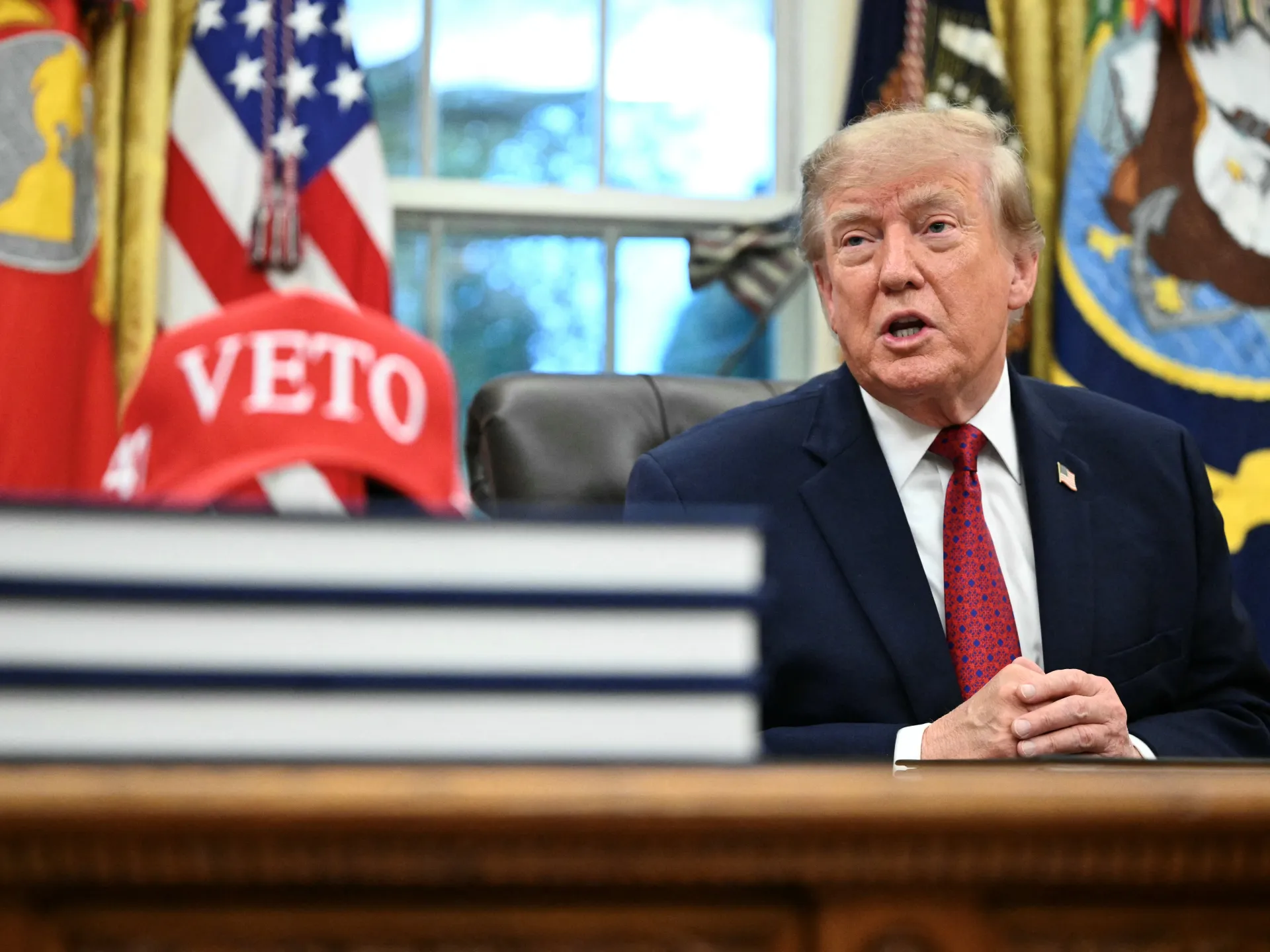
Trump has since posted a picture on his Truth Social account using the Make America Great Again red baseball hat to read “VETO”. Despite the Democrats’ success, as president, Trump holds broad executive authority, with Article 1, Section 7 of the US Constitution stipulating that the president has the power to reject legislation passed by Congress through a veto.
Congress can override the veto, but would need to have a two-thirds majority, something that the Democrats do not have in either chamber.
But Trump’s comments to Politico underscore an alternate possibility — the president may pick and choose when to veto, and when to work with Democrats.
Bipartisan negotiations
As it stands, Trump has three options: veto legislation, enforce executive orders or make deals.
Since Trump was inaugurated in January 2025, he has passed 292 executive orders: 67 this year and 225 last year, according to the Federal Register.
But now, according to Andrew Proctor, a lecturer in US politics at University College London, Trump has even less leverage than before with Congress.
“I think the biggest thing is we’re probably going to see a decent amount of gridlock. The Democrats are going to try to pass policies, but he’s got the power to veto them, and Democrats don’t have enough seats in either chamber to overcome any vetoes that he has,” Proctor said.
“So that raises questions about, will he try to work with the Democrats at all on passing legislation? I think recent history says that’s unlikely.”
Still, some Democrats have said that they would work with the president to advance programmes central to their campaign promises.
Michigan’s Abdul El-Sayed, the first Muslim elected to the US Senate, has already said he could work with Trump — even though the US president had used racist and Islamophobic rhetoric to target El-Sayed during the campaign.
El-Sayed told MSNOW on Thursday that if Trump was interested in “getting money out of politics, putting money in pockets and passing Medicare for All, that’s what I ran to do, and I’m looking forward to working with anyone who is willing to do that”.
“He is the president of the United States,” he said. “I’m going to be one United States senator, and if he’s interested in working on issues that I want to work on – getting more people healthcare, ending the Medicare cuts, ending the stupid war, stopping these stupid tariffs with Canada – then let’s talk about doing that and go and deliver for the public.”
Progressive Senator Bernie Sanders has also said, in recent interviews, that he would not rule out Trump signing onto a Medicare for All bill if Democrats pass it in both chambers of Congress. He described Trump as a “politician” who was not “too ideological”.
Proctor argued that Trump could indeed make a deal with the Democrats based on how good it could make him look, but that getting Medicare for All passed in the next two years appeared unlikely.
“I do think that a place where common ground could emerge on healthcare is rolling back, specifically the sort of subsidies that were cut” under Trump’s earlier legislation, he said. “So that would make healthcare more affordable for millions of Americans.”
Proctor pointed out that some Republicans in 2025 had said they were willing to negotiate with Democrats on healthcare reforms.
“That didn’t end up happening, but I could imagine that might be a place for healthcare-specific policy where we could see something emerge,” he said. “I don’t think that a broader healthcare debate on passing Medicare for All, though, is really in the cards.”
Veto or filibuster
Though Trump has said he would be willing to use veto, he has historically not been among the most avid proponents of the practice.
He has so far used the veto twice in this term, and used it 10 times during his first term. Joe Biden used it 12 times in his single term, while Barack Obama used the veto a dozen times over two terms.
Overall, the presidential use of the veto has declined with time: Bill Clinton vetoed legislation 37 times between 1993 and 2001. His predecessor, George HW Bush, used it 44 times in his single term — almost once a month. Ronald Reagan used it 78 times over his two terms.
But Proctor said that Republicans also have a different tool to try and block legislation. That is the filibuster, a tactic that delays a vote on a specific piece of legislation by using an extended debate, which would impact the Democrats’ ability to get something passed.
“This is what they did to [former President Barack] Obama,” Proctor told Al Jazeera. “Senate Republicans will probably try to do the same thing, and it also means that we don’t even get to the point of Trump having the power to veto because the legislation never reaches him in the first place.”
Impeachment
Since the Democrats swept the midterms on Tuesday, calls for investigations against the administration have already emerged.
In his first term, Trump was impeached twice — first for the abuse of power and obstruction of Congress, and the second time for “inciting” the US Capitol riots.
On Tuesday night, US Representative Robert Garcia, who is set to become chairman of the House Oversight Committee, wrote on X: “LAWYER UP.” Senator Ron Wyden, who is expected to lead the Senate Finance Committee, wrote in a post on X: “Subpoenas.”
However, the Trump administration has already denied any wrongdoing.
“If Democrats choose to pursue sham investigations and radical left policies, they are choosing to work against the American people,” said White House spokesperson Lauren Bis on Wednesday.
Reports also suggest that impeachment proceedings against Defence Secretary Pete Hegseth might be imminent, over the Iran war that Trump and other Republicans have blamed for the party’s losses.