Venezuelas

Venezuela’s Central Bank Confirms External Audit of US-Controlled Resources

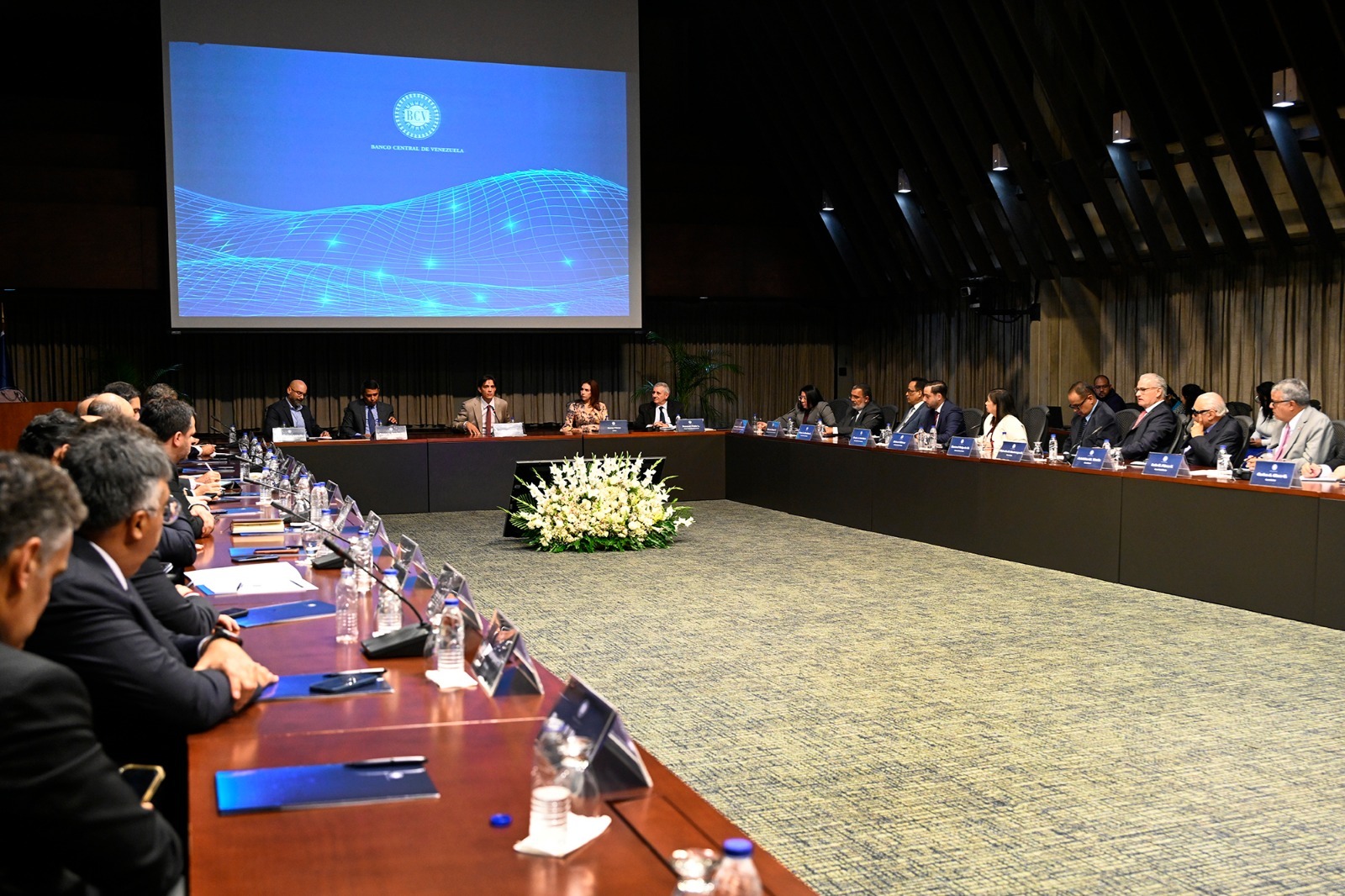
BCV authorities recently met with banking executives and pledged to loosen credit restrictions. (BCV)

Caracas, April 27, 2026 (venezuelanalysis.com) – The Venezuelan Central Bank (BCV) has announced the hiring of outside firms to audit Venezuelan export revenues currently controlled by the Trump administration and disbursed to Caracas.

In a press statement, BCV Acting President Luis Pérez confirmed that both the Venezuelan and US governments had hired auditing companies to “ensure peace of mind and impartiality.”

“The auditing of the country’s resources by external consultants gives us peace of mind,” Pérez stated. “Venezuela can be confident that the resources are being channeled where they have to and getting where they need to.”

According to Reuters and Bitácora Económica, Deloitte is one of the firms selected to inspect the Central Bank’s accounts, though it is not known whether it was chosen by Washington or Caracas.

One of the largest global consulting corporations, Deloitte has close ties to the US political establishment and national security state.  The London-based firm has a well-documented history of hiring former CIA agents and undertaking corporate espionage.

Since the January 3 US military strikes and kidnapping of Venezuelan President Nicolás Maduro, the Trump administration has taken control over Venezuelan oil revenues, mandating that all royalty, tax, and dividend payments be deposited in US Treasury-run accounts before a portion is returned to Caracas at the White House’s discretion.

US officials, including Secretary of State Marco Rubio and Treasury Secretary Scott Bessent, have stated before congressional committees that the Venezuelan government’s allocation of its own resources, once returned by Washington, would be subject to outside audits.

Rubio additionally claimed that Caracas needs to submit “budget requests” before accessing funds. Both US and Venezuelan officials have acknowledged the use of US-managed funds for imports of medicines and medical equipment from US manufacturers.

The sequestered Venezuelan earnings have not been returned directly to the BCV but injected into foreign currency auctions run by banks. US officials have confirmed the transfer of US $500 million of a projected $2 billion initial agreement, though analysts have reported a higher volume of foreign currency made available in recent weeks.

Recently issued US Treasury licenses allowing transactions with the Venezuelan Central Bank are expected to restore some of the institution’s capacity to intervene in the economy. In a recent meeting with banking executives, Acting President Pérez stated that the BCV was prioritizing inflation control and forex market stability. A black market exchange rate has consistently hovered above the official one, with a gap currently at around 30 percent. Critics have blamed the BCV’s lack of oversight for the proliferation of currency speculation.

Pérez likewise pledged to review the Central Bank’s current reserve requirements, a recurring demand from banks in recent months. Banks are presently forced to hold 73 percent of deposits as reserves.

The contraction of credit, alongside reduced public spending and the freezing of wages, were policies adopted by the Maduro government in recent years in an effort to slow down inflation in the sanctions-hit Venezuelan economy.

Pérez was appointed acting president of Venezuela’s financial authority on April 16. He replaced Laura Guerra, who had been in the post since April 2025. Last week, the Venezuelan government’s “rapid response” social media denied reports of negotiations with the US State Department and the far-right opposition to select a new BCV board.

Since January, the Venezuelan government led by Acting President Delcy Rodríguez has fast-tracked a diplomatic rapprochement with the Trump administration.

The White House’s recognition of Rodríguez as Venezuela’s sole leader has paved the way for the resumption of dealings with the International Monetary Fund (IMF), while creditors of Venezuela’s sizable foreign debt anticipate a lucrative restructuring agreement.

The Rodríguez administration has likewise driven a pro-business legislative agenda with the goal of attracting foreign investment. The Caribbean nation’s parliament has approved reforms to the hydrocarbon and mining sectors that grant increased control to foreign conglomerates, alongside reduced fiscal responsibilities and the possibility of taking disputes to international arbitration bodies.

Canadian miner Gold Reserve issued a statement Monday “welcoming” the new mining law, noting that some of its “key recommendations were reflected in the final enacted law,” including the repeal of a 2015 decree establishing majority Venezuelan state control over the sector.

Acting President Rodríguez, as well as National Assembly President Jorge Rodríguez, have both acknowledged receiving “recommendations” and “suggestions” from oil majors in the hydrocarbon industry overhaul.

Edited by Lucas Koerner in Fusagasugá, Colombia.
Source link

Venezuela’s Rodríguez and Colombia’s Petro Hold Talks on Security, Trade, Energy

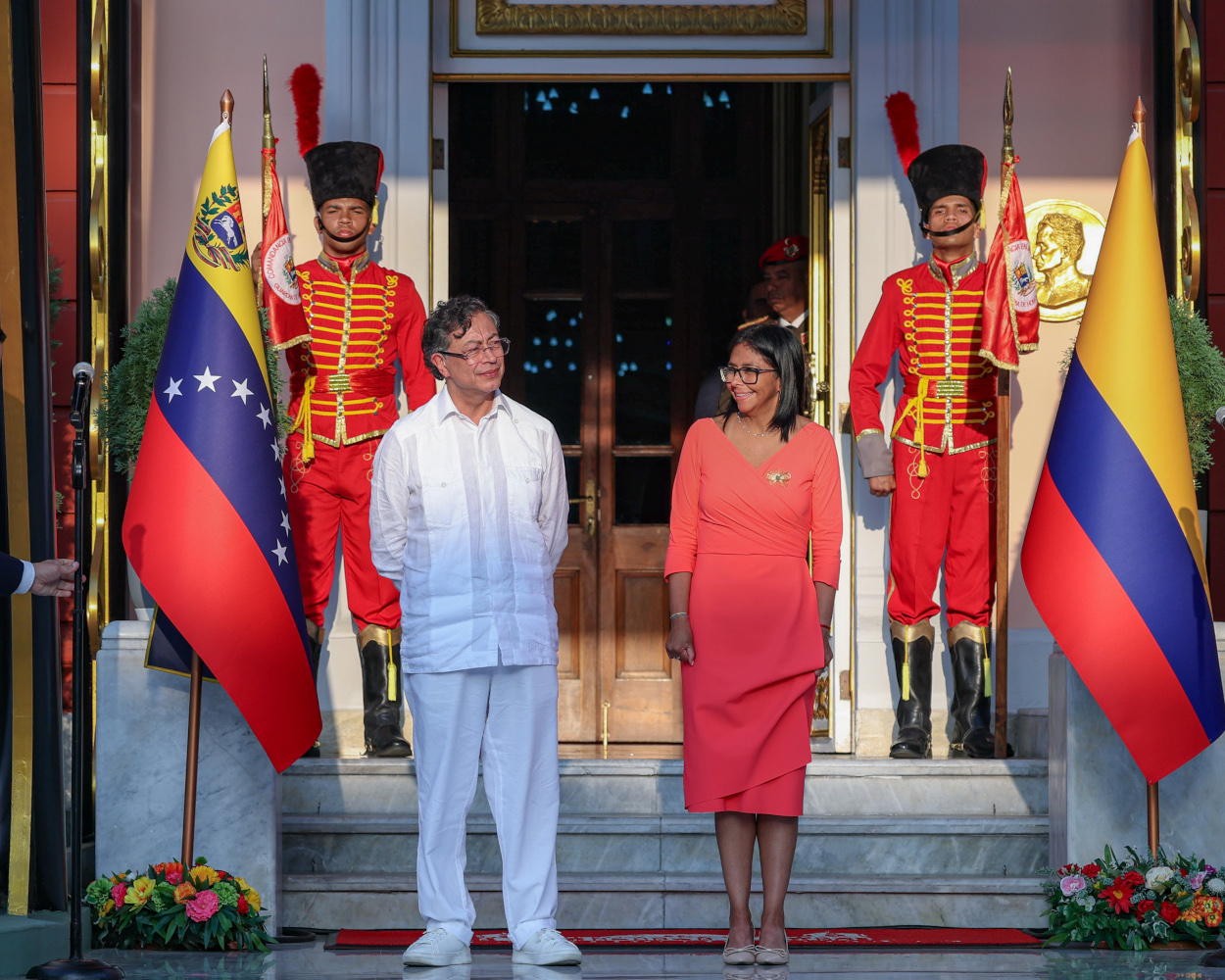
Petro was the first head of state to visit Caracas since the January 3 US attacks. (Presidential Press)

Caracas, April 24, 2026 (venezuelanalysis.com) – Venezuelan Acting President Delcy Rodríguez hosted Colombian President Gustavo Petro for bilateral talks in Caracas on Friday. 

The meeting marked the first official visit by a head of state since the kidnapping of President Nicolás Maduro during a US military operation on January 3.

Following talks at Miraflores Presidential Palace, Rodríguez said both governments committed to tackling organized crime along their shared border, one of the longest in the region at over 2,200 kilometers.

“We have undertaken a very serious and concrete approach to combating criminal groups and transnational crime,” she said, announcing the development of joint military plans and “immediate” mechanisms for intelligence sharing in a new level of security cooperation.

Petro, for his part, stated that both countries would work toward the “liberation of border communities” through coordinated military, police, and social action.

“Building a fully coordinated common effort to free border populations from mafias engaged in various illegal economies,” he said, accusing irregular groups of human trafficking, drug trafficking, and illegal gold trade activities.

The leaders also agreed on economic initiatives aimed at supporting Venezuelan and Colombian populations in border regions. Petro expressed hope that these efforts would help reintegrate the two territories and boost food security.

The joint action commitments come amid escalating violence in the Catatumbo region of Colombia’s Norte de Santander department, which borders Venezuela’s Táchira state, where clashes between armed groups have displaced thousands in recent weeks.

Armed organizations operating in the area include the National Liberation Army (ELN), the Estado Mayor Central (EMC) and the Segunda Marquetalia, both descendants of the former FARC, and the Clan del Golfo, among others.

Friday’s talks also included the neighboring nations’ trade relations. Rodríguez highlighted discussions on “import substitution” between the two countries.

“It makes no sense for Colombia or Venezuela to look to other regions or hemispheres for what we can produce within our own territories,” she said, noting that bilateral trade currently stands at approximately $1.2 billion per year.

The leaders further addressed electrical interconnection projects for western Venezuela, a region heavily affected by blackouts, as well as reopening a pipeline that would allow Venezuela to export natural gas to Colombia and beyond.

Rodríguez and Petro also discussed the revival of air connectivity to boost tourism, including the development of multi-destination travel initiatives.

Present at the private meeting were Colombia’s foreign minister Rosa Villavicencio and defense minister Pedro Sánchez, alongside Venezuela’s foreign minister Yván Gil and Interior Minister Diosdado Cabello. The presidential summit followed an earlier meeting of the two countries’ Neighborhood and Integration Commission, with bilateral working groups established for a number of areas, including trade, energy and defense. 

A prior meeting scheduled between Rodríguez and Petro on the border in early March was suspended due to security concerns.

Rodríguez hosts new US chargé d’affaires

Venezuelan Acting President Delcy Rodríguez also welcomed the Trump administration’s new chargé d’affaires to Venezuela John Barrett at the presidential palace on Friday.

Alongside Cabello and Gil, Rodríguez held a private meeting that reportedly focused on energy and a “long-term cooperation agenda.” For its part, the US embassy in Caracas stated that Barrett will continue implementing Washington’s “three-phase plan” for the Caribbean nation.

Barrett recently replaced Laura Dogu, who had been on the post since January. A career diplomat, he last served as chargé d’affaires in Guatemala, where he was accused of interference in magistrate elections in March.

Washington and Caracas fast-tracked a diplomatic rapprochement following the January 3 military strikes and kidnapping of Maduro. In March, the White House recognized Rodríguez as Venezuela’s sole leader, while the acting president recently thanked Trump and Secretary of State Marco Rubio for their “good disposition” in establishing “cooperation” between the two countries.

The diplomatic reengagement and US recognition have likewise led to a resumption of ties between Caracas and the International Monetary Fund (IMF).

Edited and with additional reporting by Ricardo Vaz in Caracas.

Source link

The Venezuelanalysis Podcast Episode 44: Venezuela’s Natural Resources, Oil Reform, and Sovereignty

Venezuela’s January 2026 hydrocarbons law reform marks a major shift in the country’s oil sector. It establishes a more flexible fiscal regime in the name of “international competitiveness,” while expanding the private sector role in extraction, operations, and dispute resolution mechanisms.

The reform follows years of US sanctions on Venezuela’s oil industry and coincides with new US licenses allowing Western conglomerates to move into Venezuela’s energy sector.

Join Blas Regnault, energy policy analyst and consultant focused on oil geopolitics, alongside Venezuelanalysis editors Ricardo Vaz and Lucas Koerner, as they break down the reform, its economic and political context, and what it means for control over strategic resources and national sovereignty.

Powered by RedCircle

Source link