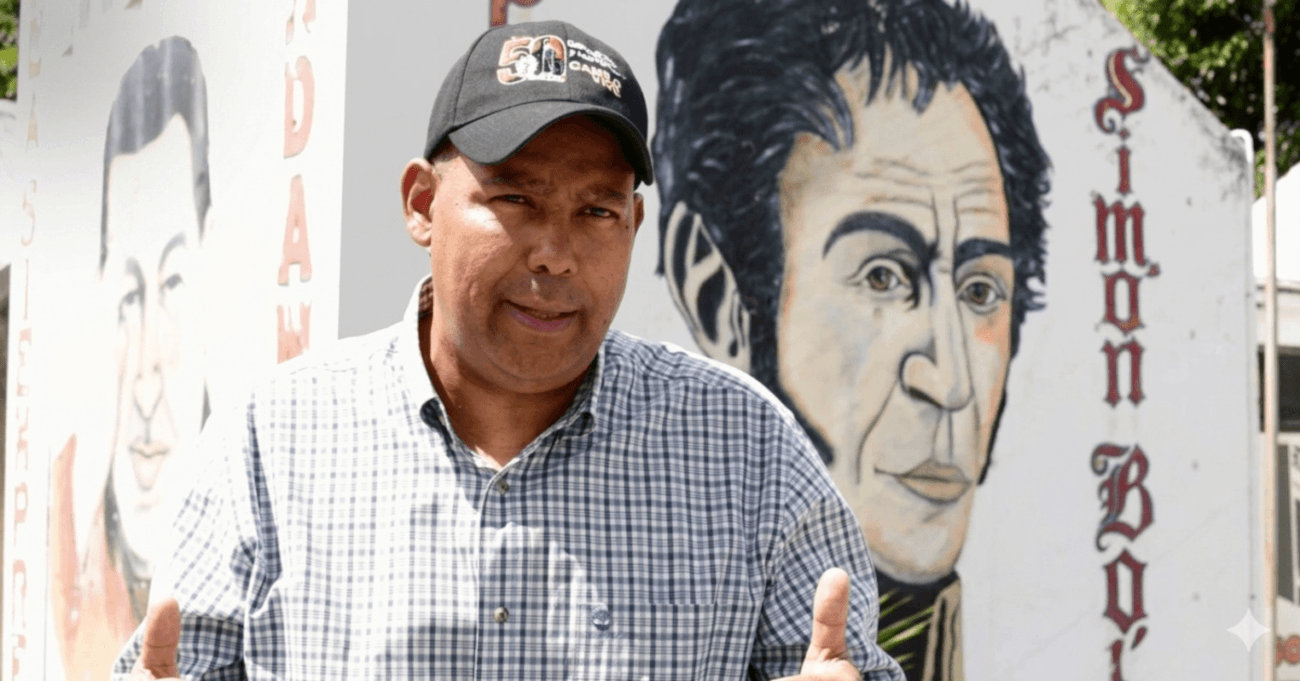
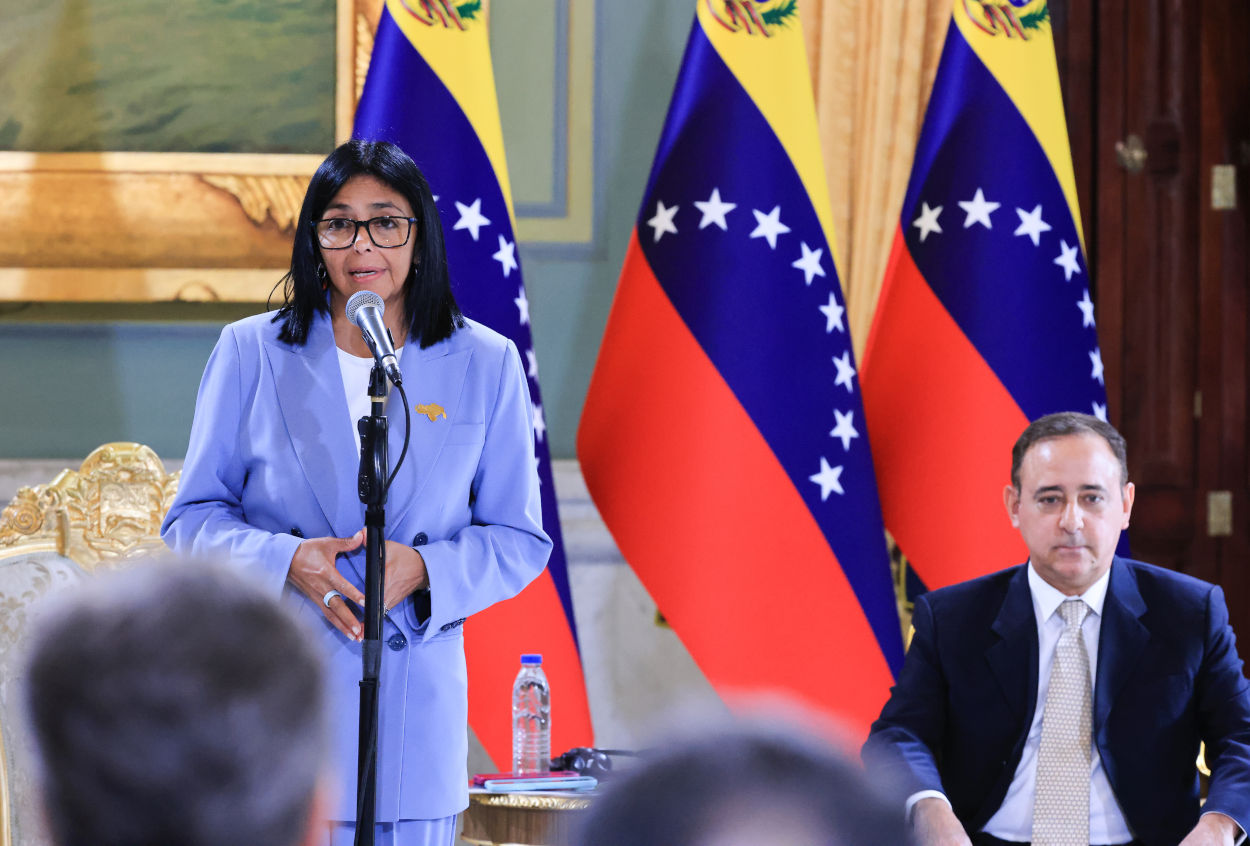
Contreras called for a unified Latin American response against ramped-up US aggression. (Tiempo)
Following the US attack on January 3, Venezuela was left in a state of turmoil and uncertainty that does not rule out further military actions. In recent days, there was “a joint operation between Venezuelan and US security agencies in the southeast of Bolívar state, in which organized crime networks were dismantled,” according to a statement from the Venezuelan government. Days earlier, the Coordinadora Simón Bolívar, a historic Chavista organization, had denounced DEA involvement in planning a repressive offensive with the aim of “decapitating” the popular movement in the iconic 23 de Enero neighborhood, which Juan Contreras describes as “the most important in Caracas.”
A community leader, social work graduate, and president of the Coordinadora, Contreras is a longtime Chavista activist and staunch defender of the Bolivarian Revolution. Today he believes there are “shameful situations that must be denounced,” but he holds the US government – ”our enemy” – responsible. Contreras was born and raised in the densely populated and combative 23 de Enero neighborhood, where he still lives and where he welcomed us to analyze the complex situation facing Venezuela, and in particular the social movements.
How are Venezuelan social organizations responding to what has been happening in the country since the US military attack on January 3?
What happened was an act of aggression, an act of war. They [the US] sought and continue to seek to break our people, but we in the social movements have kept up our efforts because we still believe in the revolutionary process. Our enemy is the US government, which must have realized that the problem wasn’t Chávez, because Chávez died and the revolution continued. President Maduro has been kidnapped, and here we are. What we’re experiencing today is unique in history; I don’t think anything like what’s happening in Venezuela has ever happened anywhere else in the world – the closest thing was in 1989 in Panama, when they kidnapped Noriega. But here, their narrative has fallen apart: it has not been proven that Venezuela is a drug trafficking country, that its government is linked to drug trafficking, or that President Nicolás Maduro was one of the biggest drug lords, as they claimed. On the contrary, today all those narratives have been debunked, and what is clear is that they are coming after our energy reserves. The Venezuelan people are well aware of this.
Is identifying a state of war and an enemy the context for the denunciation you issued about the danger of a DEA-orchestrated attack on 23 de Enero?
This is information we’ve received from a reliable source indicating that a large-scale operation is being planned against 23 de Enero, which is not far-fetched. 23 de Enero, as a barrio, has historical significance dating back to the Fourth Republic, between 1958 after the fall of Pérez Jiménez and the advent of democracy. That threat is very real. I believe that at the time, there was an underestimation of the threats posed by the US empire: the fact that our coasts were blockaded, the fact that our airspace was blockaded… Now, what we’re denouncing here has all the hallmarks of becoming a reality. It’s not just me saying this, nor the source that gave us this information, which is a reliable one. It’s that all the propaganda out there points in that direction, starting with the journalists who now live in Miami and are waging a full-scale campaign against the colectivos. “What’s going on with the colectivos? Why aren’t they attacking the colectivos? Why don’t they disarm the colectivos?” Marco Rubio himself has said it, and just recently one of the top military leaders said it: they’re coming for the “armed groups.” The problem is that, in their narrative, they label social movements as armed groups, accusing them of being armed in order to justify their aggression. Well, today our people are armed with consciousness; today, after 27 years, our people are more Bolivarian than ever. These are the people who placed their trust in Comandante Chávez, who committed to refounding the Bolivarian Republic of Venezuela. That is why we can understand all this cognitive warfare being waged against Venezuela.
There are no guerrillas here; what we have here is a people with a consciousness, a mobilized people, a people who, through culture, through popular education, have managed to advance in building the Bolivarian embryo from the barrio level, with the communal councils and the communes. So, the US seeks to dismantle that organization by employing the tactic of decapitation. They want to destroy the collectives, those who raise their voices against the empire, those who today denounce what is happening in our country, those of us who disagree with what is happening today, and who have maintained a principled and firm stance in the face of that aggression and invasion by the US empire.
Based on the information you have, how would the DEA carry out an attack of that kind on Venezuelan territory?
They have been operating by applying pressure. In all our countries, we have a repressive police force. Perhaps there is a segment of the police ranks – among their core leadership – that understands human rights issues, but there are other segments that are easily co-opted. We have 27 years of experience in which generals, colonels, and captains have turned their backs on us and served the empire’s policies. So, it’s not far-fetched to say that the United States is working with certain police forces, or with specific officials who might be willing to carry out an operation against the most important symbol in Caracas, which is the 23 de Enero parish. From 1958 to 1998, approximately 160 martyrs were killed there by the police. In other words, this is not crazy: it is serious, and as the pressure on our government to move toward an electoral process intensifies, the plan of aggression may also accelerate.
So, of course, it’s entirely possible that they’ll move forward with an action like this to eliminate what they consider “the Bolivarian resistance,” represented by social movements organized into communes, communal councils, and long-standing social organizations such as the Coordinadora Simón Bolívar, which is an expression of the popular power.
Did you receive any show of solidarity from the government?
Someone with influence within the government called us, reached out, we talked, and they agreed to investigate and look into the matter. What they recommended was caution: to steer clear of any provocation. And well, we’re waiting to see if what was discussed will be carried out, that a thorough investigation is conducted into what we’re denouncing. Because up until now, we thought [the US] would never invade, but they did; we underestimated them, and they invaded. And today they have the audacity to sell our oil, manage our finances, provoke us, and say they’re going to turn us into their 51st state. And on top of that, they’ve placed us under tutelage as if they were the owners of our country. This is, of course, shameful, and we must denounce it.
That is why we, as part of the popular movement, remain mobilized and continue to denounce what happened on January 3 and the consequences we are enduring in Bolívar’s homeland.
This situation has not yet had any international repercussions. What message do you have for the social and political forces in Latin America?
It has been 200 years since the Amphictyonic Congress, that call made by the Liberator to build a confederation of nations and defend ourselves against the US empire, which was already showing its claws. What better time to call for a continentalization of the struggle of our social organizations? It is not just Venezuela that is at risk: it is all of Latin America. They are coming for their backyard. Today, brazenly and in an interventionist manner, they are meddling in Colombia’s elections and declaring which candidate they want to win. They did the same in Honduras.
So, in light of these events, the call to expand the struggle across the continent must be a reality today. Latin America’s only chance to escape the aggression of Donald Trump’s administration is through the coordination of the popular and revolutionary movement across the region. We must unite, we must denounce this situation, and we must move forward, because they’re coming for everything. The only way forward is to make the struggle a continental one. This is something that, at one point, was not only stated by Bolívar but also attempted by Comandante Ernesto Guevara. I believe that is where we should focus our efforts: on uniting the popular and revolutionary forces of Latin America and the Caribbean.
Source: Tiempo Argentino