VC25B

New VC-25B Air Force One Will Be Pulled From Service To Be “Maxed Out” With Upgrades

The U.S. Air Force’s new VC-25B Bridge aircraft will receive additional upgrades that will result in its capabilities being “maxed out,” according to President Donald Trump. This follows a flurry of recent reports that the modified, Qatari-gifted Boeing 747-8i lacks the same array of defensive features and other capabilities as the Air Force’s existing VC-25A Air Force One jets. TWZ has repeatedly raised serious questions about the overall feasibility of turning this plane into an interim Air Force One, especially on an extremely tight timeline and with a relatively small budget, since the plan first emerged last year.

New questions were raised about the Bridge aircraft’s self-protection suite, in particular, after Trump took it to the NATO summit in Turkey earlier this month, but then left unexpectedly on an older VC-25A. Subsequent reports said that the Secret Service had urged the President to make the swap as a security precaution amid escalating fighting with Iran.

“Mr. President, this plane does not have anti-missile defense systems on it. Why are you flying it?” S.V. Date, White House correspondent for HuffPost, asked Trump at a press gaggle at Andrews Air Force Base outside Washington, D.C., yesterday. The President had just returned from a trip to attend the FIFA World Cup final in New Jersey.

“Well, it has – it has a lot, and, you know, it has a lot of capability,” Trump said in response. “But as I understand it, in about a month or so, they’re going to send it to have it be maxed out. So they’re going to be sending it, and they’ll have it be maxed out. It’ll take about a month.”

Trump did not elaborate on what “maxed out” might mean for the Bridge aircraft.

“The new Air Force One is perfectly safe for the President’s travels, but will receive additional upgrades and enhancements in the fall which will take approximately one month to complete,” White House Press Secretary Karoline Leavitt said in a statement to TWZ. “During that time, the President will fly on the old Air Force One.”

We have also reached out to the U.S. Air Force and L3Harris for more information. L3Harris is the defense contractor that served as the lead integrator for the modifications to the former Qatari 747. You can read more about what is known about the conversion process, which took approximately 10 months, here.

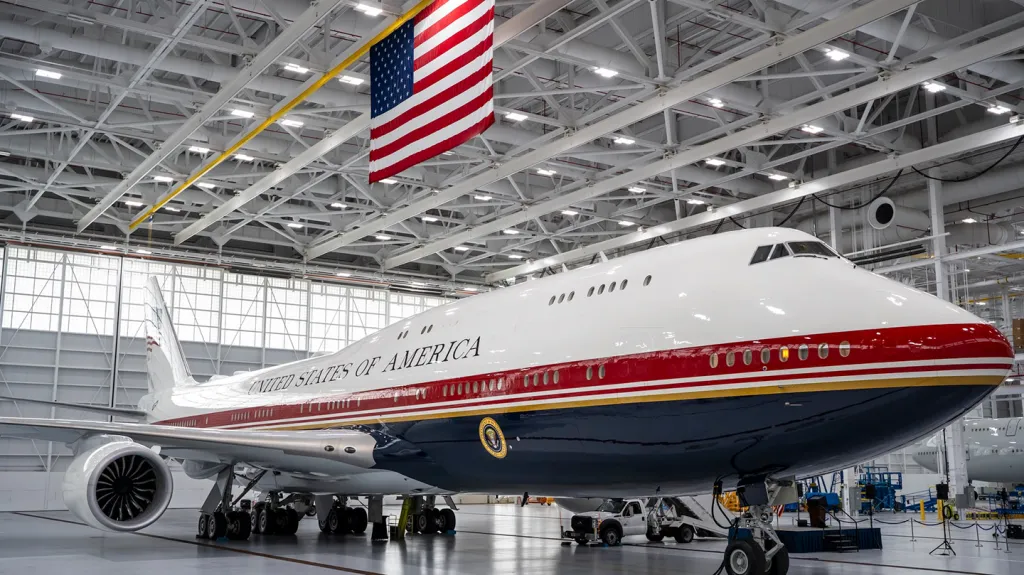
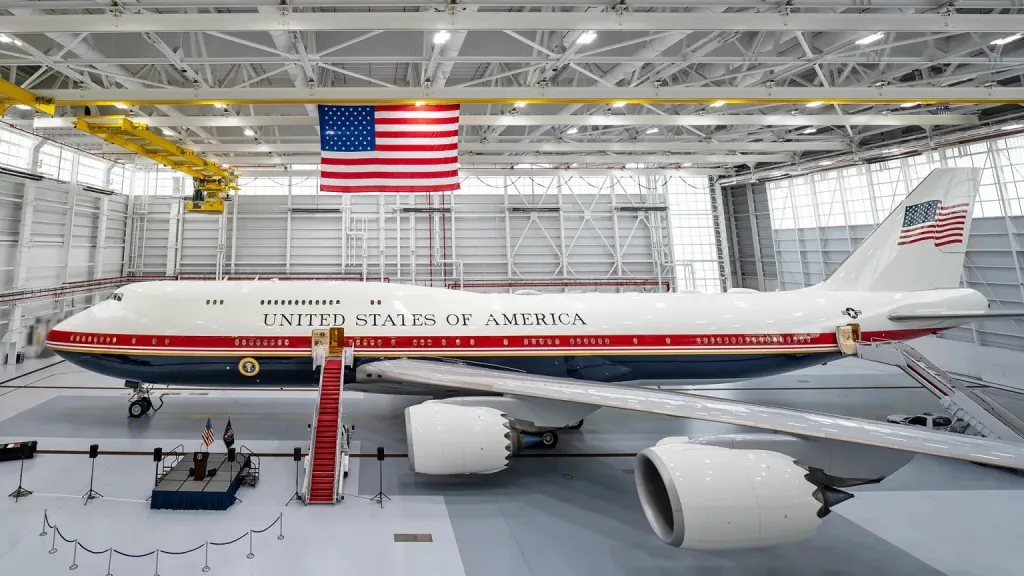
The VC-25B Bridge aircraft, seen at Andrews Air Force Base at its official unveiling in June. USAF

“We knew there were some issues around security with the plane. We’ve known that from the very beginning,” Senator Jeanne Shaheen, a New Hampshire Democrat, said separately at a roundtable at the Farnborough International Airshow in the United Kingdom today, according to Breaking Defense. “Obviously, there was an effort to address that.”

“If there … was an examination and a problem apparently was determined to exist, the good news is that it’s apparently going to be addressed,” Senator Jerry Moran, a Kansas Republican, also said, per Breaking Defense. “And I think it’s important for all of us to determine what that problem is and to be supportive of corrective measures.”

Shaheen and Moran both serve on the Senate Appropriations Committee’s Subcommittee on Defense. Shaheen is also a member of the Senate Armed Services Committee.

As noted, there has been significant new scrutiny of the Bridge aircraft’s defensive and other capabilities since Trump’s trip to Turkey and the swap with the VC-25A on the way back. On July 9, The New York Times reported that the ex-Qatari jet “lacks the same defensive countermeasures that were security features of the old model, including its advanced antimissile capabilities,” citing unnamed officials.

A stock picture of one of the Air Force’s existing VC-25A Air Force One jets. USAF

The Times‘ story included a statement from White House Communications Director Steven Cheung, saying that “the new Air Force One is a state-of-the-art aircraft that has been fitted with high-level security protocols that ensure the safety of the president and his staff.”

Other outlets published similar stories about Air Force One’s capabilities, also citing anonymous sources. In a highly unusual development, the FBI subsequently subpoenaed four journalists at the Times as part of a leak investigation, which now appears to go beyond the more recent reporting on the Bridge aircraft.

The current array of defensive features found on the VC-25B Bridge aircraft is unknown. Details about the self-protection capabilities of the existing VC-25As — arguably the most well defended aircraft on the planet — are not usually openly discussed, but at least some of the countermeasures systems on those aircraft are plainly visible to the general public. This includes a version of the AN/AAQ-24 directional infrared countermeasures (DIRCM) system, also called Nemesis or the Large Aircraft Infrared Countermeasures (LAIRCM) system. There is the AN/ALQ-204 Matador infrared countermeasures (IRCM) system, as well. The AAQ-24 uses lasers to blind and confuse the seekers on infrared-homing missiles. These laser turrets are mounted all over the bottom of the aircraft. The older ALQ-204 system has a similar function, but sends out large fixed pulses of infrared energy rather than a steerable laser beam. The VC-25As also have visible missile launch warning sensors at various points around the aircraft to cue these and other defensive capabilities, and to just provide general alerts to incoming threats. There are certainly other capabilities that are not so plainly visible, as well. The planes are hardened against electromagnetic pulses (EMP), as well.

Large Aircraft Infrared Countermeasures (LAIRCM) thumbnail

Large Aircraft Infrared Countermeasures (LAIRCM)


To date, there have been no visible signs of any of these obvious defensive features found on the VC-25As being present on the VC-25B Bridge aircraft. This is something we have noted since the official rollout of the new aircraft in June. The Air Force and L3Harris have previously pushed back on any operational security concerns surrounding the jet gifted by Qatar.

There are additional questions now about what modifications could reasonably be made to the Bridge aircraft during another month-long upgrade period. As we previously wrote after Trump’s swap back to the VC-25A on the way back from Turkey:

“Defensive countermeasures, in particular, take time and careful work to integrate onto any airframe, let alone a newer type for which there might not be pre-existing procedures. Rigorous testing has to be done after integration to ensure those systems work as intended and do not conflict with other features, physically or in the radiofrequency spectrum.”

That being said, there are countermeasures systems that have already been qualified on at least some 747 variants, such as the aforementioned capabilities known to be found on the VC-25As today. There are other self-protection options available on the open market today for 747s and other similarly large aircraft, such as the C-MUSIC DIRCM system from Elbit in Israel. Northrop Grumman also offers a podded DIRCM system called Guardian that utilizes some of the same components as NEMESIS/LAIRCM. Both of these examples are not for high-volume threats, though.

Elbit Systems / DIRCM Missile Defense thumbnail

Elbit Systems / DIRCM Missile Defense


Any move to upgrade the Bridge aircraft’s defensive capabilities now can only prompt the question as to why this was not done already. This is a matter of ensuring the safety of the President of the United States, whoever that might be, and underpinning the credibility of America’s nuclear deterrent whenever they are onboard.

There was certainly a push to have the Bridge aircraft in service, at least to some degree, by July 4th. The plane was a centerpiece of flyovers above the nation’s capital to mark this year’s Independence Day. Trump had flown on the jet for the first time just before, on a trip to North Dakota to attend the opening of the Theodore Roosevelt Presidential Library and other celebrations marking the 250th anniversary of the United States.

The new VC-25B Bridge aircraft, at left, and one of the older VC-25As, at right, seen together at Andrews Air Force Base ahead of flyovers over Washington, D.C., on July 4, 2026. USAF

If the Bridge aircraft was rushed into service without certain defensive systems installed to be available for July 4th and other 250th anniversary celebrations, it could still have been sent back for additional upgrades afterward. However, there appears to have been no plans to get the Bridge aircraft any additional defensive or other capabilities before it was put into full service. This was proven when Trump and many other passengers headed overseas to Turkey aboard the new jet. Before the plane was delivered, TWZ had questioned whether the jet would ever fly abroad in the Air Force One role, and not be reserved for lower-risk domestic travel, due to these exact kind of security concerns.

There is an additional operational security layer to the equation here given that any aircraft serving in the Air Force One role inherently slots into America’s nuclear deterrent posture. Beyond their array of self-protection features, the VC-25As, in particular, have an extensive secure communications suite designed to ensure the President remains in contact with the National Command Authority at all times. The National Command Authority is the mechanism through which the President would order a nuclear strike, as you can read about in more detail here.

A report from CBS News earlier this month implied that the new Bridge aircraft lacks the same communications capabilities, as well as defensive features, found on the VC-25As. That story suggested both aspects here pushed the Secret Service to recommend Trump use the older aircraft on the return trip from Turkey, which came amid the start of the new campaign against Iran. The President had also just directed a new round of strikes on Iranian targets from the sidelines of the NATO summit. TWZ highlighted all of this at the time as potential contributing factors in the swap between Air Force One jets.

All of this raises further questions about what risks may have been accepted in allowing Trump to use the Bridge aircraft to travel to Turkey in the first place. There’s an additional question here of what would have happened had circumstances not prompted Trump to swap Air Force Ones, and had The New York Times and others not reported on the reasons behind that decision. Would it have ever gotten these extra defenses if those things didn’t happen?

The Bridge aircraft has been the subject of criticism and controversy from the start. The circumstances under which the Qatari government gifted the plane to the United States in the first place were highly irregular.

The justification for needing the Bridge Air Force One at all remains a subject of debate, now fueled further by the clear continued relevance of the VC-25As. The Air Force’s efforts to acquire two fully equipped VC-25B Air Force One jets from Boeing have been repeatedly delayed, and the costs of that effort continue to rise. The first of those jets is now expected to be delivered in 2028, which is actually a slight improvement in the timeline. What will happen to the Bridge aircraft afterward is unclear.

The Air Force has separately acquired another 747-8i from German flag carrier Lufthansa, which is now being used as a trainer for aircrew and ground personnel. An additional ex-Lufthansa 747 will be cannibalized for spare parts, as well, in support of the burgeoning Air Force One fleet.

It is worth noting here that the VC-25As are also based on older 747-200 models, a type that has all but disappeared from service globally, even with commercial airlines. Those jets are becoming more complicated and costly to operate and maintain just as a result of diminishing supply chains.

With Trump’s comments yesterday, the VC-25B Bridge aircraft is now slated to get the defenses it should have had originally, or at least more than it has now, but the path to getting there is bizarre and raises real concerns, to say the least.

Contact the author: joe@twz.com

Joseph is TWZ’s Deputy Editor, helping to oversee the site’s highly experienced and dedicated team, while also writing informative and impactful defense and national security content. He lives right in the thick of it in the Washington, D.C. area.


Source link

VC-25B Bridge Aircraft Makes First Flight As Air Force One With Trump Aboard

President Donald Trump is flying on the U.S. Air Force’s new VC-25B Bridge aircraft for the first time. The modified, Qatari-gifted Boeing 747-8i is taking Trump and others to North Dakota for the opening of the Theodore Roosevelt Presidential Library and for other celebrations marking the 250th anniversary of the United States. The Air Force formally accepted delivery of the plane less than two weeks ago.

The White House has confirmed to TWZ that this is Trump’s first flight aboard the Bridge aircraft. The plane has been the source of controversy, including over its ability to adequately serve in the Air Force One role, something TWZ has questioned in detail in the past. The gifting of the jet from Qatar in the first place was also highly irregular, and the justification for needing it at all remains up for debate. The converted 747-8i has also been painted in a new scheme for U.S. executive aircraft preferred by Trump, which is a major departure from the Kennedy-era Air Force One livery that had been the standard for 60 years.

“This will be the first flight of what I think is maybe the greatest commercial plane ever built. I said to Boeing, what’s the best one? They said this is the best plane ever built. And you’re going to have the privilege of flying it, and I have the privilege also of flying it,” Trump told reporters before boarding the plane at Andrews Air Force Base. “I’m excited about the first flight.”

One of the Air Force’s two existing VC-25A Air Force One aircraft is serving as a backup for Trump’s trip today.

Bloomberg was first to report that the trip to North Dakota would be Trump’s first flight aboard the Bridge aircraft. NBC News had previously reported that the inaugural flight of the Bridge aircraft might come later in the week, taking Trump on a planned trip to Mount Rushmore in South Dakota on July 3. It is still very possible, if not probable, that the plane will take Trump to South Dakota, as well.

Reuters also reported back in May that the debut of the VC-25B Bridge jet might come during a July 4th flyover. The former Qatari jet was unveiled to the public on June 19, but it has been confirmed that it will fly over Washington, D.C. as part of the celebrations this weekend.

The VC-25B Bridge aircraft seen during its official unveiling on June 19. USAF

Significant questions do still remain about the Bridge aircraft’s ability to support the full spectrum of Air Force One mission requirements, especially given that the plane was modified for this role in just 10 months. U.S. officials and defense contractor L3Harris, which did the conversion work, have insisted that operational concerns have been addressed and have downplayed any potential risks.

“One of the first things we have to do on this aircraft, in conjunction with the U.S. government, is ensure it is safe. There was a lot of content and buzz on blogs and whatnot about is the aircraft secure? Is there anything that we wouldn’t want coming in on the aircraft? Somebody could listen in, something like that,” Jason Lambert, President of Intelligence, Surveillance and Reconnaissance (ISR) at L3Harris, told TWZ in an interview last week. “I can assure you that was very effectively managed to the highest degree. Experts from the U.S. government, experts from L3Harris, experts in cyber security, electronic warfare, ensured that every square inch of that plane was clean, not only on the exterior but interior of the plane and all systems within. So I’ll say, there’s just electronic scrubbing, is how I would describe it, to ensure that it was safe and secure. Frankly, that work took place even before we were able to do any real work on the plane.”

President Donald Trump is seen here with Air Force officials and others during an earlier tour of the VC-25B Bridge aircraft. Dan Scavino via X

“Survivability of the aircraft was something that was absolutely thought of, but I can’t comment on the specific systems on the aircraft yet. That’s one I’ll have to direct you back to the Air Force,” he added. Lambert also deferred to the Air Force when asked about hardening against electromagnetic pulses, command and control capabilities, and other core Air Force One requirements.

Readers can find the full interview here.

The Air Force’s two existing VC-25A Air Force One aircraft remain in service, as evidenced by the one serving today as a backup. Boeing is still working toward delivering two fully-equipped VC-25B jets around the end of the decade. The VC-25Bs are set to replace the aging and increasingly difficult to sustain VC-25As, which were converted from older 747-200 models. However, that program has suffered repeated delays and cost growth. The Air Force is also now operating an additional 747-8i, acquired from Lufthansa, as a trainer for aircrew and ground personnel. A second ex-Lufthansa 747 will serve as a source of spare parts for the expanded Air Force One fleet.

Trump’s inauguration flight today aboard the VC-25B Bridge jet makes clear that it is now firmly in the Air Force One rotation.

Contact the author: joe@twz.com

Joseph is TWZ’s Deputy Editor, helping to oversee the site’s highly experienced and dedicated team, while also writing informative and impactful defense and national security content. He lives right in the thick of it in the Washington, D.C. area.


Source link

New Air Force VC-25B “Bridge” Jet Has Joined The Presidential Airlift Group (Updated)

The new Air Force VC-25B Bridge jet “has officially arrived at the Presidential Airlift Group and will commence its initial commissioning flights, marking the successful delivery of a secure, modified executive platform,” the Air Force announced Friday afternoon. As we have reported in the past, this modified, Qatari-gifted 747-8i, is set to serve as an interim Air Force One aircraft ahead of the much-delayed arrival of two fully outfitted VC-25Bs from Boeing. The jet wears President Trump’s preferred paint scheme, a major change for dedicated Air Force One aircraft, which have worn the Kennedy-era scheme for over 60 years.

Commissioning flights are the “final exam” for the aircraft modification, the Air Force explained in a media release. “They provide both an opportunity for the White House enterprise to validate mission-capability, while also finalizing protocols required to safely and securely transport the President of the United States and enable his execution of his three constitutional roles; Chief Executive, Commander in Chief, and Head of State.”

The new VC-25B Bridge jet has arrived at the Presidential Airlift Group.
VC-25B Bridge Aircraft. (USAF) (USAF)

Once these flights are successfully completed, the aircraft is officially “commissioned” into the active executive airlift fleet and becomes available for presidential missions along with the VC-25A and C-32 fleets, the service added in a release that included the new jet in its Trump-preferred red, white and blue livery.

You can read all about the program and the controversy surrounding it, especially having to do with the level of security and connectivity this aircraft provides, in our previous story here.

The VC-25B appears to be in the presidential hangar facility at Andrews Air Force Base in Maryland. You can read more about that in our story here.

UPDATE: 4:14 PM EDT –

Trump held a press conference at the presidential hangar facility to talk about the VC-25B. Here are some highlights.

“Our pilots, designers, and engineers prepared an aircraft that is the largest Air Force One ever built. It flies further and faster than any Air Force One. Those are incredible engines. You may never have to stop for fuel. They call it unlimited — well, it’s pretty close to unlimited. And it is among the most beautiful aircraft the Air Force will ever see or operate. You’ll never have this opportunity again.”

“With the extraordinary devotion of many of you here today, this plane was transformed into a flying White House — at a level of luxury nobody’s ever seen before — in only 10 months, a timeframe no one thought possible. They put a lot of things on here that normally you wouldn’t. Great protective mechanisms, the latest and greatest in every aspect.”

“We have communications equipment up there that nobody’s ever seen before — the highest level, including Starlink. My friend Elon is going to be very happy. We have four or five different sets of double and triple communications systems like people haven’t seen. It represents what can happen with hard work, innovation, and aggressive timelines.”

“So we had it all painted up in the new colors — red, white, and blue. We liked the baby blue, but it was time for a change. This is the sleekest look. When they asked what color I wanted, I said, “I like the colors of the American flag.” That makes sense. All of the planes in the fleet are being changed to this look — a much better look, and a more appropriate one.”

“The workmanship of this plane — when you see it, you won’t believe it. The quality of the woods, the quality of the materials, the quality of the engines. These engines are the finest and best in the world. Nothing like it. So it’s really an honor, and I want to thank the Emir of Qatar. He’s a fantastic guy. He went through a lot over the last few months.”

  • On the VC-25A he used to fly to the G7 summit:

“My return from the G7 summit was the last planned trip aboard the VC-25A — the 747. We’ll probably do the museum thing. We’ll get them fixed up a little, and put them in museums. They’re great planes and great history. It’s a plane that was authorized by President Ronald Reagan so many years ago. It was flown by every president since George H.W. Bush, and it was a great plane. We had very little trouble with it. Boeing has done a fantastic job — they charge too much, but we’re going to get the prices down. Over its lifetime, that aircraft traveled to 96 countries on 223 international trips and flew over 6 million miles. It became the most famous airplane in the entire world. And as you know, it’s actually two planes — Air Force One is two planes, totally identical. The only way I can tell them apart is a slight difference in the wood grain on the desk. They became the most famous airplanes in the world.”

  • On the July 4 capital flyover:

“So we’re going to have a big July 4th at the Capitol — flying over the Capitol. The generals promise to do a lot — not just one pass. They’ll do a little back and forth.”

UPDATE: 5:02 PM EDT –

Author’s note: Trump’s statement that his “return from the G7 summit was the last planned trip aboard the VC-25A” contradicts what the Air Force told us yesterday:

“The VC-25B Bridge aircraft will soon join the active executive airlift fleet alongside the VC-25A and C-32,” an Air Force spokesperson told TWZ this morning, but did not offer a firm timeline. When asked if this also meant that both of the VC-25As would remain in the service’s active executive airlift fleet, the same spokesperson said “yes.”

UPDATE 5:25 PM EDT –

Trump left his mark on the aircraft with his signature.

Contact the author: howard@twz.com

Howard is a Senior Staff Writer for TWZ. He writes frequently about conflict, focusing heavily on the Middle East and Ukraine, and interviews with military and intelligence officials and industry leaders from around the globe. He lives near Tampa, Florida, home of U.S. Central Command, U.S. Special Operations Command.


Source link

VC-25B Air Force One “Bridge” Aircraft Now Wears Trump’s Preferred Red, White, and Blue Paint Job

The U.S. Air Force has confirmed that the VC-25B “Bridge” aircraft is now wearing its new (and controversial) red, white, and blue livery as it undergoes final preparations for its official delivery.

Aviation photographer Travis Ghormley shared the first picture of the modified Boeing 747-8i with its new paint scheme yesterday. It was taken the day before in Waco, Texas. The aircraft had been undergoing modification and flight testing at L3Harris’ facility in Greenville, also in Texas, as part of the conversion into its new role, since at least April, before subsequently moving to Waco to be painted. The jet, gifted to the Trump administration by the government of Qatar last year, is set to serve as an interim Air Force One aircraft ahead of the much-delayed arrival of two fully outfitted VC-25Bs from Boeing.

The VC-25B Bridge aircraft seen unpainted sometime circa May 1. Courtesy photo via the USAF

“The VC-25B Bridge aircraft has been painted and is going through final modifications,” an Air Force spokesperson told TWZ today when asked for more information about the aircraft’s current status. “I don’t have any additional details I can provide on delivery dates at this time.”

A press release the Air Force put out on May 1 said that the “VC-25B Bridge aircraft has officially completed modification and flight testing” and was “being painted.” We have confirmed that the completed modifications referred to here were on the contractor side, but the U.S. government still has additional modifications to make to the jet.

Ghormley’s picture does clearly show the jet wearing the same red, white, and blue scheme that has already been appearing on various Air Force and other U.S. government VVIP jets. The livery also includes a large American flag, depicted blowing in the wind, painted on both sides of the tail and “UNITED STATES OF AMERICA” written on both sides of the fuselage. The paint job is virtually identical to what President Donald Trump had previously chosen for the future VC-25B Air Force Ones during his first term. President Joe Biden had previously reversed that decision, bringing back plans to paint the VC-25Bs in the iconic scheme that dates back to President John F. Kennedy’s administration.

A rendering of a future VC-25B with the livery President Trump had originally selected. Boeing
A rendering of a future VC-25B wearing the Kennedy-era scheme. USAF A rendering of a future VC-25B Air Force one jet. USAF

The Bridge aircraft’s current location is also unclear. Video posted on social media yesterday, seen below, purported to be of the jet departing for its new home at Andrews Air Force Base just outside of Washington, D.C. This is where the two current VC-25A Air Force One jets, as well as a host of other Air Force VVIP aircraft, are based.

Online flight tracking data does show that another U.S. military Boeing 747-8i flew from Waco, Texas, to Andrews on June 7, using the callsign Crane 01. However, this callsign has been associated with an ex-Lufthansa 747 the Air Force has also acquired for use as a trainer in support of future Air Force One operations. This aircraft, which may now carry the serial number 25-3200, has been tracked multiple times flying between facilities in Texas and Andrews in recent months. There does not appear to be tracking data for the VC-25B Bridge jet, which may also now have the serial number 25-3300, but it could have made the trip without broadcasting on ADS-B.

Past reports have indicated that the Bridge aircraft could make its public debut on July 4, which this year is also wrapped up in additional celebrations of the 250th anniversary of the founding of the United States. President Trump’s birthday (June 14) is also this weekend.

Otherwise, TWZ has previously laid out significant questions about the general feasibility of actually using the VC-25B Bridge aircraft in the Air Force One role, given the kinds of modifications that should be required for this demanding mission. Potential operational security concerns have been raised about using the gifted jet as a presidential aircraft, as well.

“L3Harris, known for its executive communications systems and services, was selected to undertake a complex modification of the bridge aircraft. L3Harris not only delivers secure, reliable and resilient communications for VC-25A and the executive airlift fleet but has extensive experience with self-protection and customization of VIP aircraft,” the Air Force wrote in the May 1 press release. “The accelerated timeline was further made possible by a mission-focused partnership with Boeing, who provided the necessary engineering data to support the required structural modifications.”

“Additionally, elite specialists from multiple government agencies developed advanced protocols to detect and-if necessary-neutralize potential technical hazards on previously owned aircraft,” it added. “Their rigorous approach on the Bridge aircraft has literally ‘written the book’ and set the benchmark for integrating used airframes into the secure military inventory.”

Another picture of the unpainted VC-25B Bridge aircraft, seen after arriving in Waco, Texas. Courtesy Photo via USAF

“Safety and security were at the forefront of this program. We deliberately minimized interior aesthetic modifications to focus on modifications for safety, security and mission execution. We assessed which requirements were necessary for an interim capability. We had greater flexibility in developing our mission requirements,” the Air Force also told TWZ directly at that time. “After safety and security, we focused on the mission communications systems.”

“We have made deliberate decisions such as the reduction of the number of airstairs, less chiller space, and exclusion of the Golden Eagle mission [to fly the remains of former presidents] to minimize structural modifications, while prioritizing modifications focused on safety, security and secure communications,” the service added.

Getting a new Air Force One aircraft of some kind into service on an accelerated timetable has long appeared to be a major goal for President Trump. The fully-equipped VC-25Bs from Boeing are years behind schedule. Last year, the Air Force announced that there had been some improvement on that front, but that it still did not expect to have the first of the two jets in hand until mid-2028, which would be just months before Trump is set to leave office.

What we do know for sure is that the VC-25B Bridge aircraft is now wearing Trump’s preferred red, white, and blue paint scheme ahead of its official rollout later this summer.

Contact the author: joe@twz.com

Joseph has been a member of The War Zone team since early 2017. Prior to that, he was an Associate Editor at War Is Boring, and his byline has appeared in other publications, including Small Arms Review, Small Arms Defense Journal, Reuters, We Are the Mighty, and Task & Purpose.


Howard is a Senior Staff Writer for The War Zone, and a former Senior Managing Editor for Military Times. Prior to this, he covered military affairs for the Tampa Bay Times as a Senior Writer. Howard’s work has appeared in various publications including Yahoo News, RealClearDefense, and Air Force Times.


Source link

New VC-25B Air Force One “Bridge” Aircraft Now Fully Modified And Flight Tested

The U.S. Air Force said its new interim Air Force One jet, dubbed the VC-25B Bridge aircraft, has officially completed modifications and flight testing and is being painted in the red, white and blue livery sought by President Donald Trump. The extremely lavish 747-8i Boeing Business Jet (BBJ) – donated by Qatar to the U.S. last year for use by Trump – is set to serve in the Air Force One role while the White House awaits the delayed delivery from Boeing of two fully-outfitted VC-25B Air Force One aircraft. There are no plans to retire the VC-25As that currently serve as Air Force One until both full-up VC-25Bs are operational.

The Air Force said the VC-25B Bridge aircraft is on schedule to roll out in its new paint scheme and be delivered to the Presidential Airlift Group this summer. It is not clear when it will start flying Trump. The White House referred us to the Air Force for additional information.

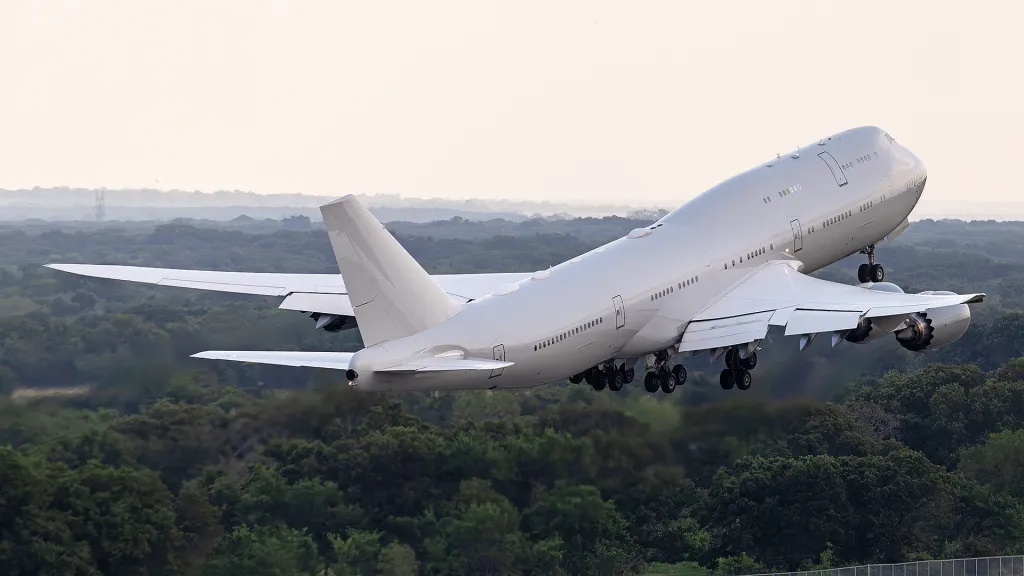
A VC-25B Bridge aircraft takes off for flight testing at Greenville, Texas. The aircraft recently completed modification and flight-testing phases, entering maintenance to be painted in red, white, gold and blue livery. The program remains on schedule to deliver the Bridge aircraft to the Presidential Airlift Group no later than summer 2026. (Courtesy photo)

The jet recently underwent flight testing in Texas, which you can see in the following photos that aviation photographer TT-33 operator was kind enough to share with us at the time.

The Qatari-donated 747-8i jet envisioned as a presidential airlifter, had a recent test flight.
The Qatari-donated 747-8i jet envisioned as a presidential airlifter, had a recent test flight. (TT-33 operator photo)
(TT-33 operator)

The USAF now says that with the Boeing VC-25B deliveries delayed far past its initial 2024 target and VC-25A heavy maintenance cycles being extended, an interim capability became “an absolute imperative.” How accurate this claim actually is isn’t clear. Trump has been talking about an interim Air Force One aircraft for some time since deliveries of the new VC-25Bs were pushed back beyond his second term. We heard of no actual requirements originating for this capability from within the USAF prior to the new administration or far in advance of Trump’s deal with the Qataris to source the jet. Very early in the new administration, Elon Musk was even working to find out how to get Trump a new Air Force One as fast as possible, for instance.

The Air Force claimed that in February 2025, a dedicated task force launched a “full-court press” on the VC-25B Bridge program while simultaneously working to accelerate Boeing’s long-term VC-25B production.

The U.S. Air Force has confirmed it is buying two Boeing 747-8 airliners from German flag carrier Lufthansa.
A rendering of a future US Air Force VC-25B Air Force One jet in the red, white and blue livery desired by President Donald Trump. (Boeing) Boeing

Though questions were swirling about the legality and ethics of receiving the gifted plane, the Pentagon last May took delivery of the aircraft and said it would rapidly undertake the required modifications.

It’s one thing to have a donated ultra-luxury jet, but turning it into one safe and connected enough to carry a president is another story.

As TWZ has previously noted, converting any aircraft into one that is secure enough to transport the president is a complex undertaking. The aircraft needs to provide constant, secure communications, including what is needed to order a nuclear strike under extreme conditions. Historically, it also needs to be physically hardened both inside and out to withstand myriad threats, from the electromagnetic pulse of a nuclear weapon going off to incoming surface-to-air missiles to enemy intelligence-gathering efforts. To do this requires significant modifications right down to the aircraft’s outer structure. It is very unlikely, if not impossible, that this aircraft was hardened against EMPs in the timeframe required for fielding it.

The VC-25As are speckled with missile approach warning sensors and many laser countermeasures turrets (DIRCM). They also include the legacy Matador infrared countermeasure system above their jet engines and APU. This is in addition to other defensive features which are less visible and remain closely guarded secrets.

Common Infrared Countermeasures (CIRCM) thumbnail

Common Infrared Countermeasures (CIRCM)


In previous coverage, we noted that at the very least, “this aircraft will have to feature some kind of DIRCM setup to repel shoulder-fired heat-seeking missiles, and modular units are available that can be attached in a canoe to the bottom of the aircraft. These systems, such as Elbit’s C-MUSIC or Northrop Grumman’s Guardian, are in service with foreign VVIP 747s, as well as commercial aircraft, including those flying for Israeli airline El Al. You can read all about these systems here. Still, while they offer far less defensive capacity compared to what is seen under the belly of a VC-25A, they would offer a significant layer of protection.” We still don’t see any evidence of the aircraft being modified with defensive countermeasures.

Northrop Grumman’s Guardian pod is a self-contained DIRCM (includes missile approach and warning sensors and laser pointer) solution for airliner-type aircraft. (Northrop Grumman)

L3Harris, known for its communications systems and aircraft alterations, was selected to undertake the “complex modification of the bridge aircraft,” the Air Force explained. The company already delivers “secure, reliable and resilient communications” for VC-25A and the executive airlift fleet “but has extensive experience with self-protection and customization of VIP aircraft,” the Air Force added. “The accelerated timeline was further made possible by a mission-focused partnership with Boeing, who provided the necessary engineering data to support the required structural modifications.”

In addition, “elite specialists from multiple government agencies developed advanced protocols to detect and – if necessary – neutralize potential technical hazards on previously owned aircraft,” according to the Air Force. “Their rigorous approach on the Bridge aircraft has literally ‘written the book’ and set the benchmark for integrating used airframes into the secure military inventory.”

In response to our question about what modifications the jet received, the Air Force told us the following:

“Safety and security were at the forefront of this program. We deliberately minimized interior aesthetic modifications to focus on modifications for safety, security and mission execution. We assessed which requirements were necessary for an interim capability. We had greater flexibility in developing our mission requirements.

After safety and security, we focused on the mission communications systems.

We have made deliberate decisions such as the reduction of the number of airstairs, less chiller space, and exclusion of the Golden Eagle mission [to fly the remains of former presidents] to minimize structural modifications, while prioritizing modifications focused on safety, security and secure communications.”

We also asked whether this jet will be able to fly overseas and into higher-risk areas, but have not gotten a response. At this point, based on the limited info we have at this time, that seems unlikely. But if this is the case, the question then can be raised why the USAF is spending billions on two full-up Air Force One aircraft if standards have been so relaxed that this simpler aircraft can do all their missions? We will update this story with any pertinent details the USAF provides.

In this February 15, 2025 a Qatari Boeing 747 sits on the tarmac of Palm Beach International airport after US President Donald Trump toured the aircraft on February 15, 2025. Donald Trump plans to accept a luxury Boeing jet from the Qatari royal family for use as Air Force One and then continue flying in it after his tenure, despite strict rules on US presidential gifts, media reported May 11, 2025. Calling the plane a "flying palace," ABC News, which first reported the story, said the Boeing 747-8 jumbo jet would possibly be the most expensive gift ever received by the American government. (Photo by ROBERTO SCHMIDT / AFP) (Photo by ROBERTO SCHMIDT/AFP via Getty Images)
A Qatari Boeing 747 sits on the tarmac of Palm Beach International airport after US President Donald Trump toured the aircraft on February 15, 2025. (Photo by ROBERTO SCHMIDT / AFP) ROBERTO SCHMIDT

To help speed up the delivery process of this interim Air Force One jet, the Air Force said it “constructed an at-scale mockup of the interior, complete with virtual reality views, to enable early commissioning activities for White House staff.”

“Our commitment to providing the president with a secure, resilient and reliable airborne command post is unwavering,” said Chief of Staff of the Air Force Gen. Ken Wilsbach. “The VC-25B Bridge program is a testament to the Air Force’s ability to innovate and rapidly evolve to ensure the continuity of our government under any conditions.”

The Air Force said the estimated delivery of Boeing’s VC-25Bs is now expected in 2028. If that holds up, then this ‘bridge’ aircraft will have served at most around two years until the first full-up VC-25B is delivered.

We will continue to follow developments in this program and provide updates when warranted.

Contact the author: howard@thewarzone.com

Howard is a Senior Staff Writer for The War Zone, and a former Senior Managing Editor for Military Times. Prior to this, he covered military affairs for the Tampa Bay Times as a Senior Writer. Howard’s work has appeared in various publications including Yahoo News, RealClearDefense, and Air Force Times.


Source link