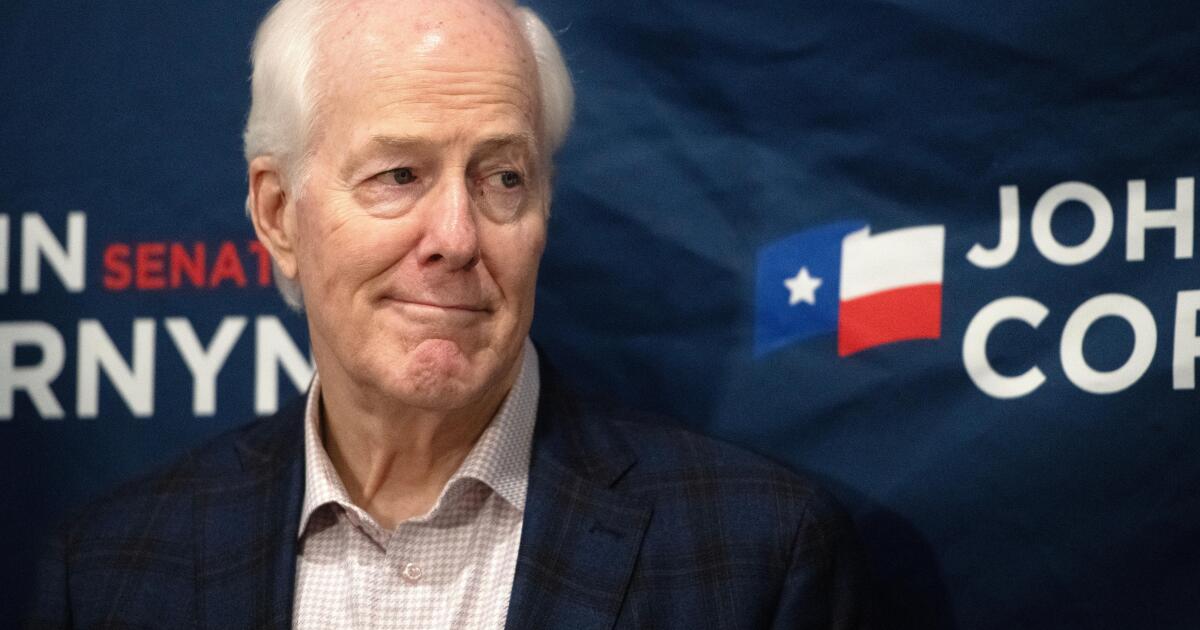
PLANO, Texas — Texans are choosing a Republican nominee for U.S. Senate in Tuesday’s runoff election, bringing to a close the extended, bitter and expensive primary where President Trump weighed in late to tip the race in another effort to rid the GOP of leaders less devoted to him.
Trump’s endorsement of state Atty. Gen. Ken Paxton over four-term Sen. John Cornyn gives the challenger a late boost and puts Cornyn at risk of becoming the first Republican senator in Texas history to seek the party’s nod and lose.
That’s despite Cornyn’s campaign and allied groups spending roughly $90 million in advertising since last year, the vast majority of it attacking Paxton.
It’s the latest GOP contest where Trump has sought to punish a Republican he sees as insufficiently loyal. This month, he has successfully backed challengers to incumbents in Louisiana, Kentucky and Indiana, a sign of his enduring influence among primary voters.
Paxton’s campaign and a pro-Paxton super PAC began airing ads promoting the endorsement within 24 hours of Trump’s announcement. Cornyn acknowledged Trump’s move would have an impact but said he wasn’t giving up.
“I know who gets to choose our senators, and it’s the people of Texas,” he said hours after the endorsement.
The winner will run in November against Democratic state Rep. James Talarico.
Tuesday’s runoffs also will decide Democratic U.S. House nominees for districts in Dallas and Houston that overwhelmingly support Democrats, and a San Antonio-area seat the party hopes to flip.
The primary has been long, bitter and costly
Cornyn led Paxton in the March primary but failed to win a majority in the three-way contest that also included U.S. Rep. Wesley Hunt, who finished in a distant third.
That was after Cornyn’s campaign and allied groups waged a monthslong ad campaign, mostly attacking Paxton for ethical and personal questions. The two-term attorney general was acquitted in a 2023 impeachment trial when allegations of extramarital affairs surfaced. Last year, Paxton’s wife filed for divorce, citing “biblical grounds.”
The alliance of pro-Cornyn groups have continued its attack, outspending Paxton’s campaign and two allied super PACs $16.5 million to $5.9 million since March 3, according to the ad-tracking firm AdImpact.
Trump promised to endorse immediately after the primary, asking the unchosen candidate to withdraw. But he didn’t act until after early voting began on May 18.
“Ken Paxton has gone through a lot, in many cases, very unfairly, but he is a Fighter, and knows how to win,” Trump wrote in a social media post endorsing him. “Our Country needs Fighters, and also Loyalty to the Cause of Greatness.”
Pro-Cornyn groups lately have been airing ads criticizing the attorney general office’s handling of a Waco sex abuse case. Pro-Paxton groups had seized on Cornyn’s awkward relationship with Trump.
Trump snubs Cornyn amid retribution campaign
The negative tenor could diminish turnout in an election already complicated by coming a day after Memorial Day, Texas Republican strategist Tyler Norris said. About 2 million of Texas’ 18.7 million voters participated in the GOP primary.
The dynamic could favor Paxton, whose support draws from more of the most loyal Trump base in Texas, said Norris, who isn’t affiliated with either campaign.
“The defining battle lines are based around hyper-negative messaging, which dampens turnout to begin with,” he said. “So who is going to show up is the hardest of the hard core.”
Trump in his endorsement also poked at Cornyn, as he has done with other Republicans who are not in lockstep with the president.
He blasted Republican Louisiana Sen. Bill Cassidy as “a Disloyal Disaster” on May 16, before Cassidy lost a GOP primary for the office he has held since 2015. The two-term senator had voted to convict Trump after his 2021 impeachment trial over the Jan. 6, 2021, attack on the U.S. Capitol. Trump backed U.S. Rep. Julia Letlow, who advanced to a runoff with John Fleming, the state treasurer. Cassidy finished well behind them.
Last week, Trump celebrated as Kentucky Rep. Thomas Massie, a critic of the Trump administration’s handling of the Jeffrey Epstein files, lost his primary to Ed Gallrein. Trump called Massie “the worst congressman in the history of our country.”
In endorsing Paxton, Trump said Cornyn “was not supportive of me when times were tough” and that “John was very late in backing me.”
Cornyn suggested in 2023 that Trump could not win the presidency again in 2024 and that his “time has passed him by.” He also was an early critic of Trump’s plan for a border wall between the U.S. and Mexico — a project he now supports.
Senate GOP leaders backed Cornyn, saying he would be stronger in the general election. Some GOP strategists have argued a Paxton nomination would cost millions of dollars more to promote in the fall, when money could be spent defending Republican seats in more competitive states. Democrats need to gain a net of four seats to take the majority.
Democrats also will choose U.S. House nominees
Newly elected Rep. Christian Menefee and veteran Rep. Al Green are vying for the party nod in Texas’ 18th District, which the Republican-led Texas Legislature redrew last year to help the GOP. The new map led to a contest between incumbents and marks the end of a dizzying series of elections in the Houston area. Menefee was elected in a special runoff in January to the seat that had been held by the late Rep. Sylvester Turner, who died in March 2025.
Menefee finished narrowly ahead of Green in the March 3 primary but didn’t win a majority to avoid the runoff.
Former Rep. Colin Allred and U.S. Rep. Julie Johnson are competing in the Dallas-area 33rd District. Johnson was elected to the seat in 2024, the year Allred lost his U.S. Senate challenge to Republican Sen. Ted Cruz. Allred was running for Senate again this cycle but dropped his bid and instead is looking to return to the House.
Near San Antonio, Democratic leaders are trying to prevent Maureen Galindo, who has expressed antisemitic views, from winning the party’s runoff with Johnny Garcia. While Texas lawmakers redrew the 35th District to help Republicans, Democrats view it as within reach and don’t want Galindo’s past comments to impede them.
Beaumont and Bedayn write for the Associated Press. Bedayn reported from Austin.