valuation

SK hynix: From near-collapse to a $1 trillion valuation and a Nasdaq listing

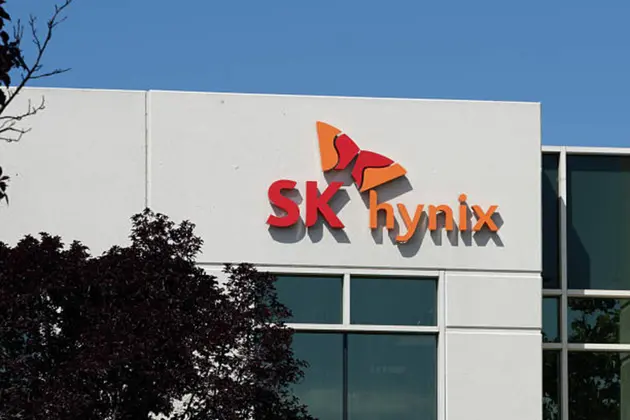
South Korean chipmaker SK hynix, known for its high-bandwidth memory chips, is preparing to raise roughly $28 billion (€24.5bn) on Wall Street, a sum surpassed only by SpaceX’s record flotation last month.


ADVERTISEMENT


ADVERTISEMENT

It is an extraordinary outcome for a firm that once survived on job cuts and asset sales.

Pricing is due on Thursday, with trading expected to begin on Friday under the ticker SKHY.

SK hynix is issuing 17.79 million new shares in the form of American depositary receipts (ADRs), each representing a tenth of a Seoul-listed share, and cornerstone investors including Baillie Gifford and funds run by Coatue Management have signalled interest in up to $7 billion (€6.1bn) worth of stock.

The target was trimmed from an initial $29.6 billion (€25.9bn) after the shares slipped in recent weeks.

ADRs are certificates traded on a US exchange that stand in for shares held abroad, letting American investors buy into a foreign company without dealing in a foreign currency or market.

Unlike a conventional flotation, this is not SK hynix’s stock market debut. Its primary listing remains on Seoul’s Kospi index, and the Nasdaq offering simply opens a second, dollar-denominated avenue for investors to gain exposure.

The listing arrives with the company already worth more than $1 trillion (€876bn), a threshold also crossed by rivals Samsung Electronics and Micron, after a surge of more than 200% this year.

Proceeds will fund new fabrication plants, chiefly a vast cluster in Yongin, plus its first US packaging facility in Indiana.

The move is partly about valuation. Korean-listed chipmakers have long traded at a discount to American peers, and a Nasdaq listing offers a chance to close that gap.

The AI memory boom — and the risks

The AI build-out has transformed the industry’s economics.

As hyperscalers pour hundreds of billions into data centres, memory prices have exploded, with DRAM up 44% and NAND flash up 53% in a single quarter, according to Citi Research, and manufacturers have already sold most of their 2026 production.

SK hynix reported first-quarter revenue above 50 trillion won (€29bn) and operating margins north of 70%, figures unheard of for a chipmaker, and commands about 60% of the high-bandwidth memory (HBM) market, according to Counterpoint Research.

Yet the timing is delicate.

Memory has always been a brutally cyclical business. The AI-driven rally that transformed SK hynix has begun to wobble as chip stocks sold off sharply across Asia last week, and Samsung lost more than $100 billion (€87.5bn) in market value despite posting a record profit.

Investors are increasingly asking whether the vast sums being spent on AI infrastructure will earn a return, a question that the Bank for International Settlements raised in late June when it warned that the boom could seed the next financial crash.

Built, broken and rebuilt

Those concerns are not new for SK hynix.

SK hynix traces its roots to Gukdo Construction, founded in 1949, which moved into electronics in 1983 as Hyundai Electronics, an arm of the Hyundai empire.

The Asian financial crisis of the late 1990s brought disaster. Under an IMF-backed restructuring of the Korean economy, Hyundai absorbed rival LG’s semiconductor business, creating a giant that promptly buckled under its own debts.

Salvation came in stages.

Renamed Hynix Semiconductor in 2001, a contraction of “high” and “electronics”, the firm cut jobs, shed assets and split from Hyundai. Profits returned, but the violent swings of the DRAM market left it perpetually exposed.

Starved of capital, it was rescued in 2012 by the telecoms conglomerate SK Group, becoming SK hynix. The takeover proved decisive. SK Group poured money into high-bandwidth memory, then a costly and unprofitable technology that few believed in.

Today it has become the scarcest commodity in AI computing. And the firm employs nearly 46,900 people.

Additional sources • AFP

Source link

Elon Musk’s SpaceX eyes $1.77tn valuation ahead of historic IPO | Technology News

Elon Musk’s rocket company SpaceX is targeting a valuation of nearly $1.77 trillion in its blockbuster initial public offering (IPO), paving the way for the largest stock market debut in history.

In a filing with the US Securities and Exchange Commission on Wednesday, SpaceX said that it plans to sell 555.6 million shares at $135 apiece, raising approximately $75bn.

Recommended Stories

list of 4 itemsend of list

The eye-popping valuation would make SpaceX the world’s seventh-largest company by market capitalisation, ahead of Musk’s electric vehicle maker Tesla and social media giant Meta, and just behind Taiwanese chipmaker TSMC.

It would also eclipse energy giant Saudi Aramco’s 2019 debut, which raised $26bn at a valuation of $1.7 trillion.

Musk, who holds a roughly 42 percent stake in SpaceX, is poised to become the world’s first trillionaire upon the company’s debut on the New York-based Nasdaq stock exchange on June 12.

Despite the public listing, Musk will retain effective control of SpaceX with more than 82 percent of voting rights, the result of a dual-class stock structure that grants certain shares 10 votes instead of one.

The Texas-based firm’s decision to set a specific share price ahead of its IPO marks a break from usual practice.

Companies preparing for a public listing usually announce a preliminary price range that can be adjusted based on investor interest.

“The genuine surprise is that SpaceX fixed a price before the investor roadshow began,” Fabien Yip, a market analyst at online trading and investment company IG Group, told Al Jazeera.

“To me, this reflects Musk’s control over the deal terms and his confidence that the book will fill.”

Musk
Elon Musk departs after a welcome ceremony with USPresident Donald Trump and China’s President Xi Jinping at the Great Hall of the People, in Beijing, China, on May 14, 2026 [File: Mark Schiefelbein/AP]

Founded by Musk in 2002, SpaceX is best known for designing and launching rockets, spacecraft and reusable launch vehicles on behalf of NASA and private companies.

The company also provides internet services and artificial intelligence models through its Starlink and xAI divisions.

Musk has outlined lofty ambitions for SpaceX, including to establish a “self-sustaining” city on Mars, “make life multiplanetary,” and “extend the light of consciousness to the stars”.

SpaceX’s listing will be a test of investors’ confidence in Musk’s vision, which has yet to translate into profits at the company.

SpaceX reported a net loss of $4.9bn on revenue of 18.7bn in 2025, followed by a $4.3bn loss in the first quarter of this year.

Jay R Ritter, an emeritus professor at the University of Florida who specialises in IPOs, said the SpaceX IPO differs from Saudi Aramco’s blockbuster listing as the state-owned oil company had a track record of generating large revenues and profits.

“SpaceX, in contrast, has trailing annual revenue of less than $20bn, and is not profitable,” Ritter told Al Jazeera.

“So, one company’s valuation was – and is – based on its demonstrated profitability, while the other company’s valuation is based on potential.”

“With SpaceX, there is a risk that cash flows will be used to send hundreds of thousands of people to Mars, at a loss,” Ritter added.

Despite SpaceX’s lack of profitability, market sentiment is strong, said IG’s Yip, noting that buyers of investment products linked to the listing are pricing the company’s end-of-first-day market capitalisation at $2.2 trillion.

“The Tesla parallel is perhaps worth drawing: It debuted in 2010 as a loss-making company and largely tracked the S&P 500 for years, only breaking away decisively once it turned profitable for the first time in Q1 2013,” Yip said, referring to the benchmark stock index on Wall Street.

“SpaceX investors are making a similar bet on future growth, with the added complexity that SpaceX’s addressable market – rockets, satellite internet, AI – is considerably broader than Tesla’s was at listing.”

Source link

Antiques Roadshow guest stunned by valuation on item that’s been in envelope for years

A guest on BBC’s Antiques Roadshow was left stunned after the price of her item she kept in an envelope since 1967

An Antiques Roadshow guest was left stunned by a “crazy” valuation.

The BBC programme visited an antiques fair at Belfast’s Botanic Gardens, with Fiona Bruce presenting as usual while guests brought along cherished possessions to discover their worth.

The opening valuation featured a guest clutching a genuine piece of rock and roll history. Expert Raj Bisram was clearly impressed when presented with three autographs from The Jimi Hendrix Experience members, reports the Liverpool Echo.

Scrawled on the reverse of three ordinary-looking tickets were the signatures of the legendary guitarist alongside bandmates Noel Redding and Mitch Mitchell. The guest revealed how she managed to obtain press passes for the Northern Ireland gig back in 1967.

She explained: “I had a friend whose name was Jerry Fox. She was a great Hendrix fan because he had a song called Foxy Lady. She had a friend, who managed to get us backstage press passes for the concert.

“It was part of Queens University Festival Belfast. We were up at the very front. It was very loud. But it was a great concert and he did all his usual of playing his guitar with his teeth. I can’t remember, but I think he smashed his guitar at the end.”

The guest recalled the gig coincided with the All Along The Watchtower musician’s 25th birthday. She added: “The organisers at the festival had arranged to have a birthday cake for him and they presented it to him backstage.

“Because we had press passes, we were allowed to go backstage and he was there. The cake was on a table. “I don’t think he was eating the cake. From what I remember, he was drinking a bottle of whisky.””

Seizing her chance in the presence of music royalty, the guest recalled: “We only had these tickets so we got the three band members to sign the back of the tickets.”

The concert took place in 1967, and the guest revealed the signed tickets had been tucked away in an envelope ever since. Expert Raj explained that the memorabilia had soared in value following Jimi Hendrix’s death at just 27 in January 1969.

Items linked to Jimi command a hefty price tag, thanks to the legendary musician’s enduring and devoted fanbase.

The expert explained: “People do that but then they forget where they put the envelope. To remember it and to keep it is absolutely lovely, because, unfortunately, he died very young, which makes some of this memorabilia that he’s left behind, even more valuable.

“As far as valuation is concerned, obviously Jimi Hendrix is the one that’s the most valuable. But putting all three together, if these went to auction, they would make somewhere between £5,000 – £7,000.”

Stunned by the staggering figure, the guest exclaimed: “What? You’re joking. That’s crazy.”

You can catch up on Antiques Roadshow on BBC iPlayer

Source link