With gas prices topping $6 a gallon and an unpopular war continuing in Iran, President Trump’s approval has slipped with California Republicans — a falloff that could diminish the party’s chances in the state’s few competitive congressional races.
A new poll by the UC Berkeley Institute of Governmental Studies, co-sponsored by The Times, found that 76% of Republican voters in the state approve of the president’s performance, down from 83% last year.
The president’s approval has softened even among those who still support his performance. Only 44% of Republicans in California said they strongly support Trump’s performance, down from 57% who said the same in August 2025.
That could translate into lower Republican turnout in the state’s few competitive races, said the poll’s director, Mark DiCamillo.
“Republicans are losing some of their enthusiasm in terms of being motivated to vote,” he said.
In addition, the more Trump tries to make the midterm elections about himself — such as the pro-Trump ads recently sponsored and paid for by the government — the more Democrats might be inclined to show up, said G. Cristina Mora, the UC Berkeley institute’s co-director.
“That might actually have a galvanizing effect on voters,” she said.
The congressional map in the state was already challenging for Republicans after voters last year approved a referendum championed by Gov. Gavin Newsom to redraw districts to be more favorable for Democrats — a response to similar efforts by Republicans in Texas and other states.
In the new map, only four of the state’s 52 districts are currently considered safe Republican districts, while three additional districts are seen as competitive, according to the Cook Political Report, a nonpartisan political handicapper.
The remaining 45 districts are seen as either likely or solidly Democratic in a state where Democrats hold a roughly 20% advantage in party registration.
Only one race is considered by Cook to be a true toss-up — California’s 22nd Congressional District in the Central Valley, which is held by Republican Rep. David Valadao.
“We’re looking at the best case scenario for Democrats at this point,” said Erin Covey, Cook’s U.S. House editor.
Valadao, one of only 10 Republicans to vote for Trump’s impeachment in the wake of the Jan. 6, 2021, insurrection, faces progressive Democrat Randy Villegas, a political science professor who has the backing of Bernie Sanders. The Vermont senator is joining Villegas this weekend for a rally in Bakersfield.
Valadao first won a seat in Congress in 2012, but was ousted from office during the Democrats’ “blue wave” election in 2018, in which the party gained 40 seats in the House in the first election after Trump took office in 2016. Valadao was able to win back his seat in 2020 and has held it since.
There has been scant public polling in the race, but a poll conducted in June by a political committee backing Villegas showed the Democrat holding a 4-point lead over Valadao.
Two other congressional districts in the state are listed by Cook as leaning Democratic:
California’s 48th Congressional District in Riverside and San Diego counties, now held by Republican Rep. Darrell Issa, who opted to retire rather than seek reelection in the redrawn district.
California’s 13th Congressional District in the San Joaquin Valley, where Democratic Rep. Adam Gray is trying to fend off a challenge from Republican Kevin Lincoln, the former mayor of Stockton.
Trump’s approval also dipped among Black and Latino voters in the poll. Both groups were part of Trump’s winning coalition in the 2024 presidential election.
The poll also found broad disapproval of two signature Trump administration policies.
It found that 70% of California voters disapprove of Trump’s decision to go to war in Iran, including 1 in 5 Republicans.
Also, 70% of California voters believe that the president’s immigration policies are hurting California’s economy and local businesses, including 1 in 5 Republicans.
The poll was conducted online in English and Spanish between Sept. 15 and Sept. 20 and included the opinions of 6,989 registered California voters. The margin of error is plus or minus 1.5 percentage points.
WASHINGTON — Since the 2024 election, Democratic congressional candidates have reached a consensus about how to broadly discuss the border — make it secure — but they still lack a cohesive message about ICE.
Some advocate abolishing the agency, while others offer visions for how to rein it in and reform it.
Meanwhile, for Republicans, President Trump’s immigration policies have offered a win on one issue (the border) while creating another issue that many voters find troubling (violence during raids).
Some battleground Republicans are distancing themselves from Trump and have shifted from talking about mass deportations to emphasizing deporting criminals.
Most voters don’t care more about immigration than the cost of living. But it remains an important issue, and for both Republicans and Democrats, the balance in messaging about immigration is delicate, as about half of Americans see the administration’s tactics against immigrants as too aggressive.
As the Nov. 3 midterms approach, Democratic candidates in various states including Illinois, Minnesota and New Jersey have said Immigration and Customs Enforcement should be abolished. In Michigan, progressive Senate candidate Abdul El-Sayed has said as much — and taken aim at fellow party members.
“The idea that somehow we can’t say ‘abolish ICE’ because we’re so afraid of what they’re going to say, when we’ve seen ICE terrorize people in our streets,” he said before Michigan’s Senate primary in July. “To me, it is exactly the kind of cowardice that we don’t need from Democrats.”
The Democratic dilemma was crystallized last month when Democratic National Committee members approved dueling messages — one to abolish ICE, the other to reform it.
Among those in the reform camp is Randy Villegas, the political science professor running against Rep. David Valadao (R-Hanford) in California’s Central Valley.
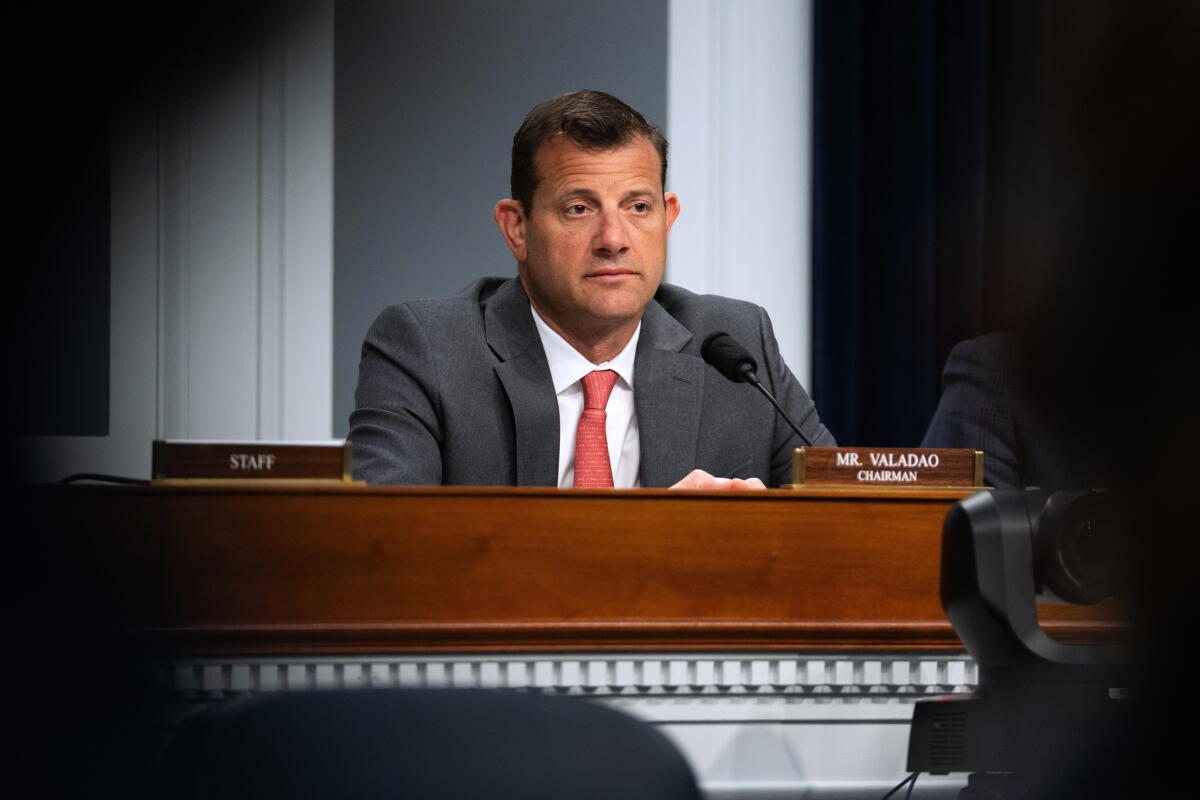
Rep. David Valadao (R-Hanford), presiding over a congressional subcommittee meeting in Washington on March 6, is seeking reelection in California’s 22nd District.
(Allison Robbert / Ap Photo/allison Robbert)
Villegas is in favor of a pathway to citizenship for longtime immigrants as well as a secure border. He’s called for ending the use of for-profit detention facilities and prosecuting ICE agents who engage in illegal conduct.
It’s a personal issue too. Villegas is the son of immigrants from Mexico, and, according to a 2021 NPR story, his brother is a DACA recipient, granted protection under the Deferred Action for Childhood Arrivals program. He said the constituents of the mostly rural 22nd District deserve a representative who understands the effects of the broken immigration system; he recalls his mother being unable to visit her sister when she was dying of cancer.
“Kern County was ground zero for these ICE raids last year. What did Valadao do or say about it? Absolutely nothing. This is somebody who likes to pretend they’re a moderate on immigration. He voted to triple ICE’s budget,” Villegas said in an interview, noting that he organized a local workshop with immigration attorneys.
After the raids, led by Customs and Border Protection agents who were reported to have gone “rogue” weeks before President Biden left office, Valadao released a statement saying he had spoken to agency officials and urged them to target “criminals rather than those responsible for producing our nation’s food supply.”
Valadao, a dairy farmer and the son of immigrants from the Azores islands of Portugal, says on his campaign website that he supports a “reasonable and responsible” pathway to citizenship, a guest worker program that could stabilize the agricultural workforce and a focus on removing immigrants who have committed serious crimes.
Last year, he sponsored the Dignity Act, a bipartisan bill that would create a new temporary legal status for immigrants who meet certain requirements and pass a criminal background check.
Valadao declined an interview request but said in a statement that “our immigration system is broken after decades of inaction, and it’s critical that we restore law and order while recognizing the contributions of people who have lived and worked peacefully in our communities for years.”
In Texas, Democratic Senate candidate James Talarico frequently has said that the southern border should be treated “like our front porch,” with a welcome mat and a lock on the door.
Talarico says immigration enforcement is necessary but that resources should be refocused to target cartels, gang members and human traffickers. As for ICE, he said the government should “tear down this secret police force and replace it with an agency that is actually going to focus on public safety.”
Texas Atty. Gen. Ken Paxton, a Republican candidate for the U.S. Senate, has embraced President Trump’s crackdown on immigration.
(Tony Gutierrez / Ap Photo/tony Gutierrez)
Centrist Democratic strategists said Talarico’s messaging strikes the right tone for swing voters.
During the Biden administration, voters lost trust with Democrats on immigration and border security, said Sarah Pierce, a former U.S. Citizenship and Immigration Services official who leads immigration work at the center-left think tank Third Way. That needs to stay top of mind for Democratic candidates, she said.
“Americans don’t trust that Democrats are even willing to enforce immigration laws, so obviously there’s a lot of pressure on the party to rectify that,” Pierce said. “At the same time, this is the most anti-immigrant administration we’ve had in history.”
Talarico’s opponent, Texas Atty. Gen. Ken Paxton, touts Trump’s hard-line immigration policies and has made border security a key part of his campaign.
Paxton also believes states should work with the federal government on immigration enforcement. This year, his office conducted raids in Houston and transferred 50 immigrants to ICE custody.
James Talarico, the Democratic Senate candidate in Texas, has called for reforming Immigration and Customs Enforcement but unlike some Democratic candidates, he has not called for abolishing the agency.
(Danielle Villasana / Getty Images)
Matt Terrill, a Republican strategist who was chief of staff for then-Sen. Marco Rubio’s 2016 presidential campaign, said Republican candidates need Trump to turn out the GOP base so they retain control of Congress.
Some Republican candidates are conveying a more nuanced message, but it might not matter to voters who already feel betrayed by Trump. That’s the assessment of Matthew Dallek, a political historian at George Washington University who studies Republican and Homeland Security politics.
“A lot of Republican candidates are struggling to figure out a message on what had been a great political strength that has turned into a major liability,” Dallek said. “Different Republicans are giving different answers to try to appeal to the Latino vote, maybe to independents, to voters who might typically vote Republican and support closed borders, but think that ICE has gone too far.”
Many Republican candidates aren’t avoiding immigration. A Third Way analysis of last month’s spending on immigration-related ads in competitive House and Senate races found that Republicans had spent more than $50 million — five times more than Democrats.
At issue, however, is the messaging. Earlier this year, White House officials and House Republican leaders reportedly told their members to avoid talking about “mass deportations” and talk up removing criminals.
Rep. Gabe Evans, who is running for reelection in Colorado, described the distinction as “gangbangers, not grandmas.”
At the Republican National Convention in 2024, Rep. Monica De La Cruz (R-Texas) denounced “open borders” before a crowd waving signs reading “mass deportation now!”
As the Trump administration’s enforcement campaign took shape, however, she signed a letter to House Speaker Mike Johnson calling on ICE to focus its resources on arresting immigrants with criminal records, and in March she intervened after local high school mariachi performers were detained.
This month, De La Cruz released a campaign ad, featuring the wife of a DACA recipient who was detained this year by ICE. The wife said that she had voted for Democrats before, “but Monica puts people over politics.”
A representative for De La Cruz did not respond to requests for comment.
Her opponent, Tejano musician Bobby Pulido, said he doesn’t like talking in absolute terms like abolishing ICE. But without the historic funding approved by Republicans this year, the agency would have been prevented from continuing what he sees as bad policy on humanitarian and economic levels.
But Pulido also says that the Biden administration waited too long to impose border restrictions.
“It feels like it went from ‘let ‘em all in’ to ‘kick ‘em all out,’” he said in an interview. “I don’t think that either one is good. We need immigrants, but everybody always says do it the legal way. We have to actually legislate pathways for that to happen.”
One Republican has directly broken with Trump in her bid for reelection. In a campaign ad released Sept. 17, Florida Rep. Maria Elvira Salazar, standing in front of the White House, speaks directly to the president. “The same Hispanics who helped you get to the White House in 2024 feel betrayed today,” she said.
Polling shows that many in that district, where Latinos make up three-quarters of registered voters and more than half were born outside the U.S., now think Trump’s immigration crackdown has gone too far. Polls also show Salazar is deadlocked with her opponent, Eliott Rodriguez, a fellow Cuban American and newscaster who fired back at her for voting in favor of Trump’s policies.
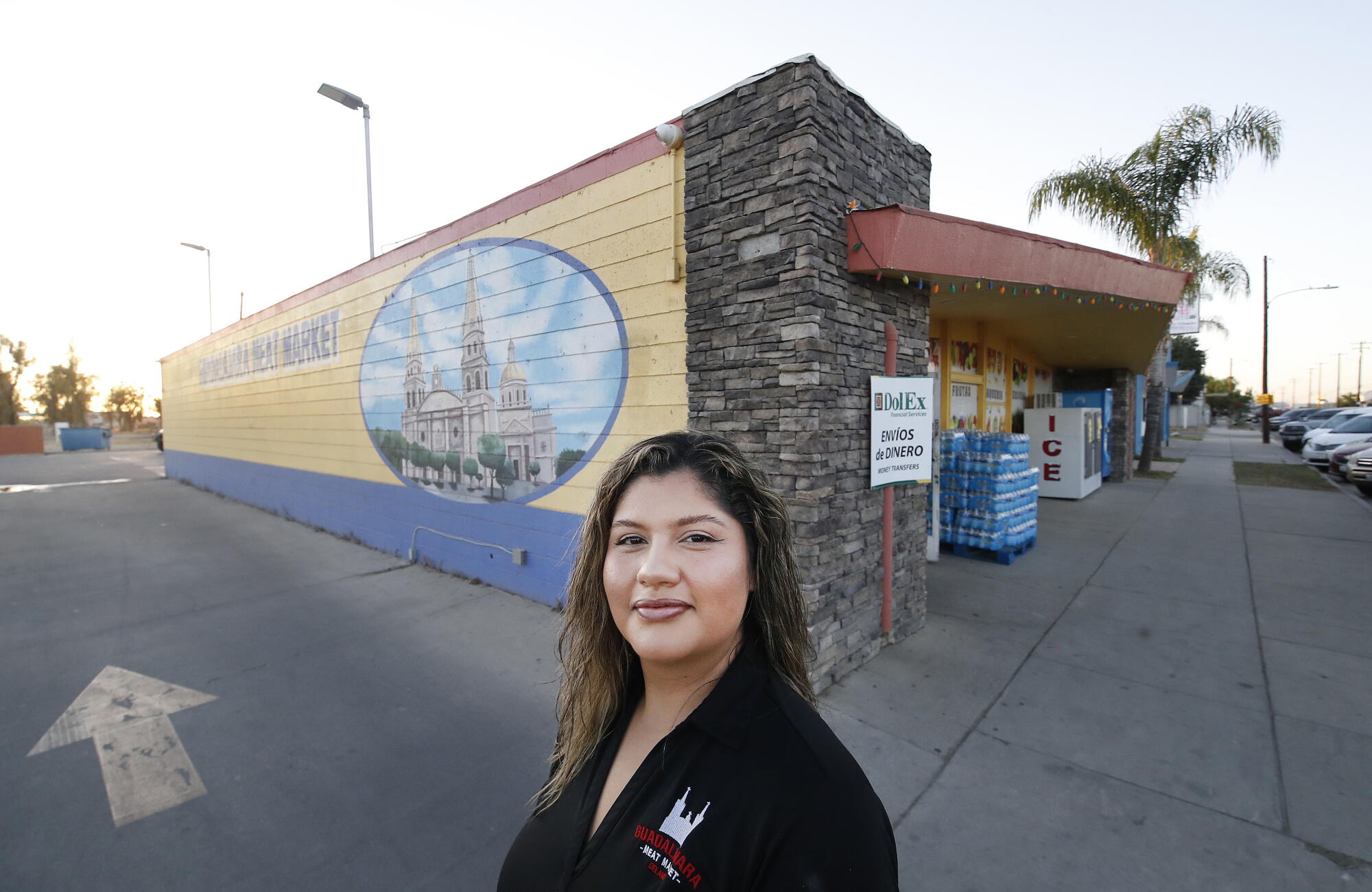
DELANO, Calif. — The rows of candies and nuts at the Guadalajara Meat Market — tamarindo con chile, seasoned pistachios, spicy paletas — sat mostly untouched as customers filtered through this carniceria in the late afternoon heat.
“You see a lot of people consuming the minimum, what they need to get by through the week,” said owner Carina Murillo, 31, as she checked out customers on a recent weekday. “Instead of buying six items, they’re buying three items.”
While customers bypass extras, like the snacks at the front counter, Murillo’s costs have gone up. Imported goods from Mexico and Canada have become more difficult to source and sometimes carry tariffs, she said. Transportation fees have risen as diesel prices respond to the war in Iran. The market’s insurance costs have risen by about a third. All of it has forced Murillo to increase prices.
“You see a lot of people consuming the minimum,” says Carina Murillo, owner of Guadalajara Meat Market. “Instead of buying six items, they’re buying three items.”
As the area struggles, Murillo, a college graduate who years ago felt motivated enough to door-knock for political causes, is among those who have become disillusioned. Those in Washington, she said, don’t understand the lives of the working people who keep the country running.
There have been “years where I feel completely overpowered to the point where I’m not motivated to take part,” said Murillo, who didn’t vote in 2024 but plans to do so in November. “That’s what happens when you feel discouraged or like nothing’s going to change.”
The economic strife plaguing Americans is clear in this rural, majority-Latino Central Valley congressional district, home to the state’smost competitive House race, the closely watched contest between Republican Rep. David Valadao and Democrat Randy Villegas.
Democrats hope the national economic angst will translate into big turnout in the midterm elections, but some in this region worry that years of financial struggle may depress voters’ desire to participate rather than motivate them.
Rep. David Valadao (R-Hanford) presides over a congressional hearing in March. The Republican is in a race against Democrat Randy Villegas that is considered a toss-up.
(Allison Robbert / Associated Press)
And Republicans, who rely on their party turnout beating that of Democrats in rural areas, also face the risk that frustration with the current political climate could dampen enthusiasm.
“Before they can think about Valadao, before Trump or Gavin Newsom or who’s going to run, families are concerned with the immediate: paying the rent, having the food on the table,” said Eliseo Gamiño, who heads the Central Valley Leadership Round Table, a coalition of Latino community leaders and elected officials. “You can’t be thinking about voting when your kids are hungry.”
Few voters who spoke to The Times in this swing district were decided on which party to support in November — or whether to vote at all. Such undecided voters will likely decide the election outcome, and persuading them is the key challenge for both parties as November nears.
Alexa Lopez sweeps up at closing time on a slower than usual Friday that saw one dress sold at Christina’s Fashion in Delano.
In a district that is the third-youngest in population in the country, the simmering uncertainty among Gen Z and millennial voters in particular could affect turnout or results.
Thirty-one percent of its voting-age population is 29 or younger, according to the Tufts University research center CIRCLE, which tracks youth civic engagement, making it among the top swath of House races in which young people could swing the outcome.
California’s swingiest district
The 22nd District, carved from the state’s agricultural epicenter, is one of fewer than two dozen toss-up races nationwide that will likely determine which party controls the U.S. House in the second half of President Trump’s current term. It is also among several high-stakes races nationwide that will test progressive candidates.
Valadao’s seat has long been considered a vulnerable one; Democrats added about 100,000 Fresno residents to the district under Proposition 50’s new map in a bid to help their chances. The boundaries include swaths of Kern, Kings and Tulare counties, along with a very small piece of Madera County.
“It’s going to be crucial in an area that is more purple, more bipartisan, where it’s very clear it can go either way … that these candidates make an effort to get those voters on their team,” said Brittany Martinez, a California-based Republican strategist.
Valadao, 49, who comes from a dairy farming family, is well known in the district and has repeatedly secured victory in close races, retaking the seat in 2020 after losing it in 2018’s blue wave. He saw a close race in 2022, then won by nearly seven percentage points in 2024, outperforming Trump.
His biggest vulnerability this time around may be his vote for the One Big Beautiful Bill Act, which included steep cuts to Medicaid. Local hospitals are bracing for funding cuts, though a carve-out may keep many valley residents from losing coverage. The district has the highest proportion of Medi-Cal recipients of any in the state, with 67% of residents enrolled as of 2025, according to the California Health Care Foundation.
Valadao spent part of the August recess touring the Central Valley for private meetings with local entities including a hospital, a housing program, a sawmill and a school district, and held a telephone town hall last week. Democrats have criticized him for not holding face-to-face voter events, including public town halls.
Democratic candidate Randy Villegas chats with residents during an August town hall in Hanford.
Villegas, 31, a professor and school board member who was endorsed by Sen. Bernie Sanders (I-Vt.) and is aligned with the Working Families Party, bested a Democrat backed by the party’s House campaign arm to win the nomination.
Villegas has banked on a more public-facing approach to win over swing voters — recently handing out popsicles from a pushcart he wheeled around a Labor Day event in Bakersfield, for instance — a strategy his campaign calls “going everywhere.” Republicans have criticized his record as too far left for the moderate district.
Both candidates have attempted to lean away from partisan narratives. Valadao rarely mentions Trump on social media and did not attend the president’s Republican convention in Dallas last week; Villegas has worked to frame the progressive issues he champions as an effort to help Central Valley voters rather than an ideology.
Trump carried the district as drawn now by less than 2 percentage points in 2024. Since then, residents say they have felt squeezed by housing, gas and grocery prices. The war in Iranhas pinched Central Valley farmers — already struggling withwater supply and other issues — by driving up fertilizer prices.
Ailyn Flores, center, picks up balloons for a party at Big Delano Discount store.
Tyler Stidham, 28, and her husband recently moved back to Lemoore from San José with their 1-year-old in order to live with family because they could no longer afford their own place.
“Rent got too high and having a family is expensive,” she said as the couple waited for their order from a food truck at the Hanford farmers market on a recent Thursday evening. They have cut out family trips and started meal-planning and budgeting to save money.
Stidham said she is planning to vote and hoping government leaders can make life more affordable. Her husband recalled a favorable impression of Valadao after once meeting him. Stidham isn’t sure who she’ll be casting her vote for.
“I haven’t done my research [yet],” she said.
Young voters said they felt frustrated waiting for a better economy that has yet to materialize.
“I feel like the government is playing in our face. I feel like everything is a show,” said Emma Woodward, 23, of Hanford.
The Sierra movie theater has closed down in Delano, Calif.
(Gary Kazanjian / For The Times)
A store manager at a coffee chain, Woodward bought a house last year to avoid throwing money at increasingly high rent payments, but it has been “hard to survive.” She got a roommate to help with costs, but the two of them sometimes find themselves using food drives for groceries. She has cut out “fun spending,” including concerts and travel.
Woodward said she wanted to vote in order to send the message to Congress that the economy needs improvement. She, too, wanted to research the candidates further; she leaned toward Villegas but was not yet convinced.
‘Whatever happens happens’
Valadao and Villegas must also battle to reach apathetic voters — those who may sit the election out or who are fed up with both parties. In one indication of voter fatigue, local organizers have found it a challenge to register new voters this year.
Dresses on display at Christina’s Fashion store after closing time on a quiet Friday night in Delano, Calif.
People who are unregistered often express mistrust in the government and the feeling that “nothing’s going to change,” said Biviana Camacho, 23, civic engagement program manager for Loud for Tomorrow, a youth organizing group based in Delano that runs voter registration events.
“A lot of folks have been in survival mode for such a long time,” she added, as the group worked on planning a fall event series on a recent afternoon. Their goal: 20 to 25 new registrations per event.
The group’s head of membership, Rosanai Paniagua, 28, agreed. “Here, there’s not a lot of hope because people haven’t seen what good policy could do for them,” she said. “A lot of apathy, for sure, because change hasn’t really happened here.”
Marco Estrada, 20, taking a break outside the Main Street barbershop where he works in Delano, said he wasn’t sure he could imagine anything Congress could do for him. He’s never voted and doesn’t plan to in November. His two co-workers said the same.
“Whatever happens happens,” Estrada said.
Valeria Valdez, a College of the Sequoias freshman, said she was planning to vote in her first election and said the government should help lower gas prices. The 18-year-old wasn’t sure, though, whether she would make a decision in the House race.
“It feels pretty far away from me, to be honest,” she said. “I just want to do what I can for our community and not focus on how corrupt the government is.”
That sentiment is part of what Villegas is aiming to target as he meets voters.
“It’s easy to feel cynical and apathetic in a moment where so many things seem stacked against us,” Villegas said in an interview. “But I tell people that … their vote and their voices do matter, otherwise we wouldn’t have billionaires and corporations spending millions of dollars trying to influence these election outcomes.”
A spokesperson for Valadao did not respond to a request for comment. Valadao said on a Washington Sun podcast in January that he “absolutely” worries about Republican voter enthusiasm, but noted it was a problem on both sides of the aisle. Earlier this month, he conveyed confidence about his race.
“I’ve won in these types of races. I can win again,” he told the Associated Press. “I think we should be fine.”
Inside Murillo’s market, business picked up as 5 o’clock neared. Murillo rang up tortillas, cuts of meat, and three-liter Mexican soda bottles. She advised a customer about treating a bug bite, helped a man wire money and cajoled a city worker about getting a sidewalk repair.
Congress should “definitely” be helping communities like hers, she said. She plans to research her voting options so she can participate in November. But trusting political candidates, she mused, can feel like a risk for voters.
“Whether they execute what they promise or not,” she said, “that’s shown with time.”