USIsraeli

US-Israeli war on Iran will push 30 million back into poverty, UN warns | US-Israel war on Iran News

Disruption to fuel and fertiliser supplies due to the Strait of Hormuz closure will hit crop yields, UNDP chief warns.

The Iran war will push more than 30 million people back into poverty, with the knock-on effects of the conflict likely to increase food insecurity in the coming months, the United Nations has warned.

Disruption to fuel and fertiliser supplies due to the ongoing blocking of cargo vessels through the Strait of Hormuz has already lowered agricultural productivity and will hit crop yields later this year, the UN’s development chief said on Thursday.

Recommended Stories

list of 4 itemsend of list

“Even if the war would stop tomorrow, those effects, you already have them, and they will be pushing back more than 30 million people into poverty,” said Alexander De Croo, administrator of the United Nations Development Programme (UNDP).

He also warned of other fallouts of the United States-Israeli war on Iran, including energy shortages and falling remittances.

Much of the world’s fertiliser is produced in the Middle East, and one-third of global supplies passes through the Strait of Hormuz, where Iran and the US are jostling for control.

The UN’s Food and Agriculture Organization (FAO) last week warned that a prolonged crisis in the strait could lead to a global food “catastrophe”.

India, Bangladesh, Sri Lanka, Somalia, Sudan, Tanzania, Kenya, and Egypt are among the countries most at risk, according to the FAO.

“Food insecurity will be at its peak level in a few months – and there is not much that you can do about it,” De Croo said.

Straining humanitarian efforts

The knock-on effects of the Iran conflict have already wiped out 0.5 percent to 0.8 percent of global gross domestic product (GDP), according to De Croo, who noted, “Things that take decades to build up, it takes eight weeks of war to destroy them.”

De Croo, the former prime minister of Belgium, also warned that the Middle East crisis is straining humanitarian efforts in other parts of the world, with the sector already facing funding cuts.

The US-Israeli attacks on Iran, which began on February 28, have also choked up key humanitarian aid routes, delaying life-saving shipments to some of the world’s worst crises.

“We will have to say to certain people, really sorry, but we can’t help you,” De Croo said. “People who would be surviving on help will not have this, and will be pushed into even greater vulnerability.”
Source link

Iran war: What is happening on day 52 of the US-Israeli conflict? | Explainer News

Islamabad talks in limbo as Tehran says it will retaliate after US marines capture an Iranian-flagged ship near the Strait of Hormuz.

Donald Trump announced on Sunday that a second round of US-Iran talks is to be held in Pakistan on Monday – but Tehran has not confirmed participation, two days before a ceasefire deal expires.

The capture by US Marines of an Iranian-flagged container ship near the Strait of Hormuz on Sunday has further clouded the Islamabad talks, as Tehran has pledged to retaliate.

Recommended Stories

list of 4 itemsend of list

The attack came hours after President Trump announced he is sending a team to Islamabad for talks, while once again threatening to knock out Iran’s power plants and bridges if there is no deal. The ceasefire, which ended more than a month of war, expires on Wednesday.

Pakistan’s Prime Minister, Shehbaz Sharif, spoke on Sunday with Iranian President, Masoud Pezeshkian, as he reaffirmed his government’s readiness to mediate the conflict.

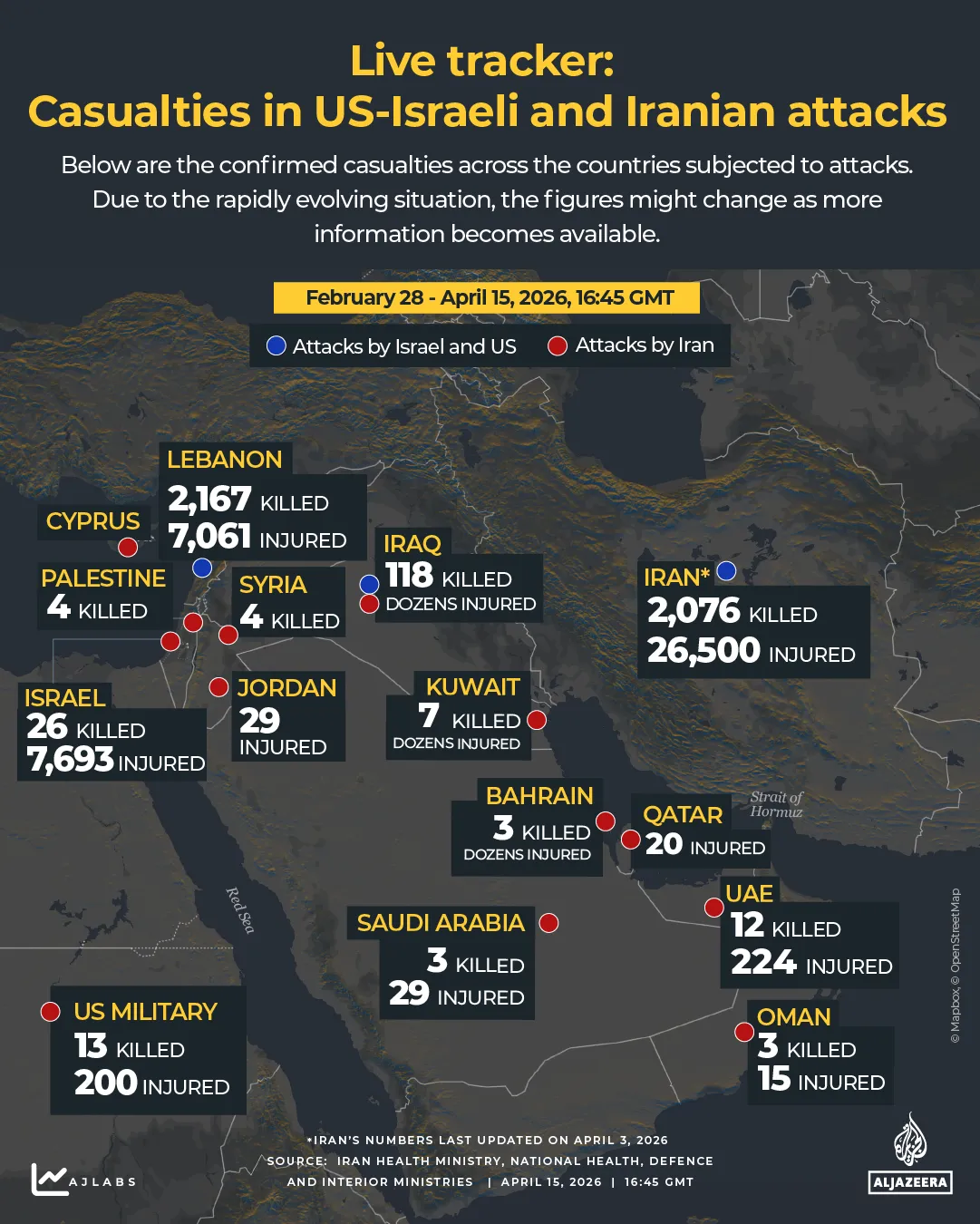
Here is what we know:INTERACTIVE-IRAN-DEATH-TOLL-TRACKER-APRIL-15-2026-1776273758

In Iran

  • ⁠Iran’s top ⁠joint ⁠military command, Khatam al-Anbiya, accused the US of ⁠violating the ceasefire by shooting at ⁠an Iranian ship in the Gulf of Oman and vowed ‌to retaliate.
  • President Trump ⁠posted on Truth ⁠Social on Sunday that US Marines ‌captured a vessel that tried to get past ⁠the American blockade on ⁠Iranian ports, adding that ⁠US forces ⁠stopped the ⁠ship by blowing a hole in ‌its engine room.
  • Iran ⁠executed ⁠two men convicted of cooperating with Israel’s Mossad ⁠intelligence service and planning attacks inside the ⁠country, the judiciary’s news outlet Mizan reported on Sunday.
  • French ⁠shipping ⁠company, CMA CGM, confirmed on Sunday that “warning shots” were fired at one ⁠of its ships in the Strait of Hormuz on Saturday. 
  • ⁠Iran’s ⁠armed forces turned back two tankers attempting ⁠to transit the Strait ⁠of Hormuz on Sunday after issuing warnings. The semi-official Tasnim ‌news agency said that was a result of the continuing US maritime ⁠blockade on Iran.
  • International flights from Mashhad airport in northeast Iran will resume on Monday, the civil aviation authority said.

War diplomacy

  • Iranian state media reported that Tehran had rejected new peace talks, citing the ongoing blockade, threatening rhetoric, and Washington’s shifting positions and “excessive demands.”
  • Iranian state media reported on Sunday that Tehran was not planning to take part in talks with the United States, hours after Trump said he was dispatching negotiators to Islamabad.
  • The US president posted on Truth Social ⁠on Sunday that representatives are going to Islamabad “tomorrow night” for Iran negotiations. “We’re offering a very fair and reasonable deal, and ⁠I hope they ⁠take it because, if they don’t, ⁠the United States ⁠is going to ⁠knock out every single power plant, ‌and every single bridge, in Iran,” ‌Trump ‌wrote.
  • Pakistan’s Prime Minister ⁠Sharif ⁠said on Sunday that he spoke with ⁠Iran’s President Masoud Pezeshkian about the conflict ⁠in the Gulf.
    Sharif posted on X that he shared insights with Pezeshkian regarding his recent ‌conversations with the leaders of Saudi Arabia, Qatar and Turkiye.
  • “I appreciated ⁠Iran’s engagement, including ⁠its high-level delegation to Islamabad for the historic talks, and ⁠recent discussions with Field Marshal Syed ⁠Asim Munir in ⁠Tehran,” Sharif said.
  • Turkiye’s Foreign Minister, Hakan Fidan, said on Sunday he was “optimistic” that a two-week ceasefire between Iran and the United States, which expires on Wednesday, would be extended, allowing more time for talks between the sides.
    Vice President JD Vance, second left, shakes hands with Pakistani Deputy Prime Minister and Foreign Minister Mohammad Ishaq Dar, as Pakistan's Interior Minister Mohsin Naqvi, left, Pakistan's Chief of Defence Forces Chief of Army Staff Field Marshall Asim Munir, third left, and Charge d'Affaires of the U.S. Embassy in Islamabad Natalie A. Baker, right, look on, as he prepares to board Air Force Two
    Vice President JD Vance led the US delegation for the first round of talks in Islamabad. They ended without a deal [Jacquelyn Martin/Pool/AP Photo]

In the US

  • Trump said on Sunday that the guided-missile destroyer, USS Spruance, fired on and seized the Iranian-flagged cargo ship, Touska, in the Gulf of Oman, and US Marines were “seeing what’s on board!”
  • The US president said Iran has committed a “serious ⁠violation” of the ceasefire ⁠but still thinks he can get a peace deal, ABC ‌News reporter Jonathan Karl posted on X on Sunday. Trump added that a peace deal “will happen. ⁠One way or another”.

In Israel

  • Argentine President Javier Milei, has reaffirmed his country’s support for the campaign against Iran, citing his government’s earlier decision to designate the Iranian Revolutionary Guards as a “terrorist organisation”.
  • Milei, who is visiting Israel for the third time since taking office, declared on Sunday that the joint US-Israel war against Iran was the “right thing to do”, as he signed on to the so-called Isaac Accords aimed at deepening bilateral ties between Israel and Latin American countries.

In Lebanon

  • ⁠The Israeli ⁠military on Monday warned residents in southern ⁠Lebanon not to move ⁠south of a specified line of villages or approach areas ‌near the Litani River, saying its forces remain deployed in the area during a ceasefire ⁠due to what ⁠it described as continued Hezbollah activity.
  • The Israeli army also said it had determined that an image circulating on social media showing a soldier in south Lebanon hitting a statue of Jesus Christ is authentic and depicts one of its troops.
  • The viral photo of the Israeli soldier hitting the Jesus statue with a sledgehammer has sparked outrage.
  • French President Emmanuel Macron is due to meet Lebanese Prime Minister Nawaf Salam in Paris on Tuesday. The announcement follows the killing of a French peacekeeper in Lebanon during the fragile 10-day ceasefire between Israel and Iran-backed militant group Hezbollah.
  • Israel’s Defence Minister Israel Katz said the military will use “full force” in Lebanon – even during the ongoing ceasefire – should Israeli troops face any threat from Hezbollah.
  • Lebanon’s military said it has reopened a road and bridge between Nabatieh and Khardali, which were damaged by Israeli strikes in the south.

Oil prices rise

  • Oil prices surged on Monday following the re-escalation of hostilities in the Middle East war However, lingering hopes that a deal to end the seven-week crisis continued to support equities, despite Tehran saying it was not planning to attend peace talks.

Source link