First Release Of USAF’s New HACM Hypersonic Cruise Missile Has Happened Over Australian Range
The U.S. Air Force’s scramjet-powered Hypersonic Attack Cruise Missile (HACM) has finally reached the flight test phase, with at least one “release” having been carried out so far over a range in Australia. HACM has suffered significant delays, and the Air Force has taken the risky step of scaling back overall testing plans to try to keep the program on schedule. The stated goal is to be able to make a decision to start rapidly acquiring HACMs in 2027.
The Air Force has been working on HACM in cooperation with the Royal Australian Air Force (RAAF). The program has been conducted, in part, under the broader umbrella of the U.S.-Australian Southern Cross Integrated Flight Research Experiment (SCIFiRE). The Defense Advanced Research Projects Agency’s (DARPA) Hypersonic Air-breathing Weapon Concept (HAWC) project also fed into HACM. Raytheon (now formally RTX), in cooperation with Northrop Grumman, was chosen to develop the missile in 2022. The weapon has reportedly been designated AHM-4A in a new branch of the U.S. military’s joint service nomenclature system for aircraft and missiles.

“The U.S. Air Force, in partnership with Australia, has conducted a flight test of the Hypersonic Attack Cruise Missile (HACM) as part of our continuous work to advance long-range strike capabilities,” an Air Force spokesperson confirmed to TWZ today. “This effort is part of the Southern Cross Integrated Flight Research Experiment (SCIFiRE), a collaborative agreement built on more than 15 years of partnership between our two nations.”
“Leveraging this enduring alliance, the Royal Australian Air Force executed the release of a HACM flight test unit over a designated Australian test range, gathering crucial data to advance the program’s objectives,” the spokesperson added. “The flight was the culmination of an extensive series of tests designed to measure the missile’s performance under realistic flight conditions.”
The spokesperson did not name the test range where the “release” was conducted or say when that occurred. Whether the missile flew under its own power for any amount of time after release is unknown. What aircraft was used to carry the missile aloft is also not known. TWZ has reached out for more information.
The Air Force did say previously that it planned to conduct HACM launches in Australia. The expectation has long been that this would be done at the country’s sprawling Woomera Test Range, which provides an ideal location for extended-range flight testing activities in general. The U.S. and Australia have partnered on other hypersonic testing at Woomera in the past, as seen in the video below. The remote inland location of the range complex makes it well suited for conducting more sensitive tests away from prying eyes, as well.

HiFiRE 5B rocket reached Mach 7.5
The Government Accountability Office (GAO), a Congressional watchdog, has also reported in the past that RAAF F/A-18F Super Hornets would be used to conduct at least some of the HACM test launches. This would fit with today’s statement from the U.S. Air Force saying that it was the RAAF that “executed the release.” The Air Force’s initial launch platform is the F-15E Strike Eagle, though others are expected to follow.

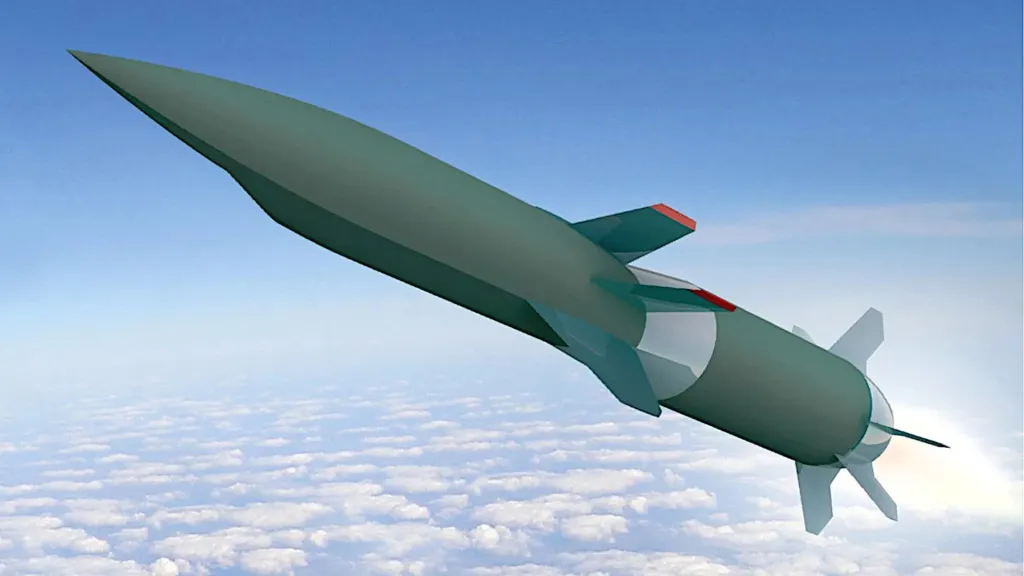
To date, neither the Air Force nor Raytheon has released a confirmed picture or rendering of HACM. In 2023, the Air Force did release a picture, seen below, showing an air-breathing hypersonic cruise missile test article related to either HACM or the preceding HAWC effort.

“The missile consists of two stages, a rocket booster and a scramjet cruiser, which separates from the booster and eventually dives toward its target,” according to GAO. Scramjets do not function effectively at lower speeds, and designs powered by them require some form of initial boost to a high Mach velocity. Hypersonic speed is generally defined as anything above Mach 5, but what HACM’s peak speed might be is unknown.
Two-stage air-breathing missile-like hypersonic vehicle designs have been tested on several occasions in the past. This includes Boeing’s scramjet-powered X-51 Waverider and HyFly 2 hypersonic test vehicles, among others. The X-51 (as its name indicates) and HyFly 2 also notably had so-called ‘waverider’ configurations designed to ‘skip’ on the shockwaves generated during high-speed flight to help provide additional lift. Whether HACM might also use this principle is not known.

X-51A WaveRider Scramjet Second Hypersonic Flight Test
It’s also worth noting here that Castelion’s Blackbeard hypersonic missile also has a two-stage configuration. It remains unconfirmed whether or not the second stage of that weapon is powered, but it does not appear to be an air-breathing design either way. Castelion is currently developing an air-launched version of Blackbeard for the U.S. Navy, which is also in flight testing now, as well as a ground-launched type for the U.S. Army. You can read more about that missile here.
Scramjet-powered air vehicle designs, including aircraft and missiles, have historically proven challenging. As noted, HACM has suffered delays over the years. The original goal had been to begin flight testing in 2024, which slipped first to 2025 and then 2026.
“The HACM program is on track to conduct its first flight test in the second quarter of fiscal year 2026, but officials said there is effectively zero margin left in the schedule for the rapid prototyping effort. The program has already descoped the rapid prototyping effort from seven to five planned flight tests,” GAO said bluntly in a report published in July. “The Air Force plans to produce 13 missiles during the rapid prototyping effort, including test assets, test spares, and operational rounds.”
“If a significant flight test failure occurs, it is likely that the program will not be able to complete all five tests within the 5-year rapid prototyping timeframe,” the report continued. “According to the program, completing at least the first three flight tests is critical for informing the Air Force’s decision to initiate a rapid fielding effort and procure HACM in fiscal year 2027.”
GAO’s July report, which had a January cutoff date, noted later on that the Air Force’s target date for initiating the rapid fielding effort, more specifically, was the first quarter of Fiscal Year 2027. This fiscal period began last Thursday and runs through the end of the year. Whether the service is still aiming to keep to that part of the schedule is unclear, but it would seem extremely difficult to do so.

“The HACM program has taken on risk to maintain its current schedule. According to program officials, maintaining the schedule has required aggressively resequencing activities to focus almost exclusively on those necessary to support the first flight test date,” GAO’s report added. “In some cases, officials said this has involved risky strategies, such as concurrently performing parts validation testing while completing the system’s design, which could require the redesign of key parts if they fail validation testing.”
In terms of U.S. hypersonic missile developments, challenges have also not been limited to scramjet-powered types like HACM. Air Force, Navy, and Army efforts to develop a variety of air- and surface-launched hypersonic missiles in various sizes and configurations have all suffered setbacks in the past decade or so. The Navy notably cancelled its own air-launched hypersonic cruise missile program, called Hypersonic Air-Launched Offensive Anti-Surface Warfare, or HALO, last year. The service subsequently shifted focus to the aforementioned Blackbeard under a program called the Multi-mission Affordable Capacity Effector (MACE). This has all prompted particular concerns about a growing and increasingly worrisome gap in this regard between the United States and its chief global competitors, especially China.

There is also a cost question. HACM traces to a time when hypersonic missiles were generally viewed, at least publicly, as highly capable, but also higher-cost and lower-density, assets. Blackbeard, for example, reflects a more recent push to develop and field more economical munition designs across the board that can also be more readily produced at scale. This demand signal has become even more pronounced in light of the dwindling American stockpiles of critical munitions due to the conflict with Iran, as well as other crises globally in recent years. More exquisite munitions, including hypersonic types, will still be part of the larger U.S. arsenal going forward.
Regardless, the U.S. military, as well as its Australian counterparts, have made it clear in the past that they view hypersonic weapons as critical for success in future conflicts, especially high-end fights, such as one in the Pacific against China. In general, air-breathing hypersonic cruise missiles offer a valuable and highly flexible way to strike targets, especially time-sensitive ones, quickly and over extended ranges. The weapon’s high speed and maneuverability drastically increase its ability to penetrate through enemy air defenses and reduce the total time an opponent has to react.
Whether or not the Air Force will be able to avoid any more major delays with HACM remains to be seen. The service’s goal to start at least limited production of HACM before the end of 2027, if not sooner, is even more ambitious now after years of schedule slips. As mentioned, officials have already acknowledged there was no more margin for error at the start of the year. There are many questions still about what form any initial fielding will take, and how that might be further impacted by the truncated testing plan.
The HACM program has at least now hit the important milestone of beginning flight testing.
Contact the author: joe@twz.com