USA

How Chinese Media Views the U.S. Hosting the FIFA World Cup

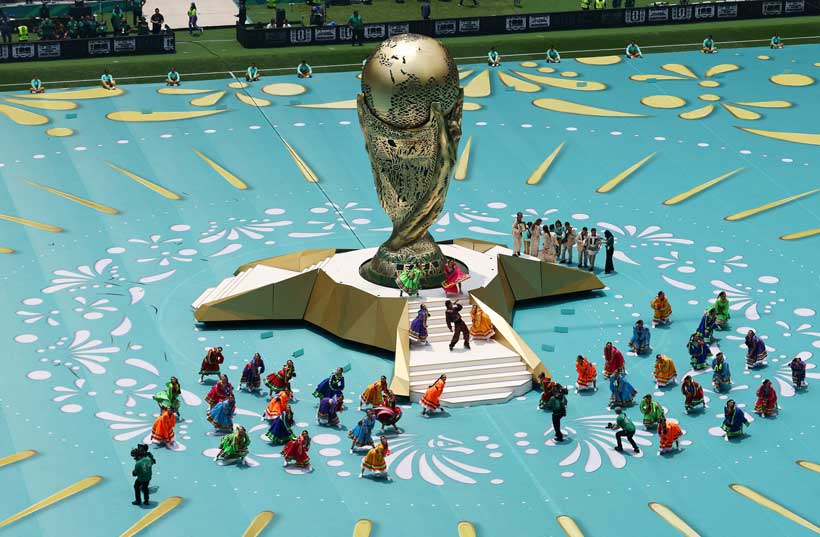
Chinese media and think tanks view the United States’ hosting of the FIFA World Cup from a purely geopolitical, economic, and commercial perspective, critically assessing the infrastructure and political climate. Chinese circles see the tournament not merely as a sporting event but as a central tool for the United States to polish its image, bolster its global leadership amidst current international polarization, and advance its political agenda. This perspective is highlighted through several key points, the most important being the geopolitical dimension. Here, Chinese think tanks argue that the tournament reflects the level of competition between major powers, with Washington attempting to use hosting as a soft power tool to project its influence. However, Chinese media, in turn, emphasized the state of sharp international polarization and division, criticizing the political challenges and the wrangling that accompanied the broadcasting negotiations. Furthermore, a number of (commercial considerations) have been raised, with the tournament facing criticism from Chinese media due to its exorbitant cost and the significant time difference between North America and China, leading to a decline in Chinese public interest. This hesitation was reflected in the negotiations, as FIFA incurred financial losses after China Media Group (CMG) signed the broadcasting agreement late and at a price significantly lower than FIFA’s requested.

Regarding the (organizational and policy challenges), Chinese research and media institutions expressed reservations about the tournament’s logistical challenges, particularly the longer travel distances between host cities compared to previous editions, as well as concerns related to US immigration laws and security restrictions. Despite the absence of the Chinese national team from the tournament, China’s commercial involvement was substantial. Beijing demonstrated its active presence through Chinese commercial sponsors, such as Hisense, and sporting goods factories in eastern China, which reaped significant economic benefits from manufacturing tournament flags and souvenirs. Chinese media coverage, particularly through its official channels, was extensive. CGTN, the Chinese state broadcaster, developed comprehensive plans to broadcast and cover the matches, ensuring the event reached millions of Chinese fans across its various platforms.

Furthermore, Chinese state media and intelligence and military think tanks utilized Washington’s hosting of the FIFA World Cup to offer a number of strategic, media, and intellectual analyses regarding China’s calculations in response to American actions. Major events are often used as a primary arena for geopolitical competition between the two superpowers. Beijing’s vision can be summarized by its use of major sporting, cultural, and other events as a political tool. Beijing views Washington’s hosting of major international tournaments or events as more than just sporting or cultural occasions; it sees them as an extension of American information and decision-making strategies aimed at projecting American influence and hegemony globally. While China seeks to highlight international contradictions, Beijing has directed its media apparatus to demonstrate that Washington’s attempts to unilaterally assume leadership or project messages of unity are, in reality, met with sharp division and polarization within the international system. Here, China has attempted to counter American soft power. This media coverage of the FIFA World Cup in the United States reflects a continuous Chinese effort to neutralize Western and American soft power by focusing on structural issues in international relations, such as the absence of multipolarity, and by promoting the Chinese model as an alternative striving for a more balanced world.

In this context, Chinese media and think tanks view the United States’ hosting of the World Cup through the lens of soft power, geopolitical strategies, and trade, while sharply criticizing the infrastructure and political circumstances surrounding the tournament, particularly in the aftermath of the Iran War and a number of global geopolitical upheavals stemming from US policies. Chinese analyses focus on purely commercial interests, criticizing the exorbitant costs of broadcasting rights. Conversely, they highlight the role of leading Chinese companies in profiting from the event by providing innovative and advanced broadcasting technologies and exporting merchandise and fan supplies. However, they also offer several critical observations regarding the infrastructure and political climate. Chinese research centers express critical skepticism about the readiness of US cities, suggesting that complexities related to visa requirements and a strict security and political environment could hinder fans and undermine the freedom of movement necessary for such events.

Based on the preceding understanding and analysis, we can discern the perspective of Chinese media and research centers that the United States exploits hosting international sporting and political events as a prominent tool for employing sports to enhance American soft power, attempting to project influence to manage conflict, and solidifying its leadership of the global order. Therefore, Chinese think tanks and intelligence agencies have developed a comprehensive media and research plan to expose American polarization worldwide. Conversely, Chinese media and think tanks emphasize Washington’s failure to garner international consensus, highlighting the sharp division and widening gap between Western powers and the rising powers of the Global South. This underscores the mechanism of conflict transformation, where competition is no longer limited to the economic and military spheres but has expanded significantly to encompass soft power tools and media discourse. This reflects a picture of expanded strategic competition and its impact on international stability.
Source link

Trump Calls Iran Deal Leak False

U. S. President Donald Trump expressed on Friday that Iran’s comments about a potential deal do not match what has been agreed in writing. He described their statement as weak and claimed they are not trustworthy in negotiations. Trump emphasized the urgency for Iran to “get their act together. “

On Thursday, Trump had decided against new strikes on Iran, believing a deal had been made. According to Iranian officials, the deal would meet many of their demands, while Trump did not achieve much besides the reopening of the Strait of Hormuz, which Iran had closed following attacks he ordered in February.

A senior Iranian source stated that the draft deal would lift sanctions on Iran’s oil, unfreeze billions of dollars of Iranian assets, and require an end to hostilities in various regions, including Lebanon. Discussions on nuclear issues would be postponed. The U. S. aims for a deal to prevent Iran from developing nuclear weapons, while Iran insists it does not seek such weapons. The source did not mention what Iran might offer in return.

With information from Reuters

Source link

Thousands welcome U.S. men’s soccer team to SoCal ahead of World Cup

With its World Cup opener just four days away, the U.S. team moved into its temporary home in Irvine on Monday, where the players found thousands of new Southern California neighbors waiting in line to watch them kick a ball.

After the U.S. announced that Orange County Great Park would be its base for at least the group stage of the tournament, the City of Irvine held a raffle for passes to see the team train in its only public workout.

Thirty-two thousand people applied and 5,500 received access on a warm Monday morning to watch the team rush through a light 45-minute practice that was notable primarily because it was the first in which injured center back Chris Richards was fully involved. Richards tore two ligaments in his left ankle playing for Crystal Palace, his English club team, on May 17 and hadn’t played or fully trained since. The team is rushing to get him ready in the hopes he can play at some point in the three-game group stage.

But the practice was also notable because it was the first at Championship Soccer Stadium, about 50 miles southeast of SoFi Stadium in Inglewood, where the U.S. will open its World Cup on Friday against Paraguay.

“[The] environment and facilities are crazy. It’s more than we expect,” U.S. coach Mauricio Pochettino said of the venue. “We are so grateful.”

Championship Soccer Stadium is owned and managed by the city, which has leased it to the Orange County Soccer Club of the second-tier USL Championship. But the club was temporarily evicted in late April to make space for the national team — which is just fine with them.

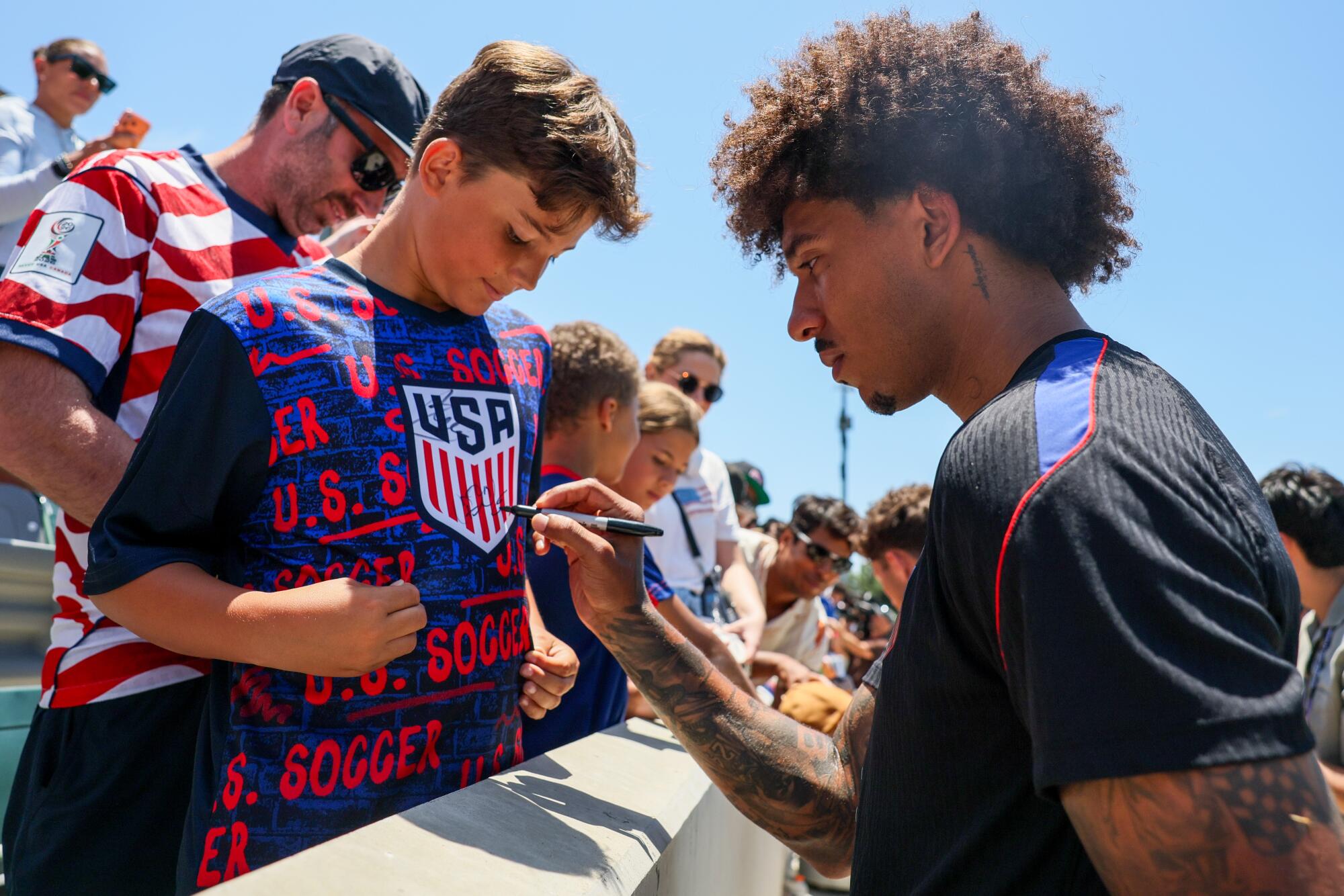
Irvine, CA - June 08: USMNT player Chris Richards autographs the shirt of a young fan.

U.S. men’s soccer player Chris Richards autographs the shirt of a young fan during a team practice Monday.

(Ronaldo Bolaños / Los Angeles Times)

“How can you not be excited about the host nation training in your facility?” said Dan Rutstein, president of business operations of the Orange County club.

“We’re proud to be associated with the U.S. national team. We wouldn’t want to ever block anything, even if we could.”

(And they couldn’t, the city said.)

The Great Park is a sprawling 500-acre complex built on the site of the former Marine Corps Air Station El Toro, which closed in 1999 after 56 years training pilots for conflicts from World War II through the first Gulf War. In 2001, voters approved a proposal to convert the space into a public park and nature preserve, one which now includes, among other things, five sand volleyball courts, four basketball courts, 25 tennis courts, 12 softball and baseball fields, the ice arena where the Ducks practice and 25 soccer fields, including the pristine one FIFA just installed inside the 5,500-seat stadium.

“The idea was that this would be a quality facility, a great park that we hope will rival San Diego’s Balboa Park and other great parks across the country,” Irvine mayor Larry Agran said. “It took a lot of nurturing, a lot of time, a lot of work.”

Bringing the World Cup — or at least a World Cup team — to Irvine also took a lot of time and work. Agran said the city put out feelers about hosting a training base five years ago and made the first cut in 2024 when the Great Park was placed on a list of options distributed to tournament qualifiers.

Over the next two years, Rutstein said, about a dozen national teams sent representatives to have a look while Sam Zapatka, the operations manager of the USMNT, said he scouted 27 facilities from Seattle to San Diego. After his first visit to the Great Park, however, he said he stopped looking and in March, the team announced it would train in Irvine.

On Monday, when the players filed out of the stadium’s locker room, which FIFA expanded and upgraded, they were greeted by rhythmic clapping and chants of “USA! USA!”

1

U.S. men's soccer player Weston McKennie takes part in a training session at

2

U.S. men's soccer players (from left) Weston McKennie, Christian Pulisic and Sergino Dest take part in a training session.

3

U.S. men's national soccer team coach Mauricio Pochettino waves to fans attending practice on Monday.

4

U.S. coach Mauricio Pochettino speaks to players after

1. U.S. men’s soccer player Weston McKennie takes part in a training session at Orange County Great Park. (Ronaldo Bolanos / Los Angeles Times) 2. (Ronaldo Bolanos/Los Angeles Times) 3. U.S. men’s national soccer team coach Mauricio Pochettino waves to fans attending practice on Monday. 4. Pochettino speaks to players after drills at Orange County Great Park on Monday. (Ronaldo Bolanos / Los Angeles Times)

“I think we’ve all been, I wouldn’t say overwhelmed, but possibly surprised by the excitement and the buzz,” said captain Tim Ream, who led the team onto the field. “Pulling up here with 5,500 fans ready to watch a training session is incredible.

“We get to train in an actual stadium with a good pitch. The support, really, from all the kids out there is amazing. You want to feel like you have a good home base, right? So really, we’re looking forward to being here.”

Especially after 5,000 of your neighbors show up for the housewarming party.

Source link

China’s military and intelligence views on Lebanon-Israel talks

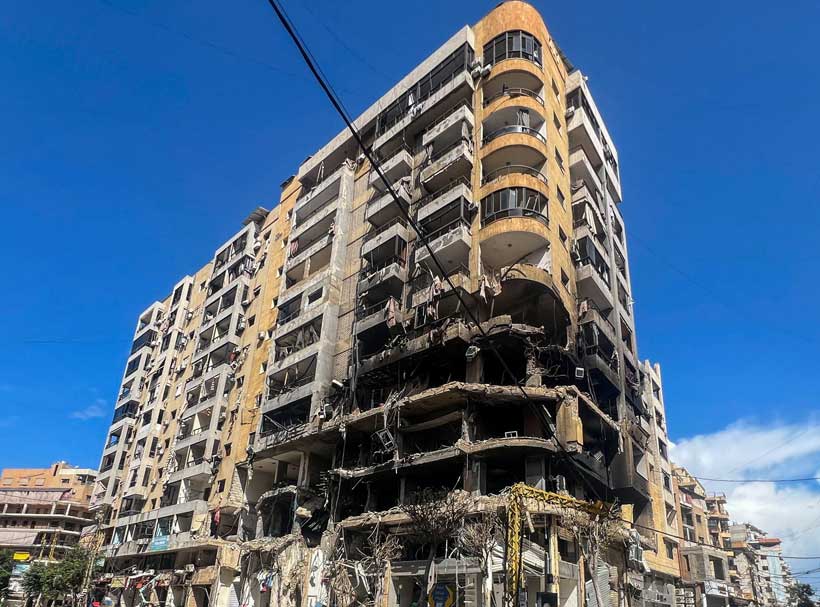
China strongly condemns the Israeli airstrikes and ground incursion into southern Lebanon, describing these operations as a dangerous escalation that threatens the stability of the entire region. China demands that Israel immediately cease its military operations and fully withdraw its forces from Lebanese territory, warning of the dangers of its incursions and violations of established lines. China views the fourth round of Washington talks between Lebanon and Israel and the military tensions as an extension of a broader crisis. Beijing sees this conflict as a consequence of the Gaza war, emphasizing clear principles in its intelligence and military assessment of the situation across several axes, most notably the necessity of an Israeli withdrawal and a ceasefire. Beijing calls for an immediate cessation of military operations and the withdrawal of Israeli forces from Lebanese territory, warning that expanding ground operations will drag the region into chaos. China’s efforts in the reconstruction of Lebanon focus on providing urgent humanitarian aid packages, signing development cooperation agreements, and encouraging Chinese companies to participate in infrastructure projects and long-term investments within the framework of China’s Belt and Road Initiative. China also defended the Lebanese position in the face of Israeli escalation at the United Nations, with its representative to the Security Council emphasizing that Israel’s advance to Beaufort Castle (Qalaat Al-Shaqif) was the most serious incursion into southern Lebanon in 30 years. He called on the international community to take urgent measures before the situation in Lebanon deteriorated further, demanding respect for Lebanese sovereignty and the withdrawal of all Israeli forces from southern Lebanon.

The most prominent features of these Chinese efforts for joint cooperation with the Lebanese side and the international community in the reconstruction of Lebanon and the cessation of Israeli attacks on southern Lebanon are the provision of direct financial and development support. The Chinese and Lebanese governments signed a development cooperation agreement in Beirut worth 50 million Chinese yuan to support reconstruction and sustainable development efforts, along with the provision of urgent humanitarian aid. China delivered shipments of emergency humanitarian aid through the Port of Beirut to alleviate the economic and living burdens on the Lebanese people. Furthermore, China encouraged the participation of Chinese companies and investments in reconstruction and development efforts in Lebanon. Beijing has expressed its readiness to encourage its major companies and national institutions to participate in Lebanon’s reconstruction projects and support the development of the energy, telecommunications, and infrastructure sectors through China’s Belt and Road Initiative. Lebanon has been a partner in this Chinese initiative since joining in 2017. China aims to enhance Lebanon’s role as a pivotal hub for trade and logistics in the Middle East. In addition to sustained Chinese diplomatic efforts, China has continued its diplomatic and developmental support for Lebanon, alongside its active participation in UN peacekeeping operations in southern Lebanon.

China’s role in halting the Israeli war on Lebanon has focused on exerting diplomatic pressure through the United Nations and utilizing international platforms to call for an immediate ceasefire and the withdrawal of Israeli forces from Lebanese territory, while supporting political and diplomatic solutions to prevent the conflict from escalating. China has consistently called for an end to Israeli military operations against Lebanon during UN sessions and warned that the collapse of ceasefires places the region on a more dangerous precipice. Beijing called for the immediate withdrawal of Israeli forces from the devastated Lebanese territories, emphasizing the need to respect international resolutions, Lebanon’s sovereignty and independence, and the protection of the United Nations Interim Force in Lebanon (UNIFIL). China stressed the importance of ensuring that UN peacekeepers could carry out their duties freely and safely and condemned any attacks against UNIFIL personnel. China also emphasized the need to intensify humanitarian aid to the Lebanese people to address the repercussions of the war and expressed its full readiness to contribute to restoring regional stability.

Here, Chinese diplomatic and intelligence agencies affirmed that Lebanon’s sovereignty and security must not be violated, stressing that extending the authority of the Lebanese state and protecting its stability are the fundamental pillars for preventing the entire region from sliding into a comprehensive regional war. They reiterated the necessity of respecting Lebanon’s sovereignty and security, considering the stability and protection of the Lebanese state as essential to preventing a full-blown regional war. China also expressed its full support for the role of the United Nations Interim Force in Lebanon (UNIFIL) and emphasized the need to provide guarantees for its protection and freedom of movement to carry out its mission. From an analytical perspective, Beijing believes that a political solution to the crisis must include respect for international resolutions and adherence to the two-state solution for Palestine and Israel. It also expressed concern that these negotiations might lead to regional arrangements that serve the interests of certain major powers and marginalize other parties in the region. On the other hand, China welcomes dialogue and diplomatic solutions as a means to ease tensions in the Middle East and supports efforts to restore Lebanon’s sovereignty. However, Beijing has criticized unilateral US actions in managing interconnected issues such as Gaza, Lebanon, and Iran, emphasizing the need to adhere to international resolutions and support regional stability, avoiding military interventions and the expansion of conflict.

Beijing adopts a clear strategic vision regarding the Lebanese crisis, which is summarized in its emphasis on respecting sovereignty. Chinese diplomacy strongly condemns any violations of Lebanese sovereignty and calls for an immediate halt to foreign military operations on Lebanese territory to ensure the safety of civilians. With Chinese intelligence and military agencies calling for a monopoly on weapons, a position reiterated by the Chinese Permanent Representative to the UN Security Council, China supports the Lebanese state as the sole guarantor of internal stability. This signifies Beijing’s strong support for the principle of state monopoly on weapons, considering official institutions the only guarantor of internal stability and the prevention of the country’s disintegration. China also supports the UNIFIL forces, opposing the termination of the UNIFIL mandate and demanding that it be enabled to fulfill its mission to ensure stability in southern Lebanon and contribute to regional de-escalation. Beijing emphasizes that escalation will not resolve crises, urging conflicting parties (including Washington and Tehran) to prioritize diplomacy and political negotiation to exercise restraint.

Source link

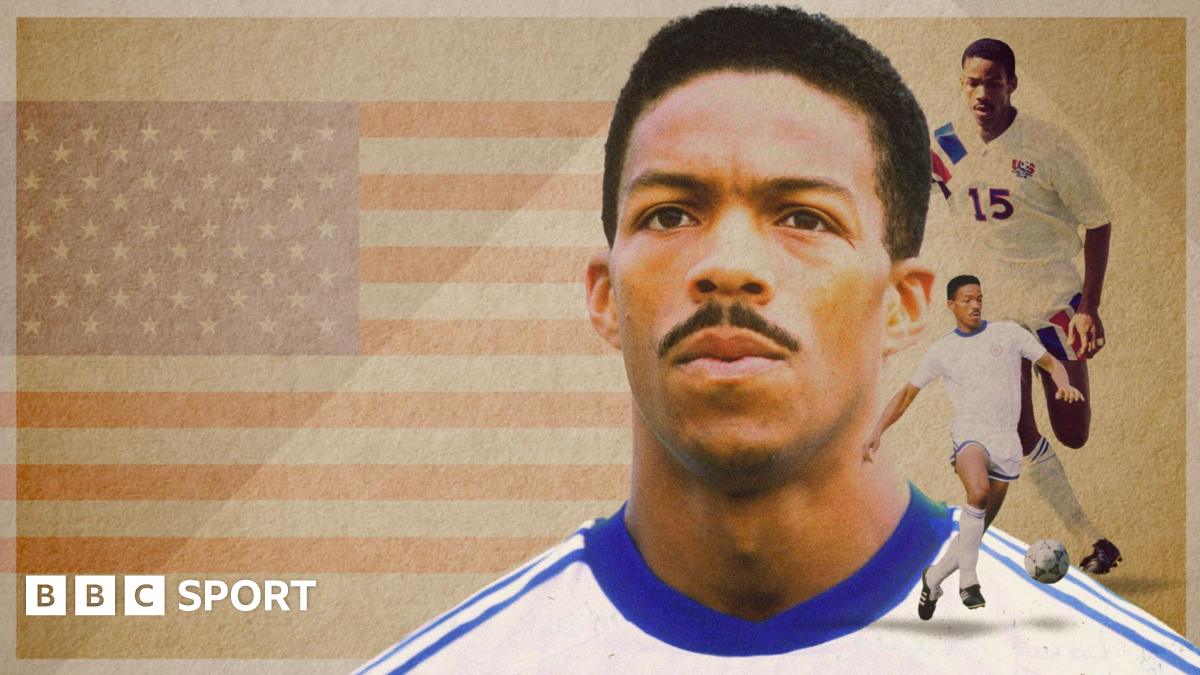
World Cup 2026: USA pioneer Desmond Armstrong and his legacy

Football came to Armstrong, via a television set, in suburbia.

His family moved from the Southeast part of Washington DC when Armstrong was young and later settled in a largely white neighbourhood in Maryland, where he befriended a soccer coach’s son. One afternoon, the coach called Armstrong over to the television.

He was pointing to a Brazilian in a New York Cosmos jersey.

“It was Pele,” says Armstrong.

“His movement reminded me of a lot of the point guards that played basketball, but he was doing it with a ball at his feet.

“He was one of the few black players on the team, so that connected me.”

While Pele was popularising a game he’d learned barefoot on the streets of Brazil, much of the American grassroots version was being built on privilege.

Unlike the developing youth academies of Europe and South America, where clubs like Ajax and Barcelona were putting money into young talent, development in the US has long run on a pay-to-play model.

Families must meet significant costs or seek sponsorship to give their children a shot at advancing – creating a system that has seldom favoured those from less affluent households.

“It’s kind of antithetical to what this game’s all about,” says Frank Dell’Apa, who has spent 40 years as the Boston Globe’s football columnist, covering the game since the days of the original North American Soccer League (NASL).

“This is the simplest game with the easiest access. Everybody plays it around the world with no money, no soccer balls, no shoes. And here, we had just the opposite thing going on.”

Armstrong knows just how easily his story could have been different.

“If my folks didn’t move into the suburbs, then hands down I’m not playing soccer,” he says.

Socioeconomics was not the only hurdle.

The NASL going under in 1985 during Armstrong’s time as a college player limited professional pathways for him and his peers before their careers had even begun.

“For me, personally, that was crushing,” Armstrong says.

He turned to the Major Indoor Soccer League to play professionally, where his performances earned him a US men’s national team debut in 1987, followed by a spot at the 1988 Seoul Olympics.

“I remember being on the field, hearing the national anthem and just thinking ‘this is where I’m supposed to be’,” he says.

That same year, world football’s governing body Fifa had selected the USA to host the 1994 World Cup finals – the first time the tournament had gone to a country outside Europe or Latin America.

They would be under the global spotlight.

“The US was not a factor in world soccer at all,” says Dell’Apa.

“I remember Des playing a lot of games on artificial turf. It was hard for those guys. They had to fight to get into line-ups, to get a playing field, to get a stadium.”

With no elite outdoor professional league in the country, the player pool was a fragmented mix largely consisting of college, semi-pro and indoor players like Armstrong.

The federation looked to work around this by securing a core group of them on full-time contracts, essentially turning the national team into the country’s professional set-up. It was an unorthodox approach, not unlike something from the Eastern Bloc playbook.

They appointed a German-Hungarian head coach named Bob Gansler. Armstrong was now among a group of young players who were handed a near impossible task: qualify for the 1990 World Cup in Italy.

Source link

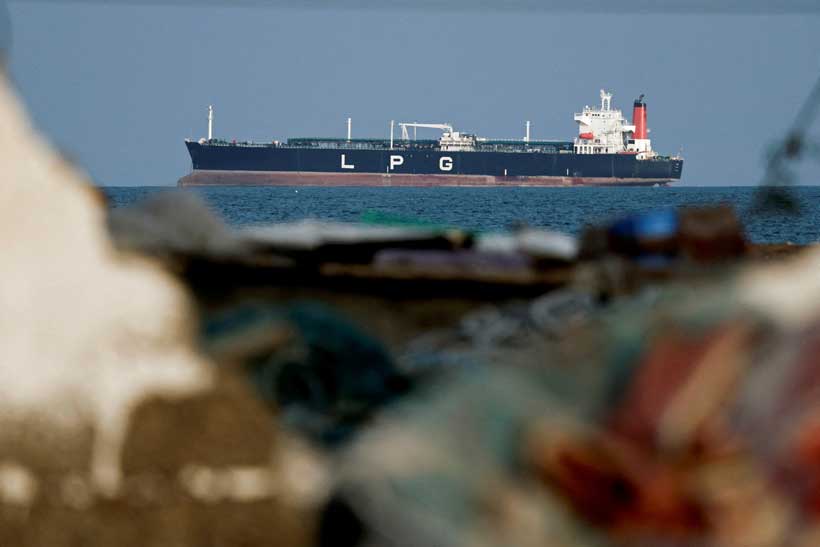
Are Hidden Oil Flows From Hormuz Reshaping the Energy Market?

Oil shipments passing through the Strait of Hormuz have quietly increased in recent weeks, but traders say the movement reflects a fragmented and opaque energy market rather than a full recovery in global supply flows.

More than four months into the ongoing conflict involving Iran, tanker traffic remains heavily disrupted, with shipping patterns increasingly shaped by risk, secrecy and shifting political arrangements.

Tanker Traffic Shows Limited but Rising Movement

Shipping data suggests that only a small number of tankers are currently crossing the Strait of Hormuz compared with pre conflict levels.

Monitoring firms including LSEG and Kpler estimate that an average of just a few vessels per day are now passing through the strait, far below normal volumes.

Despite this, analysis of oil stored on tankers in the Gulf indicates that outflows have gradually increased, suggesting more crude is leaving the region than official shipping visibility shows.

Hidden Shipping Patterns and “Dark” Tankers

A growing share of tankers are reportedly turning off tracking systems during transit through the strait, a practice known as going dark.

This involves disabling Automatic Identification System signals, making it harder to track vessel movements in real time.

According to shipping analytics firms such as Vortexa, a large majority of outbound tankers recently used this method, reflecting rising caution among operators.

This has made it significantly harder for markets to accurately assess global supply flows and has increased uncertainty in oil pricing.

Oil Stored on Tankers Shows Gradual Decline

One key indicator of market movement is the volume of oil stored on ships inside the Gulf, often referred to as oil on water.

Estimates from Kpler suggest that volumes have fallen from a peak of around 184 million barrels in March to roughly 148 million barrels more recently.

This decline indicates that more oil is gradually leaving the region, even if it is not fully visible through standard tracking systems.

Analysts estimate that outflows have increased over recent weeks, suggesting a slow and uneven recovery in shipping activity.

Security Risks Continue to Disrupt Shipping

The ongoing conflict involving Iran has significantly disrupted maritime trade through the Strait of Hormuz, one of the world’s most important oil transit routes.

Limited access to the strait has forced producers to reduce output in some cases, while storage constraints have added pressure to supply chains across the Gulf.

Some shipping routes are reportedly being managed through informal arrangements or alternative corridors, while others rely on higher risk transit strategies to avoid detection or confrontation.

Recovery Remains Uncertain

Despite signs of increased movement, analysts warn that the situation is far from a return to normal.

A sustained recovery in oil flows would require consistent shipping access, stable security conditions and sufficient tanker availability to support exports.

Many shipowners remain reluctant to operate in the region due to elevated insurance costs and the risk of vessels being stranded or targeted.

Long Term Structural Change Possible

Industry observers warn that even if diplomatic progress leads to a formal reopening of the strait, the global oil market may not return to previous conditions.

There is growing discussion that Iran could attempt to impose tolls or control systems on shipping through the waterway, which would fundamentally alter global energy logistics.

Such a scenario could force Gulf producers to seek alternative export routes or invest in new infrastructure to reduce dependence on the strait.

Analysis: Market Stability Replaced by Managed Uncertainty

The situation in the Strait of Hormuz highlights a shift from predictable global energy flows to a more fragmented and opaque system.

While oil continues to move out of the Gulf, the lack of transparency in shipping routes is creating uncertainty for traders and pricing benchmarks.

The increased use of stealth navigation and alternative transit arrangements reflects a market adapting to geopolitical risk rather than resolving it.

As long as tensions persist, energy markets are likely to remain volatile, with supply visibility as important as supply itself in determining global prices.

Conclusion

Oil shipments through the Strait of Hormuz are slowly increasing, but hidden tanker movements and ongoing conflict mean the global energy market remains deeply uncertain. Without stable political conditions and transparent shipping routes, a full recovery in oil flows is unlikely in the near term, keeping traders cautious and markets volatile.

With information from Reuters.

Source link

Leadership Factor in Trump’s Iran War Policy: A Case Study

Introduction:

In recent years, the security strategy and foreign policy of the United States have witnessed a fundamental transformation in their main principles, as demonstrated by the second US-Israeli war against Iran, which this author refers to as the “Second Iran War” to distinguish it from the first military confrontation between these three parties in the summer of 2025, known as the “Twelve-Day War.”

The leadership factor, represented by President Donald Trump, has become an unprecedentedly broad influence on the decision-making process related to US foreign policy and national security, whether concerning the declaration and conclusion of war, or even in peacetime, particularly regarding Washington’s relations with its traditional allies in Europe and the Middle East.

This analysis focuses on the case of the “Second Iran War” as a clear example of the increasing role of the US president’s personal characteristics in shaping strategic decisions related to this war and managing Washington’s relations with its partners in the Arabian Gulf region.

This analysis is divided into two main sections, as follows:

First, the traditional determinants of US security strategy and foreign policy.

Second, the Trump administration and the growing role of the president in foreign policy and national security.

Third, the Second Iran War as a model for the increasing influence of the leadership factor in the US decision-making process.

First, the traditional determinants of US security strategy and foreign policy:

There is a set of traditional constraints governing decision-making in the United States, both in domestic and foreign policy. These constraints stem intrinsically from the nature of the American political system, the constitutional and societal environment within which it operates, and the historical development of the nation some 250 years ago.

In summary, these constraints can be divided into the following:

1. Constitutional and historical constraints, including the federal constitution and the practical actions of foreign and security policy-making institutions over the past decades.

2. Institutional determinants, which consist of the roles exercised by the legislative, executive, and judicial branches as defined by the Constitution, including: Congress (the House of Representatives and the Senate), and the federal departments and agencies concerned with U.S. foreign policy and national security (the Departments of State and Defense, the National Security Council, and the various intelligence agencies, most notably the Central Intelligence Agency (CIA)).

3. Political determinants, foremost among them the role played by the President of the United States in decision-making—what political literature calls the “leadership factor”—which is determined, broadly or narrowly, by a range of considerations, including: the President’s political experience, personal characteristics and interests, and ideological orientations, convictions, and personal preferences.

Traditionally, American historical experience indicates that constitutional and institutional constraints have a dominant influence on foreign policy and national security decision-making, compared to the limited influence of the president’s personal characteristics and psychological environment.

This has resulted in a near-consistency in the general direction of US foreign policy and security strategy across successive administrations, regardless of the president’s party affiliation (Democrat or Republican) or personality traits.

Second, the Trump administration and the growing role of the president in foreign policy and national security:

Unlike previous administrations, Republican President Donald Trump, since his first presidential term (2016-2020), has expanded his role in the decision-making process related to US foreign policy and its security strategy abroad, to the point of bypassing the federal institutions responsible for making this policy and strategy, or at the very least marginalizing the role of these institutions and failing to coordinate with them in advance in an unprecedented manner.

Trump’s interference in this regard, and his violation of institutional limits during his second presidential term, which began in January 2025, has increased to the point of causing great embarrassment to those in charge of American foreign and security policy-making institutions on the one hand, and on the other hand, it has led to pushing towards taking decisions – or at best adopting a declared political discourse – that has caused great damage to the foreign relations of the United States and posed a threat to its strategic interests as a superpower, whether with its immediate geographical neighborhood in the Americas (Canada, Mexico, Venezuela, and Cuba), or with its traditional transatlantic allies (Europe and NATO), and finally with important partners in the Middle East region.

Without going into detail about the reasons for this excessive interference by President Trump in American foreign policy and security strategy, in our estimation, this is largely due to the psychological and personal characteristics of the Republican president, whose political discourse and vocabulary indicate that he considers himself the “savior” of the United States and personally qualified to restore it to its glory, which he expresses in his election slogan “Make America Great Again.”

Third, the Second Iran War as a model for the increasing influence of the leadership factor in the US decision-making process:

The events of the second Iran-Iraq War, which began on February 28, 2016, provide a clear example of the growing influence of leadership dynamics, at the expense of constitutional and institutional constraints, in shaping and implementing American foreign policy and security strategy decisions under the Trump administration.

This assertion is supported by two key indicators, as follows:

1. Washington’s Decisions to Launch the War and the Negotiations Related to Ending It:

A close examination of Washington’s decision to launch the war against Iran on the morning of Saturday, February 28, 2026, reveals that President Trump based this decision on his personal convictions regarding the reliability of the reports and information provided to him by Israeli Prime Minister Benjamin Netanyahu – with whom he has a friendly and politically harmonious relationship – concerning the threat posed by Tehran’s nuclear program and its ballistic missile capabilities to Israel, America, and the region. He believed that the opportunity was ripe to quickly eliminate the religious regime in Iran by launching a powerful and swift military strike that would lead to its downfall after instigating an internal uprising.

In contrast, Trump ignored warnings from US foreign policy, national security, and defense institutions about the risks and feasibility of a war against Iran from the perspective of vital US interests in the Middle East. The Republican president also disregarded the reservations of senior administration officials regarding this military strike, including Vice President J.D. Vance, Secretary of State Marco Rubio, and Special Envoy for Middle East Peace Steve Wittkopf.

Further bolstering this claim are Trump’s attempts to deny that Israel pushed him into this war. He has asserted on more than one occasion that he made the decision himself, and even that he was the one who pushed Tel Aviv to engage in it. He has also emphasized on other occasions that the matter of negotiating and ending the war is solely his responsibility, and that Netanyahu is simply doing what he asks of him regarding the war with Iran.

According to the literature of political psychology and the principles of political communication, when politicians exaggerate their denial of something, or deny it without directly accusing them, it often confirms the accusation, not the other way around.

This claim is is further supported by reports in the US indicating that Trump sent the Israeli Prime Minister a draft memorandum of understanding between Washington and Tehran to end the war, as part of the US president’s consultations to reach a final decision on ending the conflict.

This means that Trump made his decision to wage war on Iran—and will most likely make his final decision regarding negotiations to end it—based on elements of his psychological environment and personality traits, and not on the factual data contained in the reports and recommendations of the foreign policy and national security agencies, which are based primarily on the strategic interests of the United States and its international and regional orientations.

2. The Harshness and Crudeness of US Presidential Rhetoric Towards Strategic Partners in the Arabian Gulf:

President Trump’s public political discourse since the start of the war has included statements characterized by an unprecedented level of harshness in American policy towards Washington’s strategic partners in the Gulf Cooperation Council (GCC) countries.

For decades, the United States has maintained a balanced and rational approach to its relations with the Gulf states, a relationship cemented by strategic alliances and defense agreements since the 1991 Gulf War. This was true even during periods of open tension or simmering resentment between the US and some Gulf capitals.

In our estimation, this is explained by the fact that successive administrations and presidents in the White House have based their decisions, policies, and political discourse in general, and towards their allies and strategic partners in particular, on the constitutional and institutional parameters for drawing up and making Washington’s foreign policy and security strategy, especially in the vital geographical areas for national security and American strategic interests, as is the case with the Middle East region and at its heart the Arabian Gulf region.

However, in a departure from this approach and in an unprecedented move, the second Iran-Iraq War witnessed Trump’s political rhetoric, which included insults to some Gulf Cooperation Council (GCC) states and belittling of others. He even went so far as to issue explicit and public threats against one of the Gulf Arab states, the Sultanate of Oman, in a surprising, shocking, and unprecedented act.

On May 28, 2016, Trump threatened Oman, saying he would “blow it up” if it cooperated with Iran on joint management of the Strait of Hormuz. The US Treasury Department also threatened to impose sanctions on Muscat if it proceeded with an agreement with Tehran to manage the strait, which Iran had used as a weapon of economic pressure during the war.

Conclusion:

The leadership factor, represented by the president’s personal characteristics, psychological environment, and political beliefs, has become the pivotal and most important factor in shaping US foreign policy and national security decisions during the administration of President Donald Trump, including the decision to go to war. This has come at the expense of the diminishing influence of other objective determinants, most notably constitutional and institutional ones.

This was clearly evident in Trump’s behavior and political rhetoric during the Second Iran War. This unprecedented development is likely to continue during the remaining two years of the Republican president’s term, until 2028.

The second Iran war demonstrated that such actions would negatively impact Washington’s future relations with its allies and strategic partners, or at the very least, erode trust in it as a reliable and credible international partner.

Furthermore, it would severely damage the prevailing image of the United States, both in the eyes of American and international public opinion, as an international superpower governed by institutions rather than individuals.

Source link

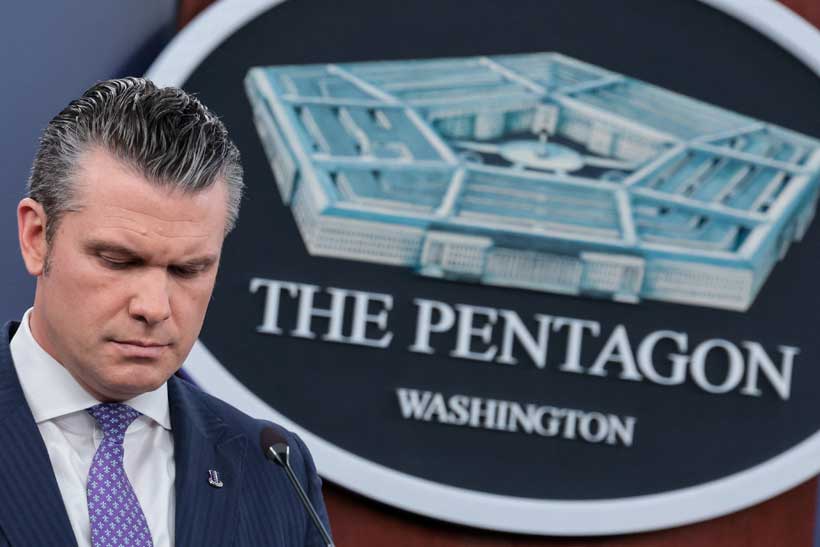
Hegseth Warns of China Threat, Urges Allies to Ramp Up Defense Spending

U. S. Defence Secretary Pete Hegseth called on Asian allies to increase military spending to counter China’s rising influence during his speech at the Shangri-La Dialogue in Singapore. He expressed concern over China’s military buildup and its potential to disrupt the regional balance of power. Hegseth emphasized the need for a robust network of allies that can deter aggression and maintain stability. The U. S. expects allies to raise defense spending to 3.5% of GDP, while the U. S. itself is investing $1.5 trillion in its military.

Hegseth addressed the need for action over discussions, suggesting that the region requires more military resources, such as ships and submarines, rather than just conferences. He underlined that partners want stability and that the U. S. must exhibit strength and disciplined leadership. He also noted improvements in U. S.-China relations, citing increased military communication to help manage tensions, while acknowledging that the relationship remains complicated.

Zhou Bo, a Chinese delegate, recognized a better tone in Hegseth’s remarks compared to the previous year, attributing this change to previous diplomatic engagements. He stated that both nations have communication channels open and that the situation might not be as severe as perceived. Hegseth reiterated President Trump’s call for allies to take more responsibility for their defense costs, proclaiming an end to U. S. defense subsidies for wealthy nations, emphasizing the need for allies to contribute actively.

Hegseth praised contributions from various allies and highlighted Japan’s efforts to enhance its defenses alongside the U. S. Regarding the Middle East, he stated the U. S. is prepared to resume strikes on Iran if diplomatic efforts fail and emphasized the ability to focus on both Asian and Middle Eastern interests simultaneously.

On the topic of arms sales to Taiwan, Hegseth avoided directly addressing concerns but affirmed that decisions about such sales are ultimately up to President Trump. The U. S. is reportedly considering a substantial arms package for Taiwan, which China views as its territory. Hegseth assured that there has been no change in U. S. policy towards Taiwan despite the ongoing dynamics in U. S.-China relations.

With information from Reuters

Source link

Mauricio Pochettino: USA boss holds initial talks with AC Milan over managerial vacancy

Mauricio Pochettino has held initial talks with AC Milan to become their next manager following Massimiliano Allegri’s sacking.

The 54-year-old Argentine is currently preparing for the World Cup with the United States, but his contract expires after the tournament.

Pochettino’s immediate focus is on this summer’s finals, which begin on 11 June and are being co-hosted by the US, Canada and Mexico, but an eventual return to club football may interest the former Tottenham and Chelsea head coach.

However, speaking after training on Thursday, Pochettino replied “no” when asked if he had met with AC Milan’s management before being opaque about his representatives’ dealings with the Serie A side.

When asked if his representatives had had a meeting, he replied: “Maybe, possible, because they need to do their job.”

He added: “If I met someone, what happened? What is going to change if I met someone?

“We have friends everywhere and my representative works for me into trying to find the best possibility for the future. That is normal.”

Pochettino said he and US Soccer Federation chief executive JT Batson had discussed the possibility of him staying.

“He asked if we are open to listen [to] the project of the federation for the next four years,” said Pochettino.

“And we said of course we are open. Do you think that if we have a commitment with another people, we are going to waste time to listen?”

Batson said Pochettino has been “incredibly transparent” about approaches from other clubs, right from when they first met a couple of years ago, and that “there were lots of people interested in Mauricio and his team”.

Batson added: “He had standing offers from other places and he wanted to be here. He’s a big believer in what we’re doing at US Soccer. He’s a big believer in soccer in America, and he’s a big believer in this men’s team.”

Pochettino’s last club spell was as Chelsea boss for the 2023-24 season, with the Blues finishing sixth in the Premier League and losing the Carabao Cup final to Liverpool.

Before that he was at Paris St-Germain for a season and a half, winning the Ligue 1 title and French Cup.

He also had a five-and-a-half-year spell at Tottenham and reached the 2019 Champions League final, only for Spurs to lose 2-0 to Liverpool.

Pochettino, who has also managed Espanyol in Spain and Southampton, was a defender during his playing career and made 20 appearances for Argentina.

AC Milan sacked Allegri earlier this week after failing to qualify for the Champions League, in a season the club’s hierarchy described as an “unequivocal failure”.

Milan dropped from third place to fifth in Serie A after a 2-1 home defeat by Cagliari on the final day to miss out on the elite European competition for the second year in a row, although they did secure a Europa League spot.

Source link