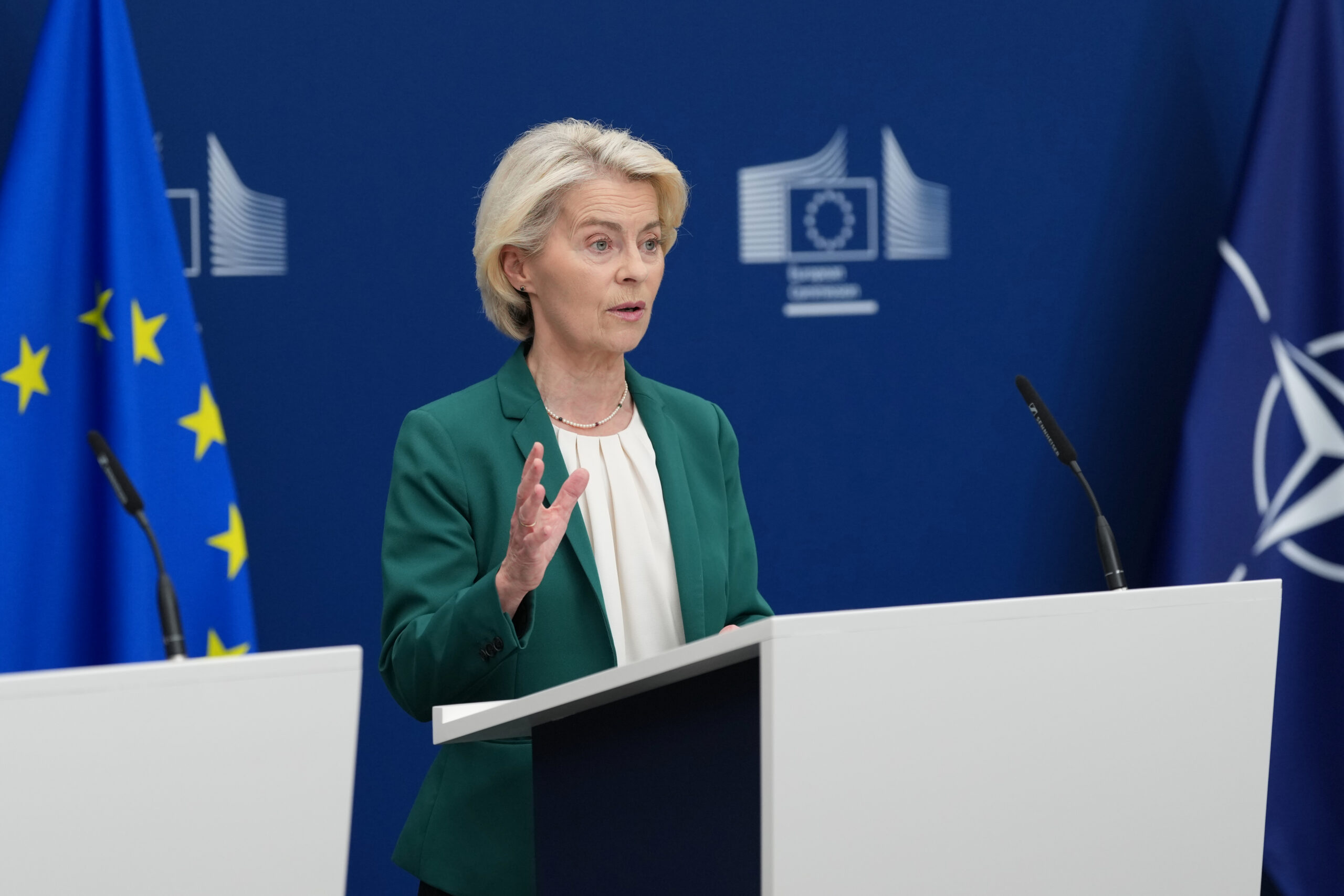
Ursula von der Leyen

EU approves trade deal with the US despite uncertainty in transatlantic relations

Published on Updated

Diplomats and MEPs reached an agreement late on Tuesday to implement the contentious EU-US agreement, which eliminates duties on most US industrial goods imported into Europe.


ADVERTISEMENT


ADVERTISEMENT

The negotiations concluded two weeks after US President Donald Trump threatened to impose 25% tariffs on EU cars if Europeans did not implement the agreement — clinched by Trump and European Commission President Ursula von der Leyen in Turnberry, Scotland, last summer — by 4 July.

The so-called “Turnberry Agreement,” criticised by MEPs as unbalanced, raises US tariffs on EU goods to as much as 15%.

“The EU and the United States share the world’s largest and most integrated economic relationship. Maintaining a stable, predictable and balanced transatlantic partnership is in the interest of both sides,” Cyprus trade Minister Michael Damianos said, adding: “Today, the European Union delivers on its commitments.”

MEPs had kept the deal frozen for several weeks following Trump’s threats over Greenland earlier this year. They also suspended it after the US adopted new tariffs following a Supreme Court ruling that declared illegal the tariffs imposed by the White House since Trump’s return to power.

Demanding clarity from the Americans, EU lawmakers finally agreed to enter into negotiations with the EU Cyprus presidency — representing EU member states — after the Commission assured them that the US would honour its side of the agreement and cap its tariffs at 15%, as agreed.

Fragile EU-US relations

However, EU-US relations remain fragile and there is concern in Brussels that the US administration could still use tariffs to put political pressure on the EU if the bloc does not comply with the White House’s demands on other issues.

Trump’s threats over EU cars two weeks ago also targeted Germany, whose Chancellor Friedrich Merz has criticised the war in Iran launched by the Americans alongside Israel.

Trump has repeatedly called on European countries to deploy ships to help secure the Strait of Hormuz, a move Europeans have been reluctant to make.

Many disagreements also continue to strain EU–US relations over Ukraine — including the recent US extension of a sanctions waiver allowing purchases of Russian oil — and over NATO, which Trump has repeatedly threatened to leave.

On Tuesday night, MEPs tried to secure the deal by attaching conditions, risking US anger with additional provisions to which Washington had not agreed.

Under the Turnberry Agreement, the EU also committed to investing $600 billion across strategic sectors in the United States through 2028 and to purchasing $750 billion worth of US energy.

Source link

China hawks are gaining ground in the Commission. Will EU countries follow?

On China, the mood at the European Commission has shifted in recent months.


ADVERTISEMENT


ADVERTISEMENT

China hawks are gaining ground inside both the Commission’s powerful Directorate-General for Trade and in the cabinet of President Ursula von der Leyen, Euronews has learned, with drastic new measures being considered to counter what is seen as unfair competition.

The 27 EU commissioners are set to debate on their China strategy on 29 May, with one official saying, “It will be about acknowledging there is a problem and that something needs to be done.”

Tensions flared Monday after China’s Ministry of Commerce threatened retaliation against the EU over its Made in Europe legislation, which sets strict conditions on foreign direct investment.

An EU official told Euronews the Chinese were “playing games,” adding that the Commission’s priority remains engagement with Beijing through multiple channels set up in recent months.

However, Commission services are already working on new measures to address China’s economic threats, sources have confirmed. “We don’t see any move from the Chinese despite all the issues we have flagged with them, so there’s a reflection on whether we should do more,” one said.

Another source said the release of Germany’s trade deficit figures before Christmas marked a turning point for the Commission.

Data published last autumn by Germany Trade & Invest (GTAI) showed a record €87 billion German trade deficit with China — a wake-up call in Berlin, long focused on securing market access in China ahead of protecting domestic manufacturing.

China has since surged up the agenda for German industry, for the Bundestag — which has set up a dedicated committee — and for the Commission, whose German president has Berlin’s ear.

The EU has long grappled with cheap Chinese imports threatening its industry. Pressure intensified last year after the US slapped steep tariffs on Chinese goods, effectively shutting its market and pushing Beijing to reroute overcapacity in sectors like steel and chemicals toward Europe.

A recent report by the French High Commission for Strategy and Planning, a French government advisory body, warned that “the production cost gaps, as assessed by industry players [across Europe], have now reached levels incompatible with sustainable competition, averaging between 30% and 40%, and exceeding 60% in certain segments (industrial robotics, mechanical components).”

Under these conditions, how can the EU defend its market?

The bloc’s leverage is mainly limited to its 450 million-strong consumer base. Still, one source said it is “increasingly becoming mainstream” inside the Commission to warn Beijing that the EU market could close without rebalancing.

But the trade-offs are stark.

Chinese electric vehicles — hit with EU tariffs in October 2024 — highlight the dilemma. China depended equally on the US and EU markets for almost all its exports before Donald Trump’s return to the White House in 2025. “It cannot easily diversify its EVs as it will not sell in Africa, nor in southeast Asia, where there’s no infrastructure,” another source said.

At the same time, Europe remains reliant on China imports in many of the same sectors where China depends on Europe. “Are we to close our market to lithium batteries from China? We cannot do this overnight,” the same source said. The same applies to solar panels, laptops and medical devices.

Commission explores anti-coercion tool

The EU has trade defence tools — including anti-dumping and anti-subsidy duties — but they can take at least 18 months to deploy after a complaint is filed. Two sources said the Commission is working on new instruments, but by the time they bite, the damage may already be done.

A fourth source described an overcapacity instrument as still “premature.”

However, Commission services are also mulling the Anti-Coercion Instrument (ACI), which allows the EU to deploy a wide range of measures — from tariffs to restrictions on public procurement or intellectual property — in response to economic pressure from third countries.

The tool, sometimes described as a “trade bazooka”, has never been used since its creation in 2023, but resurfaced after China weaponised rare earth exports in October 2025 during its trade standoff with the US by imposing strict export controls.

Exports resumed after Washington and Beijing agreed on a one-year truce, which also covers Europe. But that deal expires in October 2026, leaving uncertainty hanging over the EU.

Brussels wants the anti-coercion tool ready if needed.

Tensions could rise further after Beijing’s threats over the Industrial Accelerator Act — the Made in Europe legislation now debated by member states and MEPs — or over pressure linked to the Cybersecurity Act, which could phase out Chinese telecom operators from the EU market.

Securing member states’ backing

However, a qualified majority of EU countries is needed to activate the ACI, and member states remain split.

“It requires a political support higher than for the traditional anti-dumping or anti-subsidies duties which can only be rejected by a reversed majority of EU countries,” a source said.

Despite the wake-up call, German Chancellor Friedrich Merz struck a softer tone in March, floating a long-term trade deal with Beijing.

But in Brussels, that idea is off the table.

“There are a number of concerns and real challenges that the European Union has consistently expressed to China that we need to see them meaningfully address before we can even talk about any future agreements or anything like that,” the Commission’s deputy chief spokesperson, Olof Gill, said.

Spanish Prime Minister Pedro Sánchez — who has visited China four times in three years and secured major Chinese investment — backs closer ties with Beijing.

Meanwhile, Belgian Prime Minister Bart De Wever urged a tougher line in an 18 March letter to von der Leyen.

“We have arrived at a point of no return in which we need to make difficult choices in the short term towards China to protect our industries, economies and the well-being of our citizens in the long term,” he wrote.

France, long a proponent of a hard line on China, shares that view.

Source link

EU leaders back US president after attack

Good morning from Brussels.


ADVERTISEMENT


ADVERTISEMENT

Events in Washington DC this weekend caught Brussels off guard as officials were enjoying the start of spring.

A 31-year-old man named as Cole Tomas Allen has been arrested after opening fire Saturday evening outside the reception hall of the annual White House Correspondents’ Association (WHCA gala), which Donald Trump was attending for the first time. The White House says it was a targeted attempt at the life of Trump and his officials.

Fortunately, no one was killed.

In Europe, EU leaders quickly voiced support for the US President, who had skipped the event for years before agreeing this time to attend, despite strained relations between the White House and the press corps under his second term.

“I just spoke to @POTUS Donald Trump to express my solidarity with him and @FLOTUS after the attempted attack,” European Commission President Ursula von der Leyen wrote on X. She added that “political violence has no place in our democracies”.

French President Emmanuel Macron called the incident “unacceptable”, while German Chancellor Friedrich Merz said: “We decide by majorities, not by the gun.”

Transatlantic tensions briefly faded, even as Reuters reported the US could seek to suspend Spain from NATO over its refusal to back the US and Israel’s war in Iran.

Spanish Prime Minister Pedro Sánchez played down the threat and joined EU leaders in condemning the attack. “Violence is never the answer,” Sánchez wrote on X. “Humanity will only move forward through democracy, coexistence and peace.”

On Sunday, Trump rejected any link between the armed intrusion at the WHCA dinner and the Middle East war. He said the incident would not “deter” him from “winning the war”.

Earlier in the weekend, Trump cancelled a trip to Pakistan planned for envoys Steve Witkoff and Jared Kushner, writing on social media: “Too much time wasted on traveling, too much work!” He added, referring to Iran: “There is tremendous infighting and confusion within their ‘leadership’.”

On his side, after going to Oman and Pakistan over the weekend, Iranian Foreign Minister Abbas Araghtchi landed in Russia to meet Vladimir Putin.

According to the Iranian news agency Fars, Tehran has sent, via Pakistan, written messages to Washington regarding its “red lines” in the negotiations.

After talks with French Foreign Minister Jean-Noël Barrot, Araghchi wrote on Telegram that he had briefed his French counterpart on ceasefire developments and ongoing diplomatic efforts “to end the imposed war”. He stressed “the importance of European countries playing a constructive role in this process”.

Meanwhile, in Lebanon, the situation remains fragile. Over the weekend, Israel and Hezbollah accused each other of violating the ceasefire.

The Shia Islamist political party and military organisation released several statements on Sunday saying its fighters targeted Israeli troops and positions in response to Israeli ceasefire violations and attacks on Lebanese villages.

On Sunday evening, Israeli Prime Minister Benjamin Netanyahu convened a group of ministers and senior security officials to discuss both Iran and the situation in Lebanon, according to local media. One option under consideration is escalating strikes against Hezbollah, including targeting areas beyond southern Lebanon.

At least 2,509 people have been killed and 7,755 injured in Lebanon since the start of Israeli strikes in early March, the country’s health ministry said.

Lebanon’s Minister for Displaced Persons, and Technology and AI, Dr. Kamal Shehadi told Euronews’ Europe Today that “the truce is not holding” but there are “clear signs that both sides are making an effort” to avoid escalation beyond the current level of violence.

Shehadi said the government’s most important leverage to help disarm Hezbollah is having the vast majority of the Lebanese people backing them and calling for Hezbollah to surrender its weapons to the Lebanese Armed Forces.

“The international community is supportive of Lebanon’s intention to control all the weapons on Lebanese territory. Now, that’s not enough, clearly, and so what we need to do is continue to put pressure on Hezbollah to get Hezbollah to accept and to relinquish its weapons, because the weapons today are only going to bring more retaliation from Israel,” Shehadi said. Watch the full interview here.

Meanwhile, Brussels is preparing for the visit of Péter Magyar, whose opposition party won Hungary’s 12 April election.

“I will travel to Brussels on Wednesday for informal talks with the President of the European Commission on unlocking EU funds,” he wrote on X. “We have no time to waste.”

A honeymoon now begins between Budapest and Brussels after 16 years of tension under outgoing Prime Minister Viktor Orbán, who announced on Saturday he won’t take up his seat in parliament after his Fidesz party suffered a heavy loss in the 12 April vote.

Meanwhile, incoming Prime Minister Magyar said on Saturday he had information that wealthy figures linked to Orbán’s outgoing government were moving assets abroad and called on authorities to detain fleeing oligarch families.

“I am aware that Hungary’s National Tax and Customs Administration (NAV), based on reports from banks, has suspended several high-value transfers linked to Antal Rogán’s circle on suspicion of money laundering. I call on the leadership of NAV to immediately freeze these stolen funds,” Magyar wrote on X, referring to the outgoing top minister under Orbán’s administration.

On 40th Chernobyl disaster anniversary, Zelenskyy accuses Russia of committing ‘nuclear terrorism’

As Ukrainians marked the 40th anniversary of the Chernobyl disaster, Ukrainian President Volodymyr Zelenskyy accused Russia of “nuclear terrorism”, alleging it repeatedly sends attack drones over the site.

On social media, Zelenskyy warned that Russia’s invasion of Ukraine has once again pushed the world to “the brink of a man-made disaster”.

He also said drones now regularly fly over Chernobyl. “The world must not allow this nuclear terrorism to continue, and the best way is to force Russia to stop its reckless attacks.”

Russian strikes on Ukraine continued through the anniversary, with Moscow launching 144 drones in a barrage during the night between Saturday and Sunday.

Read the full story by Lucy Davalou.

Germany suspects Russia of Signal phishing attacks targeting politicians

The German government believes Russia is behind a new phishing campaign targeting lawmakers and senior officials via the Signal messaging app.

The incident is the latest in Moscow’s hybrid war targeting Europe.

Victims are said to receive messages posing as Signal support, prompting them to enter a PIN, click a link or scan a QR code. If successful, the scam gives hackers access to messages, group chats, and any photos or files shared by the user.

Media reports say at least 300 accounts belonging to political figures were compromised. Civil servants, diplomats, military personnel and journalists were also targeted.

Vice-President Andrea Lindholz (CSU) has ruled out banning Signal, saying MPs should be free to decide how they communicate.

You can read the story of Sonja Issel & Evelyn Ann-Marie Dom here.

More from our newsroom

Zelenskyy says he is ready to meet Putin in Azerbaijan. On a visit to Azerbaijan, Ukrainian President Volodymyr Zelenskyy said he is ready to meet Vladimir Putin there, as US-led diplomatic talks have stalled in recent weeks. Read **Sasha Vakulina’**s story here.

Kenya’s Sabastian Sawe becomes first person to run marathon in less than two hours. In London, Kenya’s Sabastian Sawe made history by becoming the first athlete ever to break the two-hour barrier in the marathon. Jesús Maturana has the full story.

Today we are also keeping an eye on

– European Parliament plenary session kicks off in Strasbourg. A debate on the “Importance of consent-based rape legislation in the EU” is scheduled later today.

Source link