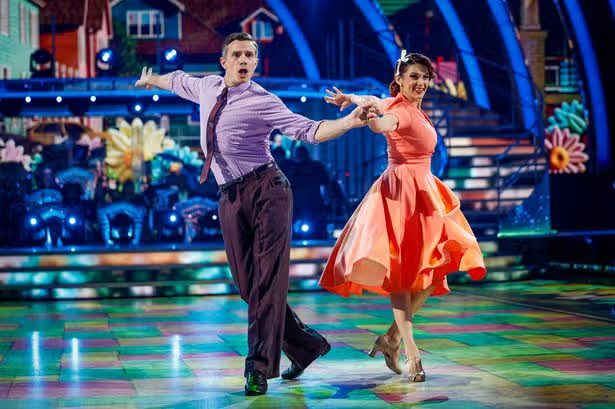
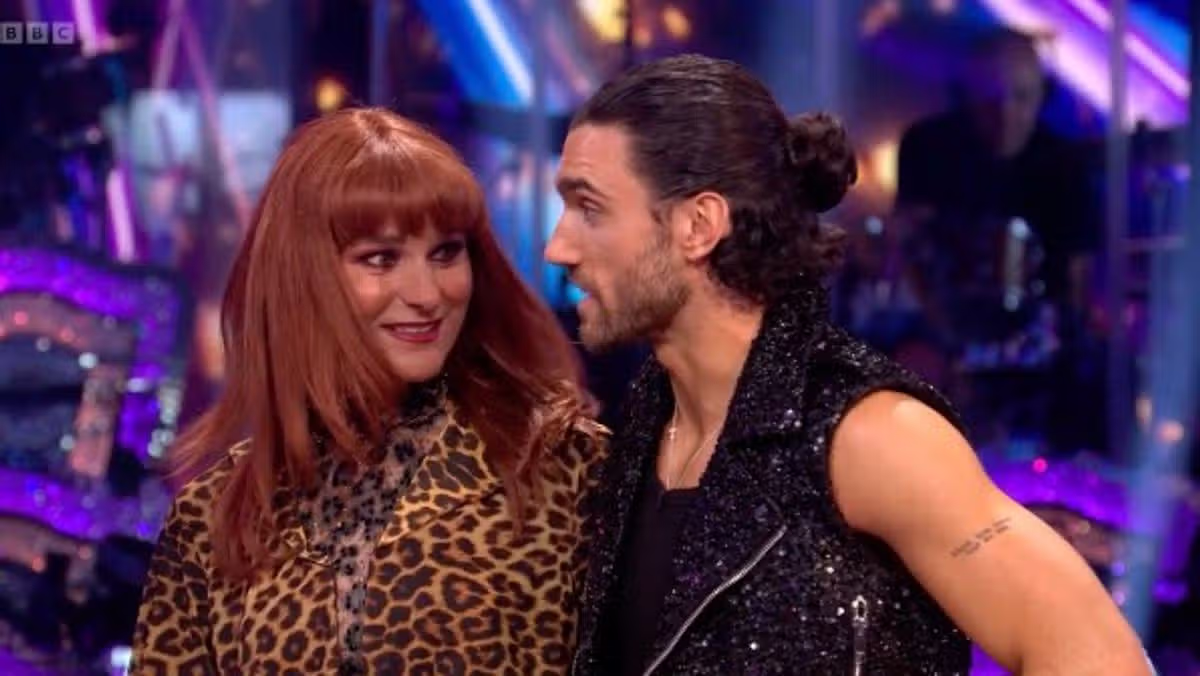
Shaun Wright-Phillips on Instagram: “Last night was a challenge, but as always, we dance, we smile, and we keep going! Thank you to all those who voted and supported as always 🙌🏾🕺🏾 #strictly”
5,020 likes, 64 comments – shaunwp98 on October 25, 2026: “Last night was a challenge, but as always, we dance, we smile, and we keep going! Thank you to all those who voted and supported as always 🙌🏾🕺🏾 #strictly”.
Sarah Storey’s performance with Julian(Image: BBC)
Sarah Storey’s performance didn’t just have the judges talking!
Judge Anton told Britain’s most successful Paralympian that she was better than she thought she was.
Craig told her she looked “fantastic”, but her solo dancing saw her “drop the ball”. Motsi didn’t agree entirely with Craig, saying she was “playing the role”.
As the scores came in, Sarah was given a message from icon Shania Twain herself, leaving them screaming.
Shania shared her hopes to see Sarah and Julian’s Tango at one of her UK shows. As for the scores, they were 5, 5, 5, 6, equalling a total of 21.
If you’re one of the (very rare) people who haven’t seen the first few episodes of the Celebrity Traitors, here’s what happened at the end of the last episode…
(Image: BBC)
The three Traitors – James Acaster, Maya Jama and Hannah Fry – had a big decision to make. They chose to play a fatal game of Hide and Seek with four of the Faithfuls. They were allowed to put themselves amongst the four but chose not to, hoping suspicion might fall on one of their chosen Faithfuls and they can safely slip under the radar…
They chose four stars – Leigh-Anne, Ross, Rob and Romesh – and will ‘kill’ one. However, they don’t know that Leigh-Anne has a special key which protects her from being murdered…
A STATE of emergency has been declared on the Greek island of Rhodes after flash floods swept cars into the sea and claimed the life of a hotel worker.
Cars are swept into the sea, following a heavy rainstorm on the Greek island of Rhodes, which left one person deadCredit: ReutersThe weather has flooded streets and caused rivers to overflowCredit: Reuters
Greek authorities have ordered British holidaymakers to restrict all but essential travel – here’s everything you need to know.
Where is the flooding in Rhodes?
Rhodes’ eastern coastline bore the brunt of the weather, with the area around Stegna beach near Archangelos suffering flash flooding.
Dozens of cars were submerged or abandoned across the island’s road network as drainage systems struggled to contain the rainwater.
Data from the National Observatory of Athens confirmed that Rhodes recorded 264mm of rain, 202mm of which fell in just six-and-a-half hours.
That’s a month’s worth of typical rainfall in a single morning.
What is the current Rhodes weather forecast?
Conditions across Rhodes have begun to calm as the worst of the storm front moves east.
The UK Met Office and the Hellenic National Meteorological Service both forecast drier conditions for the region on Thursday October 15, with sunny spells for the remainder of the day.
Temperatures are expected to peak at 23C, with moderate northwesterly winds between 12 and 16mph.
Though the forecast points toward calmer conditions, forecasters and officials stress that the danger has not fully cleared.
Because the island’s terrain is saturated, more rain could present a risk of further localised flooding and mudslides.
Tomorrow (October 16) is expected to stay largely dry and sunny, but an unsettled Atlantic front is forecast to push across the Aegean Sea over the weekend.
This is expected to bring a renewed chance of showers by Saturday.
Elsewhere in Greece, the Hellenic National Meteorological Service has issued yellow “Be Aware” alerts for Crete and the South Aegean.
What is the advice for holidaymakers?
Thousands of UK tourists visit the region every year for late-season sunshine.
With 112 emergency alerts remaining active, tourists are advised to limit their movements to absolutely necessary journeys.
Several key bridges and roads across Ialysos, Faliraki, Afandou, and Rhodes Town are submerged or damaged by mud.
Authorities have suspended multiple transport routes, including the key Rhodes–Faliraki tourist corridor and services to and from Akandia port.
Greek emergency services recommend that all travellers monitor local weather warnings through the Hellenic National Meteorological Service and follow instructions via the official @112Greece Twitter/X channel.
Never attempt to drive or walk through standing or flowing water, as road surfaces may have collapsed underneath.
Keep an eye on the UK Foreign, Commonwealth & Development Office (FCDO) travel advice pages for Greece regarding sudden disruptions.
Oh, Strictly. Home of the both the most bizarre and glorious dances known to man. Over the years we’ve seen some incredible routines – ones that brought a tear to the eye, ones that made us double over with laughter, and ones that made our jaws drop.
Many have been watched again and again online. Here are six that broke the internet:
Faye Tozer and Giovanni Pernice’s Charleston
This charleston, choreographed the The Lonely Goatherd, is amongst the most iconic, inventive, and technically brilliant performances the programme has ever witnessed. Bruno hailed it a “theatrical masterpiece” and urged them to “take it to Broadway”. Darcey Bussell emphasised how remarkable it was that a specific movement had been crafted for every single beat of the music.
(Image: BBC)
Lewis Cope and Katya Jones’ Couple’s Choice
Lewis and Katya’s Couple’s Choice to a jazz version of Radiohead’s Creep during Series 23 proved to be one of the defining, standout moments of that series. The performance moved many viewers and judges to tears, with commentators and former professionals hailing it as one of the most unforgettable Couple’s Choice routines in Strictly history.
(Image: BBC)
Danny Mac and Oti Mabuse’s Samba
Who can forget the first samba to earn a 40 on Strictly? Oti crafted professional-level choreography, and Danny delivered fluid hip isolations and relentless energy that matched her step-for-step.
(Image: BBC/Guy Levy)
Rose Ayling-Ellis and Giovanni Pernice’s Couple’s Choice
Their Couple’s Choice routine is widely regarded as one of the most powerful, moving, and culturally significant moments in British television history. Performed in Week 8 to “Symphony” by Clean Bandit ft. Zara Larsson, the contemporary routine was dedicated to the Deaf community.
At the midpoint of the routine, as the music swelled to its peak, the sound cut out entirely, leaving a silence lasting roughly 20 seconds while Rose and Giovanni continued dancing in perfect unison.
(Image: BBC)
Bill Bailey and Oti Mabuse’s Couple’s Choice
Bill, a 55-year-old actor and comedian initially regarded as the “novelty” or wildcard contestant of the series, astonished everyone with his remarkable sense of rhythm, musicality, and dedication. The performance immediately went viral on social media and established Bill as a genuine contender for the series title.
(Image: BBC)
Aston Merrygold and Janette Manrar’s Salsa
The choreography showcased numerous breathtaking overhead lifts and spins, capitalising fully on Janette’s mastery of Latin theatrical work. Their salsa proved hugely popular with audiences and achieved an impressive score, though it later became a focal point of debate within the series, as only three weeks later, Aston and Janette were knocked out.
Welcome Faithfuls, come on in Traitors, and a special hello to anyone who claims to be both (Richard E Grant, we see you there in your Burberry scarf).
Celebrity Traitors is back on screens tonight for episode 3 and we dive straight back into the first banishment with the Faithfuls hoping they’ve caught a Traitor.
But it’s a battle between people taking Richard E ‘I’m a Traitor’ Grant at his word and the others that think he’s a Faithful on a wind-up, which is proving an increasingly tricky position to take.
Will he survive? Can’t see how, but this is Celebrity Traitors and Alan Carr, who couldn’t even say “I am a Faithful” without cracking up, won it! Anything could happen.