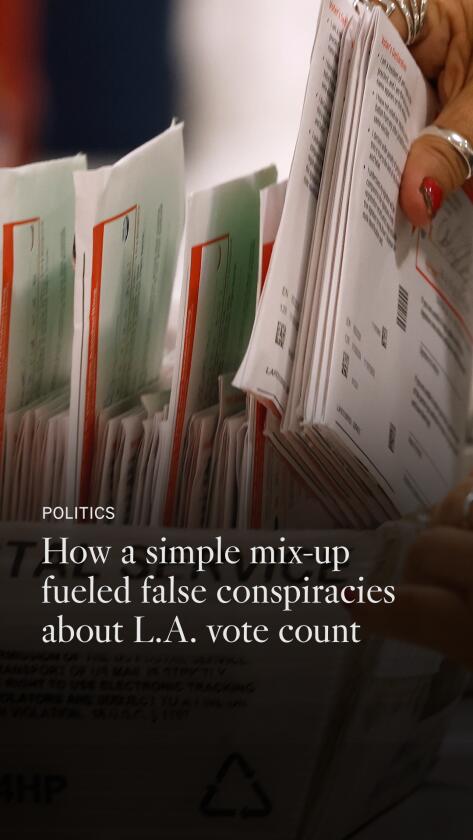
Since election night in California, a single theory of election fraud has taken root like no other — not just among online conspiracy theorists or bot accounts, but among major conservative influencers and people close to President Trump.
Late on election night, an update of vote counts in the Los Angeles mayor’s race appeared on election results pages of various media outlets including the Los Angeles Times.
It showed leading Democrats Mayor Karen Bass and Councilmember Nithya Raman receiving tens of thousands of new votes, and leading Republican former reality TV star Spencer Pratt receiving no new votes.
Close observers of the vote tally immediately took screenshots, with some shouting fraud. Others ran statistical analyses that showed it would be impossible for a candidate such as Pratt — running second in the race — to receive zero votes in such a large batch of ballots.
Share via
“They’re not even trying to hide the fraud anymore,” wrote Elon Musk, the world’s richest man and one-time member of Trump’s inner circle.
The claim fit into the broader narrative being pushed relentlessly by Trump and other Republicans in recent days, that California Democrats were cheating.
But the discrepancy in the Tuesday vote count in the mayor’s race was not fraud.
What attracted far less attention than the update with zero Pratt votes was another update one minute later that showed tens of thousands of votes for Pratt, and none for Bass or Raman.
There was no batch of votes that included zero votes for any candidate, as Los Angeles County’s own data show plainly.
But voting data pushed out by the Associated Press came as two separate updates one minute apart, with Bass’ and Raman’s votes in the first and Pratt’s in the second.
“The AP vote count receives updates as provided by election officials and adds them to our vote count. What happened in this case is that there was a lag in an automated update such that some candidates’ votes were added in one update and the other candidates followed about a minute later,” the Associated Press said in a statement to The Times.
“Specifically, an electronic update from the Los Angeles County website pulled in votes for only one group of candidates, including Karen Bass and Nithya Raman. Exactly one minute later, the electronic update picked up the votes for another group of candidates including Spencer Pratt. Taken together, the updates included 21,870 votes for Pratt, 12,850 votes for Bass and 9,521 votes for Raman, along with votes for other candidates.”
The Times’ election results page relies on the AP’s data feed, and checks for updates once a minute.
According to a Times review of election night results data, The Times pulled data from the AP’s feed at approximately 8:35 p.m. that included 0 new votes for Pratt and eight other candidates. When The Times’ system next checked for new numbers a minute later, there was an update with votes for Pratt but no new votes for Raman, Bass and others.
Michael Sanchez, a spokesperson for Dean Logan, head of the L.A. County registrar-recorder/county clerk’s office, said he could not speak for how news outlets report county data, but that he could confirm there were no batches of votes that included zero votes for Pratt.
“It is false,” he said of that narrative. “In every single result update that we released on election night and since election night, he has received votes,” Sanchez said.
Justin Grimmer, a political science professor at Stanford University and senior fellow at the Hoover Institution who researches and evaluates claims of election fraud, conducted his own data analysis of the vote updates, and came to the same conclusion.
He said there was an initial update with no Pratt votes, but a second one 41 seconds later with no votes for Bass or Raman — leading him to believe the single batch of ballots was just reported in two back-to-back updates rather than one.
“Because they came so close together, it looks like it was just a sequence of updates,” he said.
Grimmer said news outlets are “thinking about speed” and the best way to get people the most accurate information as quickly as possible, but “haven’t quite adjusted to being in this world where there’s this group of people who monitor these data feeds as if they are official government reports.”
“It leads to these horrible tweets about there being evidence of fraud,” he said.
Grimmer said he operates under the “mantra” that such fraud claims can’t be dismissed “by mere assertion” that the fraud didn’t happen, but must be looked into — which is why he dived into the data in the first place. This claim, he said, was similar to claims about odd-seeming vote tallies that were made during and after the 2020 election of Joe Biden over Trump, so he was familiar with how to look into the data.
“You can just go to the source code for the page, and then you can find where the sort of feed is, and that’s all I did — just found the feed, downloaded it, and then just saw what the updates were,” he said.
Grimmer said it was not surprising to him that people were watching the data feeds come in closely enough to notice an apparent discrepancy in the data that lasted less than a minute.
“There is a group of individuals who are convinced that there’s lots of fraud going on in U.S. elections, and for whatever reason, this group is convinced that they’re gonna uncover this by careful monitoring of these data feeds and the data that is being reported,” he said.
Grimmer said he would not presume to tell news outlets how to do their job of delivering election results quickly in the future, but does hope they balance the need to move quickly with “this reality that their feeds are now being monitored by individuals who think that they’re able to discover instances of fraud from what’s happening in the feeds.”
Sanchez reiterated that the county’s own official results of votes have been accurate — saying that “at no point” did the county office “report an official results update in which Pratt received zero votes.”
The One Show has welcomed back one of its hosts after she was absent due to illness
A presenter has returned to The One Show after being off ill(Image: BBC screengrab)
One of the presenters on The One Show has returned to the sofa after taking time off ill.
Alex Jones is usually a staple on the BBC programme but was absent on Monday and Tuesday this week, with JB Gill stepping in and hosting alongside her regular co-presenter, Roman Kemp.
However, the TV star was back on Wednesday (June 3), fronting the show alongside Angellica Bell.
Alex’s return was confirmed on Instagram ahead of the show, with Angellica exclaiming: “Good news, everyone. Alex is back!”
“Are you feeling better?” she asked the presenter.
“I am,” replied Alex. “I am slightly croaky, but we’ll get through it,” she added.
As the show started, she told Angellica that she had “nearly recovered” after being unwell, adding: “Glad to be here.”
The pair then turned to announcing the guests who would be on the show – Dara Ó Briain and Shania Twain.
Alex has been hosting the BBC programme for several years, and is one of the show’s best known presenters. The star, who has three children with her husband Charlie, has been a presenter on the programme since 2010, hosting with stars such as Matt Baker, Ronan Keating and Roman.
Speaking last year, she told the BBC: “I feel incredibly proud to have been on the iconic sofa for all these years. It certainly doesn’t feel like 15 years, and it still feels fresh, as the show keeps evolving. I feel like we keep coming back better and better.
“I started as a young girl and I feel like I’ve grown up with our viewers. They have seen me through all my big life moments like getting engaged and married, to having children. Our viewers are like extended family by now!”
She went on: “I think the reason is it really strikes a chord with people because we sit right at the heart of the nation. Our job, essentially, is to reflect what’s going on. All the small daily bits and pieces, but also the big events that affect the country.”
An A-list actress has broken her silence on one of the most anticipated TV events of the next few years
‘Best TV show ever’ gets thrilling update nearly a decade after finale
One of the show’s A-list cast members has teased filming could start soon.
A critically acclaimed television drama watched by millions of fans globally will be returning for a third series, with fresh episodes anticipated to broadcast following an almost decade-long absence.
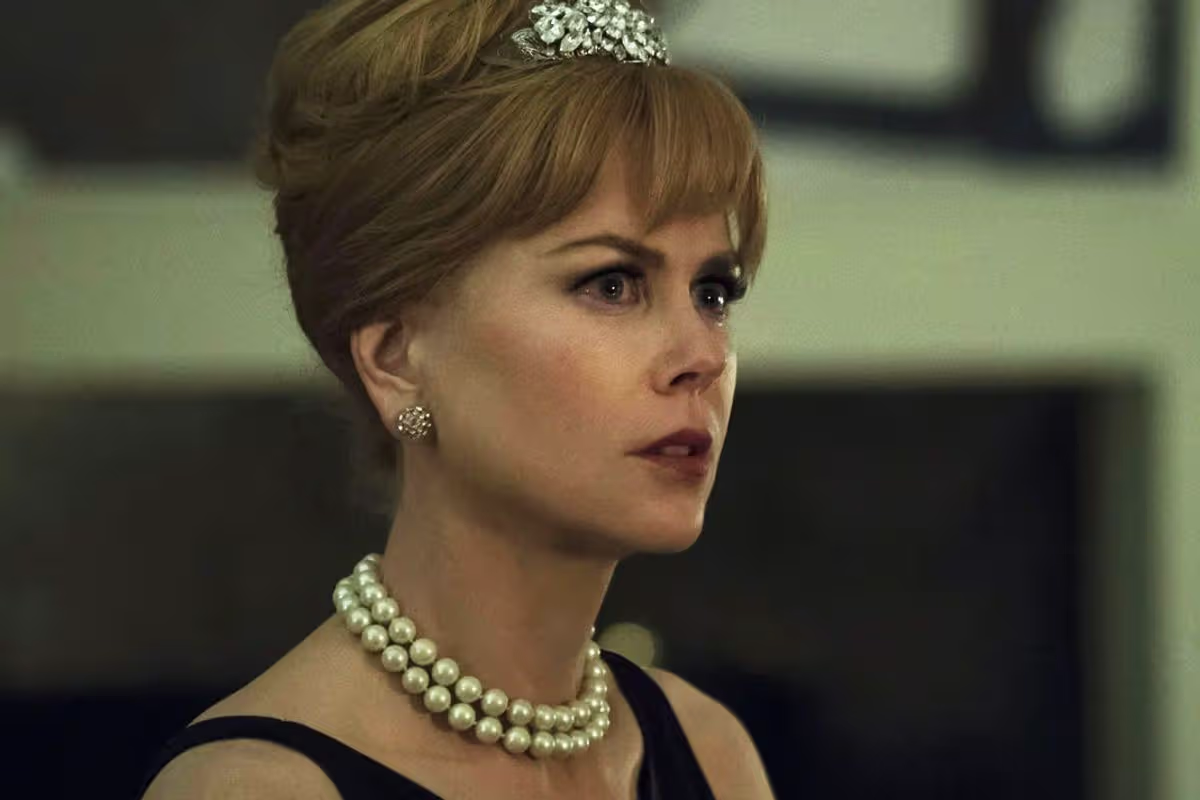
Big Little Lies first premiered on HBO in 2017, adapted from Liane Moriarty’s bestselling novel of the identical title and boasting Hollywood legends Reese Witherspoon, Laura Dern, Nicole Kidman, and Shailene Woodley amongst the cast.
A second series was swiftly commissioned and progressed the narrative with three-time Academy Award winner Meryl Streep joining the exceptional ensemble.
One IMDb user described it as “breathtaking” and “a masterpiece of art in every possible way”. Another audaciously declared: “It’s a big statement but this is possibly the best program on television, EVER!!”
Yet, despite the programme’s popularity and outstanding ratings, including an impressive 89 percent score on Rotten Tomatoes, there had been no developments regarding a third instalment until September last year, reports the Express.
The inaugural series tracked young single mum Jane Chapman (played by Woodley), who relocates to the coastal city of Monterey, California with her troubled son, Ziggy (Iain Armitage). She quickly becomes entangled in the turbulent lives of a circle of affluent women, whose picture-perfect existence is torn apart by a catastrophic incident at their local school.
The second series picks up immediately in the wake of the events, with the women desperately attempting to conceal a murder, yet the appearance of one of their mothers-in-law (Streep) places them under an extraordinary amount of pressure. There’s only so much they can endure before things begin to unravel.
Now, series regular Woodley has verified reports that a third season is currently in development, though viewers should anticipate significant changes when the story resumes.
“I mean, what I know about it is that supposedly it is happening. That is what I know,” she told Deadline.
Sky’s Ultimate TV bundle
This article contains affiliate links, we will receive a commission on any sales we generate from it. Learn more
Sky is giving away free subscriptions to Netflix, Disney+, HBO Max, Hayu and discovery+ to customers on the Ultimate TV bundle.
When pushed for further details, the actress enthused, “Oh my gosh. I love my girls. That’s what makes it so special. We’re each other’s people”.
A production schedule has yet to be confirmed, meaning Big Little Lies’ third series may not emerge until late-2027 or 2028.
Nevertheless, Woodley did verify that the new instalment will acknowledge the considerable gap between series, hinting that the likes of Armitage and Kathryn Newton, who played Madeline’s (Witherspoon) daughter Abigail, could make a comeback.
“We love each other and we’re here for each other and, also, it’s a blast to play these characters,” she continued.
“I’m really excited about the third season, and for the opportunity that might exist in exploring who these ladies are 10 years later. We’re all 10 years older. The children are all 10 years older.
“They’re not really children anymore and most of them are adults now. So the prospect of that is very cool.”
Big Little Lies is available to stream on Sky, NOW, and HBO Max.
EastEnders spoilers for next week have teased the fallout to the big episodes airing this week, hinting at Jordan’s fate as well as Denise getting a sad update on the BBC soap
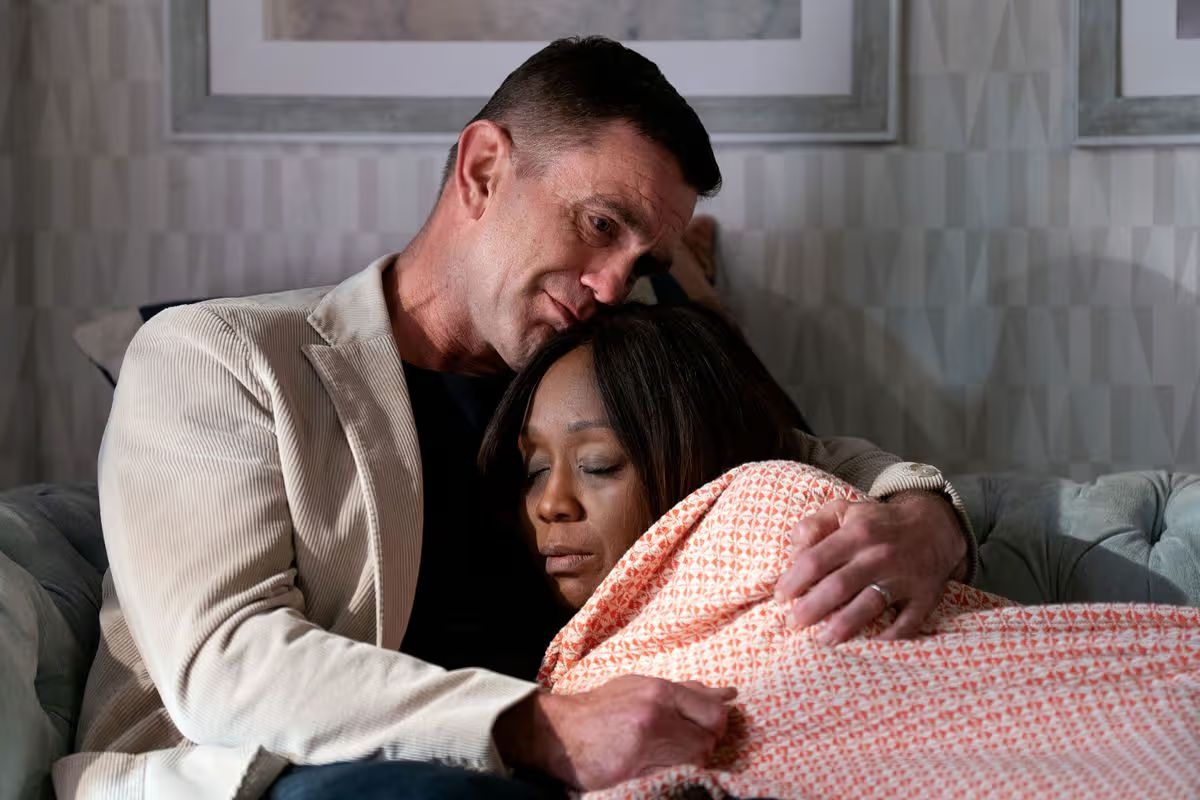
There’s some huge moments ahead on EastEnders(Image: CREDIT LINE:BBC/Jack Barnes/Kieron McCarron)
There’s some huge moments ahead on EastEnders, with spoilers for next week confirming bombshells and worrying scenes.
It’s the fallout to the show’s big week that “changes everything”, with new details confirmed about what happens. Not only that, but we see characters struggling in the fallout, and reacting to some big discoveries.
George clashes with Nicola about her deal with Eddie, leading to him heading to the boxing gym. A friendly session with Mark takes a turn though, when Mark punches George and he falls unconscious.
Phil reveals to a stunned Mark that George should never have been boxing due to his brain injury. A groggy and confused George refuses hospital treatment, so Phil takes him home and informs Nicola about George’s CTE.
Harry worries that George might tell Gina about Nicola’s deal with Eddie, fearing it will end their relationship. He does encourage Nicola to tell Gina before someone else does, while Nicola tries to get through to George.
Denise is shocked when doctors insist she be admitted immediately for treatment. Despite Jack’s pleas, Denise is determined to be there for Chelsea after Jordan’s accident involving Ian.
When Denise’s condition worsens, Jack shares the doctor’s warning with Yolande in a bid to encourage Denise to start her treatment. Denise refuses still, while later in the week Chelsea learns that Jordan’s rehabilitation may not work.
Kat plans a birthday dinner for Jasmine, while Oscar secretly juggles time seeing the twins separately. When Oscar finds out the circumstances around the death of the twins’ foster dad, and Jasmine’s departure from the family, he asks Jasmine about it, causing her to lash out.
Josh and Oscar give into temptation, but Kat spots them kissing. Kat confronts Oscar and tells him to stay away from Josh and Jasmine, before she tells Alfie what she saw.
Unaware of the situation, Zoe invites Oscar to the meal for Jasmine and Josh. It looks set to be another drama-filled week in Walford next week then!
Edinburgh Airport has said operations have no returned to normal (Image: undefined via Getty Images)
Flights were delayed at two major UK airport because of jet fuel supply issues on Sunday evening. Passengers on ten flights flying out of Glasgow and Edinburgh airport faced delays.
The two Scottish airports have now said their operations are returning to normal after issues with the supply of jet fuel on Sunday evening.
The situation around the Strait of Hormuz, where shipping has been severely constrained since the outbreak of the Iran war, has led to a reduction in the global supply of jet fuel. However the issues at the two Scottish airports are understood to be linked to a shortage in drivers for fuel lorries rather than the global market.
A spokesperson for Edinburgh Airport said 10 flights were delayed on Sunday, but deliveries had resumed on Monday.
A spokesperson for Glasgow Airport said: “A short‑term staffing issue has affected one of the fuel suppliers used by airlines at the airport, with work underway to return stock levels to normal. There have been no related flight cancellations, and the airport remains fully operational.”
The spokesperson said fuel stocks are now returning to normal and there was no widespread disruption despite delays to some flights. Jet fuel is purchased by airlines, while the airports provide storage and infrastructure.
The Hawkstone Farmers Choir was crowned the winner of Britain’s Got Talent 2026 after they sang an original song called This Is Home in the final on ITV last night
01:02, 31 May 2026Updated 01:04, 31 May 2026
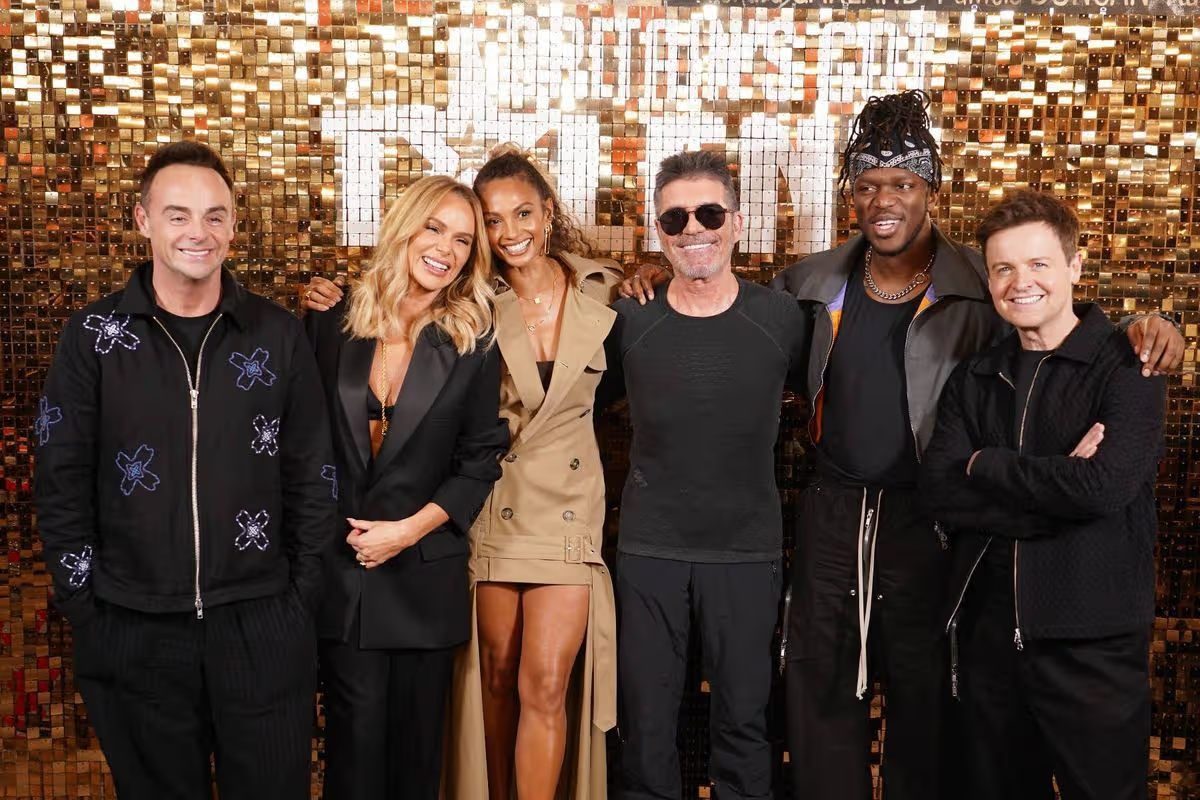
(left to right) Ant McPartlin, Amanda Holden, Alesha Dixon, Simon Cowell, KSI and Declan Donnelly (Image: PA)
Amanda Holden has expressed her delight following the crowning of the 2026 Britain’s Got Talent winners, The Hawkstone Choir.
The 10 acts, which include Golden Buzzer winner and singer Matty Juniosa and PowerPoint comedian Ted Hill, performed again for the judges – Simon Cowell,Amanda Holden, Alesha Dixon and KSI. The winner, Hawkstone Farmers Choir, won £250,000 alongside the Royal Variety spot, and was ultimately decided by a public vote.
For the final, The Hawkstone Farmers Choir sang an original song called This Is Home. The choir sang the emotional song whilst stood in front of a backdrop of the local countryside through the changing seasons. They dedicated the song to anyone who is struggling.
In a video shared to Simon Cowell’s Instagram, Simon and Jeremy Clarkson could be seen celebrating together moments after Hawkstone Farmers Choir’s win.
“Wow, wow, wow,” Simon started before panning the camera so that Jeremy could join in from over his shoulder. That was incredible,” Jeremy said. Simon remarked that he could see how nervous Jeremy got upon seeing the choir perform and whislt waiting to see in they would win. Jeremy continued: “They worked so hard, thank you for having us.”
Simon added: “They did deserve it.” He wrote in the caption: “Wow wow wow. I am genuinely thrilled. A very very very happy choir, and so they should be.”
Content cannot be displayed without consent
Amanda Holden also took to social media to express her joy that her golden buzzer act won for a second year running. Captioning the post: “Omfg. I couldn’t be more delighted that the brilliant @thehawkstonefarmerschoir won the whole thing @bgt!! I haven’t stopped crying. They deserve every second of the elation and joy!!! So BLOODY PROUD!!”
One user commented: “Sooo super happy they won! Well done. I couldn’t hold back the tears. So glad they have a voice – what a special final,” another said: “So bloody proud of them all absolutely smashed it, massive congratulations guys such hard working worthy winners chuffed to bits for them.”
Follow our live blog for the latest updates by clicking here.
Coronation Street actress Tracy Shaw, who played Maxine Peacock in the ITV soap, has been battling breast cancer and has now shared an update after completing her first day of chemotherapy
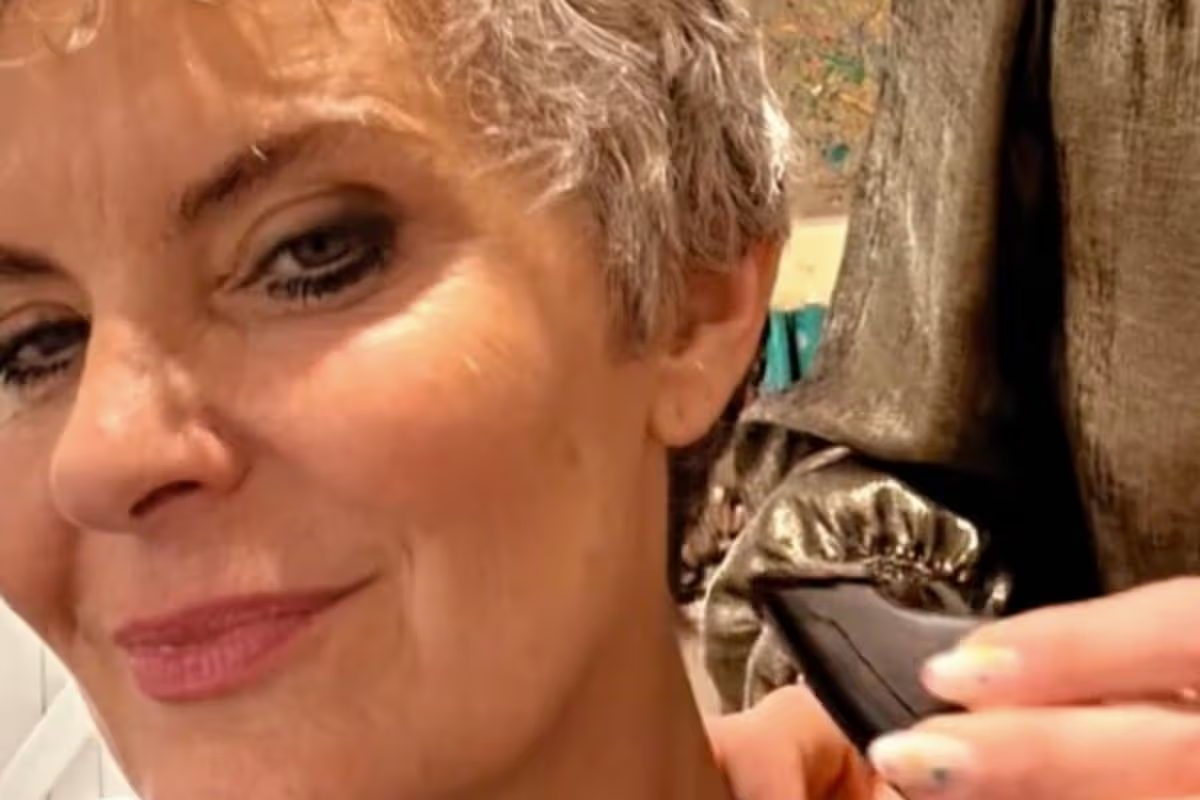
She showed herself having her hair cut off(Image: tracy.k.shaw/Instagram)
Coronation Street star Tracy Shaw, who portrayed Maxine Peacock in the ITV soap opera, has shared a health update after she revealed she has been fighting breast cancer.
Following the completion of her first chemotherapy session she explained to fans that she would be shaving her head and donating her hair to charity. Posting a video on Instagram, she disclosed to her followers that she had spent more than eight hours at her initial appointment.
The actress said: “First day of chemo done. I’m feeling alright but that has a great amount to do with the steroids which are helping my body fight the chemo that has gone in. So I went in today to start at 9am and I left at 5:30pm, very hot day and there was a bit of delay.”
She continued: “Basically with my chemo injection, one of which hadn’t arrived, it’s got nothing to do with robots or anything to do with the hospital team, it was the medics delivery, so yeah that was the delay. But I’m feeling really positive but everything I keep eating tastes horrible.
“Everything tastes of metal, just like you told me, and every now and again I feel like the Incredible Hulk, I want to start moving furniture around, the dogs keeping away from me because they sense that.”
This follows her recent decision to cut her hair to donate to The Little Princess Trust, and she has since ventured out to shop for a replacement wig. She posted footage online of herself modelling the various wigs and displaying them while being assisted by a Macmillan nurse who also offered guidance to individuals experiencing a similar situation, reports the Express.
Earlier this month Tracy revealed the emotional difficulties she’s been encountering, informing her followers: “Each morning I wake up and know that I have to go into hospital and receive more news, which has been going on for a long time, that unknown… I just think, ‘I can’t go through with this anymore,’ but I’ve not even started my journey.”
She’s received an outpouring of support online from her followers as she’s posted updates on every stage of her journey, with many of Tracy’s recent posts emphasising how waking up is a “gift” each day.