united states

US Defense Department bars journalists from its press office | Media News

Media freedom advocates condemn move as latest effort to curtail independent reporting on the US military.

The United States Department of Defense has barred journalists from its press office, the latest move by the Pentagon to restrict media access since President Donald Trump’s return to the White House.

Acting Pentagon Press Secretary Joel Valdez said on Monday that the administration had re-designated the office as a “Sensitive Compartmented Information Facility” due to its use by speechwriters with access to classified government information.

Recommended Stories

list of 4 itemsend of list

“These speechwriters routinely handle classified material and require SIPRNet access,” Valdez said in a statement provided to Al Jazeera, referring to the secure computer network used by the Pentagon to share classified information.

“As a result, journalists will no longer be permitted to enter the office space. Access to the office of the Assistant to the Secretary of War for Public Affairs and to the Press Secretary remains available by appointment only,” Valdez added, using the Trump administration’s preferred title for Defense Secretary Pete Hegseth.

The Washington Post first reported the change.

The move follows a slew of steps by the Trump administration to curtail the ability of US media outlets to report on the military and other areas of the government.

In March, the Defense Department said it would no longer allow media outlets to maintain offices at the Pentagon after a judge sided with The New York Times in a lawsuit challenging the imposition of new rules for obtaining press credentials.

The Pentagon also announced that journalists would require an official escort while inside the complex, a policy that The New York Times is seeking to overturn in a separate lawsuit filed in May.

The National Press Club, the main professional organisation for journalists in the US, condemned the latest restrictions as a “troubling escalation” in the Trump administration’s efforts to curtail media scrutiny of the Pentagon.

“Independent reporting on the US military is not optional,” National Press Club President Mark Schoeff Jr said in a statement.

“When journalists are pushed farther from the institutions they cover, the American people are left with less information, less transparency, and less oversight. Any effort to restrict that access should alarm everyone who values a free and informed society.”

The Freedom of the Press Foundation, a nonprofit advocacy organisation, also criticised the move.

“It’s rare for anything other than disingenuous spin and outright lies to come out of the Pentagon’s press office these days, so it’s hard to imagine what basis they have to call the space classified,” Seth Stern, chief of advocacy at the organisation, told Al Jazeera.

“The only thing sensitive or confidential about the information released by Pete Hegseth’s Pentagon is that it’s not true.”

Source link

Who attended this year’s Israel Day Parade in New York? | Newsfeed

NewsFeed

As Israel faces growing international scrutiny for its actions in Gaza and Lebanon, Al Jazeera’s Ava Warriner takes a look at the Israeli and US officials who joined the annual Israel Day parade in New York – the world’s largest gathering in support of the State of Israel.

Source link

AI giant Anthropic files for US IPO as investors bet big on AI future | Technology News

Anthropic, which operates AI chatbot Claude, did not disclose the size or the terms of the offering.

Artificial intelligence giant Anthropic has confidentially filed for an initial public offering (IPO) in the United States, teeing up what could become a watershed moment for Wall Street’s AI frenzy.

The move, announced on Monday, sets up a high-stakes test of whether investor appetite for the AI revolution that has reshaped white-collar work around the world can match the sky-high expectations surrounding the booming sector.

Recommended Stories

list of 4 itemsend of list

Anthropic, which operates AI chatbot Claude, did not disclose the size or the terms of the offering. Confidential submissions let companies advance IPO preparations while shielding sensitive financial details from rivals and the public.

Anthropic last raised $65bn at a post-money valuation of $965bn in late May, putting it ahead of rival OpenAI. The company said at the time it was making annualised revenue of $47bn from selling its technology to people and organisations using Claude to write code and do other work and personal tasks on their behalf.

The crucial step towards a listing comes on the heels of SpaceX’s mega-IPO, which is on course to rewrite the record books as the Elon Musk-led company pursues a $75bn offering at a $1.75 trillion valuation.

Anthropic was formed in 2021 by ex-OpenAI leaders, and now both AI firms, along with Elon Musk’s rocket and AI company SpaceX, are all expected to become publicly traded. All three are also still losing more money than they make, fuelling concerns of an AI bubble.

OpenAI and Anthropic have become the face of the AI boom that has redrawn corporate strategies, sparked a global arms race for computing power and talent, and turned AI-linked companies into some of the market’s most richly valued firms.

Anthropic’s rapid rise in early 2026 rattled markets, triggering sharp sell-offs in software and IT stocks as investors worried its increasingly autonomous AI tools could upend traditional business models and accelerate disruption across industries.

“OpenAI and Anthropic are in a race to go public before capital runs out,” said analyst Gil Luria from the investment firm DA Davidson.

“The other reason for Anthropic to try to beat OpenAI out to the public market is that they will get to set the agenda for how a frontier model reports financials and do so in a way that is favourable to their financial model.”

OpenAI is also preparing to confidentially file for a US IPO in the coming weeks, adding to a wave of blockbuster ‌listings anticipated in the year ahead.

A market milestone

As many blockbuster listings race towards public markets, companies from SpaceX to AI giants are competing for a finite pool of investor capital.

“The combined demand for capital from SpaceX, OpenAI and Anthropic will be so considerable that it is likely to create disruptions in the capital markets, so going early will be a great advantage,” Luria said.

The listing would represent one of the most consequential stock market debuts in years, potentially reshaping benchmark indexes, investor flows and the broader narrative driving US equities.

At close to a $1 trillion valuation, Anthropic would vault into the top tier of the S&P 500, alongside a handful of elite companies that dominate global equity markets.

An Anthropic debut would be a major boost for the long-sluggish IPO market, though experts and bankers warn an offering of such scale could drain liquidity and investor attention from smaller listings.

Source link

Nvidia unveils new chip to bring AI directly to personal computers | Technology News

Nvidia is set to bring artificial intelligence to laptop and desktop computers with brands like Microsoft and Dell later this year as the US tech giant broadens its AI presence.

The Santa Clara, California-based AI chipmaker unveiled on Monday at its annual Nvidia GTC event in Taipei new powerful chips that would bring advanced AI functions to laptops and desktop computers.

Recommended Stories

list of 4 itemsend of list

CEO Jensen Huang said that the new development is “going to reinvent the PC [personal computer]”.

The changes come amid three years of collaboration between Microsoft and Nvidia and pit the latter against companies like chipmaker Advanced Micro Devices and personal computer brands Intel and Apple.

“This is going to be the new PC,” Huang said as he unveiled Nvidia’s RTX Spark superchip — which combines CPU, or central processing unit, and GPU, or graphics processing unit, capabilities — that would power new Windows laptop and desktop computer models in what the company called “AI personal computers”, expected to debut in the fall of this year.

The chip, developed with Taiwan’s MediaTek, will be in compact desktops from Dell, HP, Lenovo, ASUS, Microsoft Surface and MSI, with models from Acer and GIGABYTE to follow.

Nvidia, which is already the world’s most valuable company, said the reinvention will be for creating and gaming.

“When it has an autonomous [AI] agent, an agent that’s helping you, that understands you, you could talk to it. It could look at you. You could ask it to read files, go help you do some research. It could do a lot more,” Huang said.

Microsoft said in a separate statement that the personal computers running on Nvidia’s RTX Spark superchips would be able to support “highly capable AI models” and complex workloads. With the new superchips, these personal computers can run AI agents locally, Nvidia said.

“This is the first across the lineup of PC reinvention for 40 years,” Huang said.

Nvidia’s move is significant at a time when demand is growing for the use of personal AI agents, said Lian Jye Su, chief analyst at the technology research and advisory group Omdia.

“For consumers, it means more choices, which is always a good thing,” Su said.

Neil Shah, analyst and co-founder of Counterpoint Research, described Nvidia’s announcement as a move that’s “revolutionising how PCs would look like in the next 10 years”.

The new laptops and desktop computers “will drive agentic AI applications in every home”, Shah said, with an aim of having an “AI supercomputer” in each household.

Also during Monday’s speech, Nvidia’s Huang said its new Vera CPUs for data centres are in full production and are “going to be our new major growth driver” on the boom of AI agents, with early customers including Anthropic, OpenAI and SpaceXAI.


Huang also revealed a humanoid robot reference design that could act as a blueprint for future research, especially within the higher education sector. Nvidia said its “Isaac GR00T” stands nearly 1.83 metres (6 feet) tall and has the humanoid chassis of Chinese robot maker Unitree’s H2. It is equipped with five-fingered dexterous hands, made by Singapore-based robotics startup Sharpa, that are capable of finely controlled movements.

Reception for AI PCs has been mixed so far. HP reported last week that the devices helped prop up quarterly sales, but Dell said earlier this year that demand had fallen short of initial expectations. Qualcomm, looking to capitalise on AI demand, has also been offering AI PCs with Microsoft.

On Wall Street, Nvidia stock rose nearly 4 percent on the news in midday trading. Microsoft ticked up 2.5 percent and Dell surged 9.3 percent. Competitors AMD and Intel, on the other hand, are on the decline. AMD is down 0.1 percent from the market open, and Intel is down by 2.5 percent.

Source link

Iran war day 94: US strikes Iranian sites; Kuwait intercepts missiles | US-Israel war on Iran News

While a peace deal between the US and Iran remains elusive, Israel has deepened its offensive into southern Lebanon.

The United States military says it has struck Iranian military sites, and Iran’s Islamic Revolutionary Guard Corps (IRGC) says it has targeted a US base in response, the latest in a series of exchanges as negotiations to end the three-month US-Israel war on Iran are conducted.

US President Donald Trump also on Monday described Iran as eager to reach an agreement.

“Iran really wants to make a deal, and it will be a good one for the USA and those that are with us,” he posted on his Truth Social platform.

Here is the latest on the US-Iran negotiations as both sides announced on day 94 of the war on Iran that they traded attacks:

In Iran

  • Production restored at South Pars: Iran has restored gas production at three offshore platforms in the South Pars gasfield after Israel attacked them in March.
  • US says it attacks Iranian military sites: The US military’s Central Command (CENTCOM) said it conducted “self-defense strikes” on Iranian radar and drone sites in the city of Goruk and on Qeshm Island at the weekend.
  • Iran executes two men over January protests: Iran executed two men convicted over their role in antigovernment protests in January, according to the Mizan news agency. The men were found guilty of setting fire to a mosque in Tehran, damaging public property and clashing with security forces, Mizan reported.

War diplomacy

  • Iran says messages being sent to US: Iranian Foreign Minister Abbas Araghchi said Tehran is continuing to exchange messages with the US on a deal to end the war.
  • Trump’s stance: Araghchi’s comments came after US media reported that Trump has called for tougher terms in the preliminary agreement.

In the Gulf

  • Kuwait intercepts missiles and drones: The General Staff of the Kuwaiti army said its air defences were “confronting hostile missile and drone attacks”. If sounds of explosions are heard, they are the result of air defences intercepting the projectiles, the army added.

In Lebanon

  • Israel pushes farther into Lebanon: Prime Minister Benjamin Netanyahu has ordered Israel’s military to push farther into Lebanon after Israeli forces made their deepest incursion into the country in more than 25 years.
  • Hezbollah says it downs Israeli drone: The Lebanese armed group said it shot down an Israeli Hermes 450 drone over the western sector of southern Lebanon using a surface-to-air missile on Sunday evening. It said in a statement on Telegram that the strike was in response to Israeli violations of a ceasefire that went into effect on April 8.
  • Hezbollah strikes Israeli forces in southern Lebanon: Hezbollah also said its fighters fired a large number of rockets and artillery shells at Israeli forces on the eastern outskirts of the town of Yohmor al-Shaqif in southern Lebanon early on Monday.
  • US proposes new plan: The US has put forward a proposal to de-escalate hostilities in Lebanon, a US official told Al Jazeera, adding that Secretary of State Marco Rubio held separate talks with Lebanese President Joseph Aoun and Netanyahu.

In Israel

  • Israel said rocket fired from Lebanon intercepted: The Israeli military said it intercepted a rocket that set off sirens in northern Israel and destroyed the launcher from which Hezbollah fired the projectile. Earlier, Israel’s Ynet News website reported that air raid sirens had been heard in Western Galilee, the town of Kiryat Shmona and surrounding areas.

In the US

  • The IRGC says it strikes US airbase: The IRGC said it struck an airbase that was used for an attack on a telecommunications tower on Sirik Island, located in the southern province of Hormozgan, Iran’s Fars news agency reported. The IRGC did not specify the location of the facility.
  • Trump says Iran wants to make a deal: In a new Truth Social post, Trump claimed Tehran “really wants to make a deal” and whatever deal is reached will “be a good one” for the US “and those that are with us”.

Source link

Ex-US Fed Chair Powell warns against politicisation amid Trump’s attacks | Business and Economy

Jerome Powell says the US central bank is undergoing a ‘stress test’ like other institutions in the current era.

Former US Federal Reserve Chair Jerome Powell has warned against the politicisation of monetary policy amid President Donald Trump’s repeated attacks on the independence of the central bank.

In a speech at an awards ceremony in Boston on Sunday, Powell said that the Fed had been undergoing a “stress test” like many other institutions in the Trump era.

Recommended Stories

list of 4 itemsend of list

Powell said the US Congress had “wisely” chosen to insulate the central bank from political pressure and that all other advanced economies had similar norms upholding the independence of monetary policy.

“These protections have served the public well, and administrations from both parties have respected them,” Powell said after accepting the 2026 John F Kennedy Profile in Courage Award.

“If any administration finds a way to remove Fed officials over policy differences, then future administrations will do so as well,” Powell said.

“The public would lose faith that the central bank will make decisions based only on what’s best for all Americans.”

Powell, who stepped down as the head of the central bank last month, said that the Fed’s credibility would be “lost” in such a scenario.

“That credibility enables the Fed to support a strong and stable economy for the benefit of American families and businesses,” he said.

“Our credibility has been built and sustained over many decades, and we have a duty to safeguard that priceless asset for our fellow citizens and for generations to come.”

Powell, who made the usual decision to stay on as one of the seven members of the Fed’s Board of Governors after stepping down as chair, also offered a broader defence of democratic institutions generally.

“Partisan political differences are normal – indeed essential – in a thriving democracy. But we ought to be united in our commitment to the higher principles that define our nation,” Powell said.

“Chief among them is respect for the rule of law. As John Adams wrote, ours is ‘a government of laws and not of men’. Our public institutions carry us forward through change. These institutions embody our commitment to freedom, democracy, and service of the public good.”

While Powell did not mention Trump by name, the US president has waged a sustained pressure campaign against the central bank for not heeding his demands to cut interest rates more sharply.

Trump repeatedly threatened Powell with dismissal during his tenure, while Trump appointee and ally Jeanine Pirro opened a short-lived criminal investigation into Powell’s congressional testimony about ongoing renovation works at the Fed’s headquarters.

Trump also ordered the removal of Fed governor Lisa Cook over unproven claims of mortgage fraud, though the Supreme Court has ruled that she can remain in her position while it considers a legal challenge against her firing.

Under the Federal Reserve Act, the US president must demonstrate “cause”, widely interpreted to mean malfeasance, to remove any of the Federal Reserve’s governors.

The John F Kennedy Profile in Courage Award was created in 1989 to honour those who demonstrate courage in public service without regard to professional or personal consequences.

Past winners of the award, which is named after Kennedy’s Pulitzer-winning book Profiles in Courage, include former US President Barack Obama, then-Ukrainian President Viktor Yushchenko, and then-UN Secretary-General Kofi Annan.

Source link

US says ban on AI chip shipments applies to Chinese firms outside China | Technology News

Department of Commerce issues guidance on chip restrictions amid concerns about loopholes in export control regime.

The United States has issued a notice affirming its restrictions on shipments of semiconductors to subsidiaries of Chinese companies located outside China amid concerns about loopholes in Washington’s export control regime.

The Department of Commerce said in the guidance issued on Sunday that its licensing requirements for the export of advanced AI chips applied to all businesses with headquarters or a parent company in China.

Recommended Stories

list of 4 itemsend of list

The Bureau of Industry and Security (BIS), which falls under the Commerce Department, said it issued the clarification in response to questions about whether it was enforcing preexisting licence requirements after it had overturned former President Joe Biden’s AI Diffusion Framework.

“The answer is yes,” the BIS said in the notice.

Unveiled in the final days of the Biden administration, the AI Diffusion proposed the implementation of a globe-spanning framework to control access to AI chips, including export caps for all but the closest US allies.

The framework drew backlash from tech firms, including Nvidia, the world’s most valuable chip company, which cast the proposal as a threat to innovation and cross-border collaboration.

President Donald Trump’s administration scrapped the framework last May, ahead of its implementation, citing the “burdensome new regulatory requirements” and the harm it would do to Washington’s diplomatic relations with other countries.

Chip giant Nvidia, whose top-of-the-line Blackwell GPUs are banned for export to China, said it had already been operating in keeping with the clarified rules.

“The guidance reaffirms that NVIDIA’s sales and vetting process is correct – consistent with our existing approach, licences are required to ship controlled products to PRC headquartered companies,” a Nvidia spokesperson told Al Jazeera, using the acronym for the People’s Republic of China.

AMD and Intel, Nvidia’s main competitors in the GPU space, did not immediately respond to requests for comment.

TSMC, which manufactures the most advanced chips on behalf of clients such as Nvidia, did not immediately return an email seeking comment.

The BIS also did not respond to inquiries.

Chris McGuire, a former State Department official who worked on technology policy in the Biden administration, accused the Trump administration of providing Chinese companies a loophole to buy export-controlled chips.

“Chinese companies have been buying these chips, very likely at scale. And because BIS has not updated export control regulations to clearly state what it IS enforcing, all of this was legal,” McGuire said in a post on X.

“This clarification does make clear that Blackwell shipments to China-headquartered companies outside of China are now illegal again – which is good, although obviously we have to see how many shipments have already gone to assess how much damage was done,” McGuire said.

“BIS’ statement acknowledges these shipments have been happening when it says companies who bought chips under this loophole don’t have to stop using them.”

The US has rolled out numerous restrictions on the supply of high-end technology to China, as Washington and Beijing battle for dominance in AI.

In December, Trump announced that he would allow Nvidia to sell its H200 chip to China, in a major loosening of Washington’s export controls.

While not Nvidia’s most advanced chip, the H200 is about six times as powerful as the H20, the most advanced chip previously allowed for export to China.

Source link

Newark mayor imposes curfew at Delaney Hall immigration detention centre | Protests News

Ras Baraka, the mayor of Newark in New Jersey, has imposed a curfew on the area surrounding Delaney Hall, the immigration detention centre that has become a flashpoint in the debate over United States President Donald Trump’s mass deportation drive.

The Sunday morning announcement came amid a flare-up in tensions outside the detention centre, which is run by the private contractor GEO Group, as part of a 15-year deal with Immigration and Customs Enforcement (ICE).

Recommended Stories

list of 3 itemsend of list

“Due to the escalating situation at Delaney Hall and the increasing need for police intervention, immediate action is required to protect public safety,” Baraka wrote in a statement.

“Multiple individuals have already been arrested and found in possession of weapons, underscoring the seriousness of the threat.”

As part of the curfew, movement will be restricted within half a mile (0.8km) of the detention centre between the hours of 9pm and 6am US Eastern time (1:00 to 10:00 GMT).

A nearby road, Doremus Avenue, will also be closed to pedestrians and vehicles that cannot verify their need to be in the area.

Since the reopening of Delaney Hall as an immigration detention facility last year, it has been the site of confrontations between law enforcement and protesters, including Mayor Baraka himself.

The month of May has seen more than a week of daily protests outside Delaney Hall, after lawyers for the detainees at Delaney Hall announced a hunger strike was unfolding inside.

Detainees have denounced the living conditions to human rights groups, reporting expired food, a lack of medical care and abuse at the hands of authorities.

The Trump administration has justified its mass deportation campaign as an effort to rid the US of “the worst of the worst”, framing undocumented immigrants as a criminal threat.

But critics point out that many of those detained have no criminal record, and some who do have only been cited for minor offences.

The Transactional Records Access Clearinghouse, a data-tracking service from Syracuse University, found that, as of April, roughly 71 percent of those in ICE detention had no criminal conviction.

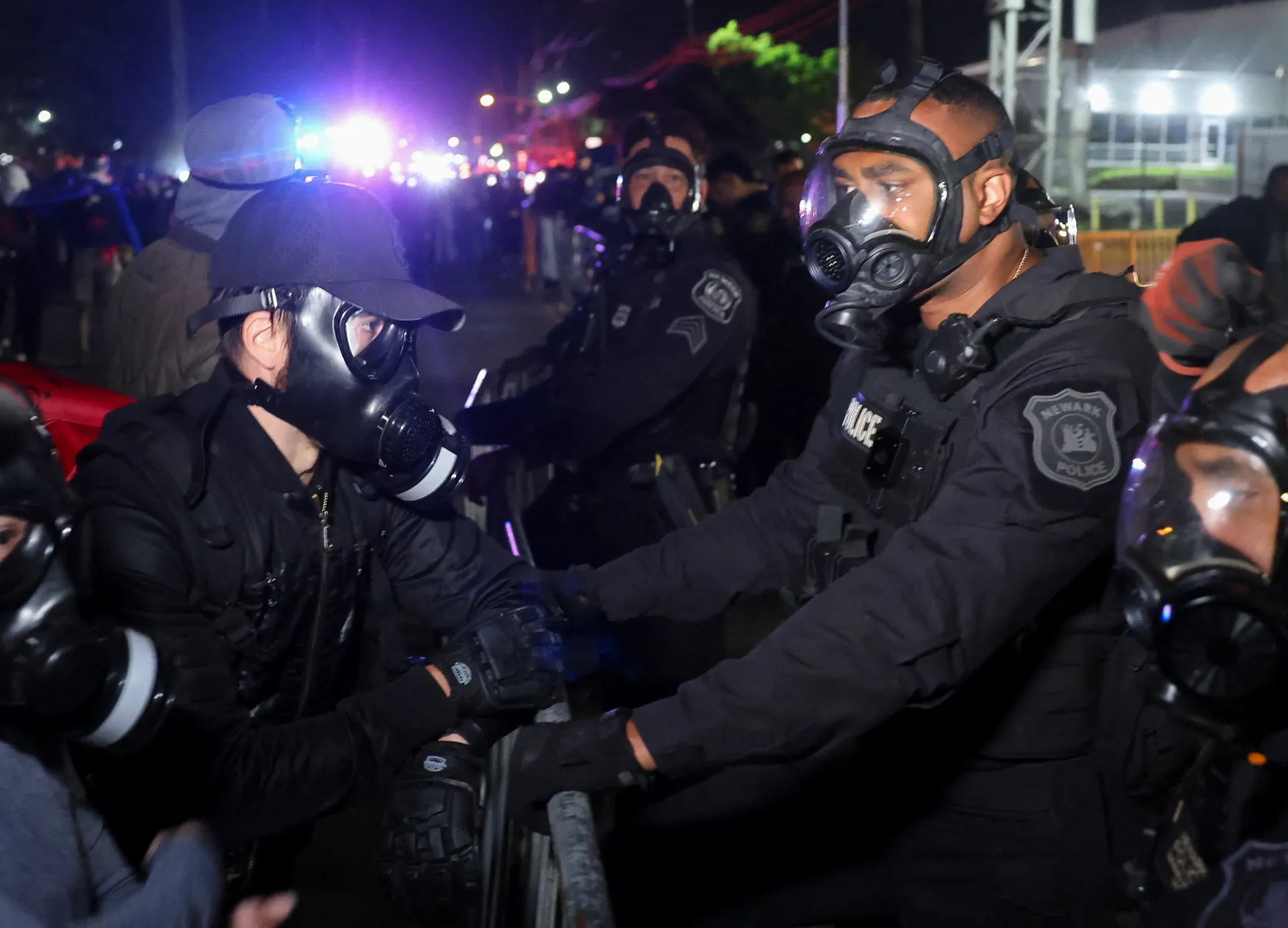
To show solidarity with the hunger strike, protesters have been gathering outside Delaney Hall, locking arms to form human chains and creating barricades to prevent access.

But that has led to tense confrontations with law enforcement, who have used batons and pepper spray to try to clear roads to the facility.

Governor Mikie Sherrill called for the establishment of designated protest zones, to mitigate the likelihood of conflict between officers and demonstrators.

But clashes have continued. Overnight on Wednesday, six protesters were arrested.

Politicians themselves have encountered tense interactions at Delaney Hall.

A year ago, one protest resulted in trespassing charges against Mayor Baraka and assault charges against US Representative LaMonica McIver, after a disagreement over which officials could enter the facility for an inspection.

While the charges against Baraka were dropped, McIver continues to face legal proceedings. She has denied the charges and called the prosecution politically motivated.

“One year ago, the Trump administration threw baseless charges against me for conducting oversight to protect immigrants at Delaney Hall,” McIver wrote on social media on Saturday.

“Have they tried to silence me? Yes. Have the stakes risen? Yes. Am I backing down from speaking up for you? Never.”

This past week, Governor Sherrill was also denied access to the facility. She has since issued a statement calling for Delaney Hall to be shut down.

At a news conference on Saturday, she blamed “national extremist groups” for arriving from out of state and escalating tensions. She added that the current precautions were designed to protect the safety of peaceful protesters.

“I urge those protesting outside of Delaney Hall to bring the temperature down, so we can focus on the detainees and their families,” Sherrill said.

She suggested that the actions of state and local officials would help head off any expanded ICE operations in New Jersey.

“I will not give ICE a pretext to expand operations at Delaney Hall or across our state. I will not put lives at risk,” she said. “I’m grateful to the vast majority of protesters who have assembled peacefully and raised their voices about Delaney Hall’s conditions.”

Source link

US Congress moves to deepen military ties with Israel: Why it matters | Military News

Lawmakers in the United States are quietly advancing a proposal that could deepen military ties between the US and Israel in unprecedented ways, at a time when public support for Israel among Americans is increasingly fractured.

Among the provisions included in the 2027 National Defence Authorisation Act (NDAA) released this week is Section 224, the “United States-Israel Defence Technology Cooperation Initiative”.

Recommended Stories

list of 4 itemsend of list

The NDAA, which Congress passes annually to set military policy and authorise defence spending, will undergo further debate and amendments before becoming law. Some legislators have already signalled opposition, with Representative Thomas Massie saying he would seek to remove the provision if it reaches the House floor.

The measure remains at an early stage, but analysts say if passed, it would limit political oversight over the defence relationship.

Analysts added that it could mark a significant shift in the US-Israel relationship, moving beyond a model centred on American military aid towards deeper institutional integration between the two countries’ defence industries and militaries.

Critics argue that such a move would make support for Israel less a matter of political choice and more a structural feature of US national security policy, embedding the relationship within joint military and industrial programmes that would be difficult to unwind.

What does the proposal include?

Section 224 incorporates elements of the US-Israel Future of Warfare Act legislation introduced by Representative Ronny Jackson, according to Track AIPAC. While the legislation did not advance as a standalone bill, key elements of it were instead folded into the NDAA.

The provision would require the US defence secretary to designate an official responsible for coordinating military cooperation between the two countries. According to the text, that official would be tasked with “synchronising cooperative efforts between the United States and Israel”, including “bilateral defence technology research, development, testing, evaluation, integration and industrial cooperation”.

The legislation envisages cooperation across a wide range of military technologies. It specifically identifies as priority areas; “counter-unmanned systems including aerial, maritime and ground platforms”, “anti-tunnelling and subterranean threats”, and “missile and air defence technologies”.

The proposal also seeks to deepen collaboration on emerging technologies, including “artificial intelligence, quantum machine learning and autonomous systems”, as well as “directed energy and advanced sensing”, “cyber defence, electronic warfare and digital resilience”, and “biotechnology, biomanufacturing, and medical defence”.

The inclusion of “network integration” and “data fusion” has drawn particular attention because it suggests significantly closer integration of military information systems between the two countries.

The United States and Israel already cooperate on defence projects, including missile defence systems such as Iron Dome. However, analysts say that Section 224 would expand cooperation into nearly every major area of emerging military technology, and could create a “lock-in” between the two countries military infrastructure.

Mark Hilborne, a senior lecturer, the School of Security Studies at King’s College London, told Al Jazeera the proposal goes well beyond the traditional foundations of the US-Israel defence relationship.

“While historically, the US-Israel defence relationship has included US military aid and weapons transfers, joint missile defence programmes such as Iron Dome, David’s Sling and Arrow, and intelligence and operational cooperation, the proposed agreement increases cooperation to include a wider set of emerging technologies,” he said.

“So this all suggests a much tighter integration – less about provision and perhaps sharing technologies and capabilities, and more about jointly developing these.

“It would point to a more institutionalised relationship, and perhaps one that might survive changing administrations in the US, as some of the development cycles could be very long and would become entrenched,” he said.

Why is it controversial?

The proposal comes amid growing debate in the US over military support for Israel, particularly as Israel’s genocidal war on Gaza continues, and concerns mount over the use of US-made weapons.

Human rights organisations and United Nations experts have repeatedly raised concerns about Israeli military actions in Gaza, where despite a so-called ceasefire in place since last October, at least 850 Palestinians have been killed. Israel is also advancing into southern Lebanon, where it has killed more than 3,000 people since the beginning of March.

These wars have led to increasing scepticism among Americans towards unconditional support for Israel, recent opinion polls suggest.

A New York Times poll in May found that only 30 percent of respondents believed Donald Trump made the right decision in ordering military strikes against Iran, while 64 percent said it was the wrong decision.

An Institute for Global Affairs poll released last week found that only 16 percent of Americans support continuing weapons transfers to Israel without additional restrictions. Thirty-eight percent said the US should stop supplying weapons entirely, while 24 percent said military aid should be conditioned on how the weapons are used.

Opposition has also emerged from parts of the Republican Party, which traditionally has always been aligned with Israel.

Former Representative Marjorie Taylor Greene criticised the proposal on social media, writing: “This is what complete capture to a foreign government looks like, and there hasn’t been a single shot fired.”

Massie, who has opposed military aid to Israel, likewise pledged to introduce an amendment removing the provision from the NDAA. The Republican senator was defeated in the primary elections last month, highlighting the financial and political influence of pro-Israel lobby groups in the US.

Influential conservative commentator, Tucker Carlson, has increasingly criticised US support for Israel, reflecting divisions within the broader MAGA movement. Criticism has also intensified among left-wing Democrats, with many calling for restrictions on military aid to Israel.

What could it mean in practice?

Critics of the measures warn that the proposal could create a form of institutional “lock-in” that makes both countries simultaneously reliant on each other for military development and procurement.

Some analysts say such integration would move key aspects of the US-Israel relationship away from highly visible aid votes or commercial contracting, and into the less transparent world of defence procurement and industrial partnerships at a state-to-state level.

Hilborne from the King’s College said the initiative could also have direct implications for Palestinians. “If joint R&D produces more effective technology, then systems related to surveillance, autonomous vehicles, AI and targeting, and various counter-drone or counter-missile technology would be improved, providing a capability boost to Israeli forces operating in Gaza or the West Bank,” he said.

“This enhanced integration would further embed US technology into Israeli forces. These would all be concerns from a Palestinian perspective.”

Critics also point to the economic implications, where expanded co-production agreements could lead to new manufacturing facilities and defence jobs in the United States, creating a further reliance on Israel.

Hilborne also argued that deeper integration could reduce Washington’s leverage over Israel. “The deeper integration may also mean that the US loses some degree of leverage over Israel, as it would be less able to withhold certain capabilities from Israel,” he said.

“As a consequence, Israel might be emboldened in its policies.”

The proposal could also have implications beyond the US-Israel relationship, according to Imad Salamey, an international relations professor at the Lebanese American University. “The proposed US-Israeli defence integration can be seen as the next phase of the Abraham Accords: moving from normalisation toward a US-backed regional security regime centred on Israel as the dominant military and technological hub,” he told Al Jazeera.

Such a framework would strengthen efforts to contain Iran, limit Turkiye’s independent regional influence and deepen security cooperation with Arab partners, he said.

“For Lebanon and Gaza, it may translate into greater pressure to accommodate Israeli-led security arrangements as part of a broader emerging Middle Eastern order.”

Whether Section 224 survives the legislative process is uncertain.

But its inclusion in the NDAA shows how some politicians, many backed by the pro-Israel lobby group AIPAC, are attempting to bind the two countries’ militaries closer together, creating long-term industrial links that future administrations may find difficult to reverse.


Source link

In ‘American on Purpose,’ Craig Ferguson celebrates America’s unusualness

When Craig Ferguson left CBS’ “The Late Late Show” in December 2014, fulfilling a pledge made public the previous April, it was assumed by some that it had something to do with not being offered the chair being vacated by his illustrious lead-in, David Letterman. (Stephen Colbert, you may be aware, was named the new “Late Show” host.) Others simply couldn’t believe anyone would just walk away from such a job, which Ferguson had held for two weeks shy of 10 years, because, even in the less prestigious 12:30 time slot it seemed like a prize — but mostly because he was so good at it.

“That’s one of the odd things about that particular genre of television,” he told me in 2016. “The minute I started at 12:30, the question became when and do you want and how are you going to get 11:30? But I never wanted 12:30, never mind 11:30. Why is that a thing?”

Ferguson went on to other things. He’s hosted game shows (currently the CW’s “Scrabble,” with puckish energy); toured as a stand-up (he’s on the road into June); hosted a history-themed panel show, “Craig Ferguson: Join or Die”; launched “Joy, a Podcast,” which is as close as he’s come to the confessional freestyling of “The Late Late Show”; and published “Riding the Elephant: A Memoir of Altercations, Humiliations, Hallucinations & Observations.”

His latest show, premiering Saturday on CNN, is “American on Purpose,” which shares a title with his first memoir, a reference to the Scottish-born Ferguson becoming an American citizen. Timed generally to the 250th anniversary of the United States, it finds Ferguson in a five-episode crazy quilt of observations, interviews, inquiries, stunts, games and documentary vignettes forming a comical, but not unserious, somewhat wayward look at American ideas and ideals — freedom of speech, capitalism, patriotism, individualism and immigration. It’s a vision wide enough to include monster trucks, lowriders, underground comedy, Miami street art, Texas barbecue and haggis tacos, dreamed up by Ferguson and executed by celebrity chef Marcus Samuelsson.

A man stands behind a food cart as another man cups his hands around his mouth shouting toward the empty street.

Ferguson, a Scotsman, having haggis tacos on “American on Purpose.”

(CNN)

“You know me,” Ferguson said when we spoke over video call recently. “Less format is better for me always.”

His caveat to the producers was that he wouldn’t “make an anti-American show. I wouldn’t make a show pointing out everything that’s wrong. I feel that’s a market that’s heavily catered to. I’m not a f—ing idiot, I’m not making propaganda, I won’t make a jingoistic show. But I want to make a show which is celebratory,” Ferguson says. “And I want to be clear that the show I make for CNN will be the same as if I was making it for Fox News. It has to be my point of view, which is upbeat without being dumb — I hope. I feel like we got pretty close.” This conversation has been condensed and edited for clarity.

A good friend of mine, an Englishman, recently became an American citizen and had only wonderful things to say about the naturalization ceremony, the diversity of his fellow new Americans, and the graciousness of the people conducting it. What was your experience?

My ceremony was in Pomona fairgrounds in 2008. And I think it was 2,000 of us; I think it was 1,999 new Mexican Americans and one new Scottish American. And it was f—ing wonderful. And it is moving. I kind of wish it for my friends who are born here, American citizens, because you have to remove your everyday, “Oh my God, did you see the news today” cynicism, and remember what this place is about — freedom, second chances, third chances, escape, representation, individualism, different ideas coexisting in one country, wildly different points of view somehow managing to get along. That is f—ing beautiful. What I still feel as an immigrant American is a certain gratitude that doesn’t leave you. I’m not blind to the faults of the United States. Show me a country that doesn’t have faults. We talk about the bloody past. Show me a country that doesn’t have a bloody past. Humans have a bloody past. I’m not saying there’s nothing wrong, but I’m not looking at that in this show. I’m looking at what makes me feel great about this place, and it is a great place, an aspirational place. To my mind, we are still the big foam finger number one. I don’t think there’s anyone can touch us for … unusualness. We’re really unusual.

It’s a very optimistic show. Is that how you feel personally about the future of the country, and humanity?

Like most people, I have my moods. I got a real boost of optimism [hanging out] with very clever academics who kind of guard the Declaration of Independence in Philadelphia. And you say to them, “People say the country’s never been this divided.” They always laugh. They laugh at the idea it’s never been as bad as this, the rhetoric has never been this hateful. They’re like, “It’s always been like this. It’s always been an argument. The whole point of this place is that it is an argument.” The guys who started this country, some of them hated each other with just as much venom and outrage and indignance as political players hate each other today. I find that quite encouraging. Like I said, I’m not blind to the fact that there are issues and faults and deep things to worry about. But that’s not what this show’s about. It’s as if I was a musician, and I decided to write a happy song. People say, “Why aren’t you sad?” I’m like, “Well, I get that sometimes, but this song is a happy song, this is a rock song. I’ll do a power ballad later on.” It’s not terrible to to do something upbeat every now and again.

What did you discover in the course of making the show?

There were many things, actually. In L.A., I did a kind of run around with the guys who make the lowrider cars, and the community and the story of how that came about are really fascinating, a kind of parallel run of the rise of the automobile in America, but how it was taken on by the Mexican culture. Another that really stuck with me was in the Everglades, when I was with the Gladesman there, finding out that a large percentage of them [were descended from] displaced Scottish peasants, cleared out of the Highlands to make room for sheep for the landowners; they went to Canada, and they drifted all the way down to the southern tip of the United States. These guys there could trace their ancestry back to 100 miles from where I grew up. Americans would be kicked out of most of the countries of the world. So it makes us awesome. I mean, 40% of this country can trace themselves through Ellis Island, through that administration building in New York. That’s insane.

A man in a suit behind a desk next to two yellow chairs on a boardwalk.

Ferguson at Venice Beach in a segment on the show.

(CNN)

When did you get interested in history?

In Scotland, we’re surrounded by it all the time. There’s a lot of stuff still lying around from a long time ago. American history became interesting to me because it was so attached to Scotland. The Scottish Enlightenment is really kind of the origin story of the Declaration of Independence. Knowing that the philosophy that was coming out of Edinburgh in the 1700s was directly feeding into what these guys were doing, it felt like the continuation of a certain strain of Scottish history. It didn’t end with “Highlander” or “Shrek.”

There’s a road movie element to the series. Do you take trips around the country on your own time?

All the time. I don’t think you can know the United States unless you’ve driven across it at least a couple of times. If you can take a car from New Orleans to Northeastern Maine, Florida to Washington state, it’s worth doing. One of the things that was in the engine for me when I started this [series] was, I’ve seen over the years a lot of — probably more in Britain than in America — lazy kind of pseudo-intellectual documentaries where somebody will say, “Well, you know, the thing about America is…” Well, which America are you talking about? And they will go and get some guy that lives on his boat in Fort Lauderdale with a hat that’s got “Who Farted?” written on it and tell you that’s America. That guy’s there and he’s awesome, but it’s not the whole story. You know what I mean? It’s like saying “Well, you know, Hitler was a vegetarian.” That’s true, he was. But it’s not really the whole f—ing story, is it?

Source link

Trump tightens terms on Iran war deal, US media say | Donald Trump News

US officials indicate Tehran may take days to respond to Trump’s tougher terms on a potential agreement to end the nearly three-month war.

President Donald Trump sought to change several terms of a proposal to end the US-Israel war on Iran, according to media reports in the United States, as a finalised deal remains elusive.

The New York Times reported on Saturday that Trump’s changes involved toughening the deal terms, and the US has sent the new framework back to be considered by Iran, according to officials familiar with the proceedings.

Recommended Stories

list of 3 itemsend of list

The report said it was not immediately clear what the changes entailed. However, Axios reported Trump wanted to reinforce multiple points of the deal that he felt were important, such as what to do with Iran’s nuclear material.

A senior US official told Axios that Trump was informed it could take three days for Iran to respond.

“They’re literally in caves, and they’re not using email,” the official told Axios.

“There will be a deal. The imminence of it, we’ll see. We’re willing to wait so the president gets what he asks for. It could be a week. It could be less. It could be more. At the turn of the week, we hope to have something,” the official added.

The new tweaks could prolong negotiations between the parties for days before a decision is reached on whether the deal would end the war, which began after the US and Israel attacked Iran on February 28.

US sources told the AFP news agency that the proposal had been waiting on Trump’s sign-off, but he made no decision after a White House Situation Room meeting on Friday.

Trump has said his priorities for any deal included Iran agreeing to never develop nuclear weapons and the reopening of the blockaded Strait of Hormuz, through which roughly 20 percent of the world’s oil supply transits.

On Saturday, the Iranian military’s Khatam al-Anbiya Central Headquarters reasserted the country’s control over the strait, warning that foreign commercial and military vessels would be targeted if they did not comply with regulations governing passage through the strategic waterway.

Tehran has also said repeatedly that it does not intend to build nuclear weapons. In March 2025, Tulsi Gabbard, the former US director of national intelligence, testified to Congress that Washington “continues to assess that Iran is not building a nuclear weapon”.

Source link

Wembanyama’s Spurs dethrone Thunder to reach NBA Finals against Knicks | Basketball News

The San Antonio Spurs, sparked by superstar Victor Wembanyama, have advanced to the NBA Finals for the first time since 2014 by dethroning the defending champions, the Oklahoma City Thunder, 111-103, to book a championship showdown against the New York Knicks.

The Spurs captured the best-of-seven Western Conference finals 4-3 on Saturday and reached the NBA Finals, which begin on Wednesday against the Knicks in San Antonio.

“Though we’re still hungry for one more, this feeling is, I can’t explain it, it’s so powerful,” Wembanyama said. “We want four more. We’re not done. Go Spurs go.”

French 7-foot-4-inch (224cm) centre Wembanyama scored 22 points and grabbed seven rebounds, Julian Champagnie added 20 points, including six three-pointers, and Stephon Castle had 16 points for the Spurs, who led the winner-take-all contest almost the entire way.

“We had a good team, a great team,” Champagnie said. “We had to stay the course and play a good game.

“We were passing the ball. We were playing as a team. We come out here and play together.

“We never knew if we were going to get this far, but when you’ve got the greatest player in the world, things happen.”

That was a nod to Wembanyama, the Most Valuable Player of the Western Conference finals and the NBA Defensive Player of the Year.

“It doesn’t mean anything for me other than the fact we are a team,” Wembanyama said of his series MVP award. “I got this for all of us and all the fans right here.”

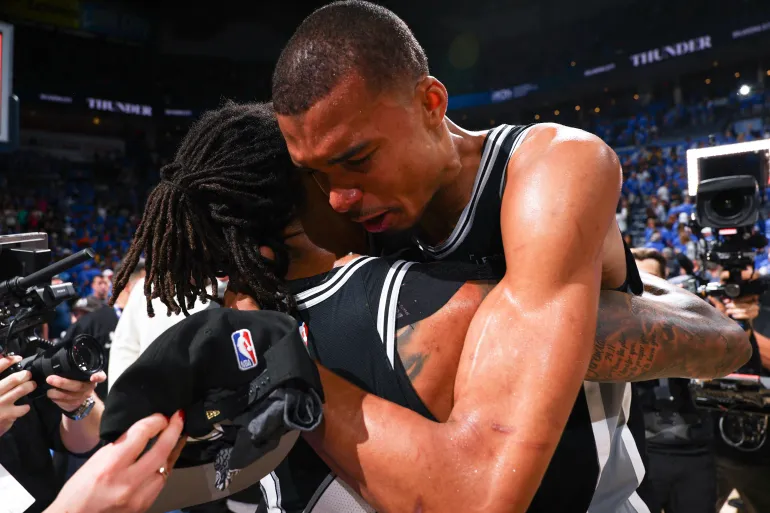
OKLAHOMA CITY, OK - MAY 30: Victor Wembanyama #1 and Devin Vassell #24 of the San Antonio Spurs hug after the game against the Oklahoma City Thunder during Game Seven of the NBA Western Conference Finals on May 30, 2026 at Paycom Center in Oklahoma City, Oklahoma. NOTE TO USER: User expressly acknowledges and agrees that, by downloading and or using this photograph, User is consenting to the terms and conditions of the Getty Images License Agreement. Mandatory Copyright Notice: Copyright 2026 NBAE Zach Beeker/NBAE via Getty Images/AFP (Photo by Zach Beeker / NBAE / Getty Images / Getty Images via AFP)
Wembanyama was emotional after securing his first appearance in the NBA Finals [Zach Beeker/Getty Images via AFP]

Of his teammates, Wembanyama added, “They don’t even know how much I love them. They are just incredible. Everybody stepped up tonight.”

“Wemby” dominated in his first playoff game seven and was emotional at the finish, laughing, crying and hugging teammates over reaching his first NBA Finals.

“Realising that some part of the childhood dream was going to come true,” the 22-year-old Frenchman said of his reaction.

The win sets up an NBA Finals repeat of this season’s NBA Cup final, which the Knicks won with a 124-113 defeat of San Antonio last December in Las Vegas.

“A lot of physicality, hit first, and rebounding,” Champagnie said of the Knicks. “It will be a nice challenge for us.”

San Antonio Spurs guard Devin Vassell hangs on the rim after a dunk against the Oklahoma City Thunder during the second half of Game 7 of the Western Conference finals of the NBA basketball playoffs series, Saturday, May 30, 2026, in Oklahoma City. (AP Photo/Tony Gutierrez)
San Antonio Spurs guard Devin Vassell hangs on the rim after a dunk [Tony Gutierrez/AP]

NBA Most Valuable Player Shai Gilgeous-Alexander led Oklahoma City with 35 points.

“He was brilliant. He had a great game,” Thunder coach Mark Daigneault said. “He delivered. It was a really big-time game for him.

“That would have been one of the stories of the game if we had been able to figure out a way to win it.”

Daigneault said the challenge to repeat was not among the things that led to the defeat.

“You can be proud of effort and progress and the level we played … and we can also be really disappointed,” he said.

“Felt like we could have won the series. We were right there. There’s nobody we don’t think we can’t beat.

“I thought we had enough to win, but credit San Antonio – they’re the ones who did.”

Oklahoma City Thunder guard Shai Gilgeous-Alexander (2) shoots against San Antonio Spurs forward Keldon Johnson (3) in the first half of Game 7 of the Western Conference finals of the NBA basketball playoffs series Saturday, May 30, 2026, in Oklahoma City. (AP Photo/Nate Billings)
Oklahoma City Thunder guard Shai Gilgeous-Alexander shoots [Nate Billings/AP]

A Spurs squad with only one player who had been in a game seven before overcame a more experienced Thunder squad that won the title in a game seven last year.

“Back in October, we knew we had a chance to be pretty good,” Spurs coach Mitch Johnson said.

“There’s a lot being talked about, words like competitiveness, resolve, togetherness, execution – who gives a damn about the word experience?

“They had to go out and execute, and they did.”

Wembanyama hit two three-pointers in a 17-9 run to start the fourth quarter that lifted the Spurs ahead 97-86 with eight minutes remaining.

“Wemby” was whistled for his fifth foul seconds later and went to the bench, boosting Thunder hopes in the dying minutes while Gilgeous-Alexander tried to rally the reigning champions, only to fall short at the finish.

Source link

US Congress advances American-Israeli military integration plan | Government News

A provision in a bill before the United States Congress could tie the American and Israeli militaries far more closely together, deepening their cooperation on weapons research, production and technology.

The proposal, titled the “United States-Israel Defense Technology Cooperation Initiative,” appears as Section 224 of the House Armed Services Committee’s version of the fiscal year 2027 National Defense Authorization Act (NDAA), the annual US defence policy bill.

Recommended Stories

list of 2 itemsend of list

The measure is still at an early stage. The NDAA is passed by Congress each year to set US military policy and authorise defence programmes and spending levels.

If enacted, the provision could mark a major change in one of the world’s closest military relationships, shifting the two countries from a partnership centred largely on American military aid towards one in which their defence industries are more deeply intertwined.

Section 224 would require the US defence secretary to appoint an “executive agent”: a single official to coordinate military cooperation between the US and Israel.

That work would cover joint research and development, the shared production of weapons, and the linking of military systems and data.

“What Congress is trying to do now is find different ways of entrenching the relationship so deep in America’s own defence industrial base that it’s impossible to root it out,” Josh Paul, a former US State Department official and founder of the advocacy group A New Policy, said about the controversial provision.

“A new section of law in the National Defense Authorization Act (NDAA) would give Israel unprecedented access to American technology and would force the United States military to integrate Israeli defence technologies into our own critical military supply chain, giving Israel incredible leverage over America’s own defence priorities,” he added in a video posted on social media on Friday.

The two countries already build missile defence systems together, such as the Iron Dome.

The bill would extend their joint work into many more areas of modern warfare, from artificial intelligence (AI) to drones and cyber operations.

The provision comes amid turmoil in the Middle East following the joint US-Israeli attack on Iran earlier this year.

In February, US and Israeli forces attacked Iran together, triggering five weeks of war; Iran struck back at Israel and at US bases in the Gulf before a ceasefire took hold in April.

Israel is also facing genocide allegations in a case brought by South Africa at the International Court of Justice, the UN’s top court, over its war on Gaza.

Decades of support

The bill must first clear the House Armed Services Committee, which is due to take it up in early June, and then pass the full House and the Senate.

It was proposed by the committee’s Republican chairman, Mike Rogers, and its most senior Democrat, Adam Smith, giving it support from both main parties, even as opinion polls suggest growing opposition among American Democrats and some Republicans to further military support for Israel.

The US has supported Israel’s military for decades.

Since 2008, US law has required Washington to protect Israel’s “qualitative military edge”, keeping its forces stronger and more advanced than those of any rival in the region, on the grounds that a small country must rely on better weapons rather than greater numbers.

Under the current aid deal signed during the administration of former President Barack Obama, Washington provides Israel with about $3.8bn a year in military assistance. The 10-year agreement runs through 2028.

Israel is the largest recipient of US foreign aid since 1948, almost all of it now military and worth well over $300bn when adjusted for inflation. 

The nature of that support may now be changing. Israeli Prime Minister Benjamin Netanyahu said recently that he wants to end Israel’s reliance on US military aid within 10 years, saying his country had “come of age”.

Closer cooperation between the two defence industries, rather than cash, would likely fit that goal.

Source link

Iran reasserts control over Hormuz Strait as deal with US remains elusive | US-Israel war on Iran News

Iran has reasserted its control over the Strait of Hormuz, warning that foreign commercial and military vessels will be targeted, if they do not comply with regulations governing passage through the strategic waterway.

The announcement on Saturday came after the United States signalled that President Donald Trump was close to a decision on a potential deal with Iran, but Tehran denied an agreement had been reached.

Recommended Stories

list of 3 itemsend of list

“The management of the Strait of Hormuz is exercised with full authority by the Armed Forces of the Islamic Republic of Iran,” the operational headquarters of Iran’s armed forces, Khatam al-Anbiya Central Headquarters, said in a statement reported by Iranian media on Saturday.

“All ships, commercial vessels, and tankers are only required to travel through the designated routes and obtain permission from the Islamic Revolutionary Guard Corps [IRGC] Navy. Any violation of these regulations will seriously jeopardise the security of their traffic,” it added.

Iran also issued a warning to foreign military forces operating in the area, saying any attempt to interfere with maritime management or shipping movements would trigger a response.

On Friday, Trump met with advisers in the White House Situation Room and said a “final determination” on a possible deal with Iran would soon be made. But no statement followed the meeting.

US sources had told the AFP news agency the deal was waiting on Trump’s sign-off, but he made no decision after Friday’s meeting.

Iran’s Foreign Ministry spokesperson, Esmaeil Baghaei, said on Friday that while messages continue to be exchanged “no final agreement has been reached” on a deal with the US.

US ‘more than capable’ of restarting war

While attending a defence summit in Singapore on Saturday, Pentagon chief Pete Hegseth said that Washington was “more than capable” of restarting the war if a satisfactory deal is not reached.

US Central Command (CENTCOM) posted on social media that American forces “remain present and vigilant across the region”.

The efforts to reach a deal were thrown into question this week by US strikes on the Iranian port of Bandar Abbas, countered by retaliatory Iranian fire.

Iran’s IRNA state news agency said air defences shot down a drone “belonging to the US-Zionist aggressor enemy” on Saturday, citing a statement from the army.

Trump said his priorities in any deal include Iran agreeing to never develop nuclear weapons, and the reopening of the blockaded Strait of Hormuz.

“President Trump will only make a deal that is good for America and satisfies his red lines,” a White House official told AFP, adding: “Iran can never possess a nuclear weapon.”

Trump ‘betraying diplomacy’

Also on Saturday, Mohsen Rezaei, an adviser ⁠to Iran’s Supreme ⁠Leader, Mojtaba Khamenei, said in a social media post that Trump was “betraying diplomacy for ⁠the third time” by ⁠continuing the US naval blockade in the strait, and making what he described ‌as “excessive demands ‌in ‌negotiations”.

In a social media post on Friday, Trump said Tehran would remove mines from the strait and end its closure of the waterway with “no tolls”, while the US would lift its blockade.

Both countries would coordinate on removing and destroying Iran’s enriched uranium, he said, adding that “no money will be exchanged, until further notice”.

Iran’s Fars news agency, however, cited sources as saying Tehran was demanding “the immediate release of $12bn” in frozen assets before moving to the next phase of negotiations.

On the toll-free reopening of Hormuz, the sources said “no such clause appears in the text of the agreement”, while Trump’s comment on destroying Iran’s nuclear material “is fundamentally baseless”.

Iran’s ISNA news agency cited legislator Alireza Salimi as saying a plan “to implement Iran’s management and sovereignty over the Strait of Hormuz will soon be approved by parliament”.

Iran’s Tasnim news agency said the US blockade remains in place, and its ships “are receiving warnings from CENTCOM to stop and not cross the blockade line”.

Source link

Israeli soldiers reach Nabatieh, one of southern Lebanon’s biggest cities | Israel attacks Lebanon News

Israel’s military has advanced beyond Lebanon’s Litani River for the first time since 2006.

Israel’s military has advanced beyond the Litani River in southern Lebanon for the first time since 2006 and appear poised to encircle the major city of Nabatieh.

Senior Lebanese military sources on Saturday told the Turkish state news agency Anadolu that Israeli forces had crossed the Litani River, which Israel has declared the perimeter of its unofficial buffer zone.

Recommended Stories

list of 3 itemsend of list

Israeli forces are now on the outskirts of Nabatieh, a city that is key to southern Lebanon’s economy and a cultural hub for the region. If the Shia-majority city were to fall, it would mark a significant development in the war on Lebanon, which began in October 2023 and subsequent official ceasefire.

Nabatieh is viewed by many Lebanese as a symbol of resistance due to its historic role on the frontline of Israeli assaults.

Reporting from the southern city of Tyre, Al Jazeera’s Obaida Hitto said Israel was expanding its air campaign in southern Lebanon and encircling Nabatieh in preparation for a potential assault on the city.

“It looks like Israel is trying to make this final push to encircle Nabatieh, breaking through the second and third lines of defence of Hezbollah and isolating the western Bekaa Valley from the south of the country,” Hitto said.

Israel has issued evacuation orders for at least 10 villages in southern Lebanon, as it expands its invasion, despite being engaged in ongoing peace talks with Lebanese officials.

The Israeli army’s Arabic spokesperson, Avichay Adraee, instructed residents in several Lebanese villages to evacuate immediately, warning they could be killed if they remained.

The order came the day after officials from both countries met in Washington to discuss a permanent end to the war. It began in early March when Iran-backed Hezbollah began attacking Israel following the assassination of Iran’s Supreme Leader, Ali Khamenei.

Hitto said people fleeing their homes have few options, with more than 20 percent of the population — around 1.2 million people — displaced by fighting.

“Those options are turning into basically people living with relatives if they have that option, or people living in makeshift camps in public parks and public spaces. I’ve seen many families living in their vehicles for long periods of time,” Hitto said.

“Some of these families have been continuously displaced since 2023,” Hitto added.

The latest forced displacement orders are a further test to the nominal “ceasefire” in place since mid-April and repeatedly violated by Israel. It justifies its actions by saying it is targeting Hezbollah as part of efforts to disarm the group.

On Friday, at least 14 people were killed in Israeli air raids in southern Lebanon.

Lebanese officials are working to disarm Hezbollah, but the task has proved extremely difficult.

Lebanese and Israeli officials are currently engaged in negotiations to end the war, marking the first time the two sides have spoken directly in decades.

The talks are being facilitated by the United States, and a new round is expected in Washington next week.

Lebanon’s President, Joseph Aoun, held talks with Prime Minister Nawaf Salam on Saturday to discuss the security situation and  ongoing negotiations with Israel. According to the state-run National News Agency, they agreed to intensify efforts to end the war, which has triggered a humanitarian crisis.

Aoun also spoke by phone with US Secretary of State Marco Rubio and stressed the importance of Israel respecting the current ceasefire.

Source link

Iran war: What is happening on day 92 as Trump weighs Iran deal | US-Israel war on Iran News

Trump weighs next steps on Iran deal as Tehran insists negotiations are continuing and no final agreement exists.

Prospects for a US-Iran agreement to end the conflict remained uncertain on Friday, with President Donald Trump saying he would make a “final determination” on a deal, while Iranian officials stressed that no understanding had yet been reached.

Iran’s chief negotiator, Mohammad Bagher Ghalibaf, said Tehran would judge any agreement by actions rather than words, adding that no steps would be taken unless Washington acted first.

Meanwhile, fighting continued elsewhere in the region. Israeli Prime Minister Benjamin Netanyahu said Israeli forces had advanced beyond Lebanon’s Litani River, as Israeli attacks across Lebanon on Friday left dozens more civilians reportedly killed or wounded.

Here is what we know:

In Iran

  • Iran says talks continue, but no deal yet: Iranian Foreign Ministry spokesperson Esmaeil Baghaei said exchanges with the United States are continuing but stressed that no final agreement has been reached. He rejected Trump’s demands-based approach and described the US naval blockade as illegal, adding that Tehran would judge any easing of restrictions by actions rather than words.

War diplomacy

  • CENTCOM highlights ongoing regional patrols: US Central Command (CENTCOM) said its forces remain “present and vigilant” across the region, sharing an image of an F-16 fighter jet conducting a patrol over the Middle East.
  • US pushes allies to boost defence spending: Speaking at the Shangri-La Dialogue in Singapore, US Defense Secretary Pete Hegseth said Trump plans a $1.5 trillion investment in defence and described it as part of a historic expansion of America’s military-industrial base. Hegseth urged allies to spend at least 3.5 percent of gross domestic product (GDP) on defence, warning that countries that fail to do so could face changes in their relationship with Washington. He also reiterated that the US remains committed to preventing Iran from obtaining a nuclear weapon.
  • Washington praises Israel-Lebanon security talks: The US Department of Defense described military-to-military talks between Israeli and Lebanese delegations in Washington as “productive”, saying they focused on regional security and stability. The Pentagon also reaffirmed support for Lebanon’s sovereignty and territorial integrity.

In the US

  • Uncertainty remains after White House talks: Reporting from the White House, Al Jazeera’s Alan Fisher said there was still no clarity after Trump’s Situation Room meeting on whether a final agreement with Iran had been reached. Fisher said any easing of restrictions around the Strait of Hormuz could signal progress, but officials are still waiting for concrete details from the White House.

In Israel

  • Air raid sirens sound in northern Israel: The Israeli military said it intercepted several projectiles launched from Lebanon, while another landed near Kiryat Shmona in northern Israel. The military reported no casualties and did not specify whether the projectiles were rockets or drones.

In Lebanon

  • Netanyahu says Israeli troops have crossed the Litani River: Israel’s Netanyahu said Israeli forces have advanced north of the Litani River near Nabatieh, signalling an expansion of operations in southern Lebanon. The move comes amid ongoing Israel-Lebanon talks and could be followed by further strikes on Beirut and the western Bekaa Valley.


Source link

Trump pledges to withdraw from Kennedy Center after court strikes his name | Donald Trump News

US President Donald Trump has announced he plans to withdraw his leadership from the John F Kennedy Center for the Performing Arts, after a federal judge ruled he could no longer have his name on the building.

On Friday, in a 580-word post, Trump blasted Judge Christopher Cooper as reckless. He also painted the performing arts centre as a dilapidated structure only he could restore.

Recommended Stories

list of 3 itemsend of list

“Unfortunately, Judge Cooper and the Radical Left would rather see it DIE than have President Trump transform it into something that everyone could be proud of,” Trump wrote, referring to himself in third person.

But Trump’s interventions at the Kennedy Center, a national performing arts centre in Washington, DC, have been controversial from the start.

Construction on the building began in 1964, shortly after President John F Kennedy was assassinated.

That year, his successor, Lyndon B Johnson, signed into law an act of Congress that established the site as a “living memorial” to the slain leader.

But since starting his second term, Trump has sought to reshape Washington, DC, in his own image, undertaking construction projects and erecting banners with his photograph.

Within weeks of his inauguration, in February 2025, he fired Democratic members of the Kennedy Center’s bipartisan board and replaced them with his picks.

He also terminated the leadership of the centre’s longtime president, Deborah Rutter. The board quickly elected Trump as chair instead.

But some of the biggest backlash came in December, when the board went a step further and voted to rename the building “The Donald J Trump and the John F Kennedy Memorial Center for the Performing Arts”.

Within a day, construction crews were seen outside the arts centre, adding Trump’s name to the outside of the edifice.

Critics immediately denounced the effort as a violation of the 1964 law, not to mention a sign of disrespect towards the late Kennedy.

Amid public pressure and a string of cancellations from performers, Trump announced in February he would shutter the arts centre for two years, starting in July. He cited renovations as his rationale for the sudden closure.

US Representative Joyce Beatty, a Kennedy Center trustee, sued to stop the closure from happening. She also sought the removal of Trump’s name.

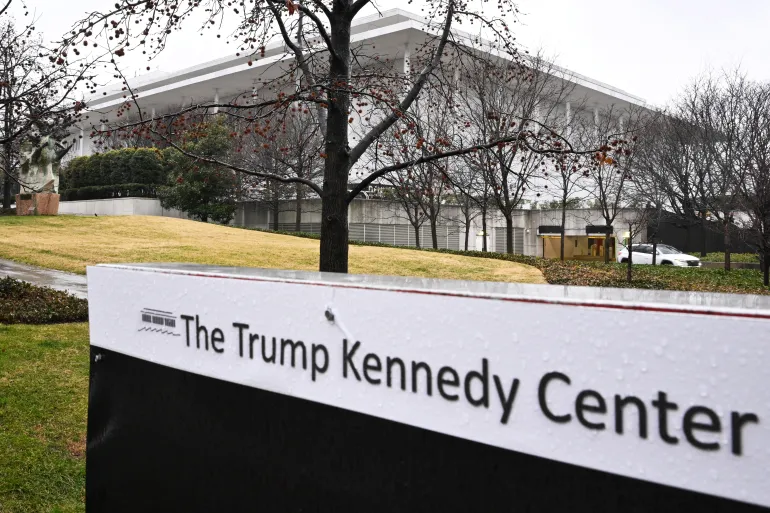
(FILES) A general view shows the Kennedy Center in Washington, DC on January 10, 2026.
Friday’s court ruling requires Trump to remove his name from all Kennedy Center signage and materials within 14 days [File: AFP]

Inside the court’s ruling

In Friday’s ruling, Judge Cooper — an appointee of former President Barack Obama — sided with Beatty’s requests.

He ordered that Trump’s name must be removed from the theatre’s facade, as well as any other signage or official materials, within 14 days, citing the 1964 law.

“The Kennedy Center’s organic statute makes crystal clear that the Center is to be named for President Kennedy, and it cannot bear any other formal name or public memorial based on the Board’s unilateral say-so,” Cooper wrote.

“Congress gave the Kennedy Center its name, and only Congress can change it.”

Cooper also overturned the Trump-led board’s decision to strip trustees like Beatty of the right to vote on Kennedy Center matters. Beatty is one of several bipartisan trustees who have a seat on the board by virtue of an act of Congress.

“If trustees presumptively possess the right to vote, what, if anything, authorizes the Board to unilaterally strip certain trustees of voting rights?” Cooper asked in his decision, striking down the Trump-era policy.

“Absent Congressional authorization, the Board may not deprive a duly-appointed Kennedy Center trustee of her right to vote on Board matters on which all other trustees are entitled to vote.”

In the last part of his 94-page decision, Cooper turned his attention to the Kennedy Center’s imminent closure.

He pointed to statements and plans from Trump administration officials touting the use of the performing arts facility before the July closure date, saying they undermined the assertion that the building was somehow hazardous.

“Former Kennedy Center President [Richard] Grenell emphasized that the Center would be one of the ‘premiere spots’ for America’s 250th celebration — quite a concerning idea if the Center is as dangerous as the Defendants now represent,” Cooper wrote, alluding to events scheduled for the coming weeks.

He later added, “Up until February 1, the Center was planning to proceed apace with some form of phased construction and cited no safety concerns about that plan.”

While closing the Kennedy Center is within the board’s powers, Cooper concluded that the board had likely violated its duty to administer the centre “as a prudent person would” under the law.

He therefore issued a temporary injunction against the centre’s closure. “The trustees might have assessed the propriety of closure in a number of prudent ways. This was not one,” he wrote.

Joyce Beatty
Representative Joyce Beatty sued the Trump administration over its planned closure of the arts facility [File: Paul Sancya/AP Photo]

Reactions to the ruling

The ruling prompted an incensed rebuttal from Trump on his Truth Social platform. The president pledged to transfer oversight of the facility to Congress, under whose mandate the centre already operates.

“We are going to be working with Congress to transfer this failing Institution back to them so they can make a determination as to what to do with it,” Trump wrote.

He also blasted Cooper as a partisan actor who had treated him “unfairly”, echoing similar criticisms he had levied against other judges.

“Judge Cooper should be ashamed of himself! I cannot be involved with a situation where danger to the Public is allowed to flourish in plain and open sight,” Trump said.

“Unless I am free to do what I do better than anyone else, bring this Institution back, physically, financially, and artistically, I have no interest in continuing what could only be a hopeless journey into ‘NEVER NEVER LAND.’”

Beatty, meanwhile, applauded the ruling as a victory against unchecked power, unfettered by the law.

“The Kennedy Center is an institution that belongs to the American people, not to Donald Trump,” she wrote.

“He has desecrated this sacred memorial for his own vanity. I am proud to have fought for the rule of law and to protect this sacred institution.”

Source link