united states

Iran soccer team heads for Mexico to prepare for World Cup

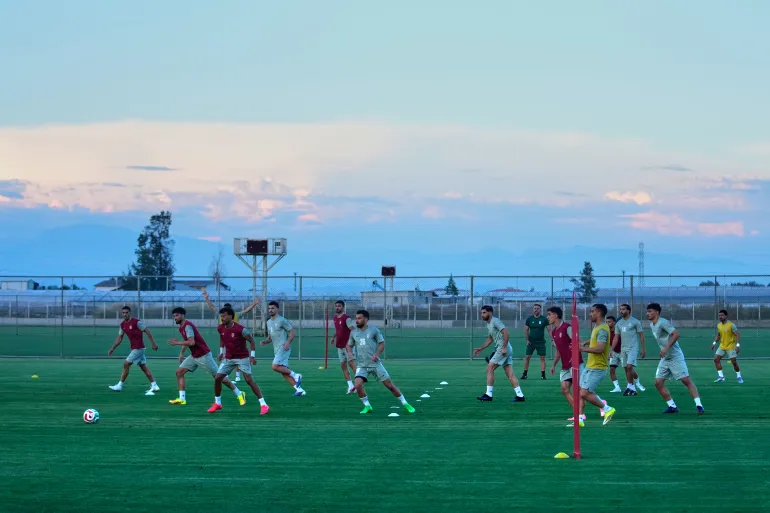
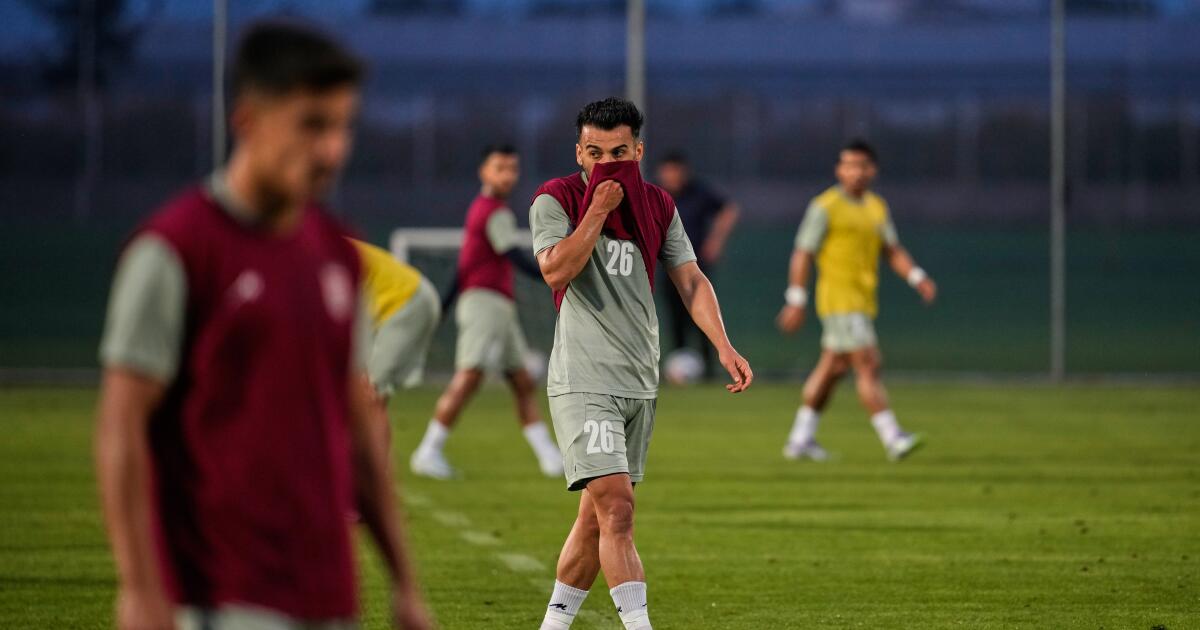
Iran’s national soccer team set off from Turkey for their World Cup training base in Mexico on Saturday, with some members of their entourage reportedly still without U.S. visas, before three group matches in the United States later this month.

The Iranian Football Federation’s secretary-general, Hedayat Mombeini, and its vice president, Mehdi Mohammad Nabi, were among 14 staff and officials without U.S. visas before games in Los Angeles and Seattle, according to Iranian state television.

It was unclear whether the federation’s president, Mehdi Taj, had been issued a visa.

The team’s participation in the World Cup has been complicated by the Iran war. Problems with processing visas had earlier led Iran to move its training base from Tucson, Ariz., to Tijuana, Mexico, which is on the border with California.

The federation accused the U.S. of “vindictive behavior” in refusing visas for “key managerial and administrative members” of the team.

The decision had “effectively denied the Iranian national team the opportunity for a level playing field and a competition free from discrimination,” according to a statement on the federation’s website. It added that the federation would pursue the matter through world soccer authority FIFA.

The Iranian Embassy in Ankara, Turkey, meanwhile, responded to an earlier social media post from U.S. Ambassador Tom Barrack, in which he congratulated his embassy staff for processing the Iran team’s visas.

“You cannot whitewash conduct that violates FIFA regulations and breaches the United States’ host obligations merely by praising yourselves,” the Iranian post read. “This represents the worst possible form of politically biased interference in sport.”

One U.S. official earlier told the Associated Press that all players on the Iranian team were approved for visas, while a second official said visas had been issued for players, coaches, trainers and some support staff. A third official suggested that some applicants affiliated with the team had been rejected for requesting visas “under false pretenses.”

The officials spoke on condition of anonymity because they weren’t authorized to discuss the visas publicly.

The squad has been preparing for the World Cup at a training camp in Antalya. The team said that it has already received visas from the Mexican Embassy in Ankara.

The players, dressed in blue blazers over white T-shirts, left the luxury Mardan Palace hotel in Antalya on Saturday afternoon. They boarded a private jet at the Mediterranean city’s airport and were due to fly directly to Mexico.

Iran plays its first two games in Inglewood against New Zealand on June 15, and Belgium six days later, then heads to Seattle to face Egypt on June 26. Iran and the U.S. could meet in the round of 32 on July 3 in Arlington, Texas, if both teams come second in their groups.

In March, U.S. President Donald Trump had discouraged Iran from participating in the tournament, saying he didn’t think it was “appropriate” and raising concerns over players’ “life and safety.” A day later, Iran’s national team pushed back, saying “no one can exclude” it from playing.

Iran finalized its team on Monday, including 17 home-based players whose clubs haven’t played since February because of the war. Star forward Sardar Azmoun was dropped in March, reportedly because of a social media post that angered Iranian authorities during the war.

Change in water bottle policy

FIFA announced that it will now allow fans to bring their own water bottles to some stadiums during the World Cup, adjusting a policy that had barred spectators from bringing refillable water bottles into the tournament’s 16 stadiums across North America, including some with limited or no shade from the sun.

FIFA in a social media post said fans will be permitted to bring one soft plastic 20-ounce, factory-sealed, disposable water bottle into any match taking place in the United States or Canada.

In a video released by FIFA, Chief Operating Officer Heimo Schirgi said fans will still not be permitted to bring in hard sided, reusable water bottles “due to safety and security reasons.”

Going green

As the tournament opens on Thursday, 13 of the 16 stadiums have earned LEED certification, the world’s most widely used green building rating system, the U.S. Green Building Council said. Ten have been certified since 2024 through the rigorous process to ensure buildings meet strict sustainability standards. The council expects at least two of the three remaining stadiums to achieve certification in the coming weeks.

Together, the LEED-certified stadiums have installed over 11,500 solar panels to generate clean electricity. Because of the changes made, they will save over 100 million gallons of potable water annually and eliminate more than 5 million single use plastics annually, according to information shared by the stadiums. Four venues are reusing, recycling or composting nearly all waste, preventing it from reaching a landfill.
Source link

Trump pardons former US Congress member accused of insider trading | Donald Trump News

Republican Stephen Buyer was convicted and sentenced to 22 months in prison, though he has maintained his innocence.

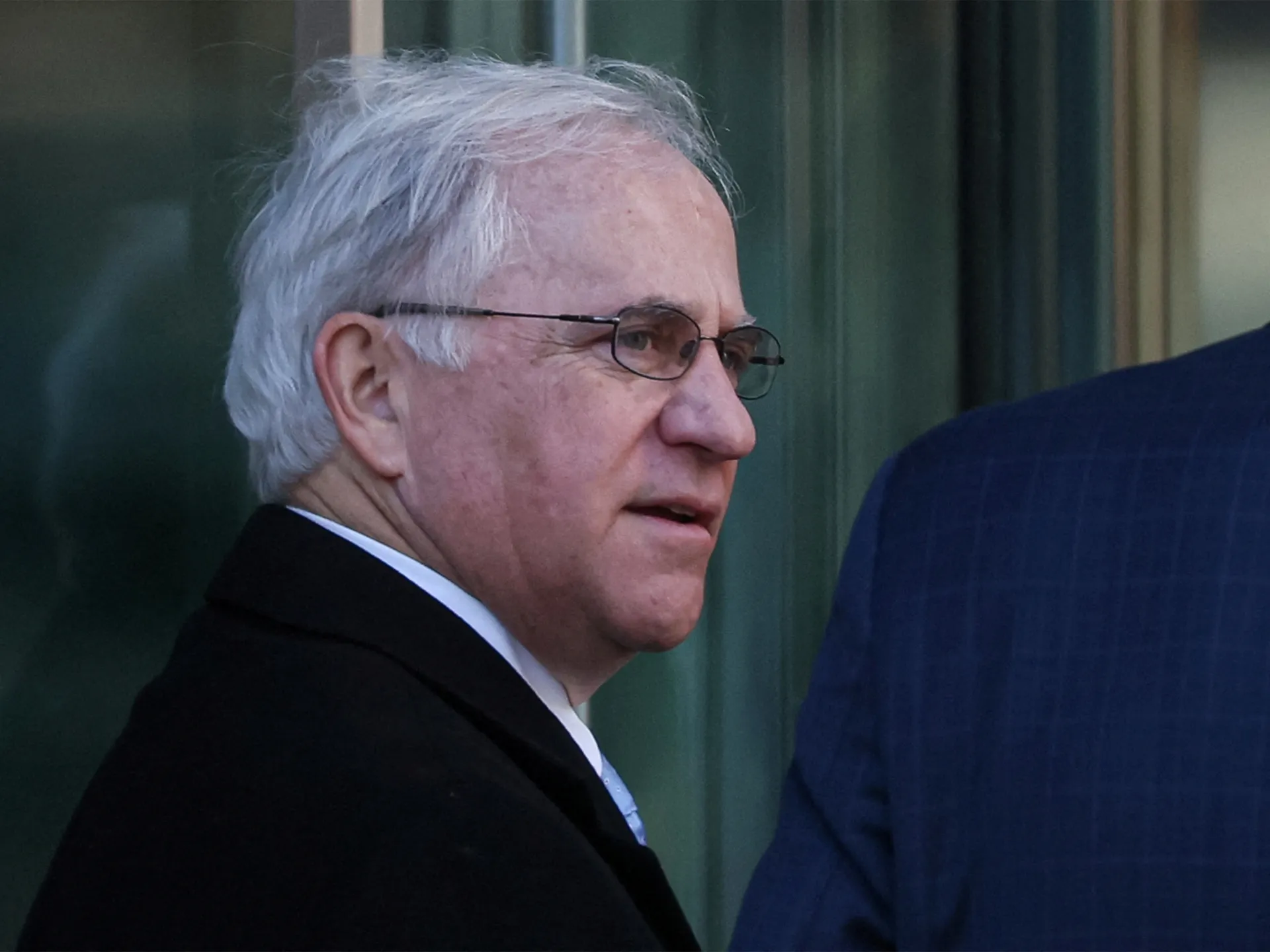
United States President Donald Trump has issued a pardon to Stephen Buyer, a former Republican congressman from Indiana who served nearly two years in prison for making illegal stock trades based on inside information after he left office.

The pardon was dated Thursday and released by the White House late Friday night.

Recommended Stories

list of 3 itemsend of list

Buyer was sentenced to 22 months in prison in 2023 for trades made while working as a consultant and lobbyist. He was ordered to forfeit more than $350,000, representing the amount of the illegal gains, as well as pay a $10,000 fine. He was released in 2025.

The Supreme Court in May rejected Buyer’s appeal without comment or noted dissent.

In granting “a full, complete, and unconditional pardon” to Buyer, Trump cited the Republican’s work, both as a judge advocate general in the US Army and as a politician in the US House. Trump described his career as “distinguished and highly productive”.

Buyer said the pardon “corrects a politically motivated prosecution” and that it was “horrific to be imprisoned for a crime that I did not commit”. He maintains that he is innocent.

Trump used his Truth Social media platform on May 31 to share a pair of letters requesting a presidential pardon for Buyer, a lawyer and Gulf War veteran who left office in 2011.

He was a House prosecutor at Democratic President Bill Clinton’s 1998 impeachment trial, and in 2016, he served on Trump’s transition team, focusing on veterans’ issues.

A letter signed by more than 40 former Republicans in Congress said Buyer was “targeted by the deep state” because of his involvement in Clinton’s trial.

“Like you, Mr President, Steve has been the victim of lawfare conducted by the Biden Administration,” they wrote in the April 2025 letter.

A second letter, from five current House Republicans, said pardoning Buyer would bring justice to his case. The June 2025 letter was signed by Tom Cole of Oklahoma, Ken Calvert of California, Marlin Stutzman of Indiana, Jack Bergman of Michigan and Pete Sessions of Texas.

Buyer, 67, was convicted in connection with insider trading involving the $26.5bn merger of T-Mobile and Sprint, announced in April 2018, and illegal trades in the management consulting company Navigant when his client Guidehouse was set to acquire it in a deal publicly disclosed weeks later.

The US Constitution gives the president broad power to grant pardons for federal crimes.

A pardon does not erase a recipient’s criminal record but can be seen as an act of mercy or justice.

Source link

Pentagon said to raise threat level on Israel spying to ‘critical’ | US-Israel war on Iran News

Department reports raise concerns about increased espionage activity amid US-Israeli war with Iran, ceasefire talks.

The Pentagon’s intelligence arm has raised the assessed threat level on Israeli spying from “high” to “critical” in recent weeks, according to US media.

NBC News first broke news of the change on Friday, with The New York Times issuing its own report the following day.

Recommended Stories

list of 3 itemsend of list

The news outlets cited anonymous sources as saying the switch came in light of concerns over increasingly aggressive tactics related to the US-Israeli war with Iran.

They said the Pentagon’s Defense Intelligence Agency (DIA) had raised the alert level amid fears that Israel is increasingly attempting to surveil top US officials. The aim is allegedly to understand internal White House deliberations about ending the war.

US President Donald Trump and Israeli Prime Minister Netanyahu have publicly diverged in their approach to the war, which the US and Israel started on February 28.

Trump, on one hand, has repeatedly said he wants to bring the war to a close, amid mounting political pressure at home.

Netanyahu, meanwhile, has called for war to resume, despite an April 8 ceasefire. The fighting has been mostly paused since the temporary truce was announced, but efforts to reach a lasting agreement have repeatedly stalled.

The New York Times reported that, while Israel has been known to spy on the US, the DIA cited an uptick in activities beginning in late 2024, as the administration of US President Joe Biden increased pressure on Israel over its genocidal war in Gaza.

That increase continued into 2025, as Trump returned to the presidency and began deliberating about how to approach Iran.

The newspaper added that other recent intelligence assessments have also documented evidence that there are Israeli efforts to monitor Trump’s special envoy Steve Witkoff as well as Elbridge Colby, a top policy official at the Pentagon, and his deputy Michael DiMino IV.

Witkoff had been the lead negotiator in nuclear talks that preceded the initial US-Israeli attack on Iran in February.

Both NBC News and The New York Times cited unnamed US officials in their reports. The US Department of Defense did not immediately respond to a request for comment from Al Jazeera.

However, an unnamed spokesperson told both news organisations that the reports were “false”.

Still, the reported concerns are likely to raise questions over the close intelligence and military coordination between Israel and the US.

Washington has, for years, provided billions in military aid and weapons sales to Israel, including throughout the genocide in Gaza.

The US Congress is also currently debating a section of a new defence bill, which would integrate the two countries’ research and development for weaponry to an unprecedented degree.

While the US and its allies are known to regularly conduct intelligence operations on each other, officials told both NBC and The New York Times that Israel’s recent vigour was unique.

The New York Times reported that the increased DIA designation surpasses all current allies, as well as a handful of countries with more fraught relations.

Recent incidents included Israel’s military intelligence trying to plant listening devices at the DIA headquarters in 2021, according to the newspaper.

In 2025, Israel’s domestic intelligence agency, Shin Bet, was found to have tried to plant a similar device in a Secret Service vehicle, the report said.

Source link

World Cup 2026: Can sub-Saharan Africa outdo noisy neighbours from north? | Football News

Africa’s performance at World Cups peaked at Qatar 2022 when Morocco became the first side from the continent to reach the semifinal stage.

Even their quarterfinal appearance was noteworthy – the Atlas Lions were only the fourth African nation to get there.

Recommended Stories

list of 4 itemsend of list

Although Cameroon, Senegal and Ghana are the three other African teams to reach the quarterfinals, North Africa has dominated the continent’s success overall at the World Cup and at the Africa Cup of Nations.

Egypt are the record seven-time winners of AFCON, while three of the top five African qualifiers for World Cup finals are Morocco, Tunisia and Algeria.

Al Jazeera breaks down the chances of the sub-Saharan nations looking to outshine their neighbours from the north at the tournament which kicks off on June 11:

SENEGAL

World Cup Appearances: Four – 2002, 2018, 2022 and 2026
Best finish: Quarterfinals
Overall record: P12 W5 D3 L4 F16 A17
FIFA ranking: 14
Prediction: Eliminated at quarterfinal stage

Senegal head to World Cup 2026 with a burning sense of injustice firing their campaign. The Lions of Teranga were stripped of the Africa Cup of Nations (AFCON) title by the Confederation of African Football (CAF), which decided the mid-game walk-off by the Senegalese players and staff voided January’s final – which was later awarded to Morocco, along with the trophy, as a 3-0 win.

In 2002, Senegal upset the odds and reached the ⁠quarter-finals in their World Cup debut at the tournament co-hosted by Japan and South Korea.

More than two decades later, expectations are running high – perhaps carrying the greatest expectation on all African teams, including Morocco.

The depth of the 26-man squad is seen as their greatest strength over continental neighbours, but their star power is also envied by rivals.

Sadio Mane remains the country’s greatest export. Although midfield kingpin Pape Gueye, goalkeeper Edouard Mendy and captain Kalidou Koulibaly would grace almost any side at the tournament.

All three are French-born and another shot at the two-time winners of the competition is in their sights.

A 1-0 win against then defending champions France at the 2002 edition announced Senegal as a rising footballing powerhouse. Their first Group ⁠I encounter this time around is against Didier Deschamps side in New York on June 16.

“It’s always a pleasure to play against France. It’s a country we know well,” said Senegal coach Pape Bouna Thiaw, who moved to France aged 17.

“If I lose even a second of my belief that I can win the World Cup with Senegal, I will step down,” he added.

Senegal’s group is completed by Iraq and Norway.

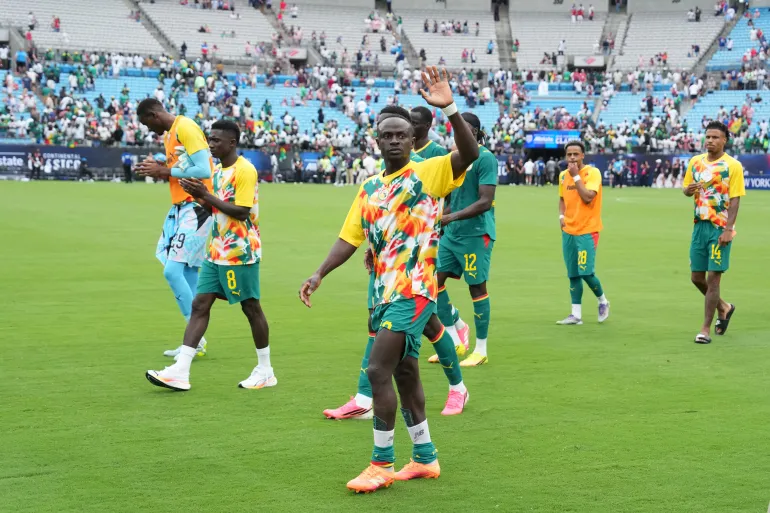
Senegal player Sadio Mane(10) waves to the crowd after the game at Bank of America Stadium
Sadio Mane remains the star name for Senegal [Bob Donnan/Reuters]

GHANA

World Cup Appearances: Five – 2006, 2010, 2014, 2022 and 2026
Best finish: Quarterfinals
Overall record: P15 W5 D3 L7 F18 A23
FIFA ranking: 74
Prediction: Eliminated at quarterfinal stage

Ghana have only missed one World Cup since their 2006 debut.

Four years after their global bow they became the third African side to reach the quarterfinal stage at Germany 2010.

Their run-up to this tournament has not been smooth, with a late change of coach as veteran Portuguese Carlos ⁠Queiroz replaced Otto Addo following a run of poor results.

The German-born former Ghana international led his nation at Qatar 2022, but the ⁠failure to qualify for the last AFCON and comprehensive losses in their four high-profile games in November and March saw him fired in early April.

It will be a fifth successive World Cup for the 73-year-old Queiroz, whose past African experience has been with South Africa and Egypt, and who managed Real Madrid, and was Alex Ferguson’s right-hand man at Manchester United.

Group L, against Panama, England and Croatia, appears to be the ‘group of death’ in the opening stage of the competition, but with Manchester City’s Antoine Semenyo leading a strong attack, Ghana will fully expect to progress.

“I think that this country has a huge, enormous potential. This is a country of footballers,” Queiroz said.

The Black Stars will, however, be without the injured Tottenham forward Mohammed Kudus, who has become the team’s talisman and key factor in their last two successful qualifying campaigns.

Ghana players pose for a team group photo before the match
Ghana have only missed one World Cup since their 2006 debut [Paul Childs/Reuters]

IVORY COAST

World Cup Appearances: Four – 2006, 2010, 2014 and 2026
Best finish: Group Stage
Overall record: P9 W3 D1 L5 F13 A14
FIFA ranking: 34
Prediction: Eliminated at quarterfinal stage

The Ivory Coast return to the global stage after a 12-year absence – one that was hard-felt following the retirement of some of their greatest players in Yaya Toure and Didier Drogba.

It has been a long rebuild for the Ivorians, but they have won two AFCON titles since their last World Cup appearance.

Their youthful attack led by teenager attacker Yan Diomande, alongside Simon Adingra and Amad Diallo of ⁠Manchester United, will be key to their chances.

When hosting AFCON two years ago, Ivory Coast were nearly eliminated in the group stage, but they promoted Emerse Fae from assistant manager for their final game of the opening phase and went on to win the title.

“I believe Ivory Coast has the potential to achieve something exceptional – why not aim for the final?” Fae said ahead of the tournament, that will begin with matches against Curacao, Ecuador and former world champions Germany.

 Ivory Coast's Amad reacts
Manchester United’s Amad Diallo has become one of Ivory Coast’s stars [Jason Cairnduff/Reuters]

CAPE VERDE

World Cup Appearances: One – 2026
Best finish: NA
Overall record: NA
FIFA ranking: 69
Prediction: Eliminated at group stage

One of the debutants, Cape Verde – with a population of about ⁠600,000 – is the third ⁠smallest nation to qualify in the tournament’s long history.

They only debuted at AFCON in 2013, but did go on to reach the quarterfinals – a feat repeated in 2023.

The task before them now – which will be led by their diaspora of players in the main – is daunting, with Uruguay, Saudi Arabia and European champions Spain, lying in wait in the group stage.

“We’ve always been aware of our talent but ‌we haven’t always believed that it could take us much further than we had achieved up to that point,” said manager Bubista, named African Coach of the Year in 2025.

“Therefore, it took courage to face any opponent. The first step in our success was truly believing in our potential. In other words, we changed the players’ mindset.”

Cape Verde's Benchimol celebrates scoring their third goal
Cape Verde’s Benchimol celebrates scoring in a pre-World Cup friendly against Serbia [Rodrigo Antunes/Reuters]

SOUTH AFRICA

World Cup Appearances: Four – 1998, 2002, 2010 and 2026
Best finish: Group stage
Overall record: P9 W2 D4 L3 F11 A16
FIFA ranking: 60
Prediction: Eliminated at round of 32 stage

After a burgeoning beginning to their return to the international fold, with qualification for the 1998 World Cup, South Africa’s fortunes have taken a downtown in the last 16 years.

A first appearance in the finals since 2010 feels long overdue for a nation hoping to reap the rewards of strong domestic growth as they head to North America.

South African ‌club Mamelodi Sundowns are the newly crowned African Champions League winners and eight of their players are in Bafana Bafana’s squad. There are also ⁠eight players from Orlando Pirates – the domestic league champions, who pipped Sundowns to the title by a point.

“We can say that we have players of the best teams of the season. Those guys have much experience at a high level,” South Africa’s Belgian-born coach Hugo Broos said of his 26-man selection.

“I’m certainly happy that Sundowns won the Champions League, because I was afraid that if they should lose, I would get players who would be very ⁠disappointed. So now they all have that boost of confidence, and that ⁠helps a lot.”

South Africa are in the other so-called ‘group of death’ as they take on Czech Republic, South Korea and co-hosts Mexico, who they face in the opening game of the tournament

South Africa players pose for a team group photo
South Africa’s squad includes eight players who won this season’s African Champions League [Siphiwe Sibeko/Reuters]

DR CONGO

World Cup Appearances: Two – 1974 and 2026
Best finish: Group stage
Overall record: P3 W0 D0 L3 F0 A14
FIFA ranking: 46
Prediction: Eliminated at quarterfinal stage

DRC’s only previous appearance was when it was still known as Zaire, competing at the 1974 finals in West ⁠Germany – the first African side from south of the Sahara to go to the World Cup.

As reigning continental champions, their 9-0 thumping by Yugoslavia did little to raise the flag for Africa at the time.

Much has changed since then for the continent and in its second-largest country. The Congolese players will arrive in North America with a FIFA ranking that outstrips three of the other five sub-Saharan qualifiers.

It did take two playoffs to reach this edition – the African legs saw the Congolese eliminate Cameroon and Nigeria, before edging Jamaica in extra time in their intercontinental playoff

Most of the squad are European-born, either in Belgium, France or Switzerland, plus the London-born Aaron Wan-Bissaka, previously called up by England but who missed out on a cap through injury.

“We ‌are ‌extremely proud because a whole generation hasn’t been able to see its national team in the World Cup but now they will see them there,” said their French coach, Sebastien Desabre.

Democratic Republic of Congo's Meschack Elia and team members applaud fans after the match
Democratic Republic of Congo return to the World Cup after 52 years [Nicolas Economou/Reuters]

Source link

Jordan World Cup 2026 preview: Players to watch, group matches and squad | World Cup 2026 News

Previous World Cup appearances: 0
Player to watch: Mousa Tamari
FIFA world ranking: 63

Jordan are appearing at the World Cup finals for the first time, with their Moroccan coach Jamal Sellami hoping that his players can emulate the heroics of The Atlas Lions four years ago.

Recommended Stories

list of 4 itemsend of list

“In big competitions, many teams can surprise. My country, Morocco, ‌reached the semifinals in the last World Cup,” the Reuters news agency quoted him as saying during a training camp in Antalya, Turkiye, in late March.

“That gives us belief.”

While a run to the semifinals might be a little bit optimistic, Jordan are coming into the tournament on a good run of form.

The Middle East nation reached the final of the 2023 Asian Cup, losing to hosts Qatar, and also played Morocco in the final of the 2025 Arab Cup, agonisingly falling short in a 3-2 defeat after extra time.

Jordan also scored 32 goals in World Cup qualifying, marking their highest tally in a single qualification campaign. But eight of those goals were scored by Yazan Alnemat, who will miss this summer’s tournament due to injury.

Sellami takes Jordan into the big time

The Al-Nashama, or the “noble ones”, have developed into a significant force in Arab football since Sellami took over as coach in June 2024 and built on the work of his predecessor, compatriot Hussein Ammouta.

Sellami believes the team he has built can deliver a shock similar to Algeria beating Germany in 1982, Cameroon stunning reigning champions Argentina in 1990, and Senegal repeating the feat against holders France in 2002.

“These results open horizons of hope and ambition for the fans, so they can dream,” Sellami, who played for Morocco at the 1998 World Cup, told Arabic sports channel TFK.

“And we too have the right to dream and to strive to be a strong team and present ourselves well,” he added.

The 55-year-old former midfielder has built a well-structured, disciplined team that utilises their wealth of creative forward talent to hit opponents on the break with lightning-quick transitions.

Star striker misses out

While Jordan’s qualifying campaign gives them plenty of hope for this summer’s tournament, their team in North America will be missing a big part of what made them such a force in Asian qualifying.

Forward Yazan Alnemat contributed eight goals, but will miss the World Cup finals after suffering an ACL injury in the Arab Cup quarterfinals last December.

“Yazan is a player who cannot be replaced,” conceded Sellami. “But we will find a combination for the team that can still be dangerous to the opponent, and that also gives us balance in our defensive performance.”

Alnemat’s likely replacement, Ali Olwan, has recovered from an Achilles injury sufficiently to take his place in Sellami’s extended squad. He contributed nine goals in qualifying, highlighting Jordan’s depth in attacking options.

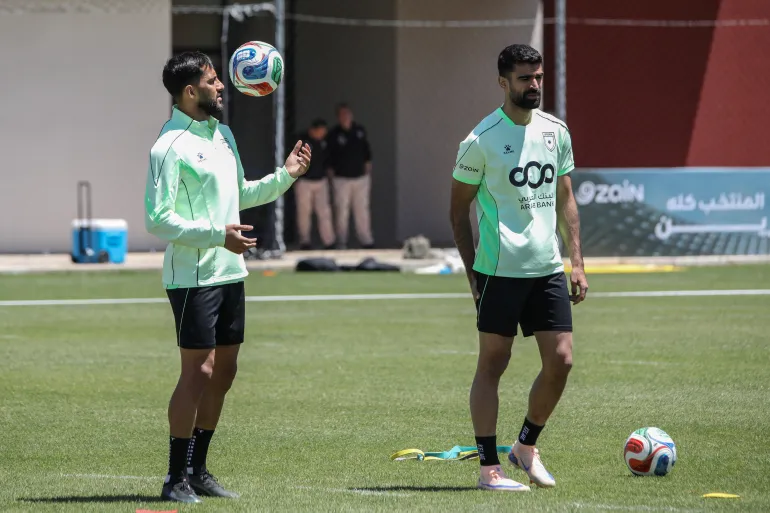
Jordan national soccer team players Mousa Al-Tamari and Nizar Al-Rashdan take part in a training session
Mousa Tamari and Nizar al-Rashdan take part in a training session in preparation for the World Cup [Alaa Al Sukhni/Reuters]

‘Jordan’s Messi’ hopes to shine

Captain Mousa Tamari is one of Jordan’s biggest attacking threats and will be looking to torment defenders on the right wing.

The 28-year-old Rennes midfielder is the only Jordan player who competes in one of Europe’s top five leagues and has enjoyed a strong season in France, scoring seven goals and grabbing 11 assists in 36 appearances for the Ligue 1 outfit.

He’s also been a key player at international level, scoring 23 goals in 76 appearances for the Jordan national team.

If Jordan are to upset the odd’s at this summer’s World Cup, they will need to rely heavily on the man known as “Jordan’s Messi”.

How does Jordan’s group look?

Defending champions Argentina provide formidable opposition in Jordan’s final game in Group J, with the real Messi squaring up against his Jordanian counterpart.

Sellami’s side will face Austria in their opening match in San Francisco, with the European nation making their first appearance at the World Cup since 1998.

Jordan are the lowest-ranked team in their group, but perhaps their best opportunity of success will come against the second-lowest-ranked side, Algeria.

The African side recorded eight wins in World Cup qualifying and will look to Riyad Mahrez to provide goals and assists.

INTERACTIVE-Football FIFA How teams are group World Cup 2026-1776670778

Jordan’s group stage match dates and kickoff times:

⚽ June 16: Austria v Jordan (San Francisco Bay Area, US), 9pm (04:00 GMT on June 17).

⚽ June 22: Jordan v Algeria (San Francisco Bay Area, US), 8pm (03:00 GMT on June 23).

⚽ June 27: Jordan v Argentina (Dallas, Texas, US), 9pm (02:00 GMT on June 28).

Al Jazeera’s prediction:

A fight for third in their group, but ultimately, qualification for the knockouts may be a stretch for Jordan.

Full squad

Goalkeepers: Yazeed Abulaila (Al-Hussein), Abdullah al-Fakhouri (Al-Wehdat), Noor Bani Attiah (Al-Faisaly).

Defenders: Abdallah Nasib (Al-Zawraa), Ehsan Haddad, Saed al-Rosan, Saleem Obaid (Al-Hussein), Yazan al-Arab (FC Seoul), Mohammad Abualnadi (Selangor), Husam Abu Dahab, Anas Banawi (Al-Faisaly), Mohannad Abu Taha (Al-Quwa Al-Jawiya), Mohammad Abu Hasheesh (Al-Karma).

Midfielders: Noor Al-Rawabdeh (Selangor), Nizar al-Rashdan (Qatar), Ibrahim Saadeh (Al-Karma), Rajaei Ayed, Mahmoud Al-Mardi (Al-Hussein), Amer Jamous (Al-Zawraa), Mohammad al-Dawoud (Al-Wehdat).

Forwards: Mousa Tamari (Rennes), Odeh al-Fakhouri (Pyramids), Mohammad Abu Zrayq (Raja Casablanca), Ali Azaizeh (Al-Shabab), Ibrahim Sabra (Lokomotiva Zagreb), Ali Olwan (Al-Sailiya).

Source link

New York Knicks hold off San Antonio Spurs 105-104 for 2-0 NBA Finals lead | Basketball News

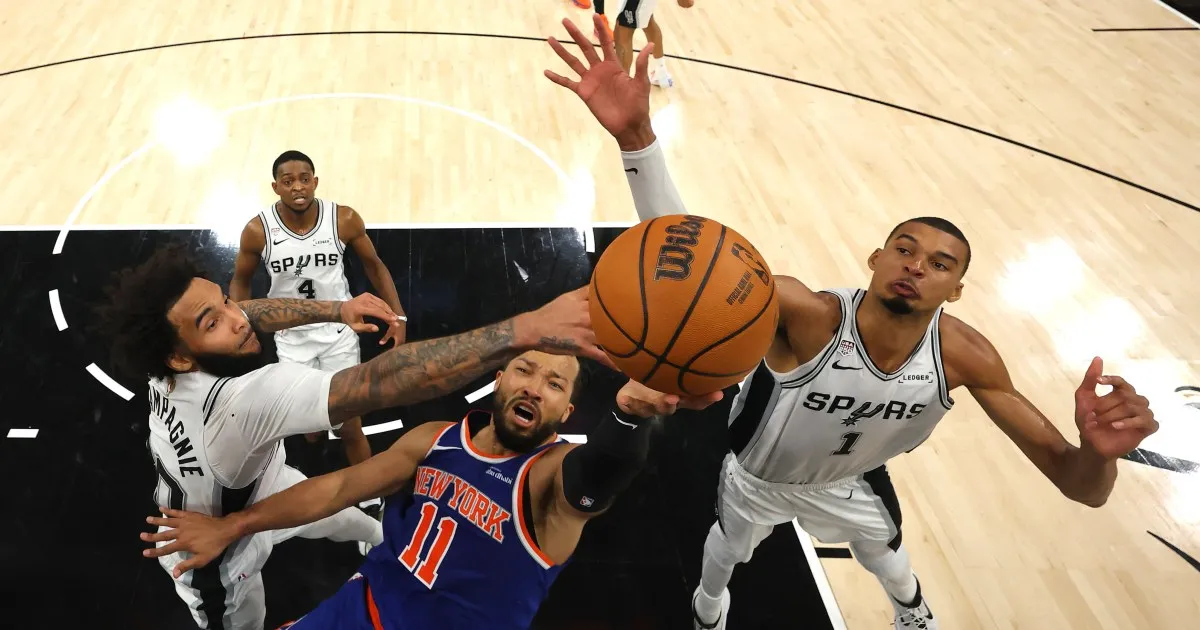
Jalen Brunson drilled the go-ahead free throw as the New York Knicks held off a furious San Antonio rally to beat the Spurs 105-104 and take a commanding 2-0 lead in the NBA Finals.

San Antonio player Victor Wembanyama had a crucial late turnover and missed a potential game-winner with two seconds remaining on Friday, leaving the Spurs in need of an unprecedented comeback when the best-of-seven series shifts to New York for games three and four.

Recommended Stories

list of 4 itemsend of list

No team has lifted the trophy after dropping the first two games of the Finals at home.

Michael Jordan’s 1993 Chicago Bulls and the 1995 Houston Rockets are the only other teams to win the first two games of the championship series on the road, and both went on to win titles.

The Knicks won their 13th straight game of the playoffs – the second-longest streak in postseason history – and will have a chance to close out their first title since 1973 in front of home fans at Madison Square Garden. United States President Donald Trump is scheduled to attend on Monday.

They had to withstand a scintillating fourth-quarter surge from the Spurs, who erased a 14-point deficit with a 14-0 scoring run.

Wembanyama shook off a slow start to score 22 of his 29 points in the second half, his three-point play with 57.3 seconds remaining giving the Spurs their first lead since the second quarter at 104-102.

It was tied at 104-104 with 9.5 seconds left when Wembanyama grabbed the rebound of a Brunson miss but turned it over with a bad pass into the back of teammate Stephon Castle.

Brunson scooped up the ball and was fouled, then made the first of two free throws to put the Knicks back in front.

San Antonio had one last chance, coming out of a time-out with 7.5 seconds left. They got the ball to their superstar, but his jump shot clanged off the rim.

“I threw that one away,” 22-year-old Wembanyama said. “I messed up. We didn’t play great as a team. We needed to win that game.”

Karl-Anthony Towns, who led the Knicks with 21 points and 13 rebounds, admitted he was praying when Wembanyama put the Spurs’ final attempt.

“A great player got a great shot, and it just didn’t go in,” Towns said.

‘What a ballgame’

For the second straight game, Towns delivered a stellar defensive performance that pushed Wembanyama out of his comfort zone.

“He’s a once-in-a-generation player,” Towns said. “You got to make it difficult on him. So, just utilising my experience, utilising my size, my skill, and just trying to make it difficult for him.”

Brunson and Mikal Bridges scored 20 points each, OG Anunoby added 17, and Landry Shamet scored 13 off the bench for the Knicks.

Wembanyama added nine rebounds, four blocked shots and two steals, and De’Aaron Fox scored 20 points for the Spurs.

Desperate not to head back to New York in a 2-0 hole, the Spurs attacked the paint early.

Wembanyama thrilled Spurs fans at the Frost Bank Center – where Knicks supporters were a vocal presence – with his first basket of the night, a left-handed dunk that gave the Spurs a 15-10 lead.

Fox’s alley-oop layup off a feed from Devin Vassell pushed the lead to 10 with less than two minutes to go in the first.

The Spurs pushed their lead to 12 before the Knicks responded in a tense second quarter, taking the lead for the first time, 49-48, on Landry Shamet’s layup with 3:39 left in the first half.

San Antonio regained the lead, but Towns’s three-pointer over Wembanyama gave the Knicks a 56-52 halftime advantage that they pushed to as many as 12 before taking an 84-75 lead into the fourth quarter.

“What a ballgame,” Knicks coach Mike Brown said. “It’s a fantastic ballgame. They made a run. We made a run. They made a run. We made a run.

“We could have folded a few times, but our guys just kept fighting … No matter what run they went on, no matter what time of the game, our guys just kept uplifting one another.”

Source link

Trump hails jobs surge, says Iran talks ‘going well’ | US-Israel war on Iran

NewsFeed

US President Donald Trump hailed stronger-than-expected jobs growth before pivoting to Iran, saying negotiations with Tehran “seem to be going quite well”. Trump offered no further details on the talks as he arrived in Wisconsin for an agriculture event.

Source link

Iran footballers issued US visas for World Cup, says White House | World Cup 2026 News

Iran players get visas 10 days before their opening ‌World Cup match against New Zealand in Los Angeles on June 15.

Iran’s World Cup football players have been granted visas to enter the United States, according to a White House official, just 10 days before their first match in Los Angeles amid a conflict between ⁠the two countries.

Iran’s ambassador to Mexico, Abolfazl Pasandideh, said late on Thursday the squad had still not received their US visas, but these were granted overnight, the White House official said.

Recommended Stories

list of 4 itemsend of list

US Ambassador to Turkiye Tom Barrack confirmed the visas in a message on X on Friday. “Proud of our outstanding team at the U.S. Embassy in Ankara for their work processing visas for Iran’s national football team on their road to the @FIFAWorldCup in the United States,” he said, commenting on a news report that Iran’s World Cup players have been granted the visas to enter the United States.

The US had not yet issued visas to some members of the Iran team’s technical and administrative staff, the semi-official Fars news agency ‌reported on Friday.

Iran’s federation has not yet made a statement on the news.

“Visas for some members of the national team’s technical and executive staff have not yet been issued, and the US embassy has so far refused to issue them,” Fars said, without citing a source.

The US-Israel war on Iran has turned the World Cup – the biggest global sporting event – into a geopolitical contest, with both sides appearing to use the tournament for political posturing.

It is the first World Cup, since its inception in 1930, in which a host nation is set to receive a country it is at war with.

Tehran negotiated a last-minute move of the team’s base from Arizona ⁠to Tijuana in Mexico due to the visa issues and a growing feeling in Iran ⁠that the squad’s presence in the United States should be kept to a minimum.

They are scheduled to land in Tijuana early on Sunday.

Iran are due to play their first Group G match on June 15 against New Zealand in Los Angeles, where they will also face Belgium before taking on ⁠Egypt in Seattle.

The US has never formally said it does not want the Iranian team to stay on its territory, Ambassador Pasandideh said.

However, Secretary of State Marco Rubio told lawmakers on ⁠Tuesday that the US would not allow Iran to include in its World Cup ⁠delegation individuals linked to the Islamic Revolutionary Guard Corps, a powerful branch of the Iranian armed forces.

Mehdi Taj, president of Iran’s football federation, was denied entry for the tournament draw in Washington in December. He is a former commander in the Revolutionary Guards.

Iran’s desire to compete in the World Cup underscored its efforts ‌to reach a resolution in the war with Washington, Pasandideh said.

“Iran’s participation in the World Cup – even on the soil of what is seen as its enemy – shows that Iran seeks peace,” Pasandideh said, speaking through a Spanish interpreter at the ‌Iranian ‌embassy in Mexico City.

Progress in peace talks between Iran and the US has been slow, with both sides seemingly inching towards an interim agreement even as they continue to carry out military strikes.

Source link

Trump makes pitch to farmers hard-hit by tariffs, high prices in Wisconsin | Donald Trump News

Trump seeks to shore up support among rural voters hard hit by tariffs, economic fallout of war with Iran.

United States President Donald Trump has sought to reassure farmers hard-hit by tariffs and the economic fallout of the US-Israeli war with Iran during a visit to Wisconsin.

The stop in Chippewa Falls on Friday for a farming roundtable comes months before the midterm elections in November. Trump was seeking to bolster support for Republican US Representative Derrick Van Orden, who has been targeted by Democrats hoping to take control of the chamber.

Recommended Stories

list of 3 itemsend of list

Van Orden has closely aligned with Trump and has long espoused the president as the best leader for rural Americans. Democrat challenger Rebecca Cook has proven a strong fundraiser and has led Van Orden in recent polls.

Democrats are considered favourites to take control of the US House of Representatives, currently controlled by Republicans, in the midterms.

“I love the place,” Trump said, referring to Wisconsin, “and hopefully you’re going to be voting Republican, because frankly, Republican is – I call it the sane way to go.”

Success for Democrats would allow the party to seriously restrict Trump’s agenda in the final two years of his term.

The Wisconsin visit was also more broadly aimed at shoring up support among farmers, who had largely backed the president in his 2024 election bid.

Farmers have been particularly hard-hit by Trump’s aggressive tariff policies, with many countries limiting imports of US products, notably soybeans, in response. The tariffs have also made importing items needed for daily operations more expensive.

The administration has sought to offset the fallout with temporary aid packages for farmers.

At the same time, fertiliser costs have surged since the US and Israel launched the war with Iran on February 28, with the effective closure of the Strait of Hormuz increasing prices of several key components, including urea.

An April survey by the American Farm Bureau Federation found that 70 percent of farmers in the US reported they cannot afford all of their fertiliser needs.

The average gas price of $4.04 per ⁠gallon of petrol this week was also $1.08 higher than a year ago, according to the American Automobile Association.

Trump assured those gathered that the administration had “largely finished” the war “one way or the other”.

He vowed fertiliser and gas prices would come “way down”.

The visit comes as several polls have shown Trump’s overall approval rating hovering at all-time lows, about or under 40 percent.

His approval was lower on specific issues, with a Marquette Law School poll conducted from May 20-26 finding just 19 percent of respondents approved of Trump’s handling of gas prices. Only 22 percent approved of his handling of inflation and cost of living.

Several top Republicans have also warned that several of Trump’s recent actions could risk alienating voters concerned about the economy.

That included a $1.8bn “anti-weaponisation fund” launched by the Department of Justice to repay individuals, including Trump supporters, who allege they were victims of political prosecutions.

The Department of Justice has since abandoned the plan.

Trump has also requested $1bn in funding for security for his controversial White House ballroom, despite earlier saying that taxpayers would not have to foot the bill.

Source link

Anthropic urges AI labs to pause, warns humans risk losing control | Technology News

Anthropic is proposing that the world’s top artificial intelligence companies come up with a coordinated way to pause development of advanced AI systems, warning that the technology is improving so quickly that there’s a risk humans would lose control.

The company behind the Claude chatbot said in a blog post on Thursday that, as cutting-edge AI gets increasingly faster at carrying out tasks, “it would be good for the world to have the option to slow or temporarily pause” its development.

Anthropic said its internal research institute plans to explore the issue in collaboration with others and “take actions” to help build the systems for a credible slowdown or pause, without being more specific.

Anthropic rival OpenAI argued for a different approach in a report published on Wednesday, saying that “democratic governments — not private companies acting alone — must ultimately determine the rules, safeguards, and accountability mechanisms”.

“Our view is that decisions about the pace of AI innovation should not be left to any one lab, company, or special interest group,” it said.

AI models are getting faster, with rapid increases in how quickly they can carry out software tasks like coding on their own, Anthropic said in its post. Based on current trends and given enough computing power, an AI system could be able to design and develop its own successor, in what is known as “recursive self-improvement”.

Self-building AI would be a major technological milestone that would bring benefits in science, healthcare and other areas, Anthropic said, but it “also might increase the risks of humans losing control over AI systems”.

Some tech industry figures have long warned of such a scenario.

Anthropic’s post comes after a different warning this week from a team of researchers at the University of Toronto who showed how AI tools could be used to create a new kind of AI “worm” that adapts its hacking strategy as it spreads from device to device and takes over a vast computing network.

“I think it’s really important that people understand that it’s not just the biggest, most powerful language models that pose the security concerns,” lead researcher Nicolas Papernot said in an interview.

The authors of the Anthropic post, company cofounder Jack Clark and Marina Favaro, head of its research institute, said the pause would be used to enable “societal structures and alignment research” to keep up with AI advances. Alignment is industry shorthand for making sure the technology matches human values and intentions.

The proposed coordination would let advanced AI labs verify that global rivals have actually stopped or slowed their work, “and that a bad actor could not use the auspices of a coordinated slowdown to jump ahead in secret”.

The company said a coordinated global mechanism is needed because, without it, a slowdown in AI development could let the “least cautious” players catch up and add to pressure on companies and governments as they make tough choices about AI safety.

Fears that advanced AI systems may get out of human control and cause societal harm have risen as the technology becomes increasingly capable. Anthropic’s own Mythos model sent shockwaves through industries, including banking and software, earlier this year with its ability to find vulnerabilities in existing code.

But regulation has been slow, especially in the US, where most leading AI labs are based. A Trump administration executive order earlier this week put the onus on the labs themselves, asking them to voluntarily submit their most capable models for government cybersecurity testing before public release.

Safety focus

AI researchers have also urged a pause before, but have had little success. Elon Musk, who owns AI lab xAI, was among the backers of a 2023 push by the non-profit Future of Life Institute to halt AI development for six months to allow time for safety guardrails.

Anthropic has long positioned itself as a safety-focused AI lab. Earlier this year, it refused to let the US military use its models for domestic surveillance and fully autonomous weapons, prompting backlash from the government, which put it on a national security blacklist, set to take effect later in 2026.

Anthropic’s post comes as the company and ChatGPT-maker OpenAI race to sell shares on the stock market, in an IPO that could value Anthropic at nearly a trillion dollars.

Papernot notified Canadian cybersecurity authorities prior to releasing his report, which shows how researchers developed the worm in a laboratory by using an “open-source” AI tool that is easy for software developers to cheaply access and modify.

“In the past, cyber attackers would focus on targets that are very high value,” he said. “Banking systems, hospitals, electricity grids, water treatment systems, schools.”

Papernot agreed that there should be more collaboration between companies, government agencies and academic researchers to develop countermeasures as AI-powered hacking tools supercharge the search for computer vulnerabilities.

“That old laptop you have in your basement that you don’t check on regularly doesn’t seem like a very high-value target, but it can be used as a launch pad to attack these higher-value targets,” he said. “Anything connected to the internet is now at risk because of how low the cost has become to mount these cyberattacks.”

Source link

FIFA cancels World Cup tickets for about 60 fans who got them for free | World Cup 2026 News

Mispriced tickets were sold through the official World Cup site ahead of next week’s showpiece event for FIFA.

FIFA has cancelled World Cup tickets issued to about 60 fans who mistakenly got them for free because of a website error.

The tickets were “allocated at no charge (0 USD) due to a prior payment issue during the checkout process,” FIFA said in a statement on Thursday.

Recommended Stories

list of 4 itemsend of list

“FIFA regrets the error and any inconvenience caused,” football’s ruling body said. “The tickets requested by these fans remain reserved, and the affected fans have been invited to complete payment of the correct amount.”

It is the latest glitch in an often controversial World Cup ticketing programme that the attorneys general of New York and New Jersey are investigating for possible violations of consumer protection laws.

The mispriced tickets were sold through the official World Cup site on May 21, FIFA said in an email message to buyers.

That date was more than three months after FIFA president Gianni Infantino said all 104 World Cup games had sold out.

Tickets are still being sold by FIFA for games at the World Cup, which opens next Thursday in Mexico City. It is unclear if seats for games in less demand will drop in price under FIFA’s surge pricing model, which has been controversial for fans.

FIFA is also operating its own resale platform — and taking 15 percent commission from both buyers and sellers — in order to cut out ticket dealers from the market. However, sales platforms such as SeatGeek were offering widespread availability on Friday for many games.

Tickets for the 2026 World Cup are wildly more expensive than any previous edition, which FIFA has justified as helping earn billions of dollars it will give to member federations for developing the game globally.

FIFA took control of pricing and selling tickets as part of bringing World Cup operations in-house. The longtime model at previous editions was working with host nations’ local organising committees.

When the football federations of the United States, Canada and Mexico won hosting rights in 2018, they promised to sell hundreds of thousands of tickets at $21 each for group-stage games. FIFA was selling official front-row tickets for the final for $32,970.

Source link

Gaza, Iran, Lebanon: If ceasefires are in place, why do strikes continue? | US-Israel war on Iran News

On Wednesday, Israel and Lebanon announced yet another ceasefire – after they had seemingly already agreed to a truce on April 16.

Iran and the United States have formally had a ceasefire in place since April 8. And Israel and Hamas, the Palestinian group, have had a ceasefire in Gaza since October 10, 2025.

Yet Israel’s attacks on Lebanon continue unchecked, with strikes on the Naqoura and Nabatieh districts of southern Lebanon on Friday, resulting in at least one death. Iran and the US have continued to trade periodic attacks that have picked up in intensity in recent days. The Iranian military has also fired missiles and drones at Gulf nations such as the United Arab Emirates, Kuwait and Bahrain, which it accuses of enabling US attacks on Iran during the ceasefire.

And in Gaza, Israel continues to carry out bombings, including one that killed nine people in a residential building this week, despite a supposed truce aimed at ending its genocidal war on the Palestinian territory.

So what does it mean for a ceasefire to be in place when fighting continues? What does international law say? And why do violations so rarely lead to consequences?

We speak to legal experts to understand:

What is a ceasefire?

Simply put, it’s a pause in fighting designed to create space for negotiations, explained Mark Kersten, assistant professor of criminal justice and criminology at the University of the Fraser Valley.

“A ceasefire is effectively a cessation of hostilities, but typically not understood to be a permanent one,” he told Al Jazeera.

It is also often fundamentally a political agreement rather than a strongly enforceable legal instrument, said Michael Lynk, an emeritus professor at Western University in Canada.

Unlike peace treaties, which often have guarantors responsible for oversight and enforcement, ceasefires can be breached with few immediate legal consequences, Lynk told Al Jazeera.

This is especially true in Gaza and Lebanon, where the United States has acted as the principal broker and overseer. While some countries have criticised Israeli strikes in Lebanon, Lynk says there has been little pressure on Washington for allowing repeated violations.

“A number of Global North countries have criticised the continuing Israeli attacks on Lebanon despite the ceasefire, but they have not called out the US for allowing Israel to repeatedly breach the ceasefires in Gaza and Lebanon.”

So are ceasefires legally binding – or not?

Yes, they are, argues Toby Cadman, a British international human rights lawyer and cofounder of Guernica 37 Chambers.

But, like Kersten and Lynk, Cadman said that ceasefires – which he described as the “temporary, military and diplomatic suspension of military operations” – are inherently fragile. Unlike peace treaties, ceasefires do not resolve the underlying conflict or end the legal state of war.

“It suspends the fighting; it does not end the state of armed conflict,” he said.

Where there is a broader peace agreement, such as in Gaza, the ceasefire too stands – at least in theory – on a stronger footing, said Lynk. The Gaza peace plan that accompanied the ceasefire was endorsed by the UN Security Council through Resolution 2803, which calls for the agreement to be implemented “in its entirety, in good faith and without delay”.

In theory, states could ask the Security Council to sanction parties violating the Gaza agreement. In practice, Lynk explained, the US veto on the body means that neither Israel, nor the US itself, can realistically be censured.

“This is why ceasefires and peace treaties are ultimately political documents because it requires political will to enforce them,” Lynk said.

Who decides when a ceasefire has been violated?

Palestinians have repeatedly pointed to the violation of the Gaza ceasefire by Israel. The US and Iran routinely accuse each other of breaching their truce. And Israel and Lebanon do the same when it comes to their ceasefire.

So who decides whether a ceasefire has been violated – and by whom?

The answer, according to Cadman, is that “there is no neutral arbiter empowered to determine, with binding effect, who has breached.”

Monitoring mechanisms do exist, but they are largely political bodies overseen by the same states that brokered and guaranteed the agreements. In the case of Gaza and Lebanon, that is the United States. But Washington occupies the unusual position of mediator, guarantor and Israel’s closest military and diplomatic ally.

That means allegations of violations are often filtered through political calculations rather than assessed by an independent legal authority, say experts.

What about international law?

For Kersten, Gaza and Lebanon expose a fundamental contradiction within the international legal system. On paper, international law has succeeded in establishing a broad consensus about the legality of what is taking place.

“The vast majority of the world recognises that what is happening in both contexts is not just wrong, but illegal – thanks to international law.”

Yet recognition has done little to halt the violence. “Little is being done to save lives and stop the carnage,” he said.

The result is a widening gap between legal findings and political action. Courts can investigate, collect evidence and issue rulings as the International Criminal Court and the International Court of Justice have both done against Israel, but that does not stop bombs from falling or guarantee compliance on the ground.

For Kersten and Lynk, the problem is not a lack of legal standards; it is the persistent failure of states to enforce them, particularly when powerful actors are involved.

“The lack of effective accountability is the hole in the heart of international law and our modern international political system,” Lynk said.

But Kersten said what was clear was that international humanitarian law, human rights law and international criminal law remain fully applicable during a ceasefire.

“Ceasefire provides no legal cover to commit atrocities against civilians.”

That means allegations of war crimes can still be investigated and prosecuted even while a ceasefire is in effect.

Is ‘self-defence’ a justification for attacks during a ceasefire?

Cadman highlights the legal argument most frequently used to justify continued strikes by Israel on Gaza and Lebanon, and by the US against Iran: self-defence.

These arguments rest on Article 51 of the UN Charter, which carves out the right for states to launch unilateral military action against other nations if they are acting in self-defence.

But Cadman said the interpretation of that clause is heavily contested.

“Article 51 answers an armed attack that has happened or is genuinely imminent; it is not a standing licence for preventive strikes.”

So why do countries feel they can get away with attacks during a ceasefire?

Asked by reporters on Wednesday how he defined a ceasefire, given the continuing – though sporadic – attacks that the US and Iran have exchanged in recent weeks, US President Donald Trump said: “It’s a different part of the world, you know. I’d say in that part of a ceasefire is when you’re shooting in a more moderate manner.”

Trump’s comments underscore what legal experts say is at the heart of the persisting violence in Gaza, Lebanon and the Gulf: The lack of any meaningful enforcement mechanism.

The Security Council is constrained by veto powers. The ICJ can issue binding orders but cannot enforce them. The ICC can issue arrest warrants, but depends on states to carry them out.

“The unifying theme is an enforcement deficit,” Cadman said.

Cadman argued that the problem is not that international law lacks rules. Rather, those rules are often applied selectively. “The law is not formally different for Israel or the US; its application is selective.”

Source link

Democrats force vote on Trump’s $1.8bn settlement fund in ‘vote-a-rama’ | Donald Trump News

Republicans in the United States Senate have renewed their push to pass a controversial $70bn immigration-enforcement funding bill, a top policy priority for President Donald Trump.

But the effort on Thursday faced a series of hurdles, with Democrats forcing votes on several amendments that highlighted controversies related to the Trump presidency.

Recommended Stories

list of 3 itemsend of list

The rapid-fire votes on the amendments were dubbed a “vote-a-rama“, and they are slated to include issues ranging from Trump’s White House ballroom to his tariff policies and the US-Israel war on Iran.

“Amendment after amendment, vote after vote, Republicans are going to have to answer to the American people,” Senate Minority Leader Chuck Schumer said.

Early on, Republicans were forced to confront a topic that has dominated headlines in recent weeks: Trump’s proposed $1.776bn “anti-weaponisation” fund.

The fund has been controversial on both sides of the aisle, with critics calling it a slush fund for Trump’s allies.

Several Republicans indicated that the optics of such a fund could be politically catastrophic ahead of November’s midterm elections, and the Department of Justice has since backed away from the scheme.

But Trump himself has avoided saying whether the fund was dead, or just on hold.

It was created as part of a settlement following a lawsuit Trump filed against the Internal Revenue Service (IRS), a part of his government, and it was designed to award payouts to alleged victims of politically motivated prosecution.

Senate Democrats have repeatedly called for such a fund to be banned outright, rather than relying on the Trump administration’s commitment not to revive it.

Nevertheless, on Thursday, Senate Republicans rejected the Democrats’ measure to permanently block the fund.

Republican Tom Tillis introduced a second amendment, which would have also banned the settlement fund. Instead, the legislation would have redirected the allocated funds to a separate anti-fraud fund within the Justice Department. That, too, was rejected.

Thursday’s votes on the “anti-weaponisation” fund were just the start of several rounds of voting on issues uncomfortable to the Republican Party.

Schumer, the top Democrat, signalled that other amendments would tackle another part of the IRS settlement: the permanent immunity from tax audits that Trump had secured for himself and his family.

Trump’s controversial immigration enforcement campaign and other issues were also scheduled to be taken up in the day’s amendments.

Senate Majority Leader John Thune said he was not sure whether Republicans would defeat every measure, with some members of the party showing an increasing willingness to stand up to Trump.

“I can’t predict how it comes out,” he said.

Immigration funding bill

The situation on Thursday was the result of a standoff between Democrats and Republicans over the Trump administration’s approach to immigration enforcement.

Democrats had pledged not to approve further funding for Immigration and Customs Enforcement (ICE) and Customs and Border Protection (CBP), following the killing of two US citizens during immigration operations in Minneapolis, Minnesota.

Republicans control 53 seats in the 100-seat chamber, short of the 60-vote threshold needed to overcome a filibuster.

They have instead been forced to pursue a lengthy procedural manoeuvre to bypass the filibuster, which has taken weeks.

The $70bn funding bill had been stalled by the Trump administration’s demand to include $1bn for security upgrades for Trump’s White House ballroom project.

The request came after the president had repeatedly said that no taxpayer dollars would go towards the project.

The security funding, which roiled several Republicans, was subsequently dropped before the voting started.

The Senate’s parliamentarian, an official who interprets the chamber’s rules, had previously ruled that adding ballroom funding to the $70bn bill would make it ineligible for the budget reconciliation process, which allows the passage of fiscal-related bills with a simple majority.

If Senate Republicans remain unified, they are expected to pass the funding bill late Thursday night or early Friday.

The Republican-controlled House of Representatives is expected to take up the bill shortly after.

Source link

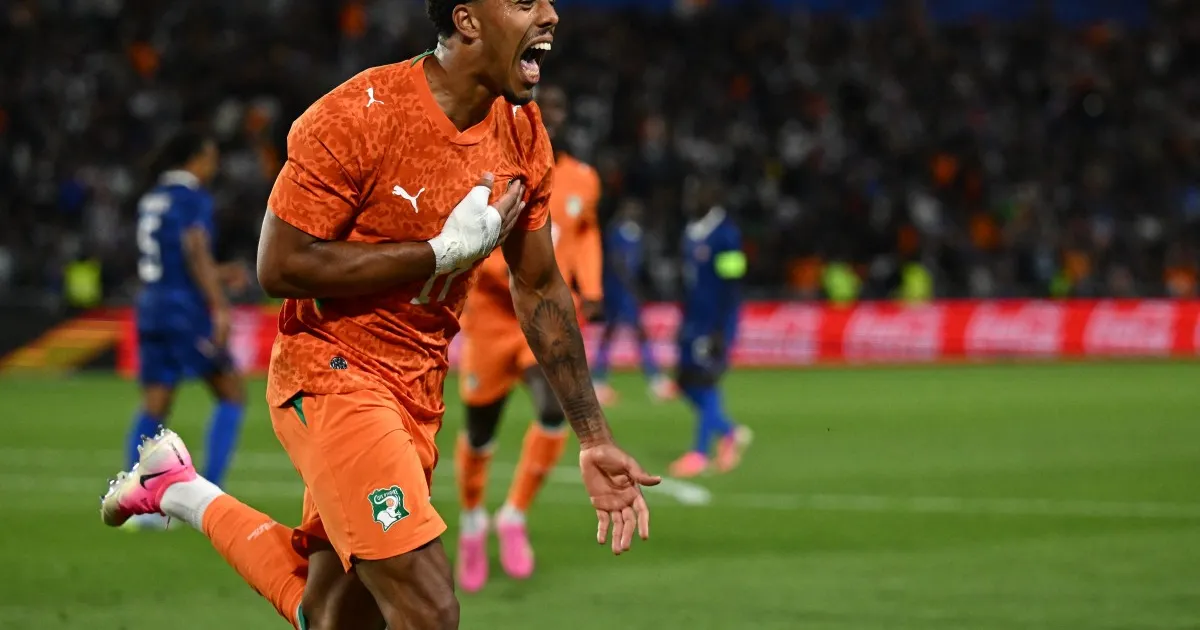
Ivory Coast beats France in World Cup warning to one of the favourites | World Cup 2026 News

Ivory Coast defeats France 2-1 in friendly ahead of the 2026 World Cup, as Manchester United’s Amad Diallo seals win.

France has brushed aside ‌concerns over their World Cup readiness after suffering a surprise 2-1 defeat by Ivory Coast in a ⁠tournament warm-up match, insisting the setback will serve as a useful reminder rather than a cause for alarm.

Didier Deschamps’s side ⁠led through a superb first-half goal from Rayan Cherki on Thursday, but they were overrun after the break as Guela Doue and Amad Diallo turned the game around for the ⁠Elephants in Nantes.

Recommended Stories

list of 4 itemsend of list

With France opening their World Cup campaign against Senegal in New York on June 16, midfielder Aurelien Tchouameni said the result should be viewed in the context of preparations.

“It’s a pity to lose, but we’re in a ‌preparation phase; we stay confident,” Tchouameni said.

“There is no conclusion to draw from this game, even if we had won it. We will be ready.”

France fielded an experimental side, with several Paris Saint-Germain players rested after last weekend’s Champions League final triumph, and made numerous changes after halftime.

Defender Lucas Hernandez also played down the significance of the defeat.

“We always want to win, but we’re in ⁠a phase of preparation, and there were a lot of ⁠substitutions,” Hernandez said.

“We’re in good spirits.”

Deschamps, however, admitted that his side had lost control of the contest after an encouraging opening 45 minutes and warned that France would face opponents with similar qualities to Ivory Coast in the ⁠United States.

“A defeat is never pleasant, even if we did some good things in the first half,” Deschamps said.

“In the second ⁠half we made a lot of changes, but that’s ⁠no excuse. We were not as good after the break, and they brought a lot of pace.

“We will face the same type of team on June 16.”

The France coach said the result could prove useful ‌if it prevented his players from becoming complacent before the tournament.

“It’s a reminder, if we needed one, not to think we’re better than we are,” he said.

‌Cherki ‌added: “It’s a little warning, and I can tell you we’re not going to the World Cup thinking we’re favourites, but we’re going to crush everyone.”

Source link

Democrat fails to block US measure to deepen Israel military cooperation | Israel-Palestine conflict News

A congressional panel in the United States has rejected an effort to revoke a provision from the defence budget that would further integrate the US and Israeli militaries.

An amendment to sink the pro-Israel measure, introduced by Democratic Congressman Ro Khanna, failed in a voice call on Thursday in the House Armed Services Committee.

Recommended Stories

list of 3 itemsend of list

That defeat paves the way for the proposal to advance to the floor of the House of Representatives.

Khanna had argued that the provision in the National Defense Authorization Act (NDAA), formally called Section 224, rewards Benjamin Netanyahu at a time when the Israeli prime minister is trying to dictate US policy in the Middle East.

The progressive Democrat cited recent reports that President Donald Trump is angry at Netanyahu over Israel’s escalation in Lebanon.

“Everyone in America — whether you’re a Republican, an independent or a Democrat — says that we need to tell Netanyahu that America calls the shots, not the prime minister of any other country,” Khanna said.

“They want less cooperation and blank checks to Israel, not more. Only the United States Congress would dream up at this moment, ‘Let’s actually do more for Israel.’”

The vote on the amendment was taken by calling on committee members to say aloud either “yes” and “no”, and the “nays” clearly were more numerous. It was not recorded as a roll-call vote, which would require each member’s preference to be logged.

Section 224 would require the Pentagon chief “to designate an executive agent responsible for synchronising cooperative efforts between the United States and Israel”.

That official would be in charge of overseeing several joint initiatives, “including bilateral defence technology research, development, testing, evaluation, integration, and industrial cooperation”, the NDAA reads.

Netanyahu’s endorsement

Critics have raised concern that Section 224 may make US military aid to Israel more opaque, concealing the assistance as cooperation rather than a separate expense.

The measure also risks tethering the US military to its Israeli counterpart technologically at a time when the American public is rapidly turning against Israel, according to recent public opinion polls.

“As political pressure builds to reduce US military assistance to Israel, Section 224 provides the framework for continuing — and expanding — US-Israel military ties by entrenching Israeli technology within the US defense supply chain in a way that would shield it from the annual appropriations process,” the nonprofit lobbying group A New Policy said in a brief last week.

“The use of must-pass legislation as the NDAA as a mechanism of integration speaks to the plummeting popularity of continuing unconditional support to Israel.”

The measure comes as Netanyahu pushes to transform US aid to Israel from direct assistance to military “cooperation”.

The Israeli prime minister wrote a letter to Republican Congressman Marlin Stutzman endorsing a bill facilitating that transition.

In the letter, Netanyahu said, “The time has now arrived for us to move from aid recipient to partner.”

He added he supported Stutzman’s plan for a “new framework of joint defense cooperation, codevelopment, coproduction and mutual investment in areas including advanced missile defense, artificial intelligence … and next generation military platforms”.

Referencing the letter on Thursday, Khanna argued that Section 224 “directly” follows Netanyahu’s language.

“I am for Team America. I am for the interests of this country, and I believe that when Donald Trump ran, he ran ‘America First’,” the Democrat said.

“That includes American interests against any foreign country. We should have American sovereignty and make it clear that we strike 224. If we want to give aid to Israel, if we want to sell them weapons, that should be a vote for the entire Congress.”

But both Democrats and Republicans pushed back against his argument, saying that the provision aims to streamline existing cooperative programmes that benefit the US.

Key Democrat backs Section 224

Congressman Adam Smith, the top Democrat on the panel, said he was “very sympathetic” to Khanna’s frustration with Netanyahu.

“Mr Netanyahu insisted on this war with Iran that has strengthened Iran and weakened our position. I do not like his leadership of Israel or where he is going,” Smith said.

But he added that it is in the US’s interests to have deep military ties with Israel, a country accused by leading rights groups and United Nations investigators of committing genocide in Gaza.

“The reason that we have these partnerships with Israel, where we may not have as many developed partnerships with other NATO countries, is because Israel has actually been having to fight,” Smith said.

“They have faced drone attacks and missile attacks. They have had to develop new technologies, technologies that we’ve benefitted from.”

Rights advocates often decry the promotion of Israel’s weapons as “battle-tested” — because they have been tested on the Palestinian and Lebanese communities that they devastated, killing tens of thousands of people along the way.

Earlier on Thursday, Palestinian rights advocates warned against approving Section 224 during a news conference on Capitol Hill.

“It is unfathomable that this is the American response to a country that has, over the past two and a half years, carried out a genocide against Palestinians and started wars in both Iran and Lebanon,” said Margaret DeReus, the executive director at the Institute for Middle East Understanding (IMEU).

Republican Congressman Thomas Massie has promised to introduce an amendment to revoke Section 224 when the NDAA goes to a full House vote.

Source link

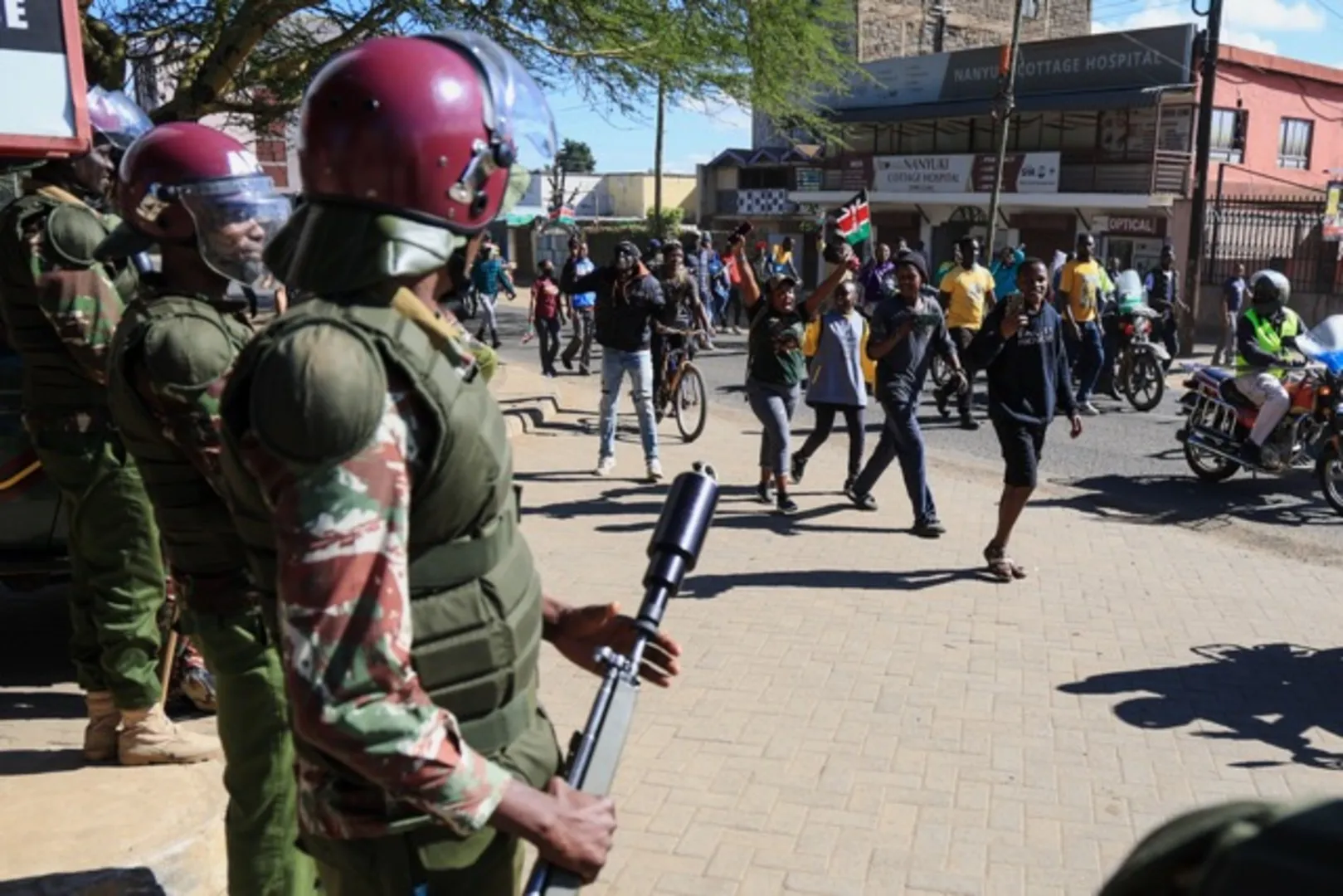
Kenyan president defends US Ebola facility amid deadly protests | Ebola News

NewsFeed

Kenyan President William Ruto said allowing the US to build an Ebola quarantine facility in Kenya was the “right thing”. At least two people were killed this week in protests against the facility, which is being built on a US air force base for Americans exposed to the virus.

Source link

Ronaldo, Messi at World Cup: Who else is playing their final tournament? | World Cup 2026 News

The FIFA World Cup 2026 could be the final act for some of football’s finest talents.

Although some of this tournament’s players will set a men’s football record by appearing in their sixth World Cup, age is catching up, and other players have struggled with injuries.

Recommended Stories

list of 4 itemsend of list

Al Jazeera takes a look at who might be making their final bow on the global stage at the tournament in North America:

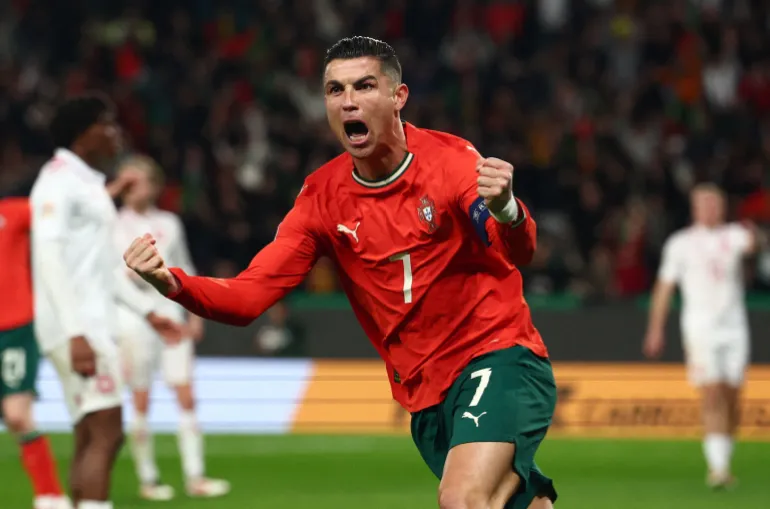
Cristiano Ronaldo – Portugal

Although fitness has been one of Ronaldo’s biggest strengths during his illustrious career, at 41, the Portugal forward knows his playing days are numbered.

Numbers have always been on the former Manchester United and Real Madrid forward’s side, though, and he fired in 30 in 37 matches for Al-Nassr this season, while his tally for Portugal currently sits at 143 goals.

The second-oldest player at this year’s tournament, only behind Scotland’s 43-year-old Craig Gordon, Ronaldo heads to his record sixth World Cup, well aware it could be his final chance to lift the coveted golden trophy: the only one missing from his glittering cabinet.

Ronaldo clenches his fists as he celebrates
Cristiano Ronaldo will play in his sixth, and possibly his last, World Cup this year [Pedro Nunes/Reuters]

Lionel Messi – Argentina

Like Ronaldo, Messi is also off to his record sixth finals appearance, one where he will lead Argentina’s defence of the title they won in Qatar four years ago.

Argentina’s all-time leading scorer and appearance holder, Messi, has struggled with injury in the build-up to the tournament, raising doubts about whether he will feature in each game and if his body can keep up with the gruelling demands of an expanded World Cup.

The eight-time Ballon d’Or winner’s impact and talent, however, are such that, even at 38, he remains the heartbeat of the football-crazy South American nation.

FILE PHOTO: Soccer Football - World Cup - South American Qualifiers - Argentina v Bolivia - Estadio Mas Monumental, Buenos Aires, Argentina - October 15, 2024 Argentina's Lionel Messi celebrates scoring their first goal REUTERS/Matias Baglietto/File Photo
Injuries have cast doubt over Lionel Messi’s involvement in the upcoming World Cup [File: Matias Baglietto/Reuters]

Luka Modric – Croatia

After playing a key role in Croatia’s run to the 2018 final and a third-place finish in 2022, Modric is ready for his fifth and final appearance at the World Cup. As the 40-year-old heads to the tournament after undergoing cheekbone surgery, the veteran knows the team still relies heavily on him for his playmaking prowess.

The ageing midfielder, also the Balkan nation’s captain, still enjoys a hero’s status within a side that has often defied expectations on the global stage. Enjoy his magic in midfield before he bows out.

FILE PHOTO: Soccer Football - World Cup - UEFA Qualifiers - Group L - Croatia v Montenegro - Stadion Maksimir, Zagreb, Croatia - September 8, 2025 Croatia's Luka Modric in action REUTERS/Antonio Bronic/File Photo
Luka Modric, Croatia’s midfield magician, is set for his swansong [File: Antonio Bronic/Reuters]

Neymar Jr – Brazil

At 34, Brazil‘s all-time leading scorer Neymar is much younger than Messi or Ronaldo, but unlike the two greats of the game, his place in the national team is not guaranteed. Neymar’s comeback in the Brazil squad after a two-and-a-half-year hiatus electrified football fandom, and only time will tell whether it was a gamble or a tactical masterclass by coach Carlo Ancelotti.

With a history of fitness issues, a series of injuries and mounting age (he would be 38 by the 2030 World Cup), what looks more certain is that this could be Neymar’s fourth and final act at the tournament.

FILE PHOTO: Soccer Football - FIFA World Cup Qatar 2022 - Quarter Final - Croatia v Brazil - Education City Stadium, Doha, Qatar - December 9, 2022 Brazil's Neymar celebrates scoring their first goal with Marquinhos REUTERS/Dylan Martinez/File Photo
Brazil’s beloved Neymar Jr is off to the World Cup after a two-and-a-half-year hiatus from the national set-up [File: Dylan Martinez/Reuters]

Manuel Neuer – Germany

Such is the “aura” of Neuer, as coach Julian Nagelsmann said last month, that the 40-year-old came out of retirement to be named Germany‘s first-choice goalkeeper for the 2026 World Cup. Back in the squad after nearly two years, fans will have a final chance to see him at the World Cup.

Widely regarded as one of the greatest goalkeepers, Neuer has played at four World Cups, most notably having a key role in Germany’s 2014 World Cup triumph on Brazilian soil.

FILE PHOTO: Soccer Football - Euro 2024 - Round of 16 - Germany v Denmark - Dortmund BVB Stadion, Dortmund, Germany - June 29, 2024 Germany's Manuel Neuer celebrates after Jamal Musiala scores their second goal REUTERS/Kai Pfaffenbach/File Photo
Manuel Neuer reversed his retirement decision to play for Germany at the World Cup for the final time [File: Kai Pfaffenbach/Reuters]

Mohamed Salah – Egypt

Arguably Africa’s greatest player of all time, Salah became a global superstar on the back of his success at Liverpool, where he won nine trophies. At 33, and no longer at the peak of his powers, this could be the forward’s second, and possibly final, World Cup.

An underwhelming season and his subsequent departure from Liverpool may have tempered expectations. Yet Egyptians continue to place their faith in their beloved number 10, hoping he can inspire the nation and help deliver something it has never experienced before: the joy of celebrating a World Cup victory.

Soccer Football - CAF Africa Cup of Nations - Morocco 2025 - Third Place Match - Egypt v Nigeria - Mohammed V Stadium, Casablanca, Morocco - January 17, 2026 Egypt's Mohamed Salah misses a penalty during the penalty shootout REUTERS/Siphiwe Sibeko
Egypt are back at the World Cup for only the third time, and Mohamed Salah’s second [File: Siphiwe Sibeko/Reuters]

Kevin de Bruyne – Belgium

A big part of Belgium’s “golden generation” between 2014 and 2022, playmaker De Bruyne continues to flourish in his duties for club and country. Age, however, is starting to catch up with the playmaker, who turns 35 later this month.

The Napoli midfielder’s performance is central to Belgium’s odds of a deep run at the 2026 World Cup, and he will be eager to drive them to a memorable finish in what will be his fourth and presumably final appearance at the tournament.

FILE PHOTO: Soccer Football - Euro 2024 - Group E - Belgium v Romania - Cologne Stadium, Cologne, Germany - June 22, 2024 Belgium's Kevin De Bruyne reacts after the match REUTERS/Wolfgang Rattay/File Photo
Kevin De Bruyne will appear at this fourth World Cup [File: Wolfgang Rattay/Reuters]

Virgil van Dijk – Netherlands

Experienced centre-back van Dijk is not quite the force he was a few years ago, when he won the Champions League and Premier League in back-to-back seasons with Liverpool.

The Netherlands captain turns 35 next month, and the Dutch could move on with a younger defensive core by the time the 2030 edition comes around.

After reaching the 2022 World Cup quarterfinals and Euro 2024 semifinals, van Dijk will hope to take the team one step further in what will be his third finals.

FILE PHOTO: Soccer Football - World Cup - European Qualifiers - Group G - Netherlands v Malta - Euroborg Stadion, Groningen, Netherlands - June 10, 2025 Netherlands' Virgil van Dijk celebrates scoring their third goal REUTERS/Piroschka Van De Wouw/File Photo
Netherlands captain Virgil van Dijk turns 35 on July 8 [Piroschka Van De Wouw/Reuters]

Sadio Mane – Senegal

Widely regarded as one of the world’s best wingers, Mane heads to the World Cup seeking to make up for the disappointing leg injury that denied him a shot at Qatar 2022.

At 34, the Senegal international is far from the peak of his career, which saw him enjoy trophy-laden spells at Liverpool and Bayern Munich.

Despite his mounting age, Mane remains the team’s source of inspiration and creativity, and he was an integral part of the side that beat Morocco in the Africa Cup of Nations final – only for the result to be overturned due to Senegal’s mid-game protest.

Mane will feature in his third, and likely final, World Cup, given that the Teranga Lion has said the last AFCON was his last, although the coaching team have said they have not given up on changing his mind.

FILE PHOTO: Soccer Football - Africa Cup of Nations - Round of 16 - Senegal v Ivory Coast - Charles Konan Banny Stadium, Yamoussoukro, Ivory Coast - January 29, 2024 Senegal's Sadio Mane celebrates after he scores a penalty during the shoot-out REUTERS/Siphiwe Sibeko/File Photo
Sadio Mane is Senegal’s top scorer with 53 goals [Siphiwe Sibeko/Reuters]

Guillermo Ochoa – Mexico

Part of an esteemed group which includes Messi and Ronaldo, Ochoa is also set to play at a record sixth World Cup. The goalkeeper, who will turn 41 next month, had not been part of the national squad in recent years, but was picked for the tournament, which is being co-hosted by his country, Mexico.

Known for being a formidable figure in Mexico’s previous World Cup campaigns, Ochoa will retire at the end of the team’s run at the tournament.

FILE PHOTO: Soccer Football - FIFA World Cup Qatar 2022 - Group C - Saudi Arabia v Mexico - Lusail Stadium, Lusail, Qatar - November 30, 2022 Mexico's Guillermo Ochoa in action REUTERS/Kai Pfaffenbach/File Photo
Guillermo Ochoa is the first Mexican to play at six World Cups [Kai Pfaffenbach/Reuters]

The FIFA World Cup begins on June 11. You can follow the action on Al Jazeera’s dedicated World Cup 2026 page with all the latest news, match build-up and live text commentary, and keep up to date with group standings, real-time match results and schedules.

Source link

Lebanon’s latest truce: What is different from the April agreement? | Israel attacks Lebanon News

Israel and the Lebanese government have agreed to implement a new US-mediated ceasefire, the Trump administration has said, despite Israel’s defence minister insisting the military will continue operations in Lebanon.

Furthermore, while Lebanese President Joseph Aoun said on Thursday that the ceasefire would come into force within 24 hours of approval by all concerned parties, Hezbollah leader Naim Qassem has dismissed the deal, labelling it a “surrender and defeat”.

Recommended Stories

list of 4 itemsend of list

The Trump administration announcement comes just weeks after a previous agreement to cease hostilities was supposedly reached on April 16. Since then, however, more than 600 people have been killed in Israeli strikes across Lebanon while Israel has expanded its military presence in the south of the country, now occupying about one-fifth of the country.

The renewed diplomatic push also comes as Washington pursues parallel shuttle negotiations with Iran. Tehran, a close ally of Hezbollah, has made a ceasefire in Lebanon a condition for any broader agreement to end the war with the US and has repeatedly called for Israel to withdraw from southern Lebanon.

Iran’s position was underlined when Quds Force commander Esmail Qaani said the baseline demand in Lebanon is for Israeli forces to withdraw to the positions they held before the start of the US-Israel war on Iran at the end of February – a demand that is not explicitly reflected in the agreement.

Iran and Hezbollah’s responses to the US announcement, coupled with Israel’s insistence that military operations will continue, have cast serious doubt on its viability. Critics of Israel’s war on Lebanon also point to the April truce, which they say has completely failed to halt Israeli attacks or Israel’s occupation of the south of the country.

What has been announced?

According to the Trump administration, Israel and Lebanon have agreed to implement a ceasefire contingent on a “complete cessation” of Hezbollah fire and the evacuation of its fighters from the area south of the Litani River.

The agreement also calls for the creation of “pilot zones” where Lebanese Armed Forces would take exclusive control “to the exclusion of all non-state actors”. The stated aim is to move towards a wider political and security agreement, including the dismantling of non-state armed groups and preventing their re-emergence.

But Hezbollah was not party to the talks and has already rejected the agreement. Lebanon was represented by government diplomats, even though the Lebanese army is not a party to this conflict.

According to the wording of the agreement, the parties are due to reconvene during the week of June 22 to continue diplomatic and security talks, with the US facilitating communications in the meantime. It remains unclear if that stage of the agreement will ever be reached.

INTERACTIVE - Israel south lebanon bint jbeil map-1777363494
[Al Jazeera]

What was agreed in April?

The April agreement used different language, saying Israel and Lebanon would implement a “cessation of hostilities” from April 16, and never actually used the word ceasefire.

It also included a clause allowing Israel to “take all necessary measures in self-defence, at any time, against planned, imminent or ongoing attacks”.

That clause does not appear in the new text, which could be interpreted as a small concession. That was until Israel Katz said Israel would continue its military operations in Lebanon regardless.

The latest agreement also repeats Israel’s longstanding demand that Hezbollah withdraw from south of the Litani River.

Meanwhile, there is one major glaring omission. While the text focuses heavily on Hezbollah’s withdrawal from parts of southern Lebanon, it does not mention Israel’s withdrawal from southern Lebanon.

Lebanese journalist and analyst Souhayb Jawhar told Al Jazeera the agreement is defined as much by what it leaves out as by what it includes.

The text, he said, focuses on Hezbollah’s obligations and those of the Lebanese state: removing armed elements from south of the Litani and creating zones where the Lebanese army holds exclusive control.

“This point alone explains much of the scepticism within Hezbollah and its political environment,” Jawhar told Al Jazeera. “From the party’s perspective, any agreement should include a clear ceasefire, an Israeli withdrawal, and a framework for addressing outstanding issues, rather than becoming a document focused primarily on restructuring Lebanon’s internal security landscape.”

INTERACTIVE - LEBANON YELLOW LINE_MAY31_2026_3-1780440840

What else is different this time?

Other points of contention regarding the new agreement are the “pilot zones”, which appear to go beyond stopping the fighting and instead test a new security model in southern Lebanon – one that could eventually be expanded elsewhere, analysts say.

“This is why many observers see these zones as the beginning of a gradual transition from a security environment in which Hezbollah played the dominant role to one in which the Lebanese state and its armed forces become the sole security authority,” Jawhar said.

He added that the fate of the agreement may depend less on Lebanon-Israel talks than on the US-Iran track. If Washington and Tehran reach a wider understanding, the ceasefire in Lebanon will have a stronger chance of holding because both sides will have an interest in stabilising the Lebanese front.

“If those negotiations stall or collapse, Lebanon could quickly return to being one of the main arenas of pressure and confrontation between the two sides,” Jawhar added.

What is the situation in Lebanon now?

Southern Lebanon remained under heavy military pressure on Thursday, with Israeli strikes on Kafra and al-Mansouri in the southwest of the country. In the Bekaa Valley, one person was killed and four others wounded in an Israeli strike on Sohmor, according to Lebanon’s state-run National News Agency (NNA).

A separate strike hit Tell al-Aqareb, while further raids targeted Haddatha, Tibnin, Haris, and Harin. The NNA also reported more Israeli strikes across southern Lebanon as drones flew at low altitude over Beirut. In Maaroub, one person was killed and another wounded when Israeli forces targeted a motorcycle.

Israeli warplanes also struck towns and villages across the south, including Zawtar al-Sharqiya, Zawtar al-Gharbiya, Shoukin, Barachit, Srifa, Zibdin, Haris and Deir Zahrani. Jets and drones have also been flying over the south for much of the morning, including a drone seen at extremely low altitude over Tyre.

Lebanon’s Civil Defence authorities have warned people not to return south, citing the continued danger to civilian life in towns and villages across southern Lebanon.

More than 3,000 people have been killed, and more than one million have been forced from their homes since Israel renewed its assault on Lebanon in early March.

Source link

Iran footballers describe how war with US-Israel affects their World Cup | World Cup 2026 News

Iran is heading to the World Cup while the country is at war with a host nation, a situation that is unique in the tournament’s history.

The United States-Israel war on Iran began on February 28, and there has been an uneasy ceasefire in place since April 8, but the uncertainty – and occasional flare-up in hostilities – means an end to the conflict is far from certain.

Recommended Stories

list of 4 itemsend of list

For the Iranian players and staff, the situation has thrown their World Cup preparations into chaos – all of their matches are scheduled to be played in the US.

The Iran team has spent more than two weeks in Turkiye, mostly practising at the coastal resort Antalya, and some travelled to the capital, Ankara, to submit visa applications at the US embassy.

The team’s participation in the event in the US, Canada and Mexico has long been in doubt and, with the visa situation still up in the air, nothing can yet be fully guaranteed.

“Well, to be honest, it’s not easy,” said Saeid Ezatolahi, a 29-year-old midfielder who also played for Iran in the 2018 and 2022 World Cups.

“This is going to be my third World Cup. So for me and some of the other players, it might be easier to manage these kinds of things,” he told The Associated Press news agency in English on the sidelines of a training session on Wednesday.

“But at the end … it is going to be difficult for us because, at the same time, we are following the news in our country and the political things, of course, can affect the mind of the players and the people.”

The team is set to travel to Mexico this weekend after receiving visas from the Mexican embassy in Ankara. The team said Thursday that the process of obtaining entry permits had been finalised for all members of the squad.

Problems with visa processing meant Iran’s World Cup training base was moved from Tucson, Arizona, to Tijuana, on Mexico’s border with California.

Iran will play its first two games near Los Angeles, which has a large Iranian community, many of whom oppose the current government.

“So for sure, we are expecting to have a lot of fans during our games at the stadium,” Ezatolahi said. “And this is going to be a lot of pressure for us because the expectation is going to be high. I just wish we can make them proud and show them that Iranians, they are prepared for every hard job in the world,” he said.

Iran's players work out during a training session, in Antalya, southern Turkey,
Iran’s players work out during a training session in Antalya, southern Turkiye [Khalil Hamra/AP]

Mohammad Ghorbani, 24, is going to his first World Cup for Iran.

“It’s true that we are facing special circumstances right now, but we are football players, and we have to play, practise, and prepare ourselves for the competitions we have ahead,” the Abu Dhabi-based player said in Farsi.

“On the other hand, we know that our people have been going through a lot of difficulties throughout the war, and we are going there for them, to get the best results for their joy and the joy of the people of our country.”

The US and Israel killed Iran’s supreme leader and other top officials in their initial attacks. Iran responded with strikes targeting Israel, US forces and the Gulf Arab states. It also has maintained a chokehold on the Strait of Hormuz, the narrow mouth of the Gulf, imperilling global energy supplies.

Despite the nominal ceasefire, Iran and the US have yet to negotiate a permanent end to the war, and attacks continue in the region.

Iran is in Group G with New Zealand, Belgium and Egypt and Iran’s team is not required to enter the US until June 14, one day before its first match against New Zealand at the Los Angeles Rams’ stadium in Inglewood.

Iran returns to Inglewood to face Belgium on June 21 and completes Group G in Seattle, against Egypt on June 26.

“I’m really proud to be part of my national team,” said Ezatolahi, whose career has taken him to play for clubs in Spain, Russia, England, Belgium, Denmark, Qatar and now Dubai in the United Arab Emirates.

“We need to clear up our minds and be fresh because our target and our duty is to fight for our people, to represent our country and to show how good we are,” he said.

Ghorbani agreed, saying the team wants to bring joy to Iranians.

“The best message I can give right now is that the Iranian team is showing what it means to be a team,” he said. “We are showing that we are one team under one flag that can bring joy to our whole country, and to show the power of Iranian players and Iranian people to the world.”

The FIFA World Cup begins on June 11. You can follow the action on Al Jazeera’s dedicated World Cup 2026 page with all the latest news, match build-up and live text commentary and keep up to date with group standings, real-time match results and schedules.

Source link