Police make 12 arrests as demonstrators defy government restrictions to gather on Thames embankment.
Published On 15 Mar 202615 Mar 2026
Share
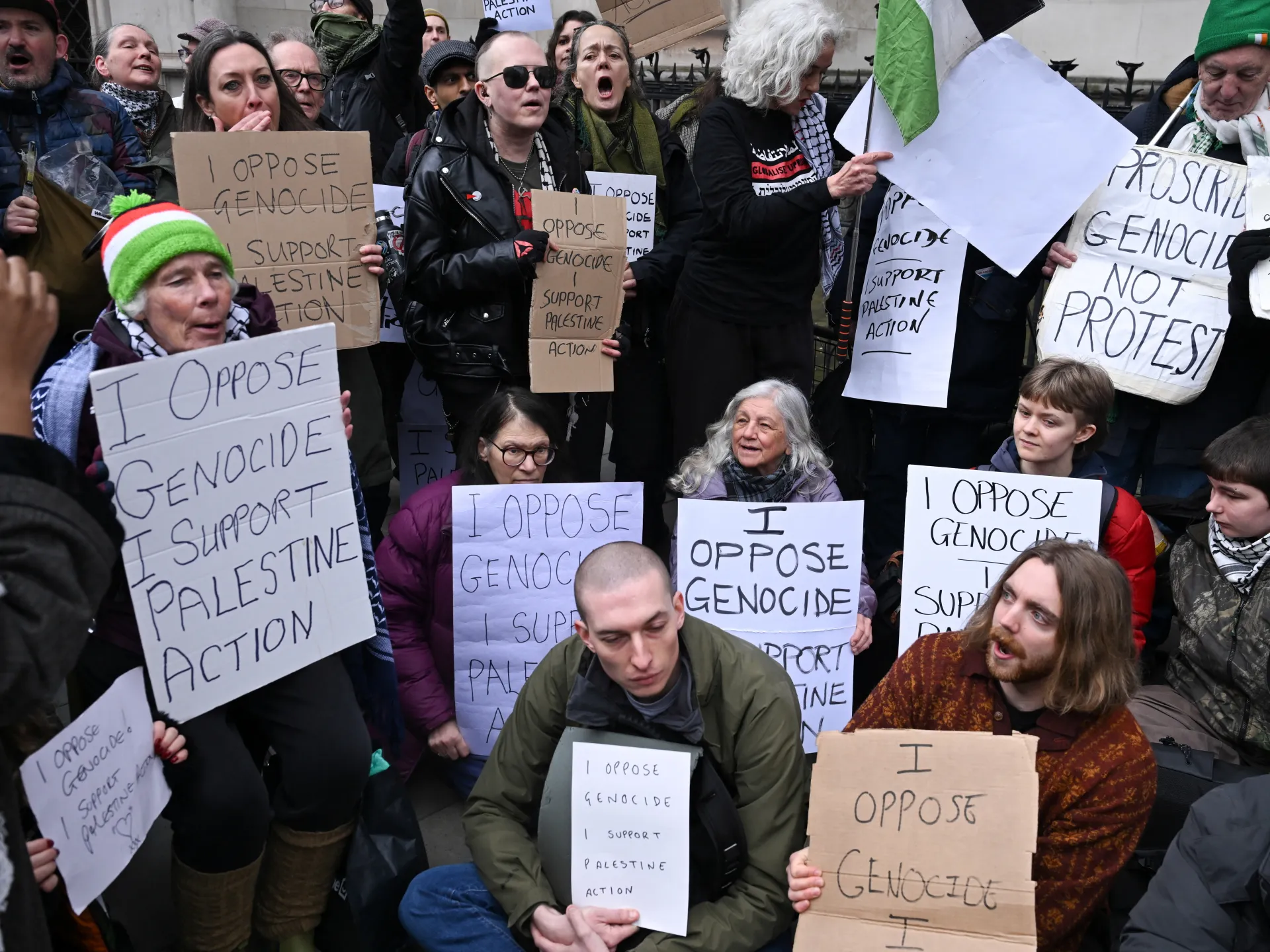
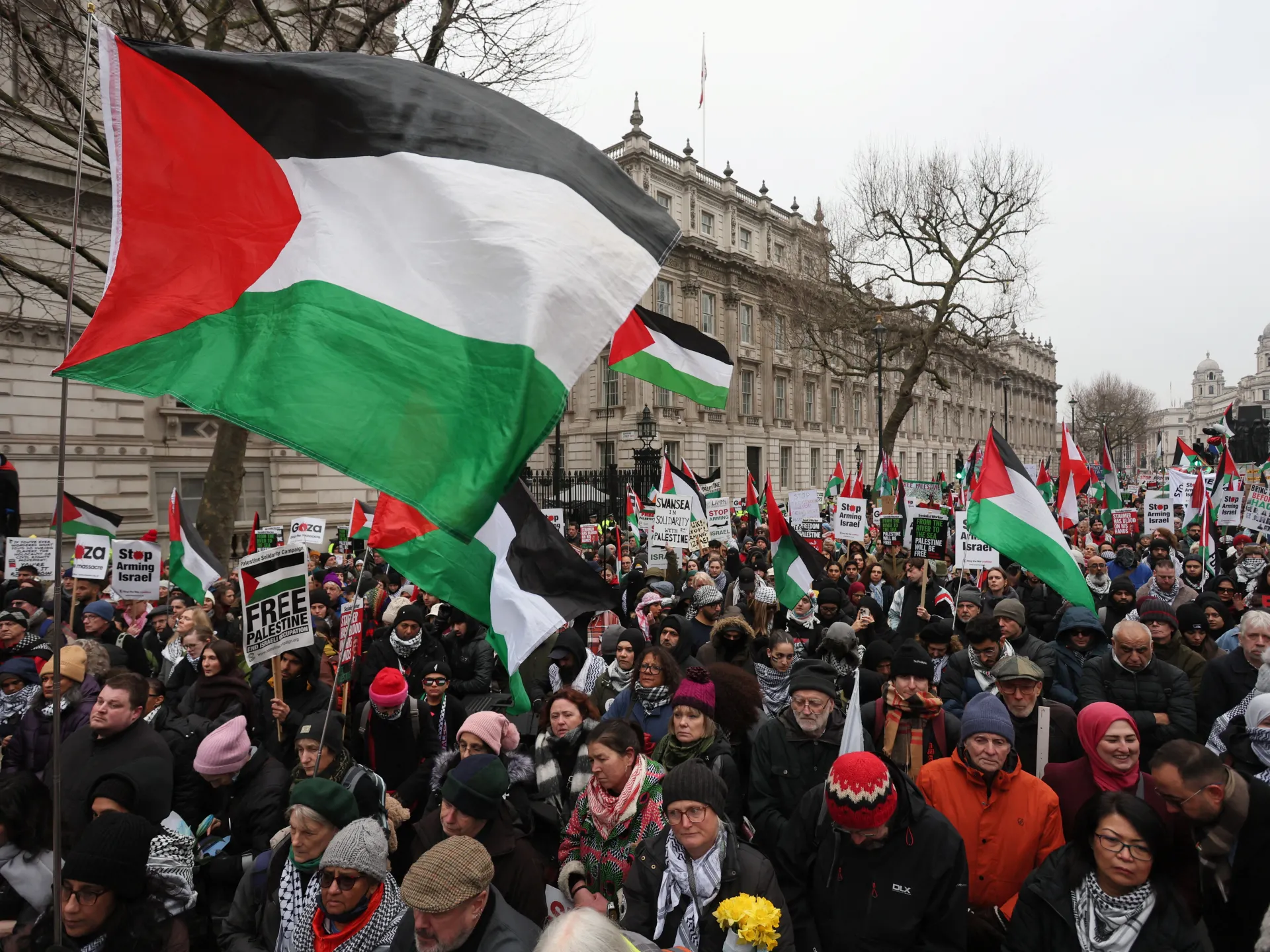
Hundreds gathered in central London for the annual Al-Quds Day demonstration, an international show of solidarity with Palestinians that this year took place under sweeping new restrictions and a heavy police presence.
Crowds assembled on Sunday along the Albert Embankment of the River Thames, where demonstrators waved Palestinian flags, held banners, and chanted slogans – some carrying images of Iran’s late Supreme Leader Ayatollah Ali Khamenei, who was killed earlier this month during US-Israeli attacks on Iran.
Recommended Stories
list of 2 itemsend of list
Police made 12 arrests during the event, including for showing support for a proscribed organisation and threatening or abusive behaviour.
Chants of “from the river to the sea” and “Israel is a terror state” were heard. Al-Quds Day is named after the Arabic name for Jerusalem.
More than 1,000 officers were deployed across the area ahead of what police Assistant Commissioner Ade Adelekan warned would still be “a difficult public order weekend”. Earlier estimates suggested 12,000 people could attend, but only hundreds showed up.
The demonstration marked the first time in more than a decade that authorities banned the march through the capital.
Home Secretary Shabana Mahmood approved Scotland Yard’s request for a month-long prohibition on marches, with the government citing public disorder risks linked to the “volatile situation in the Middle East”, and potential clashes between different groups of demonstrators.
Organisers from the Islamic Human Rights Commission proceeded with a “static” rally in defiance, telling supporters the event would go ahead regardless.
The group accused London police of having “capitulated to the pressure of the Zionist lobby”.
‘Words have consequences’
Al-Quds Day takes place annually on the final Friday of Ramadan, with rallies held worldwide in solidarity with Palestinians and in opposition to Israel’s occupation of Palestinian territory. It was held on Sunday in London as Friday was a regular workday.
Police put demonstrators on notice that “intifada” chants and displays of support for proscribed groups would result in arrest, with Adelekan stating “these words have consequences”.
On the opposite bank, a smaller counterprotest organised by Stop The Hate and the Lion Guard of Iran drew Iranian dissidents and others opposed to the Islamic Republic, some waving Israeli flags.
Scotland Yard used the River Thames as a physical barrier, with police boats patrolling the water and Lambeth Bridge closed to separate the two sides.
Both demonstrations were confined to the stretch between Vauxhall and Lambeth bridges and permitted only between 1pm and 3pm.
Both demonstrations wrapped up at 3pm, with police saying the security plan had worked and neither side attempted to breach conditions by marching.
The rally was the first protest march to be banned in the United Kingdom since 2012 [Carl Court/Getty Images]
Bruno Fernandes reaches 100 assists in all competitions after setting up two goals in crucial 3-1 win over Villa.
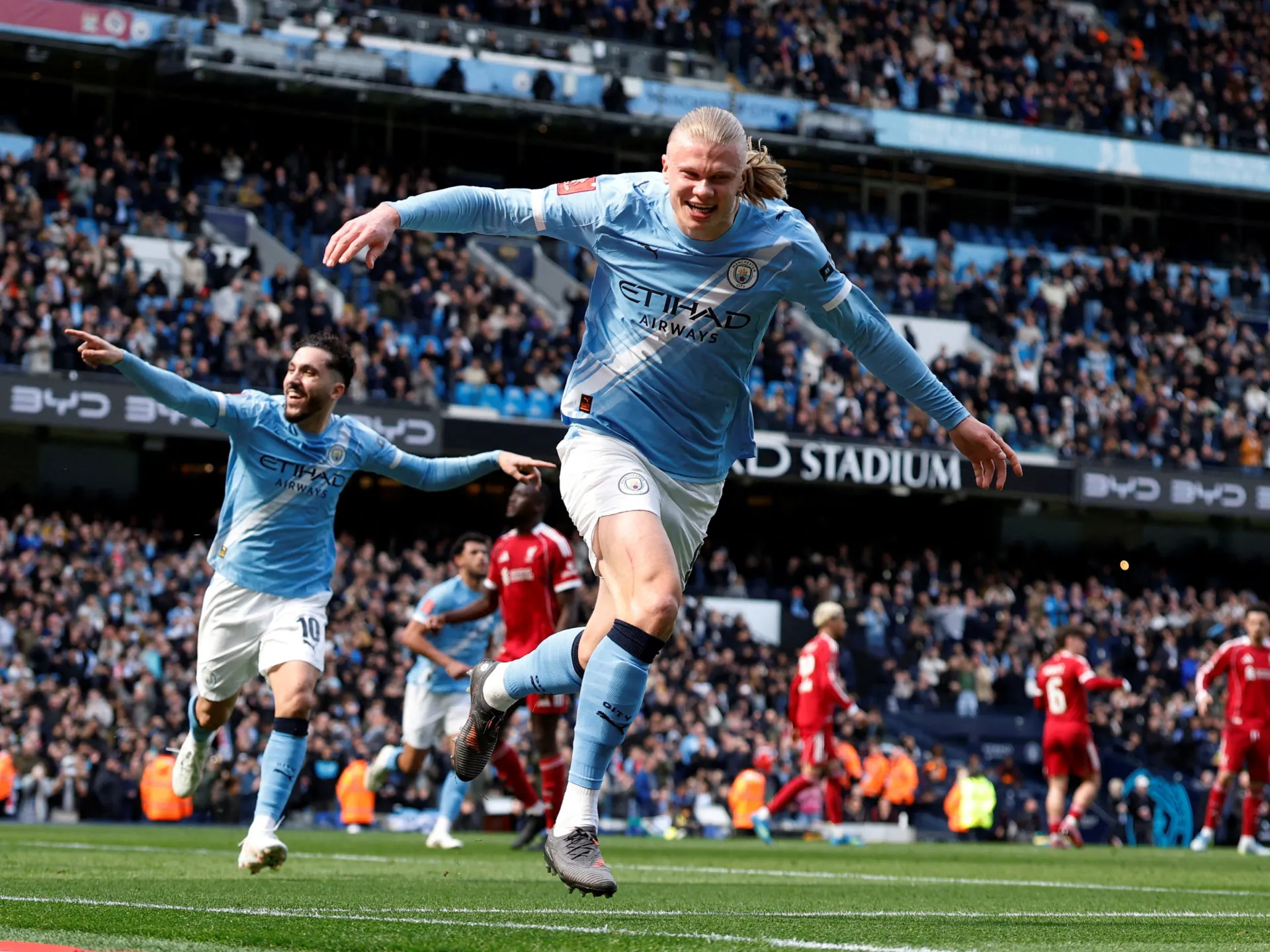
Manchester United bolstered their bid to qualify for the Champions League with a vital 3-1 win against top-four rivals Aston Villa.
Michael Carrick’s side took the lead through Casemiro’s second-half opener at Old Trafford on Sunday before Ross Barkley hauled Villa level.
Recommended Stories
list of 4 itemsend of list
United finished strongly with Matheus Cunha and Benjamin Sesko scoring in the closing stages to seal Carrick’s seventh win in nine games since taking over as interim boss.
Sitting third in the Premier League, United are three points clear of fourth-placed Villa in the race to reach the Champions League via a top-four finish.
United co-owner Jim Ratcliffe this week praised Carrick’s “excellent” work but stopped short of committing to the former Old Trafford star on a long-term basis.
However, Carrick is making a strong case to earn the job on a permanent basis after stabilising United after Ruben Amorim’s sacking.
United’s latest victory came after an 11-day break since the first defeat of his reign at Newcastle, and Carrick celebrated with a jig of delight on the touchline after Sesko wrapped up the points.
Spluttering Villa have lost their last three league games and have just one win in seven top-flight matches, leaving them three points above fifth-placed Chelsea with eight games left in the battle for European places.
After a lethargic first half, United finally prised open the Villa defence in the 53rd minute.
Bryan Mbeumo’s stinging strike was palmed away by Emiliano Martinez, earning a corner that brought the opener.
Bruno Fernandes curled a corner to the near post, and Casemiro made a perfectly timed run to glance a header past Martinez.
With Casemiro likely to leave when his contract expires at the end of the season, United fans serenaded the Brazilian midfielder with chants of “one more year”.
United lost focus and surrendered the lead in the 64th minute.
In his first Premier League start for 14 months, Barkley slammed a superb strike past Senne Lammens from 11 metres (12 yards) after United failed to clear the danger.
But Cunha netted in the 71st minute to ensure Carrick’s men did not pay for their stumble.
Bursting onto Fernandes’s sublime pass into the Villa area, the Brazilian forward slotted a fine finish into the far corner.
It was Fernandes’s 16th Premier League assist this term, moving the United captain past David Beckham’s previous club record of 15 in 1999-2000.
He has 100 assists for United in all competitions since signing from Sporting Lisbon in 2020.
Sesko came off the bench to prove a point to Carrick after being dropped, and the Slovenian striker fired home with a deflected effort in the 81st minute.
Fernandes said he was delighted to provide two assists for his teammates to move past Beckham’s record.
“I’m more proud and pleased because I did it serving my teammates. Giving joy to others is also very good,” he said.
“When you play in the position I play, I’m very happy I can help them to score and be happy in that moment. It’s a huge achievement for me, but the main achievement would be in the top spot at the end of the season.”
Elsewhere, Nottingham Forest climbed out of the relegation zone after a 0-0 draw against Fulham at the City Ground.
Still waiting for their first win under Vitor Pereira, fourth-bottom Forest, who have had four managers this term, are above third-bottom West Ham on goal difference.
Ten-man Leeds held on for a 0-0 draw at Crystal Palace despite Dominic Calvert-Lewin’s missed penalty and a red card for Gabriel Gudmundsson.
Later on Sunday, troubled Tottenham head to Liverpool with only goal difference keeping them outside the relegation zone.
Arsenal beat Everton 2-0 in a nervy match in the Premier League as they continue their pursuit of the title.
Published On 14 Mar 202614 Mar 2026
Share
Max Dowman, a 16-year-old Arsenal winger, became the Premier League’s youngest goalscorer with a remarkable stoppage-time strike in his team’s 2-0 win over Everton.
Dowman collected the ball midway in his own half, dribbled around two Everton players and raced clear unchallenged from the halfway line to tap into an empty net, with Everton goalkeeper Jordan Pickford stranded upfield having gone forward for a corner.
Recommended Stories
list of 4 itemsend of list
An English football prodigy, Dowman — at 16 years, 73 days — was playing just his third Premier League match after two previous substitute appearances at the start of the season.
He broke the record of former Everton player James Vaughan, who was 16 years, 270 days when he scored against Crystal Palace in 2005.
In November, Dowman became the youngest player in Champions League history at 15 years, 308 days when he entered as a second-half substitute against Slavia Prague.
Dowman is still in school. He was 14 when he was asked by Arsenal manager Mikel Arteta to train with the senior team in December last year, and he starred on the club’s preseason tour of Asia in matches against AC Milan and Newcastle.
To abide by Premier League regulations for players under 18, Dowman has to change into his Arsenal kit for training sessions and matches in a separate locker room from his senior teammates.
CCTV shows the moment a car hits a Muslim woman in broad daylight in southeast London before the driver speeds away. The woman survived, and an investigation is ongoing, but no suspects have been arrested yet.
Who: Manchester United vs Aston Villa What: English football’s Premier League Where: Old Trafford, Manchester, United Kingdom When: Sunday March 15, at 2pm (14:00 GMT) How to follow: Al Jazeera’s live coverage begins at 11:00 GMT
Manchester United and Aston Villa face a crunch clash on Sunday in the race for UEFA Champions League qualification.
Recommended Stories
list of 4 itemsend of list
The pair hold third and fourth spots respectively in the Premier League, with United edging Villa on goal difference, while Chelsea and Liverpool sit three points behind the pair in fifth and sixth.
With only the top four being guaranteed a place at the top table of European football, the encounter at Old Trafford holds huge value to both with nine games to go of the season.
Al Jazeera Sport takes a closer look at the match.
Man Utd look to bounce back from first defeat under Carrick
Manchester United’s interim manager Michael Carrick on Friday said his players were “itching to get going” again, after suffering their first defeat under his leadership.
Last week, 10-man Newcastle United ended Carrick’s unbeaten run since he replaced Ruben Amorim in January.
“I understand the first defeat feels different but it was going to come at some point. Most teams have suffered that at some point,” Carrick told reporters.
“It has been a really good week in some ways, we have put ourselves in a position where there is a lot to play for.”
Carrick brushes off Scholes dig at Man Utd
United’s defeat by Newcastle prompted a dig from former player Paul Scholes, who wrote on Instagram: “Michael has definitely got something special about him … cos Utd have been crap last four games.”
Asked about his former teammate’s comment, Carrick said: “It was nothing really, nothing to say about it really.
“I think that is just where we are in terms of social media and things, and captions and quotes. It can be taken in different ways, so just be calm about it and understand the real meaning of things.
“Listen, there are different opinions out there and it’s fine. People can have different opinions.
“It’s just things get taken from one extreme to another. It is what it is. I am not worried about it and don’t make a big deal of it either.
“There’s nothing to say about it, really,” he said.
How have Aston Villa fared in the Premier League this season?
Villa had a turbulent start to the campaign, as they failed to register a win in their first five league matches – losing two. A run of 12 league wins in 13, however, propelled them into a title challenge by the turn of the year.
A 4-1 defeat at Arsenal on New Year’s Eve marked the start of another downturn, though, with only three wins recorded in 11 games starting with the defeat in London.
The midlands club have lost three of their last five on the road in the league, recording only one win in that time.
Last up for Man Utd
United suffered their first defeat under Carrick in their match at Newcastle United on March 4.
The home side were reduced to 10 men when Jacob Ramsey was sent off on the stroke of half-time.
It came in a frantic end to the first half that saw Anthony Gorden give Newcastle an injury-time lead from the penalty spot, only for Casemiro to head home an equaliser to send the sides in level.
William Osula netted the winner in the 90th minute to give Eddie Howe’s side all three points despite their numerical disadvantage.
“It was disappointing the way the game ended (against Newcastle) but we have digested that, looked at it and learned from it,” Carrick said ahead of the Villa match.
“We have trained really well this week and the boys are itching to get going.”
Last up for Aston Villa
Villa were 1-0 winners at Lille in the UEFA Europa League on Thursday, ending a four-game winless streak that included three defeats.
Ollie Watkins scored the only goal of the game in the 61st minute.
The return leg will be played at Villa Park on Thursday.
What happened the last time Man Utd played Aston Villa?
Villa recorded a 2-1 win in the reverse Premier League fixture at Villa Park in November, despite an encouraging display for Ruben Amorim’s United.
Morgan Rogers scored both goals for Villa – his first was scored in the 45th minute but United were level in first-half stoppage time through Matheus Cunha.
What happened in the corresponding fixture between Man Utd and Villa last season?
United were 2-1 winners in the Premier League match at Old Trafford last season.
The Red Devils were greatly aided by the sending off of Villa keeper Emiliano Martinez just before the break.
Amad Diallo and an 87th minute Christian Eriksen penalty sealed the win for the home side.
Head-to-head
This will be the 202nd meeting between the clubs with Manchester United winning 107 of the matches. Aston Villa have won 52 of the encounters, which date back to November 1892 and a 2-0 home win for United in the old Division One.
Manchester United team news
Carrick said Mason Mount had taken a “big step” and could return from a two-month absence against Villa this weekend.
The midfielder missed their last six league games due to injury.
“He is an important player for us,” he said.
“He is not 100 percent and he has only trained for a small period of time. But he is back and that’s good for us. We will see if he is involved on Sunday. That is it in terms of the players coming back.”
Matthijs de Ligt, Patrick Dorgu and Mason Mount all remain absent though, and Lisandro Martinez has been added to that list with a calf injury, while there remains an injury doubt over Luke Shaw.
The defender was forced off with injury in the defeat by Newcastle, but Noussair Mazraoui, who also came off injured in that game, is set to be available.
Aston Villa team news
Midfielder John McGinn returned to action at Lille on Thursday night and could be in line for a start at Old Trafford.
Youri Tielemans and Boubacar Kamara remain absent through injury, leaving a gaping hole in the middle of the Villa lineup.
Right-back Matty Cash is also a doubt having missed the Lille match after picking up a knock in Villa’s last Premier League outting.
Ghana international Thomas Partey faced initial charges of rape just days after leaving Arsenal last summer.
Published On 13 Mar 202613 Mar 2026
Share
Former Arsenal player Thomas Partey intends to plead not guilty to two new charges of rape, his lawyer told a London court on Friday.
The 32-year-old Ghana midfielder, who now plays for Spanish club Villarreal, is separately awaiting trial on five counts of rape related to two women and one count of sexual assault involving a third woman.
Recommended Stories
list of 4 itemsend of list
The new charges were brought after a different woman alleged Partey twice raped her on the same day in December 2020. According to a court hearing on Friday, the new allegations arose after the first set of charges were publicised.
Partey was not required to attend Friday’s preliminary session at Westminster Magistrates’ Court. His lawyer, Emma Fenn, indicated he intends to plead not guilty to both charges. The next court date for the case is April 10.
Partey pleaded not guilty to the first set of charges and faces trial in November at Southwark Crown Court. Those alleged offences were between 2021 and 2022, prosecutors have said.
The midfielder had joined Arsenal in 2020 from Atletico Madrid.
He was initially charged last July, just days after his Arsenal contract expired. Villarreal signed him in August, two days after he was granted bail.
Ghana has qualified for the World Cup and is in the same group as England, Croatia and Panama.
Partey played in three World Cup qualifying games in September and October. He has made more than 50 appearances for Ghana.
Irish rapper Liam O’Hanna welcomes ruling in case he says was ‘never about any threat to the public, never about terrorism’.
Published On 11 Mar 202611 Mar 2026
Share
British prosecutors have lost an appeal seeking to reinstate a “terrorism” charge against a member of Irish rap group Kneecap accused of waving a Hezbollah flag during a gig in London.
London’s High Court on Wednesday rejected prosecutors’ attempts to challenge a lower court’s decision to throw out the case against Liam O’Hanna in September due to a technical error.
Recommended Stories
list of 3 itemsend of list
The decision means the case will not proceed. In a statement, the Crown Prosecution Service said the High Court had “clarified how the law applies” to such cases and that it accepted “the judgement and will update our processes accordingly”.
O’Hanna – also known as Liam Og O hAnnaid (his name in Gaeilge, the Irish language) and by the stage name Mo Chara (“My Friend”) – was charged in May of last year with displaying a Hezbollah flag during a November 2024 concert in London, in violation of the United Kingdom’s 2000 Terrorism Act.
Kneecap’s members – who rap in Gaeilge and English and have been outspoken in their condemnation of Israel’s genocide against Palestinians in the Gaza Strip – have called the attempted prosecution a “British state witch-hunt”.
Liam O’Hanna (Liam Og O hAnnaid) welcomed the ruling during a news conference in Belfast, Northern Ireland [Charles McQuillan/Getty Images]
O’Hanna welcomed the ruling on Wednesday, saying during a news conference in Belfast that the case was “never about me, never about any threat to the public and never about terrorism”.
“It was always about Palestine, about what happens if you dare to speak up, about what happens if you can reach large groups of people and expose their hypocrisy, about the lengths Britain will go to cover up Israeli and US war crimes,” he said.
Cheered by supporters at the event, O’Hanna was joined by Kneecap bandmates JJ O Dochartaigh and Naoise O Caireallain – better known by their respective stage names, DJ Provai and Moglai Bap.
“Your own High Court ruled against you,” O’Hanna added, addressing the UK government.
“The pathetic thing about this whole process is that you falsely tried to label me a terrorist when it is the British government ministers that are arming and assisting a genocide in Gaza, the destruction of Lebanon, and the senseless slaughter of schoolkids in Iran.”
Barcelona needed Lamine Yamal’s penalty with the last kick of the game to cancel out Harvey Barnes’s opener.
Published On 10 Mar 202610 Mar 2026
Share
Barcelona’s Lamine Yamal struck from the penalty spot with the final kick of the game to salvage a 1-1 draw with Newcastle United in the first leg of their Champions League last-16 tie, cancelling out a late strike from Harvey Barnes.
Newcastle appeared set to take a slender advantage into the second leg after Barnes scored in the 86th minute, when he volleyed home Jacob Murphy’s cross on Tuesday.
Recommended Stories
list of 4 itemsend of list
But elation for the home fans turned to heartbreak when Malick Thiaw brought Dani Olmo down in the box in the fourth minute of stoppage time, and Yamal fired the penalty into the bottom corner as Aaron Ramsdale dove the wrong way.
Newcastle’s Joelinton thought he had scored earlier in the second half when he smashed home the rebound of Barnes’s shot off the post, but the linesman quickly raised his flag for offside.
The second leg is at Barcelona on March 18.
Elsewhere on Tuesday, Mario Lemina’s early diving header handed Galatasaray a 1-0 victory over Liverpool in their Champions League last-16 first leg in Istanbul, leaving the tie finely balanced after a compelling contest in which both sides saw goals disallowed.
The Turkish champions struck after seven minutes, when Lemina nodded home after Victor Osimhen headed a corner back across goal, giving them a precious advantage ahead of the second leg at Anfield.
In Italy, Bayern Munich dismantled Atalanta 6-1 in a dominant Champions League last-16 first-leg performance on Tuesday, seizing control from the outset in Bergamo.
The visitors surged into a three-goal lead within the opening 25 minutes, leaving the home side struggling to gain any sort of foothold in the contest.
Meanwhile, Atletico Madrid tore Tottenham Hotspur apart in a stunning first-half blitz on Tuesday, powering to a 5-2 victory in the first leg of their Champions League last-16 tie and leaving the Premier League side with a mountain to climb in London.
The visitors’ 22-year-old goalkeeper, Antonin Kinsky, endured a night to forget on his first appearance since October and only his third of the season.
Two costly errors from the Czech helped Atletico race into a commanding lead, and he was substituted in the 17th minute by manager Igor Tudor immediately after Atletico’s third goal.
United States President Donald Trump has posted on social media that he does not need the United Kingdom to deploy aircraft carriers to the Middle East, amid the ongoing war with Iran.
Saturday’s post on Truth Social follows a statement from the UK’s Ministry of Defence that one of its two flagship aircraft carriers, the HMS Prince of Wales, has been placed on “high readiness”.
Recommended Stories
list of 3 itemsend of list
“The United Kingdom, our once Great Ally, maybe the Greatest of them all, is finally giving serious thought to sending two aircraft carriers to the Middle East,” Trump wrote.
“That’s OK, Prime Minister Starmer, we don’t need them any longer — But we will remember. We don’t need people that join Wars after we’ve already won!”
The post, with its reference to the UK as a “once great ally”, signals a deepening rift between the two countries that has emerged since Trump returned to office last year.
The divide appears to have deepened over the past week, as the US and Israel continue to hammer Iran as part of a war they launched on February 28.
The conflict has sparked fears across the Middle East, as retaliatory strikes from Tehran target US allies across the region.
Already, an estimated 1,332 people have been killed in Iran, and the US has confirmed the deaths of six of its service members. More deaths have been reported in countries like Lebanon, Kuwait, the United Arab Emirates and Iraq.
The UK government has increased its involvement in the war on Iran, widely considered illegal under international law.
The UK Defence Ministry, for instance, said on Saturday that the government of Prime Minister Keir Starmer had allowed the US to use its military bases for what it termed “limited defensive purposes”.
The bases include RAF Fairford in Gloucestershire and the Diego Garcia site in the Chagos Islands, located in the Indian Ocean. Initially, there had been reports that Starmer had blocked the US use of the bases.
In the immediate aftermath of the initial US-Israeli strike, Starmer appeared to blanche at the prospect of joining the war.
He and the leaders of France and Germany issued a joint statement, underscoring that any actions they might take would be defensive in nature.
“We will take steps to defend our interests and those of our allies in the region, potentially through enabling necessary and proportionate defensive action to destroy Iran’s capability to fire missiles and drones at their source,” the joint statement said.
“We have agreed to work together with the US and allies in the region on this matter.”
But Starmer has had to push back on domestic criticism both for and against joining the war.
On Monday, he told the UK Parliament, “We are not joining the US and Israeli offensive strikes”, citing the need to protect “Britain’s national interest” and “British lives”.
The war in Iran remains largely unpopular in the UK. The polling firm Survation conducted a survey over the last week of 1,045 British adults, in which 43 percent of respondents called the war not justifiable.
When asked if they supported Starmer’s initial decision not to allow the US to use UK bases, 56 percent of respondents approved. Only 27 percent said it was the wrong choice.
Thousands of protesters gathered outside the US Embassy in London on Saturday to call for an end to the ballooning conflict.
The US president, meanwhile, has upped his criticism of Starmer over the past week, further fraying relations with the UK government.
On March 3, for instance, Trump held an Oval Office meeting with German Chancellor Friedrich Merz, in which he said repeatedly he was “not happy with the UK”.
Of Starmer, Trump said, “This is not Winston Churchill that we’re dealing with.”
Trump has long admired Churchill, and last year installed a bust of the late UK wartime leader in the Oval Office, just as he had during his first term.
By contrast, Trump has issued a flood of criticism against Starmer, particularly for his 2024 decision to transfer control of the Chagos Islands to Mauritius.
The transfer came after the International Court of Justice found the UK acted unlawfully in 1965 by separating the islands from Mauritius to create a separate colony.
The deal with Mauritius allows the US and the UK to maintain a military base on Diego Garcia, part of the archipelago.
However, Trump has repeatedly slammed the transfer, writing on social media that “giving away extremely important land is an act of GREAT STUPIDITY”.
Tensions between the US and UK also rose in January after Trump told Fox News that NATO allies had “stayed a little off the front lines” during the US war in Afghanistan.
Starmer had responded that he found Trump’s comments “to be insulting and frankly appalling”.
The Trump administration has signalled it is pivoting away from its traditional European allies in favour of more politically aligned countries.
At a summit on Saturday with right-wing Latin American leaders, US Secretary of State Marco Rubio appeared to praise the attendees while casting shade on other allies.
“At a time when we have learned that, oftentimes, an ally, when you need them, maybe may not be there for you, these are countries that have been there for us,” Rubio told the summit.
Sanju Samson hit 89 for India as they posted 253-6 and beat England by 7 runs in second semifinal of cricket’s 2026 T20 World Cup.
Published On 5 Mar 20265 Mar 2026
Share
Defending champions India edged one of the all-time great T20 World Cup matches to beat England by seven runs in their semifinal in Mumbai.
Sanju Samson appeared to put the tournament co-hosts in a near-unassailable position with a total of 253-6 on Thursday, but a century for Jacob Bethell put England on the verge of a historic run chase.
Recommended Stories
list of 4 itemsend of list
Having found themselves 64-3 inside the powerplay, England were looking down the barrel of a heavy defeat at Wankhede Stadium.
A cameo of 17 from 5 balls by Tom Banton ignited the chase, however, and Will Jacks’s 35 from 20 aided matter in a partnership of 77 in 6.3 overs with Bethell.
When the latter fell – run out in the final over – with 105 from 48 balls, the game was up and India were on their way to the final as England finished on 246-7
Suryakumar Yadav’s side will now seek a record third T20 World Cup title when they take on New Zealand on Sunday.
Earlier, England decided to field upon winning the toss, but saw Samson’s scintillating 89 off 42 balls lay the platform for India to pile up a massive total.
The in-form opener, who made 97 not out against the West Indies in the previous match, hit seven sixes and eight fours to thrill a raucous home crowd.
The hosts flayed England’s attack to all parts of the ground, hitting 19 sixes and 18 fours, meaning Harry Brook’s side needed a T20 World Cup record chase of 254 to reach the final.
Samson signalled his intent with a four and six off Jofra Archer’s first over after Brook won the toss and decided to bowl.
Jacks took the second over and struck a blow for England when Abhishek Sharma (9) lifted the off-spinner to Phil Salt at deep mid-wicket.
Samson was given a life on 15 when Brook dropped a simple chance at mid-off off Archer.
It proved a costly mistake as, helped by some ill-disciplined bowling, Samson raced to his half-century off 26 balls with another huge six as Liam Dawson’s first over was pummelled for 19 runs.
Ishan Kishan put on 97 from 48 balls with Samson for the second wicket before the left-hander holed out to Jacks off Adil Rashid in the 10th over to make it 117-2.
Samson powered on until Jacks returned to have him caught by Salt in the deep in the 14th over, at which point India were 160-3.
Shivam Dube continued the onslaught with 43 off 25 balls with four sixes before being run out by Brook’s direct hit.
Hardik Pandya hit 27 off 12 balls late on and Tilak Varma 21 off seven balls to take India past the 250 mark.
Jacks was the pick of the England bowlers with 2-40 but the wayward Archer was plundered, taking 1-61 off his four overs.
New Zealand beat South Africa in a comprehensive victory on Wednesday and await in Sunday’s final in Ahmedabad.
UK Prime Minister Keir Starmer has allowed the US to use British bases for so-called “defensive strikes” targeting Iran, after Tehran started hitting civilian targets. Still, Al Jazeera’s Milena Veselinovic explains why US President Trump says the US-UK relationship isn’t what it used to be.
South Africa captain Aiden Markram says his team’s win over New Zealand in the group phase will count for nothing in the T20 World Cup semifinal, which will be a “completely fresh start”.
The two teams clash at Kolkata’s Eden Gardens in the first semifinal on Wednesday, with both having never lifted a cricket World Cup in either the 20-over or 50-over formats.
Recommended Stories
list of 4 itemsend of list
South Africa are the only unbeaten side in the last four, and are trying to rid themselves of a reputation for choking in the final stages at World Cups.
They have been the team to beat in this edition and got the better of New Zealand by seven wickets in a group game in Ahmedabad on February 15.
“We had a good run against them in the group stages, but both teams have played a lot of cricket since then,” Markram told reporters on Tuesday.
“It’s a completely fresh start [on Wednesday] and it being a semifinal, which is exciting as well.
“I don’t think it’s as straightforward as just being able to repeat that. We’ll try to bring our best game to the front again.”
South Africa suffered a heartbreaking defeat in the 2024 T20 World Cup final against India in Barbados, when they needed 30 off 30 balls with six wickets and lost by seven runs after a clatter of wickets.
The Proteas beat India and the West Indies in the Super Eight to have many marking them down as the favourites to lift the trophy.
“With regards to being favourites or not, that’s all different people’s opinions,” said Markram.
“Us as a team really just try to focus on putting good games of cricket together and playing that exciting brand that we’ve been trying to play for the last 18 months or so.”
Markram has led South Africa from the front with 268 runs, including three half-centuries and a top score of 86 not out in seven matches.
He holds an impressive captaincy record of 15 wins in 16 T20 World Cup matches, with the only defeat in the 2024 final.
“The senior guys in the team, we lean on them a lot. They help guide you and lead you when you have a few doubts,” said Markram.
“I think because of that and a really strong group of players over the years, we’ve developed that. Fortunately, it reflects well, but it’s definitely a reflection on the group as a whole.”
New Zealand ‘back themselves’ as outsiders for T20 World Cup
Underdogs New Zealand, meanwhile, back themselves against anyone in “one-off games”, according to captain Mitchell Santner.
Santner admitted that Markram’s unbeaten South Africa were “very good”.
New Zealand have lost twice at this edition, also falling to England in the Super Eight, and squeaked into the semifinals on net run-rate ahead of Pakistan.
“Whether you want to call us the underdogs or not, I think for us it is everyone’s goal throughout the tournament to get to this stage,” Santner told reporters at Eden Gardens.
“We are here now, and we back ourselves on one-off games against most teams, being able to adapt as quick as we can to what’s in front of us.
“South Africa look like a very good outfit as they have shown.
“I guess they are in the same boat as us now, it is one game, and you are into the final,” said the left-arm spinner.
New Zealand will be playing their fourth semi-final in the last five T20 World Cups. They reached the final in 2021 but lost to Australia.
“It is probably two teams that have been in and around it for a long time. We know the heartbreak of South Africa two years ago,” Santner added.
“It is whoever turns up on the day, whoever sees the conditions the best.”
New Zealand are the only semifinalist to lose more than once in the tournament and defeated only two Test-playing nations on the way to the last four – Afghanistan and cohosts Sri Lanka.
“We haven’t played the perfect game throughout this tournament,” said Santner.
“That’s a good thing for us. If we can put it all together, it can put us in a pretty good position.
“There is no real hiding or secrets about what South Africa are going to bring.
“We know they are probably going to roll out the same team and a very good team.”
New Zealand fast bowler Matt Henry returned home for the birth of his second child after the defeat to England in Colombo on Friday.
Santner said the bowler would arrive back later Tuesday night.
“He’ll obviously have a little run around in the morning to see if he’s ready to go.”
Early on Monday, a suspected Iranian drone crashed into the runway at the United Kingdom’s RAF Akrotiri base in southern Cyprus. British and Cypriot officials said the damage was limited. There were no casualties.
Hours later, two drones headed for the base were “dealt with in a timely manner”, according to the Cypriot government.
Recommended Stories
list of 4 itemsend of list
The incidents came as Prime Minister Keir Starmer signalled on Sunday that the UK was prepared to support the United States in its confrontation with Iran – raising the prospect that it could be drawn deeper into a war it did not choose by its closest ally.
In a joint statement with the leaders of France and Germany, Starmer said the European group was ready to take “proportionate defensive action” to destroy threats “at their source”.
Later, in a televised address, he confirmed that Westminster approved a US request to use British bases for the “defensive purpose” of destroying Iranian missiles “at source in their storage depots, or the launches which are used to fire the missiles”.
But his agreement did little to placate US President Donald Trump, who said the decision came too late.
UK-based military analyst Sean Bell cautioned against reading too much into the Akrotiri incident.
“I understand the projectile that hit Cyprus was not armed, it hit a hangar [with] no casualties, and appears to have been fired from Lebanon,” he said, citing sources.
Al Jazeera was not able to independently verify the claim.
The broader context, he argued, is more consequential.
The US has taken the action “and everybody else is having to deal with the fallout”, he said.
Iran’s military strength lies in its extensive ballistic missile programme, he said, adding that while some have the range to threaten the UK, they do not extend far enough to strike the US.
“I don’t think [US] President Trump has yet made the legal case for attacking Iran, and … international law makes no discrimination between a nation carrying out the act of war and a nation supporting that act of war, so you’re both equally complicit,” he said.
Bell said that Washington likely reframed the issue, communicating to London that, whatever triggered the escalation, US forces were now effectively defending British personnel in the region.
That shift, he suggested, provided a legal basis to “not to attack Iran, but to protect our people”, allowing the UK to approve US operations from its bases under a “very, very clear set of instructions” tied strictly to national interest and defence.
UK officials ‘tying themselves in knots’
However, concerns of complicity had reportedly shaped earlier decisions, according to Tim Ripley, editor of the Defence Eye news service, who said the British government initially concluded that US and Israeli strikes on Iran did not meet the legal definition of self-defence under the United Nations Charter.
When Washington requested the use of bases such as RAF Fairford in Gloucestershire, UK, and Diego Garcia in the Indian Ocean, Starmer is understood to have consulted government lawyers, who advised against participation.
Up until Starmer’s televised address, in which he approved the US request, the UK had not considered the campaign a war of self-defence, said Ripley. While Washington’s legal reasoning has not changed, the war’s trajectory has.
Iranian retaliatory strikes – which have seen drones and missiles targeting Gulf states – have placed British expatriates and treaty partners under direct threat.
“The basis of our decision is the collective self-defence of longstanding friends and allies, and protecting British lives. This is in line with international law,” Starmer said.
According to Ripley, several Gulf governments, which maintain defence relationships with the UK, sought protection, allowing London to focus on protecting British personnel and partners rather than endorsing a broader campaign. However, with memories of the Iraq War hanging over Westminster, British ministers have stopped short of explicitly backing the US bombing campaign.
British officials are “tying themselves in knots” trying to describe a position that is neither fully participatory nor detached, he said.
US-UK: A strained relationship
Starmer on Monday told Parliament that the UK does not believe in “regime change from the skies” but supports the idea of defensive action.
But Ripley warned that any arrangement allowing US warplanes to operate from British air bases carries significant risks.
Iran’s missile systems are mobile and launchers mounted on trucks, he said. From RAF Fairford or Diego Garcia, US aircraft face flight times of seven to nine hours to reach Iranian airspace, necessitating patrol-based missions.
Once airborne, pilots may have only minutes to act. The idea that a US crew would pause mid-mission to seek fresh British legal approval is unrealistic, he said.
London must rely on Washington’s assurance that only agreed categories of “defensive” targets will be struck. If an opportunity arose to eliminate a senior Iranian commander in the same operational zone, the temptation could be strong. Yet such a strike might fall outside Britain’s stated defensive mandate. The aircraft would have departed from British soil, and any escalation could implicate the UK, Ripley said.
Bell highlighted another weakness: Britain has no domestic ballistic missile defence system.
If a ballistic missile were fired at London, he said, “We would not be able to shoot it down.”
Intercepting such weapons after launch is notoriously difficult, reinforcing the argument that the only reliable defence is to strike before launch.
The UK, therefore, occupies a grey zone: legally cautious, operationally exposed and strategically dependent on US decisions, it does not fully control.
Beyond the legal and military dilemmas, Starmer must also contend with a sceptical public.
A YouGov poll conducted on February 20 found that 58 percent of Britons oppose allowing the US to launch air strikes on Iran from UK bases, including 38 percent who strongly oppose.
Just 21 percent support such a move, underscoring limited domestic backing for deeper involvement.
Arsenal won their set-piece battle with 10-man Chelsea as Jurrien Timber sealed the Premier League leaders’ crucial 2-1 victory over their London rivals.
Mikel Arteta’s side struck twice from corners and also conceded from the same route in a match on Sunday that underlined the increasing importance of set-pieces in the Premier League.
Recommended Stories
list of 4 itemsend of list
William Saliba’s first goal since December 2024 put Arsenal ahead in the first half at the Emirates Stadium.
Piero Hincapie’s own goal drew Chelsea level from one of Reece James’ deadly corners just before the break.
But Timber won a priceless three points for Arsenal with his second-half header before Chelsea winger Pedro Neto was sent off for a second booking.
The Gunners’ second successive league win reestablished their five-point lead over second-placed Manchester City, who have a game in hand and had closed the gap with a 1-0 victory at Leeds on Saturday.
After enduring scathing criticism of their mentality during a recent wobble that breathed new life into the title race, Arsenal have got back on track just in time as they followed last weekend’s 4-1 rout of Tottenham with a far more tense triumph.
Arsenal travel to Brighton on Wednesday with nine games left in their bid to win a first English title since 2004.
The Gunners, through to the League Cup final, the Champions League last 16 and the FA Cup fifth round, have just one top-flight match left against sides currently in the top six – a potentially decisive trip to Manchester City on April 18.
Chelsea’s third consecutive game without a win was a blow to their bid to qualify for next season’s Champions League.
They dropped to sixth place after losing to Arsenal for the third time in Liam Rosenior’s brief reign.
Robert Sanchez nearly gifted Arsenal an early goal when the Chelsea goalkeeper stumbled under pressure from Viktor Gyokeres, but he managed a last-ditch clearance to avert the danger.
When Sanchez gave the ball away with another nervous clearance, Rosenior held his head in frustration.
Arteta preyed on Chelsea’s weakness at the back to take the lead with one of set-piece coach Nicolas Jover’s trademark routines in the 21st minute.
Gabriel Magalhaes towered above Reece James and Joao Pedro to nod Bukayo Saka’s corner into the six-yard box, where Saliba’s goal-bound header deflected in off Chelsea’s Mamadou Sarr.
Chelsea have conceded eight goals from set-pieces in Rosenior’s first 13 matches and four of those have been against Arsenal.
But the Blues got their revenge on the stroke of half-time.
Arsenal were given a warning when James’ corner hit Declan Rice’s shoulder, forcing David Raya to make a superb save.
But they did not learn the lesson and from the resulting corner, James’ in-swinger was headed into his own net by Hincapie.
Arsenal remained vulnerable from James’ corners and Joao Pedro should have done better than head straight at Raya before nodding wide from another of the Chelsea captain’s teasing set-pieces.
Those misses proved costly for Chelsea as Arsenal once again showed their own set-piece prowess in the 66th minute.
Timber made a perfectly timed run to head home from Rice’s corner, with Chelsea’s furious appeals for a foul on Sanchez failing to get the goal overturned.
It was the 16th league goal scored from a corner by the Gunners this season and their jubilant fans celebrated by chanting “set-piece again, ole, ole”.
Neto, booked for protesting in the aftermath of Timber’s goal, rashly took out his frustration on Gabriel Martinelli, chopping down the Arsenal winger to earn his marching orders in the 70th minute.
Arsenal still needed a brilliant stoppage-time save from Raya to deny Alejandro Garnacho before they could celebrate.
Timber said it Arsenal should “enjoy” the thrilling title race.
“We have to enjoy it. It is a privilege to be standing here with my teammates fighting for this title. It is a beautiful place,” he said.
“There are nine games to go, but we have to go game by game. Hopefully, there will be something beautiful at the end of it.”
James, meanwhile, admitted that Chelsea are receiving too many red cards due to ill discipline.
“We have spoken. It has come up a number of times. Every time, it is someone different. We need to review it internally,” the Chelsea captain said.
“Of course, it is a problem. We are playing in the toughest league in the world. 11 vs 11 [players] is tough. 10 vs 11 is even harder, no matter who you’re playing.”
Earlier on Sunday, Manchester United climbed up to third place in the Premier League with a 2-1 win against Crystal Palace.
Benjamin Sesko’s seventh goal in eight games sealed the win at Old Trafford that moved United above Aston Villa on goal difference.
“It feels like a big result,” said United captain Bruno Fernandes, who scored from the penalty spot.
At the other end of the table, Tottenham’s winless run extended to 10 games after a 2-1 loss at Fulham – leaving them mired in a fight to avoid relegation.
Nottingham Forest also failed to pull further away from the drop zone after a 2-1 loss at Brighton.
Britain once ruled over the largest empire in history. For many Britons, it remains a source of pride. Others argue its power was built on a legacy of brutality, colonial conquest and the enslavement of millions.
Can Britain reckon with that past and make amends? Some say it shouldn’t have to.
Mehdi Hasan goes head-to-head with author and Oxford professor emeritus Nigel Biggar on Britain’s colonial history, its slavery and the question of reparations.
Joining the discussion: Kojo Koram – Professor of law and history at Loughborough University Lawrence Goldman – Fellow and tutor in modern history, St Peter’s College, Oxford Gurminder Bhambra – Professor of historical sociology at the Department of International Relations, University of Sussex
The latest tranche of documents released by the United States Department of Justice on the convicted sex offender and financier Jeffrey Epstein has caused an uproar and a slew of resignations by senior officials and businesspeople across the US and Europe.
In Africa, the more than three million emails, photos, and videos released on January 23 are also causing some aftershocks as they reveal the extent of Epstein’s connections with prominent African figures, though appearing in the Epstein files does not automatically indicate a crime or wrongdoing.
Recommended Stories
list of 3 itemsend of list
According to the documents, Epstein had ties with former South African President Jacob Zuma; Karim Wade, a politician and son of Senegal’s ex-president Abdoulaye Wade; and deceased Zimbabwean President Robert Mugabe.
The new files also shed more light on Epstein’s connections to a relative of Ivory Coast President Alassane Ouattara, who appeared to connect the two men. This connection reportedly opened the door for a friend of Epstein’s, Israeli Prime Minister Ehud Barak, to propose a mass surveillance system to Ouattara that would work in the West African country. It is unclear if such a system is in place now.
Epstein’s possible fixing role culminated in a formal 2014 security deal between the two countries, although the details of it are scant.
The revelations, in general, underscore the range of Epstein’s influence on powerful figures across continents.
Epstein, who was first convicted in 2008 on charges of sex trafficking, was found dead by suicide in his prison cell in 2019 while awaiting a trial on sex trafficking charges. His ex-girlfriend and co-conspirator, Ghislaine Maxwell, was convicted and sentenced in 2021.
Here’s what we know about the Ivory Coast deal and his ties to Africa’s political elite:
A balloon bearing the image of President Alassane Ouattara floats above supporters during a campaign rally in Koumassi, Abidjan, Ivory Coast, before the 2025 election [File: Misper Apawu/AP]
Israel and Ivory Coast: The context
Discussions between Ouattara and Barak appeared to start in mid-2012, after the Ivorian president travelled to Jerusalem for talks with Israeli leaders, presumably in hopes of striking a security agreement. Ouattara met Barak, who was then the Israeli defence minister, and Prime Minister Benjamin Netanyahu.
Five days before the trip, on June 12, 2012, exiled military officials linked to the Ivory Coast’s former president had attempted to overthrow Ouattara’s government.
Ouattara’s predecessor, Laurent Gbagbo, had refused to hand over power to Ouattara, and a civil war that killed at least 3,000 people ensued. The fighting had only ended about a year before when UN and French forces intervened and arrested Gbagbo.
Ouattara’s son, Dramane, and niece, Nina Keita, also met Epstein in New York on the same day, according to the Epstein files. It’s unclear what the parties discussed.
Keita, a former model, was friends with Epstein and travelled regularly on his private jet, according to the documents. She appeared to have connected Epstein with her uncle, as well as other highly placed Ivorian politicians, according to the documents.
The files showed that on September 12, three months after Epstein met Ouattara’s son, he again met Keita in New York.
He met Barak immediately after in a private meeting at the Regency Hotel in New York, according to a schedule published in the files. It’s not known what was discussed.
In November, Drop Site News reported that Epstein referred to a trip to the Ivory Coast, Angola and Senegal in a note to his assistant, but that there are no flight records to confirm the travels.
What did Israel propose to Ouattara?
A month after Ouattara’s travel to Jerusalem, an Israeli delegation visited Abidjan.
At the meetings, Ouattara reportedly asked about Israeli defence systems to overhaul security in his country, according to reporting by Calcalist, an Israeli publication that covered the exchanges at the time.
In late 2012, Ivorian Interior Minister Hamed Bakayoko travelled to Tel Aviv for a meeting with Barak, where they discussed a cybersecurity deal, Drop Site News found.
Then, in spring 2013, Barak, who had now left office as defence minister, travelled to Abidjan himself to converse with Ouattara in what would be their second meeting.
Barak presented an expensive security defence plan to the president, Calcalist reported. The $150m proposal encompassed border security, army training, and strategic military consulting, the publication said.
Drop Site News, in an investigation in November, added that the proposal included a mobile and internet surveillance centre, as well as a video monitoring centre.
The publication cited two sets of documents: an archive of leaked emails released by the Handala hacking group and hosted by nonprofit whistleblower site, Distributed Denial of Secrets, as well as earlier Epstein-linked documents released by the US House Oversight Committee in October 2025.
Barak’s surveillance centre was to be developed by the French-Israeli private security company, MF-Group, which specialises in surveillance systems, and was to be located in Abidjan, Drop Site News reported.
Email logs showed Epstein introduced Barak to Ouattara’s chief of staff later in September 2013, and planned a meeting in New York where the two men met.
Although Ouattara was pleased with the plan, he ultimately did not sign the deal because of the price tag, Calcalist reported.
Barak, in a response to Calcalist at the time, denied that he offered to build the Ivory Coast an intelligence apparatus. “The claims about establishing an intelligence apparatus and price offers are incorrect. These are private conversations, and the public has no interest in them,” he was quoted as saying.
Ivory Coast’s President Ouattara being sworn in for another term at the Presidential Palace in Abidjan on December 8, 2025 [File: Sia Kambou/ Reuters]
What was the final agreement?
Although the plan appeared to be rejected, both countries continued to forge friendly ties.
In June 2014, then-Israeli Foreign Minister Avigdor Liberman was welcomed in Abidjan on a state visit.
Liberman had travelled to the country along with 50 Israeli businesspeople who were interested in investing in the Ivory Coast.
In a news release at the time, the Ivorian government said two agreements were signed: “One concerning regular consultations between the two countries and the other on defence and internal security.”
No details were provided. It is not known if Abidjan is using Israeli surveillance security systems.
Nevertheless, the Israeli-Ivorian security relationship has continued, with the latter buying military vessels, aircraft, and armoured tanks from Israeli weapons companies.
In 2016, a United Nations report found that Israeli firm Troya Tech Defence had sold weapons and night vision goggles to Ivory Coast in 2015, violating a UN arms embargo that was in place at the time.
In 2018, an investigation into Israeli spyware Pegasus, developed by the NSO Group, revealed that the malware had targeted journalists’ phones in the Ivory Coast. Pegasus, believed to be used by governments, was found to be operating in 45 countries.
In March 2023, privately owned Israel Shipyards, which builds naval vessels, delivered two offshore patrol vessels (OPVs) to Abidjan.
Critics of President Ouattara say the Ivory Coast has slid further from democracy under his rule and point to incidents like the Pegasus scandal, among other issues.
Former Israeli Prime Minister Ehud Barak in 2019 [Corinna Kern/Reuters]
Did Epstein and Barak strategise about other African countries?
Barak also tried to leverage the Boko Haram crisis in Nigeria for a security deal, according to Drop Site News, citing the new documents.
Epstein was aware of Barak’s business deals and advised him on doing business in Nigeria between 2013 and 2020, according to email exchanges.
Both saw the escalating violence in the West African nation not as a humanitarian crisis, but as a business opportunity, the publication found.
In June 2013, Barak attended a cybersecurity conference in Abuja, which organisers said privately was a pretext to meet Nigeria’s then-President Goodluck Jonathan.
It came after Nigeria awarded Israeli firm, Elbit Systems, a controversial contract to surveil digital communications in the country. Public outrage caused Jonathan to consider cancelling the project, but the government never announced that it was withdrawn.
Barak continued leveraging his access in Nigeria to promote Israeli products and services. In 2015, he facilitated the sale of Israeli biometric surveillance equipment to a private Christian university in Nigeria, Drop Site News found. The university, in a statement, denied the sale.
In 2020, the World Bank selected Barak’s intelligence firm, Toka, and the Israeli National Cyber Directorate to advise Nigeria on designing its national cyber-infrastructure.
Epstein, meanwhile, also facilitated high-level access for Sultan Ahmed bin Sulayem, ex-chairman of the Emirati firm DP World. In 2018, Epstein connected bin Sulayem with Jide Zeitlin, then-chair of Nigeria’s sovereign investment fund, for discussions on securing port ownerships in Lagos and Badagry.
Bin Sulayem, last March, visited Nigeria and proposed that DP World establish industrial parks at Nigerian ports. The proposal has not been approved.
Former South African President Jacob Zuma in 2025 [File: Rogan Ward/Reuters]
Which other African leaders had links to Epstein?
Jacob Zuma
The new files revealed that Epstein had some relations with former South African President Jacob Zuma, who led the country from 2009 until 2018.
Epstein appeared to arrange a “small dinner” on behalf of Zuma in March 2010 at the Ritz Hotel in London.
It’s unclear what the purpose of the dinner was, but emails released as part of the Epstein files seemed to show that a Russian model was invited. The model was told her presence would “add some real glamour to the occasion”, according to emails sent by Epstein’s planner, whose name was redacted in the files.
In a different email, Epstein appeared to share that information with British politician Peter Mandelson, who is now under investigation for his links to Epstein. A host, whose name was redacted “is having dinner for zuma tomorrow night at the ritz„ i have invited a beautiful russina named (redacted) to attend,” he wrote.
It’s unclear if Mandelson responded.
After the dinner appeared to have taken place, one email sender whose name was redacted wrote to Epstein: “(Redacted name) was a delight last night and enchanted all those she met…By the way, Jacob Zuma was much more impressive and engaging than I thought he would be!”
Karim Wade
Politician and son of Senegal’s ex-President Abdoulaye Wade, Karim Wade’s name appeared 504 times in the released files.
Wade, under his father, was a minister with an open-ended portfolio, and was so powerful that he was nicknamed “minister of heaven and earth”.
His relationship with Epstein began in 2010, according to an investigation by the Organised Crime and Corruption Reporting Project (OCCRP), which cited the newly released files.
In an email to an unnamed contact in November of that year, Epstein wrote: “the President of Senegal is sending his son to see me in paris,” the publication noted. Over the years, they planned trips in Africa along with Emirati businessman, bin Sulayem. They also discussed business ideas, the files showed.
In 2015, after Wade was convicted on corruption charges by a new administration, records show Epstein approaching Norwegian leader of the Council of Europe, Thorborn Jagland, to ask about possibly filing an appeal at the European Court of Human Rights. Wade’s lawyers regularly updated Epstein on efforts to free him, according to OCCRP.
Senegal pardoned Wade in 2016, after which he went into exile in Qatar. Keita, niece to Ivory Coast’s President Ouattara, who appeared to play some role in the efforts to free Wade, texted Epstein: “Thank you for everything you have done for him!!!!”
Robert Mugabe
The Epstein documents revealed that the sex trafficker planned to meet then-President Mugabe to propose a new currency for Zimbabwe amid that country’s hyperinflation crisis.
In email exchanges back in 2015, Japanese financier Joi Ito recommended to Epstein that they both approach Mugabe to discuss the currency after the Zimbabwean dollar lost its value. It’s unclear if the meeting ever took place.
Released along with the emails were FBI documents from 2017, which appeared to show unverified testimony from a “confidential source” who said Epstein was a wealth manager for Russian President Vladimir Putin, as well as Mugabe.
The United Kingdom’s government is investing in spyware developed and tested on Palestinians in Gaza and the occupied West Bank despite its public criticism of Israeli action there.
In addition to the Corsight facial recognition technology used to track, trace and detain thousands of Palestinian civilians passing through checkpoints in Gaza and the West Bank, the UK government has disregarded its own public concerns over Israel’s war on Gaza and de facto annexation of the West Bank and has purchased spyware from at least two other Israeli-linked manufacturers: Cellebrite and BriefCam.
Recommended Stories
list of 4 itemsend of list
Cellebrite
Cellebrite is an Israeli company closely linked to that country’s military. It has developed software that can bypass passwords and security protocols on smartphones and computers and access data from them.
That software has been used extensively by the Israeli military on Palestinians across Gaza and the West Bank, including to harvest data from the phones of thousands of detained Palestinians, many of whom have been subjected to systematic torture, a report by the American Friends Service Committee said.
Cellebrite is also reported to have received support from the United States Department of Defense to work on technology designed to map underground tunnels in the Gaza Strip.
Despite its stated public concerns over Israeli action in Gaza and the West Bank, records show the UK has entered into several agreements to take advantage of the technology used by Israel in Palestinian territory.
According to public records, a number of UK police forces have purchased access to Cellebrite software, including the City of London Police, which renewed its one-year contract with the Israeli company for more than 95,000 pounds ($128,600) in June. Leicestershire Police also renewed its contract with the Israeli spyware company in March for 328,688 pounds ($445,300). The British Transport Police, the UK’s Serious Fraud Office, Kent and Essex police, and Northumbria Police have also entered into contracts with Cellebrite.
Inquiries from Al Jazeera to the UK Home Office, Home Secretary Shabana Mahmood and the UK Police’s commercial agent, Blue Light Services, have all gone unanswered.
However, while declining to comment on “specific customer relationships or contracts”, Victor Cooper, Cellebrite’s senior director of corporate communication, rejected the characterisation of the company’s activities as “hacking”, instead saying, “Cellebrite’s solutions are forensic tools used in legally sanctioned investigations and require physical possession of the device. They do not enable remote access.”
Rights groups have raised concerns over Cellebrite exporting its technology to hardline states worldwide, including Myanmar, Serbia and Belarus, where it has been used to extract information from the phones of opposition figures, journalists and activists.
BriefCam
The Israeli-founded company BriefCam, which was acquired by Canon in 2018 and then by the Danish company Milestone Systems last year, has been providing the UK’s Cumbria Police with surveillance software since at least 2022.
A further disclosure by Police Scotland in June confirms that Scotland’s police service is also considering using the service.
BriefCam was founded in 2007 by Shmuel Peleg, Gideon Ben-Zvi and Yaron Caspi based on technology developed at Israel’s Hebrew University.
The company provides video synopsis programmes to law enforcement agencies, governments and companies. Police forces and private firms can use BriefCam’s Protect & Insights platform to sift through and condense hours of CCTV and home-surveillance footage, making it easily searchable.
The system includes facial-recognition and licence-plate search tools and allows police to build “watch lists” of specific faces or vehicle plates.
The technology has been used in East Jerusalem, Palestinian territory illegally occupied by Israel.
According to undated files accessed by the research centre Who Profits, a tender document published by the Israeli Ministry of Housing and Construction inviting companies to bid for maintenance contracts for 98 security systems within East Jerusalem specified that the successful bidder must be able to maintain BriefCam’s software. Israeli public records also show that in 2021, Israeli police committed to a contract valued at $1m for BriefCam’s video analysis systems.
A May 2023 report by the rights group Amnesty International documented how surveillance technology, such as that provided by BriefCam, was instrumental in maintaining Israel’s subjugation of Palestinians.
According to the report, the use of surveillance software is critical in maintaining the “continued domination and oppression of Palestinians … [w]ith a record of discriminatory and inhuman acts that maintain a system of apartheid”.
While not mentioning BriefCam by name, the report continued: “The Israeli authorities are able to use facial recognition software – in particular at checkpoints – to consolidate existing practices of discriminatory policing, segregation, and curbing freedom of movement, violating Palestinians’ basic rights.”
According to the company, the software can also filter footage by a wide range of characteristics, including gender, age group, clothing, movement patterns and time spent in a given location.
And that, despite the technology’s links to the oppression of Palestinians, is what makes it attractive to UK police forces.
Cumbria Police has said it does not currently use the facial recognition capabilities of BriefCam’s technology.
A spokesperson for Cumbria Police also clarified that the force has been using BriefCam for “several years” and, before introducing the technology, it had “consulted Cumbria’s independent Ethics and Integrity Panel and Strategic Independent Advisory Group”.
A request for a copy of those findings went unanswered.
Police officers are deployed in occupied East Jerusalem, where, records show, technology supplied to the UK has been used extensively [File: Atef Safadi/EPA]
Corsight
As previously reported by Al Jazeera, the Israeli company Corsight, through a subcontract with UK company Digital Barriers, has also been selected by the UK Home Office to play a key role in its expansion of facial recognition vans.
In March 2024, long before the UK government chose to include Corsight within its rollout of facial recognition technology, The New York Times revealed that misgivings over Corsight’s facial-recognition technology in Gaza had led to various members of the Israeli military voicing objections to its use by Unit 8200, Israel’s cyberintelligence branch.
The expansion of systems such as those marketed by Corsight, Cellebrite and BriefCam is part of a global trade in Israeli spyware, developed and refined through prolonged surveillance of Palestinians, that is now being exported worldwide.
Rights groups warned that techniques pioneered in Israel are being used by governments to target activists, journalists and political opponents as concerns deepen over the spread of unregulated cyberwarfare tools.
“The government and police should not be awarding contracts to Israeli spyware firms under any circumstances,” Palestine Solidarity Campaign Deputy Director Ryvka Barnard told Al Jazeera. “These companies develop and test their products through Israel’s regime of military occupation and apartheid against Palestinians. It is unacceptable for public money to be given to these companies, allowing them to profit from and develop new products used to surveil and harm Palestinians.”
Names marked with an asterisk have been changed to protect identities.
London, United Kingdom – “People here are tired, scared and feel forgotten,” says Nabila*, a Muslim mother of two in Basildon, a town in the English county of Essex.
Recommended Stories
list of 4 itemsend of list
Sitting in her living room with a mug of tea, a Qur’an visible on the bookshelf and Japanese prints hanging to its right, she recalls a string of incidents in recent months: Glass thrown from a residential building at Muslim children, a racist attack on the local mosque where red crosses were daubed across its walls alongside the words “Christ is King” and “This is England”, and reports of drivers accelerating as Muslim women cross the road with their children.
Nabila has been documenting incidents of racism in Essex, her home county [Courtesy of Nabila]
According to the 2021 census, Basildon is 93 percent white, and Muslims make up less than 2 percent of the population. Campaigners have warned that in areas where ethnic minority communities are smaller and more geographically isolated, they face heightened risks, as visibility increases vulnerability.
A single mother working full time, Nabila has been documenting incidents of racism, supporting victims and organising meetings with local authorities.
She said she no longer feels safe in the place she calls home.
After being racially abused while walking through her favourite park, she stopped going there altogether. Women, she said, are increasingly changing their daily routines, constantly watching over their shoulders. Racism now permeates every aspect of their lives, she added.
At a women’s listening circle organised by Nabila in collaboration with the local authority at the Wat Tyler Centre, another Muslim woman, Zarka*, spoke about her experiences as a young mother in Basildon who wears the hijab.
After being told to “take that rag off your head” during the school run by a passer-by, she stopped taking her children to school for two weeks. Beyond verbal abuse, she described the cumulative effect of everyday hostility, from cars failing to stop at zebra crossings and hostile looks from passersby.
‘I can’t do this any more, Mum.’
Hundreds of miles north, similar experiences are unfolding in Scottish classrooms.
Etka Marwaha’s daughter Anisa was seven when she first experienced racist taunting at her primary school in Glasgow.
Marwaha said Anisa became quiet and withdrawn. She was isolated on the playground and subjected to racial slurs. Months later, she broke down in tears in front of her mother, explaining the abuse she had suffered.
On multiple occasions, Marwaha contacted the school, urging them to take action, even offering her own support on understanding racism. But, she said, they failed in their duty of care, and the extent of the problem was kept hidden.
It went on for two years before Etka felt compelled to take her daughter out of the school.
“The plan was never to move her into a different school,” she told Al Jazeera. “But she was refusing to go to school; she would come home very, very upset. She was isolated.
“She was in tears, saying, “I can’t do this any more, Mum.’ So she made the decision, at that young age, that ‘I want to get out of here.’”
The girl’s new school is not in the catchment area, nor is there a direct bus to it, causing further inconvenience. But it has a zero-tolerance approach to racism, and Anisa is happier.
At her new school, Anisa can speak about her experiences of racism and how it made her feel.
The ordeal brought back painful memories for Marwaha’s own experiences at school.
“The racist bullying, for me, started at secondary school. You’d think times have changed, that people have been educated, but I think things have changed for the worse when a seven-year-old can openly make a racist comment and that’s accepted by society, and parents don’t address it.”
Sam*, a doctor in northwest Scotland with dual heritage children, said he has been surprised by the level of racism in local schools.
“There has been a clear normalising of racist jokes and name-calling. Every one of our kids has been affected,” he said. “Perhaps the biggest surprise is how few other students stand up against racism. When I was growing up, if someone was racist, they would be the person being socially excluded. Now, silence. It has forced us to look at moving out of the UK.”
‘Racism is out of control’
In the latest incident of alleged and potentially dangerous racism, a man walked into Manchester Central Mosque on Tuesday, reportedly with an axe and weapons. The man was arrested. There had been 2,000 worshippers in the mosque at the time, for the evening tarawih prayers during Ramadan.
Official figures underline the scale of the problem.
In October 2025, the UK Home Office revealed that the number of hate crimes recorded by police in England and Wales had risen for the first time in three years, including increases in racially and religiously motivated offences.
Religious hate crimes against Muslims rose by 19 percent, with a spike following the Southport murders and subsequent riots in mid-2025, the Home Office said.
The rise comes as hard-right politicians and activists, such as Reform leader Nigel Farage and the Islamophobic activist Tommy Robinson, rail against immigration. According to recent YouGov polling, if a general election were held tomorrow, Reform would lead with 24 percent.
Shabna Begum, head of Runnymede Trust, a race equality think tank, said, “Mainstream political and media actors have played in normalising and enabling racist narratives that have scapegoated migrants, people seeking asylum, Muslims and people of colour generally.”
In a report released last year, How Racism Affects Health, Runnymede highlighted the hypervigilance that people of colour have to operate with in order to guard their safety, and which causes long-term physiological damage, affecting life expectancy and mental health outcomes.
“For those that live in more disparate communities where they show up as minorities in a more visible way, that sense of threat is acute,” said Begum.
School suspensions for racist incidents have more than doubled in recent years, according to UK Department for Education data.
“Children as young as four are being sent home for racist behaviour,” Begum said. “This shows a society where racism is out of control, and that our school systems are failing to deal with the problem.
“They are making calculated decisions about where they will go, what travel routes they will take; withdrawing from regular social and community activities because they can no longer trust that those spaces will be safe for them.”
Robinson is notorious in the UK where he has been accused of promoting hatred against Muslims and organising mass anti-migrant protests.
Published On 26 Feb 202626 Feb 2026
Share
British far-right activist Tommy Robinson says he visited the United States Department of State as part of a recent trip to Washington, DC, where he was welcomed by government officials and supporters of the Make America Great Again (MAGA) movement.
“In America making alliances & friendships, today I had the privilege of an invite to the @StateDept,” Robinson posted on X on Wednesday, alongside a photo of himself next to a US flag.
Recommended Stories
list of 4 itemsend of list
Robinson is a household name in the UK, notorious for his anti-Muslim rhetoric and multiple prison terms. He was also a cofounder of the now-defunct far-right English Defence League – a street protest movement.
US State Department official Joe Rittenhouse, who is a senior adviser for the department’s Consular Affairs bureau, said he met with Robinson, calling him a “free speech warrior”.
“Honored to have free speech warrior @TRobinsonNewEra at Department of State today. The World and the West is a better place when we fight for freedom of speech and no one has been on the front lines more than Tommy. Good to see you my friend!” Rittenhouse said in an X post.
Rittenhouse posted photos of what appeared to be Robinson touring the State Department.
The State Department did not answer questions from the Reuters news agency on who else Robinson met, what was discussed and what the objective of his visit was.
A representative for the United Kingdom’s embassy in Washington did not immediately respond to a request for comment from Reuters.
Robinson, whose real name is Stephen Yaxley-Lennon, has become an icon for British nationalists and one of the UK’s most high-profile anti-migration campaigners, organising a large rally last September in London attended by about 150,000 people.
Social media posts show that during his trip to Washington, Robinson also met far-right US influencer Jack Posobiec and filmed a video with Congressman Randy Fine, a Republican from Florida, who has a history of anti-Muslim rhetoric. Robinson said on X that he will next travel to Florida.
Robinson’s visit to the US State Department follows a surge in support from the administration of President Donald Trump for far-right activists in the UK and Europe under the pretext of protecting “free speech”.
In December, the Trump administration accused Europe of engaging in “civilisational erasure” due to demographic and cultural changes from what Washington has described as weak immigration policies.
US Vice President JD Vance took aim at European countries during his first international trip last year, accusing the region’s leaders of stifling free speech – particularly voices from the far right – and being lax on migration to the detriment of their societies.
“No voter on this continent went to the ballot box to open the floodgates to millions of unvetted immigrants,” Vance said in remarks that shocked European leaders.
The UK and European countries have stronger rules on hate speech than the US, and the European Union has taken a proactive stance on regulating social media and internet content – positions that have angered the White House.
Robinson was banned from Twitter in 2018, but his account was restored in 2022 following its acquisition by Elon Musk, CEO of Tesla and SpaceX.
After its failure to strike a deal to tap into the EU’s defence for loan scheme, the UK is now on a charm offensive to secure “Made in Europe” access for its industry.
ADVERTISEMENT
ADVERTISEMENT
UK Business and Trade Secretary Peter Kyle is in Brussels on Wednesday and Thursday to press the case for UK involvement in the European preference scheme the Commission is drafting, as speculation circulates that it will be limited to EU countries only.
“We have a shared challenge on the continent of Europe about economic security,” Kyle told journalists after meeting Commission Vice President Teresa Ribera, adding that “the continent of Europe should come together” to build “resilience” at a time of increasing worldwide economic tensions.
The UK fears Brussels’ push to favour “Made in Europe” products will shut London out of EU public procurement and state aid, escalating post-Brexit trade tensions.
London argues that the EU and UK economies are too deeply intertwined to withstand a strict EU-only European Preference.
The EU’s “Made in Europe” strategy is set to feature in the long-delayed Industrial Accelerator Act, held up for months by divisions among member states and within the European Commission. Baltic and Nordic countries have warned that the plan could curb innovation and restrict access to non-EU technologies, joining Germany in calling for a broad definition of “Made in Europe” that includes the bloc’s “trusted” trade partners.
France, by contrast, wants to limit eligibility to members of the European Economic Area – including Norway, Liechtenstein and Iceland – as well as countries with reciprocal procurement agreements with the EU.
Limits of participation
London has previously sought to secure preferential access to the EU’s €150-billion Security Action for Europe (SAFE) defence loan scheme – so far, to no avail.
That programme also contains a European preference, with member states required to ensure that at least two-thirds of the weapon systems they buy using loaned EU money are manufactured in an EU or EEA/EFTA country or Ukraine. Third-country participation is capped at 35%.
Talks to bring the UK to the same level as a member state collapsed last November when they failed to find a compromise over how much London would have to contribute financially.
Euronews understands that those talks fell apart over a major gap between the two sides: whereas the final offer on the table from the EU was around €2 billion, the UK estimated it ought to contribute just over €100 million.
But the UK also wants to participate in the EU’s €90 billion loan to Ukraine, two-thirds of which is earmarked for military assistance.
Starmer said last month that “whether it’s SAFE or other initiatives, it makes good sense for Europe in the widest sense of the word – which is the EU plus other European countries – to work more closely together.”
But the British premier is walking a difficult political tightrope. His Labour party is consistently polling several points behind the right-wing populist Reform UK, led by arch-Brexiteer Nigel Farage.
Yet, a recent YouGov poll showed that a majority of British people (58%) now believe that it was wrong for the UK to leave the EU, with 54% supporting rejoining the bloc. An even bigger majority – 62% – support having a closer relationship without rejoining the EU, the Single Market, or the Customs Union.
Brussels, however, has always been clear that the UK cannot pick and choose privileged access to the Single Market without accepting the EU’s “four freedoms”: the full freedom of movement of goods, services, capital and people – the latter of which would feed into Farage’s anti-immigration platform.