union

Dems. tap Virginia Gov. Abigail Spanberger for State of the Union response

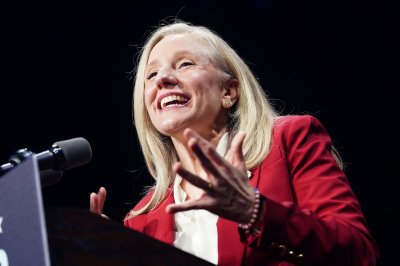
Feb. 20 (UPI) — Virginia Gov. Abigail Spanberger has been tapped to give the Democratic response next week to President Donald Trump‘s State of the Union, the party’s leaders said.

Spanberger was announced as the Democratic speaker Thursday in a joint statement from Senate Minority Leader Chuck Schumer and House Minority Leader Hakeem Jeffries, both from New York.

“Gov. Spanberger has always put service over politics — defending our national security and delivering real results for working families,” Schumer said.

“She knows real results for working families. She knows Americans want lower costs, safer communities and a stronger democracy — not chaos and corruption.”

Spanberger is a rising star in the Democratic Party. A former CIA officer, Spanberger ousted a Republican incumbent to win a U.S. House seat for her state in 2018.

After three terms in the chamber, she was elected in November as the first female governor of Virginia. Democrats are hoping her win flipping the governor’s mansion blue will help cement Virginia’s status as a Democratic-led state come the midterm elections.

Jeffries on Thursday praised the 46-year-old for standing “in stark contract to Donald Trump, who will lie, deflect and blame everyone but himself for his failed presidency on Tuesday evening,” which is when the president is scheduled to speak to a joint session of Congress.

“As our nation marks its 250th anniversary this summer, Gov. Spanberger embodies the best of America as a mother, community leader and dedicated public servant.”

The Democratic leaders also announced Thursday that Sen. Alex Padilla of California would deliver the Democratic response in Spanish.

“Americans don’t need another speech from Donald Trump pretending everything is fine when their bills are too high, paychecks are too low and masked and militarized federal agents are roaming our communities violating constitutional rights on a daily basis,” Padilla said in a statement Thursday on his selection to give the Democratic rebuttal.

“We refuse to accept his failed economic agenda that makes billionaires richer while middle class Americans see their healthcare costs rise. We refuse to accept a federal government that weaponizes enforcement agencies against immigrants and U.S. citizens alike. And we refuse to accept attacks on the right to vote.”

Padilla said “there is a better path” and that’s what his Tuesday speech will be about.

Trump’s address is to be held Tuesday, but at least 12 Democratic members of Congress are planning to boycott the speech and attend a competing rally organized by progressive organizations MoveOn and MeidasTouch.
Source link

Q&A: What’s next for MLB players after union chief Tony Clark quit?

On the cusp of what promises to be a bitter showdown with major league owners, the players’ union has no leader. Tony Clark, the executive director of the Major League Baseball Players Assn., resigned under pressure Tuesday.

Why did Clark resign?

Clark and the union had engaged separate attorneys as federal authorities investigated alleged financial improprieties within the MLBPA, an affiliated licensing company and an affiliated youth sports venture.

The union also commissioned an investigation, initially focused on those allegations, that uncovered an “inappropriate relationship” between Clark and an employee, a person familiar with the matter confirmed to The Times, with the eight-man MLBPA player leadership team advising Clark that he should depart. The employee was his sister-in-law, the person confirmed.

The allegations remain under federal investigation, meaning that player leaders determined Clark could have been a liability on at least two fronts as players and owners head toward what is expected to be the most contentious collective bargaining in the sport in 31 years.

The Athletic first reported Clark had resigned; ESPN first reported on the relationship.

Who will replace Clark as the union leader?

The MLBPA issued a statement late Tuesday saying player leaders had met Tuesday. Players planned to canvass their peers scattered across spring training camps, then meet again Wednesday, with the possibility of voting on a new executive director then.

That could be either a permanent hire or an interim hire; the latter would reflect the urgency of the upcoming labor negotiation. Although the collective bargaining agreement does not expire until Dec. 1, Commissioner Rob Manfred said last week he expected talks on a new deal to start soon after opening day.

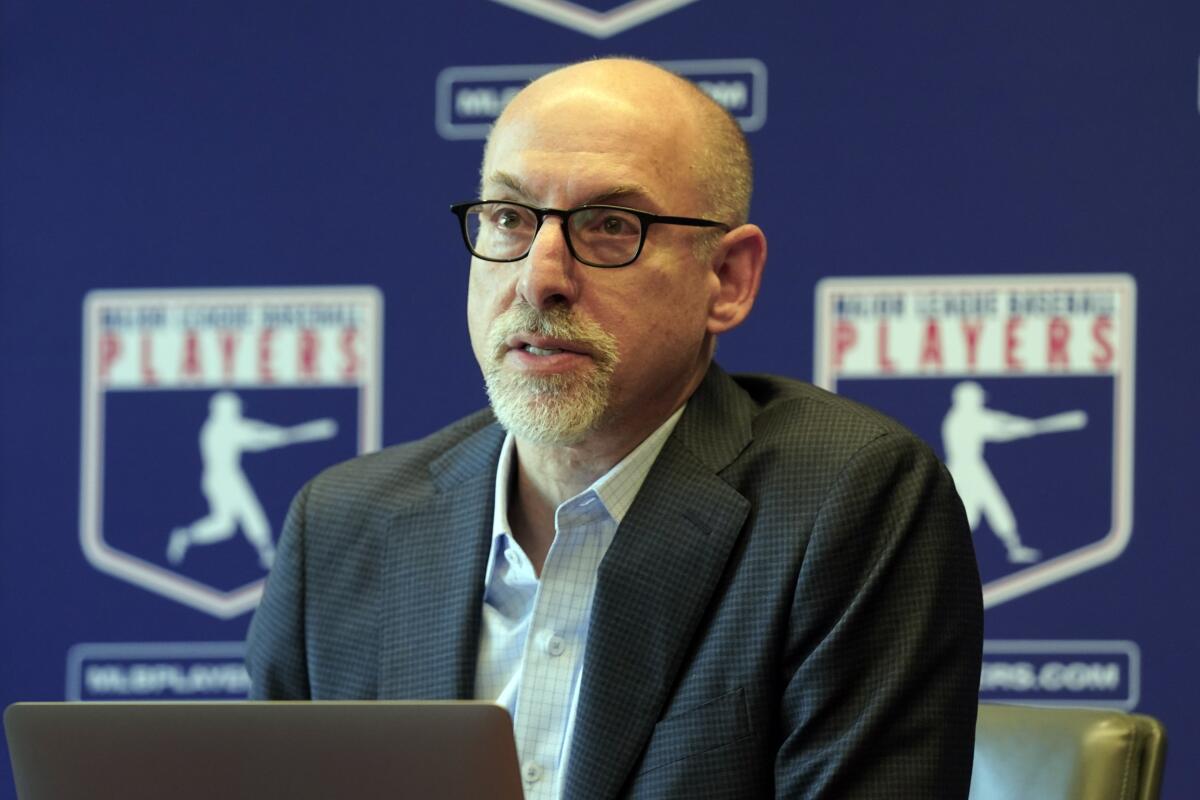
Bruce Meyer, the union’s deputy executive director and lead negotiator, would be the most logical successor. The MLBPA hired Meyer away from the NHLPA in 2018, one year into a bargaining agreement in which Clark and union negotiators were widely viewed as being badly beaten by Manfred and league negotiators.

No. It just acknowledged his resignation.

Is Meyer’s ascension a foregone conclusion?

Bruce Meyer in 2022

Bruce Meyer in 2022

(Richard Drew / Associated Press)

Likely, yes, but not foregone. In 2021, with Meyer as lead negotiator and pushing for a better deal even as a 162-game season was threatened, players voted to accept the deal on the table. The union promoted Meyer into his current position in 2022.

In 2024, ESPN reported a majority of player representatives supported the replacement of Meyer with Harry Marino, who had unionized minor league players. Ultimately, Clark stuck with Meyer.

At this late date, however, internal bargaining preparations are underway, and Meyer is now a veteran of MLB negotiations. The goal is to “keep everything as stable as we can this year,” Angels pitcher Brent Suter told reporters. Suter is one of eight players on the union’s player leadership team.

Does this mean the players are divided and the owners are united?

No, and not that simple in any case.

On what looms as the core bargaining issue — the potential adoption of a salary cap — Clark and Meyer were aligned. Clark was the union voice calling a cap “institutionalized collusion,” with Meyer filling in the details of why the MLBPA believed a cap would not necessarily enhance parity and could leave players liable to receive a shrinking percentage of revenue over time.

Manfred has argued the current system helps elite players while squeezing the salaries and the jobs of the so-called middle class.

The owners currently appear united on pushing for a salary cap. If at some point they believe they have to do what the NHL did to get a cap — that is, lose an entire season — the interests of the large-market owners and the small-market owners could diverge.

What does this mean in terms of a potential lockout?

Nothing, really. Within the game, a lockout is considered all but inevitable.

Manfred has said he views a lockout as a negotiating tool. If MLB locks out players Dec. 1, no games are lost. If a lockout remains in place April 1, regular-season games could be lost.

In the last collective bargaining negotiation, owners locked out players in December, and a new deal was reached in March, preserving a 162-game season that started one week late.

Source link