Director Na Hong-jin’s action movie “Hope” opened in 1,500 U.S. cinemas this month, marking the biggest domestic theatrical footprint for a Korean-language film since the Academy Award-winning “Parasite.”
That’s a big bet, particularly for a foreign film. But after the success of “Parasite,” the growth of Korean shows such as Netflix’s “Squid Game” on streaming and the broader acceptance of subtitles in film and television, it was a bet Neon was willing to make.
The indie studio snapped up North American and English language rights to “Hope” for an undisclosed price before the film’s world premiere in the spring at the Cannes Film Festival.
Right off the bat, Neon knew the film would be positioned in South Korea as a big action thriller and massive event film for director Na, and wanted to match that.
In the film, which includes Alicia Vikander and Michael Fassbender in its cast, a group of people fight back against a creature that rampages through a Korean village.
“The reality is that just because a movie has subtitles, doesn’t make it an art film or a niche film,” Elissa Federoff, Neon’s chief distribution officer, told me this month. “And this, to us, felt like a big action blockbuster.”
You’re reading the Wide Shot
Samantha Masunaga delivers the latest news, analysis and insights on everything from streaming wars to production — and what it all means for the future.
By continuing, you agree to our Terms of Service, which include arbitration and a class action waiver. You agree that we and our third-party vendors may collect and use your information, including through cookies, pixels and similar technologies, for the purposes set forth in our Privacy Policy such as personalizing your experience and ads.
She continued, “To me, it was this movie that certainly cinephiles were going to be curious about. But I also knew that we could cross over to a broader audience if we gave it a shot.”
So far, “Hope” has grossed more than $8 million domestically and $45.6 million worldwide on a reported production budget of at least $45 million.
Neon expected to reach Korean and Korean American audiences with “Hope,” but the film also over-indexed with Latinos, who represented 27% of the audience, according to PostTrak theatrical data.
Such a wide national release is unusual for foreign films, which typically play in specialty theaters on fewer than 100 screens. Though its domestic box office total doesn’t indicate that the film fully crossed over to mainstream audiences, “for a foreign film, it’s very successful” and has done “solid business,” said David A. Gross, who writes the FranchiseRe movie industry newsletter.
Neon, of course, has experience with Korean cinema. It distributed 2019’s “Parasite,” which became the first non-English-language film to win Best Picture. After “Parasite” won the Oscar, it was shown on 2,000 screens, about 17 weeks after its release. The Bong Joon Ho-directed film ended up grossing more than $53 million domestically and brought in more than $263 million worldwide.
The film put Neon on the map in many ways, Federoff said, and also pushed the boundaries for what the industry considered a best picture nominee. Films such as “Parasite” and “Hope” should also expand what studios consider to be mainstream fare.
“Studios and distributors are still boxing things out a little bit and thinking of these as not as accessible or not for a general commercial audience,” Federoff said. “And I would totally disagree with it.”
Though “Hope” is a long way from the domestic box-office success of “Parasite,” these kinds of swings are important to keep the pipeline of original films humming and to vary the types of fare mainstream audiences can see at their local theaters.
Although art house films once skewed toward older audiences, indie films are now popular with younger generations, who have also become accustomed to reading subtitles.
That could bode well for future foreign language films looking to make inroads with mainstream audiences. While giving a wide release to a foreign language film could be seen as risky, it’s a move Federoff believes can help bolster creative filmmaking and keep people engaged at cinemas.
“My hope is that studios start to trust their audience and respect their audiences a little bit more,” she said. “I think we can all do this. I think we can all say that we just have to have more risk taking involved with what we do. There’s a lot of incredible international cinema out there that should be seen by everybody.”
Paramount and the states fight back
Paramount Skydance and the state attorneys general are defending their proposed settlement in the face of skeptical questions from Sen. Cory Booker (D-N.J.), arguing that the judge overseeing the case should approve the agreement without the deeper review the senator has requested.
On Thursday, U.S. District Judge Araceli Martínez-Olguín told both sides to answer Booker’s questions before she ruled on whether to approve the proposed consent decree. She said at the time that she would issue a ruling “in due course.”
On Monday, both sides issued separate filings that argued the terms of the settlement were adequate. In particular, the states pushed back on assertions that the consent decree was too weak, saying it “reflects a reasonable compromise that addresses the competitive issues posed by the proposed merger in the markets alleged in the complaint.”
“The decree’s enforcement provisions have teeth,” the states wrote in their filing.
The proposed legislation would provide a 20% credit on above-the-line and below-the-line U.S. labor costs for eligible productions, including postproduction and visual effects work — two industries that have increasingly moved overseas.
The uncapped credit could increase to 30% with several uplifts, including for independent productions or filming in a federally declared disaster area, such as Los Angeles County.
What I’m watching
It’s fall, which means I’m all in on “Dancing with the Stars,” as I have been since Season 2, when Drew Lachey won with pro partner Cheryl Burke back in 2006.
This season feels like it was made for millennials like me, with contestants such as Julia Stiles, Harry Shum Jr. and Jenna Dewan. But my favorite dance last week was actually Guillermo Rodriguez’s paso doble.
As war and sexual violence rage in eastern Democratic Republic of the Congo (DRC), women are joining pro-government Wazalendo fighters to defend their communities. However, the armed group itself faces serious accusations of human rights abuses, including gang rape.
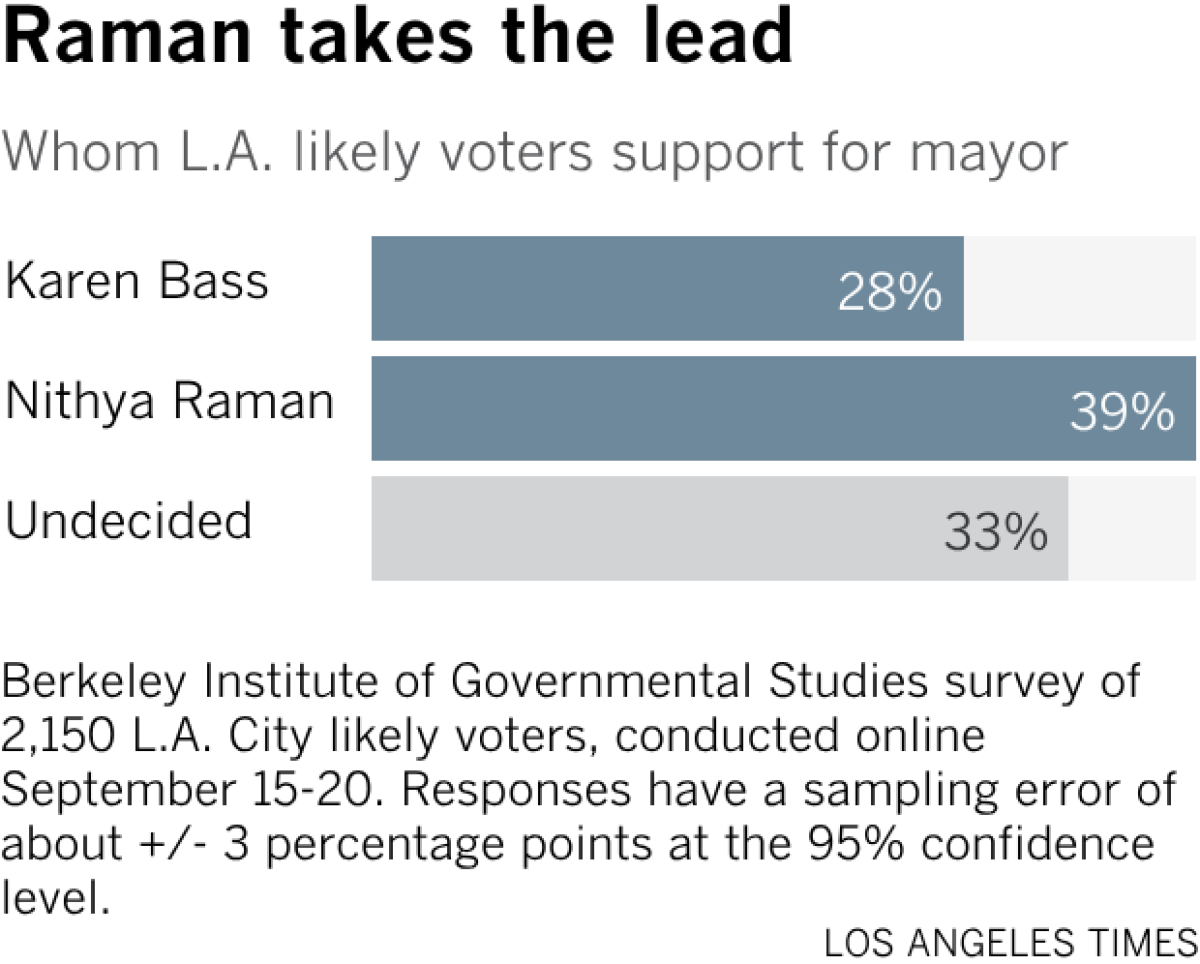
Los Angeles Councilmember Nithya Raman has taken a wide lead over incumbent Karen Bass in the L.A. mayor’s race, according to a new poll released Wednesday, although a high percentage of voters remain undecided less than two weeks before mail-in ballots are sent out for the Nov. 3 election.
Raman is favored by 39% of likely L.A. voters, compared with 28% for Bass, according to the poll by the UC Berkeley Institute of Governmental Studies, which was co-sponsored by The Times. The poll found that 33% of voters were undecided.
“Raman clearly has the advantage. Her task is a little less onerous than Bass’,” said Mark DiCamillo, the director of the Berkeley IGS Poll.
Adding to Bass’ low poll numbers are high unfavorability ratings.
The mayor had 63% unfavorable ratings, the poll found, with 28% favorable and 9% having no opinion. By comparison, 40% had a favorable view of Raman, according to the poll, while 39% said they had an unfavorable view of her and 21% had no opinion.
The survey released Wednesday was conducted online with a sample of 2,150 likely city voters between Sept. 15 and Sept. 20. It has a margin of error of about 3 percentage points.
The poll represented the strongest showing yet for Raman, who trailed Bass in almost every poll during the primary campaign and who came in second to Bass in the primary election, with 29% of the vote compared with Bass’ 34%.
Mayoral candidate and Councilmember Nithya Raman, center, enjoys a light moment with Alliance of Californians for Community Empowerment (ACCE) Action members at La Cita Bar in downtown Los Angeles.
(Genaro Molina / Los Angeles Times)
Even so, DiCamillo said the large number of undecided voters means the race is far from over.
“It’s extraordinarily unusual to see this many undecided voters at this point in the race,” he said. Mail-in ballots will be sent out beginning Oct. 1, local elections officials say.
The large number of undecided voters can be linked to the elimination of mayoral candidate Spencer Pratt in the June 2 primary, according to DiCamillo. The former reality TV star received 26% of the vote in the primary, and most of the voters who cast ballots for him — 63% — say they haven’t decided whom to vote for in the runoff, the poll found.
Among those Pratt voters who have decided, 22% favored Bass compared with 16% for Raman.
One of the most significant findings in the poll was a massive “generational divide” among L.A. voters, DiCamillo said.
Raman, 45, dominated the 72-year-old Bass among younger voters, with 66% of likely voters ages 18 to 29 choosing the council member while just 4% chose Bass, according to the poll.
Raman also had 64% of likely voters ages 30 to 39 compared with Bass’ 12%, and the council member had 50% of likely voters ages 40 to 49 compared with Bass’ 18%. Raman also was leading among voters 50 to 64 years old by a slim margin of 35% to 33%.
Bass, meanwhile, led among the oldest set of voters — those 65 and up — but not by the same margins. Bass had 41% of likely voters in that group compared with Raman’s 21%.
According to the poll, 56% of likely voters thought Bass did a poor or very poor job responding to the disaster, which killed 12 people and destroyed more than 4,000 homes, including Pratt’s.
Fourteen percent of the likely voters thought Bass had done either an excellent or a good job and 17% thought she had done a fair job.
Mayor Karen Bass campaigns at Ernest E. Debs Regional Park on Sunday.
(Kayla Bartkowski / Los Angeles Times)
The most important issues to likely voters were fixing city infrastructure, moving homeless people indoors, crime and public safety, and building more affordable housing, the poll found.
The poll shows Raman leading in nearly every geographic area of the city. Bass was leading in South Los Angeles and the Harbor region, 37% to 34%, but central Los Angeles as well as northeast and the east side of Los Angeles broke strongly for Raman.
The San Fernando Valley went 34% to Raman and 26% to Bass with 40% still undecided. The Westside favored Raman by a single percentage point, at 35% to 34%.
Raman has led in other polls recently, though none by as wide a margin as in the Berkeley IGS/L.A. Times poll. Shortly before the primary, a separate Berkeley IGS/L.A. Times poll showed Raman leading Bass in a potential head-to-head matchup by just four percentage points, with 32% support compared with the mayor’s 28%.
On the negative side, Raman was booted from her position in the council as chair of the Housing and Homelessness Committee, a move she said was politically motivated.
LAS VEGAS — Four-time MVP A’ja Wilson scored 18 points and grabbed 10 rebounds to lead the Aces to an 89-79 victory over the Sparks on Tuesday night and clinch at least a No. 3 playoff seed for Las Vegas.
The Aces (30-13), on a six-game winning streak, will get home-court advantage in the first round of the playoffs, which begin Sunday. If the standings hold, they would face No. 6 seed Washington (27-16) in the best-of-three series.
Chelsea Gray scored 17 points for the Aces, Stephanie Talbot had 14 points and Jackie Young totaled 14 points and 11 assists.
Nneka Ogwumike, who was honored before the game, scored 17 points to lead the Sparks (16-27). Erica Wheeler added 16 points.
The Aces used a 15-point run in the first quarter to take early control, going up 17-5. They led by 17 points when the Sparks went on their own long run, an 11-point spurt in the second period to cut the lead to 35-29.
The Sparks then remained within striking distance, but never closed the gap. Las Vegas’ 10-point run in the third period put the Aces back in control with a 63-45 lead.
The Aces presented Ogwumike, an eight-time All-Star and 2016 MVP, with a flower bouquet before the game. Ogwumike, who announced Aug. 19 she would retire after this season, also received a standing ovation from the crowd. She also is president of the players’ union.
The Sparks played without Dearica Hamby (left knee) and Cameron Brink (right ankle). Hamby, who played in the Aces’ organization from 2015-22, averages 14.4 points and 7.0 rebounds. Brink, the second overall pick in the 2024 draft, averages 9.5 points and 5.0 rebounds.
Publisher Fuel has spotlighted 150 of the best Soviet hotels in its latest book, Socialist Hotels, a photographic project by Elena Amabili that traces the state-sponsored holiday industry in the former Eastern Bloc
Days before the Lucas Museum of Narrative Art officially opens, protesters from the Fair Games Coalition — wearing Jedi robes and Jar Jar Binks masks and carrying lightsabers — rallied together outside the new museum.
Dozens of people from the group fighting for better worker protections during major sporting events were loudly blowing horns, banging drums and chanting, “Sí se puede,” directly across from Exposition Park’s newest museum. The group was at the museum’s private opening party Saturday night to take a stance against museum co-founder Mellody Hobson‘s recent resignation from the Los Angeles Olympics organizing committee, LA28.
“We launched the campaign with some real, reasonable demands,” said Jessica Durrum, the director of the Fair Games Coalition, for the Los Angeles Alliance for a New Economy. “If the Olympics are coming to town, we want to make sure there are lasting benefits for our communities.”
The Fair Games Coalition, which is made up of over 80 organizations, formed to fight for better labor deals during major events like the Super Bowl and the Olympic and Paralympic Games. Some of the unions in the coalition include United Teachers Los Angeles, National Union of Healthcare Workers, United Food and Commercial Workers Local 770, United Farm Workers and various community groups.
Ahead of these events, the group is asking that employers provide union and living wage jobs, funding for 50,000 units of housing for working families, a moratorium on short-term rentals and protections for immigrant workers.
Gladys Avyla marches in a Fair Games Coalition protest outside the Lucas Museum of Narrative Art.
(Jonathan Alcorn / For The Times)
Gladys Avyla, a member of Unite Here Local 11, has worked as a cleaner at the W Hotel in Hollywood for the last 14 years. Several years ago she had to move to Victorville when her rent in L.A. got too high. Avyla said that with these major sporting events coming through town she’s worried the cost of living will continue to rise as her work gets busier and busier.
“Rent is very high, and everything is expensive. It’s hard living here. We need a wage increase for the Olympics because everything costs so much,” Avyla said in Spanish. “We need help for all workers. We’re human beings, but, honestly, we aren’t treated like human beings.”
Hobson, who co-founded the billion-dollar museum alongside her husband, George Lucas, resigned from LA28 earlier this week. She reportedly stepped down from the position due to the demands of running the Lucas Museum.
But the Fair Games Coalition claims she responded to their requests to meet and discuss their concerns by resigning. The 35-person board led by Casey Wasserman, who was recently under heat for his ties to Jeffrey Epstein and Ghislaine Maxwell, is meant to help plan and execute the upcoming Olympic Games.
“That’s how you hide your head in the sand. But we’re not giving up. She still has clout and still has a lot of power in the city of Los Angeles with the Olympic Committee,” said the Rev. Gary Bernard Williams from St. Mark United Methodist Church, a member of the coalition. “There’s going to be a lot of money flowing at the top. Very little money will be trickling down to the workers who need it the most.”
Demonstrators at a Fair Games Coalition protest at the Lucas Museum of Narrative Art.
(Jonathan Alcorn / For The Times)
LA28 and the Lucas Museum did not immediately respond to a request for comment.
During this year’s World Cup, where several games were hosted in L.A., Unite Here Local 11, the union which represents workers including dishwashers, concession workers, bartenders and servers and SoFi Stadium’s food-service operator Legends Global, came to a tentative agreement days before the first match. Pastor Bridie Roberts, who works as the community organizing director at Unite Here Local 11, said having the Fair Games Coalition’s support was helpful during the negotiations.
“Our members face serious, critical decisions every single day about how to make ends meet and they work with some of the biggest tourism companies in the world that will profit in the billions of these games,” said Roberts. “We feel that the games have potential to bring real outcomes for working people, but only if we fight for them.”
SACRAMENTO — The California Primary Care Assn. and five clinics filed a civil lawsuit in federal court Friday accusing SEIU-United Healthcare Workers West and its president, Dave Regan, of racketeering and using ballot initiatives to “shake down” community health centers.
The association alleges that Regan and his union orchestrated a “multi-year campaign of coercion, threats, and economic pressure” to “extort” what the lawsuit describes as “valuable property rights” and “labor-organizing terms” from CPCA and the health centers the association represents in California, according to a copy of the complaint obtained by The Times.
The suit says Regan pushed Proposition 44, which if approved by voters in November will restrict spending at nonprofit community health clinics, as political leverage against the industry. Regan then offered to call off the measure if CPCA agreed to support the union’s efforts to unionize 25,000 industry workers, the lawsuit states.
In the complaint, CPCA estimates that 25,000 new union members would generate $2.37 million in monthly revenue from dues paid to UHW.
“This is about Dave Regan and UHW in particular adopting a strategy to create harmful legislation and harmful ballot initiatives to force people to the table to negotiate favorable agreements that will benefit them financially and then when those agreements don’t go through, they allow these initiatives to go through to create punishment for the organizations that can’t come to terms, and then they keep coming back, over and over and over again,” said Brandon Thornock, chief executive of plaintiff Shasta Community Health, echoing claims in the lawsuit.
“It’s a complete waste of resources and it’s amoral.”
A spokesperson for UHW did not immediately respond to a request for comment on the lawsuit. In an interview in July, Regan denied asking the clinics to support his unionization efforts in exchange for dropping Proposition 44.
“We wanted to construct a relationship with the clinic association that prioritized appropriate funding of the community clinics in California, including restoring the healthcare cuts that were introduced by the ‘One Big [Beautiful] Bill,’” Regan said previously. “It was a strategic relationship where we’re working in a mutually cooperative way to properly fund the healthcare system to respect workers, and they were not interested in that.”
Regan is a powerful figure in California politics who has a history of using the ballot box to try to force the healthcare industry to unionize. The union leader has come under scrutiny this year over claims about his extreme political tactics, intimidating behavior toward and threats against women, and an allegation of assault more than 15 years ago, all of which he denies.
Regan is also the architect of California’s billionaire tax, a proposal on the November ballot to apply a one-time 5% tax on the net worth of billionaires that has splintered labor and divided Democrats.
The CPCA lawsuit, in the federal court in the Eastern District of California, alleges that Regan’s political tactics are not designed to win initiatives, “but to subjugate and terrify.”
The union, the lawsuit states, has filed dozens of punitive ballot measures in California “targeting hospitals and dialysis providers with the implied threat or directly stated purpose of coercing health care providers into acquiescing to their union organizing or bargaining demands.” UHW has spent over $216 million, the suit says, on measures to “harm patients, destroy services, and drive providers out of business.” The vast majority of the UHW-backed measures have been withdrawn, usually after the industry agrees to concessions, the suit states.
“No other singular entity or individual has engaged in such widespread corruption of California’s initiative process,” the suit states.
Proposition 44 requires that community clinics spend 90% of revenue on patient services, which Regan has said ensures that money is aligned with the mission of the health centers.
CPCA and health centers say restricting the funding would dramatically reduce money for other essential services and leave some clinics at risk of closing their doors.
The CPCA lawsuit alleges that Regan’s demands on Proposition 44 were sent in an email in January from a legislative staff member on behalf of the union. The offer, presented as a joint submission from UHW and two union affiliates, included a requirement that community health centers “hold elections for at least 5,000 employees in each of five years the agreement would be in effect, resulting in elections for 25,000 employees over the five-year period.”
The complaint says the email also disclosed that UHW said it would drop the initiative if CPCA agreed to the terms.
“The e-mail unambiguously shows that UHW and the Union Affiliates — bullied and instructed by Regan — agreed and intended to participate in an endeavor to abuse the ballot initiative process to extract valuable labor concessions from CPCA and CHCs, in violation of federal and state law,” the complaint states.
Negotiations to withdraw the measure fell apart on June 24, the day before the deadline to rescind initiatives from the statewide ballot.
The lawsuit alleges that the union offered a new deal that same day.
“UHW would withdraw the Clinic Penalty Initiative if, in exchange, CPCA reversed its opposition to UHW’s billionaires’ wealth tax initiative and took the funds it raised to oppose the Clinic Penalty Initiative and instead used that money to assist UHW in passing its wealth tax,” the lawsuit alleges. “The next morning, Regan, through an intermediary, offered the same ‘deal.’ CPCA refused to entertain such discussions.”
The lawsuit states that California’s community health centers served 6.7 million people in 2025 and 67% are enrolled in Medi-Cal, state subsidized healthcare coverage for low-income Californians. In many rural areas, health centers are sometimes the only source of primary care.
Thornock said Shasta Community Health has patients who travel more than an hour to get care and provides a program that transports them to health facilities. Under Proposition 44, the program would not be considered patient services.
“It was designed to create for us what becomes an existential crisis in many cases,” he said.
The CPCA lawsuit states that Regan and the union began seeking to extort unionization from nonprofit hospitals through ballot measures in 2011 and used the same strategy to try to grow their membership among dialysis center workers beginning in 2017. In early 2022, they began targeting CPCA and health centers through legislation, the lawsuit stated.
The suit also alleges that Regan and UHW are in violation of a California law that prohibits a proponent of a ballot initiative from seeking, soliciting, bargaining for, or obtaining any money or a thing of value from any person or entity for abandoning or preventing an initiative from moving forward.
A week before the lawsuit became public, The Times reported that independent investigators hired by SEIU found in a report that Regan had tried to “extort” an SEIU state council endorsement of the billionaire tax from other California union leaders. An outside law firm that investigated internal charges against Regan found that he suggested to David Huerta, then president of SEIU California, that the state council could be investigated for “governance issues” if the council did not endorse the billionaire tax on the November ballot. The state council later voted to remain neutral on the measure.
The law firm’s investigation, which was paid for by Service Employees International Union, substantiated an allegation that Regan threatened Tia Orr, executive director of SEIU California, over the council’s position on the ballot measure. The SEIU probe found an allegation that Regan also assaulted one of Orr’s predecessors in the job, Courtni Pugh, in 2009, to be credible.
A second investigation conducted by an outside law firm hired by SEIU California found sufficient evidence to substantiate a complaint that Regan bullied Jessica Bartholow, the council’s government relations director.
In interviews with investigators hired by the union and with The Times, Regan admitted to swearing at a staff member for SEIU California and adamantly denied bullying, threatening and assaulting women or seeking to force the state council to back his measure.
Regan remains in his job and alleges that he’s being unfairly targeted over his advocacy for the billionaire tax. SEIU, the national umbrella organization that represents local SEIU affiliates, has not taken any disciplinary action against him while an internal administrative review process moves forward.
Sources involved in negotiations over the billionaire tax said Regan also asked for concessions to grow his union in exchange for rescinding the measure from the ballot this year, which The Times previously reported.
Regan’s list of demands included union contracts with two private hospitals and a health clinic, an organizing neutrality agreement with healthcare clinics statewide, recognition of his union from dialysis clinics and for billionaires to remove measures they launched in response to his tax, according to two sources familiar with the talks who were granted anonymity to share details of the discussions.
The union leader called the allegation “categorically false” and denied that he asked for concessions for his union in exchange for removing the billionaire tax from the ballot.
Virtually all NFL players come via the US college system, and in many parts of America, college football is more popular than the NFL.
College games often have bigger crowds – eight of the world’s 10 biggest stadiums are for college football, all holding more than 100,000.
The fans are also more passionate as support is often passed down from one generation to another, and multiple generations attend the same school. Kansas player Calvin Clements, for example, is a fifth-generation Jayhawk.
Actor Paul Rudd is also a Jayhawk, while lifelong fan Jason Sudeikis grew up in Kansas and frequently weaves KU references into his work.
“They’re very spirited, and you get the tribalism, so it’s the closest thing we have to European football fanbases,” Dubiski told BBC Sport.
Both the NFL and college football have tailgate parties, where fans gather in the car park and eat and drink for hours before the game.
But college football fans chant during games, which feature marching bands and spirit squads – made up of cheerleaders, dancers and mascots.
“We want the game to showcase what we think is one of the greatest sports in America,” said Yormark.
“There’s something special about college football – the pageantry, the traditions, the fandom. It’s dynamic – there’s a lot of energy and passion. It truly is an experience.”
In address to European parliament, Canadian Prime Minister Mark Carney listed areas where he wants to boost cooperation.
Published On 17 Sep 202617 Sep 2026
Canadian Prime Minister Mark Carney has welcomed the prospect of his country becoming the European Union’s first associate member, saying such an alliance is aimed to be a “beacon for democracies” and not to “dominate others”.
Speaking in the European Parliament in Strasbourg, Carney said Canada “welcomes” von der Leyen’s ambition to make the country an associate member.
Recommended Stories
list of 3 itemsend of list
“We are not fair-weather allies. We do not pursue zero-sum deals. We hold common values for which we have always fought, and in whose defence we must always remain vigilant,” Carney said to applause from European lawmakers.
“Canada and Europe are each strong. Europe and Canada are stronger together.”
“I am not proposing a third bloc in order to become a great-power rival – only with better manners,” he continued. “We do not seek power to dominate others. On the contrary, we are pursuing resilience so that no one can control our open markets, impair our sovereignty, threaten our territorial integrity, or undermine our freedoms, our democracies, our rule of law.”
Carney listed a slew of areas where he wanted to ramp up cooperation.
“Canada and Europe should secure our strategic autonomy through deep cooperation in the full range of strategic capabilities, including critical minerals, defence industrial capacity, AI and compute, energy security, space and payments.”
He also said the EU and Canada should move towards “seamless digital trade” and allow young people from both sides to work and study on either side of the Atlantic.
The EU and Canada have been facing stiff rivalry and pressure from Trump’s administration on trade, among other matters, and from an increasingly assertive China.
Trump threatened late on Wednesday to take action against the EU if it moves forward with von der Leyen’s proposal of associate membership for Canada.
“If they do that, if I think it’s at all a hostile act, I will put very serious tariffs or stop trading with Europe on many things,” Trump told reporters, calling the proposal “laughable”.
“If it’s a good intention, that’s fine. If it’s a bad intention, we’ll put very heavy tariffs on Europe,” he added.
The European Commission (EC) said von der Leyen’s proposal – which is yet to be fleshed out and will need to be approved by EU member states to go forward – was not a hostile act.
“As our President (von der Leyen) made clear yesterday, the proposed strengthening of our partnership with Canada is not against anyone else, but for our common strength,” said Olof Gill, an EC spokesperson.
The race for California’s next superintendent of public instruction is meant to be nonpartisan. Still, the two candidates — both school board presidents — are pushing decidedly political campaigns, one aligning with liberal Democrats and the other with pro-Trump Republicans as they present dueling visions for how the state’s children should be taught.
Democrat Richard Barrera, the favorite, beat out six other Democrats with his background in union organizing and liberal politics — and with more than $5 million from the California Teachers Assn. Republican Sonja Shaw rode a wave of support from a conservative education movement she helped build alongside MAGA organizations, Christian nationalists and anti-LGBTQ+ groups, while also consolidating mainstream Republicans behind her.
Although Democratic state lawmakers recently stripped many of the powers from the superintendent, the race remains a bellwether for how Californians feel about the public education of about 5.7 million children — as the Trump administration aggressively targets the state over its progressive policies.
Candidates’ disparate visions
Taking the California Democratic Party convention stage in February, Barrera, president of the San Diego Unified Board of Education, gave a quick shout-out to the California Teachers Assn. for backing his bid.
He then promoted his work in San Diego to improve student performance, raise teacher salaries and construct “environmentally sustainable schools built by union workers.” He blasted “downtown Republican business interests” for trying to privatize schools, and President Trump’s immigration policies, which he said terrify many California students who fear losing their undocumented parents.
“It’s time for us to organize, stand up to Trump, abolish ICE and create the schools our students are worthy of,” Barrera said.
Two months later, Shaw, president of the Chino Valley Unified School District Board of Education, introduced herself at an event as a mom and a “fighter” who isn’t afraid to “look the enemy in the eye” because God protects her.
She described her opponents as California liberals who pushed school closures and mask policies during the COVID-19 pandemic and now advocate for the rights of transgender students at the expense of other students.
Shaw said she entered politics inspired by the MAGA-aligned group Moms for Liberty, which campaigns against teaching about ongoing systemic racism, opposes diversity programs as discriminatory and has fought against classroom instruction on sexual orientation and gender identity.
Shaw also described being called a year prior and encouraged to run for superintendent by then-state Assemblymember Bill Essayli, who is now the lead federal prosecutor in Los Angeles and one of Trump’s strongest local allies.
“And I kind of laughed,” she said. “Ha ha. Me? The soccer mom? Really?” She said she told Essayli that she had to talk to God and her family. Essayli urged her to decide quickly.
Despite her humble, “who, me?” persona on the campaign trail, Shaw argues that her message resonates with parents in both parties. Shaw said she would use the superintendent position as a bully pulpit to expand that base beyond party lines and fight what she sees as the state’s failed liberal schooling policies from within. She also would challenge in court the new state law that transferred most of the post’s authority to an appointee of the governor.
Morgan Polikoff, a USC education professor, said that to win, Shaw would have to “dramatically broaden her base, inviting people who aren’t animated primarily by anti-LGBTQ animus to vote for her.”
Barrera, meanwhile, a senior aide to current state Supt. Tony Thurmond, represented the California Department of Education at a recent event held by the statewide LGBTQ+ group Equality California, where school districts were rated on their LGBTQ+ policies and resources. San Diego Unified received a high rating, while Chino Valley did not participate in the voluntary analysis.
Tony Hoang, executive director of Equality California, has described Shaw as a threat to LGBTQ+ students and endorsed Barrera as a candidate who has spent his career “advancing policies that make schools safer and more inclusive.”
Lance Christensen, of the conservative California Policy Center, disagreed. He said Barrera “will continue to be the servant and mouthpiece of the CTA,” while Shaw “represents a return to common sense, or better yet, good sense — because she’s speaking to basic issues of education policy that have been ignored for far too long.”
Barrera acknowledged his primary win over the other Democratic challengers was largely thanks to the CTA, which he said “made all the difference.” But he also credited a “long partnership” with San Diego educators and a record of believing in public education.
Shaw consolidated conservative Republican support in the primary, in which she finished first, with her campaign raising $399,000.
Barrera’s campaign collected $274,000 in primary contributions. Since the primary, Barrera’s campaign has raised at least $340,000, compared with $104,000 for Shaw.
However, it is in independent expenditures — spending by outside groups on behalf of political candidates — that Barrera has the financial leg up on Shaw. Already considered the likely fall winner because he no longer will be splitting the state’s sizable liberal vote with other Democratic candidates, Barrera also has benefited from the CTA’s massive spending covering the cost of mailers, text message campaigns and TV, radio, newspaper and digital ads, among other things.
Shaw: Soccer mom to MAGA warrior
Shaw, a 44-year-old Chino native and mother who has worked in fitness training and photography, said pandemic school closures and mask and vaccine mandates she opposed prompted her to show up to school board meetings, confront officials and challenge school policies in court. “I’m relentless. I don’t let go,” she said.
In November 2022, she was elected to the Chino Valley Unified school board, part of a small wave of evangelical Christians and far-right candidates to win seats across the state that cycle, and quickly became a go-to conservative voice on education issues.
Shaw has sidestepped concerns about immigration agents targeting schools as an issue outside of a school district’s jurisdiction. She also has derided the influence of unions in the education sector. And she lambasted efforts by California Democrats to oppose “school choice,” calling charter schools, homeschooling and other “alternative learning models” critical “lifelines” for families.
Shaw also became laser-focused on LGBTQ+ issues, challenging state laws that allow transgender students to participate in athletics and use school facilities in line with their gender identity. She also fought a state privacy policy that dissuaded school administrators from informing the parents of children who change their gender presentation or pronouns at school, and backed bans on library books with passages deemed sexually obscene. Critics have said the policy targets LGBTQ+ books, which Shaw denied.
Separately, Shaw has rallied her followers online to protest transgender teen athletes, including Jurupa Valley High School track star AB Hernandez. Shaw has showed up at track meets to protest Hernandez’s participation — which Hernandez’s mother has called threatening.
Shaw also has filed federal civil rights complaints on behalf of and helped draft complaints for cisgender high school athletes — including some of Hernandez’s teammates — who, she said, told her they were unhappy with sharing races, podiums and athletic facilities with transgender peers.
Shaw said she did not consult with Essayli on his recent unsuccessful lawsuit challenging the state’s transgender sports policies, which was based on the participation of some of the same high school athletes Shaw has protested. However, she said she would be in touch with federal authorities about such issues were she to win.
“You don’t think I’ll be calling, in my position, to the federal government?” she said. Essayli did not respond to a request for comment.
Barrera: Built by labor
Barrera, a 59-year-old father of grown children and member of the San Diego Unified school board since 2008, has been a union organizer for decades.
He never has been a teacher — nor has Shaw — but said his organizing experience makes him a natural fit as the chosen candidate of the teachers union and other labor groups, where he said he believes “the educator voice comes out most powerfully.”
“For me, the unions are a partner and will always be a core … voice in influencing the way that I make decisions,” he said.
In the 2000s, Barrera served as a regional organizer for the United Domestic Workers and United Healthcare Workers, then helped start the Chula Vista chapter of ACORN, a liberal pro-labor group.
Barrera rejects the assertion that California’s public schools are failing and wants to help “create a different narrative,” that students are “capable of anything” and educators are “capable of bringing out the best in our young people.”
Barrera helped turn the San Diego school board from a conservative-dominated body to a liberal, union-allied one. He once joined a five-day hunger strike in support of hotel workers.
Barrera has long subsidized his school board pay — a stipend of about $20,000 a year plus health benefits — with outside union work. In 2013, he was appointed secretary-treasurer of the San Diego and Imperial Counties Labor Council, earning about $110,000 per year. The council includes the San Diego Unified employee unions, which critics considered a clear conflict of interest because as a school board member, Barrera was on the opposite side of the negotiation table from unions that were helping pay his Labor Council salary.
In 2016, Barrera switched to a lower-profile role as secretary-treasurer of UFCW Local 135, holding the No. 2 position in the San Diego area’s largest private-sector union representing grocery, pharmacy, casino and factory workers but not school employees.
During that period, Barrera’s direct supervisor, Mickey Kasparian, was accused of sexual harassment, which Kasparian denied. Three accusers were paid settlements with no admission of wrongdoing. Barrera was not accused of sexual misconduct but was swept out of office alongside Kasparian in 2018.
The subsequent union leadership, which is still in place, opposes Barrera for superintendent, arguing that he should have taken a stand against Kasparian. Barrera dismissed these criticisms as part of a “decade-old internal union leadership fight.”
In 2021, as officials debated when and how to reopen campuses closed during the pandemic, Barrera was aligned with the local teachers union, and his school board approved a vaccine mandate for all district employees and conditioned the return to in-person instruction on educators having the opportunity to be fully vaccinated.
Today, Barrera is in near lock-step with the CTA when it comes to policy. His only critique is that CTA lobbying in Sacramento should be better connected to ground-level demands, a goal that CTA leadership has been working toward, he said.
SACRAMENTO — SEIU United Healthcare Workers West President Dave Regan allegedly tried to “extort” an SEIU state council endorsement of the billionaire tax ballot measure from other California union leaders, according to an investigation commissioned by Service Employees International Union.
The investigation and a second inquiry conducted on behalf of SEIU California found that Regan allegedly threatened and intimidated women who worked for the state council, and in one instance, physically assaulted a former executive director of the labor organization.
Regan, in an interview with The Times, denied the allegations that he attempted to extort from union officials. He also denied assaulting the executive director and said he did not threaten female labor leaders. He repeated a counterclaim he made to the union: The allegations against him are retaliation for his advocacy for Proposition 40, the proposed wealth tax that will be on the Nov. 3 ballot.
“They are internally contradictory, they are fundamentally biased, and maybe most importantly, they are politically motivated,” Regan said about the probes.
The law firm hired by the national union investigated Regan’s claim of retaliation but found the allegation could not be substantiated.
David Huerta, the president of SEIU United Service Workers West, and three other labor leaders filed a rare formal union charge against Regan in February.
The national union of SEIU has ultimate authority to resolve charges filed under its constitution and hired the New York labor law firm Cohen, Weiss and Simon to independently investigate the claims. The firm interviewed 18 current and former SEIU leaders and others in the California labor movement over nearly three months, according to its report.
The law firm’s report, reviewed by The Times, supported Huerta’s claim that on Dec. 3 Regan suggested the state council could be investigated for “governance issues” if the council did not endorse the billionaire tax on the November ballot. Huerta was then president of SEIU California.
“During the investigation, Huerta reported that he left the conversation with Regan feeling ‘extorted’ and believing that Regan might report unspecified governance concerns to the U.S. Department of Labor, which is known to be unfriendly to labor unions under the Trump administration, if state council did not support the billionaire tax,” the report said.
The law firm’s investigation substantiated an allegation that on the same day, Regan threatened Tia Orr, executive director of SEIU California, over the council’s position on the ballot measure. The SEIU probe found an allegation that Regan also assaulted one of Orr’s predecessors in the job, Courtni Pugh, in 2009, to be credible.
“SEIU California leaders filed charges against Dave Regan alleging a pattern of bullying, threats, abuse, harassment, physical violence and attempted extortion,” Christopher Calhoun, a spokesperson for SEIU California, said in a statement. “Initial investigations pertaining to these charges substantiated most of SEIU California leaders’ allegations.”
State union officials have temporarily banned Regan from the offices of SEIU California, a council of union leaders that coordinates political operations for all SEIU-affliated unions in the state, to protect female employees, according to the state council’s report.
Democratic National Committee delegate Courtni Pugh speaks at the California Democratic Party breakfast in Chicago on Aug. 20, 2024.
(Myung J. Chun / Los Angeles Times)
“Sufficient evidence was also found to substantiate that Regan has engaged in a pattern of subjecting former and current SEIU California female directors to intimidating and threatening physical behavior and verbal abuse,” the report commissioned by the state council said.
Leaders and workers within the labor movement describe Regan’s alleged behavior as an open secret at SEIU, which represents more than 2 million members nationwide and is the largest union in California.
The law firm hired by SEIU submitted its investigation report on July 28. Regan remains in his job as an administrative process moves forward with hearings. Regan will get a chance to make his case before SEIU determines any appropriate disciplinary action.
SEIU President April Verrett has the power to temporarily suspend Regan as the process plays out.
“SEIU is deeply committed to the safety and well-being of all people, including our members, staff, and the public, and takes these matters seriously,” said Dan O’Sullivan, a spokesperson for SEIU. “As soon as these concerns were raised, we initiated a deliberate and thorough process and retained independent, outside investigators to look into these allegations. Our process is active and ongoing, and the next steps include appointing a hearing officer and holding an evidentiary hearing through which all parties will be afforded due process.”
At a California Federation of Labor event on Dec. 3, Regan told Orr that “state council better endorse this measure by Jan. 1 or I’m coming for you,” she told investigators in both probes.
Regan rode to the airport with Orr and sat next to her on the plane “as part of a continued effort to intimidate her into providing state council’s support for the billionaire tax,” Orr told the investigators. As they left, Regan tapped his watch to suggest her time was running out, the report stated.
Regan told investigators that he learned last year that Orr was working behind the scenes to undermine his billionaire tax proposal. If approved by voters, the measure will retroactively apply a one-time 5% tax on the net worth of billionaires who were residing in California as of Jan. 1, 2026.
Regan denied that he threatened Orr, calling the claims “completely fabricated.”
“And again, the source of that is somebody who is not in favor of Proposition 40, and somebody who has not been leading the state council with practices of good governance,” Regan said in an interview.
Regan also denied intimidating Orr to investigators hired by the national union, but offered a different perspective on the SEIU California executive director. He said he traveled with Orr as a friend that day, had previously supported her professionally and offered her a job, according to the report.
The law firm said Orr believed that Regan was a “bully” who mistreated women of color and made it difficult for them to do their jobs at SEIU and had even “fought someone” when he didn’t “get his way.” Regan denied those allegations, including that he mistreated women of color.
“Orr therefore took Regan’s statement that he was ‘coming for’ her as a threat to her job security and her physical safety. She contemporaneously shared this fear with a colleague. Moreover, her response to Regan’s statement is reasonable because three interviewees — both current and former employees of state council — corroborated that Regan has verbally berated and at times physically intimidated or assaulted former state council executive directors,” the report stated.
The investigation commissioned by the national union concluded that UHW then launched a “fishing expedition” into the state council’s finances under Orr’s leadership, but did not substantiate a claim that Regan defamed her to allies of the labor movement.
The SEIU investigators also wrote that the claim that Regan assaulted Pugh was substantiated.
Pugh told investigators that Regan kicked open her office door and “jacked” her against the wall, according to the investigative report. While she was “pinned,” Regan pressed his finger into her chest and screamed that she was a “dumb ass,” the report said.
When he left her office, Pugh fell to the ground and began to hyperventilate, according to the report. Two colleagues found her, helped her breathe into a paper bag and walked her home, the report said.
Regan denied the allegation.
“It is a complete fabrication and a fiction made by somebody who has all of the incentive possible to critique or trash or criticize UHW generally, and me specifically, and no, there was no mention of it for 17 years,” he said.
The report also concluded that Regan recently threatened to sue SEIU Local 221 President Crystal Irving in an attempt to silence her from warning others about the alleged assault against Pugh.
Regan said the national union’s investigation was “fundamentally flawed” because it stated that Pugh “had nothing to gain from sharing her story” with Irving. Pugh, now a political consultant, has worked against the billionaire tax ballot measure, something Regan said gave her a reason to lie about him.
Pugh called Regan’s response “offensive to the women” who she said objected to his behavior. She said she detailed the alleged incident at the time to board members who oversaw her work and SEIU leadership. The encounter, she said, was well-known.
“I told my colleagues and organization leaders when it occurred,” Pugh said in a statement. “I was asked to participate in the later investigation because so many people had heard about the 2009 incident over the years. I chose to participate in the investigation because I saw that his behavior had continued and in hopes that no one else would have to endure this kind of treatment from him.”
Regan, in his interview with The Times, also denied the allegation that he attempted to force the state council to support the billionaire tax.
David Huerta, president of SEIU-USWW, speaks during a Memorial Day action in Los Angeles on May 21.
(Kayla Bartkowski / Los Angeles Times)
“Huerta then asked Regan if it was his intention to initiate an investigation,” according to the report. “Regan replied, ‘I don’t have to; there are others who would.’ In that conversation, Regan demanded a full endorsement of the billionaire’s tax initiative measure by the state council by Jan. 1.”
Regan told investigators he raised governance issues with Huerta and could not remember if he demanded the council’s support for the billionaire tax during the conversation, though he said he had been seeking the endorsement for months, according to the national union’s report.
“The investigation found that Regan likely suggested he would cause the DOL to investigate state council,” the report said. “According to Regan, he did discuss with Huerta that an investigation was possible.”
The executive board of SEIU California later voted in July to remain neutral on Proposition 40, marking a blow to Regan’s efforts to overcome an onslaught of opposition from California Gov. Gavin Newsom, billionaires and liberal groups concerned that the measure could backfire and reduce state tax revenue collected from the ultra wealthy.
Regan filed a counterclaim with SEIU in April, alleging that the state council initiated the complaint and launched its own investigation into him as a retaliatory “character assassination” for his advocacy for the billionaire tax, something the SEIU report said was not substantiated.
The investigative report submitted to the national union raised questions about Regan’s tactics to earn support for his causes.
Investigators said their probe “revealed that Regan has been associated with similar extreme efforts to secure political endorsements in the recent past.”
The firm reported that it reviewed text and email messages in which a representative for Regan offered to drop part of his counterclaim “in exchange for the state council’s endorsement of Tom Steyer for governor.”
“In an email response to that offer, a State Council representative stated they have ‘no interest in a behind-the-scenes trade involving dropping internal charges of misconduct in exchange for the making of a political endorsement.’”
The person working with Regan who sent the offer denied to the law firm that the conversation constituted extortion.
“This denial is not credible,” the firm wrote in the report. “The Regan Offeror stated that they were ‘extremely careful’ with their language when conveying Regan’s offer, as they were aware that what they said could be misconstrued as extortion. That the Regan Offeror took such care suggests that the offer was likely extortion.”
Regan also denied the claim, which he called a “complete fabrication.”
A second investigation by the Los Angeles law firm Barboza & Associates, which was hired by SEIU California, found sufficient evidence to substantiate a complaint that Regan bullied Jessica Bartholow, the council’s government relations director.
Bartholow reported to her superiors at SEIU California that Regan stood uncomfortably close and hovered over her at the bar at a fundraiser for the state Senate leader in San Diego in March as tensions flared over the billionaire tax. He then screamed an expletive at her in front of a crowd of lawmakers and lobbyists when she walked away from him, according to the state council’s report.
“Bartholow was scared and her heart was pounding,” investigators wrote in the report for the state council that was reviewed by The Times. “Bartholow had heard that Regan could be violent, and she did not know what he was going to do.”
Regan told investigators and The Times that he swore at Bartholow but denied that he physically intimidated her. Regan said he was upset with her over an allegation that she previously threw “four staff members of UHW out of the state council office.” The report commissioned by the state council discredited his claim and said “Bartholow did not throw UHW staff out of the SEIU California office or treat them rudely or disrespectfully.”
Lawyers hired by the state council said Regan intimidated another woman within the union during their investigation.
The state council investigation included an allegation that Regan physically and verbally intimidated Susan Li, an assistant director of external organizing for SEIU Local 721, on April 30 after a meeting with the Assembly Speaker’s Office and the California Primary Care Assn. Regan was allegedly upset with David Green, president of SEIU Local 721 who had just left for the airport, and began randomly screaming at Li, according to the investigative report on the probe commissioned by the state council.
Regan described the encounter as a conversation and said he did not scream at Li.
The state report said Regan “attacks female staff members instead of taking his concerns to the individuals who had the authority to make decisions.”
“Time and again, Regan unleashed his hostility toward the women who worked for SEIU California, and one from Local 721, in a physically intimidating and verbally abusive manner,” the report concludes.
Regan vigorously denied this assertion.
The state council report said Regan often berated Pugh when she worked at SEIU.
“Every week it was, ‘What the f— were you doing in this meeting? Why did you say that? You dumb ass bitch,’” the SEIU state report said. “Every time Regan called Pugh, she put him on speaker phone so everyone could hear him call her a f—up and tell her to f— off. Not one person said anything.”
Pugh told investigators hired by the national union that Regan continued to belittle her in meetings until she eventually resigned from the state council. She said she believed he formed a coalition to force her out of her job and that she would have been fired if she had not stepped down.
Terry Brennand, director of pensions, revenue and budget at SEIU California, told investigators that he and Mary Gutierrez, now deceased, heard Pugh sobbing in her office after Regan allegedly assaulted her.
“Brennand believed Pugh was in shock and traumatized,” the state SEIU report stated. “Pugh seemed frozen, terrified and not quite clear-headed. It was not the usual Pugh, who was direct, thoughtful and expressive. She was shaking and clearly traumatized.”
Three current and former SEIU California executive directors, all women of color, told Brennand that Regan had bullied them, the report said.
“That’s his forte,” Brennand said to investigators. “That’s his wheelhouse.”
Regan denied that he has a problem with women, or women of color.
“It is 100% false,” he said.
Lorena Gonzalez, president of California Labor Federation, said Regan’s union is overwhelmingly composed of women and women of color, who just reelected him to a position he’s held for 16 years.
“Ultimately they have the ability to make this determination of whether he’s an appropriate leader, which they just made again,” she said. “I think what’s most important is that we have to keep our eyes on the fact that Medi-Cal is being cut and we have no solution but the billionaire’s tax to fill that cut.”
Times staff writer Kevin Rector contributed to this report.
SACRAMENTO — Labor leader Dave Regan claimedFriday that he was the victim of a “smear” campaign orchestrated in part by wealthy Californians and said he has been falsely accused of attempting to “extort” an endorsement of the billionaire tax ballot measure and of physically assaulting a female union leader.
Investigations commissioned by the Service Employees International Union and SEIU California, and conducted by outside law firms, determined the allegations against Regan were credible, along with reports that he threatened and intimidated other female labor leaders. Regan, who is president of SEIU-United Healthcare Workers West, vehemently denied the allegations, which were first reported by The Times Friday morning.
During a video news conference hours after the allegations were published, Regan claimed the probes were launched by opponents of Proposition 40 — the billionaire tax measure he helped place on the Nov. 3 ballot — as well as members of the SEIU California labor council with whom he had clashed in the past.
Regan, joined by other SEIU-United Healthcare Workers West union leaders and members, also criticized Gov. Gavin Newsom for opposing the proposed one-time 5% tax on billionaires’ assets.
Newsom is “trying to curry favor with the richest people in the state to fund [his] presidential campaign,” Regan said. “That is shameful behavior.”
Newsom and other opponents of the measure, including Democratic gubernatorial candidate Xavier Becerra, Planned Parenthood Affiliates of California and the California Teachers Assn., have expressed concern that Proposition 40 could push many of the state’s biggest taxpayers to relocate and destabilize state finances.
“The Governor supports a national tax on billionaires and is proud to stand with teachers, firefighters, reproductive health clinics, and others in opposing this poorly written state measure that will harm California,” said Newsom’s spokesperson Izzy Gardon.
Regan also criticized The Times’ reporting on the allegations, and an editorial opposing Proposition 40. He alleged that Dr. Patrick Soon-Shiong, the Times’ owner, influenced coverage about the measure because he is a billionaire.
“We stand by our reporting,” said a Times spokesperson.
David Huerta, president of SEIU-United Service Workers West, and three other labor leaders filed a rare formal union charge against Regan in February. The SEIU investigation report, which was reviewed by The Times, supported Huerta’s claim that in December, Regan suggested the state council could be investigated for “governance issues” if the council did not endorse the proposed billionaire tax. Huerta was then president of SEIU California, which along with their national arm, did not endorse Proposition 40.
In July, the executive board for SEIU California voted to take a neutral position on the proposed wealth tax.
The investigation and a second inquiry conducted on behalf of SEIU California substantiated allegations that Regan threatened and intimidated women who worked for the state council. The investigation also determined an allegation that Regan physically assaulted a former executive director of the state labor organization, Courtni Pugh, in 2009, was credible.
Regan called the allegation that he assaulted Pugh a “complete fabrication.” Regan and other SEIU-United Healthcare Workers West members downplayed Pugh’s allegations against him because of her political consulting firm’s role opposing Proposition 40.
Pugh called his remarks “offensive” to the women who participated in the independent investigation.
“My testimony and the testimony of the other women were substantiated by investigators,” she said. “His claims were not.”
Regan remains in his job as the SEIU administrative process moves forward with hearings. Regan will get a chance to make his case before SEIU determines any appropriate disciplinary action.
Times Staff Writer Phil Willon contributed to this report.
Court also acquits Dow Jones on the charge of dismissal over Selina Cheng’s leadership role with the Hong Kong Journalists Association.
Published On 10 Sep 202610 Sep 2026
A Hong Kong court has convicted Dow Jones for trying to deter a journalist from taking a union role, but also acquitted the publisher on the charge of dismissal over the role, in a case that raised concerns about media freedom in the city.
Selina Cheng, who was fired by the Wall Street Journal (WSJ) in July 2024, had accused the newspaper’s publisher Dow Jones of unlawfully terminating her employment over her role chairing the Hong Kong Journalists Association (HKJA) and of trying to prevent her from standing for a union position.
Recommended Stories
list of 3 itemsend of list
The court found the company guilty on Thursday of trying to prevent Cheng’s right to run for the union chairmanship.
However, the judge sided with Dow Jones’ argument that she was made redundant because of corporate restructuring, and not due to her role as HKJA chair.
The right to take part in a trade union is protected by Hong Kong’s labour laws. An employer found guilty on “prevent or deter” charges could be fined up to 100,000 Hong Kong dollars ($12,755).
“If reporters’ employment rights are not sufficiently safeguarded, or when their rights are violated and not enforced in law, then we can no longer work safely as reporters,” Cheng told reporters outside the court after the ruling.
The judge said the company’s requirement that Cheng seek prior permission to take a union role was an “unjustified deterrent” of her rights.
Dow Jones said it disagreed with the ruling and was evaluating next steps.
“The Wall Street Journal has a long and proud history as an employer in Hong Kong. Throughout that time, we have remained deeply respectful of its labour laws and supportive of our employees’ rights, while publishing excellent, impartial journalism about the region,” a spokesperson said.
Sentencing is expected to be handed down at a later date.
Cheng launched a private prosecution last year for illegal termination, after filing a complaint with the Labour Department that did not result in a prosecution.
Founded in 1968, the HKJA is Hong Kong’s longest-established journalists’ organisation and one of the last remaining groups advocating for media rights in the city.
Although Hong Kong was once known for its independent news outlets, media freedom has come under strain and many outlets have disbanded since Beijing imposed a 2020 national security law following sometimes violent pro-democracy protests, according to international rankings and HKJA surveys.
Workers at “World of Warcraft” video game developer Blizzard Entertainment have ratified union contracts after two years of bargaining.
The ratification vote means all union-represented Blizzard employees — nearly 1,900 people across all units in the company’s games teams and shared services — will have the same contract language in their respective departments, the union said Wednesday.
Blizzard quality assurance workers in Albany and Austin were the first to unionize in 2022, followed by “World of Warcraft” employees in 2024. Last year, workers on the “Overwatch,” “Diablo,” “Hearthstone” and Warcraft Rumble” games teams, as well as the story and franchise development and platform technology units unionized.
“This contract marks the beginning of a new era at Blizzard Entertainment, but it doesn’t stop with us,” “Overwatch” bargaining committee member and quality analyst Simon Hedrick said in a statement. “I believe that the positive change we have won will ripple out and help make the games industry as a whole a better place for workers and players alike.”
The Blizzard contracts include wage increases and a hybrid work week of three days in the office, among other provisions, the union said. The contracts also require Blizzard to discuss and bargain over the use of artificial intelligence in the workplace.
“We appreciate the dedication and engagement of our represented employees and the bargaining committees throughout this process, as well as every Blizzard employee whose work continued alongside it,” Johanna Faries, Blizzard’s president, said in a statement. “The ratification of these agreements marks a significant milestone and reflects our shared commitment to continuing to work together in support of our teams and our players.”
Blizzard is a subsidiary of Santa Monica-based Activision Blizzard. The company was acquired by tech giant Microsoft Corp. in 2023.
In July, Microsoft said it would cut 3,200 jobs in its video game division, or about 20% of that staff, over the next year as the gaming industry continues to face a flagging landscape. The layoffs were part of a larger cost-cutting effort at Microsoft, which is laying off about 2% of its workforce in total.
Blizzard’s union said the planned layoffs, as well as job cuts throughout the video game industry, were a major issue during contract negotiations.
One of the provisions in the Blizzard contracts gives laid-off workers the right to be “recalled” into open jobs across Blizzard’s bargaining units for 14 months after the announcement of their layoff.
“This contract secures a lot of what people already love about working here while adding strong protections around layoffs, job security and remote work,” Daniel Weltz, platform and technology bargaining committee member and principal software engineer, said in a statement. “Blizzard helped shape the gaming industry, and I’m proud that this contract allows us to continue setting new standards for this work.”
Thousands of union workers, their family members and supporters marched through the streets of industrial Wilmington on Monday, taking part in a Labor Day parade whose festive mood overshadowed their serious concerns about the future.
Jesse Munoz, a 63-year-old longshoreman, who belongs to International Longshore and Warehouse Union Local 13, talked of how automation has eliminated more than 2,000 jobs over the last 15 years or so and worries that foreign-owned companies will do more to shrink the workforce and worsen working conditions.
“The concern is the future,” Munoz said. “I have a son that’s on a list to become a casual worker, which is a worker that will accumulate his hours, and then hopefully within time become a regular member of the union. But the future is not as promising as we would like it to be.”
“If you eliminate the workforce, you eliminate taxes. You eliminate pensions,” he said.
International Longshore and Warehouse Union members throw candy to onlookers at Monday’s Labor Day parade.
(Kayla Bartkowski / Los Angeles Times)
The Wilmington rally joined Labor Day events throughout the nation Monday, a holiday that also marks a prime campaign opportunity for candidates in midterm elections and other political races.
The first U.S. Labor Day celebration took place in New York City on Sept. 5, 1882, with 10,000 marchers. In 1894, President Cleveland signed a congressional act establishing the first Monday of September as a legal holiday, which has become known for promotional sales as well as a day off for many.
The holiday has particular resonance in Southern California, where the labor movement remains large in numbers and powerful in political influence. Across the nation, that’s far from a given.
The number of workers represented by unions rose by 463,000 in 2025, according to data collected by the pro-labor American Prospect, and national density — meaning the number of U.S. workers who are unionized — edged from 9.9% to 10.0%. However, private-sector union density stayed at 5.9%, meaning the numerical gain came chiefly from government employment.
Munoz said he has a message for President Trump, who has used steep tariffs on foreign-made goods in an attempt to return more manufacturing to the United States, leading to price increases domestically.
“Stop those tariffs and stop this automation,” Munoz said. “Just get the people back to work. Help the economy build itself up again with the workers, not with politicians.”
Giovanna Mendez, right, hugs her sibling’s elementary school teacher during the Labor Day parade in Wilmington.
(Kayla Bartkowski / Los Angeles Times)
While the Wilmington crowd was heavily Democratic, one longshoreman in his early 60s showed it was possible to be pro-labor and pro-Trump.
“We’re a lot better than when [President] Biden was in, way better,” said the worker, who also spoke of his union as “wonderful.”
Jordan Gonzales, a 20-year longshoreman, expressed worries about the future of trade work.
“A lot of people would rather be in the office and in the AC,” said Gonzales. “We’ve lost our workers that are outside of an office.”
He was enjoying a hearty free breakfast at a union hall and looking forward to his 12-year-old’s marching band performance in the parade, where she played a glockenspiel.
Participating school bands included San Pedro High, Banning High, Harry Bridges Middle, Port of Los Angeles High and Garfield High.
Delegations from many unions marched with their local chapters and a procession of restored and souped-up cars completed the picture. L.A. Mayor Bass was front and center behind the banner of the shore workers.
Politicians at work on Labor Day
In the pre-parade free breakfast inside the Longshoremen’s & Warehousemen’s Memorial Assn. cavernous meeting hall, a parade of elected and aspiring politicians introduced themselves, straining to be heard and noticed in brief remarks over a sometimes inattentive din.
Xavier Becerra, the Democratic candidate for California governor spoke briefly, thanking union members for their daily labors and campaign support.
“None of us should forget where we came from,” Becerra said. “Let us work hard,” he said, referring to election day. “November 3rd belongs to us just the way Labor Day belongs to us.”
Also on hand were both Los Angeles mayoral candidates: incumbent Bass and challenger Nithya Raman.
1
2
1.L.A. Mayor Karen Bass speaks to security during the Labor Day parade in Wilmington.2.L.A. mayoral candidate Nithya Raman greets parade watchers.(Photographs by Kayla Bartkowski / Los Angeles Times)
Bass praised the city and union movement for positive strides “even in the midst of Donald Trump, who has done everything he can do against working people, including invading our city, but we are back, and we stay united, and we’re going to continue to do that,” she said. “L.A. is a labor city, and I am there with you 100%.”
Labor leaders also are almost 100% behind her in terms of endorsements. One exception is the Western States Regional Council of Carpenters, which endorsed Raman. The union represents about 65,000 members across 10 states.
“We need more housing in L.A.,” said Doug Hicks, the union’s vice president and director of organizing. “How many cranes are there in downtown Los Angeles today?”
In her brief breakfast remarks, Raman, an L.A. City councilmember, said that “automation, AI, are taking away jobs all over this country, and it is up to us to step up and fight back, and that is why I’m here to stand alongside the workers of this country.”
Master carpenter Joseph W., who did not want to give his last name, declined to speak about endorsements, focusing instead on the challenges of workers.
“We build the houses, but we can’t buy them,” he said. In 1977, his dad bought a house in Norwalk in 1977 for less than $50,000. Now that property is worth close to a million dollars.
“That’s 20 times what my dad paid for it,” said Joseph, who is 55 and rents his own home. “I don’t make 20 times what my dad got paid.”
The younger workers included members of ILWU Local 56, the “ship scalers” union, which cleans up hazardous materials and provides environmental remediation both in the ports and beyond. Its members were involved in wildfire cleanups and removing waste from the hazardous Lineage warehouse fire in Boyle Heights in June.
Two members of the Western States Regional Council of Carpenters bump fists after Monday’s Labor Day parade.
(Kayla Bartkowski / Los Angeles Times)
Evan Briseno, 18, would like to move on to safer work before his health is potentially affected. But fellow union member Francisco, 21 — who declined to give his last name, wants to move up in the trade, while noting that some areas are so dangerous that every patch of skin needs to be covered.
Neither follows politics, but they’re both concerned with workplace safety issues.
Other unions included Teamsters, Service Employees International, SAG-AFTRA (for performers) and teachers — along with their students.
Mark Ramos wore multiple hats as chair of the Los Angeles County Democratic Party and president of the United Food and Commercial Workers International Union Western States Council and UFCW Local 1428.
Ramos said one current union battle is to make self-serve checkout lines manageable for the workers who must supervise them.
Greece signs $3.5bn deal with Israel to acquire its first multi-layered air defence network by 2029.
Published On 31 Aug 202631 Aug 2026
Greece has signed a $3.5bn defence deal with Israel to provide its first integrated “multi-layered” air defence network.
Israel said the agreement, negotiated over three years, is one of the largest in the country’s history..
Recommended Stories
list of 2 itemsend of list
Engineers will set up an aerial defence shield for the Greeks, integrating three Israeli systems, including the SPYDER system, produced by Rafael Advanced Defense Systems, the BARAK MX system, made by Israel Aerospace Industries and David’s Sling air defence technology, an Israeli defence ministry statement said on Monday.
The agreement comes as Israeli weapons’ exports are soaring, despite widespread criticism over its genocidal war against Palestinians in Gaza and other wars in Lebanon and Iran.
Israeli weapons exports reached record highs with more than $19bn last year, a 30 percent increase from 2024, according to official data.
“Modern conflicts have already altered the parameters of military defence and deterrence,” Greece’s Defence Minister, Nikos Dendias, said in a statement after the agreement was signed.
“Technology, ballistic missiles, satellite communications, unmanned systems, cyber threats, hybrid forms of warfare and the interconnection of fields of operations have long rendered pre-existing defence doctrines completely unrealistic,” he said.
Reporting from Athens, Al Jazeera’s John Psaropoulos said the systems could counter a range of aerial threats.
“The SPYDER and David’s Sling are short-to-medium-range air defence missile systems. They fire missiles to intercept incoming aircraft, cruise missiles and large drones. The BARAK can do all these things, but it also intercepts incoming ballistics,” he said.
Separately, Greece signed a $30m deal with Israel for Rafael’s Drone Dome system, “to defend strategic sites against UAVs and drones and to reinforce existing defences”.
Europe’s changing security landscape
Greece is the second European Union member to agree to buy the David’s Sling system, after Finland.
“This is Greece interpreting the lessons from the war in Ukraine, which has changed the nature of armed conflict and realising that it needs much stronger air defences to intercept whatever might come in from the East.” Psaropoulos said.
“Now that the war in the Gulf has reawakened Iranian animosity towards US allies in Europe, there is a perceived threat from there as well as from other countries in the East,” Psaropoulos added.
Greece spends nearly 3.5 percent of its gross domestic product on defence, a higher proportion than many NATO allies due to its long-standing dispute with neighbouring Turkiye.