UNGA

UNGA 81: Five key takeaways from general debate | Explainer News

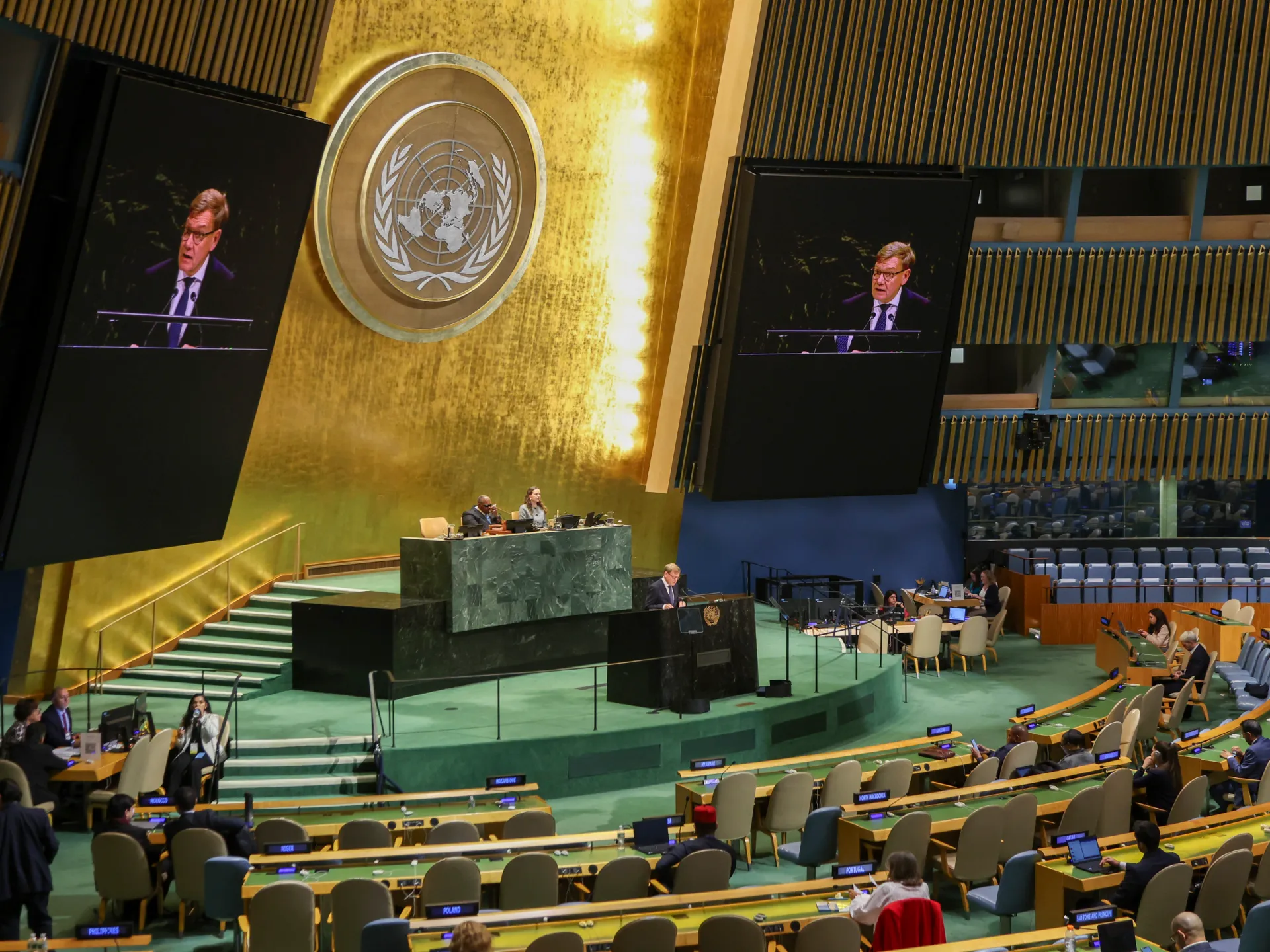
The 81st United Nations General Assembly (UNGA) concluded on Monday with artificial intelligence (AI), the Israel-Palestine conflict and the US-Israel war on Iran dominating world leaders’ addresses during the general debate.

UN Secretary-General Antonio Guterres, in his final address before his term ends, warned that the future of the world would be shaped by four tests: AI, climate change, wars and inequality.

Recommended Stories

list of 3 itemsend of list

“Across all four tests, the decisive issue is power. Power over force, money, energy, technology, rules and the future. That is why the UN Charter – and the work of the United Nations – matter more than ever,” Guterres said.

Speeches ranged from calls to reform the UN to appeals for upholding international law, as the global body has been undermined by the unilateral foreign policy pushed by United States President Donald Trump.

Here are the biggest takeaways from this year’s summit:

Palestine

The situation in Palestine was a key issue among members amid Israel’s ongoing genocidal war on Gaza despite the so-called “ceasefire” and escalating settler pogroms in the occupied West Bank.

France, Canada, Iraq, the United Kingdom and others called for Palestinian sovereignty during their speeches.

“What credibility do we have if we continue to remain inactive in the face of Gaza,” French President Emmanuel Macron said in his address.

“Some boast of a supposed peace, but this peace hasn’t reopened humanitarian routes for a single second,” he said, adding: “Must we stand by and watch this spectacle that shames us all?”

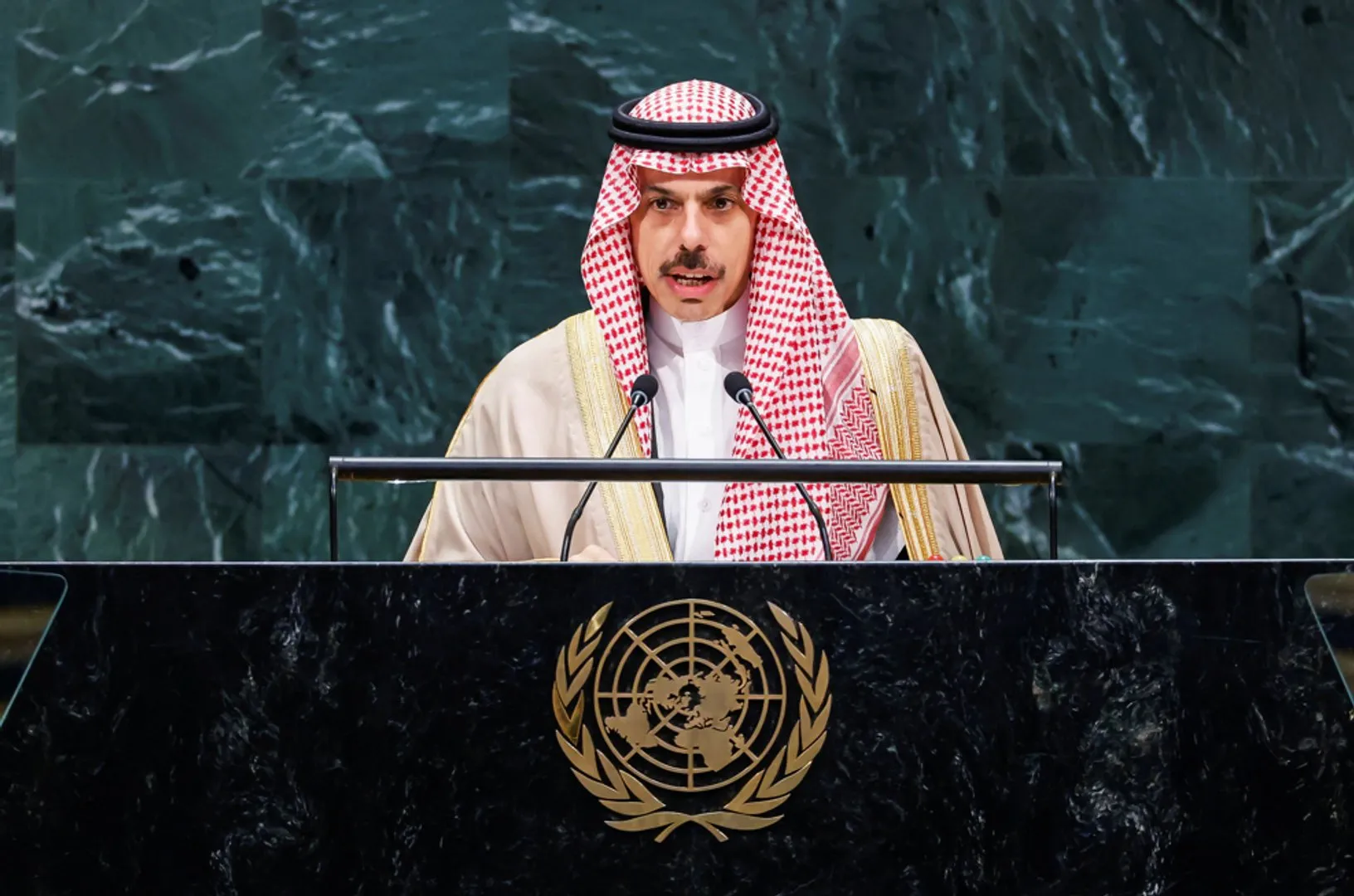
Macron, British Prime Minister Andy Burnham, his Canadian counterpart Mark Carney and Saudi Foreign Minister Prince Faisal bin Farhan Al Saud chaired a meeting at the UNGA on Palestinian statehood, which is being actively undermined by Israel. Israeli Prime Minister Benjamin Netanyahu’s government has accelerated construction of illegal settlements and provided impunity to settlers in the occupied territory.

At the same time, the US-led Board of Peace unveiled a 66-project reconstruction blueprint with proposed funding of $2.4bn for the Gaza Strip on the sidelines of the UNGA.

However, the board’s plan excludes the UN agency for Palestinian refugees (UNRWA), saying it has no role in the future of Gaza. The decision was described by Palestinian political analyst and playwright Ahmed Najar to Al Jazeera as aligned with Israeli efforts to “marginalise and ultimately dismantle the agency, removing it not only from Gaza’s present but from its future”.

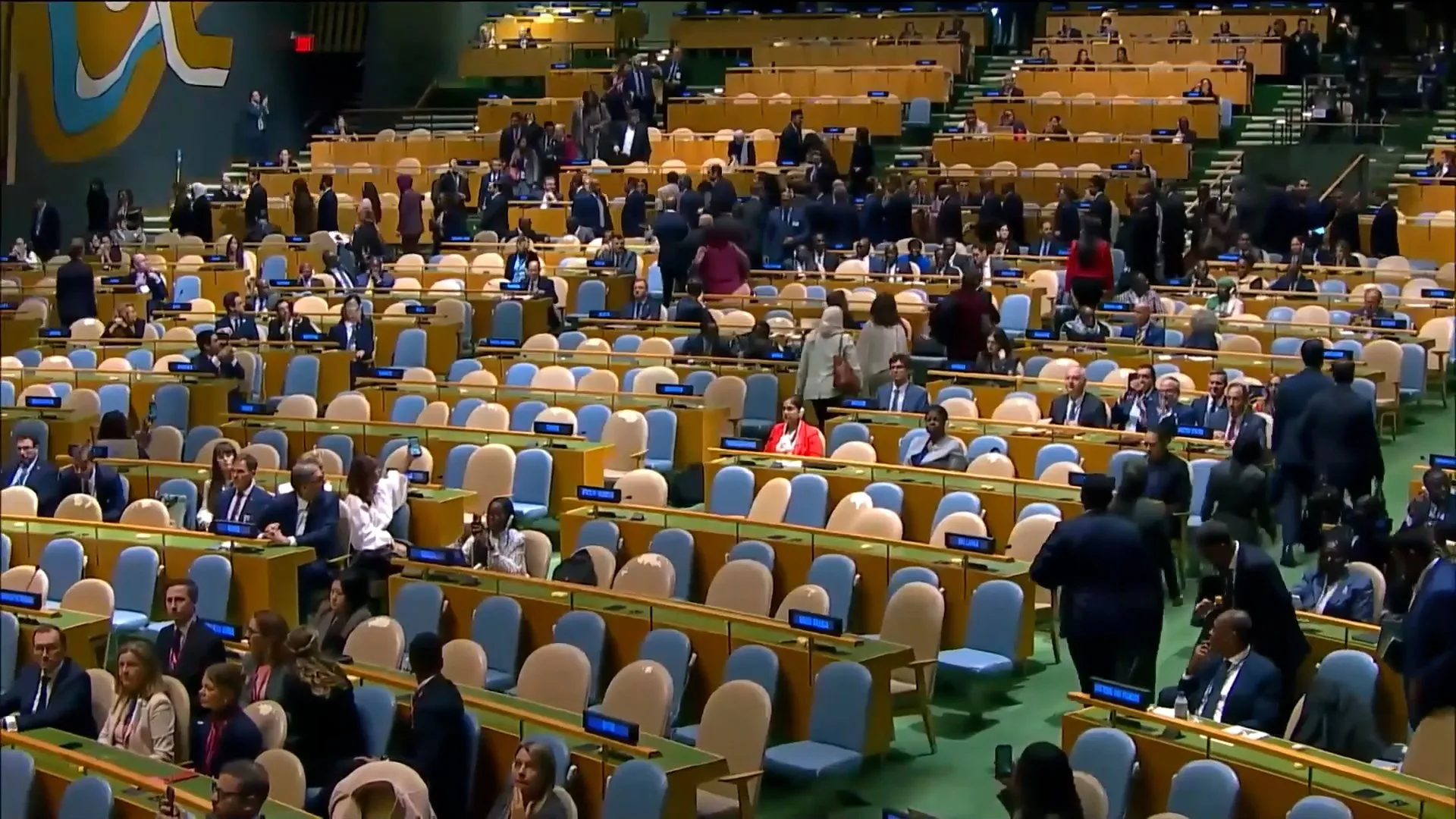
Dozens of delegates left the hall in protest as Netanyahu delivered his speech, in which he declared that Israeli forces would continue fighting against Hamas and Iran.

Trump defends military action on Venezuela, Iran

In his address, Trump emphasised that while others spoke of peace, he “made peace”.

Trump defended his actions in abducting the then-Venezuelan President Nicolas Maduro in January and said, since his military operation, hundreds of political prisoners had been freed in the South American country and that Caracas had signed the largest oil deal in history last month, covering “65 billion barrels of oil, which will benefit both Venezuela and the United States enormously and help drive down the cost of energy all over the world”.

“It was perhaps the biggest deal ever made. To the victor belong the spoils – you’ve all heard that,” Trump boasted.

Trump reiterated that he would never allow Tehran to have nuclear weapons and that the 12-day war in July 2025 had “obliterated their nuclear programme beneath mountains of rubble” as the ongoing US-Israel war on Iran had sunk “159 ships of their navy” to the bottom of the sea.

“I have a big decision to make – will a deal be made with Iran that lets them rebuild and create a far greater country than it ever was before … or do I annihilate the Islamic Republic and do it quickly, never giving them a chance to kill and destroy people and countries again,” he said, adding: “I believe we make a deal right after the elections.”

During sideline talks and one-on-one meetings, Iranian officials were in demand.

In his speech to delegates, President Masoud Pezeshkian emphasised that Iran had only “defended ourselves” amid attacks on his country and killings of Supreme Leader Ayatollah Ali Khamenei, scientists and children.

“We are not terrorists, our innocent people have been the targets of cowardly attacks and aggressions imposed upon our country,” he said.

Pezeshkian added Iran would not accept that peaceful nuclear technology is held exclusively in the hands of a few countries.

“We will not bow our head and give up the right that is inherently ours,” he said.

Meanwhile, on the sidelines of the summit, Foreign Minister Abbas Araghchi met his counterparts from India, Qatar, Turkiye, Pakistan, Ukraine and other countries.

He also met US Special Envoy Steve Witkoff and Trump’s son-in-law Jared Kushner in a four-hour meeting mediated by Qatar.

AI dominance

World leaders used their time at the podium to call for a global approach to using AI as interest in the technology grows, but fears that it could escalate if unchecked are also growing.

In his address, Finnish President Alexander Stubb said AI was the “most consequential technology in the history of mankind”.

“It will impact science, the economy, politics, security, and the very essence of our humanity. Humans can and should be in the driver’s seat. We have a choice: we can compete, cooperate or slow down. For me, cooperation is the best way forward,” he said.

While discussions are moving away from a good-versus-bad dichotomy, officials disagreed on approaches.

While Guterres and the European Union called for safety standards and international rules, Trump said AI innovation should not be constrained by international regulation, adding that the US should control its AI sector.

Xi skips the UNGA

Chinese President Xi Jinping skipped the UNGA despite being in the US for a summit with Trump. He sent Vice President Han Zheng to attend.

Xi rarely attends the UNGA. He had sent Premier Li Qiang in his place last year. In 2024, Foreign Minister Wang Yi attended the annual gathering.

Without mentioning Iran in his address, Han reiterated Beijing’s position that “sovereignty and security of countries in the Middle East, including the Gulf, should be respected”.

“China calls for advancing the governance of the West Bank and the post-conflict reconstruction of Gaza in accordance with the principle of the Palestinians governing Palestine. It also calls for bringing the Palestinian question back onto the right track of the two-state solution at an early date,” he said.

Han also called for a “people-centred approach and develop AI for the positive and for good, narrow the digital divide, and promote development that is universally beneficial”.
Source link

Inside Al Jazeera’s UNGA coverage | United Nations

Once a year, leaders from across the globe meet face-to-face at the UN General Assembly, and Al Jazeera’s journalists were there covering daily developments. Here’s a look at what it was like behind the scenes of the coverage you saw online and on TV.

Source link

Saudi FM accuses Iran of ‘flagrant attacks’ and condemns Houthis at UNGA | Mohammed bin Salman

Saudi Arabia has used its address to the UN General Assembly to accuse Iran of flagrant attacks on civilian and economic targets across the region, while calling on the international community to condemn Houthi actions threatening Red Sea shipping.

Source link

Which countries walked out of Netanyahu’s UNGA speech? | News

Dozens of countries’ delegations walked out of or were absent for Israeli Prime Minister Benjamin Netanyahu’s UN General Assembly speech in protest over Israel’s war in Gaza. Here’s which countries’ seats were visibly empty — and which delegations remained.

Source link

Converging crises, chaos and walkouts dominate UNGA Day Three | United Nations

Dozens of delegates walked out on Netanyahu, Yemen’s government pleaded for help, and Kuwait riled against threats to sovereignty. Al Jazeera’s Zeena Aqel explains what happened on day three of the UN General Assembly.

Source link

To the victor belong Venezuela’s spoils: Delcy Rodriguez’s UNGA about-face | Donald Trump

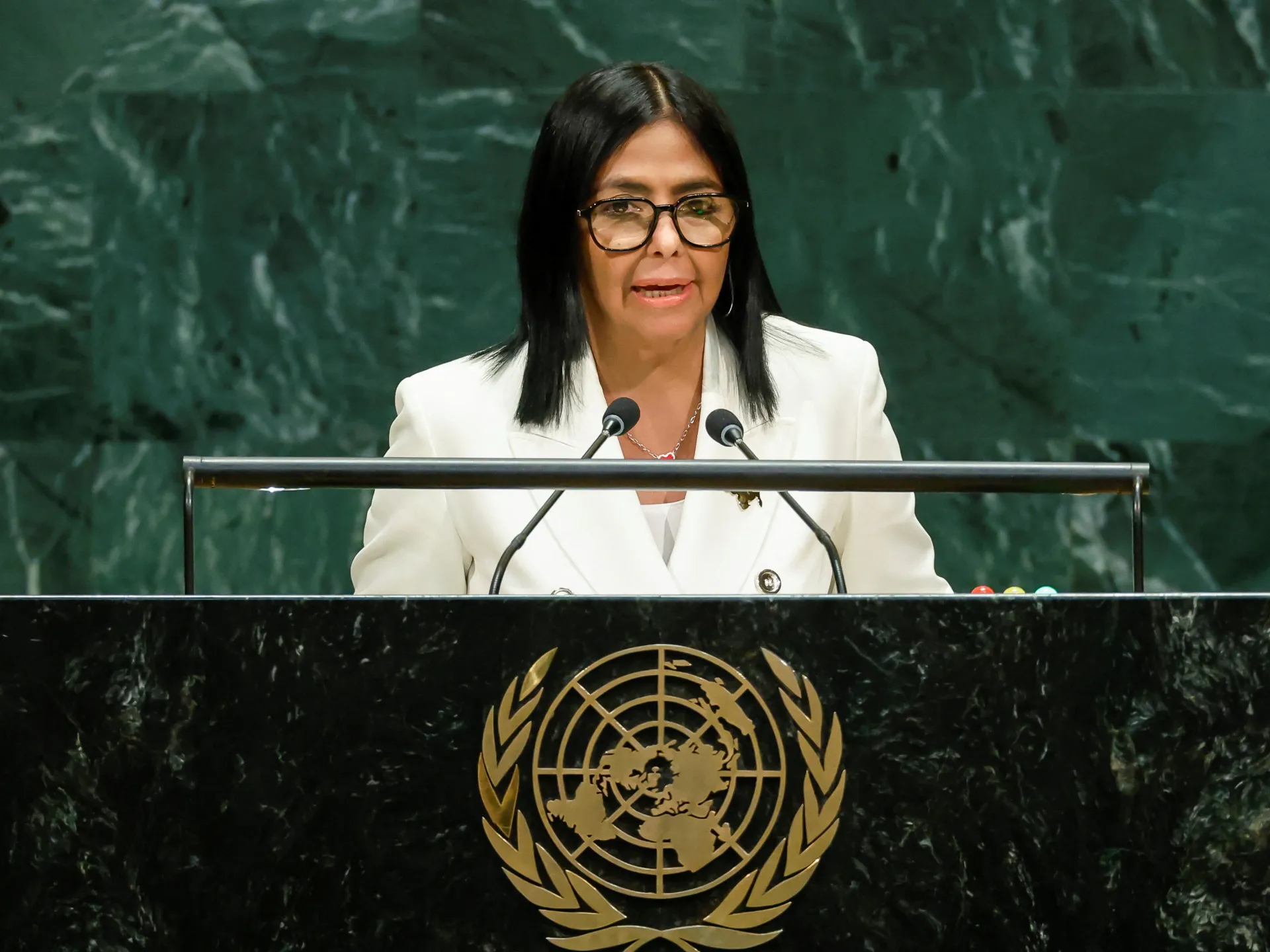
Venezuela’s interim President Delcy Rodriguez took to the stage yesterday at the United Nations General Assembly meeting in New York City to deliver a rather bland speech, in which she thanked United States President Donald Trump for resuming “diplomatic relations and cooperation” with Venezuela.

This was a different vibe, to be sure, than the one she opted for at the same venue in September 2019, when, as vice president under Nicolas Maduro, she accused the US of perpetrating “economic terrorism” that did not require the use of bombs “but rather through banks and insurance companies”.

Denouncing the global superpower’s militarisation of international relations and punishment of millions of innocent people “in order to apply regime change doctrines and steal other nations’ resources”, the Rodriguez of 2019 went on to cite Venezuelan economic losses to the tune of $130bn between 2015 and 2018 alone on account of US sanctions.

She additionally offered her opinion that the domination of the US political system by “plutocratic minorities” made the country unqualified to impose its model on other countries.

Seven years later, US plutocracy is going strong with Trump at the helm – the same Trump alongside whom a grinning Rodriguez appeared in a photograph taken in New York on Tuesday, less than nine months after he oversaw regime change in Venezuela by kidnapping Maduro.

The kidnapped president is now also in New York, albeit in jail, and is scheduled to stand trial in June 2027. This despite his attempts to remind everyone that, as a sitting head of state, his prosecution in a foreign court contravenes international law.

Then again, abducting other countries’ presidents is also pretty glaringly illegal. But Trump has made it clear that he alone is in charge of deciding what is and is not permissible on any given day.

The abduction took place on January 3, when the US military launched air attacks on Venezuela, killing some 100 people and whisking Maduro and his wife away.

He is accused of an array of misdeeds, including being the leader of the “Cartel of the Suns” – which, mind you, does not actually exist – and engaging in “conspiracy to possess machineguns and destructive devices”.

This is quite the accusation coming from the country that just used all manner of destructive devices to bomb Venezuela and kill a bunch of people.

Anyway, bald-faced hypocrisy is nothing new in the land of the “plutocratic minorities”.

Now, the waning corporate media interest in Maduro’s fate amounts to another coup for US impunity, as folks go about more or less forgetting that there is a foreign head of state sitting in a Brooklyn prison.

But Maduro’s disappearance works out well for Rodriguez, as she goes about enabling the very theft of resources she once decried.

Rodriguez took the stage at the UN the day after Trump, who used the platform to pat himself on the back for the trampling of Venezuelan sovereignty that conveniently culminated in last month’s announcement from the White House of the “biggest oil deal in world history”, securing US majority control of more than 65 billion barrels of Venezuela’s proven oil reserves.

Speaking to his international audience, Trump boasted: “To the victor belong the spoils. You’ve all heard that.”

Never mind that you’re not technically supposed to admit that you attacked a country just to get its oil. (You’re also not, in polite company, supposed to threaten to annihilate Iran – another of Trump’s UN talking points.)

Since January, the US has lifted many coercive economic measures against Venezuela (including against Rodriguez herself), easing the brutal sanctions regime that as of 2020 was estimated to have already killed 100,000 Venezuelans, according to former UN independent expert Alfred-Maurice de Zayas.

But trading sanctions for de facto colonialism isn’t a great deal, either.

Meanwhile, Trump’s continued manic bombing of vessels in the Caribbean and Pacific, which a recent UN report warned may constitute crimes against humanity, suggests the US is nowhere near to kicking its old habit of terrorism – and is all the more reason that Rodriguez might have refrained from thanking the US leader for his “cooperation”.

As Gregory Wilpert, founder of the Venezuelanalysis website and author of Changing Venezuela by Taking Power, diplomatically put it to me: “One cannot help but wonder whether Delcy Rodriguez is over-complying with Trump in some aspects of her negotiations with him.”

Noting that Rodriguez is “in a highly vulnerable position”, Wilpert ran through a few of the options she faces, such as “the possibility that the Trump administration could treat her as it treated Maduro – by attempting to kidnap her – or as it treated Iran, by targeting the country’s highest levels of government”.

Or, Wilpert said, there is always the Cuba approach, which would entail “the kind of economic siege” that is undertaken “with the aim of starving an entire country”.

In her UN address, Rodriguez promised that Venezuela would hold elections at some unspecified point in time – not that the US, for its part, really cares about democracy as long as the right people are in power.

And although it’s still too early to tell, Rodriguez might just be one of those people.

The views expressed in this article are the author’s own and do not necessarily reflect Al Jazeera’s editorial stance.

Source link

US, Iran hold mediated UNGA talks on ending war, opening Strait of Hormuz | US-Israel war on Iran News

The United States and Iran have engaged in hours of indirect talks through mediators on the sidelines of the United Nations General Assembly (UNGA) in New York, but accounts differed over whether officials from the two countries met directly.

US special envoy Steve Witkoff said mediators had “shuttled between” the American and Iranian delegations throughout Tuesday.

Recommended Stories

list of 4 itemsend of list

“Today, on the sidelines of the United Nations General Assembly, we engaged in lengthy talks with the Iranian delegation through the mediators, who shuttled between the two sides throughout the day,” Witkoff said in a post on X.

“They successfully completed a round of discussions that we hope will prove constructive and promising. The mediators will continue their work.”

US President Donald Trump gave a more direct account, saying Witkoff and Jared Kushner had held a three-hour meeting with Iranian officials.

“They had a very good meeting, a very productive meeting,” Trump told reporters at the UN, adding that he believed there was “a lot of momentum” towards an agreement. Trump later said talks were continuing and that he believed a settlement would eventually be reached.

Al Jazeera’s Kimberly Halkett, reporting from Washington, said Trump’s initial comments had created confusion over who had participated. She said the White House later clarified that Trump had not attended and that Witkoff and Kushner represented the US side.

Al Jazeera’s Tohid Asadi, reporting from Tehran, said state media had confirmed a meeting between Iranian Foreign Minister Abbas Araghchi and Witkoff after weeks without direct contact.

“This latest meeting was held at the request and insistence of the American side, and was aimed at conveying Iran’s messages and conditions, particularly around reopening the Strait of Hormuz,” Asadi reported.

Iranian state media said those conditions included lifting the US naval blockade, releasing frozen Iranian assets and ending the war on what Tehran describes as the “resistance” fronts.

Asadi also reported that an Iranian security source told Al Jazeera there could be room for further diplomatic engagement if Washington met Iran’s conditions and commitments.

The contacts came after a senior Iranian official told the Reuters news agency that Tehran’s delegation in New York had full authority to pursue diplomacy and described the UN gathering as a “golden opportunity” for Washington to return to negotiations.

The official said Iran had submitted its latest proposal to Washington through mediators on September 16 and that details of a possible agreement to end hostilities could be discussed in New York.

The official also said Iran could reopen Hormuz within seven days if the US eased military pressure and lifted its blockade of Iranian ports.

Regional powers push for de-escalation

The indirect talks have been accompanied by a broader diplomatic effort involving the Gulf and other regional states.

Qatar said it was working with Pakistan to reduce tensions between Washington and Tehran, safeguard freedom of navigation through the Strait of Hormuz and promote regional stability.

Qatar’s Prime Minister and Foreign Minister Sheikh Mohammed bin Abdulrahman bin Jassim Al Thani also met Araghchi in New York on Tuesday.

Qatar’s Ministry of Foreign Affairs said they discussed developments in the region, efforts to de-escalate tensions and ways of creating conditions for dialogue.

Oman has also been involved in maritime diplomacy over the waterway, having previously discussed maritime arrangements with Tehran aimed at facilitating navigation through the strait.

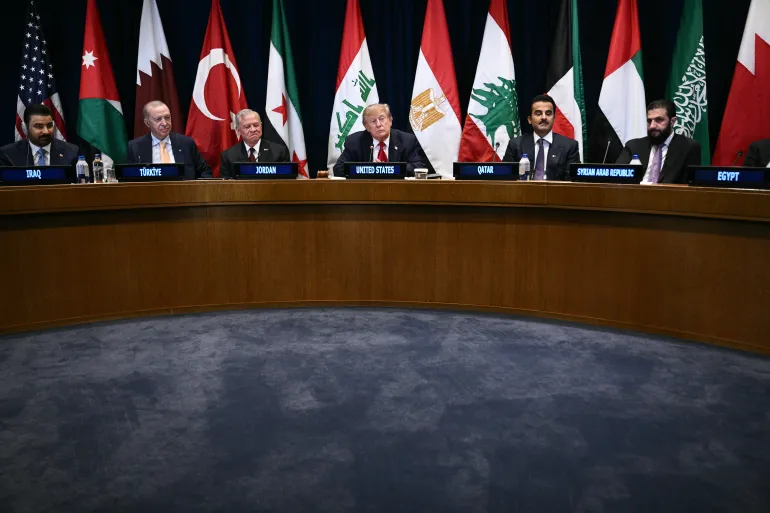
Trump also met leaders and senior officials from Gulf Cooperation Council states, Turkiye, Jordan, Syria and Iraq on Tuesday to discuss Iran and regional security.

Reuters reported that a Qatari proposal for a common security framework involving Iran and Gulf states was among the issues under consideration, with one regional source saying Tehran was reviewing it.

Qatar has not made the proposal public.

US President Donald Trump (C) attends a Gulf Cooperation Council (GCC) multilateral meeting alongside (L/R) Iraqi Prime Minister Ali al-Zaidi, Turkey's President Recep Tayyip Erdogan, King Abdullah II of Jordan, Qatar's Emir Sheikh Tamim bin Hamad al-Thani and Syrian President Ahmed al-Sharaa on the sidelines of the 81st United Nations General Assembly in New York on September 22, 2026. (Photo by Brendan SMIALOWSKI / AFP)
US President Donald Trump attends a multilateral meeting on the sidelines of the 81st UN General Assembly in New York with leaders and senior officials from Arab countries and Turkiye on September 22, 2026 [Brendan Smialowski/AFP]

Talks follow Trump’s warning

The indirect talks came hours after Trump used his UNGA address to combine the possibility of an agreement with another warning of military escalation.

Trump said he faced a “big decision” between reaching a deal that would allow Iran to rebuild and moving to “annihilate the Islamic Republic”. He also said Washington had previously offered Tehran “full economic cooperation” in return for ending its nuclear programme and what the US describes as Iranian support for terrorism.

Iran’s General Staff of the Armed Forces and Khatam al-Anbiya Central Headquarters responded in a statement carried by Iranian media, describing Trump’s threats as evidence of “strategic weakness” and saying Iran was ready to deliver “more severe, crushing, and unpredictable blows” in response to further attacks.

US officials have repeatedly suggested that negotiations were making progress following the collapse of the June memorandum of understanding. In early August, Trump said the sides had reached parameters for a possible agreement and later described talks over Hormuz as “moving along nicely”, although significant differences remained. Earlier this month, he again said he hoped the war was “towards the end”.

Tehran continues to condition the reopening of the Strait of Hormuz on the US easing military pressure and lifting its blockade of Iranian ports, while Witkoff said mediators would continue their efforts following Tuesday’s mediated exchanges.

Source link

Cooperation is the goal at the UNGA, but is it possible? | United Nations News

Debate opened at the UN General Assembly and leaders from across the world made their arguments for making the world a better place. International cooperation seems to be the central goal, but as Al Jazeera’s Emma Withrow explains, only a handful of countries hold the cards.

Source link

Canada pledges aid for Palestine as UK and France demand action at UNGA | United Nations News

Canada pledges 100 million Canadian dollars ($71m) in aid for Palestinians as the UK and France call for action against Israeli settlement expansion in the occupied West Bank.

Canadian Prime Minister Mark Carney has announced that Canada is pledging 100 million Canadian dollars ($71m) in international assistance for Palestinians in an effort to preserve “the possibility of a two-state solution”.

Speaking on the sidelines of the United Nations General Assembly (UNGA), Carney outlined that 80 percent of the funding will go towards direct humanitarian aid. The remaining 20 percent will be allocated to “support peace and security”, including Canada’s multiyear initiative to train Palestinian police in the occupied West Bank.

Recommended Stories

list of 3 itemsend of list

Carney prefaced the pledge by noting that Palestinians in Gaza continue to endure “immense human suffering”, while Israelis confront “existential threats from Hamas and from Iran and its proxies”.

The prime minister was also critical of Israel’s E1 settlement project, with the “intention to bring forward trade restrictions targeting goods produced in those illegal Israeli settlements”.

Canada is one of the 12 states that announced restrictions on trade in goods ⁠with settlements in the occupied territory.

Since the beginning of Israel’s genocidal war on Gaza, Ottawa has pledged more than 600 million Canadian dollars ($426m) in aid for Palestinian civilians.

‘Shame on all of us’

Carney was not the only Western leader to speak on Palestine. French President Emmanuel Macron also slammed world leaders for restrictions on aid in a UNGA speech on Tuesday.

“There are those who claim that peace has been achieved, but this has not opened the way for humanitarian aid deliveries. This sight is shameful. Shame on all of us,” he said.

“But what is our credibility worth if we remain inactive in the face of Gaza?” he added.

British Prime Minister Andy Burnham looks at French President Emmanuel Macron as they pose for photos ahead of a bilateral meeting at 10 Downing Street on September 3, 2026 in London, UK [Leon Neal/Reuters]
British Prime Minister Andy Burnham with French President Emmanuel Macron in London, UK [File: Leon Neal/Reuters]


British Prime Minister Andy Burnham said failure to deliver a two-state solution will “corrode trust” in politicians who have talked about the issue but not taken action.

Burnham told delegates from dozens of countries that the UK has also banned trade with illegal Israeli settlements in the West Bank because the E1 settlement expansion plan is “a deliberate attempt to block a two-state solution”.

“We all live in an era of low trust in politics. Many people in this room, many politicians around the world, have spoken for decades about a two-state solution. But if we fail to back those words with deeds, we will further corrode trust in the political, diplomatic and international process,” Burnham added.

Source link

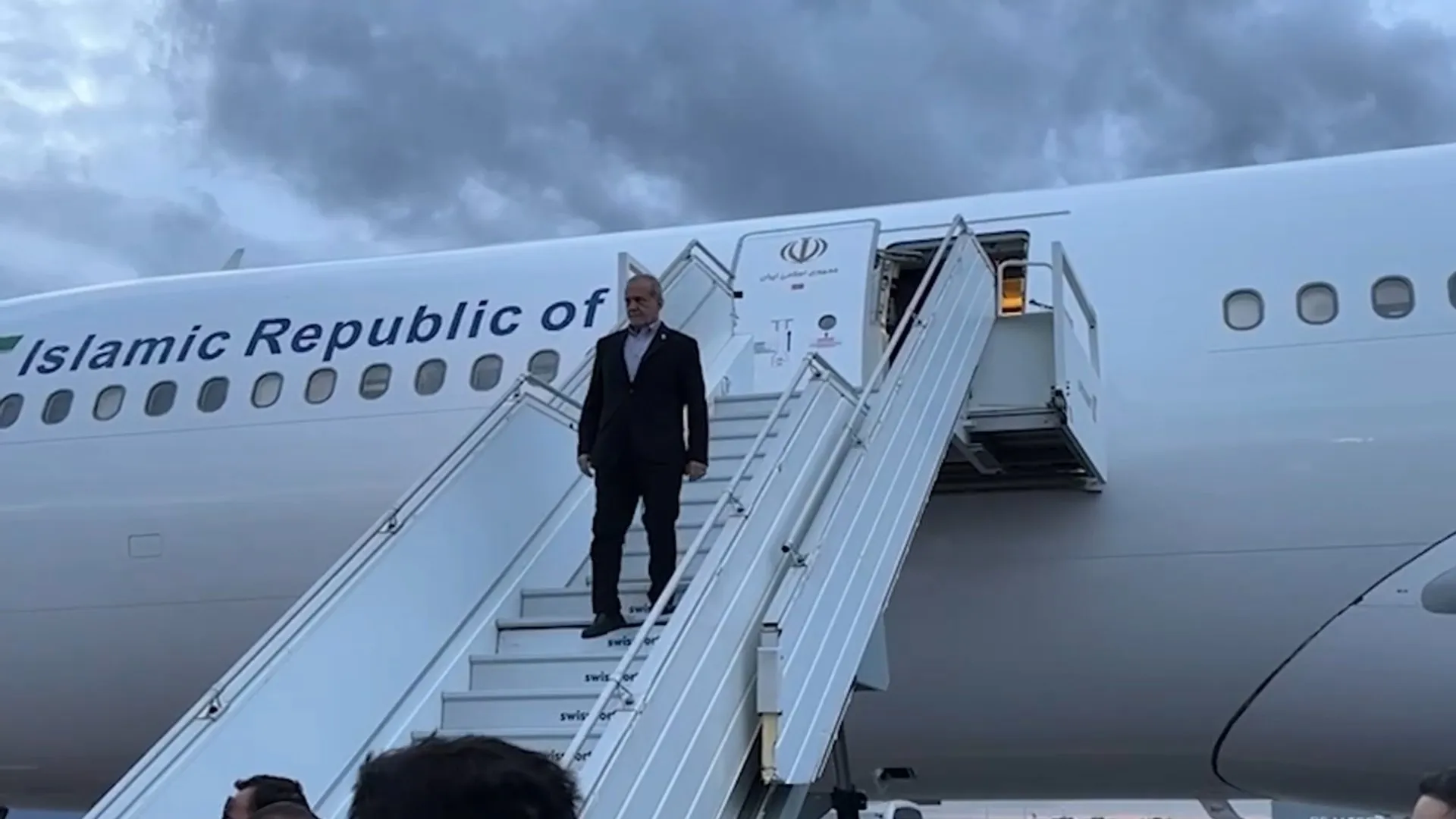
Iranian President Masoud Pezeshkian arrives in New York for UNGA | US-Israel war on Iran News

Iranian President Masoud Pezeshkian has arrived in New York as the US-Iran war continues. He’s due to address the UN General Assembly, where Iran is expected to press its case over the conflict and seek diplomacy aimed at easing tensions.

Source link

UNGA Day 1: US and Iran hold talks despite Trump’s threat | United Nations

The 81st UN General Assembly opened with US President Donald Trump threatening to ‘annihilate’ Iran. Despite the threat, US and Iranian officials met for three hours on the sidelines of UNGA. Al Jazeera’s Diplomatic Editor James Bays reports.

Source link

Here’s what to pay attention to at the UNGA | United Nations

World leaders arrive in New York for UNGA 81 as wars multiply and trust in international institutions erodes. Al Jazeera’s @EmmaWithrow explains the real question is whether global rules still matter when powerful countries choose to ignore them.

Source link

EU urges US to lift travel ban on Palestinian delegation for UNGA meeting | United Nations News

The United Nations General Assembly will allow Palestinian President Mahmoud Abbas to address via a prerecorded video.

The European Union says it regrets the denial of visas by the United States for the second year running to Palestinian Authority (PA) officials seeking to attend the United Nations General Assembly (UNGA) in New York, urging it to reconsider the decision.

The statement on Saturday comes just days after the UNGA voted to allow Palestinian President Mahmoud Abbas to address the body during the upcoming 81st session via a prerecorded statement.

Recommended Stories

list of 3 itemsend of list

“In light of its existing headquarters agreements with the UN and its obligations as host state, we urge the United States for this decision to be reconsidered,” said Anouar El Anouni, a spokesman for the EU’s diplomatic service.

On Friday, UN Secretary-General Antonio Guterres also expressed regret at Washington’s decision, adding he was concerned about its impact “on the ability of the State of Palestine to participate fully in the work of the United Nations”.

The US Department of State announced on Wednesday that it would prolong visa sanctions on officials of the PA and members of the Palestine Liberation Organization (PLO).

“As a consequence of their failure to reform, contrary to their commitments to the United States, and their ongoing activities that undermine the prospects for peace, the United States will extend sanctions that deny visas to PLO members and PA officials,” the State Department said in a statement.

The department accused the PA of violating US law by bypassing direct negotiations to seek international recognition of Palestinian statehood.

It also cited the PA’s decision to take its dispute with Israel to international courts and its financial support for people the US and Israel label as convicted attackers and their families.

No Israeli officials face equivalent US travel restrictions, despite an International Criminal Court arrest warrant issued against Israeli Prime Minister Benjamin Netanyahu over alleged war crimes in Gaza.

Abbas’s address this year is expected to push for international recognition of Palestinian statehood and revive momentum for a two-state solution, building on a wave of formal recognitions by the United Kingdom, France, Canada and other Western nations last year.

His speech will also highlight the severe humanitarian crisis in Gaza alongside the rapid growth of illegal Israeli settlements and settler pogroms across the occupied West Bank.

Palestine’s Ministry of Foreign Affairs and Expatriates welcomed the UN resolution passed on Thursday allowing Abbas to address the assembly next week, saying it “represents a breaking of the attempt to prevent Palestine’s participation” in the UNGA’s annual session.

Source link

Why does Brazil get to speak first at UNGA? | United Nations

Brazil has opened the UN’s General Debate for decades, with the US traditionally second in line as the host country. Here’s how that tradition began and how the rest of the speaking order is decided. 

Al Jazeera’s Farah Samir explains.

Source link