This photo shows Bowe Bergdahl, an U.S. Army soldier who was captured by the Taliban in 2009 after walking off his base in Afghanistan and held hostage of five years. A federal appeals court said Tuesday that a judge that vacated Bergdahl’s conviction in 2023 didn’t have jurisdiction over the case. File Photo courtesy of the U.S. Army.
Sept. 2 (UPI) — A judge who vacated the conviction of former U.S. Army Sgt. Bowe Bergdahl in 2023 lacked the jurisdiction to do so, a federal appeals court ruled.
The case of Bergdahl, who walked off an Army base in Afghanistan in 2009 and was captured by the Taliban, has stretched for years. The ruling by the U.S. Court of Appeals for the District of Columbia Circuit on Tuesday reinstates Bergdahl’s dishonorable discharge from the military and other punishment.
“Obviously, we are disappointed by the outcome,” said Eugene R. Fidell, Bergdahl’s lawyer, The New York Times reported. “This entire controversy has lasted a very long time. But it continues to be an important case, not only for Sergeant Bergdahl but for the integrity of the military justice system.”
Fidell said Bergdahl can request a rehearing before the same panel or seek a review by the entire appeals court or the U.S. Supreme Court.
In the ruling Tuesday, the judges said the case “presents nuanced questions regarding jurisdiction and the evolving relationship between [federal district] courts and military courts.”
“Jurisdiction here turns on whether the remedy sought falls within a district court’s power to grant,” the ruling said. “Because Article III district courts lack jurisdiction on collateral review to vacate court-martial judgments, the District Court lacked jurisdiction over Bergdahl’s claims. Therefore, we remand the case to the District Court to dismiss for lack of jurisdiction.”
That is the date Bergdahl pleaded guilty to desertion and misbehavior before the enemy for his actions in Afghanistan — and the date the military judge in that court martial, Jeffery Nance, applied to become an immigration judge during President Donald Trump‘s first term, Walton’s ruling said. The Justice Department later hired Nance.
During his first presidential campaign, Trump called Bergdahl “a dirty, rotten traitor” and called for him to be executed or returned to the Taliban.
Nance refused a defense request to dismiss the case against Bergdahl because of those remarks, saying he was “completely unaffected” by them and that Bergdahl would still have a fair sentencing hearing. That hearing took place at the end of October 2023.
Walton, in his 2023 ruling, said that based on Nance’s application as an immigration court judge, any reasonable person could conclude that Nance’s impartiality was jeopardized.
An Army investigation found in 2015 that Bergdahl intended to hike to another Army post and report issues in his unit when he left his base in Afghanistan in 2009. He was captured not long after leaving and held and tortured by the Taliban over five years. In 2014, President Barack Obama secured Bergdahl’s release in a prison exchange.
Sept. 2 (UPI) — Patagonia, an outdoor apparel company, announced Wednesday it sued the Trump administration for cuts dramatically shrinking the size of Bears Ears National Monument in Utah.
This is the second time Patagonia has sued the administration, the company said. In 2017, during Trump’s first term, it became the first company to sue a sitting president over public land after the president issued orders shrinking Bears Ears by 85% and Grand Staircase-Escalante National Monument, also in Utah, by nearly half.
The case was not decided by the time of the 2020 election, and President Joe Biden restored both monuments to their original size in 2021.
On July 13, Trump issued orders to shrink them again — Bears Ears by about 91% this time and Grand Staircase-Escalante by about 90%. This amounts to nearly 3 million acres of land that will lose monument-related protections, the company said in a press release.
“Slashing Bears Ears and dismantling the Bears Ears commission is a betrayal of Tribal sovereignty and needlessly throws away years of effort to create the first Tribal co-management structure of a national monument in U.S. history,” Ryan Gellert, Patagonia CEO, said in a statement. “Patagonia worked with the Bears Ears Inter-Tribal Coalition, scientists, conservation groups, outdoor industry advocates and more to establish the monument in 2016, and we are committed to defending it today and into the future.”
President Barack Obama designated the Bears Ears monument in late 2016, following a proposal by five Tribal entities: the Navajo Nation, Hopi Tribe, Ute Mountain Ute Tribe, Ute Indian Tribe of the Uintah and Ouray Reservation and the Pueblo of Zuni. A coalition of these groups co-manages the monument with the U.S. Bureau of Land Management.
Patagonia says the U.S. Antiquities Act gives presidents the power to designate national monuments but not to undo them. However, the Trump administration, as well as others including Republican Utah Gov. Spencer Cox, say the monuments violate that act, which they say limits the designation to the smallest parcel of land necessary for the proper care and management of the objects to be protected.
The Trump administration argued that term “objects of historic or scientific interest” in the Antiquities Act has been stretched to include landscapes and biodiversity — and should not.
When signing the new orders in July, Trump criticized the size of the monuments, claiming that the public cannot hunt, fish or “virtually not even walk” on the land. However, the Utah Division of Wildlife Resources and the U.S. Bureau of Land Management explicitly say people canhike, hunt and fish in both monuments, as well as take part in other forms of outdoor recreation.
The Center for Western Priorities said in July that Trump’s orders could open the land for sale or lease oil, gas, mining or logging companies within 60 days.
Medical groups have released vaccine recommendations this fall in lieu of guidance from the CDC. File Photo by Javier Aparico/EPA
Sept. 2 (UPI) — A group of medical organizations has released guidance on fall vaccinations against respiratory illnesses.
The Centers for Disease Control and Prevention usually launches a fall campaign to recommend seasonal vaccines for diseases like RSV, influenza and COVID-19. This year, however, the agency has not issued its updated recommendations for the respiratory virus season.
In March, the American Academy of Pediatrics won a lawsuit against the federal government that blocked Health and Human Services Secretary Robert F. Kennedy Jr. from overhauling the childhood vaccine schedule.
Kennedy and President Donald Trump have said that children get too many vaccines and have reduced the number of vaccines routinely recommended. They have also linked vaccines to autism, which has been proven untrue by research.
In response, the American Academy of Pediatrics, the American College of Obstetricians and Gynecologists, the American Academy of Family Physicians, the Infectious Diseases Society of America each issued guidelines for fall immunizations. They based those guidelines on research from the American Medical Association and the University of Minnesota’s Vaccine Integrity Project
Last year, the CDC changed the COVID-19 recommendations to say that patients should talk to their own doctors.
On Tuesday, the agency said, “the CDC states the recommendations for seasonal influenza vaccination from the July 2025 immunization schedule remain in effect for the 2026-2027 influenza season.” It doesn’t mention the new mRNA flu vaccine, approved by the U.S. Food and Drug Administration last month.
“For more than 60 years, the United States has benefited from an established federal process for evaluating vaccine evidence and translating that science into recommendations for the American public. At the center of that process were the Centers for Disease Control and its Advisory Committee on Immunization Practices, the ACIP,” CNN reported Dr. Bruce Gellin, board chair of the Vaccine Integrity Project and professor of medicine at Georgetown University, said at a press briefing.
“Unfortunately today, the federal government is not fulfilling that responsibility in the way that it historically has. But the need for that work has not disappeared. Influenza, SARS-CoV-2 [COVID-19] and the RSV viruses will circulate again this fall and winter,” Gellin said.
“We cannot allow the breakdown of a federal process to create a vacuum in evidence-based vaccine guidance,” he added.
Dr. Sarah Nosal, president of the American Academy of Family Physicians, said in the news briefing that insurance companies have indicated they will cover the vaccines.
“Vaccines are one of medicine’s greatest success stories. They prevent serious illness, reduce hospitalizations and long-term complications and save lives,” Nosal said in a press release. “As federal guidance evolves, the science behind vaccines remains strong. These recommendations are grounded in the latest evidence, informed by public health experts and shaped by what family physicians are seeing every day in their patients.”
The John F. Kennedy Center for Performing Arts is seen in Washington, D.C., on Thursday. On Wednesday, workers removed a large sculpture that had been on the grounds since 2019. Photo by Bonnie Cash/UPI | License Photo
Sept. 2 (UPI) — Workers removed a 24-foot-tall blue sculpture by Joel Shapiro from the grounds at the John F. Kennedy Performing Arts Center on Wednesday amid President Donald Trump‘s efforts to overhaul the venue in Washington, D.C.
The abstract blue sculpture of a stick figure appearing to be mid-kick called Blue was installed outside the Kennedy Center in 2019. Shapiro, who died in 2025, said the artwork was a “celebration of possibility,” The Washington Post reported.
The National Park Service announced the temporary closure of the northbound lane of Rock Creek and Potomac Parkway between the Kennedy Center and the Potomac River to allow heavy machinery to remove the sculpture.
A representative at the Kennedy Center told The Hill the sculpture’s relocation will be determined by the Joel Shapiro and Ellen Phelan Foundation.
“We are deeply grateful to Joel Shapiro for the years Blue has spent animating our campus and connecting visitors to his vision,” the representative said. “We are honored to have been stewards of his vibrant work and park of his enduring legacy.”
The venue confirmed the work to remove the sculpture was done at the facility’s request but didn’t specify the reason. The Joel Shapiro and Ellen Phelan Foundation declined to comment on the move.
The removal of the sculpture is one of several changes to take place at the Kennedy Center in the past year. The Board of Trustees voted in December to add Trump’s name to the building less than a year after the president dismissed the entire existing board and named new members, who in turn elected him chairman.
Since then Trump announced the building would be renamed to include his own name, which sparked a legal battle resulting in the courts ordering his name to be removed from the facade. Trump also planned to shutter the building for two years to carry out renovations.
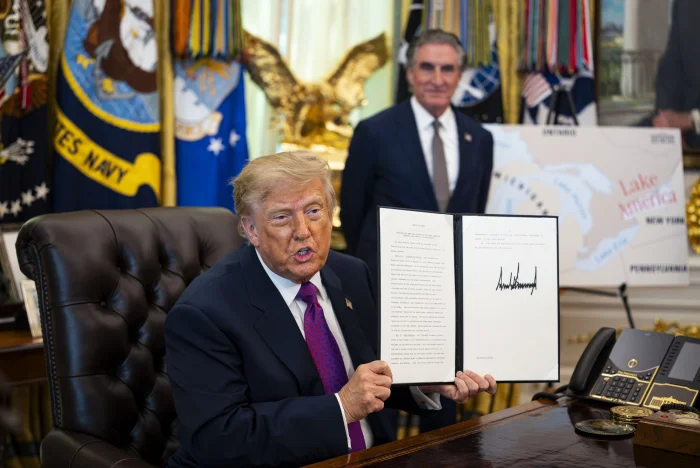
President Donald Trump signs an executive order to rename Lake Ontario as Lake America in the Oval Office of the White House on Thursday. Photo by Al Drago/UPI | License Photo
Private payrolls rose by 38,000 in August, though it was less than expected and fell below the 46,000 jobs added in July, ADP reported on Wednesday. File Photo by Tasos Katopodis/UPI | License Photo
Sept. 2 (UPI) — Private payrolls rose by 38,000 in August, though it was less than expected and fell below the 46,000 jobs added in July, ADP reported on Wednesday.
August’s new hires report was the slowest month in terms of hiring since January with the manufacturing, professional services and information industries cutting jobs.
“Pay can tell us a lot about today’s choppy hiring,” Dr. Nela Richardson, chief economist for ADP, said in a statement. “To understand hiring patterns, you have to look deeply into where pay growth is accelerating, where it’s slowing, and for whom. Once-predictable wage growth has been overtaken by the complexities of demographic change, persistent inflation, and AI’s effects on jobs.”
Manufacturing jobs posted the biggest losses, down 17,000, followed by professional and business services, down 16,000. The losses offset a 45,000 gain in education and health services jobs and 16,000 new hires in the leisure and hospitality industry.
Large businesses of more than 500 employees added the most new hires, up 34,000, followed by small businesses with one to 19 employees, up 20,000. Small businesses with 20 to 49 employees decreased by 17,000 jobs.
The Dow Jones consensus estimate projected 47,000 new hires in August, 9,000 jobs more than ADP’s reported results.
Wednesday’s report comes ahead of the U.S. Bureau of Labor Statistics’ monthly nonfarm payrolls report expected on Friday.
President Donald Trump signs an executive order to rename Lake Ontario as Lake America in the Oval Office of the White House on Thursday. Photo by Al Drago/UPI | License Photo
A U.S. Navy helicopter lands on the nuclear-powered aircraft carrier USS Abraham Lincoln (CVN-72) while the ship sails to dock at the deep-sea port in Laem Chabang, Chonburi province, Thailand, Wednesday. The Nimitz-class nuclear-powered aircraft carrier with roughly 5,000 sailors and Marines aboard and other vessels from its Carrier Strike Group, is docked with personnel to come ashore in Thailand to rest and recuperate while the warship replenishes supplies after an extended deployment. Photo by Rungroj Yongrit/EPA
Sept. 2 (UPI) — The USS Abraham Lincoln docked in Thailand Wednesday morning, the first break for the sailors aboard since before Thanksgiving.
The 5,000 crew members aboard the nuclear-powered aircraft carrier stepped on land and headed to the beach town of Pattaya, Thailand, to begin their first significant shore leave in nine months.
The ship, based in San Diego, has spent more than 250 consecutive days supporting actions in Venezuela and Iran. The crew has faced issues with morale, plumbing and food supplies. At least one sailor aboard the ship has attempted suicide, and there have been reports of more.
During the Lincoln’s deployment in the Middle East, the U.S. naval base in Bahrain was mostly destroyed at the beginning of the war, making restocking and repairs more challenging.
After public outcry, the Navy replaced the Lincoln with the USS George Washington, allowing the Lincoln to head home.
The Lincoln docked Wednesday at Laem Chabang, north of Pattaya, and crew members traveled by bus into the beach town. Many of them booked hotels for their shore leave, said Pattaya Mayor Poramet Ngampichet.
“It is a well-deserved break for all of the crew, and we really look forward to our time here,” said Capt. Daniel J. Keeler, commanding officer of the Lincoln, The New York Times reported.
“It’s good to have you here,” the mayor said, shaking hands with the Captain.
The mayor and other local dignitaries greeted the first arriving sailors at the Hard Rock Hotel in Pattaya. They handed the crew members gifts and welcomed them to the area.
“Our arrival in Laem Chabang provides a well-deserved opportunity for our sailors and Marines to rest and recharge. It also underscores the strong and enduring partnership and alliance between the United States and Thailand,” Rear Adm. Robert E. Loughran, commander of Carrier Strike Group 3, which includes the Lincoln, said in a statement. “What this strike group has accomplished is truly historic. I could not be prouder of the exceptional professionalism and expertise demonstrated by every member of this team during our operations in the U.S. Central Command area of responsibility.”
The statement pointed out that Thailand has been a partner of the United States since the 1833 Treaty of Amity and Commerce, and it’s the only treaty ally in mainland southeast Asia.
Pattaya is just north of U-Tapao, where an airbase hosted U.S. B-52 bombers during the Vietnam War. It also provided a rest and relaxation spot for U.S. servicemembers during the war and since. For this shore leave, local authorities said the military has restricted certain activities, including consuming marijuana, parasailing and jet skiing.
After the weekend in Thailand, the Lincoln is scheduled to leave for San Diego Sunday.
President Donald Trump signs an executive order to rename Lake Ontario as Lake America in the Oval Office of the White House on Thursday. Photo by Al Drago/UPI | License Photo
Sept. 2 (UPI) — President Donald Trump has nominated Hung Cao to be secretary of the Navy amid an ongoing shakeup of the U.S. military.
Trump announced his nomination of Cao for a position he has held on an interim basis for months on his Truth Social media platform Tuesday, calling him “a true WARRIOR.”
“We need Patriots like Hung leading our Navy and Marine Corps, and I can think of no one better than him to make sure our Great Navy and Marine Corps remain the FIERCEST and BEST Force the World has ever seen,” the commander in chief said.
“The Senate needs to confirm this Warfighter, ASAP, so he can continue the fantastic work he has been doing over the past 4 months.”
Cao has served as acting secretary of the Navy since April when his predecessor, John Phelan, was reportedly forced to leave the position over clashes with Defense Secretary Pete Hegseth, Deputy Defense Secretary Stephen Feinberg and Cao.
The announcement comes as there has been a high turnover rate in U.S. military leadership during Trump’s second administration, with high-ranking officers resigning, quitting or purged. On Monday, it was reported that Army Secretary Dan Driscoll resigned following months of clashes with Hegseth.
Cao in a statement late Tuesday thanked Trump for the nomination, saying “it’s an honor of a lifetime to lead the great warriors of the Navy and Marine Crops team.”
“I’m grateful for your leadership and support as we continue to get after shipbuilding and ensure the defense of the homeland.”
If confirmed by the Senate, Cao, as secretary, will oversee the entire Navy from recruiting to equipping and mobilizing as well as be in charge of construction, outfitting and repairing naval ships, equipment and facilities, among other responsibilities.
“Congrats to Hung Cao on being nominated as our nation’s next @SECNAV,” Sen. Rick Scott, R-Fla., said online.
“I know you will work hard to support our incredible Sailors and Marines.”
Sept. 2 (UPI) — The Trump administration sued a Kansas City school district on Tuesday, accusing it of violating federal law with guidelines concerning disclosure of a student’s gender identity to their parents.
The Justice Department described the lawsuit as the first it has filed against a school district alleging that gender-identity guidelines violate the Family Educational Rights and Privacy Act and the Protection of Pupil Rights Amendment.
“Parental rights are paramount in operation of America’s public schools, and Kansas City, Kansas Public Schools does not know children better than their own parents,” Assistant Attorney General Harmeet Dhillon of the Justice Department’s Civil Rights Division said in a statement.
“The department will not tolerate school districts playing fast and loose with federal law in the service of radical gender ideology.”
Having campaigned on an anti-“woke” platform that included opposition to transgender rights, President Donald Trump has repeatedly targeted policies benefiting transgender Americans, particularly minors and students, seeking to ban transgender girls and women from competing in female sports and restrict minors’ access to gender-affirming healthcare.
The lawsuit filed Tuesday challenges as unlawful KCKPS guidelines that allow students to request that their transgender or gender-nonconforming identity be withheld from their parents, with such requests considered on a case-by-case basis, as well as guidelines allowing school officials to consider using a student’s preferred name, gender, and pronouns. The Justice Department described such policies as “facilitating secret ‘gender transitions’ for children at school without their parents’ knowledge or consent.”
Federal prosecutors allege that the guidelines are unlawful because they require a meeting to be held to discuss the student’s request, creating records that the Justice Department argues FERPA requires school districts to provide to parents. FERPA also arms parents with the authority to challenge records, and the KCKPS guidelines deny them the opportunity to even see the gender plan for their child, let alone challenge, correct or delete it, the Justice Department argues.
Its PPRA claim is that the guidelines violate the law’s guarantee that minor students will not undergo a survey, analysis or evaluation that reveals certain information, including mental or psychological problems, sexual behavior or attitudes and religious beliefs, without parental consent.
U.S. Attorney Ryan Kriegshauser for the District of Kansas said the lawsuit should “not come as a surprise” given that public education only works when schools and parents work together.
“When schools withhold information from parents, they undermine trust and disrupt the essential balance between families and public educators,” he said in a statement.
KCKPS denies the allegations, stating it is in compliance with both FERPA and the PPRA and that it was “disappointed by the DOJ’s decision to file the lawsuit.”
The lawsuit comes more than a year after the Education Department initiated an investigation into the school district following receipt of a complaint against its guidelines from the conservative Defense of Freedom Institute for Policy Studies, which was founded by former Trump administration officials.
In July, KCKPS Superintendent Anna Stubblefield told local KSHB41 that what the Trump administration is targeting are guidelines, not policies.
“There’s nowhere in the guidance where we say ‘withhold information from parents.’ We have no reason or incentive to withhold information from parents about anything that they’re entitled to for their students,” she said.
“When they say we have a policy, we’ve never had a policy.”
Tropical Edouard made landfall Tuesday at the Texas-Louisiana border. The storm is expected to weaken into Wednesday. Photo courtesy of the NOAA.
Sept. 1 (UPI) — Tropical Storm Edouard made landfall Tuesday at the Texas-Louisiana border, moving inland toward the northwest with gusty winds and heavy rainfall.
The National Hurricane Center said a tropical storm warning was in effect from Port Bolivar, Texas, to the Vermilion/Cameron parish line in Louisiana. As of Tuesday afternoon, wind speeds had slowed to about 50 mph after measurements of about 60 mph at landfall.
“Continued weakening is expected during the next day or so, and Edouard is forecast to weaken to a tropical depression tonight and dissipate by Wednesday night,” the NHC said.
The storm’s small size will lessen its impact, CNN reported. “Locally significant flash flooding” is possible in southeast Texas, and river flooding was also possible. Texas Gov. Greg Abbott activated the state’s Emergency Operations Center to prepare, mobilizing more than 1,500 personnel.
The storm is expected to produce 3 to 7 inches of rainfall with some totals up to 12 inches for parts of the upper Texas coast inland through east-central Texas, the NHC said. There is the potential for 2 to 4 inches in far southwest Louisiana.
Tornadoes are possible through Tuesday evening across parts of southwest Louisiana and southeast Texas.
A storm surge/tide combination could cause normally dry areas near the coast to flood, the NHC said. The degree of this flooding depends on the timing of the surge and tidal cycle.
Rep. Chuck Edwards, R-N.C., left, was formally censured Tuesday by the House Representatives over allegations of misconduct toward two female staff members. File Photo by Bonnie Cash/UPI. | License Photo
Sept. 1 (UPI) — The House of Representatives on Tuesday voted to censure Rep. Chuck Edwards, R-N.C., over allegations of misconduct toward two female staff members.
The House voted 412-2 in favor of the punishment. Edwards’ “highly unprofessional” behavior toward two staff members — one 19 years old and another in her 20s – led to a House Ethics Committee investigation earlier this year.
Censure does not remove a lawmaker from the House, so Edwards will finish out his term. The committee recommendation to formally censure a representative was the first since 2010.
The committee’s report said Edwards “engaged in persistent unprofessional and inappropriate conduct towards two young female staffers.”
“While Representative Edwards denied that any of his conduct was intended as a sexual or romantic advance, his pattern of behavior would lead a reasonable observer to interpret it as such,” the report said. “… Both women were uncomfortable with his behavior (which they attempt to communicate) but were put in an untenable position by virtue of his status as their boss and a member of Congress.”
Before the vote, Edwards apologized for his actions but denied he ever sexually harassed them.
“Regret is not an admission of sexual harassment,” he said, CNN reported. “I am imperfect. I have made mistakes, but I do not believe I committed sexual harassment.”
The report said that Edwards gave the two staff members lavish gifts, including jewelry and handguns, and frequently commented on their appearance and clothing. He also invited them to intimate dinners and vacations and sent them notes about his “effusive affection.”
Edwards wrote poems to one of the staffers, one of which he read at her going-away party, at which he cried. Other staff members also testified it made them feel uncomfortable.
WASHINGTON — President Trump on Monday urged Congress to approve federal tax incentives aimed at reviving American film and television productions, saying Hollywood has been hollowed out by productions moving to Canada and other countries.
In a social media post, Trump said he met with actor Jon Voight, whom he has designated as “Hollywood Ambassador,” and concluded there is “no incentive” to work in Hollywood anymore and that it is “hurting California very badly.”
“Jon, and many others in the Industry, are suggesting we do Federal Tax Incentives in order to Make our Movie and Television Production Business GREAT AGAIN, Perhaps GREATER THAN EVER BEFORE!,” Trump said wrote on Truth Social.
Trump said meetings are already being set up to talk to lawmakers from both parties, noting that he wants to the discussions to be bipartisan, “especially since so much money is being lost in California, and other largely Blue States.”
“I am going to suggest that Republicans and Democrats get together, and immediately craft Legislation to save the Movie, Television and Entertainment Business in America,” he said.
There are few details about what these incentives would look like at this time, but Trump said “the amount of money spent” on tax breaks will be made up “tenfold by the money pouring into the Treasury’s coffers.”
Charles Rivkin, chairman and chief executive of the Motion Picture Assn., applauded Trump’s announcement, and, in a statement, added that “for over a century, American studios, casts, and crews have produced the films and series that the world wants to see.”
“A federal incentive,” Rivkin added, “would be a landmark step toward bringing more production to local communities in all 50 states, strengthening our nation’s economy, and making our country a more competitive place to produce, create, and tell great stories.”
Trump’s push comes as production has continued to shift overseas. Last year, 45% of all U.S. films and scripted television shows were shot internationally, up from about 33% in 2022, an issue that has worried California lawmakers such as Sen. Adam Schiff (D-Calif.).
California and other states have bolstered their production incentive programs, but Schiff has said in the past that it is not enough. He, too, has made the case for a federal tax credit.
“State programs cannot simply substitute for the kind of global, federal and competitive tax incentives that are needed to bring production back to American soil and stop its offshoring,” Schiff said at an event in March. “The urgency could not be greater.”
Trump has previously floated more aggressive measures, including a threat to impose tariffs on foreign-made films, but that idea did not gain traction.
Sept. 1 (UPI) — A 17-year-old from Maine is the first juvenile in the United States to be charged in federal court, convicted and sentenced in connection to their role in online nihilistic extremist groups connected to the 764 network, the FBI said Tuesday.
The FBI’s Boston office, which led the investigation, said the teenager “was found to have committed multiple acts of juvenile delinquency, including conspiring to sexually exploit a child, sexually exploiting and enticing a child, distributing child sexual abuse material, sending interstate threats, cyberstalking victims and identity theft.”
The Juvenile Delinquency Act prevents authorities from revealing the teen’s identity. The FBI said they will serve a term of “official detention to be followed by juvenile delinquent supervision.”
“This first-in-the-nation case should make it crystal clear that if you conspire to commit violent, extremist crimes, your age will not shield you from accountability,” Ted E. Docks, special agent in charge of the FBI Boston division, said in a statement. “What this juvenile did would shock most people to their very core, and it is our hope that by publicizing this case, others will be deterred from making the same devastating choices this teen did.”
The “764 network” refers to multiple online groups of various names in which members seek to coerce others, including “minors and other vulnerable individuals,” into “escalating sexual and violent behavior, including pushing victims to create graphic content and [child sexual abuse material], sexually exploit siblings, harm family pets, cut themselves with sharp objects or attempt suicide,” the FBI said.
The bureau says it’s investigating more than 500 people throughout the country with links to the 764 network. Members “work in concert with one another toward a common purpose of destroying civilized society through the corruption and exploitation of vulnerable populations,” the FBI said. “They want to sow chaos and create social unrest.”
In February, the Boston FBI office issued a public service announcement to parents and guardians, warning them about a rise in activity for 764 and nihilistic extremist groups.
Secretary of Health and Human Services Robert F. Kennedy Jr. listens as Administrator of the Centers for Medicare and Medicaid Services Mehmet Oz whispers to him behind President Donald Trump at an announcement on healthcare affordability on Monday. On Tuesday, Kennedy hosted a symposium on children’s screen time. Photo by Annabelle Gordon/UPI | License Photo
Sept. 1 (UPI) — The U.S. Department of Health and Human Services encouraged families to reduce screen time for their children during a symposium Tuesday in Washington, D.C.
The event, called the Live Real Life Symposium, was held at the Hubert H. Humphrey Building and brought together “leaders from technology, medicine, research, education, government, and advocacy groups to examine the harms of screen use in children and discuss actionable approaches to supporting healthier childhood development,” a press release from HHS said.
The symposium also introduced The Magic Tablet, a children’s book released by HHS meant to communicate the Live Real Life principles in a children’s book format.
“Our children get one childhood, and we cannot allow screens to replace the real-world experiences they need to grow and thrive,” HHS Secretary Robert F. Kennedy Jr. said in a statement. “Through the Office of the Surgeon General’s ‘Live Real Life initiative,’ we are giving families practical tools to put technology in its proper place and get children back to playing, exploring, connecting and experiencing the world around them.”
The event was meant to build on the Surgeon General’s Warning on the Harms of Screen Use issued earlier this year, which outlines how factors such as age, content, design, purpose and duration influence when screen engagement may be beneficial and when it’s harmful.
“The well-being of children is not just important today, but must be an ongoing priority for the public health communities,” said Dr. Stephanie Haridopolos, director of national health communications for the Office of the Surgeon General and principal deputy assistant secretary for health. “Technology has a place in our lives, but it should never come at the expense of our children’s health.
President Donald Trump signs an executive order to rename Lake Ontario as Lake America in the Oval Office of the White House on Thursday. Photo by Al Drago/UPI | License Photo
Anyone wondering what look fashion-forward tennis star Naomi Osaka would sport at the U.S. Open this year received “The Answer” on Monday night at Flushing Meadows in New York.
That is, her look was very much inspired by basketball icon Allen Iverson, complete with cornrows, a headband and arm sleeves.
After her 7-6 (6), 7-6 (3) first-round victory over Anastasia Zakharova, Osaka said she decided to pay homage to the Naismith Basketball Hall of Famer and his signature style after her apparel sponsor chose basketball as its U.S. Open theme.
“It’s my, I guess, my tribute to Iverson. I really like him a lot,” Osaka said during an on-court interview. “I mean, Nike said basketball, so I said, ‘OK, you want basketball, I’ll give you basketball.’”
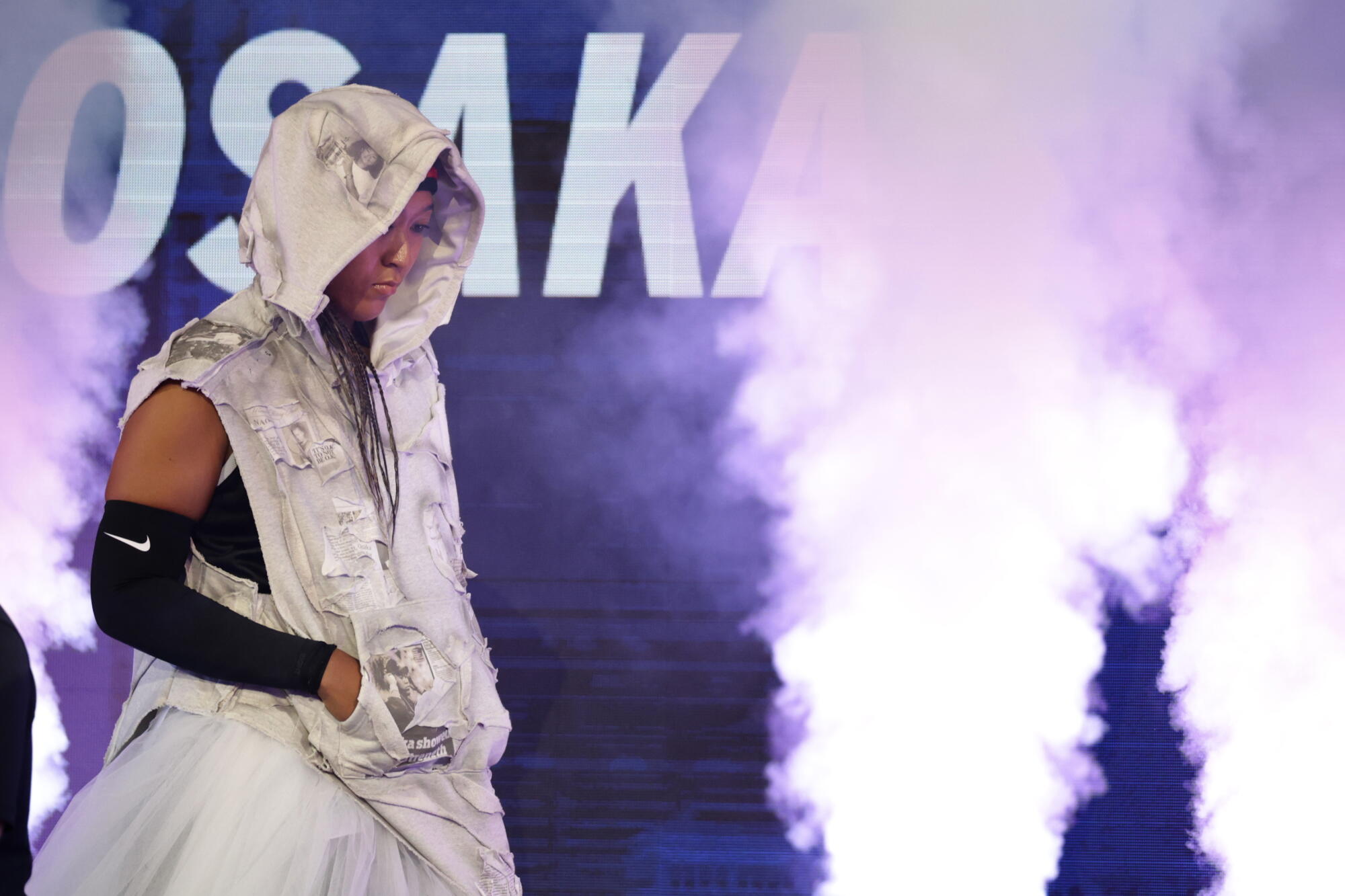
Osaka took the court wearing a long, hooded gown — possibly inspired by Iverson’s hoodies and baggy clothes from back in the day — with newspaper clippings about her attached to it. She first took off the hood to reveal her hair and headband, then removed the gown to play in a black tank top and metallic tennis skirt.
Naomi Osaka arrives to compete against Anastasia Zakharova during the first round of the U.S. Open on Monday in New York.
(Adam Hunger / Ap Photo/adam Hunger)
Naomi Osaka reacts to winning the first set against Anastasia Zakharova on Monday at the U.S. Open.
(Adam Hunger / Associated Press)
The two-time U.S. Open champion also gave a nod to the 11-time NBA All-Star during her media day news conference Saturday by wearing a T-shirt that featured the longtime Philadelphia 76ers star’s 1999 Slam magazine cover.
“For me, he’s a trailblazer,” Osaka said when asked about the shirt. “He’s also someone that I look up to a lot, because he’s done a lot in fashion, whether it’s on purpose or not, but he’s shifted the way that NBA players dress. And I also think the whole conversation around clothes in sports, and also just expressing yourself through style, I feel like he’s someone that I look up to in that regard.”
Philadelphia 76ers’ Allen Iverson plays against the Boston Celtics pn March 8, 2006.
(Winslow Townson / Associated Press)
With his hair, tattoos, jewelry and clothes, Iverson gained his reputation as an NBA fashion trailblazer during his playing career from 1996-2010 — so much so that in 2005, when then-commissioner David Stern instituted a stricter dress code for players arriving to games, many felt it was in response to Iverson’s look.
“I took the ass whooping for it, but the dress code thing I actually was just — I was 21,” Iverson said on “The Breakfast Club” last year. “Where am I going after the game? I’m going to the club. Before that, they were used to dudes wearing suits, and I was like, damn. I’ve never worn a suit growing up — going to church or to a funeral was the only time I put on a suit … and the courtroom. I never wore a suit to the gym to play, to the park.”
On Saturday, Osaka said she had never communicated with Iverson — “but hopefully he’ll see this,” she added.
Turns out, he did. Iverson posted a photo of Osaka in the shirt featuring his image and a clip of her comments about him Monday on Instagram.
“Wow, what a honor!!” Iverson wrote. “BIG FAN can’t wait to meet you. @naomiosaka”
Weekly insights and analysis on the latest developments in military technology, strategy, and foreign policy.
For about a month, the United States had refrained from attacking Iranian targets as the Trump administration turned toward economic warfare against the Islamic Republic. However, that changed last night when U.S. Central Command (CENTCOM) struck what it said were Iranian rocket launchers preparing to fire naval mines into the Strait of Hormuz. The problem is that mine-deploying rockets are not a common capability, so much so that the statement seemed bizarre at first glance. But it just turns out that Iran does claim to have such a system and that system would have a glaring application in the current state of play of the conflict. In fact, it would be absolutely critical to do exactly what CENTCOM did, blowing them up prior to launching, because if they didn’t, the final and very fragile energy lifeline between the Persian Gulf and the world could be severed at the worst possible time.
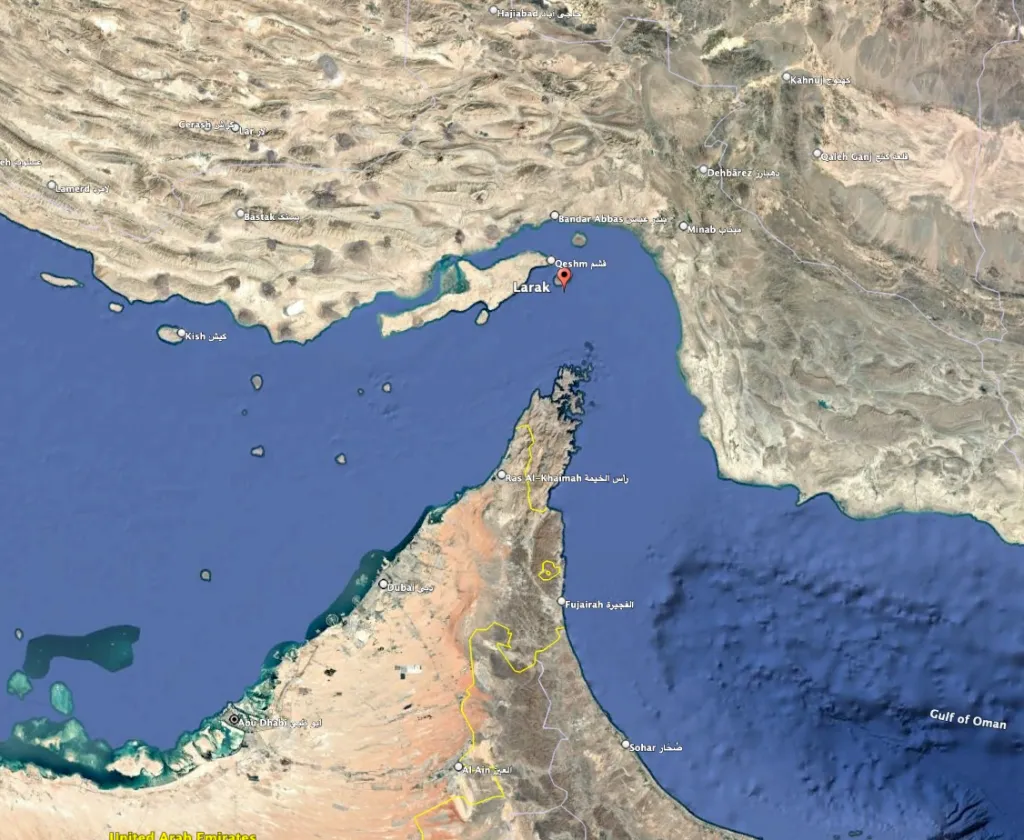
“I can confirm that earlier today U.S. forces struck two Iranian launchers on Larak Island,” Navy Capt. Tim Hawkins, CENTCOM’s spokesman, told us Sunday evening. “Islamic Revolutionary Guard Corps forces were observed preparing to launch rockets with sea mines into the Strait of Hormuz.”
Larak Island. (Google Earth)
The U.S. strikes against the launchers on Sunday spurred Iran to respond with ballistic missile attacks on a Jordanian air base housing U.S. troops. Jordanian officials said all eight missiles were intercepted, and no casualties or damage was inflicted.
Jordan’s @ArmedForcesJO say air defense systems intercepted eight missiles that entered the Kingdom’s airspace early Monday.
The military said the missiles were destroyed before posing a threat to civilians or property.
📍 Details:
🔹 A…
— Dana Zureikat Daoud دانا زريقات (@DanaZkat) August 31, 2026
Hawkins did not specify what exact type of rocket launcher was struck or whether this was the first time CENTCOM had seen Iran use this type of system to launch sea mines.
Though CENTCOM won’t comment on what kind of system was attacked, Iran did tout just this kind of a system last year with exactly the kind of range needed to be a huge problem for the U.S. and its allies. This system uses a variant of the Fajr-5 rocket that is converted with a sea mine warhead.
You can see a video of that system below.
Video of the Iranian rocket deployed naval mine system which is claimed to be able to deploy hundreds of mines in the sea from the coast in an hour. pic.twitter.com/ba897On0nV
The clip shows the rockets being fired from a truck-mounted multiple launch rocket system (MLRS). The video later cuts to nose cone-shaped mines that appear to float on the surface above the spent missile body, however, little is known about the Fajr-5 sea mine warhead conversion process that allows them to be delivered by rocket.
We also don’t know the full extent to which Iran has developed and/or fielded this particular capability, or whether it has other options for similarly deploying naval mines by rocket. Neither Behnam Ben Taleblu, a senior fellow at the Foundation for Defense of Democracies (FDD) think tank, nor the Ambrey maritime security firm has seen any indication that Tehran has used an MLRS to launch sea mines in the past.
At the same time, “the Fajr-5 is an Iranian calling card, a 333mm caliber rocket that can reportedly travel 75 km carrying between an estimated 90 to 170 kg warhead, depending on the payload,” Taleblu, an expert on Iranian weapons systems, told TWZ.
The Fajr-5 is an established design that traces its roots back to the 1990s and has been evolving since then. “The Fajr class was initially designed as unguided artillery rockets, though Iran claims to have developed a guided version,” Taleblu added.
A Fajr-5 rocket and launcher. (U.S. Army)
In general terms, being able to seed naval mines via artillery rockets would offer several advantages for Iran, most immediately by offering an alternative to traditional maritime mine-laying platforms. The destruction of Iran’s naval forces was a top stated objective for the U.S. military during the opening phases of the conflict earlier this year. Iranian vessels, including ones capable of laying mines, were heavily targeted. Still, Iran has retained a large number of its smaller boats that can be used for seeding minefields.
Regardless of what boats they have left, mining the area that actually matters most would be impossible to do as any vessel approaching the southern coast of the Strait of Hormuz would be destroyed. It’s through these tight and complex littorals that a reduced flow of commercial vessels are still traveling, under the kinetic umbrella of the U.S. and its Gulf state allies. The Fajr-5, fired from Iranian controlled islands in the strait, has the range to land in these waterways, seeding mines without risking any boat crews or other platforms. If the rocket-delivered mines splash down, the de-mining process would have to begin, which can be arduous and last weeks, potentially shutting down all shipping.
With that in mind, Iran’s weapon is remarkably relevant to the situation, assuming it works. But even if it doesn’t, it could still pose a risk to mariners even if its efficacy is questionable.
Furthermore, being able to turn any launcher for Fajr-5s (and/or potentially ones for other types of artillery rockets) into a naval mine layer rather than having to rely on specialized systems would be a boon unto itself. Artillery rockets and launchers are something Iran had deep stockpiles of before the war with the United States and Israel started earlier this year. How many naval mine rockets Iran might have, and whether it might be possible to convert existing types to that configuration, are open questions.
Using a road-mobile launcher would also give Iranians a ‘shoot-and-scoot’ option for deploying naval mines where the launch could be exposed only for a short period of time. This, in turn, would create additional targeting challenges for U.S. forces. It is possible that, as it does elsewhere, Iran has constructed tunnels under Larak Island to hide these systems, as well.
A Fajr-5 launcher. (U.S. Army)
Overall, the “deployment of naval mines by missile significantly speeds up the deployment process, improves the ability to penetrate airspace, and increases the standoff distance between the minelayer and the field, making it the least risky minelaying method,” a piece published by the Center for International Maritime Security (CIMSEC) think tank last year, which also highlighted Iran’s apparent demonstration of the Fajr-5-based capability, noted.
While the Fajr-5’s estimated payload capacity is “light compared to U.S. or Chinese naval mines,” the mines the rockets could deliver “are still heavier than diver-delivered limpet mines and could conceivably disable a ship if struck by enough mines from the field,” the piece added. “Most importantly, this field could be delivered rapidly and with little warning. Even though the explosive capacity of this mine individually is small, the psychological impact from inflicting minor damage on a small number of merchants could still be enough to force shipping companies to avoid the area.”
“Though it’s a bit unconventional, using a rocket launcher again signals that the regime is sensitive to cost and risk, and is trying to deploy mines in a way that doesn’t put as much personnel at risk as by dropping them overboard,” Taleblu posited. “It was reported in the military exercise over a year ago that the regime had used an MLRS system like the Fajr to deploy these, but I haven’t seen significant video confirmation of this most recent round.”
With all this in mind, the point about “psychological impact” mentioned in the CIMSEC piece could be particularly relevant in this case. By launching the attacks on Larak Island, CENTCOM has in a way given credence to Iran having a real capability to launch mines via rocket into the Strait of Hormuz. That threat by itself could be enough to cause commercial ship crews, their corporate operators, and insurance companies to think twice about attempted transits.
This is exactly the issue that President Trump, among others, has repeatedly sought to downplay, including multiple times just within the past week.
“We’re taking them in,” Trump told Glenn Beck last week. “The mines are gone. You probably saw that, we put it out yesterday, all the mines. We got rid of the mines. But the strait, it’s functioning, it’s a functioning strait. Uh, yes, every once in a while, there’ll be a drone or a rocket or something shot, but it is a very functioning strait.”
President Trump Exclusive: Dolly Parton, Canada, Iran and Rise of Sharia Law | Hour 1 | 8/26/26
“Last week, CENTCOM completed clearing sea mines from the strait’s international shipping routes,” Hawkins, the CENTCOM spokesman, told us yesterday. “U.S. forces are monitoring the area closely and remain prepared to protect the free flow of commerce through this essential waterway.”
“The U.S. military has achieved a major milestone in the Strait of Hormuz,” Adm. Brad Cooper, CENTCOM’s commander, stated last week. “We have successfully cleared sea mines in the strait’s international shipping lanes that were laid months ago by Iran’s Islamic Revolutionary Guard Corps. Internationally recognized transit routes in the strait are free of Iranian sea mines, thanks to the incredible work of the U.S. military.”
CENTCOM pushed back Monday on Iranian claims that an oil tanker was hit by mines in the command’s preferred transit route.
“CLAIM: Iran’s Islamic Revolutionary Guard Corps (IRGC) claims that a supertanker passing through the southern route of the Strait of Hormuz struck two mines and was brought to a complete stop. This is FALSE,” the command stated on X. “FACT: No ships have hit mines in the Strait of Hormuz. This is yet another IRGC attempt to intimidate regional commercial shipping through disinformation.”
🚫 CLAIM: Iran’s Islamic Revolutionary Guard Corps (IRGC) claims that a supertanker passing through the southern route of the Strait of Hormuz struck two mines and was brought to a complete stop. This is FALSE.
Still, the Joint Maritime Information Center (JMIC) — a group of international navies which provides timely information to the shipping industry — sees mines as an ongoing risk in the strait.
“Commercial traffic through the Strait of Hormuz remained at reduced levels, with a modest uptick from recent lows, still far below baseline,” JMIC stated on Sunday. “Independent tracking data indicated suppression with single-digit numbers transiting in both directions. There remained a continued risk of drifting or uncharted mines in and near the TSS, with mine danger areas still active.”
The combination of ongoing dangers in the strait continues to result in reduced traffic, the global trade intelligence firm Kpler noted on X.
“Vessel traffic through the Strait of Hormuz and Bab el-Mandeb declined on 25 August, while the IMO [International Maritime Organization] verified no additional attacks,” Kpler added. “Five vessels crossed the Strait of Hormuz, down 28.6% day on day from seven. All five used the Iranian Unilateral Scheme, with two entering the Middle East Gulf and three exiting. Four were classified as shadow vessels and one as sanctioned.”
Strait crossings remain subdued
Vessel traffic through the Strait of Hormuz and Bab el-Mandeb declined on 25 August, while the IMO verified no additional attacks. Five vessels crossed the Strait of Hormuz, down 28.6% day on day from seven. All five used the Iranian Unilateral… pic.twitter.com/BI9cFAaJRy
The latest flare-up in fighting came after the Trump administration last week unleashed the threat of harsh new sanctions to further isolate Iran. However, that failed to move Tehran to change its position on maintaining control over the Strait of Hormuz, its nuclear ambitions or support for proxies like the Houthis in Yemen and Hezbollah in Lebanon.
Monday morning, Trump told Fox News reporter Trey Yingst that he was going to retaliate for Iran launching ballistic missiles last night after the U.S. strike on Larak Island.
“We’re going to hit them hard,” Trump told the network. “There will be a response.”
President Trump says the United States will respond to the Iranian missile attack on U.S. forces overnight.
“We’re going to hit them hard,” President Trump told Fox News. “There will be a response.” pic.twitter.com/sjLOLSxm4g
Trump and his senior aides “have been consideringwaging limited strikes in the Strait of Hormuzto prevent Iran from reconstituting its radar and missile capabilitiesto attack ships,” Axios reported, according to three U.S. officials.
“One U.S. official said the idea behind the plan is to reduce the risk of Iranian attacks on oil tankers, U.S. Navy ships and Air Force aircraft — to ‘mow the lawn,’ as this person put it.”
It is unclear if Iran has used rockets to mine the strait or how well this system works if it did. However, the fact the U.S. resumed hostilities just to attack sea-mine-launching rocket systems shows the level of concern they engendered and the options Iran may still have to threaten the strait.
Sept. 1 (UPI) — A North Carolina grand jury has indicted a 17-year-old girl as an adult on charges of murder stemming from allegations that she aided and abetted two other teens who killed three people in a hate-filled attack on a San Diego mosque before taking their own lives.
Caleb Vazquez, 18, and Cain Clark, 17, are alleged to have shot and killed three people, including a security guard, at the Islamic Center of San Diego in California on May 18. Their bodies were found dead from apparent self-inflicted gunshots in a car parked near the scene.
On Monday, Forsyth County District Attorney Jim O’Neil told reporters during a press conference that a 17-year-old girl was arrested last week in North Carolina and that a grand jury indicted her on three counts of first-degree murder and one count of conspiracy to commit first-degree murder, on allegations that she livestreamed the attack, disseminated the recording afterward and released the manifesto the attackers authored to justify their crime.
Court documents identified the suspect as 17-year-old Sarah Lindsey Santiago.
“Today’s indictment sends a clear message: physical distance from an attack does not place someone beyond accountability for the role they allegedly played in making it happen,” Special Agent in Charge Mark Remily of the FBI San Diego Field Office said in a statement.
“In today’s threat environment, individuals may believe they can encourage or facilitate acts of violence from hundreds of miles away without facing consequences. This case demonstrates that law enforcement will aggressively investigate those connections and pursue accountability wherever the evidence leads, including when juveniles are involved.”
According to the indictment, she is also alleged to have purchased a “Sonnenrad” patch for Vazquez, which he wore during the attack. According to the advocacy organization Anti-Defamation League, the Sonnenrad, which translates to “Black Sun,” is a symbol associated with White supremacy and was adopted by the Nazis in the 1930s.
The court document states that the conspiracy charge stems from allegations that she, Clark and Vazquez planned to murder worshipers at the Islamic Center of San Diego but also worshipers at Kehilat Ariel Messianic Synagogue, which is also in San Diego, and Black students at an unnamed public high school.
O’Neil, in the press conference, said that aiding-and-abetting charges in North Carolina come with the same penalties as if the accused had perpetrated the crime.
“So, she didn’t have to be in California. She’s in our jurisdiction. And today, a grand jury indicted her and held her responsible for her actions,” he said.
According to police, the shooting occurred at about 11:42 a.m. on May 18.
Shortly before, at about 9:40 a.m. that morning, San Diego police received a call from Clark’s mother reporting her son was suicidal and that several of her weapons and her vehicle were missing. Her son was with a companion, both dressed in camouflage, she said.
San Diego police were working to locate the teens when the first calls of the shooting at the mosque came in.
The suspects parked in the Islamic Center’s parking lot, ran past security and opened fire, hitting 51-year-old Amin Abdullah, who exchanged gunfire, wounding Clark. Abdullah has been heralded as a hero who saved lives by initiating lockdown protocols before dying from his injuries. O’Neil said there were 140 children on the premises at the time of the shooting.
The two suspects entered the building, but then exited through the back door and into the parking lot, where they encountered Mansour Kazhia, 78, and Nadir Awad, 57, whom they shot and killed.
The suspects fled the scene in their vehicle, from which they shot at a gardener who was uninjured, before dying by suicide.
Searches of residences associated with the suspects uncovered more than 30 guns and a crossbow, including rifles, along with ammunition, tactical gear and electronics.
“There exists in our world an underground subculture. It’s an echo chamber of intense hate against different cultures and religions. Cain and Vasquez, by what is contained in their manifesto, seemed to hate everyone, regardless of skin color, politics, religion or ethnicity,” he said.
“And this underground subculture of hate, they listen to each other, they talk to each other in encoded platforms. It radicalizes one another to the point where they carry out these horrific crimes of violence and murder.”