u. s. troop

Trump’s failed strong-arming of allies on Iran shows that pressure is losing its effect

We’ve long had your back, now it’s our turn. That is how the famously transactional President Trump is framing his demands that allies help him with the Iran war. He wants to call in IOUs for decades of U.S. security guarantees.

The string of refusals indicates his stock of European goodwill is low. He has put allies through the wringer since returning to the White House, bullying them over tariffs, Greenland and other issues, and disparaging the sacrifices their soldiers made alongside U.S. troops in Afghanistan.

Now he’s demanding — not just requesting — that they send warships to help the U.S. unblock the Strait of Hormuz, through which a fifth of the world’s traded oil passes — essentially mop up behind the conflagration that he and Israel ignited in the Middle East.

The reply has been a “global raspberry.”

That’s how a veteran French defense analyst, François Heisbourg, described allied responses.

No close ally has come forward with immediate help. Britain is flat-out refusing to be drawn into the war. France says the fighting would have to die down first. Others are non-committal. China, which is not an ally but was also asked to help, is ignoring Trump’s call.

“This is not Europe’s war. We didn’t start the war. We were not consulted,” European Union foreign policy chief Kaja Kallas said Tuesday.

Trump’s frustration with the ‘Rolls-Royce of allies’

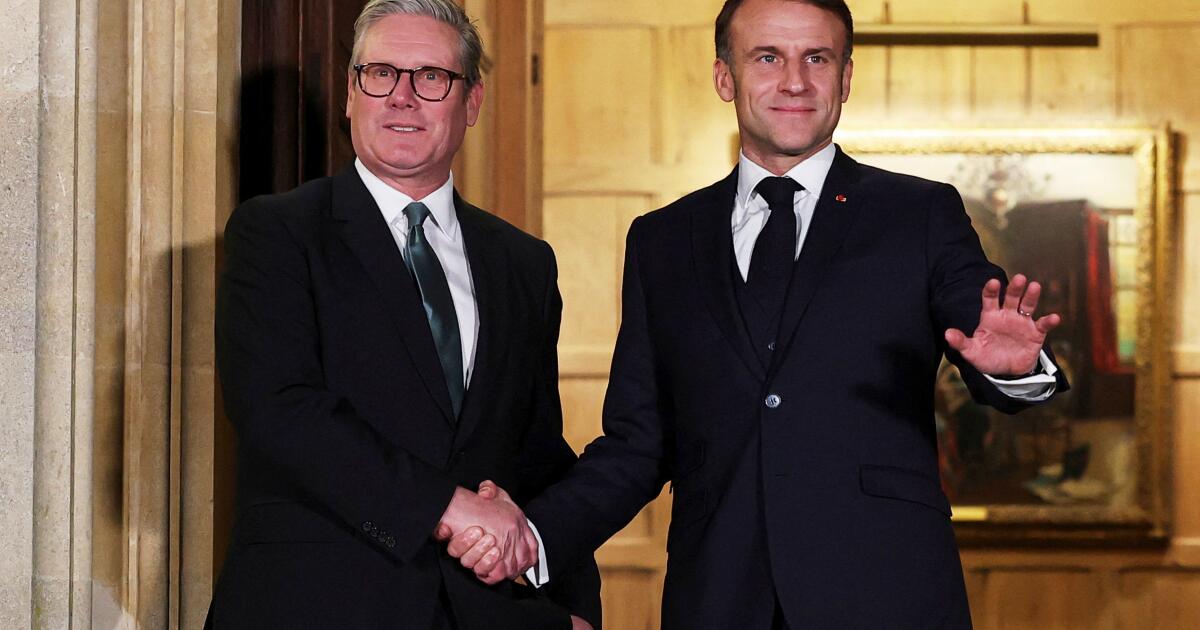
Trump has singled out the refusal from the United Kingdom. Prime Minister Keir Starmer cultivated ties with Trump and reached an early trade deal with the administration, but is now among allies who refuse to join a regional war with no clear endgame.

The U.K. “was sort of considered the Rolls-Royce of allies,” Trump said Monday, adding that he’d asked for British minesweeping ships.

“I was not happy with the U.K,” Trump said. “They should be involved enthusiastically. We’ve been protecting these countries for years.”

Starmer said Britain “will not be drawn into the wider war” and that British troops require the backing of international law and “a proper thought-through plan” — suggesting those were not in place.

He initially refused to let U.S. bombers attack Iran from British bases before accepting their use for strikes on Iran’s ballistic missile program.

Retired Lt. Gen. Ben Hodges, former commanding general of the U.S. Army in Europe, said allies are “looking at the United States in a way that they never have before. And this is bad for the United States.”

Having previously appeased Trump, some European leaders are “starting to realize that there’s no benefit or value in using flattery,” he said.

European leaders say it’s not their war

Going to war without consulting allies was in keeping with Trump’s America-first outlook.

“My attitude is: We don’t need anybody. We’re the strongest nation in the world,” he said Monday.

But failing to get an international mandate, as the U.S. did before intervening in the 1990 Gulf War, is boomeranging.

“It is not our war; we did not start it,” German Defense Minister Boris Pistorius said. “We want diplomatic solutions and a swift end to the conflict. Sending more warships to the region will certainly not contribute to that.”

French President Emmanuel Macron envisions possible naval escorts in the Strait of Hormuz — but only once fighting has died down.

“France didn’t choose this war. We’re not taking part,” he said.

After bruising tariff battles with Trump last year, the first months of 2026 have further strained alliances. Trump’s renewed pressure for U.S. control of Greenland, including a tariff threat against eight European nations, and his false assertion that allied troops avoided front-line fighting in the Afghanistan War, upset partners in the NATO military alliance.

“Allies, or at least the Europeans, aren’t willing to be at the beck and call of a demand from Donald Trump,” said Sylvie Bermann, a French former ambassador to China, the U.K. and Russia.

“And even in asking for a helping hand, he is doing so in a brutal manner, saying: ‘You’re useless, we’re the strongest, we don’t need you, but come,’” she said.

A dangerous mission

Retired naval officers say that unblocking the Strait of Hormuz with military escorts while the war rages and without Iran’s consent would be dangerous.

France, which has rushed its Charles de Gaulle aircraft carrier to the Mediterranean, is working with other countries to prepare such a mission once the air war has subsided. French military spokesman Col. Guillaume Vernet said any escorting would be conditional on talks with Iran, and Macron has publicized two calls in eight days with Iranian President Masoud Pezeshkian.

That has won points with Trump.

“On a scale of zero to 10, I’d say he’s been an eight,” Trump said Monday. “Not perfect, but it’s France. We don’t expect perfect.”

But he’s fuming at other allies.

“We will protect them, but they will do nothing for us, in particular, in a time of need,” Trump said Tuesday.

Trump has leverage, including in Ukraine

Allies in Europe and Asia need oil, gas and other products from the Middle East to flow again. That gives Trump some leverage.

Allies also know from experience that resisting Trump carries risks of retaliation.

“It really could be anything. Are the Europeans prepared for that?” asked Ed Arnold, a former British army officer and now a researcher at the Royal United Services Institute, a London think tank.

European allies need Trump’s continued blessing for U.S. weaponry, intelligence, and other support for Ukraine, as well as financial pressure on Russia. The U.S. has started to chip away at some sanctions on Moscow by temporarily allowing shipments of Russian oil to ease shortages stemming from the Iran war. Allies also want him to reengage in talks to end the war.

“That was what kept European leaders quiet for a lot of last year in the face of the rhetoric and actions,” said Amanda Sloat, a former U.S. national security adviser who now teaches at Spain’s IE University.

“It is also the thing that is making them a little bit nervous now.”

Leicester and Burrows write for the Associated Press. Burrows reported from London. AP journalists Jill Lawless in London, Lorne Cook in Brussels, Suman Naishadham in Madrid, Geir Moulson and Kirsten Grieshaber in Berlin, Simina Mistreanu in Taipei, Taiwan, and Mari Yamaguchi in Tokyo contributed to this report.
Source link

Trump urges Latin American leaders to use military action against cartels

President Trump said Saturday that the United States and Latin American countries are banding together to combat violent cartels as his administration looks to demonstrate it remains committed to sharpening U.S. foreign policy focus on the Western Hemisphere even while engaged in war in the Middle East.

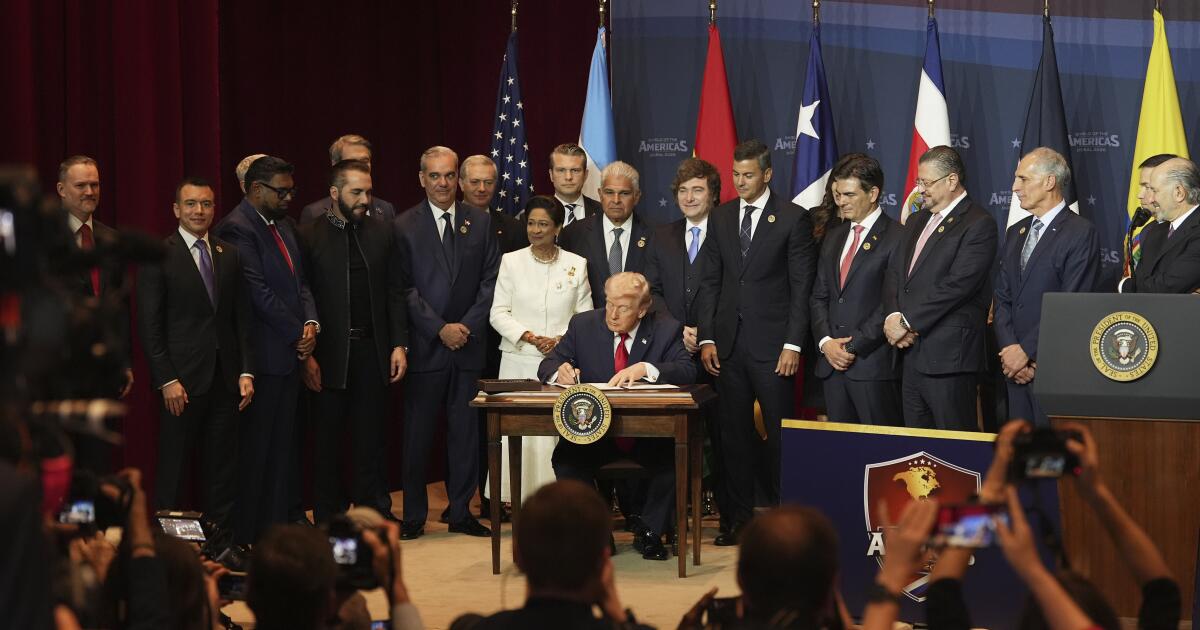
Trump encouraged regional leaders gathered at his Miami-area golf club to take military action against drug trafficking cartels and transnational gangs that he says pose an “unacceptable threat” to the hemisphere’s national security.

“The only way to defeat these enemies is by unleashing the power of our militaries,” Trump said. “We have to use our military. You have to use your military.” Citing the U.S.-led coalition that confronted the Islamic State group in the Middle East, the Republican president said that ”we must now do the same thing to eradicate the cartels at home.”

The gathering, which the White House called the “Shield of the Americas” summit, comes two months after Trump ordered an audacious U.S. military operation to invade Venezuela and capture its president, Nicolás Maduro, and whisk him and his wife to the United States to face drug conspiracy charges.

Looming even larger is Trump’s decision to launch a war on Iran with Israel a week ago, a conflict that has left hundreds dead, convulsed global markets and unsettled the broader Middle East.

Trump’s time with the Latin American leaders was limited: Afterward, he set out for Dover Air Force Base in Delaware to be on hand for the dignified transfer of the six U.S. troops killed in a drone strike on a command center in Kuwait. They were killed one day after the U.S. and Israel launched their war on Iran.

Trump called the American deaths a “very sad situation” and praised the fallen troops as “great heroes.”

With the summit, Trump aimed to turn attention to the Western Hemisphere, at least for a moment. He has pledged to reassert U.S. dominance in the region and counter what he sees as years of Chinese economic encroachment in America’s backyard.

Trump also said the U.S. will turn its attention to Cuba after the war with Iran and suggested his administration would cut a deal with Havana, underscoring Washington’s increasingly aggressive stance against the island’s communist leadership. “Great change will soon be coming to Cuba,” he said, adding that “they’re very much at the end of the line.”

Cuban officials have said on several occasions that they were open to dialogue with the U.S. as long as it was based on respect for Cuban sovereignty, but they have never confirmed that such talks were taking place.

Who was there

The leaders of Argentina, Bolivia, Chile, Costa Rica, the Dominican Republic, Ecuador, El Salvador, Guyana, Honduras, Panama, Paraguay, and Trinidad and Tobago joined the U.S. president at Trump National Doral Miami, a golf resort where he is set to host the Group of 20 summit later this year.

The idea for a summit of like-minded conservatives from across the hemisphere emerged from the ashes of what was to be the 10th edition of the Summit of the Americas, which was scrapped during the U.S. military buildup off the coast of Venezuela last year.

Host Dominican Republic, pressured by the White House, had barred Cuba, Nicaragua and Venezuela from attending the regional gathering. But after leftist leaders in Colombia and Mexico threatened to pull out in protest — and with no commitment from Trump to attend — the Dominican President Luis Abinader decided at the last minute to postpone the event, citing “deep differences” in the region.

The Shield of the Americas moniker was meant to speak to Trump’s vision for an “America First” foreign policy toward the region that leverages U.S. military and intelligence assets unseen across the area since the end of the Cold War.

To that end, Ecuador and the United States conducted military operations this week against organized crime groups in the South American country. Ecuadorean and U.S. security forces attacked a refuge belonging to the Colombian armed group Comandos de la Frontera in the Ecuadorean Amazon on Friday, authorities reported.

This joint fight against drug traffickers “is only the beginning,” said Ecuador’s president, Daniel Noboa.

Notably missing at the summit were the region’s two dominant powers — Brazil and Mexico — as well as Colombia, long the linchpin of U.S. anti-narcotics strategy in the region.

Trump grumbled that Mexico is the “epicenter of cartel violence” with drug kingpins “orchestrating much of the bloodshed and chaos in this hemisphere.”

“The cartels are running Mexico,” Trump said. ”We can’t have that. Too close to us. Too close to you.”

The challenge from China

Trump made no mention of his administration’s position that countering Chinese influence in the hemisphere is a top priority for his second term.

His national security strategy promotes a “Trump corollary” to the 19th century Monroe Doctrine, which had sought to ban European incursions in the Americas, by targeting Chinese infrastructure projects, military cooperation and investment in the region’s resource industries.

The first demonstration of the more muscular approach was Trump’s strong-arming of Panama to withdraw from China’s Belt and Road Initiative and review long-term port contracts held by a Hong Kong-based company amid U.S. threats to seize the Panama Canal.

More recently, the U.S. capture of Maduro and Trump’s pledge to “run” Venezuela threaten to disrupt oil shipments to China — the biggest buyer of Venezuelan crude before the raid — and bring into Washington’s orbit one of Beijing’s closest allies in the region. Trump is scheduled to travel to Beijing later this month to meet with Chinese President Xi Jinping.

For many countries, China’s trade-focused diplomacy fills a critical financial void in a region with major development challenges that include poverty reduction and infrastructure bottlenecks. In contrast, Trump has been slashing foreign assistance to the region while rewarding countries lined up behind his crackdown on immigration — a policy widely unpopular across the hemisphere.

Secretary of State Marco Rubio hosted the leaders for a working lunch after Trump left for the event in Delaware. The lunch gave Kristi Noem, whom Trump fired as Homeland Security secretary on Thursday, the chance to make her debut in her new role as a special envoy for the newly formed Shield of the Americas.

“We want our hemisphere to be safer, to be more sovereign, and to be more prosperous,” Noem told the leaders.

Madhani, Goodman and Richer write for the Associated Press. Madhani and Goodman reported from Doral and Durkin Richer from Washington. AP writer Gabriela Molina in Quito, Ecuador, contributed to this report.

Source link