u. s. soil

Asylum seekers may be turned away at the southern border, Supreme Court rules

Asylum seekers may be turned away without a hearing at the southern border, the Supreme Court ruled Thursday in a historic retreat from the promise of relief for those who say they are fleeing persecution.

The justices split over whether this was a simple dispute over legal wording or a moral question involving desperate families.

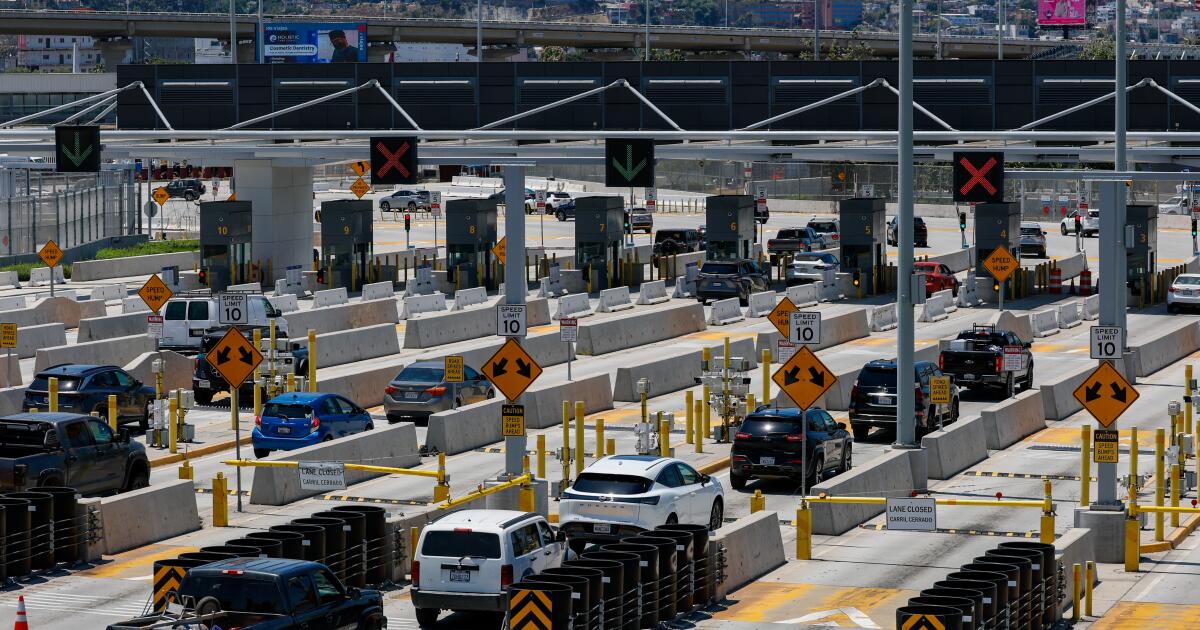
Siding with the Trump administration, the court’s conservatives said the Refugee Act of 1980 offers a right to seek asylum to migrants who “arrive in the United States” but not those who are turned back when they approach a border crossing or a port of entry.

“This case presents a straightforward question” that turns on the word “in,” said Justice Samuel A. Alito Jr. “In ordinary speech, no one would say that a person ‘arrives in’ a place — for example, a house, a city, or a country — before the person enters that place.”

The liberal dissenters agreed with immigration rights lawyers who saw this as a nonsensical reading of the law.

Justice Sonia Sotomayor said the asylum law arose from the “international moral reckoning that followed the Holocaust and World War II.”

She cited the infamous voyage of the MS St. Louis in 1939. More than 900 Jewish refugees attempted to flee persecution in Nazi Germany by setting sail aboard the ship, which was turned away from Cuba and the United States.

Most of the passengers were returned to Europe, and several hundred died in the Holocaust, she said.

“Congress passed the Refugee Act in 1980 because it did not want this country to repeat the mistakes of its past. Yet if the refugees on the M.S. St. Louis were to walk up to a port of entry on our southern border today, the majority’s interpretation would allow immigration officers to refuse even to consider their asylum applications by physically blocking them from stepping foot onto U. S. soil,” Sotomayor wrote.

Justices Elena Kagan and Ketanji Brown Jackson agreed.

The decision upholds a turn-back policy that began in 2016 as an emergency response to a surge of Haitian immigrants at the San Ysidro border crossing.

The Department of Homeland Security said these asylum seekers must wait on the Mexican side of the border until they could return for a scheduled interview. The policy was extended to other border crossings, but it was challenged as illegal in federal court in San Diego.

Last year, a divided 9th Circuit Court of Appeals ruled that those restrictions were illegal if they prevented migrants from applying for asylum.

“To ‘arrive’ means ‘to reach a destination,’” wrote Judge Michelle Friedland. “A person who presents herself to an official at the border has ‘arrived.’”

She said the “government’s reading would reflect a radical reconstruction of the right to apply for asylum because it would give the executive branch vast discretion to prevent people from applying by blocking them at the border.”

The 2-1 decision upheld a federal judge in San Diego who ruled for migrants who had filed a class-action suit and said they were wrongly denied an asylum hearing.

But Solicitor Gen. D. John Sauer urged the Supreme Court to review and reverse the appellate ruling, noting 15 judges of the 9th Circuit joined dissents that called the decision “radical” and “clearly wrong.”

The administration argued federal immigration law “does not grant aliens throughout the world a right to enter the United States so that they can seek asylum.”

From abroad, they may “seek admission as refugees,” Sauer said, but the government may enforce its laws by “blocking illegal immigrants from stepping on U.S. soil.”

Defenders of the asylum system denounced the decision.

“We believe that today’s ruling violates international law, as well as the express intent of Congress,” said Erika Pinheiro, executive director of the migrant support organization Al Otro Lado, which led the legal fight. “For decades, the United States has allowed individuals and families who are fleeing persecution, torture and death to ask for protection at U.S. borders.”

“Cruelty is not a substitute for real solutions. Blocking people from seeking asylum at official ports of entry will do nothing to fix our broken immigration system, said Rebecca Cassler, senior litigation attorney at the American Immigration Council. “It only makes things more chaotic and dangerous for vulnerable families.”

The Federation for American Immigration Reform applauded the decision.

“Our immigration laws are written to be pro-enforcement, not-anti-enforcement,” said Christopher J. Hajec, deputy general counsel of FAIR. “Because of this, courts that hamstring enforcement are often forced to violate basic logic, as the 9th Circuit did here. We are pleased the Supreme Court saw that the lower court’s reading would make immigration law incoherent, and reversed.”

Source link

U.S. players aim to build on electric World Cup win over Paraguay

The U.S. men’s soccer team isn’t only trying to win games in this World Cup. It is trying to win hearts and minds as well.

“We want the game to grow,” star midfielder Christian Pulisic said. “We want to get Americans excited to watch this game, to watch our team. That’s obviously a big goal of ours. And being successful would give that the best boost.”

The Americans certainly got a great start Friday, opening the second World Cup played on U.S. soil with a dominant 4-1 win over Paraguay. It was one of the most complete performances the American men have had on the sport’s biggest stage, with Folarin Balogun scoring twice, Pulisic setting up two goals, and just one momentary lapse on defense separating goalkeeper Matt Freese from a shutout.

The U.S. passed well, defended well and, most important, was clinical and dangerous in front of the net, finishing well.

U.S. midfielder Giovanni celebrates with Antonee Robinson and Sebastian Berhalter after scoring during a World Cup game.

U.S. midfielder Giovanni celebrates with Antonee Robinson and Sebastian Berhalter after scoring against Paraguay.

(Robert Gauthier/Los Angeles Times)

“It was a real statement,” Balogun said. “And that’s what we wanted. I’m very delighted with the overall performance.”

The effort was warmly received by a sold-out crowd of 70,492 at SoFi Stadium, with record-setting crowds watching on TV throughout the country.

Fox Sports announced 15.99 million watched the win, making it the most-viewed U.S. World Cup match on English-language television.

And the Spanish-language broadcast drew a total audience of 8.9 million across Telemundo, Peacock and Telemundo’s streaming platforms. It was the most-watched U.S. World Cup match on Spanish-language television network platforms, harking back to the 1994 World Cup, the first played in the U.S. that also attracted record TV audiences.

At 38, captain Tim Ream is the only member of the team who was alive in 1994, but he and his younger teammates repeatedly have been reminded of the impact that tournament had on soccer in the U.S. That 1994 team won just one game, though, scored just two goals and didn’t make it past the round of 16.

This team is convinced it can do better — on and off the field.

Fans cheer after U.S. beat Paraguay to open the World Cup Friday at SoFi Stadium.

Fans cheer after U.S. beat Paraguay to open the World Cup Friday at SoFi Stadium.

(Kelvin Kuo/Los Angeles Times)

“It’s trying to be an inspiration for the next generation and grow the game,” midfielder Tyler Adams said. “I think we have the opportunity to do that.”

Part of that is kick-starting the kind of interest in soccer that briefly swept the country during the first U.S. World Cup 32 years ago. And this team certainly energized fans Friday.

“Having this crowd around us, seeing the red, white and blue, it’s awesome,” Pulisic said. “It’s really pushing us forward. We just hope it continues like that.”

It will if Pulisic and Co. continue playing like that.

The U.S. controlled the ball for nearly an hour of the 90 minutes, completed more than twice as many passes as Paraguay and took almost twice as many shots. It was a game that was as attractive and inviting as it was one-sided, one that might turn the most skeptical viewer into a fan.

It was, midfielder Weston McKennie said, the kind of game that could push the U.S. closer to becoming a proper soccer nation.

American midfielder Weston McKennie out runs two Paraguay defenders during a World Cup match at SoFi Stadium Friday.

American midfielder Weston McKennie outruns two Paraguay defenders.

(Kelvin Kuo/Los Angeles Times)

“Because it’s a World Cup and it’s in America, people came out,” McKennie said. “We’re OK with that. There’s a lot of people that maybe have never come out to support us. But hopefully today, with this performance, they can connect with us.

“You feel this electricity in the stadium and the passion. That’s one thing that’s going to change soccer here.”

Pulisic and McKennie helped put the U.S. in front to stay in the seventh minute, although the goal was credited to Paraguayan midfielder Damián Bobadilla, who got his right foot in front of a McKennie pass intended for Balogun and deflected it into the net for an own goal. Pulisic made the whole sequence happen, however, pushing the ball between a pair of defenders before poking it on to McKennie in the center of the box.

Balogun scored twice in the final 20 minutes of the first half, one-timing a perfect pass from Pulisic in from the penalty spot in the 31st minute, then running on to a perfectly weighted through ball from Malik Tillman and avoiding two defenders to line a left-footed shot into the top left corner five minutes into stoppage time.

The brace was the first of Balogun’s international career and came in his World Cup debut before a crowd of family and friends, a cheering section he saluted from behind the goal line after scoring.

“I had to sort through a lot of ticket [requests.] It’s a dream night, you know? I’ve not been able to take it all in,” said Balogun, whose brace marked the first multigoal game by an American in the World Cup since 1930.

And that wasn’t the only history the U.S. made Friday. Defender Chris Richards, whose status for the opener was in doubt after he tore two ligaments in his left ankle a month ago, completed all 83 of his passes, the most without a miss in a World Cup game since 1966.

Mauricio pulled one of those goals back for Paraguay in the 73rd minute, before Gio Reyna closed the scoring with his first World Cup goal deep in stoppage time.

Pulisic, who said he took a kick to his left calf in the first half, was replaced by Sebastian Berhalter to start the second. Pulisic showed no signs of injury while talking with reporters after the match, and coach Mauricio Pochettino is hopeful the injury will not limit Pulisic during the next match Friday against Australia.

For the U.S., the commanding win over Paraguay was just the start. The best, the players promise, is yet to come.

Fans fill SoFi Stadium during the U.S. World Cup win over Paraguay on Friday.

Fans fill SoFi Stadium during the U.S. World Cup win over Paraguay on Friday.

(Kelvin Kuo/Los Angeles Times)

“Today was a great starting point for us,” McKennie said. “But we know that’s just a start and this is something we don’t want to over-celebrate. Because we want this to be the normal for us.

“We have two more games to go in the group. Hopefully we improve.”

Added Pulisic: “There’s so much more we want to accomplish.”

And not all of that will take place on the field.

Source link

SoFi Stadium workers vote to authorize strike ahead of World Cup

Nearly 2,000 food and beverage workers at SoFi Stadium voted overwhelmingly Friday to authorize a strike just a week before the venue will stage the first World Cup game on U.S. soil in more than three decades.

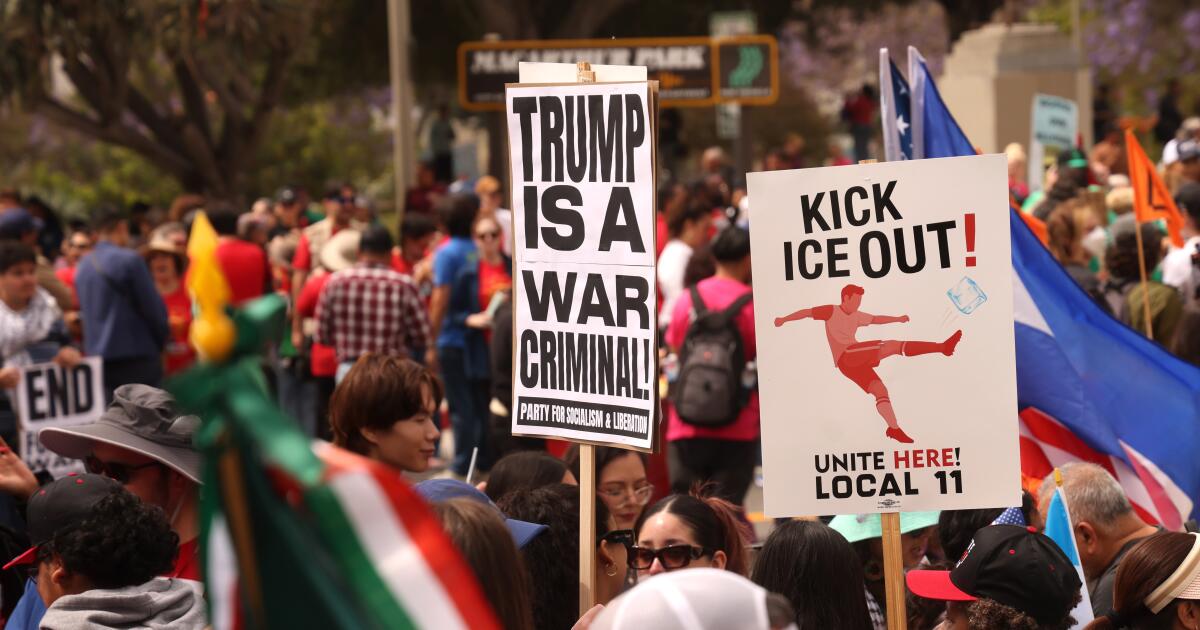
Negotiations on a labor contract between Unite Here Local 11, the union representing the cooks, dishwashers, concession workers and bartenders at SoFi and, Legends Global, the stadium’s food-service operator, are expected to continue Monday despite the vote. But Kurt Petersen, the union’s co-president, said if an agreement isn’t reached workers will walk off the job and the 70,000 fans arriving for the June 12 match between the U.S. and Paraguay will be greeted by hundreds of picketers.

Union members have been working without a contract for a year and Petersen said Unite Here is demanding salary increases, protection against subcontracting and job loss through automation, and are protesting the collection of sensitive private information such as nationality and home addresses that FIFA, organizer of the World Cup, said it needs to accreditate workers.

Workers are also demanding the right to walk off the job if federal immigration enforcement enters the stadium and creates a reasonable fear for their safety. Ninety-six percent of the vote was in favor of strike authorization.

Legends Global, the stadium’s food-service operator, responded to the vote with a statement.

“Legends Global has presented progressive wage proposals to Unite Here Local 11 throughout our negotiations and remains confident an agreement is within reach,” it read. “While we expect a contract will be finalized in time, a contingency staffing plan is in place to ensure seamless operations and no disruption to fans. We remain committed to delivering an outstanding hospitality experience at the FIFA World Cup matches.”

That contingency plan would involve hiring replacement workers who would have to undergo the same detailed accreditation procedures demanded by FIFA, plus job training. SoFi Stadium is scheduled to play host to eight World Cup matches, including two of the U.S. team’s three group-stage games. The first of those is on June 12 when the U.S. faces Paraguay in its World Cup opener.

Petersen said the union is looking for “substantial increases” in hourly pay, to more than $30 an hour. Legends’ most recent proposal calls for wage freezes for some workers and a 25-cent hourly increase for cooks and dishwashers, the union said.

But perhaps the biggest sticking point is FIFA’s demand for workers’ sensitive personal information, including Social Security numbers and fingerprints, to process background checks. Under California privacy laws, workers have the right to know exactly what personal information their employer collects, how it will be used, and who it will be shared with. Local 11 said its members fears such information, if collected, could be made available to the Department of Homeland Security and ICE.

According to Petersen, when workers were originally hired by Legends they submitted the documentation necessary for employment, and under the current collective bargaining agreement the company does not have the right to request it again for FIFA.

FIFA has refused to comment on the contract talks, saying they are “between Legends Global and Unite Here Local 11.” But its insistence on collecting personal information is something Legends cannot address during contract talks, which makes a resolution impossible.

FIFA said it was partnering with the governments of the U.S., Canada and Mexico, the three countries in which the 39-day tournament will be played, “to enhance safety and security of all workers, staff, team members, vendors, journalists, volunteers, and spectators by mitigating potential insider threats. … Such name checks do not constitute pre-employment checks.”

All data collected during the name-check process, FIFA said, will be processed “in accordance with applicable data protection and privacy laws, and will be deleted by FIFA as soon as it is no longer needed for purposes of adjudicating requests for credentialed access to FIFA-controlled spaces.

Source link