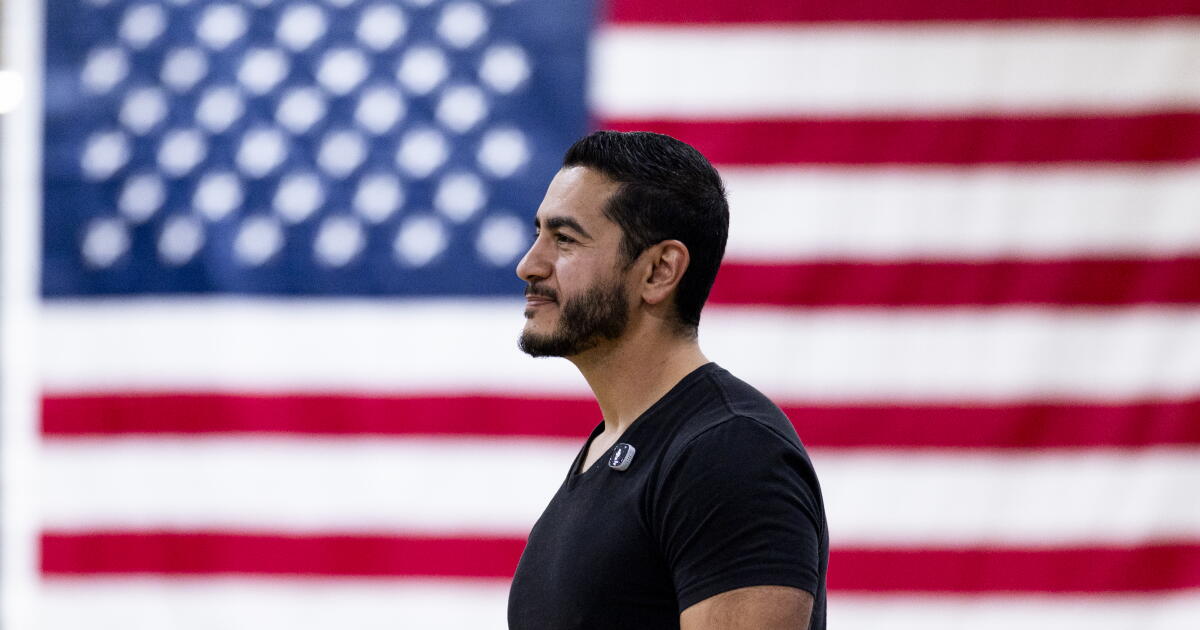
Muslims have always had to prove our Americanness. Enter Abdul El-Sayed
Michigan’s Democratic candidate for the U.S. Senate, Abdul El-Sayed, is many things to many people.
He represents change, part of a new generation of outspoken leaders who aren’t afraid to challenge the status quo.
He represents possibility: As the son of Egyptian immigrants, his trajectory is the American dream realized.
And he represents a threat to those who fear that his Muslim faith means he can’t possibly love America. El-Sayed is a handy bogeyman for Republican politicians who seek to scare their constituents into voting for them instead of the foreboding Arab name on the ballot.
But for people like me — American Muslims, or anyone with roots in the Middle East, North Africa, South Asia or other Muslim-majority regions — El-Sayed embodies the exhausting experience of having to explain yourself over, and over, and over …
We know what’s truly going on when someone discovers our lineage, then apropos of nothing asks, “How do you feel about the Oct. 7 Hamas attack?” In previous eras it was, “What are your thoughts about 9/11? The Iranian hostage crisis? The PLO?”
Regardless of the decade, the underlying question was the same: How American are you, really?
For generations, the insinuation has been that your loyalty lies somewhere else and that you have a predisposed soft spot for groups such as ISIS or Al Qaeda. Beneath that Taylor Swift-loving exterior, there must be a Bin Laden fighting to get out.
It was disappointing but hardly surprising when El-Sayed was asked at a recent town hall in Caro, Mich., if he would “disavow the Muslim Brotherhood.”
The questioner, who identified himself only as Tommy, was referring to a century-old Islamist movement with branches that have been designated as terrorist organizations by various countries and U.S. administrations.
It’s worth noting that El-Sayed was born and raised in Detroit, not Egypt or Jordan. He attended the University of Michigan medical school, not a radical madrassa, and received a Rhodes Scholarship to Oriel College, Oxford, where he completed a doctor of philosophy in public health (not bomb making).
El-Sayed answered the question without hesitation. “Sure, yeah, absolutely,” he said, then swiftly turned the tables and began interrogating the motives of his interrogator.
“You’re asking the question because implicitly, you assume that I’ll have dual loyalties, right?” El-Sayed said. “You assume that I wouldn’t disavow, or that I’ll have some higher order allegiance than to the Constitution, correct? Tommy, is that what you imply?”
The candidate spent four to five minutes laying bare the political motives behind what was clearly designed to be a “gotcha” moment.
His opponent in next month’s election, former Rep. Mike Rogers, has claimed without evidence that the Muslim Brotherhood funds El-Sayed’s campaign and that his family members have terrorist links. The attacks are on brand with a wider Republican strategy around sinking El-Sayed. Fearing a blue tsunami might flip the crucial swing state, Rogers and his allies have leaned heavily into Islamophobic attacks against the progressive Democrat.
It’s a campaign tactic endorsed at the highest levels. President Trump has referred to El-Sayed as a “radical jihadist” and claimed he is associated with the Muslim Brotherhood, mispronounced his name, infused it with nonsensical babble and called him “Muhammad Al-Fayad.” Trump has defended his racism by stating: “I’m the president. I can call him whatever the hell I want.”
El-Sayed preferred to talk about another president while addressing Tommy’s question at the town hall. He recalled that John F. Kennedy faced similar scrutiny during his 1960 presidential campaign when asked whether his Catholic faith would make him loyal to the pope and Vatican rather than the U.S.
“His answer, famously, was that he was not running to be a Catholic president,” El-Sayed said. “He was running to be president that happened to be Catholic. I’m not running to be a Muslim senator. I’m running for the U.S. Senate and happen to be Muslim.”
The standoff between El-Sayed and Tommy (who has since been outed as Thomas Teepell, the son of a Republican strategist and a former staffer to Republican Sen. Josh Hawley) has gone viral and is now being referred to as a 2026 election Rorschach test because both the right and left believe they prevailed.
It’s unclear to me how anyone might see El-Sayed’s evisceration of Teepell’s means-to-an-end question as a victory for the right. Perhaps it comes from eight years of watching Barack Obama weather insidious and overt racist attacks with the patience of a Shaolin monk. El-Sayed reacted, therefore they won?
On the left, El-Sayed’s articulate defense was widely applauded, but there were still criticisms that he may have come off as condescending. Liberal podcasters and influencers opined that El-Sayed should have just let it slide — for the 1,000th time.
Such an easy solution when it comes from those outside the sphere of suspicion.
But the reason we’re even having this conversation is because El-Sayed is challenging the norm. His rise to a formidable candidate who is willing to publicly dismantle loaded questions like Tommy’s represents progress wrought by successive generations of immigrants who’ve had to explain themselves ad nauseam.
Our parents and grandparents went out of their way to avoid those kinds of questions by taming their accents, changing their hard-to-pronounce names or eating their “ethnic” lunches outside the break room. The hope was that they’d melt into the proverbial pot with as little friction as possible.
My father, who emigrated from Iraq, did what all his Arab friends did here in L.A. — fit in. They used Brylcreem to tame their thick hair, listened to Johnny Cash and used terms like “guys and gals” as if they’d just stepped out of an Elvis movie.
As the next generation, I made it a point to openly embrace what my dad often downplayed — that we are Arab and Muslim. But given the post-9/11 climate, it came buffered with calming disclaimers: We are not a threat. Al Qaeda does not speak for Islam. And dolma is delicious, dammit.
El-Sayed’s refusal to brush off questions aligning him with terrorists may or may not cost him the election, but it’s a victory for all of us who’ve been defusing suspicion since we were kids.
The clip from the town hall ends with El-Sayed asking Thomas if he’s a Christian who has tried to live by Christian doctrine. Thomas affirmed. Then El-Sayed asked, “Do you disavow any attempt to read any religious doctrine into the laws of our country?” Thomas responded, “I do not.”
El-Sayed replied, “I think it’s you who needs to understand the Constitution, not me.”