The shy 9-year-old Nathan Negrete doesn’t naturally gravitate toward the spotlight, but as Negrete stood with Weston McKennie in front of the roaring 74,904 fans at SoFi Stadium, he smiled.
Looking back nearly a month later, the Pico Rivera resident doesn’t remember much of the U.S. men’s national team win over Paraguay, getting overwhelmed by the experience. But he remembers what McKennie told him — something Negrete decided should be kept secret despite a large smile on his face.
“The best day ever,” he said of the experience. “Because I went to the World Cup.”
Quaker and Common Goal partnered with FIFA to select children and young adults to escort teams out onto the pitch before kickoff. Negrete, who attends Rio Vista Elementary, was one of the lucky few who joined the U.S. team before its 4-1 win over Paraguay. It was a joyous start to a tournament run that would eventually end in the Round of 16.
A fan of both the U.S. and Mexico, Negrete started playing soccer at 4. His mother, Monica Ocampo, and his father, Jonathan Negrete, were both soccer fans, and they encouraged him to play as a striker. After his practices, though, Negrete would step into the goal and block his teammates’ shots. And once he strapped on the gloves officially, his parents couldn’t convince him to leave the net.
But there wasn’t anything quite like the experience of stepping out in front of the roaring crowd. Even as the city prepared to host the World Cup, as nearby restaurants hung banners to attract pedestrians and watch party notifications flooded social media, Ocampo said she wasn’t prepared for the impact of watching her child take the field with the national team.
The family held a 15-person watch party, just not for the actual game — for her son. The Telemundo broadcast zoomed in on Negrete and McKennie. For a couple of moments, Negrete scanned the stadium seriously, but then he looked up to see himself and McKennie on the SoFi Stadium video boards. So, he smiled.
“I cried,” Ocampo said. “His dad looked like he wanted to cry when he saw him.”
Messages from friends and family flooded her phone as the rest of the people who knew Negrete realized he was on the broadcast. Was that Nathan? Was that your son? Negrete took on a new nickname after his appearance: “Famous Nathan.”
As Nathan drove home with his mom, he still couldn’t believe what had happened. It took a few days for him to take it all in, and once he started talking about it, not a lot could stop him. The one priceless memory he kept with him was simple:
“‘I really want to be a professional soccer player now,’” Ocampo remembers her son saying in the car ride home. “Actually being there, seeing the field, actually living it, that’s one thing he told me that night: I really want to be a professional.”
He wouldn’t be the first. Graham Zusi, who played for the U.S. men’s national team between 2012 and 2017, participated in the 1994 World Cup opening ceremony as a 7-year-old. And even now, Negrete is using his experience to fuel his dreams of playing professionally, revisiting the YouTube video of the experience again and again.
“Hopefully one day he gets there, but wherever his life takes him, just for him to see that experience, it’s something he’s never going to forget,” Ocampo said. “Even now, sometimes we talk about him like I can’t believe he actually did that.”
Steve Cherundolo, who took LAFC to two MLS Cup finals in four years as manager, was named Thursday as head coach of the U.S. Under-23 Men’s National Team that will compete at the 2028 L.A. Olympics.
A three-time World Cup veteran and member of the National Soccer Hall of Fame, Cherundolo, 47, had 30 caps with three U.S. junior teams before making his senior debut in 1999. He went on to play 87 times for the senior national team and played 15 seasons at Bundesliga club Hannover 96, making 415 appearances.
Cherundolo, who grew up in San Diego, transitioned into coaching in Germany at the youth level, then returned to the U.S. in 2021 to lead the Las Vegas Lights, then LAFC’s affiliate in the USL Championship. A season later he replaced Bob Bradley as the head coach at LAFC.
In his first season in MLS, he guided the club to an MLS Cup victory and won the Supporters’ Shield, breaking the record for most victories by a first-year manager with 21. He also had the most wins (29), most points (96) and best winning percentage through 50 games of any coach in league history, won a U.S. Open Cup and took LAFC to the CONCACAF Champions Cup final before leaving the club last November, saying he was returning to Germany with his family.
“Throughout his career, Steve Cherundolo has been a proven winner, an elite talent developer, and a great ambassador for American soccer,” Dan Helfrich, U.S. Soccer’s chief operating officer and the man who led the coaching search, said in a statement. “The 2028 Olympics present a critical platform to develop our next generation of players.”
Cherundolo’s main responsibility as the new head coach for the U.S. U-23 Men’s National Team will be to build a roster for the 2028 Summer Olympics.
“Representing the United States at the Olympic Games is one of the greatest honors in sports, and I’m grateful for the opportunity to lead this team,” Cherundolo said in a statement. “I believe we have an exciting group of players with tremendous potential, and I’m looking forward to building an environment where they can challenge themselves, grow together, and represent our country with pride.
“Our responsibility is to compete with courage, humility, and a clear identity, one that reflects the values of U.S. Soccer and gives our supporters a team they can be proud of.”
The problem is, having our President butt in here was a joke. Unfunny and out of bounds, offsides, an own goal — all of the things.
It put the U.S. team at the center of a geopolitical maelstrom, which is exactly what they did not need in the hours before the biggest match of their lives and the biggest match in the history of the U.S. men’s soccer program.
Some 40 or 50 million viewers were expected to tune in; how many of them watched for the first time? And what sort of impression did Monday’s 4-1 blunder-filled meltdown against Belgium make? That we stink at soccer — still?
If you were one of them, please, believe your soccer-fan friends when they tell you the Americans played much better in previous matches.
But so much for a magical run. On their home turf, the Americans pulled up lame before the finish line (aka, for the U.S. team’s purposes, its first quarterfinals since 2002).
To their credit, after the debacle, members of the U.S. team didn’t complain about anything being rigged. They didn’t use the distraction as an excuse. And they didn’t point fingers at anyone — anyone at all.
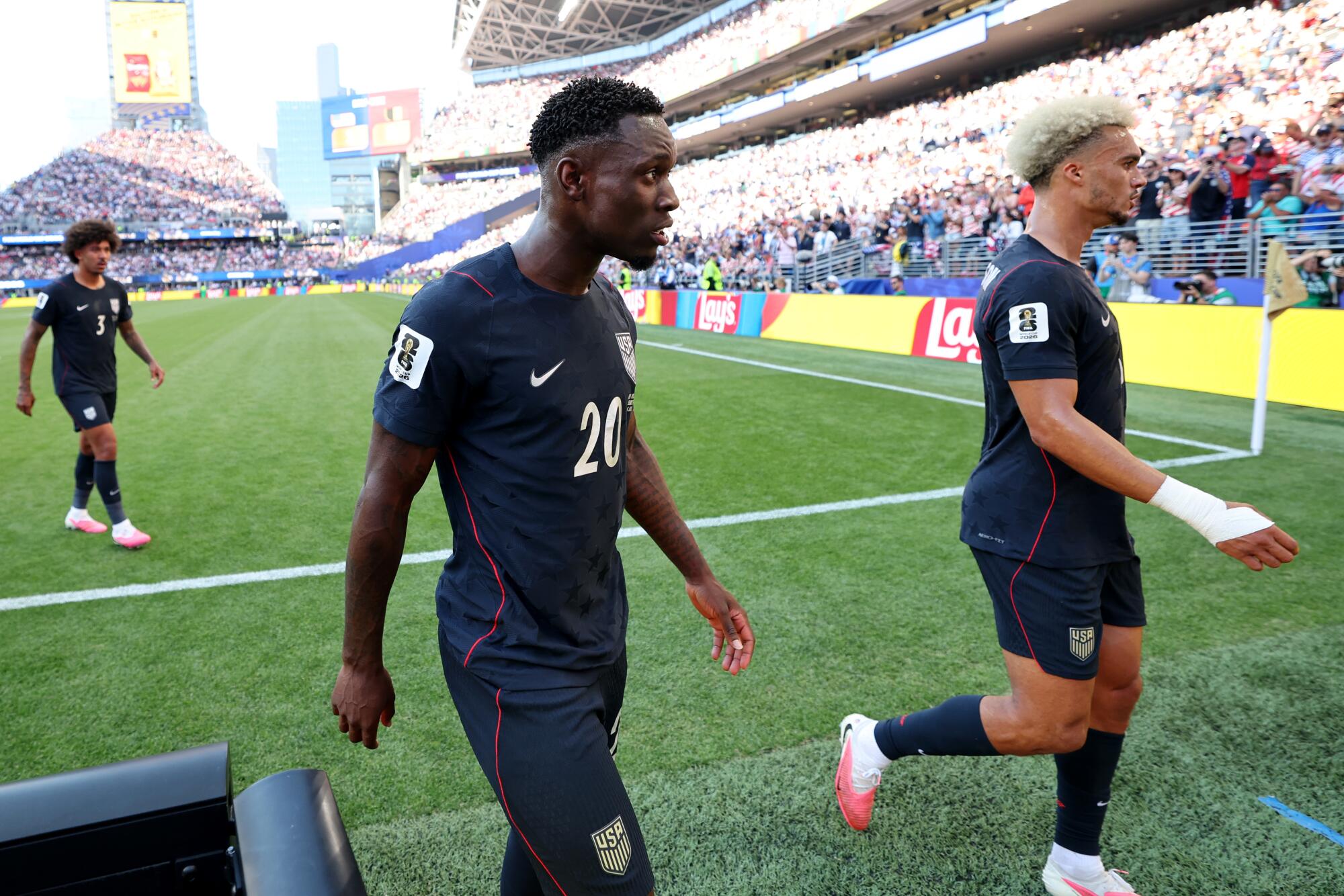
U.S. striker Folarin Balogun (20) walks to the locker room at halftime against Belgium in the World Cup on Monday at Lumen Field in Seattle.
(Allen J. Schaben / Los Angeles Times)
“We’re playing on home soil,” defender Chris Richards said. “So the only pressure we put on ourselves is to perform for our country, and ultimately didn’t feel the way we wanted to today. But I don’t think the antics of the last 24 hours had anything to do with it.”
No, they said the “debate,” or “outside noise” or “political manipulation” — as Tim Ream, Alex Freeman and coach Mauricio Pochettino described what others are calling “Balogate” — were not to blame for the gut-punch that answered the question: Why not us?
Because the U.S. is not yet good enough to beat the world’s great teams. Especially not when their pregame preparation includes having to try to block out an international uproar.
To have any hope against the Belgians in the round of 16 — a matchup between FIFA’s Nos. 9- and 17-ranked sides — the Americans needed to be going full-tilt, to be focused and ferocious and probably also a little bit lucky.
Instead, they looked shook, rattled. And they got rolled.
They were the worst version of themselves at the worst time, which was so weird from a team that had been on its front foot from the first whistle against Paraguay.
Not Monday. Against Belgium, they were on their heels from the outset. Heavy touches, slow afoot, playing like they had the weight of the World Cup on their shoulders.
And all that White House maddening meddling — for what?
Balogun started and played most of the match, but it could just as well have been reserve striker Ricardo Pepi. Or you or me, Balogun was that ineffective.
His play of the day came postmatch, when he approached Belgian coach Rudi Garcia and the two had a respectful exchange. A real diplomat, that Brooklyn-born, Britain-raised American by birthright.
This loss was a real team effort, of course. Christian Pulisic came off in the 59th minute after twisting his right ankle — leaving this World Cup without a goal in the four matches he appeared.
Matt Freese, the Harvard-educated starting goalkeeper, had a brain cramp of epic proportions when he stepped outside of the box and failed to corral a ball. Belgium’s Charles De Ketelaere kicked it loose and set up Hans Vanaken, whose shot traveled behind Ream for an easy score that made it 3-1 in the 57th minute.
There was a lot of poor decision-making with this match, on and off the pitch.
In the end, Trump’s appeal to Infantino did more harm than good. But what if some good could come from it?
Hey, FIFA, what about giving teams a process to appeal cards, like our American athletes in the NBA, NFL and MLB have?
Offering a suggestion box wouldn’t be opening Pandora’s box, not if it were a transparent and regular part of the game that would, hopefully, offer increasingly fair outcomes in a tournament where every match is so monumental — as our President recognized, much too enthusiastically.
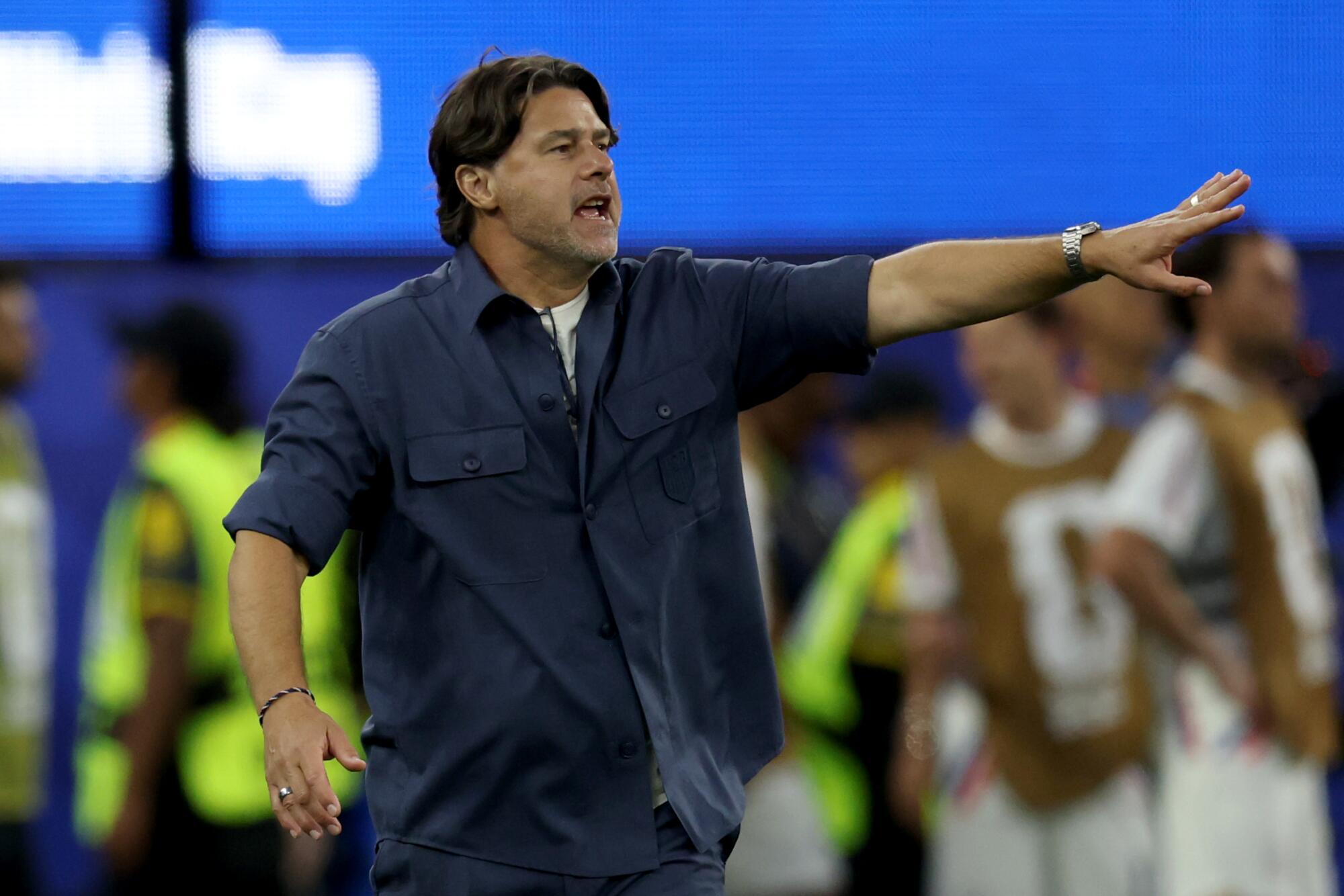
U.S. coach Mauricio Pochettino waves to the crown after a 4-1 loss to Belgium at the World Cup on Monday.
SANTA CLARA, Calif. — Mauricio Pochettino’s team continues to do things in this summer’s World Cup that no U.S. team has ever done before.
Its three wins are the most in a single tournament. So are the 10 goals in four games. It has the best goal differential ever and its two shutouts ties a record.
Yet all that means absolutely nothing to the players.
“They’re great milestones,” captain Tim Ream said. “But I don’t think anybody’s even once mentioned the different things that we’re doing. We’re focused on what we’re doing daily on the training ground, because that puts us in the best possible position to to put these performances.
“So yeah, not aware or even worried about records that we’re breaking.”
Well, except for maybe one.
With Wednesday’s gritty 2-0 over Bosnia and Herzegovina, a game the U.S. finished with just 10 men, the Americans won a game in the World Cup knockout stage for just the second time. That sends them on to a round-of-16 meeting with Belgium on Monday in Seattle where a win would be — you guessed it — historic.
“It’s cool and it’s great and it’s an accomplishment,” midfielder Weston McKennie said of the records. “But at the same time, we have high expectations for ourselves. That’s what we expect of ourselves, what we expect of our team.
“We just want to focus on Belgium now and continue to try to make history.”
That chore got a good deal more difficult because of an unwanted team record that was also set Wednesday. When Folarin Balogun scored a goal late in the first half then drew a red card early in the second, he became the first American — and third player ever — to get one of each in the same World Cup knockout game.
“Cool record,” defender Chris Richards said.
But while the goal, Balogun’s third of the tournament, proved to be all the U.S. needed to beat Bosnia, the red card — which cannot be appealed according to U.S. Soccer — means he’s suspended for the game with Belgium.
“It’s just so unfortunate, honestly,” Christian Pulisic said. “Looking back at it, it seems so harsh. I just told him he’s done so much for us, and now we’ve got his back.”
The red card came in the 64th minute with the U.S. protecting a 1-0 lead built on Balogun’s goal just before the intermission. The American striker was battling hulking Bosnia defender Tarik Muharemovic for a loose ball when he inadvertently raked Muharemovic’s right calf with his studs up, then landed on his ankle, twisting it awkwardly.
Brazilian referee Raphael Claus did not flash either card before stopping play at the behest of the video assistant referee. But after consulting a slow-motion reply, Claus gave Balogun a red card for a dangerous challenge.
“For me, never is this a red card,” said Pochettino, now the winningest U.S. coach in World Cup history. “Watching after on TV, never was [it his] intention to step up on the player. That was a normal action in football.”
Maybe. But Claus sent Balogun off just the same, leaving the U.S. to protect a one-goal advantage for the final 30 minutes while playing a man down. It was probably the sternest test the Americans have faced in the tournament.
“It would be easy to have an excuse if they did score,” McKennie said. “But that’s not the type of team we are.”
For Ream, the challenge was actually no challenge at all.
“Would it be weird if I downplayed this and said [I] wasn’t even fazed by it?” he said. “It didn’t feel like we were down a man. We were still able to carve out chances and we were still able to keep hold of the ball. Everybody knew their roles.
“It felt really calm and felt really, really easy and simple for us in that moment.”
And that allowed another hero to shrug off the pain of his own wounds and step up big.
Early in the second half a Bosnian player stomped on Malik Tillman, shredding his boot and cutting his right foot (but not drawing a red card). During the hydration break, Tillman was able to change shoes and in the 82nd minute, his white sock turning red with blood, he found himself standing over a free kick just outside the Bosnian penalty area.
“I’ve been dreaming about this game. I’ve been dreaming about, yeah, maybe taking a free kick and scoring,” said Tillman, who bent the ball off the gloved right hand of Bosnian keeper Nikola Vasilj and into the net for his first World Cup goal. “I trained for this in our practices and then it actually came true.”
So did the team’s dreams of reaching the round of 16, only now they’re arriving without their leading scorer, who will have to watch the Belgium game from the stands. Balogun’s absence, however, creates opportunity for others, with Haji Wright and Ricardo Pepi the most likely candidates to take his place.
And if this U.S. team has proven anything, it’s proven that it loves nothing more than embracing opportunities to prove people wrong.
“We’re going to miss him for the next game but we know that if it’s Pepi or Haji, whoever, is going to step up next and they’re going to do the job just as well as he did,” Richards said of Balogun. “One thing about this team is we’re really a big family and we’re shown it this whole tournament.
“Coming in, there was a lot of question marks about our whole team in general. Game by game we started to put ourselves right. Because we knew we had it the whole time.”
A bowl of lemons sits on a table in the conference room Mauricio Pochettino has turned into an office at the U.S. men’s soccer team’s beachfront resort in south Orange County. The citrus fruit, the coach believes, has the spiritual ability to absorb negative energy. On the corner of another table, the flame from a candle flickers.
“I like candles,” says Pochettino, who believes they release therapeutic fragrances and create a calming environment.
But it is the massive, blood-red mural covering the entire south side of the room that truly reveals what Pochettino believes. In the center of the wall, just behind the coach’s desk, white block letters spell out “Why Not” above a script “U.S.,” which, despite the periods, is meant to be read as “us.”
Pochettino has turned the question in a mantra for a World Cup team that has answered it with two wins in as many games and has a chance to win a third match in the tournament for the first time when it meets Turkey at SoFi Stadium on Thursday.
The idea came to him during a team meeting last November when he sensed his players had doubts about their upcoming World Cup run. So Pochettino turned those doubts into a question. If South Korea could come from nowhere and make the semifinals of the 2002 World Cup, and if Morocco could do the same four years ago in Qatar, why not the U.S.?
Why not us?
“Hey, come on, guys, are you listening to me?” Pochettino said he asked the group. “We need to believe.”
Before he could convince his players, however, he had to convince himself. And that might have been the hardest part.
The 54-year-old Pochettino is a benevolent Svengali with a whistle; Ted Lasso with an Argentine accent. Belief isn’t so much a concept for him as it is a way of life. But when he and his coaching staff took over the U.S. team in the fall of 2024, following its disastrous performance in the Copa América, he said he inherited a demoralized, dispirited group.
“We received a big bang,” Pochettino said, mimicking a punch to the face. “We were knock[ed] out for a while.”
“We were so naive,” he continued. “The situation was way worse than we really believed.”
Pochettino refused to change the system that has brought him success at European clubs Tottenham, Paris Saint-Germain and Chelsea. So he set out to change the players instead. That would take time, something he had very little of since he took over with the World Cup just 20 months away.
“It’s difficult to analyze the process, you know,” Pochettino said during an informal, 40-minute discussion at his team’s Dana Point hotel, the sun setting over the ocean through the open patio doors of his office.
“When you put the seed on the soil, [the] first seed, you don’t see nothing. Then you start to grow the tree. It was difficult to explain the plant because it’s not easy.”
The seed Pochettino planted with the national team took time to sprout. He lost five of his first 10 games, including a disastrous four-game stretch that included Nations League losses to Panama and Canada in the spring of 2025. The team’s supporters revolted, but Pochettino rejoiced.
“What happened, that was [a] good crash,” he said. “When we detect all the problems, we go for the solution. And we knew that the solution will arrive. The object is to challenge people.”
U.S. men’s soccer coach Mauricio Pochettino during the second half of his team’s World Cup match vs. Paraguay at SoFi Stadium.
(Robert Gauthier / Los Angeles Times)
So he stayed the course.
“That was the process. Now is not a coincidence,” he said of the team’s success.
Pochettino has long believed that building a roster isn’t about picking the best players, but picking the right players. Players who fit his tactical approach, players who get along with one another, players who contribute to the team chemistry.
For him, the human connection, human respect is as important — if not more important — than the ability to dribble through tight spaces. And those traits are particularly important in a World Cup since the team will spend every day together for six weeks or more.
Although Pochettino’s team includes 13 holdovers from the 2022 World Cup roster, it also includes five players who made their national team debuts in the last 18 months.
Sometimes, he concluded, it is easier to simply change the player than it is to change what the player thinks or believes. And the newbies have totally bought in.
“We’re all in total belief. We’re all totally supportive and have faith in the process that he’s been outlining,” said goalkeeper Matt Freese, who made his first appearance for the national team more than 12 months ago and now is starting in a World Cup. “Our task was to keep believing, keep working hard and keep trusting. And we did that. We fully bought into the process.”
That process has made Pochettino the first U.S. coach to win a group stage in 16 years while his two victories in as many games match Bruce Arena, the most successful World Cup coach in U.S. history, who managed eight games over two tournaments.
The lemons and candles Pochettino keeps in his office are manifestations of energia universal or universal energy, a foundational concept common to many Eastern philosophies that believe a fundamental life force connects all things. Pochettino said he has long felt this connection and it has been a foundational part of his coaching.
But it doesn’t stop with the candles and citrus fruit. Pochettino also has filled the mural behind his desk with inspirational sayings.
“The talent has brought us here, but it is heart, effort and unity that will make us unforgettable,” one reads.
“If I dream of touching the moon, maybe I can get close to it. If I only dream of getting close, I’ll stay on Earth,” another says.
Each ends with the coach’s initials, similar to the way a painter signs his portraits.
Pochettino’s faith in the power of fruit and candles and his penchant for penning aphorisms hasn’t taken away from the ferociousness of his approach to soccer. Many players say the training sessions under Pochettino — which are intricate, focused and highly physical — are frequently more intense than the games. But most also are punctuated with laughter.
“Training is still very competitive, it’s very intense,” said midfielder Max Arfsten, who made his national team debut under Pochettino last year. “That’s the culture that the coaches created. Everyone’s still trying to prove something.”
Although Pochettino has spent his life in Argentina and Europe and still splits his time between houses in Barcelona and London, flying to the U.S. for matches and training camps, he’s been a quick study in this country’s culture and quirks.
“One of the things that we really like, and we learn from you, is in the way that you approach life. It’s more casual than formal,” said the coach, whose English is still a work in progress. “People are very approachable and make you feel comfortable. That, for me, was a massive surprise. You always want to welcome people.
“Even the music, even the food. People say ‘no, Americans have crazy food.’ Yes, you have crazy food. But also you have Whole Foods. In Europe, you don’t have a Whole Foods.”
And Pochettino has adopted it all. He’s become a big fan of country artist Lainey Wilson, went to hear Teddy Swims, a uniquely American genre-blending singer, last winter in New York, and is learning the words to John Denver’s “Take Me Home, Country Roads,” the unofficial victory anthem of the World Cup team.
Perhaps more important, at times he’s taken his lemons and his candles and pushed them aside, replacing them with another distinctly American trait: the in-your-face confidence to will yourself to victory from the most hopeless situations.
It’s how Americans won at Valley Forge even before they were Americans and how they won on the beaches of Normandy when the concept of America was threatened. It’s how Americans went to the moon and invented the internet.
“We’re American. We don’t take s—,” midfielder Sebastian Berhalter said Pochettino told the team during one meeting. “Even though he’s Argentinian, he has that mindset of, ‘Look, this is what we do. This is who we are. This is what America’s about.’ Even from an outside perspective, he showed us Americans what we’re about.
“He really drills that into us.”
For decades Americans have measured World Cup success in advancing beyond the group stage. Pochettino entered this summer’s tournament predicting a run to the semifinals, runs like South Korea and Morocco made.
“When people believe in each other, impossible dreams become possible,” reads another message the coach has scratched onto the wall of his office.
Playing in goal for the U.S. men’s national soccer team is a little like playing right field for the Yankees. You’re following a long line of great players, making the comparisons — and the high expectations — unavoidable.
Matt Freese is the latest to be thrown into that crucible. But he considers that pressure to be a privilege, not a problem.
“I wouldn’t say it’s intimidating, I would say it’s inspiring,” he said before the U.S. training session Tuesday morning in Irvine. “It’s a long line of goalkeepers that I’ve looked up to for my whole life — and there were some before my life as well.”
Two games into this summer’s World Cup he’s certainly held his own with that group, giving up just one goal for a team that’s unbeaten and already through to the next round. However Thursday’s group-stage finale with winless Turkey will be far from meaningless for Freese since his first start for the U.S. came against Turkey 55 weeks ago, bringing his whirlwind international team career full circle.
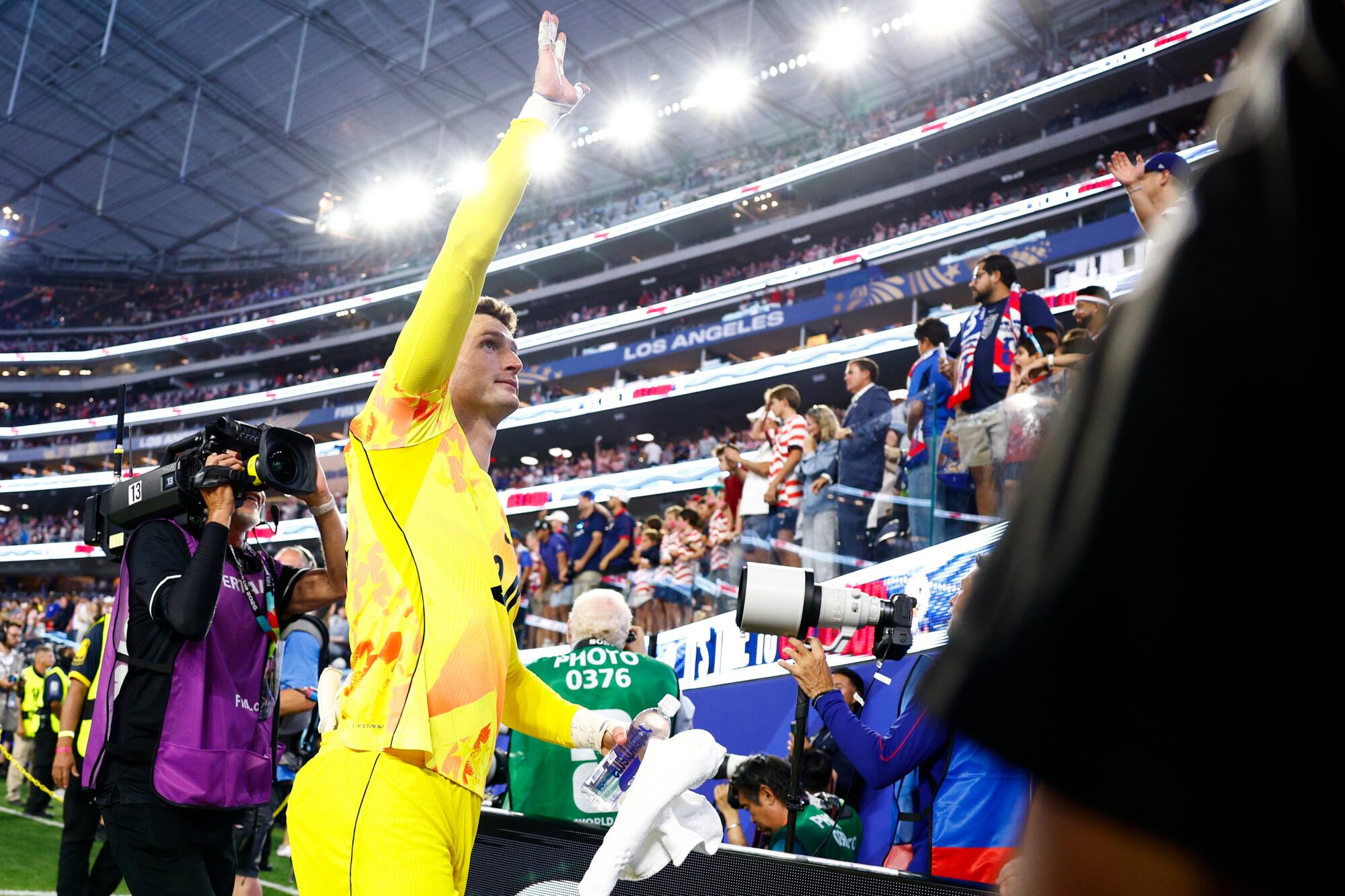
U.S. goalkeeper Matt Freese waves to the crowd after beating Paraguay during a World Cup match at SoFi Stadium on June 12.
(Kelvin Kuo/Los Angeles Times)
He lost that game but his performance was good enough to make him the starter in the Gold Cup, where he was even better. A little over a year ago he was just a faint blip on coach Mauricio Pochettino’s radar. Now he has a World Cup shutout and with another clean sheet Thursday, he’ll join Matt Turner as the only American keepers to post back-to-back shutouts in a World Cup in 96 years.
“I dreamt of this opportunity. But you never know if it’s going to come,” Freese said. “I learned the ones that work hard without the promise of reward are the ones that usually succeed.”
Turner, who gave up just a goal in the group stage in Qatar four years ago, is Freese’s backup in this tournament. And he’s just the most recent U.S. keeper to stand out in a World Cup. In 2014, Tim Howard set a tournament record with 16 saves in a knockout-stage loss to Belgium and 12 years before that Brad Friedel made six stops in a 2-0 win over Mexico to send the U.S. to the quarterfinals for the only time.
“To have my name next to theirs as the next guy up is an incredible honor, and it’s something I’ve dreamed of,” Freese said. “The bar is set high and I’m going to strive to reach that bar and raise it even higher.”
Freese, 27, took an unusual route to that bar. The son of a neurosurgeon who earned a doctorate from MIT and the grandson of scientists who immigrated from Germany after World War II, Freese grew up in a household where academics were more important than athletics. So while he joined the Philadelphia Union academy as a teen, he craved the demands of school and left soon afterward to enroll at Harvard.
“When you’re a professional athlete at age 18, 19 sometimes it can be difficult to keep a routine, keep a regimen that keeps you focused and keeps you hungry,” Freese said. “For me, taking classes was something that occupied my time, occupied my mind and gave a very natural release off the field.
“I think at that age it was necessary.”
After two seasons at Harvard, he returned to Philadelphia to sign with the MLS team while continuing to take classes online, once writing a paper on penalty-kick analytics. In 2022, he graduated from Harvard with a degree in economics.
The soccer part wasn’t going nearly as well. Playing behind Andre Blake, a three-time MLS keeper of the year, Freese rarely saw the field in Philadelphia. But a trade to New York City FC in the winter of 2023 gave him a second chance and likely saved his career.
He made the most of it, earning the starting job in his second season, when he finished third in the league in saves, and getting his first call-up to a national team training camp in January 2025.
Six months later he was the team’s starter in goal.
The late-blooming Freese’s journey was unusual in another way too since he traveled to the World Cup from MLS. In the five World Cups between 1998 and 2014, the U.S. started Friedel, Kasey Keller and Howard — three English Premier League keepers — in goal. A dozen years later, the Athletic reports, there are no American goalkeepers in the top five European club leagues and the three goalies on this summer’s roster all play in MLS.
U.S. goalkeeper Matt Freese clears the ball as Australia’s Mohamed Toure closes in during a World Cup match in Seattle on June 19.
(Maddy Grassy / Ap Photo/maddy Grassy)
However as a guy with a Harvard diploma on his resume, Freese knows enough to know that getting to a World Cup isn’t about where you came from or even how long it took you to get there. All that matters is that you made it. And now that he’s there, his job isn’t to stand out, but to blend in.
“Being a goalkeeper is recognizing that it’s not always about you. And I’m comfortable with that,” he said. “The less action I have in a game means the better that we’re playing, and the more likely we are going to win.
“So I’m typically more focused on that and preventing any shots rather than just being only ready to save them.”
The U.S. men’s soccer team isn’t only trying to win games in this World Cup. It is trying to win hearts and minds as well.
“We want the game to grow,” star midfielder Christian Pulisic said. “We want to get Americans excited to watch this game, to watch our team. That’s obviously a big goal of ours. And being successful would give that the best boost.”
The Americans certainly got a great start Friday, opening the second World Cup played on U.S. soil with a dominant 4-1 win over Paraguay. It was one of the most complete performances the American men have had on the sport’s biggest stage, with Folarin Balogun scoring twice, Pulisic setting up two goals, and just one momentary lapse on defense separating goalkeeper Matt Freese from a shutout.
The U.S. passed well, defended well and, most important, was clinical and dangerous in front of the net, finishing well.
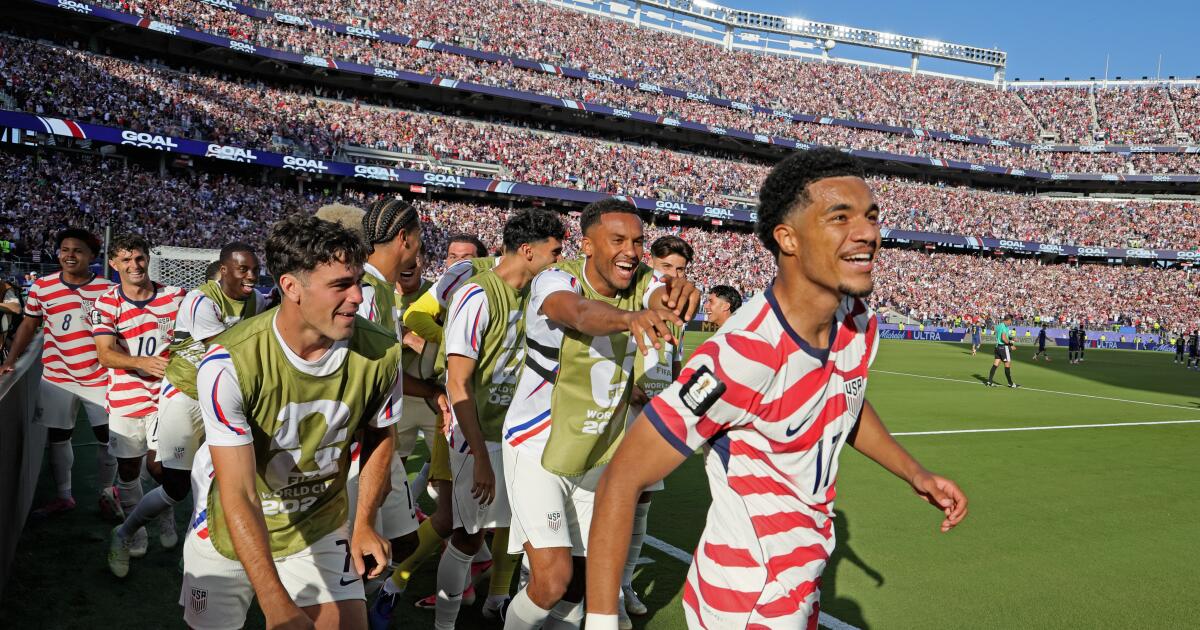
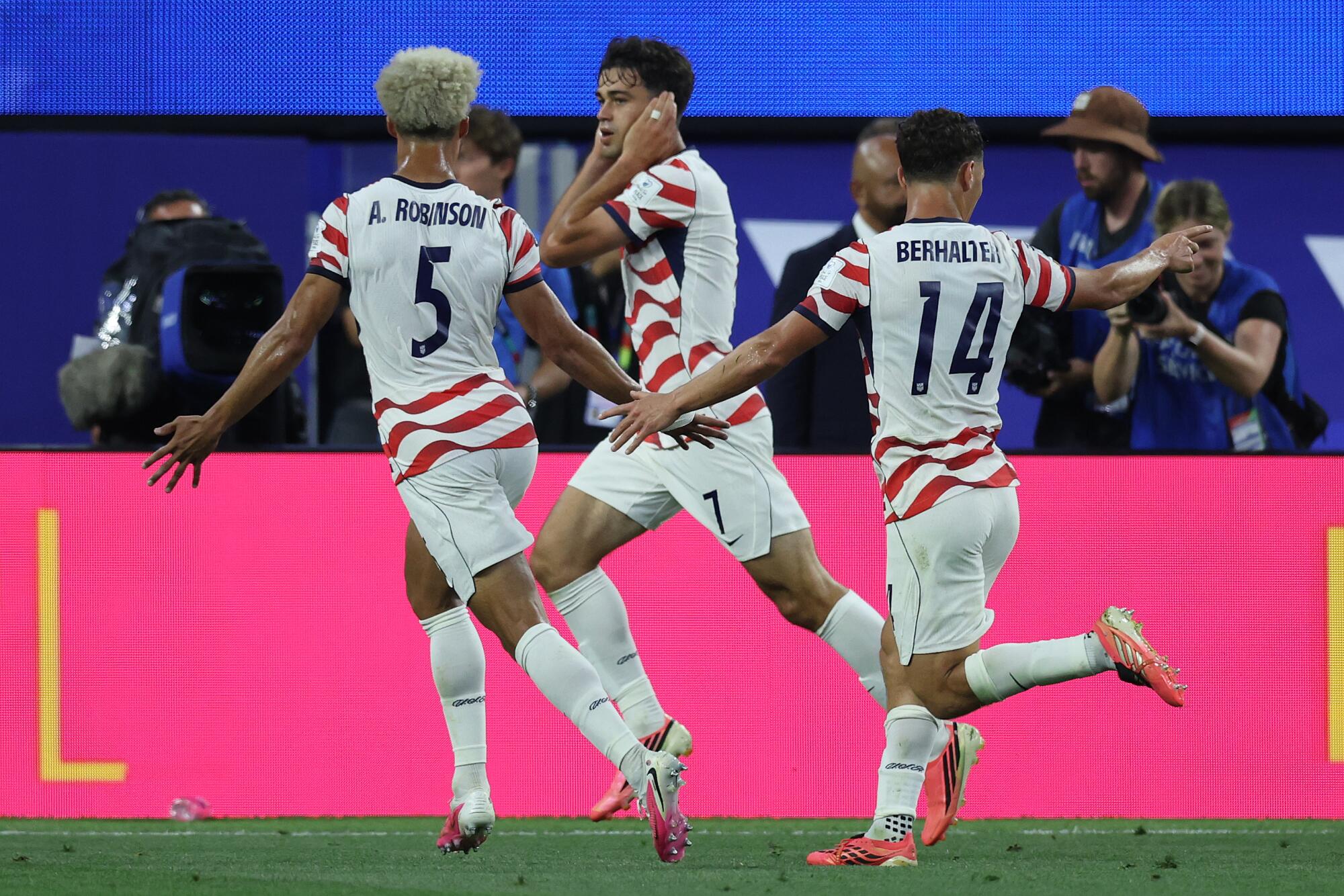
U.S. midfielder Giovanni celebrates with Antonee Robinson and Sebastian Berhalter after scoring against Paraguay.
(Robert Gauthier/Los Angeles Times)
“It was a real statement,” Balogun said. “And that’s what we wanted. I’m very delighted with the overall performance.”
The effort was warmly received by a sold-out crowd of 70,492 at SoFi Stadium, with record-setting crowds watching on TV throughout the country.
Fox Sports announced 15.99 million watched the win, making it the most-viewed U.S. World Cup match on English-language television.
And the Spanish-language broadcast drew a total audience of 8.9 million across Telemundo, Peacock and Telemundo’s streaming platforms. It was the most-watched U.S. World Cup match on Spanish-language television network platforms, harking back to the 1994 World Cup, the first played in the U.S. that also attracted record TV audiences.
At 38, captain Tim Ream is the only member of the team who was alive in 1994, but he and his younger teammates repeatedly have been reminded of the impact that tournament had on soccer in the U.S. That 1994 team won just one game, though, scored just two goals and didn’t make it past the round of 16.
This team is convinced it can do better — on and off the field.
Fans cheer after U.S. beat Paraguay to open the World Cup Friday at SoFi Stadium.
(Kelvin Kuo/Los Angeles Times)
“It’s trying to be an inspiration for the next generation and grow the game,” midfielder Tyler Adams said. “I think we have the opportunity to do that.”
Part of that is kick-starting the kind of interest in soccer that briefly swept the country during the first U.S. World Cup 32 years ago. And this team certainly energized fans Friday.
“Having this crowd around us, seeing the red, white and blue, it’s awesome,” Pulisic said. “It’s really pushing us forward. We just hope it continues like that.”
It will if Pulisic and Co. continue playing like that.
The U.S. controlled the ball for nearly an hour of the 90 minutes, completed more than twice as many passes as Paraguay and took almost twice as many shots. It was a game that was as attractive and inviting as it was one-sided, one that might turn the most skeptical viewer into a fan.
It was, midfielder Weston McKennie said, the kind of game that could push the U.S. closer to becoming a proper soccer nation.
American midfielder Weston McKennie outruns two Paraguay defenders.
(Kelvin Kuo/Los Angeles Times)
“Because it’s a World Cup and it’s in America, people came out,” McKennie said. “We’re OK with that. There’s a lot of people that maybe have never come out to support us. But hopefully today, with this performance, they can connect with us.
“You feel this electricity in the stadium and the passion. That’s one thing that’s going to change soccer here.”
Pulisic and McKennie helped put the U.S. in front to stay in the seventh minute, although the goal was credited to Paraguayan midfielder Damián Bobadilla, who got his right foot in front of a McKennie pass intended for Balogun and deflected it into the net for an own goal. Pulisic made the whole sequence happen, however, pushing the ball between a pair of defenders before poking it on to McKennie in the center of the box.
Balogun scored twice in the final 20 minutes of the first half, one-timing a perfect pass from Pulisic in from the penalty spot in the 31st minute, then running on to a perfectly weighted through ball from Malik Tillman and avoiding two defenders to line a left-footed shot into the top left corner five minutes into stoppage time.
The brace was the first of Balogun’s international career and came in his World Cup debut before a crowd of family and friends, a cheering section he saluted from behind the goal line after scoring.
“I had to sort through a lot of ticket [requests.] It’s a dream night, you know? I’ve not been able to take it all in,” said Balogun, whose brace marked the first multigoal game by an American in the World Cup since 1930.
And that wasn’t the only history the U.S. made Friday. Defender Chris Richards, whose status for the opener was in doubt after he tore two ligaments in his left ankle a month ago, completed all 83 of his passes, the most without a miss in a World Cup game since 1966.
Mauricio pulled one of those goals back for Paraguay in the 73rd minute, before Gio Reyna closed the scoring with his first World Cup goal deep in stoppage time.
Pulisic, who said he took a kick to his left calf in the first half, was replaced by Sebastian Berhalter to start the second. Pulisic showed no signs of injury while talking with reporters after the match, and coach Mauricio Pochettino is hopeful the injury will not limit Pulisic during the next match Friday against Australia.
For the U.S., the commanding win over Paraguay was just the start. The best, the players promise, is yet to come.
Fans fill SoFi Stadium during the U.S. World Cup win over Paraguay on Friday.
(Kelvin Kuo/Los Angeles Times)
“Today was a great starting point for us,” McKennie said. “But we know that’s just a start and this is something we don’t want to over-celebrate. Because we want this to be the normal for us.
“We have two more games to go in the group. Hopefully we improve.”
Added Pulisic: “There’s so much more we want to accomplish.”
With its World Cup opener just four days away, the U.S. team moved into its temporary home in Irvine on Monday, where the players found thousands of new Southern California neighbors waiting in line to watch them kick a ball.
After the U.S. announced that Orange County Great Park would be its base for at least the group stage of the tournament, the City of Irvine held a raffle for passes to see the team train in its only public workout.
Thirty-two thousand people applied and 5,500 received access on a warm Monday morning to watch the team rush through a light 45-minute practice that was notable primarily because it was the first in which injured center back Chris Richards was fully involved. Richards tore two ligaments in his left ankle playing for Crystal Palace, his English club team, on May 17 and hadn’t played or fully trained since. The team is rushing to get him ready in the hopes he can play at some point in the three-game group stage.
But the practice was also notable because it was the first at Championship Soccer Stadium, about 50 miles southeast of SoFi Stadium in Inglewood, where the U.S. will open its World Cup on Friday against Paraguay.
“[The] environment and facilities are crazy. It’s more than we expect,” U.S. coach Mauricio Pochettino said of the venue. “We are so grateful.”
Championship Soccer Stadium is owned and managed by the city, which has leased it to the Orange County Soccer Club of the second-tier USL Championship. But the club was temporarily evicted in late April to make space for the national team — which is just fine with them.
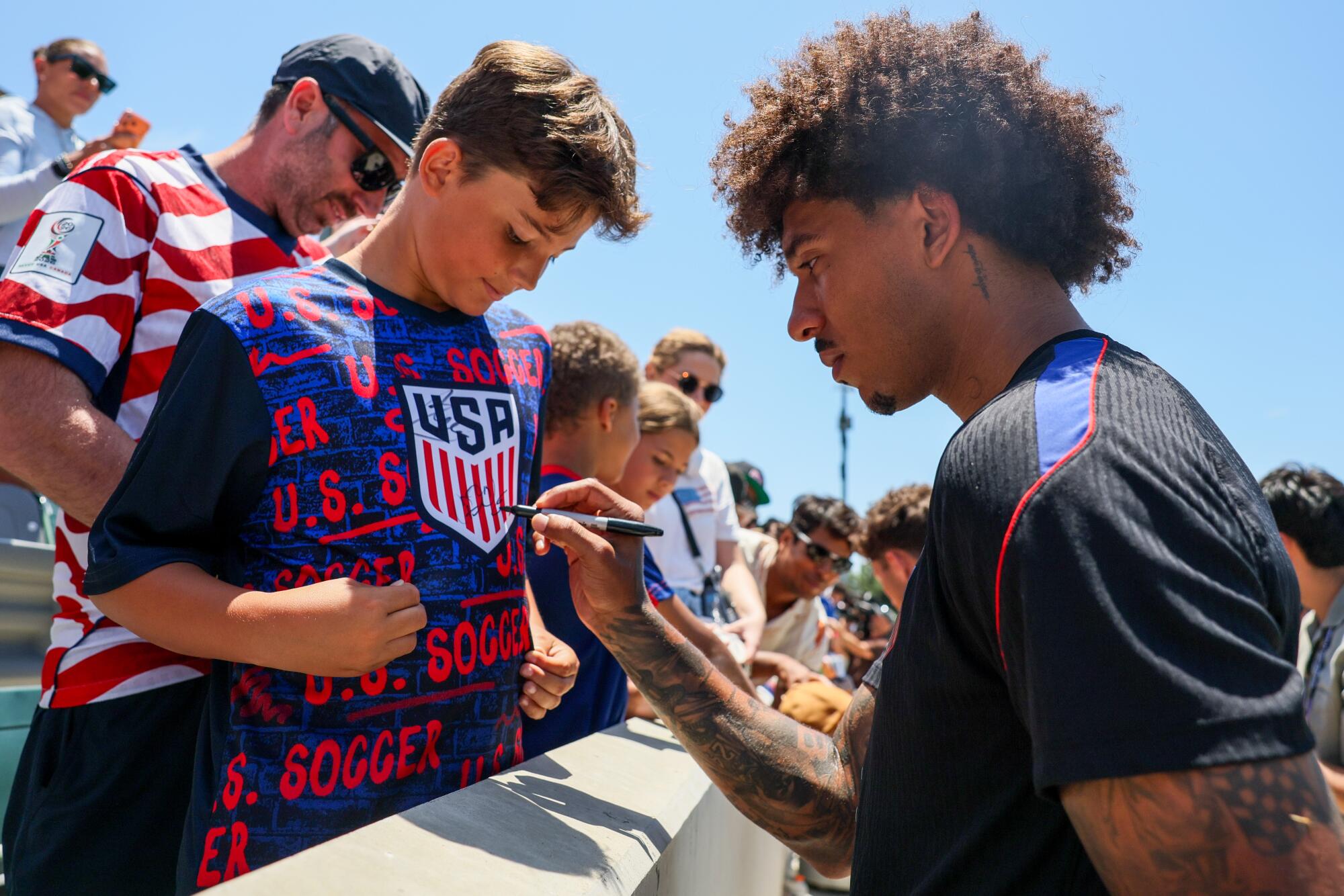
U.S. men’s soccer player Chris Richards autographs the shirt of a young fan during a team practice Monday.
(Ronaldo Bolaños / Los Angeles Times)
“How can you not be excited about the host nation training in your facility?” said Dan Rutstein, president of business operations of the Orange County club.
“We’re proud to be associated with the U.S. national team. We wouldn’t want to ever block anything, even if we could.”
(And they couldn’t, the city said.)
The Great Park is a sprawling 500-acre complex built on the site of the former Marine Corps Air Station El Toro, which closed in 1999 after 56 years training pilots for conflicts from World War II through the first Gulf War. In 2001, voters approved a proposal to convert the space into a public park and nature preserve, one which now includes, among other things, five sand volleyball courts, four basketball courts, 25 tennis courts, 12 softball and baseball fields, the ice arena where the Ducks practice and 25 soccer fields, including the pristine one FIFA just installed inside the 5,500-seat stadium.
“The idea was that this would be a quality facility, a great park that we hope will rival San Diego’s Balboa Park and other great parks across the country,” Irvine mayor Larry Agran said. “It took a lot of nurturing, a lot of time, a lot of work.”
Bringing the World Cup — or at least a World Cup team — to Irvine also took a lot of time and work. Agran said the city put out feelers about hosting a training base five years ago and made the first cut in 2024 when the Great Park was placed on a list of options distributed to tournament qualifiers.
Over the next two years, Rutstein said, about a dozen national teams sent representatives to have a look while Sam Zapatka, the operations manager of the USMNT, said he scouted 27 facilities from Seattle to San Diego. After his first visit to the Great Park, however, he said he stopped looking and in March, the team announced it would train in Irvine.
On Monday, when the players filed out of the stadium’s locker room, which FIFA expanded and upgraded, they were greeted by rhythmic clapping and chants of “USA! USA!”
1
2
3
4
1.U.S. men’s soccer player Weston McKennie takes part in a training session at Orange County Great Park.(Ronaldo Bolanos / Los Angeles Times)2.(Ronaldo Bolanos/Los Angeles Times)3.U.S. men’s national soccer team coach Mauricio Pochettino waves to fans attending practice on Monday.4.Pochettino speaks to players after drills at Orange County Great Park on Monday.(Ronaldo Bolanos / Los Angeles Times)
“I think we’ve all been, I wouldn’t say overwhelmed, but possibly surprised by the excitement and the buzz,” said captain Tim Ream, who led the team onto the field. “Pulling up here with 5,500 fans ready to watch a training session is incredible.
“We get to train in an actual stadium with a good pitch. The support, really, from all the kids out there is amazing. You want to feel like you have a good home base, right? So really, we’re looking forward to being here.”
Especially after 5,000 of your neighbors show up for the housewarming party.