Lebanon continues its gamble in U.S.-backed peace talks with Israel

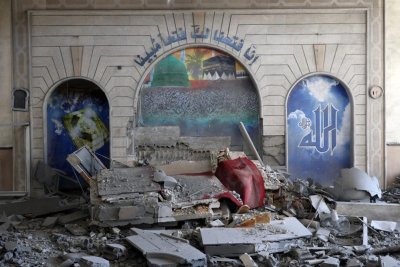
A damaged mosque is shown Wednesday, a day after an Israeli airstrike hit the village of Maashouk in southern Lebanon. According to the Disaster Management Unit of the Lebanese government, Israeli attacks across Lebanon have killed more than 3,045 people and injured more than 9,310 others since the start of renewed hostilities between Israel and Hezbollah. Photo by Wael Hamzeh/EPA
BEIRUT, Lebanon, May 21 (UPI) — Lebanon took a gamble by engaging in direct negotiations with Israel that opened the door to security and political talks. Yet, that failed to stop the fighting despite a 45-day extension of a cease-fire.
The U.S.-brokered talks emerged as Lebanon’s last resort to end the raging war between Israel and Hezbollah that broke out when the Iran-backed militant group opened a support front for Gaza on Oct. 8, 2023.
A first cease-fire was achieved Nov. 27, 2024, but it failed to restrain Israel, prompting Hezbollah to resume fighting March 2 after 15 months of inactivity as it regrouped from heavy losses.
A second cease-fire, reached April 16, was extended for 45 days Friday during the third round of Lebanon-Israel negotiations in Washington.
The new truce did not take effect on the ground, as Israel and Hezbollah continued to clash, while talks in Washington were set to proceed under fire.
Israel continued to focus largely on southern Lebanon, carrying out airstrikes and expanding its ground operations, while Hezbollah maintained its fighting with new tactics that involved fiber-optic drones and small first-person-view systems.
Riad Kahwaji, a Middle East security analyst, said the extended cease-fire does not cover areas in which Hezbollah is active, especially southern Lebanon, but applies to Beirut and other parts of Lebanon.
“It is obvious that this is being done under the pretext of allowing Israel to retain its right to act against threats from Hezbollah,” Kahwaji said.
The latest casualty count released by the Lebanese Health Ministry on Wednesday showed that 3,073 people have been killed and 9,362 wounded since March 2.
Despite Hezbollah’s rejection of direct negotiations and its insistence on maintaining its anti-Israel resistance, Lebanese President Joseph Aoun remained committed to continuing the Washington talks.
“We are proceeding with this process because there is no other option. We are betting on the U.S. to help more,” a Lebanese official source told UPI.
The source said that the U.S. officials have been showing “understanding” of Lebanon’s position, but it is yet to be seen if “they would force Israel to abide by the cease-fire and withdraw” from southern Lebanon.
Lebanon — while not ready to conclude a peace agreement or normalize ties with Israel — engaged in the negotiations with five demands: consolidate the cease-fire, secure Israel’s withdrawal from occupied Lebanese territories, obtain release of Lebanese prisoners captured during the war, enable return of displaced people to their homes and villages, and initiate reconstruction.
Lebanese and Israeli military delegations are to meet on May 29 at the Pentagon in Washington in a “security track” aimed at, as the U.S. State Department put it, “meaningfully improving communication and coordination” between the two countries under U.S. facilitation.
While Lebanon prepares its military delegation, that meeting is expected to focus on enforcing and maintaining the cease-fire through structured military coordination.
According to Lebanese retired Maj. Gen. Abdul Rahman Chehaitli, the 45-day extension of the truce was a “window of time” for Israel to end or stop its military operations and for Lebanon to build confidence in its capacity to carry out its mission in southern Lebanon.
Supporting and equipping the Lebanese Army will be part of the discussions, aimed at enabling its forces to deploy and take control of southern Lebanon following any eventual Israeli withdrawal.
“All military operations should then stop completely for the Lebanese Army to begin deploying,” Chehaitli told UPI.
In addition to creating conditions for an Israeli withdrawal, the issue of Hezbollah’s disarmament would be on the table.
Kahwaji noted that Israel and Lebanon are heading into the Pentagon meeting with their own expectations and objectives.
“Lebanon wants the army to be strengthened, but there is so far no intention to forcibly disarm Hezbollah,” he said, adding that the United States and Israel expect the Lebanese Army to handle disarmament and security in southern Lebanon once properly equipped.
If an agreement is reached, the disarmament process would not succeed without Hezbollah’s consent and cooperation.
“Hezbollah would have to inform the army of all the locations where its weapons and missiles are hidden. That would require a decision by Hezbollah’s leadership, as these are secret locations not known to many.” Chehaitli said. “If this happens, we could then say that the war in Lebanon is over.”
However, the final word remains with Iran, which has heavily financed and armed Hezbollah since its establishment in the early 1980s.
“The key is in Iran’s hands. Ending the war and Iran’s military investment in Lebanon is the necessary entry point for the negotiations,” Chehaitli said.
While Lebanon seeks to break free from Iran and has opted for U.S.-brokered direct negotiations with Israel, it is working to revive the 1949 Armistice Treaty as a basis for ending hostilities in the upcoming political track expected in early June.
According to the official source, the plan is an “Armistice Treaty Plus” with some modifications — a feasible objective that would end the state of war between the two countries and resolve their border disputes.
“The Armistice Treaty is fully valid but requires some geographical and military amendments, which are easily addressed,” said Chehaitli, who is the author of The Lebanese Land and Maritime Borders: A Historical, Geographical and Political Study.
“It is either the solution or the gateway to a solution and could be sufficient to prevent any future war.”
He said military observers from the United Nations Truce Supervision Organization — placed under the operational command of the U.N. peacekeeping force in southern Lebanon, or UNIFIL, after the 2006 Israel-Hezbollah war — would resume their primary role of observing ceasefires and supervising armistice agreements.
UNIFIL’s mandate is set to expire in January.
Such an agreement to end the war would “keep the door open for a future peace deal that could involve political and economic relations,” Kahwaji argued.
That would largely depend on Israel’s acceptance and on the U.S. acting as guarantor.
“But the U.S. has not always been an honest broker, and will always side with Israel,” Kahwaji said.