Peter Cullen, the voice actor whose regal timbre as the heroic Optimus Prime in the “Transformers” franchise and deep tone as the gloomy Eeyore in “Winnie the Pooh” projects who was beloved by generations, has died. He was 85.
Cullen died Wednesday in his Los Angeles home, his agent Kevin Motley confirmed to The Times on Thursday. A cause of death was not given.
He “passed away peacefully, surrounded by his loving family — and held in the hearts of his many friends and countless fans worldwide,” his family said in a statement. They ask “that you honor his remarkable legacy by serving your communities and leading others with compassion, integrity, and loyalty and always remember ‘be strong enough to be gentle.’ ”
A prolific voice actor whose work spanned television shows, movies, video games and even theme park rides, Cullen amassed more than 200 credits over his career. This includes the eponymous giant ape in the 1976 remake of “King Kong,” the villainous vehicle KARR (Knight Automated Roving Robot) in the “Knight Rider” TV series and the clicks and trills of the deadly alien hunter in the original “Predator” film.
But Cullen is best known for his work in animation and children’s cartoons in the 1980s and ‘90s.
His signature role was Optimus Prime, the leader of a heroic faction of sentient alien robots known as Autobots who battle the villainous Decepticons in the “Transformers” franchise. Cullen often spoke about how his voice for the leader — who transforms into a truck — was inspired by his older brother, Larry, a Marine who had served in Vietnam.
On the day of his “Transformers” audition, Cullen had mentioned to Larry, his roommate at the time, that he was on his way to try out to be the voice of “a hero truck.”
Larry responded, “Well, if you’re gonna be a hero, be a real hero. Don’t be a jerk … Be strong enough to be gentle. Be understanding. Be compassionate, and be able to kick ass — in a good way,” Cullen previously told The Times.
“He said it in a voice that was subdued and calm,” Cullen continued. “He’s 13 months older and 6 inches taller. Made of steel. He was my hero. [His words] weighed heavily on me. So I’m at the audition reading the breakdown of the character and what I have to say in the audition. I can just feel Larry’s words coming out of my mouth. So, I took his sound — my first words were, ‘My name is Optimus Prime.’ ”
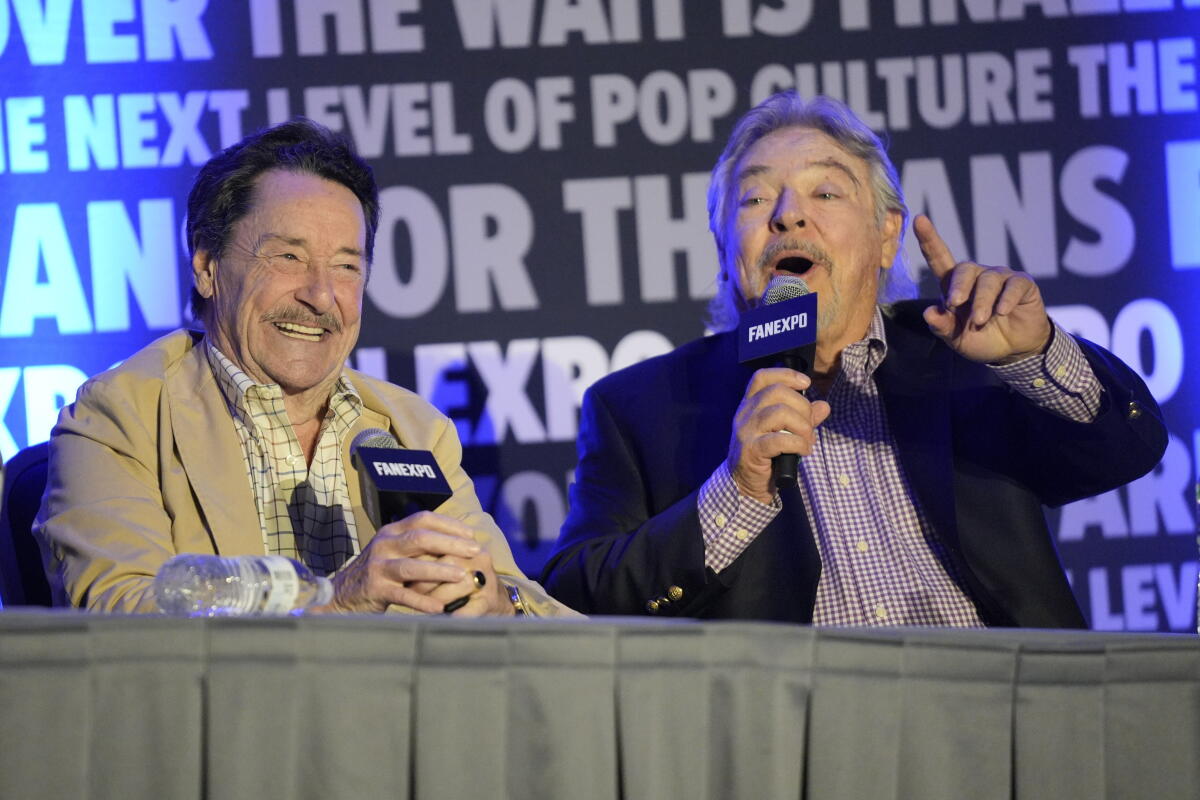
“Transformers” voice actors Peter Cullen, left, and Frank Welker at the 2024 Comic-Con Fan Expo in Rosemont, Ill.
(Rob Grabowski / Invision/Associated Press)
Cullen originated the role in the 1980s animated “Transformers” series, referred to by fans as “G1” or “Generation 1.” The era also includes the big-screen “The Transformers: The Movie” (1986), which featured the beloved character’s controversial death, but the character eventually returned after fan outcry.
He told NPR that returning to play Optimus Prime in these films was “like slipping into an old pair of shoes that you hid in the back of your closet.”
Cullen was nominated for a Daytime Emmy for his work as Optimus Prime in the TV series “Transformers: Prime” in 2011 and won a Lifetime Achievement Award at the Children’s and Family Emmy Awards in 2023.
Peter Claver Cullen was born on July 28, 1941, in Montreal, to American parents Henry and Muriel Cullen. One of four children, he graduated from the National Theatre School of Canada in 1963. He later did Shakespeare for a summer in Stratford, Ontario, before working for a year at the Crest Theatre in Toronto as a member of the repertory company, according to the Hollywood Reporter.
He told NPR he discovered his talent for doing different voices while working on a farm as a child and imitating animals.
Besides Optimus Prime, one of Cullen’s favorite roles was Eeyore, the endearing but pessimistic donkey from “Winnie the Pooh.” Cullen first voiced the character in “The New Adventures of Winnie the Pooh” series, which aired from 1988–1991. He continued his work as Eeyore through numerous franchise installments, including “The Tigger Movie” (2000), “Piglet’s Big Movie” (2003) and “The Book of Pooh” series.
“I enjoyed doing Eeyore because he was simply charming,” Cullen said to NPR. “And I get an awful lot of reactions from, especially, young kids, when I go up and just say [in Eeyore’s voice], ‘Hello. Thanks for noticing me.’ And to see their faces light up, that to me is one of the great joys.”
Cullen is survived by his four children, Angus, Claire, Pilar and Clay, according to the Associated Press.
Stephen King’s epic novel “It” injected a devilish twist on the traditionally joyful image of circus clowns with his introduction of Pennywise, a deadly clown who feeds on children. The murderous entity has earned iconic status in pop culture thanks to its central role in “It,” “It: Chapter Two” and HBO’s “It: Welcome to Derry.”
But though Bill Skarsgård’s eerie portrayal of Pennywise in the films and TV series has won high acclaim, it’s Tim Curry’s Pennywise in the 1990 ABC miniseries “It” that is considered by some horror buffs to be the most iconic version of the creature — or at minimum, the most memorable.
Curry, who died Tuesday at 80, made a gleefully evil turn as a clown that sparked nightmares for legions of Gen X and millennial viewers that continue to haunt to this day. His Pennywise is among the career-defining roles that showcased the actor’s uncanny ability to morph into a villain, whether it was as Dr. Frank-N-Furter in “The Rocky Horror Picture Show,” the Lord of Darkness in “Legend” or Rooster Hannigan in “Annie.”
Curry’s performance is even more impressive given his limited screen time — his scattered appearances as Pennywise total less than 20 minutes over a three-hour running time. But he makes all of his brief scenes count, whether he’s in a storm drain, emerging from the drain in a shower room or standing in a marsh, and his gravelly voice layers a number of chilling moments.
The two-part adaptation of “It” aired on ABC in November 1990, and drew a huge audience, attracting a reported 30 million viewers. The project starred several top stars of the time, including John Ritter, Richard Thomas, Tim Reid, Annette O’Toole, Harry Anderson and Dennis Christopher. Curry’s on-screen credit reads “special appearance.”
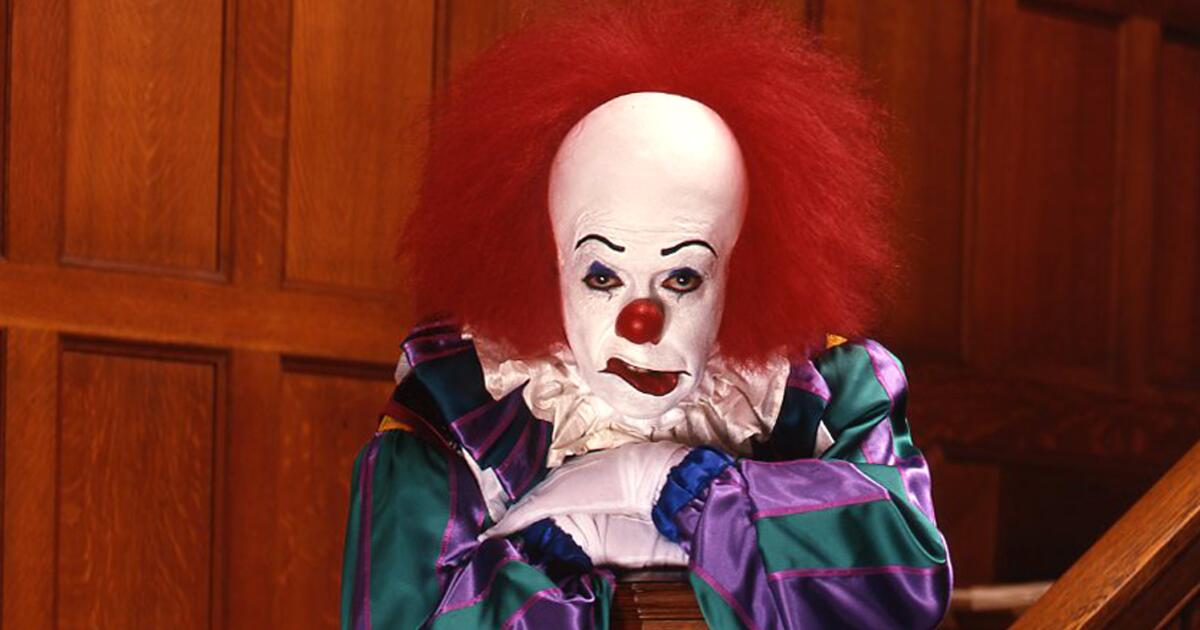
With a massive shock of red hair, bone-white makeup and oversized brow, Curry looked like a hellish Bozo the Clown. He would charm his victims with light banter and offers of a balloon before moving in for the kill, armed with a deep guttural voice and razor-sharp fangs.
In one of the series’ most terrifying scenes, Pennywise comes to life inside a black-and-white photo of Derry 200 years ago when it was a mining town. As the young members of the Losers Club look on in horror, the clown addresses them directly with a lethal glare.
“I am every nightmare you’ve ever had,” he tells them. “I am your worst dream come true. I’m everything you ever were afraid of.” A gloved hand comes out of the picture to grab them.
In a later confrontation, Pennywise tells the youths, “You all taste so good when you’re afraid. I am the eater of worlds, and of children.”
Dolly Parton, the singer and songwriter from Locust Ridge, Tenn., who willed herself into being the very symbol of country music stardom, has died in Nashville.
Parton died peacefully Tuesday, her nephew Bryan Seaver announced in a press release shared with The Times. Seaver also announced her death in a video shared to the singer’s Instagram page. She was 80.
The fabled entertainer died after a series of health issues that led her to postpone several performing commitments. In September 2025, she missed the announcement of a Dollywood attraction to recover from a kidney stone. Later that month she delayed her residency at Caesars Palace — her first residency on the Las Vegas Strip in more than 30 years — due to unspecified “health challenges.”
Over the course of a flamboyant 50-plus-year career as a songwriter, recording artist, actor and businesswoman, Parton reinvented the American success story through a combination of grit and wit, faith and sex appeal, virtuosity and plainspokenness, empathy for the human condition and plastic surgery.
She seized on the roles that American culture allowed for women in the spotlight — waif, trollop, fallen woman, country girl in over her head — and played them to the hilt, achieving artistic and financial heights few female performers have ever reached. By the time of her death, she was said to be one of the few things that Americans of most every persuasion could agree on.
One of the most honored musicians in modern history, Parton earned 10 Grammy Awards, two Academy Award nominations, a Primetime Emmy, 10 Country Music Assn. awards, and in 1999 she was enshrined in the Country Music Hall of Fame.
In 2005 President George W. Bush presented Parton with the National Medal of the Arts, and a year later she was given a Kennedy Center for the Arts Award for her lifetime contribution to the arts. Parton logged some 25 gold or platinum records and 25 No. 1 songs on the country chart. Parton also won a Liseberg Applause Award, the biggest prize in the theme park industry, for her fabled tourist attraction Dollywood.
Parton’s rags-to-riches tale reads like a classic country music story-song. But before it became mythical, it was only incredibly hard.
Dolly Rebecca Parton was born in Locust Ridge, Tenn., in the Great Smoky Mountains, on Jan. 19, 1946. Her father was a tobacco sharecropper and she was the fourth of 12 children. In her autobiography, “Dolly: My Life and Other Unfinished Business,” Parton related how her parents were so poor they paid the doctor who delivered her with a sack of cornmeal.
Raised in a one-room cabin with no electricity, she listened to the Grand Ole Opry on a battery-powered radio. When she was 7 she started writing songs; a year later she picked up the guitar. At 10 she was singing on a Knoxville radio and TV program, “Cas Walker Farm & Home Hour.”
The Parton family was musical, and there were always banjos, fiddles, mandolins and guitars around the cabin. Her voice, a birdlike soprano with an animated trill, hadn’t changed much from her youth: “I sound like a little girl singing all these Lord-awful songs,” she told “Fresh Air’s” Terry Gross in 2001.
On a Friday night in 1964, Parton became the first in her family to graduate from high school. The next afternoon she was on a bus heading for Nashville, targeting a career in country music.
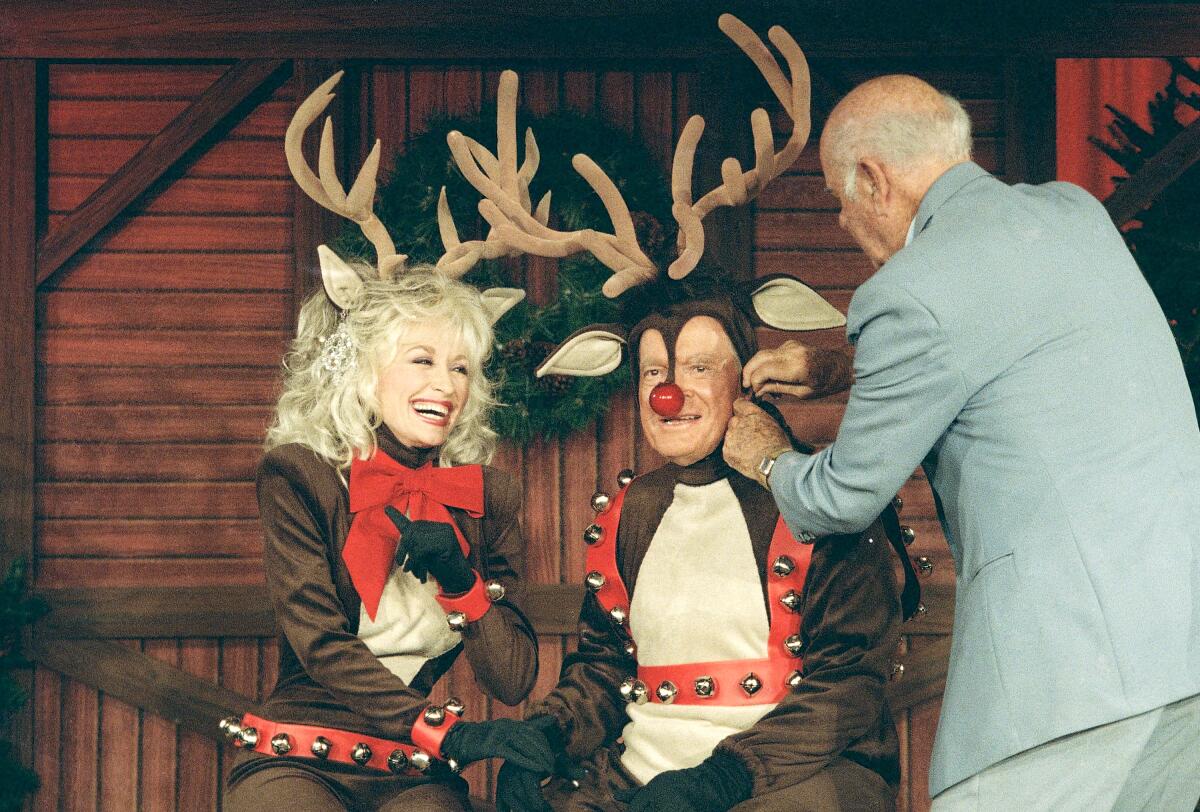
Bob Hope gets an adjustment to his reindeer costume as he and Dolly Parton prepare to tape a 1988 Christmas special on a cruise ship docked in Miami.
(Kathy Willens / Associated Press)
Women had little real power in Nashville at the time, and though rural women were a growing part of the country music audience, they were marginalized as artists. Parton signed to the Monument label, but felt that they wanted a pop singer more than they wanted her. An early breakthrough came when singer Bill Phillips heard a demo version of her “Put It Off Until Tomorrow”; not only did he want to record the song, but he recorded it with Parton singing harmony on it. The song went to No. 6 on the country chart in 1966.
In 1967 she recorded Curly Putman’s “Dumb Blonde,” her first charting song as a singer and a savvy choice that spoke to her as both an image and as flesh and blood, as she sang:
Just because I’m blond Don’t think I’m dumb ‘Cause this dumb blond ain’t nobody’s fool
Nashville noticed. That year, country music star Porter Wagoner was looking for a new “girl singer” for his popular TV show, after Norma Jean left. Parton got the gig, and for weeks, legend has it, was greeted by the studio audience shouting “Norma Jean” when Parton opened her mouth. It was the kind of challenge she lived for. Carefully deferential to the star, Parton carved out a foothold for herself.
They were a complicated team. Tall, gaunt and calculating, Wagoner’s angles had angles, but somehow standing next to her, his pompadour dwarfing her considerable bouffant, it worked. At their peak, they had a weekly TV viewership of over 3.5 million, and recorded numerous hit duets, “Holding on to Nothin” (1968), “If Teardrops Were Pennies” (1973) and “Please Don’t Stop Loving Me” (1974) among them.
On her solo recordings at the time, Parton included a raft of songs about poor children in trouble. These gothic, occasionally autobiographical compositions, including “Coat of Many Colors,” “My Blue Ridge Mountain Boy,” “Evening Shade,” “Daddy Come and Get Me” and “Down From Dover,” would have been more than enough to make her, if not a star, at least a country music legend. But the kind of attention even her lesser work with Wagoner enjoyed continued to elude her own material.
Dolly Parton and Kenny Rogers laugh together backstage at an April 2010 show honoring her “Islands in the Stream” singing partner.
(Rick Diamond / Getty Images)
By 1973, Parton realized that if she was going to be her own star she would have to be on her own. Wagoner fought and threatened, and finally, Parton wrote a song as a way to help him understand both her gratitude and her need for independence, “I Will Always Love You.” He liked the song, but it didn’t convince him. Wagoner sued her for $20 million over breach of contract and settled for $1 million.
But Parton had won her freedom, and she made the most of it. Her album from that year, “My Tennessee Mountain Home,” was a reintroduction to her audience, an autobiographical cycle of songs telling the story of a singer leaving home to make it on Music Row. And in 1974, “Jolene” became her chart-topping breakthrough.
The title was the name of a red-haired, green-eyed young fan Parton met signing autographs, and the story of a woman begging a rival to leave her man alone. Parton said she made it up after discovering a bank teller had a crush on her husband. With a beveled chord progression and a haunting repetition of the name, it became perhaps her most requested song, and was covered by many, including the White Stripes, Candi Staton, Reba McEntire and Olivia Newton-John.
“I wanted to be seen, I wanted to be recognized, I wanted to be a star,” she explained. The last part was now coming into focus.
In 1976 she hosted a short-lived variety TV series, “Dolly!” Her name was her brand, and so, too, was her profile: the full bosom and tiny waist, platinum wig and baubles like sprinkles on an ice cream cone, 5 feet tall standing in five-inch heels. She was a disarming contradiction: manufactured and utterly sincere.
“A country girl’s idea of what glamour was,” she explained.
“I didn’t have any money to have stuff and I’ve often joked about it, but it’s the real truth that I patterned myself after what they considered the trash in our hometown.” She took shame and made it a flag, one big enough for all sorts of Americans to settle beneath.
Dolly Parton checks out an exhibit honoring her life and career at the Country Music Hall of Fame and Museum in May 2025.
(Jason Kempin / Getty Images)
Building on her fame, in the mid-’70s Parton decided to reinvent herself by reaching beyond the confines of country music. She signed with L.A.-based talent manager Sandy Gallin, who had made Mac Davis a country crossover star and would soon work with Cher and Michael Jackson.
Parton laid off her longtime Traveling Family Band and sought out musicians and songs that were more purely pop. Hits that followed included “Here You Come Again” (No. 20 on the pop chart, 1977), “Heartbreaker” (No. 37, 1978) and duets with Kenny Rogers like “Islands in the Stream” (No. 1, 1983).
The pop move was muttered over and seen by gatekeepers as a rejection of Southern-based authenticity. It was the era of “Urban Cowboy” and purity was being policed. “I love country music. It’s my first love,” she told the SoHo News. “But it was confining. You can only go so far in a circle.”
The movie “9 to 5” from 1980 settled her broadening stardom; acting alongside Jane Fonda and Lily Tomlin in a comedy about three office workers who get even with an abusive boss, Parton charmed viewers. It was her first acting role, and Roger Ebert called her “a natural born movie star.” She wrote and sang the movie’s theme song, which topped Billboard’s pop and country charts.
Dolly Parton and her “9 to 5” castmates Jane Fonda, left, and Lily Tomlin assemble at a 1980 news conference to promote the movie.
(Wally Fong / Associated Press)
Parton would go on to act in “The Best Little Whorehouse in Texas” (1982), “Rhinestone” (1984), “Steel Magnolias” (1989), the “Hannah Montana” TV series (she was Miley Cyrus’ godmother in real life too), and in many more films and TV shows. But her biggest cinematic moment came with a song she’d written years before; “I Will Always Love You” was sung by Whitney Houston in the 1992 film “The Bodyguard,” turning her air kiss to Porter Wagoner into a No. 1 hit for 14 weeks.
In the mid-1980s, Parton suffered a number of setbacks. She experienced depression. “I was just broken down,” she said later. In 1982, abdominal pain and bleeding forced her to cancel a tour, and in 1984 she had a partial hysterectomy. There were bouts of binge eating, and when she hit bottom she considered suicide. A series of conversations with God were instrumental in her recovery, Parton said.
Underscoring her connection to her origins while also illustrating how far she had gone, in 1986 she bought an old amusement park in Pigeon Forge, Tenn., and reinvented it as Dollywood, a booming theme park, resort and theater. Other businesses included Sandollar Productions, a film and TV company. In the 1990s Parton formed her own label, Blue Eye Records.
Success meant she could settle into being Dolly. A trio of beloved bluegrass albums, “The Grass Is Blue,” “Little Sparrow” and “Halos & Horns,” around the turn of the millennium reestablished her as a performer with extensive roots in rural America. She recorded with everyone from Linda Ronstadt and Emmylou Harris to Ladysmith Black Mambazo. Her 2019 cover of John Hiatt’s “Faith,” made with Swedish duo Galantis, topped the EDM charts.
She embraced her Christian and LGBTQ+ fans, and perhaps no American artist had more of each. Inclusivity mattered to Parton. She was an icon to the LGBTQ+ community. In 2002 at the House of Blues in Los Angeles, Parton replaced the name Jolene with “drag queen” and sang her famous song as a roster of drag performers looked on.
Dolly Parton at the 57th Academy of Country Music Awards in 2022.
(John Locher / Associated Press)
Just two years later, in 2004, the Library of Congress presented Parton with the since-retired “Living Legend Medal,” which sought to recognize those that made significant creative contributions to American life.
Singer and songwriter Brandi Carlile called Parton “an angel on my shoulder and also the devil on my other shoulder.”
“When I was 15 years old I read the back of Dolly Parton’s book when she became the first country artist ever to speak out in support of LGBTQ people. And I can tell you that as a queer kid from a small town, getting love from Dolly is second only to God.”
Parton has been honored in musical tributes by Carrie Underwood, Alison Krauss and Shania Twain. “Jolene” became the subject of the short story “Jolene: A Life,” by E.L. Doctorow. In 2019 WNYC and Jad Abumrad presented “Dolly Parton’s America,” a nine-segment podcast devoted to, and with the cooperation of, Parton; it examined her persona and impact on American life.
That same year Netflix presented “Dolly Parton’s Heartstrings,” an anthology series in which each episode presents a fictional narrative built around a Parton song; the series features appearances by Kathleen Turner, Delta Burke and Melissa Leo.
Dolly Parton and President Carter embrace as First Lady Rosalynn Carter looks on before a White House luncheon in October 1979.
(Georges / Associated Press)
Her influence was so vast she has even been proposed as a field of academic study, and scrutinized in the 2018 academic study from Leigh H. Edwards, “Dolly Parton, Gender, and Country Music.”
She was married to the same man, Carl Thomas Dean, for over 50 years. They met on the day she arrived in Nashville in 1964, as she stood outside a laundromat. Parton and Dean were rarely seen in public together, and renewed vows in 2016. Dean died at age 82 in March 2025.
“Carl and I spent many wonderful years together,” Parton said in a statement at the time. “Words can’t do justice to the love we shared for over 60 years. Thank you for your prayers and sympathy.”
Parton remained a source of interest and fascination, and though few if anyone could really claim to know her, many thought they did. As she once put it: “I look one way and am another. It makes for a good combination.”
Hayden Panettiere spent much of her life in front of a camera, beginning her acting career before she was even a year old, starring in commercials. At the tender age of 4, she landed her big break with a recurring role on the ABC soap opera “One Life to Live,” which led to a role on another soap opera, CBS’ “Guiding Light.” Over the years, she performed in a number of films and TV series, landing notable roles that made her a staple of network television. In addition to her onscreen work, she did voice acting for animated films like “A Bug’s Life” and “Dinosaur,” as well as the video game franchises “Kingdom Hearts” and “Until Dawn.”
The actor, who died Sunday at 36, was a versatile performer whose no-nonsense attitude and vocal range added depth to roles. Here is a guide to some of her notable work.
‘Remember the Titans’
Disney’s 2000 sports drama was based on the real story of Herman Boone, a Black football coach who was installed as head coach at the desegregated T.C. Williams High School in Arlington, Va., and led the team to a perfect season and state championship. In the film, Panettiere plays Sheryl Yoast, the young daughter of coach Bill Yoast (Will Patton), whose job Boone is given by the school district to placate Black community members as racial tensions rise. Panettiere’s Sheryl makes an impression right away, with a fiery speech directed at an official who comes to tell Yoast that Boone will now be head football coach of T.C. Williams. “You can’t just walk in here and take my daddy’s job away,” she cries as she stomps away, but not before kicking said official in the back of the leg. Later, she understands the implications of the decision, even if it comes at the cost of her father’s selection into the high school football hall of fame, preferring to put the team and their teamwork first: “Bunch of old rednecks … Let’s knock ‘em dead at state, coach.” (Watch on Hulu and Disney+.) — Maira Garcia
‘Ice Princess’
In Disney’s 2005 film, Panettiere was a little too good at playing the popular mean girl. She was even better at playing the popular mean girl who lets her icy walls melt away to welcome in the new girl. As talented figure skater Gennifer Harwood, Panettiere faithfully portrayed the evolution of friendships — especially for young women — in highly competitive sports and the tension between young athletes and their well-intended, but overbearing parents. While Panettiere could stand on her own talents, her performance was even more memorable for the dynamic she shared with screen partner Michelle Trachtenberg. The latter played Casey, a student with Ivy League ambitions whose interest in physics brings her to the figure skating world. Trachtenberg died in 2025 at 39. (Watch on Disney+.) — Alexandra Del Rosario
‘Heroes’
Claire Bennet (Hayden Panettiere) with her father Noah (Jack Coleman), also known as H.R.G., in NBC’s “Heroes.”
(Chris Haston / NBC)
This superhero series was a hit from the moment it debuted in 2006. An international cast fueled a show that featured people gifted with superpowers around the world that had a mysteriously ominous connection. At its heart was Panettiere’s Claire Bennet. An unbreakable high school cheerleader, she embraced the role of hero, facing pushback from a shadowy government group, serial killers and a twisted family dynamic. Panettiere became the face of NBC’s freshman ensemble success story, and despite an industry work stoppage and dwindling fan support afterward, the show’s viral campaign — “Save the cheerleader, save the world” — centered her, and her character’s courage, on a bona fide fandom-generating ride that ended way too soon in 2010, after four seasons. (Watch on Netflix and Tubi.) — Jevon Phillips
‘Scream’ franchise
Hayden Panettiere at the premiere of “Scream VI” in New York City in 2023.
(Nina Westervelt / Variety via Getty Images)
The actor joined the hit horror franchise in 2011’s “Scream 4” as Kirby Reed, a Woodsboro High student who is a horror film buff. One of that film’s memorable scenes featured Kirby in a tense trivia telephone showdown with the Ghostface killer, rushing through the titles of several slasher films while attempting to save one of her friends.
Although Kirby was seemingly killed off, she returned as an FBI agent in 2023‘s “Scream VI” when the franchise continued with younger characters and moved its setting to New York. “Scream” fans cheered during an early screening when Panettiere’s character appeared — she and Courtney Cox were one of the few “Scream” veterans to return for the new film.
Panettiere’s hair was longer and her role was expanded in the new “Scream.” Kirby explained that she had survived the Ghostface attack: “I was technically dead for four minutes. When I was revived, I got mad … I wanted the monsters to be afraid of me.”
Kirby also engaged in another trivia back-and-forth with Mindy Meeks-Martin (Jasmin Savoy Brown) where they agreed on the best “Nightmare on Elm Street” (“the original”) and that “Psycho 2” was “underrated,” but disagreed on the best “Friday the 13th” sequel. Although she is investigating a new set of Ghostface killings, Kirby later becomes a prime suspect. (Watch all on Paramount+.) — Greg Braxton
‘Nashville’
In ABC’s “Nashville,” Juliette Barnes’ storyline was infused with personal struggles similar to Panettiere’s.
(Katherine Bomboy-Thornton / ABC)
Panettiere was noticeably more mature when she became a co-lead role in ABC’s “Nashville” as Juliette Barnes, a crossover singer with more than a few similarities to Taylor Swift. The music-flavored drama, which premiered in 2012, starred Connie Britton as country star Rayna Jaymes, whose career was on the downturn at the same time Barnes was climbing the charts.
The actor injects her “Nashville” character with a mix of sexiness, snark and edge as Barnes becomes rivals with Jaymes. When the two first meet in a dressing room during the pilot, Jaymes is gracious while Barnes is condescending.
Panettiere said in an interview that she was tense during that scene. particularly since it was the first time the two actors had met. She said she apologized to Britton repeatedly saying, “‘I am so sorry!’ Because it was our first experience together, and I didn’t want to step on toes. Sometimes it gets real, very real, you know?”
While filming the series, Panetierre gave birth to her daughter in 2014. She detailed her struggles with postpartum depression in interviews, saying the condition was “scary and needed to be talked about.” In the series, Barnes also suffered from postpartum depression during the show’s third and fourth seasons. (Watch on Pluto TV and Netflix.) — G.B.
‘Kingdom Hearts’
Square Enix’s beloved video game series was my personal introduction to Panettiere and her acting abilities. In the first two installments, Panettiere voiced the kind island kid turned princess Kairi for the games’ English dub. Before protagonist Sora’s (voiced by a young Haley Joel Osment) world descends into darkness, Panettiere’s Kairi is playful and tender early in “Kingdom Hearts 1.” In the slightly more complicated “Kingdom Hearts 2” Panettiere’s older Kairi is contemplative, defiant and desperate to help all her friends. Kairi’s scenes are often accompanied by the powerful score from composer Yoko Shimomura, amplifying the emotion that has driven the games’ fanbase for more than two decades.
“Don’t ever forget. Wherever you go, I’m always with you,” Panettiere’s Kairi says in a memorable cut scene. — A.D.R.