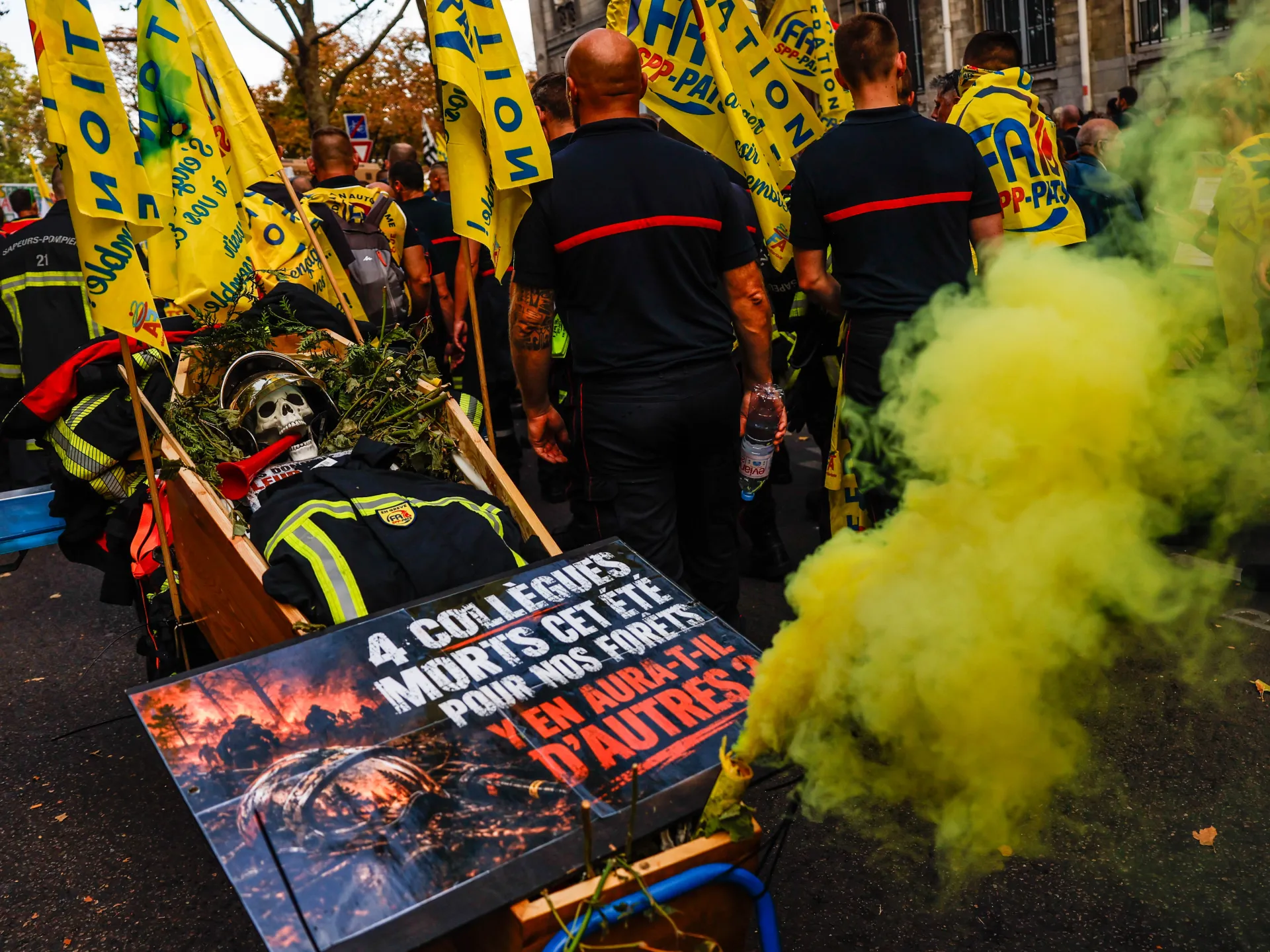
Broadcasters boycotting the Eurovision final due to Israel’s participation plan to show alternatives like reruns of “Father Ted,” an alternative music show with Spanish artist Raphael, or documentaries about Gaza. This year’s contest has faced criticism due to the ongoing conflict in Gaza, leading broadcasters from Ireland, Spain, the Netherlands, Slovenia, and Iceland to withdraw, citing the killing of Palestinian civilians and journalists. During the semi-final, Israel’s contestant Noam Bettan faced protests.
Participating broadcasters typically pay fees and choose contestants, with Eurovision celebrating pop music and cultural diversity. Ireland’s national broadcaster RTE opted to air an episode of “Father Ted,” which satirizes the Eurovision contest. This decision faced backlash, with co-creator Graham Linehan criticizing RTE for allegedly using the episode in an antisemitic context; RTE chose not to comment on his remarks. However, many in Ireland still have access to watch the contest via BBC.
In Spain, viewers will see a program featuring local musicians in honor of the U. N.’s International Day of Living Together in Peace. Slovenia’s RTV will show documentaries titled “Voices of Palestine,” focusing on the Gaza conflict. Despite boycotting, the Netherlands and Iceland will broadcast the show with their own commentary, asserting the importance of making significant events accessible. Protests continue in participating countries; for instance, in Belgium, an alternative festival is promoting watching parties instead of the Eurovision event. Meanwhile, the European Broadcasting Union emphasizes the contest should remain non-political.
A BRAND new lido could be coming to one of the UK’s most beautiful cities under new plans.
A formal bid has been made to transform an old leisure centre into a prime swim spot in the city of Winchester.
Sign up for the Travel newsletter
Thank you!
The lido could be built on the site of a former leisure centreCredit: Friends of River Park
Follow The Sun’s award-winning travel team on Instagram and Tiktok for top holiday tips and inspiration @thesuntravel.
Winchester’s River Park Leisure Centre, which closed in 2021, would instead have an outdoor swimmingpool, as well as lido a splash pad and food and drink stands.
The lido designs have been created by Design Engine Architects, with previous projects including university campuses and private homes across the UK.
The bid has been put to Winchester City Council by Sea Lanes which runs the lido in nearby Brighton and Hilsea Lido in Portsmouth.
Harry Smith, director of Sea Lanes, said: “We submitted our bid as part of the consultation for the site. We worked with the (Winchester Lido) community group, which really supported the bid.
“We’re really excited to bring a lido to Winchester. I think the decision will be soon, if it’s still on track, and then we will be working with the city if we get the opportunity to pursue the project.
New renders have revealed the design for Winchester’s potential lidoCredit: Design Engine Architects
“There’s huge community support for the lido. We have worked with the community group, which contacted us about the site. It is something that has been bubbling around for a while.”
The plan has been met with positivity from locals.
On a Facebook post announcing the news, one said: “Absolutely stunning! Can’t wait to hear more about it!”
Another wrote: “Hard to imagine how this would not be good for everyone in Winchester. Wonderful first visual.”
The site of the River Park Leisure Centre has been marked for the lidoCredit: Alamy
A third added: “I swam in Hilsea Lido the other day – fantastic. This would be great.”
There was previously an open-air swimming lido in Winchester on Worthy Lane, which opened in the 1930s and closed in the late 1970s – since then, Winchester hasn’t had a lido.
Nearby Hilsea Lido had been closed since 2022 but reopened on May 2 after a £7.6million revamp.
New showers and toilets, including a Changing Places toilet, and a sauna were added as part of the upgrades.
Formerly a saltwater pool, the 220-foot lido now uses unheated chlorinated fresh water.
The lido served as a training centre for the Team GB diving team ahead of the 1936 and 1952 Olympics, and it also featured as a filming location for The Who’s 1975 film Tommy.
A parade of celebrities, including Naomi Osaka, Angela Bassett, Madonna, and Sabrina Carpenter posed for the cameras. Some famous faces – Bad Bunny, Heidi Klum, and Katy Perry – were nearly unrecognisable thanks to their commitment to the “costume” theme.
September 2024 came with water. It moved through Maiduguri, in Nigeria’s North East, in fast, stubborn currents, destroying homes and property, and displacing thousands.
In many affected areas, like London Ciki, where Khadija Usman lives, it washed away firewood and charcoal, a critical source of cooking fuel for many homes. She was home alone one afternoon when that absence settled into something practical. Khadija wanted to cook, but there was nothing to burn.
“The water destroyed almost everything,” she said. “It became difficult to find firewood and charcoal.” Moving out to search for fuel was not easy, as she uses a wheelchair. And like for most people here, the expectation did not shift with the flood. Meals still had to be prepared.
So, Khadija turned her attention to what was left behind: charcoal residue, bits of waste, and a technique she had once seen. “I decided to come up with a solution,” she stated. She gathered what she could, shaping it into compact pieces that might hold a flame. When it finally caught, it was small, steady, and enough.
Not yet a long-term solution, but a way through that day.
In the weeks that followed, that small flame evolved into something more substantial. The turning point came when she visited a friend, Zara Tijjani, who also has a disability and was cooking over firewood. The smoke stung Zara’s eyes as she struggled to keep the fire alive. Inspired, Khadija went home, made briquettes, and then returned to show her friend how to make them as well.
From there, the knowledge began to spread among women, particularly those for whom gathering firewood posed significant risks or challenges. What Khadija started in the aftermath of the flood has since contributed to a broader shift in Borno, where biochar is gradually being adopted. However, her focus remains shaped by those around her: women navigating limited mobility, daily cooking demands, the risks of gathering firewood in terror-controlled territories, and a changing climate.
When cooking depends on the forest
Across Maiduguri and much of northeastern Nigeria, cooking still depends heavily on firewood and charcoal. For many households, especially in low-income and displaced communities, these remain the most accessible and affordable sources of energy.
National data reflects this dependence. The 2024 Nigeria Residential Energy Demand-Side Survey by the National Bureau of Statistics (NBS) shows that about 67 per cent of households rely on firewood, 22 per cent on charcoal, and only 19.4 per cent on liquefied petroleum gas (LPG). In the North East, the pattern is even more pronounced.
The report shows that wood use rises to 93.4 per cent in the region, the highest in the country, while LPG remains limited, particularly outside urban centres. Electricity and kerosene play only marginal roles in cooking.
In Borno State, reliance is near-total. A 2019 joint assessment by the Food and Agriculture Organisation (FAO), the United Nations High Commissioner for Refugees (UNHCR), and the World Food Programme (WFP) found that 98.7 per cent of households rely on firewood and charcoal, with only a small fraction using cleaner fuels. Even access to these traditional sources is constrained. Many households purchase firewood rather than gather it, reflecting both scarcity and restrictions on movement in conflict-affected areas. This aligns with humanitarian reporting that “firewood is the primary source of cooking energy” in Borno.
This dependence carries layered costs. Trees are cut steadily to meet demand, placing pressure on already fragile ecosystems. For women in these communities, who are primarily responsible for cooking, the burden extends beyond the home. Finding fuel often means travelling to the outskirts of town or into nearby bush areas, where risks of harassment and violence persist.
The September 2024 flooding deepened these pressures. Supply chains were disrupted, stored firewood was washed away, and charcoal became scarce and more expensive. In homes already navigating scarcity, cooking became uncertain.
Beyond immediate access, the environmental toll is significant. The NBS 2024 General Household Survey shows that Nigeria consumes an estimated 30 billion kilogrammes of fuelwood annually, driving deforestation. In regions like Borno, where vegetation is already sparse, this accelerates land degradation and desertification, reinforcing a cycle of environmental stress and energy poverty.
Health and safety risks are also closely tied to this dependence. Smoke from firewood and charcoal contributes to indoor air pollution, which is linked to respiratory illnesses, particularly among women and children. In the North East, these risks extend further. Women who gather firewood often face threats of harassment, violence, and abduction, making the simple act of cooking fuel collection a dangerous task.
Women in Borno, especially in displaced communities, often trek into the bush to gather firewood for household use, risking abduction and harassment from terrorists. Others gather to sell in order to buy food items with the proceeds. Photo: Al’amin Umar/HumAngle.
Within this system, energy, environment, and security are tightly bound. It is this reality that shapes both the problem Khadija is responding to and the limits of the solutions emerging around it.
Improvising in the aftermath of the flood
Khadija’s first attempts were small, almost tentative, as though she was testing not just the materials in her hands but the possibility that something useful could still be made from what the flood had left behind.
Without equipment or formal training, she worked with what was available: charcoal residue, scraps of household waste, fragments others might have discarded without a second thought. She burned them, pressed them, broke them apart again when they failed — testing what held, what crumbled, and what caught fire and stayed lit. The process was slow.
There was no machine then. No structured method. Only a need that could not be postponed.
Khadija Usman at the Faaby Global Services briquettes production facility in Maiduguri. Beside her, two women manually mould biochar into briquettes. Photo: Al’amin Umar/HumAngle.
The knowledge has since gone from one woman to another: Women with limited mobility. Women navigating spaces where stepping out to collect fuel is not always safe.
Get our in-depth, creative coverage of conflict and development delivered to you every weekend.
Subscribe now to our newsletter!
Within the disability community, the effort did not go unnoticed.
“We rallied behind her,” said Hassana Mohammed Bunu, women’s leader of the Association of Persons with Physical Disabilities in Borno State.
“I have stopped using charcoal and firewood ever since I began using her briquettes,” Zara said. Although Zara has been taught how to make them, she prefers to buy them from Khadija. “She uses a machine to make them. And they are more compressed than handmade,” she added. “It is smokeless, and they burn longer.”
Climate shocks uniquely affect persons with disabilities in Nigeria and other parts of the world. These disasters deepen already existing barriers. Mobility becomes more difficult. Access to resources narrows. In conflict-affected settings like Borno and much of the North East, those constraints are often sharper, less visible, and rarely addressed directly.
In energy access, the gaps are even more pronounced. Clean cooking programmes, where they exist, are not always designed with accessibility in mind. Physical barriers, cost, and social exclusion often limit participation. Nigeria’s legal framework, including the Discrimination Against Persons with Disabilities (Prohibition) Act, exists, but its translation into everyday interventions, particularly in climate and energy responses, remains uneven.
Scaling a local idea
To sustain what she had started, Khadija began to think bigger.
She raised her first capital in small, deliberate ways, selling caps and setting aside the earnings. With that, she bought sawdust, Arabic gum, and starch, enough to stabilise her production and move from improvisation to something more consistent. What began at home remained modest but steady, supported by family, friends, and members of the disability community who saw the value in what she was building.
In 2025, her work drew the attention of the United Nations Development Programme (UNDP). After three months of training at the Abdul Samad Rabiu Centre for Innovation and Entrepreneurship at the University of Maiduguri, she received a grant that marked a turning point. With it, she purchased a briquette-making machine.
With the machine, she could produce up to 100 bags of briquettes per day, each sold at ₦6,500.
To deepen her technical knowledge, she partnered with Faaby Global Services, a Maiduguri-based environmental organisation, where she now works closely with a production team. There, she contributes not only as a learner but as a practitioner.
“She shares her ideas in production and on tackling some challenges,” said Heriju Samuel John, an assistant manager at the organisation. “She is also a native of this town, so she helps us in sourcing raw materials.”
Two Faaby Global Services workers mould briquettes with a machine at their production facility in Maiduguri. The organisation operates three machines, one of which belongs to Khadija, whom the UNDP supported in buying. Photo: Al’amin Umar/HumAngle.
Her machine is now one of three in the facility, a small but significant marker of how far the work has moved from its starting point.
Yet, the broader briquette ecosystem in the region remains uneven. Programmes led by organisations such as FAO have introduced briquettes and fuel-efficient stoves to thousands of households across Borno, Adamawa, and Yobe, often linking energy access to protection concerns.
But outside these interventions, the market is still thin. Production is limited. Adoption is inconsistent. Many initiatives remain tied to donor funding rather than sustained commercial demand.
In that landscape, Khadija’s work sits somewhere in between, not fully independent of institutional support, but not entirely defined by it either.
A block of briquette moulded at the Faaby facility in Maiduguri. Photo: Al’amin Umar/HumAngle.
Can briquettes change the equation?
The briquettes Khadija produces are made largely from what others leave behind. Charcoal residue. Sawdust. Rice husks. Groundnut stalks. Agricultural waste is sourced from farmers and traders who would otherwise discard it. Coconut shells, when available, add density, though they are harder to find in places like Maiduguri and are more expensive.
The materials are burned in a low-oxygen environment, then converted into biochar, and finally ground into fine particles and bound together using eco-friendly binders such as gum arabic or starch. What emerges is a compact fuel that holds its shape and, according to Khadija, burns longer and with less smoke.
“We are recycling,” she said, describing a system that pulls from multiple points in the local economy.
A stock of groundnut stalk at the Faaby production facility in Maiduguri. Photo: Al’amin Umar/HumAngle.
Farmers sell their waste. They also source leftover charcoal and firewood particles from traders. Additionally, waste management actors like the Borno State Environmental Protection Agency (BOSEPA) deliver degradable materials.
To manage fluctuations, especially during the rainy season when materials become scarce, Khadija stores raw inputs in bulk in a rented facility in the Abbaganaram area of Maiduguri.
Her briquettes now move through different layers of the market; restaurants, bakeries, and roadside food vendors buy in bulk. Households purchase for daily use. Some consignments travel beyond Maiduguri, to nearby towns like Bama, and even across borders into Cameroon, with up to two trucks dispatched weekly.
For women, particularly those with disabilities, the impact is measured less in scale than in use. Khadija sells at discounted rates within the community and has trained more than 20 women to produce their own briquettes. “She taught some of our members,” Hassana said.
In some households, Khadija told HumAngle, the shift is already complete. Firewood has been replaced. “This gives me joy,” she said, adding that the transition could extend further. “If people fully understand the benefits, they would stop using charcoal and firewood.”
But the shift is not without constraints.
Raw materials fluctuate. Storage remains limited. Transport is still a challenge. And beyond logistics, there are social barriers that do not disappear with production. “People say I am doing what able-bodied people should be doing,” she said. “Being a woman makes it even worse.”
Still, she continues to plan, looking toward a larger production facility that could employ more women and stabilise supply.
If you’re looking for something binge-worthy to watch right now, look no further than this “brilliant” series that is “excellent from start to finish”.
Gripping BBC crime thriller you won’t be able to turn off is the ‘best thing on TV’
After nearly four years of anticipation, The Capture has made a return to screens last month, bringing back the highly praised BBC conspiracy thriller drama for its third season. The show, created by Ben Chanan, features Holliday Grainger as Rachel Carey, an inspector who has climbed the ranks.
As the third season begins, Rachel has taken on the role of acting commander of Counter Terrorism Command.
The latest storyline depicts her efforts to restore public confidence through a new surveillance system, but it quickly faces scrutiny when Rachel becomes involved in a terrorist act in London.
The description for the third series reads: “How do you protect the truth in a world where lies are daily currency? And with the proliferation of deepfakes, how can we trust what we see?”
Many viewers took to IMDb to share their love for the “mind-blowing” drama. One user said: “Six parts of complex, intriguing and baffling drama.
“This isn’t your average six-part mystery series, this will have you scratching your head, questioning everything you see, and doubting the things you’ve seen with your own eyes. It’s excellent from start to finish.”
Another wrote, “A strong and solid storyline and sequence of scenes and events form the basis of edge-of-seat thriller. Oh my, how a simple camera footage can be the root of gripping thriller!
“No fancy gimmicks, dialogues, shoot-out scenes, computer coding thingies, CGI scenes and whatnot. It’s all about how the storyline is delivered. It’s delivered to perfection!”
A third commented: “Wow, the whole series keeps you on your toes; big twist, truly amazing. A very cleverly written piece of drama, the best thing on current TV.”
A fourth said: “One of the best BBC shows ever! Great script, loving the twists and turns! Haven’t watched something this gripping in a long time; it’s really pushing the boundaries.”
All three series that consist of 18 episodes are available to watch now on BBC iPlayer.
It’s unclear yet whether there will be a fourth season of The Capture, but Ben told Radio Times: “I’d think to myself, as I was writing it, ‘this is going to be the last series’, Now, is that true? I don’t know.
“Never say never, right? But I think it’s really healthy to just write each series as if it’s going to be the last, that you’re not just hanging on to people for the sake of it.”
Their steamroll hit a speed bump as they squandered opportunities in Saturday’s 4-3 loss to the Colorado Rockies at Coors Field.
Even the hottest of Dodgers’ hitters cooled off as the night did. Collectively, they went 0-for-6 with runners in scoring position and left eight runners on base, including two in the ninth inning.
Now 15-5, it was their first loss in five games and their first all season to a National League opponent.
Kyle Tucker, the Dodgers’ pricey new right fielder, had three hits, including his third home run this season. And backup catcher Dalton Rushing hit his fifth home run.
But that was all the damage the Dodgers did in support of starter Emmet Sheehan, who left with a one-run lead that reliever Will Klein relinquished in a matter of three batters in the sixth inning.
Shohei Ohtani also saw his career-best on-base streak reach 50 when he singled in the ninth inning to tie Willie Keeler’s 50-game mark established in 1901.
The two-time reining World Series champs threw the proverbial first punch when Tucker launched a 435-foot two-run home run into the second deck, making it 2-0 two batters into the game.
Tucker’s third home run as a Dodger drove home Ohtani, who chopped the first pitch he saw to Troy Johnston and would have been out at first if not for the errant throw by the first baseman.
In the bottom of the first, the Rockies responded when Mickey Moniak doubled and TJ Rumfield drove him in with a single to cut the lead in half, 2-1.
Dodgers catcher Dalton Rushing follows the flight of his solo home run off Colorado pitcher Ryan Feltner Saturday in Denver.
(David Zalubowski / Associated Press)
The Dodgers came right back in the second inning, when Rushing — in his one expected start behind the plate this series — kept crushing, launching a 1-1 pitch 371 feet over the right field wall to make it 3-1. It was his fifth home run in 18 at-bats until that point.
The Dodgers’ two home runs in the first two innings gave them multiple homers in 10 of their first 20 games this season — and ran their MLB-leading season total to 37 as a team.
But the Rockies returned serve in the bottom of the second, when Johnston scored on a Kyle Karros sacrifice fly to stay within a run, 3-2.
That’s how it stayed for the next three innings, as Sheehan got out of the third and fourth unscathed, despite the Rockies putting runners in scoring position in both the third and fourth. His only 1-2-3 inning was the nine-pitch fifth.
His control wasn’t as sharp as in his prior outing, but he left after five innings with the lead, having thrown 77 pitches, allowed four hits, two runs, struck out four and walked two.
The Dodgers got something going again in the sixth inning when Freddie Freeman hit a one-out triple into the gap in the expansive Colorado outfield, just beyond the grasp of diving center fielder Brenton Doyle.
A batter later, the Rockies’ diving third baseman Karros made a nifty play to throw out Teoscar Hernández after he drilled a ball up the line — holding Freeman at third in the process.
Then left-hander Brennan Bernardino came on in relief and tied up a clearly frustrated Max Muncy with a curveball, striking him out and ending a scoreless inning with Freeman stranded on third.
Klein took the loss after taking over for the Dodgers in the sixth and immediately gave up a double to Hunter Goodman before Ezequiel Tovar’s grounder ricocheted off Klein’s left foot and right knee. Tovar reached before Freeman could corral the ball and get it to Klein at first.
Both runners scored on a no-out double by Johnston and Colorado had a 4-3 lead that would stand.
In the eighth, “Let’s go Dodgers” chants picked up with Andy Pages at bat and Ohtani and Tucker on first and second base. But Pages struck out on a strike that was determined to find the bottom of the zone by baseball’s new ABS system.
Hernández then walked to load the bases but Muncy grounded out to second base, leaving more runners stranded.
Some 8,000 years ago, behind the retreating glaciers, a remarkable environment was born on the western fringes of Scotland’s Outer Hebridean islands, forged by the wind and waves. It began with rising sea levels and sweeping Atlantic gales depositing crushed shell-sand inland; this settled over glacial sediment to form a coastal belt of lime-rich soil. Buffered from the sea by mounting sand dunes, this winter-wet and summer-sunned substrate produced one of Europe’s rarest habitats: the “machair”, Gaelic for “fertile grassy plain”. Abounding in diverse, colourful wildflowers and an array of associated wildlife, coastal machair is a precious, globally important outpost of biodiversity, supporting everything from purple orchids and nodding blue campanulas to endangered birdlife, otters and rare bumblebees.
As a wildflower fanatic, visiting the Outer Hebrides in peak machair bloom has long been an aspiration. Over the years, I’d read accounts of its arresting, vibrant seasonality – its shifting blankets of red and white clover, yellow trefoil and creamy eyebright, bold against the sky. Although remnant machair is also found in north-west Ireland, its greatest extent lies on this Scottish archipelago, notably the islands of Barra, Uist and Harris.
Moreover, here it has a fascinating symbiotic relationship with crofting, the traditional, small-scale agriculture unique to Scotland’s Highlands and Islands. For generations, crofters have managed areas of machair as low-intensity pastureland, improving its fertility, grazing livestock and growing crops on sustainable cycles sympathetic to wildlife regeneration. With crofting undergoing a quiet resurgence on the islands, and many crofters exploring new ways of sustaining an old way of life, experiencing the Outer Hebrides appealed to me all the more. Last summer, I finally made the trip, travelling from Barra in the south right up to Lewis – and it was everything I had hoped for.
Now a parent of two young boys, and with the machair’s flowering season falling squarely within the school holidays, it was clear this trip would need to be a family affair. I pitched it to my wife: “Fancy a holiday of white sands, turquoise waters and local food?”
“Sicily? Sardinia? Greece?” came the expectant reply.
The Isle of Barra, ‘unquestionably one of the prettiest islands’. Photograph: Ian Rutherford/Alamy
Thankfully, she was won round with the promise of fresher-than-fresh salmon, unrestricted space to exhaust the boys and, appealing to her interests in history and design, the islands’ heritage of traditional crafts. But there was one other necessary sell: in order to cover all islands in one go, and to allow for surprise and discovery, we’d need to travel by motorhome. Having spent last summer negotiating the confines of a family tent, this, too, was agreed. With swivelling car seats, a three-hob stove and a sky bed deemed certifiable upgrades, we were off.
Collecting our motorhome from Just Go outside Edinburgh and driving the mountainous, lochside road towards the west coast, we spent two nights at pleasant North Ledaig caravan park, outside Oban, the primary port for the Western Isles. Perched beside the placid waters of Ardmucknish Bay, we underwent some necessary pre-island preparations: namely, getting to grips with motorhoming essentials (wastewater disposal, tethering breakables, navigating single lanes), and refamiliarising ourselves with the inescapably chaotic nature of travelling with small children. Thus decompressed, we were borne across the Sea of the Hebrides on a CalMac ferry to Barra, the second most southerly of this spectacular island chain.
As I had read multiple times when researching this trip, the Isle of Barra is not to be overlooked. At a mere 9 by 7 miles, it is among the smaller islands, but unquestionably one of the prettiest. A short, easy drive from the landing at Castlebay village – marked by medieval Kisimul Castle, protruding from the water – brought us to Borve Camping & Caravan Site, where we pitched in view of waves crashing upon blackened gneiss boulders.
Over the next two days, we explored the quiet, colourful island and that of smaller Vatersay (connected via a causeway), hiring bikes, taking coffee mugs on to the marram grass dunes, and making sand tunnels at stunning beaches Traigh a Bhaigh and Tangasdale. Approaching the latter, I got my first taste of machair, my heart singing when suddenly surrounded by yellow bedstraw and kidney vetch, red bartsia and scattered orchids. A magical quality of machair, I quickly learned, is that its detail can appear disguised at a distance, owing to the complexity of species. Once up close, thousands upon thousands of low-lying flowers are revealed in an effect akin to pointillism.
The writer’s wife and youngest son on Traigh a Bhaigh beach on the Isle of Barra. Photograph: Matt Collins
Machair has hosted crofts for centuries, its light, workable soil contrasting with therocky peatland often prevalent across the islands. Considered a semi-natural habitat, it is sustained by the low-intensity agriculture practised by crofters: locally harvested seaweed (kelp) is spread as an organic fertiliser, enriching and preserving the sandy soil and providing sustenance for migrant birdlife. Similarly, cycles of crop and fallow benefit wildflower regeneration and support ground-nesting birds, while silage harvesting is carefully timed to protect endangered species such as the corncrake.
Some of the most impressive machair is found at the RSPB reserve of Balranald on North Uist, where the mixture of fallow wildflower fields and areas under cultivation (for cereals such as barley, black oats and hebridean rye) shows as a subtle patchwork over the landscape. Camped on the reserve itself – our highlight campsite – my eldest and I spent a memorable evening wandering back from the beach through the engulfing blooms.
While on South Uist, we visited crofters DJ and Lindsay of Long Island Retreats & Larder, who subsidise their livestock crofting by hosting island experiences, from island and machair tours to sheep shearing demonstrations.
“Our love of the land and the livestock is what drives us,” Lindsay told me, meeting at the smart “larder” shop that she and DJ – a sixth-generation crofter – run from their home at Loch Skipport. “But we wouldn’t be doing what we’re doing if it weren’t for all the people that came before us.”
Lindsay said it is common for crofters to have second jobs, but having started a family, they sought new avenues to make their crofting more viable. In recent years, the Scottish government’s crofting agricultural grant scheme has made money available for agricultural improvements, business development and croft house refurbishments, encouraging many crofting families to diversify their income streams.
Machair has hosted the small-scale agriculture of crofts for centuries. Photograph: Matt Collins
Farther north on Harris, we stopped by Croft 36, a crofting enterprise that’s part of the growing Outer Hebridean culinary scene. Operating from an unmanned honesty-box kiosk, Croft 36 offers homemade soups, pastries and other baked produce made with machair-grown ingredients.
Our journey was punctuated by memorable meals, almost all of them found at a pop-up of one kind or another, often out in the wilds: the scallop and black pudding bun devoured at The Wee Cottage Kitchen food van on the North Uist coast; the salmon at Namara Seafood Cafe. On Lewis, the Crust Like That takeaway pizzeria – a shipping container isolated in dramatic moorland – offered haggis-topped pizza. And don’t get me started on the cake-packed honesty boxes dotted around like treasure chests.
The freedom of the motorhome meant that these and so many other discoveries could be enjoyed along the road. Travelling the islands this way gave a great sense, too, of their shifting character – of Barra and Eriskay’s pristine coves, Uist’s freshwater lochs, and the hilly, moorland drama of Harris and Lewis.
By the time we were heading back to Edinburgh from Ullapool, I was losing count of the special moments. We’d seen peregrines, hen harriers, basking seals and diving gannets, and spent evenings off-grid on breathtaking remote beaches. We’d swum sunlit coves (none more sparkling than at Eriskay and west Berneray) and made hot chocolate for the boys on the pebbles. When it rained, there were heritage museums, charming cafes and woollen mills; Stornoway’s An Lanntair arts centre and the poignancy of Geàrrannan Blackhouse Village in Lewis, its restored 19th-century drystone houses conveying the challenging life of a once prominent crofting community.
And the machair left an impression not easily forgotten: a rare floral spectacle I now understand as a lifeblood of these islands.