Turkiyes

Turkiye’s AK Party turns 25: A journey of change and renewal | Opinions

The initial step taken on August 14, 2001 cannot be viewed merely as the submission of a political party’s founding petition within the annals of international political history; rather, it is the reincarnation of a millennium-old, deep-rooted civilisational vision on the modern world stage. Today, having left a quarter of a century behind, the AK Party is not merely a tale of national development within its borders, but an unparalleled 25-year epic of democracy on a global scale. Coming to power with immense public favour just 16 months after its founding, and steering the country with uninterrupted stability for a quarter of a century, this political movement has secured a highly exceptional place in world political history.

The greatest power behind this stability lies in the fact that this movement is not a rootless structure blown about by the wind. It carries on its shoulders, as a historical trust, the democratic struggle of the late Prime Minister Adnan Menderes and his companions, who sacrificed their lives for the nation’s beliefs during the arduous days of the single-party era. The mighty plane tree founded by our President and Chairman Recep Tayyip Erdogan – under whose shade our nation and oppressed geographies have drawn a breath of relief for 25 years – is the very embodiment of this tremendous historical legacy.

While the lifespans of political parties are generally measured by election results or their terms in government, the AK Party’s ability to overcome successive global and national crises with the continuous support of vastly diverse social segments over 25 years can be explained by a much more structural concept: Its “capacity for political translation”.

This capacity is the process of accurately hearing the expectations, needs, and objections within society, transforming them into viable party programmes, budgets, and public policies, and submitting the resulting outcomes back for societal evaluation. Social needs do not always arrive in politics as ready-made texts; it is here that the AK Party has established a colossal “translation” mechanism that turns seemingly disparate experiences into common problems and solutions. Indeed, for someone of a generation like mine – who grew up in a Turkiye shaped by the AK Party, took on responsibilities in its youth branches since childhood, and today serves as a member of parliament and the party’s secretary-general – this political ground is the very essence of that transformation.

To grasp the magnitude of this transformation, one must look back at the Turkiye of the 1990s. It is essential to read those years not just as an “era of a unipolar world and severe economic crises”, but as a colossal “age of political collapse and instability” that paralysed the state and deepened societal fault lines.

The 90s were a lost decade in which fragile coalitions lasting only months, political bargaining and recurring crises shook state authority. While unsolved murders and an escalating spiral of terror threatened citizens’ lives on the one hand, the heavy fist of tutelage brought down upon civilian politics via the February 28 post-modern coup explicitly usurped the nation’s will on the other. Even though voter turnout reached 87 percent in parliamentary elections during that era, this high public interest in politics could not translate into a stable and effective governing capacity, with no single party able to form a majority government.

The closure of the Refah Party in 1998 and the Fazilet Party in 2001 through judicial tutelage created a profound crisis regarding the continuity of legitimate channels of representation for the masses. Therefore, the year 2001 was a historical threshold – not merely a year of economic bankruptcy marked by cash registers being thrown in protest, but the absolute peak of political fragmentation, tutelary regimes, governance vulnerabilities, and constitutional rights remaining strictly on paper. Inheriting this multidimensional political and economic wreckage, the AK Party built the world’s most experienced cadres in every field, from security to economics, from foreign policy to social policies, establishing a “game-changing” political style.

At the core of this game-changing politics lies the dismantling of the “state commands its citizens” mentality, replacing it with the principle that “the state is the servant of the nation”. Believing that true change lies in execution rather than packaging, the AK Party tore down the cold walls built between the state and the nation, making the nation’s red lines the same as the state’s.

The silent majority, who for decades had been left disheartened like “tenants” in their own homeland, rose with self-confidence to become the true “landlords” of their country. Today, as the world’s largest and most dynamic school of politics with more than 12 million members, the AK Party conducts politics not by pontificating from television screens, but by directly sharing the burdens of the people and keeping a finger on the pulse of the streets. The secret behind these victories is hidden in these devoted organisations that hold the nation’s consent above all else, and in the vision of the leader of this great march, our President and Chairman Recep Tayyip Erdogan.

The party’s quarter-century has gone down in history not through noisy destructions and polarising conflicts, but through institutional “silent revolutions” woven stitch by stitch. The Health Transformation Program and national fighter jets and unmanned aerial vehicles (UAVs) produced in the defence industry are the building blocks of this revolution.

Moreover, Turkiye does not view technological transformation merely as instrumental progress; it presents a brand new vision. By openly opposing the algorithmic exploitation of global digital giants, it advocates for a value-oriented and ethical technological order that places human dignity, privacy, and the family at its centre. TEKNOFEST is not just a technology fair; it is a ceremony of institutional self-confidence where a generation – once intended to be manipulated in the streets during past coup eras – becomes the builder of this very moral and fully independent technological future.

The greatest outcome of this will for full independence is the historic struggle waged against the scourge of terrorism – which has made the nation weep blood – under the ideal of a “Terror-Free Turkiye”. Recipes dictated from the outside have been crumpled up and thrown away; terrorism has been dried up at its source, and the dirty corridors intended to be established at our borders have been shattered by the “Turkiye Model”. A Turkiye completely cleansed of terrorism has thwarted Israel’s expansionist ambitions built on dividing, weakening, and destabilising the region; it has become the greatest hope for the Palestinian cause, for Jerusalem, and for the oppressed in Gaza.

Viewing democracy not as a tool but as an unshakable value, this political mindset forever closed the dark parenthesis of tutelage opened on May 27, 1960, on the night of July 15, when the nation lay down in front of tanks and braved gun barrels. This democratic resilience achieved at home has today made Turkiye the vanguard of a global conscience movement abroad.

The objection raised by our President and Chairman Recep Tayyip Erdogan that “The World is Bigger Than Five!” has transformed into an “Erdogan Doctrine” that maps the conscience of humanity against those who fancy themselves masters of the globe. This quest for justice – embodied in the human tragedy in Gaza, in baby Aylan whose washed-up body shook the world, and in a little boy who recited the Quran with his last breath under the rubble – is the clearest indicator of Turkiye’s determination to defend the rights of the innocent in international diplomacy.

Today, moving far beyond being a passive ally in global politics, Turkiye has risen to the position of a subject that rewrites the rules of the international system, produces solutions to geopolitical crises, and personally steers diplomatic change.

Having long transcended artificial agendas and polemics in domestic politics, the AK Party’s true power in this multipolar world lies not only in the country’s economic and strategic capacity. It lies in the unshakeable democratic legitimacy behind our President and Chairman Recep Tayyip Erdogan – one of the most senior and experienced heads of state in world politics – and in the profound trust that all oppressed peoples across the earth place in Turkiye.

Our tremendous state experience over the past quarter-century is our most solid reference; yet, this political movement, with its face always turned towards the future, is determined to build the “Century of Turkiye” vision on the axis of justice, compassion, and sustainable global peace by blending it with the nation’s internal dynamics. In this new age marked by great trials that deeply affect humanity, under the leadership of our President and Chairman Recep Tayyip Erdogan – who shapes global politics with his unparalleled state experience and vision in the international arena – Turkiye marches forward with strong steps, shoulder to shoulder with our nation, as a playmaker towards new targets and a bright new quarter-century.

The views expressed in this article are the author’s own and do not necessarily reflect Al Jazeera’s editorial stance.
Source link

How the failed 2016 coup reshaped Turkiye’s civil-military relations | Turkey Attempted Coup News

Istanbul, Turkiye – At around 19:30 GMT on July 15, 2016, a faction of the Turkish military launched a coordinated attempt to overthrow President Recep Tayyip Erdogan’s democratically elected government.

But within hours, the attempted takeover involving tanks and fighter jets had been quashed. Thousands of people poured onto the streets of major cities, joining loyalist members of the army and the police, and much of the chain of command, in defeating the putschists.

The failed coup attempt 10 years ago was not only the bloodiest in Turkiye’s modern history – some 250 were killed and more than 2,200 wounded – but also a watershed moment that fundamentally changed relations between civil and military authorities in the country.

“The failure of July 15 had three pillars,” said retired Colonel Unal Atabay.

“The resistance of the people, the officers, noncommissioned officers and soldiers inside the Turkish Armed Forces who resisted the coup, and the institutional reflex of the armed forces themselves.”

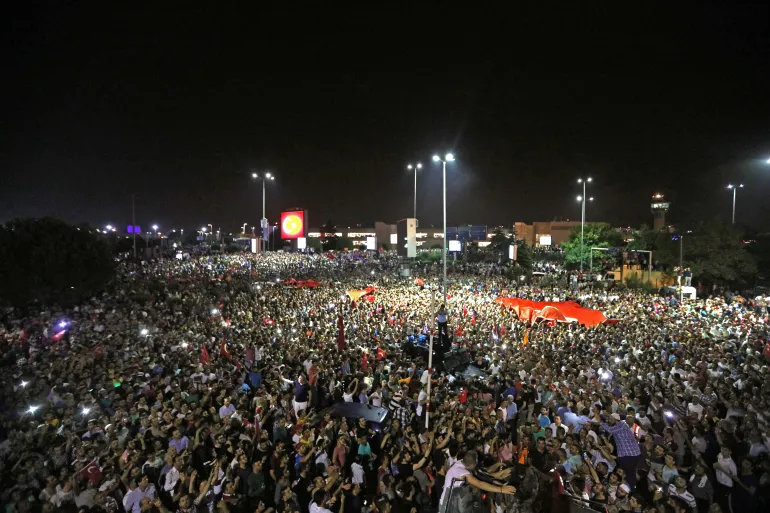
People demonstrate outside Ataturk international airport during an attempted coup in Istanbul
People demonstrate outside Ataturk international airport on July 16, 2016 [Huseyin Aldemir/Reuters]

Military intervention cast a long shadow over Turkish politics for decades.

The armed forces overthrew governments in 1960 and 1980; intervened through a memorandum in 1971; and forced another elected government from office in what became known as the “post-modern coup” of 1997.

Although civilian rule returned after each intervention, the military remained one of Turkiye’s most influential institutions, seeing itself as the guardian of the republic’s founding principles.

Yet that was not how the republic’s founders had envisioned civil-military relations. Mustafa Kemal Ataturk and Ismet Inonu, both commanders during the War of Independence of the early 1920s, entered politics only after leaving military service.

“If the military had remained involved in politics, it would most likely have been exploited by various groups in the uncertain and weak conditions of those early years of the republic. They made the most accurate diagnosis and said that the military should stay out of politics.

Political scientist Ali Carkoglu said separation between military command and civilian politics was regarded as one of the republic’s founding principles, calling it “the most accurate diagnosis”.

Over time, however, the armed forces increasingly came to see themselves as guardians of the state, repeatedly invoking that role to justify intervention in politics.

But 10 years since the latest attempt, few experts believe Turkiye faces another conventional coup.

“You never say never,” said Howard Eissenstat, a Turkiye specialist at St Lawrence University in New York. “But to bet on a military coup in Turkiye is to lose money.”

Turkish President Tayyip Erdogan addresses during an attempted coup in Istanbul, Turkey
Turkish President Recep Tayyip Erdogan speaks to reporters on July 16, 2016 [Huseyin Aldemir/Reuters]

While the military’s political role appears to have receded, the broader consequences of the post-coup transformation remain the subject of debate.

Reducing the military’s influence over politics had already become a central objective of the governing Justice and Development Party, or AK Party, after it came to power in 2002.

Following years of tension with the military establishment, the government steadily expanded civilian oversight – and the failed coup accelerated that process dramatically.

Ankara accused the network of United States-based Muslim scholar Fethullah Gulen, designated by the Turkish government as the Fethullah Terrorist Organisation (FETO), of orchestrating the coup attempt. Tens of thousands of soldiers, judges, police officers, teachers and civil servants were dismissed or arrested. Military academies were replaced by the National Defence University, command structures were overhauled, and civilian oversight of the armed forces expanded.

Atabay said these changes have fundamentally reshaped the relationship between the military, the state and society.

He added the military has strengthened its internal oversight after the coup to prevent another organised infiltration, noting that both the armed forces and wider society are now more alert to attempts to penetrate state institutions.

“External centres of power may always make such attempts,” he said. “The important thing is to detect them early, expose them and build a system that prevents them from infiltrating the state.”

People react near a military vehicle during an attempted coup in Ankara, Turkey, July 16, 2016
People take to the streets of Ankara to resist the coup attempt on July 16, 2016 [Tumay Berkin/Reuters]

For Carkoglu, however, the military cannot be examined in isolation from the broader health of Turkiye’s democratic institutions.

He said bringing the armed forces firmly under civilian authority was essential. But civilian supremacy alone, he argued, does not necessarily amount to democratic consolidation.

“It is certainly a success that civilian authority has established greater control over the military,” he said. “But if that comes at the expense of democracy, then it is, at the very least, an unfortunate outcome for Turkish politics.”

Carkoglu noted that institutions derive legitimacy not simply from who controls them, but from whether citizens trust them.

“The healthy development of trust in institutions requires competitive politics and the possibility of free expression,” he said. “Otherwise, institutions themselves begin to lose credibility.”

That debate has become increasingly prominent in recent years.

The arrests of several opposition mayors – including Istanbul mayor and presidential candidate for the main opposition Republican People’s Party (CHP) Ekrem Imamoglu, together with investigations into other opposition politicians, have fuelled criticism from political parties and rights groups, who argue judicial processes are increasingly being used against rivals.

The government rejects those accusations, saying the investigations are conducted independently and are based solely on evidence of criminal wrongdoing.

The debate has unfolded during a period of remarkable political continuity. Since coming to power in 2002, the AK Party has won every parliamentary election, most recently in 2023, when the governing People’s Alliance retained its parliamentary majority.

Rights groups, meanwhile, focus on a different legacy of the coup.

Human Rights Watch says emergency powers introduced after the 2016 coup attempt gradually evolved into broader restrictions on civil liberties. It argues the crackdown extended well beyond those responsible for the attempted overthrow, leaving many dismissed public employees unable to rebuild their professional lives even after acquittal.

The government says the measures were necessary to dismantle clandestine networks inside the state and prevent Turkiye from facing a similar threat again.

Ten years on, that effort continues. On Monday, two days before the anniversary, Turkish authorities launched coordinated operations across all 81 provinces targeting nearly 1,000 suspects over alleged links to FETO.

For the government, it was another reminder that the events of July 2016 remain an active national security issue rather than a closed chapter in the country’s history.

Source link

NATO summit begins in Turkiye’s Ankara: Who is attending, what is at stake? | NATO News

NATO leaders are meeting in Ankara, Turkiye on Tuesday and Wednesday.

The summit gets underway as US President Donald Trump renews pressure on member states over defence spending. European nations are expected to respond with billions of dollars in new military contracts.

At the NATO summit last year, members agreed to increase their target to 5 percent of GDP: 3.5 percent on military spending by 2035 and 1.5 percent on security-related needs.

Who is there and what is at stake?

Leaders from all 32 NATO member states are at the summit in Turkiye this week.

Two non-alliance heads of state will also be there: Ukraine’s Volodymyr Zelenskyy and South Korea’s Lee Jae-myung.

Australia, Japan and New Zealand are sending defence or foreign ministers, as are Gulf countries affected by the US-Israel war on Iran: Bahrain, Kuwait, Qatar and the United Arab Emirates.

Syrian President Ahmed al-Sharaa is not expected to attend the summit but is holding a bilateral meeting with Trump in Ankara.

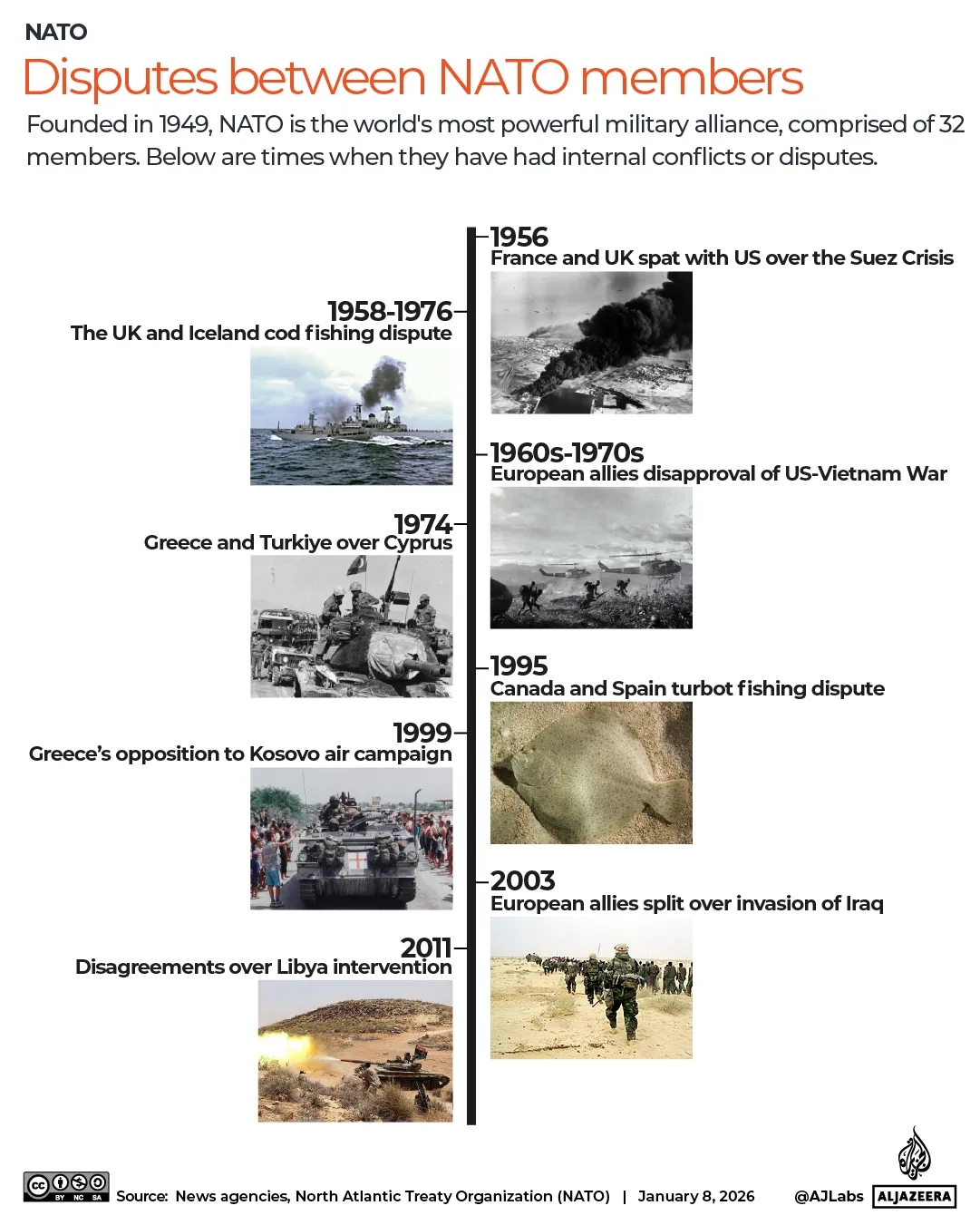
INTERACTIVE-NATO-MEMEBERS-DISPUTES-TIMELINE-1767962265

What Trump wants from NATO allies

Trump has questioned NATO’s value since his first presidential campaign. He argued that the US carried an unfair share of the costs. At the time, only five countries spent the agreed two percent GDP on defence.

His questions about shared defence responsibility have produced some results in recent years within the alliance as member states pledged an increased defence budget.

Ozgur Unluhisarcikli, the German Marshall Fund’s regional director for Turkiye, believes NATO this year will focus on implementing its promises from last year. “NATO allies just decided to increase their defence spending to five percent last year at The Hague and European allies took action to upgrade their defence industries,” he said. “This year in Ankara the discussion will be on how to translate spending to capabilities. It is therefore stronger than it was last year.”

But Paolo von Schirach, president of the Global Policy Institute, noted that any capability gains from increased spending are years away, saying that more orders mean more military hardware but only eventually. “You can spend a lot and obtain not too much,” he said.

What Ukraine needs from this summit

Ukrainian President Volodymyr Zelenskyy is meeting Trump for a bilateral meeting on Wednesday. Ukraine is not a NATO member.

Zelenskyy will be using his face-to-face with the US president to request additional Patriot air defence systems as Russian attacks are intensifying on Ukrainian cities. A drone attack on the Ukrainian capital Kyiv killed at least 11 people on Monday morning.

Jack Watling, a senior research fellow at the Royal United Services Institute said that Ukraine is looking for ongoing political and military technical support from alliance members, to signal to Russia “that this support will be sustained”.

The idea, he said, was “to show Russia that there will be no diminution in its defensive capacity over the next 12-24 months”.

“There is a direct correlation between the number of interceptors supplied to Ukraine and the damage that Russia can inflict with ballistic missiles,” says Watling.

INTERACTIVE - Total troop levels of NATO countries-1740988951

What European nations are trying to solve for

The billions in contracts expected to be announced by European nations at this summit are seen by some analysts as trying to appease the Trump administration.

When European nations didn’t join the war on Iran, Trump stated he didn’t want their money, just their “loyalty”. He added he might not have attended the summit if it wasn’t hosted by Turkish President Recep Tayyip Erdogan. Turkey has in recent years not only increased its defence spending, it also has grown into one of NATO’s largest military exporters.

For now, the tone around defence spending remains sharp. On the eve of the summit, Trump called Germany’s defence spending “ridiculous”. Chancellor Friedrich Merz defended his country’s budget, saying that “this is the greatest effort we have ever made to strengthen our defence capabilities”.

Meanwhile, the US has gone a step beyond rhetoric and announced a phased withdrawal of warplanes, destroyers and submarines from NATO countries. “Less US infantry or armour in Europe has an impact on messaging but little else,” Watling said. But, he added, “the withdrawal of US air power has a more tangible impact”.

Whether the alliance can project unity amid the rhetoric and withdrawals is a key question, said analysts.

“The main value of this summit is political, it shows that the allies are still talking, still meeting, still trying to project unity, even if the underlying disagreements and doubts haven’t disappeared,” von Schirach of the Global Policy Institute said. “Ankara is more about reassurance and signalling than about concrete, immediate changes on the ground.”

Source link