Turkiye’s AK Party turns 25: A journey of change and renewal | Opinions
The initial step taken on August 14, 2001 cannot be viewed merely as the submission of a political party’s founding petition within the annals of international political history; rather, it is the reincarnation of a millennium-old, deep-rooted civilisational vision on the modern world stage. Today, having left a quarter of a century behind, the AK Party is not merely a tale of national development within its borders, but an unparalleled 25-year epic of democracy on a global scale. Coming to power with immense public favour just 16 months after its founding, and steering the country with uninterrupted stability for a quarter of a century, this political movement has secured a highly exceptional place in world political history.
The greatest power behind this stability lies in the fact that this movement is not a rootless structure blown about by the wind. It carries on its shoulders, as a historical trust, the democratic struggle of the late Prime Minister Adnan Menderes and his companions, who sacrificed their lives for the nation’s beliefs during the arduous days of the single-party era. The mighty plane tree founded by our President and Chairman Recep Tayyip Erdogan – under whose shade our nation and oppressed geographies have drawn a breath of relief for 25 years – is the very embodiment of this tremendous historical legacy.
While the lifespans of political parties are generally measured by election results or their terms in government, the AK Party’s ability to overcome successive global and national crises with the continuous support of vastly diverse social segments over 25 years can be explained by a much more structural concept: Its “capacity for political translation”.
This capacity is the process of accurately hearing the expectations, needs, and objections within society, transforming them into viable party programmes, budgets, and public policies, and submitting the resulting outcomes back for societal evaluation. Social needs do not always arrive in politics as ready-made texts; it is here that the AK Party has established a colossal “translation” mechanism that turns seemingly disparate experiences into common problems and solutions. Indeed, for someone of a generation like mine – who grew up in a Turkiye shaped by the AK Party, took on responsibilities in its youth branches since childhood, and today serves as a member of parliament and the party’s secretary-general – this political ground is the very essence of that transformation.
To grasp the magnitude of this transformation, one must look back at the Turkiye of the 1990s. It is essential to read those years not just as an “era of a unipolar world and severe economic crises”, but as a colossal “age of political collapse and instability” that paralysed the state and deepened societal fault lines.
The 90s were a lost decade in which fragile coalitions lasting only months, political bargaining and recurring crises shook state authority. While unsolved murders and an escalating spiral of terror threatened citizens’ lives on the one hand, the heavy fist of tutelage brought down upon civilian politics via the February 28 post-modern coup explicitly usurped the nation’s will on the other. Even though voter turnout reached 87 percent in parliamentary elections during that era, this high public interest in politics could not translate into a stable and effective governing capacity, with no single party able to form a majority government.
The closure of the Refah Party in 1998 and the Fazilet Party in 2001 through judicial tutelage created a profound crisis regarding the continuity of legitimate channels of representation for the masses. Therefore, the year 2001 was a historical threshold – not merely a year of economic bankruptcy marked by cash registers being thrown in protest, but the absolute peak of political fragmentation, tutelary regimes, governance vulnerabilities, and constitutional rights remaining strictly on paper. Inheriting this multidimensional political and economic wreckage, the AK Party built the world’s most experienced cadres in every field, from security to economics, from foreign policy to social policies, establishing a “game-changing” political style.
At the core of this game-changing politics lies the dismantling of the “state commands its citizens” mentality, replacing it with the principle that “the state is the servant of the nation”. Believing that true change lies in execution rather than packaging, the AK Party tore down the cold walls built between the state and the nation, making the nation’s red lines the same as the state’s.
The silent majority, who for decades had been left disheartened like “tenants” in their own homeland, rose with self-confidence to become the true “landlords” of their country. Today, as the world’s largest and most dynamic school of politics with more than 12 million members, the AK Party conducts politics not by pontificating from television screens, but by directly sharing the burdens of the people and keeping a finger on the pulse of the streets. The secret behind these victories is hidden in these devoted organisations that hold the nation’s consent above all else, and in the vision of the leader of this great march, our President and Chairman Recep Tayyip Erdogan.
The party’s quarter-century has gone down in history not through noisy destructions and polarising conflicts, but through institutional “silent revolutions” woven stitch by stitch. The Health Transformation Program and national fighter jets and unmanned aerial vehicles (UAVs) produced in the defence industry are the building blocks of this revolution.
Moreover, Turkiye does not view technological transformation merely as instrumental progress; it presents a brand new vision. By openly opposing the algorithmic exploitation of global digital giants, it advocates for a value-oriented and ethical technological order that places human dignity, privacy, and the family at its centre. TEKNOFEST is not just a technology fair; it is a ceremony of institutional self-confidence where a generation – once intended to be manipulated in the streets during past coup eras – becomes the builder of this very moral and fully independent technological future.
The greatest outcome of this will for full independence is the historic struggle waged against the scourge of terrorism – which has made the nation weep blood – under the ideal of a “Terror-Free Turkiye”. Recipes dictated from the outside have been crumpled up and thrown away; terrorism has been dried up at its source, and the dirty corridors intended to be established at our borders have been shattered by the “Turkiye Model”. A Turkiye completely cleansed of terrorism has thwarted Israel’s expansionist ambitions built on dividing, weakening, and destabilising the region; it has become the greatest hope for the Palestinian cause, for Jerusalem, and for the oppressed in Gaza.
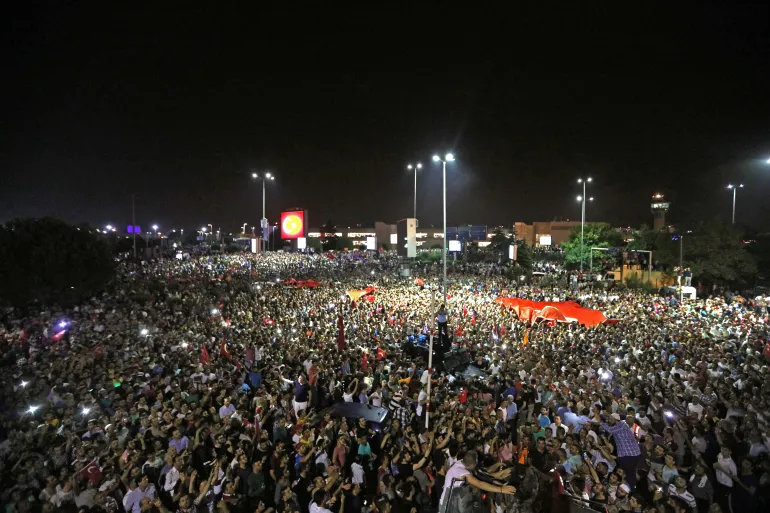
Viewing democracy not as a tool but as an unshakable value, this political mindset forever closed the dark parenthesis of tutelage opened on May 27, 1960, on the night of July 15, when the nation lay down in front of tanks and braved gun barrels. This democratic resilience achieved at home has today made Turkiye the vanguard of a global conscience movement abroad.
The objection raised by our President and Chairman Recep Tayyip Erdogan that “The World is Bigger Than Five!” has transformed into an “Erdogan Doctrine” that maps the conscience of humanity against those who fancy themselves masters of the globe. This quest for justice – embodied in the human tragedy in Gaza, in baby Aylan whose washed-up body shook the world, and in a little boy who recited the Quran with his last breath under the rubble – is the clearest indicator of Turkiye’s determination to defend the rights of the innocent in international diplomacy.
Today, moving far beyond being a passive ally in global politics, Turkiye has risen to the position of a subject that rewrites the rules of the international system, produces solutions to geopolitical crises, and personally steers diplomatic change.
Having long transcended artificial agendas and polemics in domestic politics, the AK Party’s true power in this multipolar world lies not only in the country’s economic and strategic capacity. It lies in the unshakeable democratic legitimacy behind our President and Chairman Recep Tayyip Erdogan – one of the most senior and experienced heads of state in world politics – and in the profound trust that all oppressed peoples across the earth place in Turkiye.
Our tremendous state experience over the past quarter-century is our most solid reference; yet, this political movement, with its face always turned towards the future, is determined to build the “Century of Turkiye” vision on the axis of justice, compassion, and sustainable global peace by blending it with the nation’s internal dynamics. In this new age marked by great trials that deeply affect humanity, under the leadership of our President and Chairman Recep Tayyip Erdogan – who shapes global politics with his unparalleled state experience and vision in the international arena – Turkiye marches forward with strong steps, shoulder to shoulder with our nation, as a playmaker towards new targets and a bright new quarter-century.
The views expressed in this article are the author’s own and do not necessarily reflect Al Jazeera’s editorial stance.