IF you want to live like an A-lister on your next holiday without paying eye-watering French Riviera prices, you’ll want to check out this Turkish hotspot.
Dubbed the St Tropez of Turkey, Bodrum delivers boutique beach clubs, yacht-packed marinas, and turquoise bays on a budget.
Bag yourself a boujee break in Bodrum for nearly half the cost of a St Tropez holidayCredit: Getty
The best part? Holidays here can cost you hundreds of pounds less when compared to its French rival.
According to travel experts at First Choice, holidaymakers who swap St Tropez for Bodrum can save an impressive £440 per person on their trip, which is 43% cheaper.
Sign up for the Travel newsletter
Thank you!
This is based on comparing a seven-night, all inclusive stay at the four-starBodrum Holiday Resort and Spawith a week-long stay at the four-starHôtel Brin d’Azur in St Tropez.
While the St Tropez holiday would cost you £951pp, the Bodrum holiday would cost just £590pp.
And if you’re on a tighter budget, you can even bag yourself a break from £313pp with First Choice.
The holiday savings don’t stop when you land, either.
A three-course meal for two in Bodrum sets you back roughly €46 (£39) compared to €68 (£58) in St Tropez.
Local beers are also more than 50% cheaper, making going out for food and drink around one third cheaper overall.
Everything you’d be looking for in St Tropez – a glamorous waterfront, celeb-spotting, fancy bars and beach clubs – can also be found in Bodrum.
Famous figures including Kate Moss and even Royal Family members have been spotted strolling its glamorous streets.
Book in for a holiday at Bodrum Holiday Resort and Spa with First Choice from £481ppCredit: First Choice
Beyond the glam beach clubs and sunset cocktails, Bodrum packs in world-class history.
Visitors can explore the ruins of the Mausoleum at Halicarnassus, which is one of the Seven Wonders of the Ancient World.
Or you could wander medieval Bodrum Castle, built using stones salvaged from the ancient tomb itself.
Late summer and early autumn are prime times to visit for prices, temperatures and beating the crowds.
Average temperatures sit around a warm 29°C in September, meaning you can soak up the sunshine long after the peak summer rush has passed.
For the ultimate day trip, you can even tick off two countries in one holiday.
Daily ferries zip across the Aegean to the Greek island of Kos in under an hour for just €35 (£30) return – meaning you could eat your breakfast in Turkey and dinner in Greece.
Alternatively, hop aboard a traditional wooden boat at the harbour to sail around hidden coves and quiet swimming spots, giving you a taste of the glitzy sailing life for a fraction of the cost.
The glamorous Turkish resort of Bodrum has been dubbed the St Tropez of TurkeyCredit: Getty
Weekly insights and analysis on the latest developments in military technology, strategy, and foreign policy.
Turkish Aerospace has released new footage showing the second airworthy prototype of its next-generation TF Kaan fighter conducting powered taxi tests, marking the latest milestone in the aircraft’s flight-test campaign and signaling that its maiden flight is now approaching.
The aircraft, designated P1, follows the original P0 prototype that made Kaan’s first-ever flight in February 2024. Unlike that initial demonstrator, P1 is intended to be a far more representative development aircraft. It is expected to play a central role in expanding the fighter’s development program as Turkey pushes toward production later this decade.
The newly released video shows P1 taxiing under its own power at increasing speeds, confirming that it has entered the final stages of ground testing before its first flight. Powered taxi tests verify engine operation, braking, steering, flight-control systems, and other critical functions before an aircraft is cleared to leave the ground.
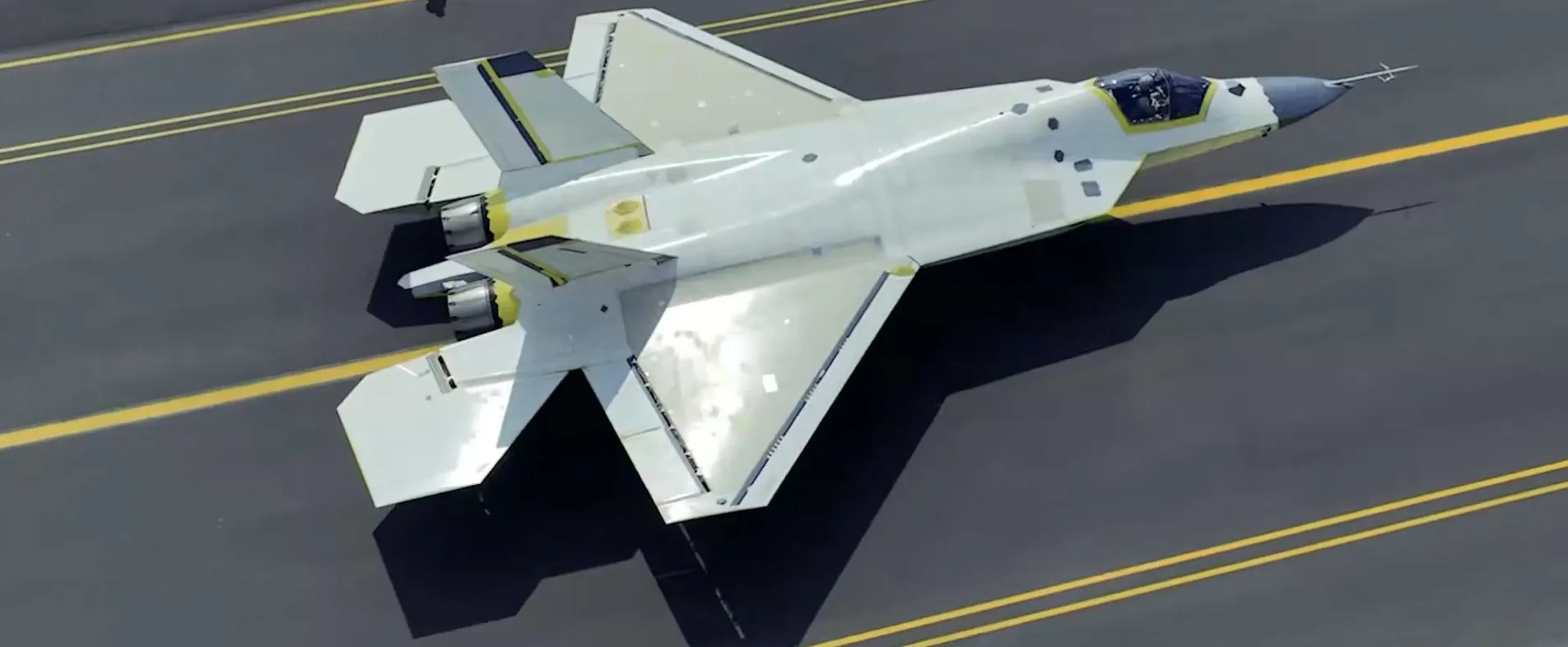
The appearance of P1 also provides the clearest indication yet of how the Kaan design is evolving beyond the original demonstrator. While the overall stealthy twin-engine configuration remains unchanged, the new prototype incorporates several visible refinements that are in line with the move toward a more production-representative aircraft. Compared with P0, the control surfaces have been revised, there are subtle changes around the engine intakes and cockpit areas, and a cleaner external finish.
An overhead view of the P1 during taxi tests. TUSAS
Standard (non-stealthy) exhaust nozzles remain for the twin GE Aerospace F110 turbofans.
The first prototype had a distinctive forward sensor installation, including what appears to be multi-purpose electro-optical and infrared search and track, or IRST, sensors in front of the cockpit and beneath the nose, respectively. These features remain present on the newer aircraft. The faceted sensor enclosures were both removed for the first flight of the P0. You can read more about the aircraft’s intriguing sensor setup here.
Infrared search and track, or IRST sensor on the P1. TUSAS
Turkish Aerospace has not detailed every modification, but P1 is widely expected to feature substantially more representative avionics, flight-control software, and mission systems than the P0, which is largely a proof-of-concept aircraft.
The P1 represents the Kaan program’s transition from a technology demonstrator to a developmental test fleet. Additional prototypes are expected to incorporate further structural, aerodynamic, and systems improvements before the aircraft reaches its final production configuration.
A head-on view of the P1 (above) compared to the P0 (below) reveals a different configuration for the actuators for the aerodynamic surfaces below the wings, a larger sensor aperture above the nose, and landing gear that is both more robust-looking and with main units set wider apart:
Head-on view of the P1 Kaan. TUSASHead-on view of the P0 Kaan. SSB
Turkish Aerospace has indicated that P1’s maiden flight is expected within the next couple of months. A third prototype, designated P2, is also under assembly, with the company aiming to have both aircraft flying before the end of this year. That would significantly accelerate the program by allowing multiple aircraft to conduct different elements of the flight-test campaign simultaneously. Initial deliveries to the Turkish Air Force continue to be targeted for 2028 — an ambitious schedule, to say the least.
The P1 Kaan on the runway. TUSAS
The Kaan program was launched back in 2010 as the Milli Muharip Uçak (MMU), or National Combat Aircraft. Early on in its development, the aircraft was known as the TF-X. Now named TF Kaan, it is very much the jewel in the crown of Turkey’s burgeoning aerospace industry.
The second flight of the first prototype Kaan, on May 6, 2024. According to the statement made by SSB, it stayed in the air for 14 minutes, reaching an altitude of 10,000 feet and a speed of 230 knots. Photo by TUR Defence Industries Presidency/Anadolu via Getty Images Anadolu
However, it is also worth keeping expectations in perspective. Kaan’s stated objective is to deliver a reduced-radar-signature fighter with high performance, advanced avionics, and modern mission systems. Achieving the same degree of sensor integration, data fusion, networking, and low-observable performance as a fifth-generation fighter, such as the F-35, represents a much higher bar. Even so, a meaningful reduction in radar signature — particularly from the frontal aspect — combined with modern sensors and weapons, would still represent a significant step-up in capability, at least in some respects, over Turkey’s existing fighter fleet, which is dominated by the 1970s-era F-16.
Reportedly, Turkey plans to complete three pre-production prototypes, to be followed by 250 series-production aircraft, incorporating yet more refinements.
A top view of the P1 Kaan. TUSAS
Last month, a contract was reportedly signed for 20 examples of the initial Block 10 versions of the Kaan.
One of the biggest questions surrounding the Kaan program has been its powerplant.
Although Turkey ultimately intends to equip the fighter with an indigenous engine, the prototypes and the first production aircraft will instead rely on the U.S.-built F110 turbofan. Export approval for those engines had emerged as one of the program’s most significant schedule risks. F110s are assembled under license in Turkey but are still governed by U.S. export restrictions.
That uncertainty eased after the Trump administration moved to approve the sale of dozens of F110 engines to Turkey in a deal reportedly worth more than $700 million, ensuring propulsion for the prototype fleet and early production aircraft while development of the indigenous TF35000 engine continues. The domestic engine is expected to arrive only in later production blocks, making continued access to the F110 critical to maintaining the current development timeline.
The engine nozzles on the P1 Kaan. TUSAS
The Kaan’s fortunes have also been entwined with Turkish plans to buy the Lockheed Martin F-35. In 2019, Turkey was kicked out of the Joint Strike Fighter program, in which it had been deeply involved, including at an industrial level, with plans to buy around 100 of the stealth fighters. Washington took that decision after Turkey refused to give up its plans to purchase Russian-made S-400 air defense systems. Since then, there have been signs that the United States might reverse its decision and offer Ankara F-35s again, a development that would surely have knock-on effects for the Kaan.
Once in service, it is anticipated that the Kaan will be used alongside one or more domestically developed drones. Chief among these are the ANKA-3, a low-observable flying-wing uncrewed combat air vehicle (UCAV), and the fighter-like Bayraktar Kizilelma. Again, should these prove successful, Ankara may opt for larger fleets of drones at the expense of more costly crewed fighters. The Kizilelma has already completed the first live trials of the K-SWARM concept, demonstrating collaborative operations between crewed and uncrewed aircraft as part of an effort to develop next-generation autonomous air combat capabilities.
A top view of a Kizilelma UCAV. Baykar
It was announced only yesterday that the Kizilelma had successfully used its internal weapons bays to deploy air-to-ground munitions — in the shape of glide bombs — for the first time. The UCAV had already demonstrated surface-strike and air-to-air capabilities using conventional underwing hardpoints.
Export potential is another important consideration. The Kaan enters an increasingly competitive segment of the global fighter market alongside other medium-weight, low-observable designs, including China’s FC-31 and South Korea’s KF-21, both of which are positioned as more affordable alternatives to Western fifth-generation fighters. Turkey is likewise expected to pursue export customers to help sustain production and reduce program costs. Until the TF35000 engine comes online, any Kaan export sales would also be governed by U.S. restrictions on its engines.
The latest taxi-test footage signals that Turkey is moving into the next phase of Kaan development with a more mature prototype and an expanding flight-test fleet. If P1 flies on schedule and P2 follows later this year, Turkish Aerospace will have multiple aircraft collecting flight data in parallel, an essential step if it hopes to meet its questionably ambitious objective of new fighters being handed over to the Turkish Air Force in 2028.
Weekly insights and analysis on the latest developments in military technology, strategy, and foreign policy.
The Turkish Air Force looks set to receive a major boost to its fighter fleet, with the delivery of dozens of F110 engines required to power the homegrown TF Kaan combat jet. This would be one of the most significant positive developments in U.S.-Turkish defense relations since Turkey was ejected from the F-35 program in 2019, and may even pave the way for Ankara to rejoin that effort.
Citing four sources familiar with the matter, Reuters reports that President Donald Trump’s administration plans to go ahead with the engine sale, said to be worth more than $700 million, despite some resistance from Congress.
Reporter: Türkiye wants the F-110 jet engines, and they want their F-35 fighter jets. Are you going to Türkiye with a big gift bag?
Trump: I think so. He’s a member of NATO. Some people don’t consider himself, but he really is.
Ahead of his July trip to a NATO summit in Turkey, Trump was asked by a reporter whether Turkish President Tayyip Erdogan would be provided with a “big gift” in the form of F110 engines and potentially F-35 fighter jets.
“He’s a member of NATO,” Trump replied. “He really is a strong member of NATO. Yeah, I’m going to probably do something that’s going to make him very happy.”
Speaking alongside Trump, Vice President JD Vance said a review was underway to see if Turkey could receive the F-35.
JD Vance on Türkiye’s F-35 jets:
Pete and the entire team are reviewing this right now, because there are certain things that we have to certify have happened — that have happened in order to comply with American law. The president has asked us to do that.
“Pete and the entire team are reviewing this right now, because there are certain things that we have to certify have happened … in order to comply with American law,” Vance said, referring to Secretary of Defense Pete Hegseth.
The question of whether Turkey might receive F-35s has long been a fraught one, with Ankara kicked out of the program back in 2019, a development we will return to later.
For now, however, Turkey’s priority seems to be securing F110 engines.
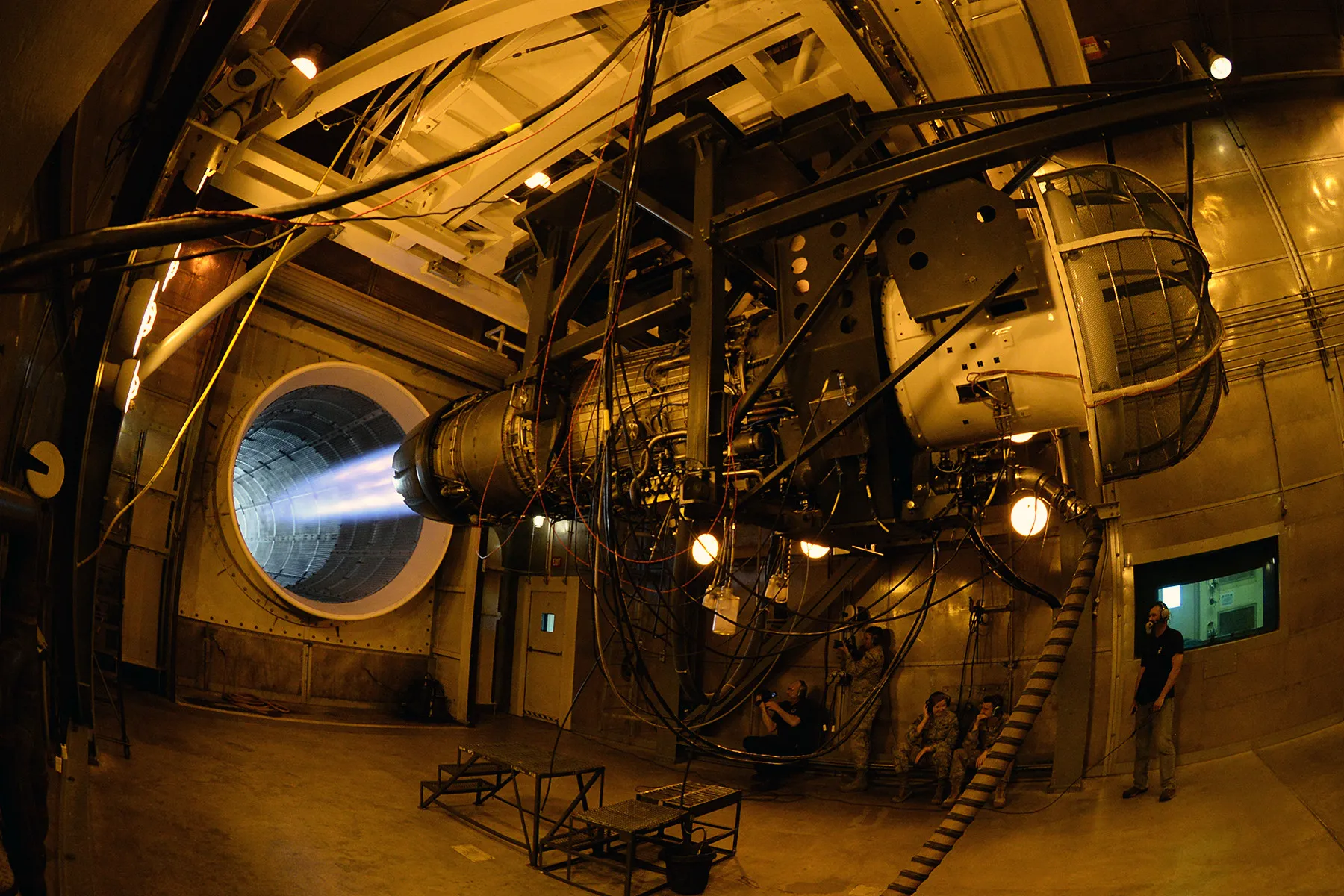
The F110 engine for an F-16 at max power during a test in the hush house engine facility at Hill Air Force Base, Utah. U.S. Air Force photo by Alex R. Lloyd
Turkey’s TF Kaan next-generation fighter is a flagship program of the country’s burgeoning aerospace industry. The program was launched in 2010, and the first prototype took to the air in early 2024.
Reportedly, Turkey plans to complete three pre-production prototypes, to be followed by 250 series-production aircraft, incorporating various refinements.
Last month, a contract was reportedly signed for 20 examples of the initial Block 10 versions of the Kaan.
The twin-engine Kaan was developed with a reduced radar signature in mind, as well as a high level of performance and modern avionics and other systems. As a result, it doesn’t offer the same level of low observability as the F-35, while its sensor fusion, electronic warfare capabilities, and other ‘fifth-generation’ features lag behind the U.S.-designed jet.
One of the F-35s that was completed for Turkey before its ejection from the program. Lockheed Martin
Critically, the Kaan is powered by U.S.-supplied General Electric F110 turbofans.
F110s are assembled under license in Turkey by TUSAS Engine Industries (TEI) but are still governed by U.S. export restrictions. These engines are already used in significant numbers by the Turkish Air Force F-16 fleet, the third-largest in the world. Outside of the F-16, the F110 is also used in the F-15E Strike Eagle and F-15EX Eagle II, among other F-15 variants. An F110 comes with a typical flyaway unit cost of $10 to $15 million.
The Kaan program has long been overshadowed by the question of whether Washington will make available in larger numbers the F110 turbofans used in the prototype. Reportedly, an initial batch of 80 engines is required.
While Turkish officials have expressed hope of ultimately switching to a domestically produced engine type for the Kaan, TEI’s TF35000, it’s unclear how realistic this is, at least in the near term. Turkey has also looked at acquiring alternative engines, too, including those from Russia or Rolls-Royce in the United Kingdom.
In the meantime, the importance of the Kaan to the Turkish Air Force increased significantly in 2019, when it became clear that Ankara would be kicked out of the F-35 program, in which it had a considerable industrial stake, and a plan to buy around 100 of the fighters. Washington took that decision after Turkey refused to abandon its purchase of Russian-made S-400 long-range air defense systems.
A Russian Ilyushin Il-76, carrying the first batch of equipment for the Turkish S-400 missile defense system, arrives at Murted Air Base in Ankara on July 12, 2019. Photo by Turkish National Defense Ministry / Handout/Anadolu Agency/Getty Images
As well as the S-400, U.S. lawmakers were unhappy with Turkey’s worsening relations with Greece, its other connections with Russia and Azerbaijan (which included the deployment of F-16s to the latter country), its conduct in the Syrian civil war, and human rights abuses. Turkey’s opposition to Sweden joining NATO also proved to be a significant hurdle.
In the wake of all this, the chances of Turkey receiving F110 engines were dramatically reduced. At the same time, Turkey’s request to buy additional F-16 fighters was also turned down. Turkey reportedly also began stockpiling spare parts for its F-16 back in 2019, fearing the effects of U.S. sanctions.
Turkish Air Force F-16 fighters at Balikesir, Turkey, in May 2022. Photo by Ali Atmaca/Anadolu Agency via Getty Images
Toward the end of the Biden administration, U.S.-Turkish relations began to improve, and Washington moved to push through sales of new F-16s and upgrade kits for older jets to Turkey. There also began to be suggestions that the F-35 was potentially back on the table for Turkey.
Under the Trump administration, Washington’s relationship with Ankara has become closer, with Erdogan frequently praised by the U.S. leader.
At the same time, the issue surrounding the S-400 and the sanctions that followed that acquisition remains.
As it stands, U.S. law does not permit Turkey to operate or possess the S-400 system if it wishes to rejoin the F-35 program, as a result of security concerns around the Russian-made system.
The first F-35 for Turkey was rolled out during a ceremony at the Lockheed Martin plant in Fort Worth, Texas, on June 21, 2018. Photo by Atilgan Ozdil/Anadolu Agency/Getty Images
During a visit to Turkey in early 2024, the U.S. Acting Deputy Secretary of State Victoria Nuland reportedly suggested that the United States might be willing to offer Patriot air defense systems if it were to give up its S-400s, which could also clear the way to re-entering the F-35 program.
“Frankly, if we can resolve this S-400 issue, which we want to do, the United States would be pleased to welcome Turkey back into the F-35 family,” Nuland said. “But we must solve this other issue first, and while we solve it, we must also ensure that Turkey has a strong air defense.”
The apparent decision to clear the F110 sale certainly represents a further softening of Washington’s stance, and it could be a stepping-stone to Ankara eventually being readmitted to the F-35 program.
Turkey’s desire for F-35s has only been intensified by the fact that Greece, its major strategic rival, has been approved for a purchase of the jets. You can read all about how tensions between Greece and Turkey are reflected in the countries’ respective air forces in this previous feature.
Presentation ceremony of the Kaan on May 1, 2023, in Ankara. Photo by Yavuz Ozden/ dia images via Getty Images
Even regarding the F110 transfer, some opposition to defense sales to Turkey remains in Washington.
In particular, Representative Gregory Meeks of New York, the leading Democrat on the House of Representatives Foreign Affairs Committee, has reportedly stood in the way of the engine sale during an informal review process.
However, according to the four sources who spoke to Reuters, the F110 deal should be “finalized in the coming days, followed by a formal notification from the State Department to Congress.”
While lawmakers can use the congressional review process to raise their concerns over big-ticket defense exports, the administration can override these.
According to the Wall Street Journal, the Trump administration is expected to override Meeks’ effort to block the engine deal.
For the Kaan program, the F110 is vital.
Denied the F-35 and with F-16 deals moving forward only slowly, Turkey has been forced to look elsewhere to meet its short-term fighter needs. Most significantly, it signed a deal for 20 Eurofighter Typhoon jets last October.
U.K. Prime Minister Keir Starmer and Turkish President Tayyip Erdogan sign the Typhoon deal in Ankara in October 2025. Eurofighter
Turkey has also been investing heavily in drones, including the ANKA-3, a low-observable flying wing uncrewed combat air vehicle (UCAV), and the fighter-like Bayraktar Kizilelma. Still, these are viewed as adjuncts to advanced crewed fighters, like the Kaan.
Whether securing the F110 engines means the Kaan meets its target of service entry around the 2030 timeframe remains questionable.
However, it is a major step in that direction.
As well as being fielded by the Turkish Air Force, the Kaan could have significant potential for export, although sales would be governed by U.S. restrictions on its engines. It is one of a number of medium-weight fighters that feature low-observable characteristics and advanced avionics. These include China’s FC-31 and South Korea’s KF-21.
The Chinese Shenyang FC-31 fighter prototype. via Chinese internet
Perhaps most importantly, the F110 deal would get back on track what is very much the flagship of Turkey’s military aerospace industry. At the same time, a U.S. decision to provide Ankara with these engines will also be welcomed by those in Turkey who still wish for a way back into the F-35 program.
Weekly insights and analysis on the latest developments in military technology, strategy, and foreign policy.
Turkey’s Baykar and Leonardo of Italy say they have successfully completed the first live trials of their K-SWARM concept, demonstrating collaborative operations between crewed and uncrewed aircraft as part of an effort to develop next-generation autonomous air combat capabilities. The trials, involving Baykar’s Kizilelma uncrewed combat air vehicle (UCAV) and Leonardo’s M-346 light fighter-trainer aircraft, are the latest to explore what is fast becoming a key element in the evolution of air combat.
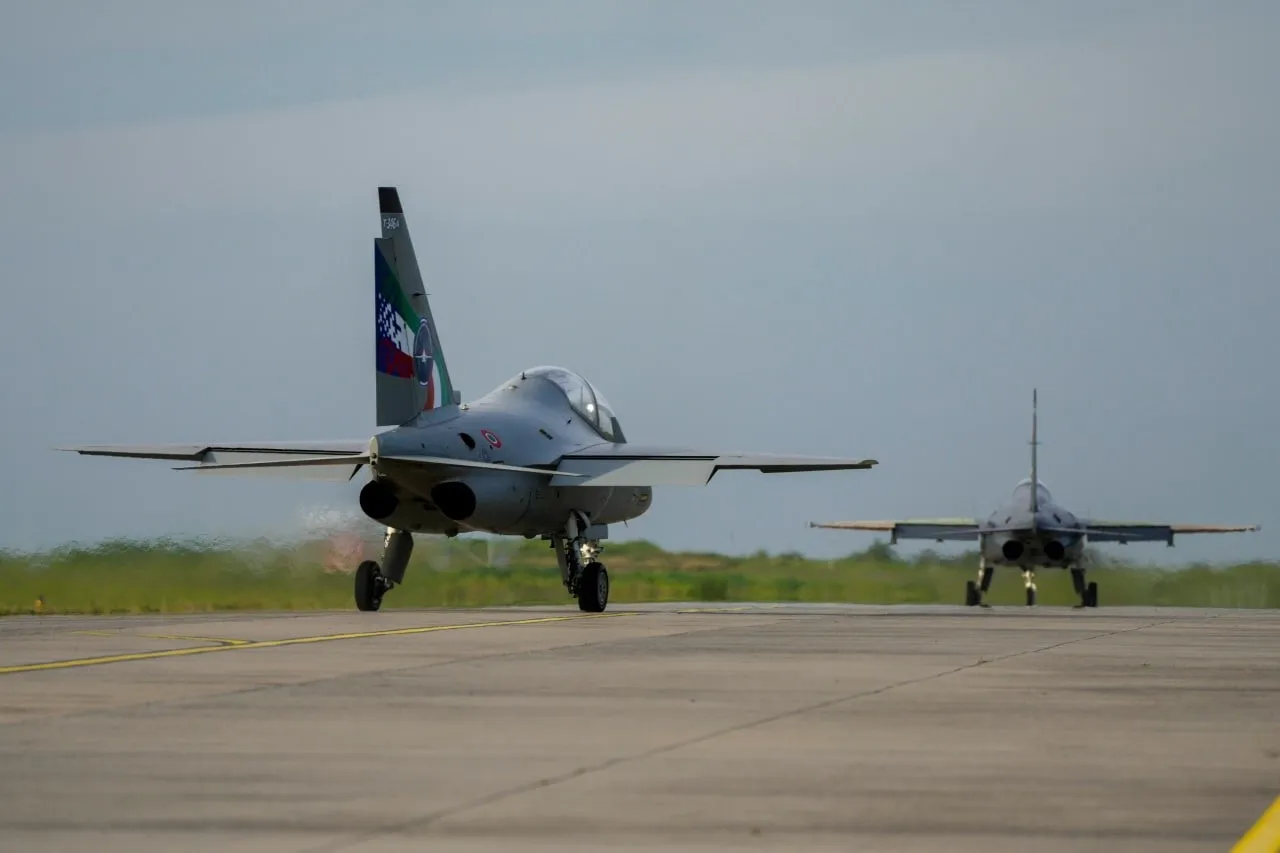
Leonardo and Baykar announced the development today. The trials took place last month at Baykar’s flight and test center in Çorlu, Turkey, and involved a Leonardo-owned M-346 Fighter Attack variant and a Kizilelma UCAV. An Italian Air Force T-346A, the trainer version of the M-346, was on hand as chase aircraft.
T-346A and M-346FA taxi out for a sortie during the K-SWARM trials. Leonardo
During the flight-test campaign, the Kizilelma completed its taxi and takeoff autonomously. It then autonomously joined the M-346 in formation. At this point, the two-person crew in the jet assumed full control of the Kizilelma.
The Kizilelma used so-called Smart Fleet Autonomy algorithms developed by Baykar’s Hardware-in-the-Loop (HIL) Laboratory for the trials.
Once ‘handed over’ to the M-346, the pilots in the jet made use of a newly developed and fully integrated avionics suite to command different formations. Via a crewed/uncrewed computing system, the Kizilelma performed different maneuvers and formations, including position changes, separations and rejoins. These were executed autonomously by the drone, with the M-346 pilots only responsible for providing the initial commands.
The M-346FA as used in the K-SWARM trials. Leonardo
What was described as an advanced radio-frequency data exchange system was used to share all data between the platforms.
The Kizilelma/M-346 trials in Çorlu were the first live phase of Leonardo and Baykar’s K-SWARM program, which focuses on developing interoperability between crewed and uncrewed aircraft. The companies refer to this as crewed/uncrewed teaming (CUC-T), but it’s also referred to by other names, including manned-unmanned teaming (MUM-T), or collaborative combat teaming.
TWZ was provided the opportunity to experience the M-346FA firsthand during a visit and demonstration flight at the Beech Factory Airport in Wichita, Kansas:
We Fly Aboard The M-346 That Could Become The Navy’s Next Jet Trainer
Whatever the term, the ambition is similar: to have future fighter pilots go into battle accompanied by drones under their control, ready to fire weapons, gather intelligence, jam communications, or serve as decoys.
Baykar and Leonardo helped accelerate the start of these crewed/uncrewed teaming trials by first running simulated missions, including using an M-346 full-mission simulator in Venegono, Italy, and the Leonardo product capability and concept laboratory, or PC2LAB, in Turin. This meant that algorithms, as well as tactics and procedures, could be tested in the virtual realm first.
The Kizilelma’s rapid rise to prominence as a fighter-like UCAV has been notable, and there have been some impressive milestones along the way.
A top view of a Kizilelma UCAV. Baykar Baykar
In general, the Kizilelma is one of only a few fighter-type air combat drone projects to have resulted in hardware. The development of the Kizilelma began as long ago as 2013, although the project was only revealed to the public in July 2021, when conceptual studies were presented.
Kizilelma was flown first — very briefly — in December 2022, as you can read about here. That milestone came only weeks after the Kizilelma’s emergence for ground testing.
The UCAV is claimed to be supersonic (at least in later versions), have a degree of reduced-observable characteristics, and be tailored for the kinds of air combat missions typically undertaken by crewed fighter jets. In particular, it is eyed as being a drone companion to Turkey’s next-generation TF Kaan crewed fighter. In its definitive form, the drone is powered by a single Ukrainian-made Ivchenko-Progress AI-322F turbofan delivering close to 10,000 pounds of thrust with afterburner.
A next set of K-SWARM tests is planned for the coming months, with more complexity and additional functions. The companies say these will require greater levels of situational awareness and assets working together ‘as one’ toward mission objectives. Further details, including how enhanced situational awareness will be achieved, were not disclosed, but it should be noted that the Kizilelma has already been tested with a Toygun electro-optical sensor and targeting system, as well as an active electronically scanned array (AESA) radar.
Ultimately, however, the K-SWARM program aims to harness AI technology to enable uncrewed systems to incrementally shift from remote piloting to autonomy, suggesting that, in future trials, the Kizilelma will autonomously conduct more complex missions and maneuvers on the command of the M-346 pilots. At all times, those human pilots will maintain full control and decision-making, the companies say.
A UCAV operating under the control of a crewed tactical jet represents a major milestone for Turkey, placing it among a very small group of countries pursuing this advanced capability. Publicly, such crewed-uncrewed teaming has largely been confined to experimental efforts in the United States and China. We meanwhile know a lot about what the United States has been doing in the “white world” in this regard, and it is now only accelerating its CCA efforts, while it is clear that China has also prioritized it.
A view from the backseat of an L-39 Albatros light jet being used as a drone controller in a Skunk Works test. Note the touch-screen type user interface. Lockheed Martin
Russia has also reportedly flight-tested its S-70 Okhotnik UCAV with a crewed Su-57 Felon fighter, but there is no confirmation about the degree of collaboration achieved. Last year, meanwhile, the U.S. Air Force demonstrated an MQ-20 Avenger drone being controlled by a pilot in an F-22 Raptor, during a mock mission.
Given the current surge in interest in collaborative combat aircraft (CCAs), the joint trials by Baykar and Leonardo also appear especially well-timed.
To take just one European country, Germany currently has a stated requirement for an operational CCA to be fielded before the end of this decade. While the Kizilelma might not necessarily be in the running for that, the AI technology that it is now demonstrating could be of considerable interest to a variety of export customers.
The Kizilelma during earlier taxi trials. Baykar
Meanwhile, the Kizilelma, like other Turkish defense products, comes with the advantage of being free from the restrictions imposed by the U.S. International Traffic in Arms Regulations (ITAR) guidelines. ITAR serves to limit the transfer of defense and military technologies and services — especially the more sensitive ones — to certain countries. Already, Turkey has leveraged its drone developments to secure major arms sales to a variety of countries for which these kinds of capabilities would otherwise be out of reach — in both technological and political terms.
The opportunity for Turkey to offer for export the Kizilelma in concert with the high-end TF Kaan, or the lower-end Hürjet light combat aircraft, would put it in a unique position, at least in Europe. The same platforms could also be supplied with integrated weapons options, providing another significant advantage.
Turkish light fighter trainer made its first flight in 2023. TAI screencap TAI screencap
As for Leonardo, the M-346 has recorded some notable sales, with the combat-optimized Fighter Attack version also gaining increasing traction. Meanwhile, through its stake in Eurofighter, the Italian firm may well be looking forward to offering these ‘drone commander’ capabilities to the multirole fighter. As we have discussed only recently, the collapse of the pan-European Future Combat Air System (FCAS) effort means that CCA capabilities are even more in the spotlight, including efforts to team UCAVs with advanced fourth-generation platforms like the Eurofighter Typhoon.
A rendering from Airbus of manned-unmanned teaming with Typhoon fighters, a type that is also on order for Turkey. Airbus
For Baykar and Leonardo, demonstrating that the Kizilelma can be commanded from an M-346 is an important achievement, but scaling that capability to different aircraft, larger formations, and increasingly autonomous mission execution will ultimately determine whether K-SWARM becomes an operational capability rather than simply a technology demonstrator. It should also be remembered that while the autonomy engine and AI agent are critical parts of an effective fighter-CCA teaming concept, it is unclear how developed these technologies are in the K-SWARM experiments. After all, just controlling the UCAV is one thing, but having the drone do much of the thinking while the pilot gives approvals and basic directions is the key. The companies have also proposed developing these technologies further to achieve ‘swarming,’ which presents an even greater challenge in this context.
However, with demand for affordable force multipliers continuing to grow and air forces looking for ways to increase combat mass without buying ever more expensive crewed fighters, a UCAV that can combine with a crewed combat aircraft further demonstrates the rapid pace of advances in Turkey’s burgeoning drone capabilities.