Tulsi Gabbard

Trump says he wants his new acting director of national intelligence to cut the office

President Trump said Friday that he wants Bill Pulte, his new acting director of national intelligence, to cut the office, which has already been significantly scaled back during his second term.

Trump noted that the size of the office has been “way too high for way too long” and that “if he cut, I wouldn’t mind.”

“Bill Pulte is very good, he’s very talented,” Trump told reporters on Air Force One as he traveled to Wisconsin. The Republican president said in an earlier interview with the Wall Street Journal that he has asked Pulte to start the process of firing employees.

In the interview with the Journal, the president says he has already conveyed his view to Pulte, the incoming acting director of national intelligence, who has served as head of the Federal Housing Finance Agency but apparently has no national security expertise.

“I’d like to see it smaller. I think there are a lot of people in there that shouldn’t be there,” Trump said, which the Journal said was in reference to intelligence community officials who had served in the Democratic administrations of Presidents Biden and Obama.

Trump told the Journal that he wants Pulte to “start the process” of firing personnel and that the eventual permanent director of national intelligence should continue it. The president has indicated that he would not formally nominate Pulte for the position.

“Frankly, it might be good for him to shake it up before people come,” Trump said. “Because, if he [Pulte] reduced the size, in conjunction with me … and in conjunction with possibly the person coming in … he can do a lot of the hard work and we wouldn’t have to saddle somebody that goes in.”

Pulte was tapped by the president earlier this week in a surprising move that has been met with bipartisan resistance in the Senate, which confirms presidential nominations. The temporary appointment has now snarled the renewal of a critical national security surveillance program on Capitol Hill, with Democrats key to the vote pointing out that they did not trust Pulte — whose office oversees 18 intelligence agencies — to help administer the surveillance program.

Under Pulte’s successor, Tulsi Gabbard, the director of national intelligence’s office had already taken steps to scale back its size. In August, the Trump administration said that the office’s budget would be cut by more than $700 million per year, while slashing the size of its workforce.

At the time, Gabbard said the office had become “bloated and inefficient” while she announced the roughly 40% workforce reduction.

Gabbard resigned last month after revealing her husband’s cancer diagnosis.

Price and Kim write for the Associated Press. Kim reported from Washington.

Source link

Trump: Pulte won’t be ‘permanent’ director of national intelligence

June 4 (UPI) — Acting Director of National Intelligence Bill Pulte, whose new assignment has drawn bipartisan criticism, won’t be the “permanent” choice for the job, President Donald Trump said Thursday.

Trump, speaking to reporters Thursday the White House, said Pulte’s role as acting director of DNI to replace Tulsi Gabbard, which began Tuesday, would not be “permanent.”

Rather, the president said Pulte will be “very good” as he takes the job on for a “little while,” while also asserting he will be able to “figure it out quickly.”

Gabbard announced her resignation in May, saying she will step down June 30, and Trump’s pick of Pulte to replace her two days ago ignited a backlash among lawmakers of both parties.

A former housing developer and currently director of the Federal Housing Finance Agency, Pulte — a staunch Trump loyalist — has no experience in foreign intelligence work, a fact that has sparked criticism from both sides of the political aisle.

Sen. Thom Tillis., R-N.C., on Wednesday blasted Pulte as an “incendiary attack dog” for Trump who likely wouldn’t pass Senate muster for confirmation.

“I don’t think he has a prayer” of becoming the permanent DNI, Tillis told CNBC, adding that Pulte’s presence could hurt the GOP congressional majority’s efforts to reauthorize the part of the Foreign Intelligence Surveillance Act governing warrantless surveillance.

Similarly, Sen. Ron Wyden, D-Ore., a long-serving member of the Senate Intelligence Committee, decried the choice of Pulte for DNI director, saying Trump is “appointing his top political henchman to one of the most important positions for protecting the safety of Americans and preventing terrorist attacks like September 11th.”

Pulte, he said, “appears to be unscathed by intelligence or any semblance of ethics,” noting he has already used his post at a housing agency “to persecute Trump’s political opponents, including Senator Adam Schiff, New York Attorney General Leticia James and Federal Reserve Board member Lisa Cook.”

Pulte has alleged fraud against several of Trump’s foes in their mortgage applications, including Cook for claiming two different homes as her primary residence. She has appealed her firing by Trump to the U.S. Supreme Court.

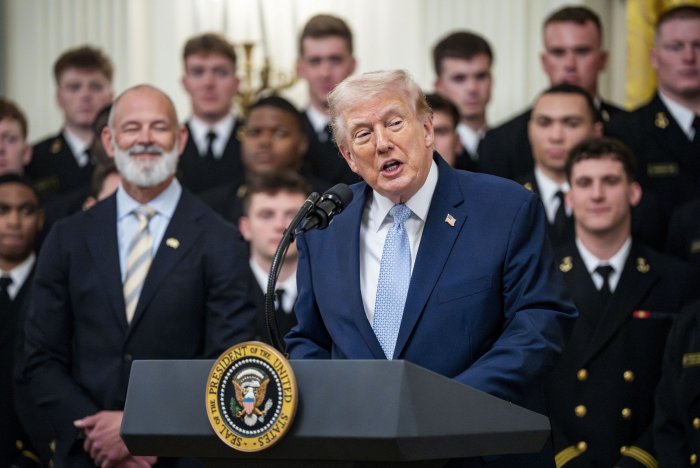
President Donald Trump presents the Commander in Chief’s Trophy to the Navy Midshipmen football team during a ceremony in the East Room of the White House on Friday. The award is presented annually to the winner of the football competition between the Navy, Air Force and Army. Navy has won the trophy back to back years and 13 times over the last 23 years. Photo by Bonnie Cash/UPI | License Photo

Source link

Trump taps housing finance director Pulte as acting director of national intelligence

President Trump has tapped Bill Pulte, head of the Federal Housing Finance Agency, to be the acting director of national intelligence — putting a real estate scion and fierce Trump loyalist in a key national security post as the U.S. remains at war with Iran.

Trump made the surprise announcement Tuesday on social media that Pulte would be replacing Tulsi Gabbard, the former Hawaii congresswoman who served as the director of national intelligence.

The Republican president cited Pulte’s work at the FHFA and his role as chair of the mortgage giants Fannie Mae and Freddie Mac, saying that the 38 year-old “has deep experience managing the most sensitive matters in America, the safety and soundness of the Markets, and over 10 Trillion Dollars at Fannie Mae/Freddie Mac, a substantial increase from where it was just 12 months ago.”

Pulte’s sudden elevation to a role coordinating sensitive national security matters is a sign of how Trump is putting a priority on loyalty over a traditional resume full of previous military and intelligence assignments. It’s unclear what national security expertise Pulte has, but he has been a frequent guest on Air Force One as Trump has traveled to Mar-a-Lago, his home and club in Palm Beach, Florida.

As the grandson of the founder of PulteGroup, one of the country’s largest homebuilders, Pulte has cut a combative streak on social media and used his post at the FHFA to attack perceived opponents of the Trump administration.

His time overseeing mortgage finance has been linked with criminal referrals for mortgage fraud by public officials Trump sought to punish, including New York Attorney General Letitia James, a Democrat; Sen. Adam Schiff, D-Calif.; and Lisa Cook, a member of the Federal Reserve, who was nominated by a Democratic president, Joe Biden.

Pulte has famously gone after then-Federal Reserve Chair Jerome Powell for not cutting the central bank’s benchmark interest rates as aggressively as the president wanted. He has also been linked to ideas such as the 50-year mortgage and efforts to lower mortgage rates through the purchase of home loan debt that have not paid off as promised.

Trump said Pulte will keep his other positions even as he fills in for Gabbard, who resigned last month after revealing her husband’s cancer diagnosis.

If formally nominated, Pulte would need to be confirmed by the Senate to hold the position full time.

Boak writes for the Associated Press.

Source link

Trump moves cabinet meeting back to White House citing weather

May 27 (UPI) — President Donald Trump said his cabinet meeting on Wednesday afternoon will be at the White House instead of Camp David, as was planned, due to weather.

“Based on the possible bad weather conditions tomorrow, we will be having our Cabinet Meeting in the White House, and will be postponing the Cabinet trip to Camp David,” Trump posted on Truth Social Tuesday afternoon.

Thunderstorms are expected in the region.

The meeting will “highlight recent successes of the administration, including economy and small business wins, Task Force to Eliminate Fraud highlights, and foreign policy updates,” a White House official told ABC News.

Trump hasn’t been to the Presidential Retreat at Camp David in Frederick County, Md., in nearly a year.

Director of National Intelligence Tulsi Gabbard is expected to attend. She will depart her position at the end of June after announcing her resignation last week.

President Donald Trump leaves the White House on Tuesday. Trump is traveling to Walter Reed National Military Medical Center for his annual physical. Photo by Will Oliver/UPI | License Photo

Source link

Tulsi Gabbard resigns as intelligence chief after husband’s cancer diagnosis

May 22 (UPI) — Tulsi Gabbard resigned as director of national intelligence Friday to support her husband, who has been diagnosed with a rare form of bone cancer.

Gabbard said in a resignation letter, which she posted on X, that after her husband Abraham Williams’ recent diagnosis she will “step away from public service to be by his side and fully support him through this battle.”

The principal deputy director of national intelligence, Aaron Lukas, will take over as acting DNI after Gabbard departs June 30, President Donald Trump said in a post on Truth Social.

“I am deeply grateful for the trust you placed in me and for the opportunity to lead the Office of the Director of National Intelligence for the last year and a half,” Gabbard said in her letter.

Gabbard, who told Trump that she is resigning during a meeting in the Oval Office on Friday, was a controversial nominee for the position.

Nearly all Republicans voted to confirm her on a party-line vote, but former Senate Republican leader Sen. Mitch McConnell voted against her because she had “failed to demonstrate” that she was ready for the position.

Before she was named DNI, Gabbard served in the U.S. House of Representatives and the Hawaii House of Representatives dating to 2002.

The decision to resign, Gabbard said, is the balance of her husband’s dedication to her career, dating to her time in the military, and that she “cannot in good conscience ask him to face this fight alone while I continue in this demanding and time-consuming position.”

In his post, Trump said that Gabbard “has done an incredible job, and we will miss her.”

“She, rightfully, wants to be with [Abraham], bringing him back to good health as they currently fight a tough battle together,” Trump said. “I have no doubt he will soon be better than ever.”

Kevin Warsh takes the oath of office as he is sworn-in as the new chairman of the Federal Reserve by Supreme Court Associate Justice Clarence Thomas in the East Room of the White House on Friday. Photo by Yuri Gripas/UPI | License Photo

Source link

Tulsi Gabbard resigns as director of national intelligence, citing her husband’s health

Tulsi Gabbard resigned as President Trump’s director of national intelligence on Friday, saying she needed to step away as her husband battles cancer. She is the fourth Cabinet official to depart during Trump’s second term.

“Unfortunately, I must submit my resignation, effective June 30, 2026,” Gabbard wrote in her resignation letter, which she posted on X. “My husband, Abraham, has recently been diagnosed with an extremely rare form of bone cancer.”

There had been rumblings that Gabbard would split with Trump after the president’s decision to strike Iran, which caused some division within his administration. Joe Kent, the director of the National Counterterrorism Center, announced his resignation in March, saying he “cannot in good conscience” back the war.

Gabbard, a veteran and former Democratic congresswoman from Hawaii, built her political name on her opposition to foreign wars. This put her in an awkward position when the U.S. joined Israel in launching attacks on Iran on Feb. 28.

During a congressional hearing in March, her measured comments were notable for their careful non-endorsement of Trump’s decision to strike Iran. She repeatedly dodged questions about whether the White House had been warned of potential fallout from the conflict, including Iran’s effective closure of the Strait of Hormuz.

Gabbard said in written remarks to the Senate Intelligence Committee that there had been no effort by Iran to rebuild its nuclear capability after U.S. attacks last year “obliterated” its nuclear program. That statement contradicted Trump, who has repeatedly asserted that the war was necessary to head off an imminent threat from the Islamic Republic.

This created several awkward exchanges with lawmakers who asked Gabbard for her opinion on the threat posed by Iran as the nation’s top intelligence official. She repeatedly said it was Trump’s decision to strike, not hers.

“It is not the intelligence community’s responsibility to determine what is and is not an imminent threat,” she said.

Gabbard’s departure follows Trump having ousted Homeland Security Secretary Kristi Noem in late March, in the midst of mounting criticism over her leadership of the department — including the handling of the administration’s immigration crackdown and disaster response.

The second Cabinet member to leave was Attorney General Pam Bondi, in response to growing frustration over the Justice Department’s handling of files related to Jeffrey Epstein. And Labor Secretary Lori Chavez-DeRemer resigned in April, after being the target of various misconduct investigations.

A surprising choice for the job

A veteran but without any intelligence experience, Gabbard was a surprising choice to head the Office of the Director of National Intelligence, which oversees the nation’s 18 intelligence agencies. She ran for president in 2020 on a progressive platform and her opposition to U.S. involvement in foreign military conflicts.

Citing her military experience, she argued that U.S. wars in the Middle East had destabilized the region, made the U.S. less safe and cost thousands of American lives. Gabbard later dropped out of the race and endorsed the ultimate winner, President Joe Biden.

Two years later she left the Democratic Party to become an independent, saying her old party was dominated by an “elitist cabal of warmongers” and “woke” ideologues. She subsequently campaigned for several high-profile Republicans and became a contributor to Fox News.

She later endorsed Trump, who also was a strong critic of past U.S. wars in the Middle East and campaigned on a pledge to avoid unnecessary wars and nation-building overseas.

Iran caused early tensions

But friction with the president started soon after he began his second term and tapped Gabbard to lead ODNI, which was set up after the Sept. 11, 2001, attacks to improve coordination between the nation’s intelligence agencies.

Shortly after taking on the job, Gabbard testified before lawmakers that there was no intelligence suggesting Iran was seeking to develop nuclear weapons. After Trump launched attacks on Iranian nuclear sites in June he said Gabbard was wrong and that he didn’t care what she said.

She appeared to be back in Trump’s good graces when she took a lead role in Trump’s effort to relitigate his 2020 election loss to Biden, whom Gabbard had endorsed. She appeared at an FBI search of election offices in Fulton County, Georgia, even though her office was created to focus on foreign espionage, not state elections.

Earlier this week, however, she testified to lawmakers during an annual threats hearing that last year’s strikes on Iran’s nuclear sites had “obliterated” their nuclear program and that there had been no subsequent effort to rebuild.

The statement seemed to complicate Trump’s repeated assertions that Iran posed an imminent threat and created several awkward exchanges with lawmakers who asked Gabbard for her opinion on Iran’s threat as the nation’s top intelligence official. She repeatedly said that it was Trump’s decision to strike, not hers.

“It is not the intelligence community’s responsibility to determine what is and is not an imminent threat,” she said at one of this week’s hearings.

Gabbard wrought big changes in one year

Gabbard vowed to eliminate what she said was the politicization of intelligence by government insiders. But she quickly used her office to support some of Trump’s most partisan of arguments — that he won the 2020 election.

She also worked to undermine the results of earlier investigations into Trump’s ties to Russia.

In her year on the job, Gabbard oversaw a sharp reduction in the intelligence workforce, as well as the creation of a new task force that she charged with considering big changes to the intelligence service.

Earlier this year an intelligence sector whistleblower filed a complaint that Gabbard was withholding intelligence for political reasons, a complaint that prompted calls from Democrats for Gabbard’s resignation.

Gabbard, 44, was born in the U.S. territory of American Samoa, raised in Hawaii and spent a year of her childhood in the Philippines. She was first elected as a 21-year-old to Hawaii’s House of Representatives but had to leave after one term when her National Guard unit deployed to Iraq.

As the first Hindu member of the House, Gabbard was sworn into office with her hand on the Bhagavad Gita, the Hindu devotional work. She was also the first American Samoan elected to Congress.

During her four House terms she became known for speaking out against her party’s leadership. Her early support for Sen. Bernie Sanders ’ 2016 Democratic presidential primary run made her a popular figure in progressive politics nationally.

Kinnard, Weissert and Klepper write for the Associated Press.

Source link

Lawmakers grill Pete Hegseth over Iran war in defense budget hearing

WASHINGTON, Apri; 29 (UPI) — Secretary of Defense Pete Hegseth alternated between championing a proposed massive increase to defense spending and fielding attacks from Democratic lawmakers during testimony on Capitol Hill Wednesday.

It marked the secretary’s first appearance before lawmakers since the start of a war that has roiled the global economy and decimated Iran’s military.

Hegseth appeared before the House Armed Services Committee alongside Gen. Dan Caine, chairman of the Joint Chiefs of Staff, and the Pentagon’s comptroller, Jules Hurst III. They entered the hearing room past protesters’ chants of “arrest Hegseth” and yells of “war criminal.” The secretary appeared unfazed.

“We’re rebuilding a military that the American people can be proud of — one that instills nothing less than unrelenting fear in our adversaries.” Hegseth said in his opening statement.

Hegseth’s testimony was intended to serve as a defense of the White House’s petition to Congress for $1.5 trillion in defense spending for 2027, a 44%t increase from the 2026 budget.

It’s an increase that, by itself, would be more than the total defense spending of any other nation, according to recently released figures. The spending level exceeds that spent on the Reagan-era military buildup and would be only overshadowed by levels seen during World War II.

The spending boom would come at the cost of domestic programs and at a time when federal tax revenue is set to take a $4.5 trillion hit over the next 10 years, mostly from tax cuts codified in last year’s One Big Beautiful Bill Act, according to the Bipartisan Policy Center, a Washington-based think tank.

But rather than question Hegseth on the specifics of the budget proposal, many Democratic members grilled him about the war in Iran, recent firings of senior leaders in the Pentagon and lethal strikes against alleged drug traffickers in the Pacific and Caribbean oceans.

In one heated exchange, Rep. John Garamendi, D-Calif., delivered a sharp critique of the war in Iran when questioning the defense secretary, calling it a “blunder” in which the United States had expended much to gain little.

Garamendi said it would take years for the U.S. and global economies to recover. The war has hiked average unleaded gas prices in the country to more than $4.20 a gallon and inflation to its highest level in nearly two years.

“Secretary Hegseth, you have been lying to the American public about this war from Day 1,” Garamendi said. “The strategy has been an astounding example of incompetence.”

Hegseth counterattacked. With his voice raised, he accused the congressman of “handing propaganda to our enemies.”

“I hope you appreciate how reckless it is,” Hegseth said of Garamendi’s description of the two-month-long war as a quagmire. “Shame on you.”

Hurst, the comptroller, told lawmakers the Iran war has cost the Pentagon $25 billion. Committee ranking member Rep. Adam Smith, D-Wash., responded that was the first time he had been given a cost figure, despite repeated inquiries to the department.

In March, the Pentagon reportedly petitioned Congress for an additional $200 billion to replace stocks from the war and prepare for future operations, should they be ordered. When asked about it at the time, Hegseth indicated the report’s veracity.

“That number could move, obviously,” Hegseth said then. “It takes money to kill bad guys.”

Hegseth’s central defense of the war during the hearing was arguing that it served to prevent Iran from obtaining a nuclear weapon. Republican members echoed his contention.

Iran maintains uranium supplies that could eventually be used to build a nuclear weapon if it were to be further enriched. But since the U.S. bombed Iran’s nuclear facilities in June, Iran has made “no efforts since then to try to rebuild their enrichment capability,” Tulsi Gabbard, the director of national intelligence, said in a written statement to Congress in March.

“What is it worth to ensure Iran never gets a nuclear weapon?” Hegseth asked rhetorically in Wednesday’s hearing.

A defense budget unprecedented in modern times

The Pentagon’s budget request is composed of $1.1 trillion in base discretionary funding and an additional $350 billion in mandatory spending.

The mandatory funds, which are earmarked mostly for munitions and the expansion of the defense industry, would go through the budget reconciliation process and therefore would be shielded from a potential Democratic filibuster in the Senate.

The expansion of America’s defense industrial base — the network of private manufacturers that supply the Pentagon — is a central facet of the proposed budget.

“President Trump inherited a defense industrial base that had been hollowed out by years of ‘America Last’ policies,” Hegseth said. “Under the leadership of President Trump, our builder-in-chief, we are reversing this systemic decay and putting our defense industrial base on a war-time footing.”

Another of the administration’s top defense funding priorities, as reflected in the budget document, is the procurement of munitions.

“Critical munitions are vital to the administration’s priorities to defend the homeland and deter potential aggression after years of neglect by the previous administration,” the White House wrote in a recent budget justification. Limited munitions stockpiles and the United States’ inability to quickly produce them have long troubled U.S. war planners.

While the Trump administration has pushed to expand munitions stockpiles, it has also expended massive amounts of scarce ordnance in the Middle East in recent months.

An April analysis by the Center for Strategic and International Studies estimated that the U.S. military has expended more than 850 Tomahawk cruise missiles in the Iran war from an estimated prewar inventory of 3,100.

Key U.S. capabilities like the Patriot and THAAD air defense systems have also seen stockpiles dwindle by about half since the start of the war, according to the report.

“We’re fighting wars”

The administration’s request for the massive infusion of cash comes as Trump has said that federal spending on healthcare and social programs should take a back seat to “military protection.”

In its proposed budget, the White House moved to cut non-defense discretionary spending by 10%. The spending category comprises public health, scientific research and scores of other domestic programs, but excludes mandatory programs like Medicare and Medicaid.

In a speech at a private Easter luncheon, Trump said spending on childcare, Medicare and Medicaid should be left to the states, while the federal government should be focused solely on national defense.

“We’re fighting wars,” Trump said.

The sentiment runs contrary to Trump’s long-held foundational critique of his predecessors — that money spent on foreign wars from Iraq, to Afghanistan, to Ukraine, should have been used to benefit Americans at home.

Source link