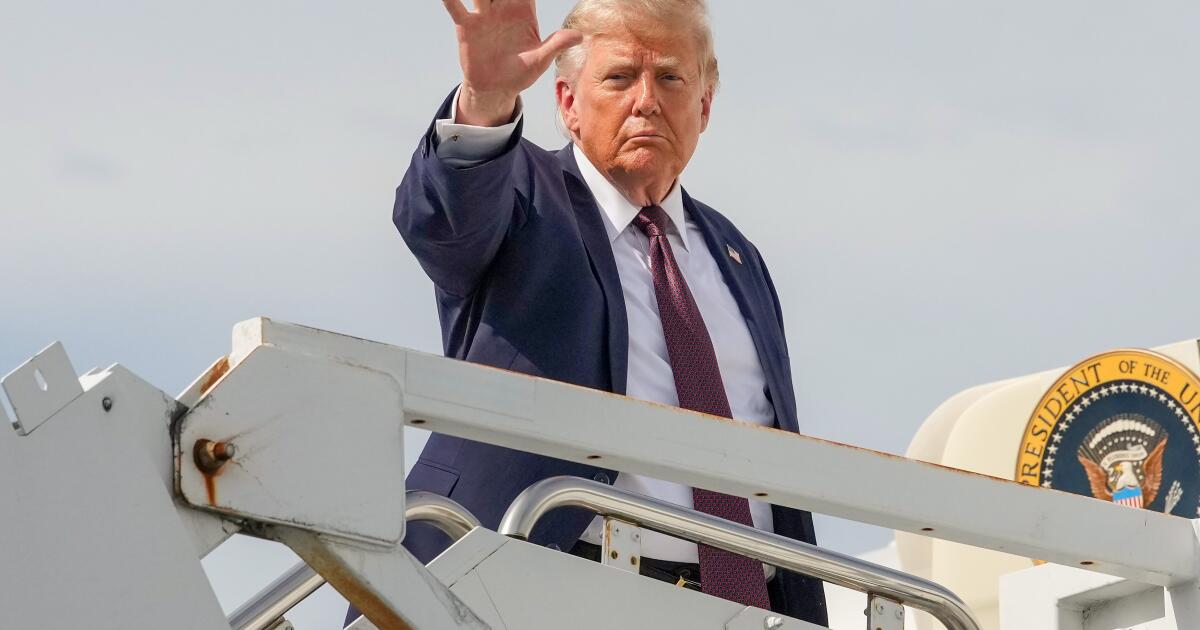
Trump is selling early access to his posts on Truth Social
Things people don’t want to do this summer, as evidenced by poor ratings: Watch CBS news anchor Tony Doukopil. Tune into Paramount+’s sci-fi teen drama “Star Trek: Starfleet Academy.” Read President Trump’s Truth Social posts.
No matter how much Trump posts, and he has been posting a lot lately, traffic to the platform he uses as his megaphone for official White House statements and personal rants has fallen off significantly this summer. Last month, the overall number of monthly visitors to Truth Social was down about 36% from where it was in 2025, according to the online tracking firm Similarweb. The numbers were similarly dismal in June.
But Trump’s slumping media fortunes may soon get an infusion of cash, or bitcoin, or whatever it takes to line his coffers before the jig is up.
Never one to leave a source of income untapped, the president has come up with yet another way to add to the $2.2 billion he made in just the first year of his second term. His majority-owned Trump Media & Technology Group earlier this month announced that it was rolling out a new service aimed at cashing in on the president’s every word.
Truth API is a subscription service that offers early access to posts from Trump and other notable users of the platform, for a price. It’s charging fees of up to $100,000 and month.
But there’s a hiccup in the president’s latest grift. On Wednesday, media organizations Freedom of the Press Foundation and The Intercept sued Trump, filing a complaint saying that providing quicker access to his posts to those who pay was “extraordinary, corrupt, and unconstitutional.”
Their suit alleges that Truth API contradicts the First Amendment’s guarantee of equal public access to the president’s statements and violates the Fifth Amendment by granting preferential access for “unreasonable sums.” The lawsuit filed in the U.S. District Court for the Southern District of New York, asked the court to block Trump from publishing official government information exclusively on Truth Social.
So why is this particular money-making scheme garnering so much attention outside Trump’s many other grifts? Because a president’s words can, and often do, sway the stock market. In the frenetic world of Wall Street trading, early access to statements and news from the Commander-in-Chief gives subscribers an edge, and as NPR pointed out, that could mean a difference of millions of dollars.
Unlike any other sitting U.S. president, Trump in his second term has ignored traditional means of communication such as press briefings, live addresses or posting official announcements, executive actions, press releases, and statements on the official White House Website. He’s done so in favor of communicating through his own privately controlled platform, delivering wild posting sprees that often forgo the fact-based, informative briefings we the people still need from our elected officials. But even back when he was using Twitter (now X) during his first term, the White House said his tweets should be considered official statements.
That standard still holds for his frequent barrages of boasts, insults, threats, grouses and indecipherable dispatches via Truth Social. After the humiliating failure of his America 250 celebration, he fired off 67 posts on Truth Social in just two hours, posting almost every single minute between 11:12 a.m. and 1:14 p.m. His musings ranged from attacks on a federal judge to a photo of himself at a 1991 New York City tree-lighting ceremony with his “Home Alone 2” co-stars.
That spree is now among the thousands more posts from the president, that have not been followed up by announcements from the White House outside of Truth Social. “In other words, President Trump’s posts are the only way to get official government news,” the lawsuit said.
Trump Media & Technology Group, or TMTG, is majority-owned by the president. It was launched following Trump’s account suspension across mainstream social platforms including Twitter, Facebook and YouTube. The platforms cited risks of inciting violence following the Jan. 6, 2021, U.S. Capitol riot. Trump responded by creating his own platform, and Truth Social debuted in 2022.
But the platform’s parent company, TMTG, has lost money ever since it went public in 2024. On Monday, Trump Media reported a $238-million loss for the second quarter, tied mostly to cryptocurrency assets. Executives told investors on a conference call that they are now going to focus their energy on Truth Social and soft-explained their latest scheme to profit off the presidency.
“Our customers will get published and publicly available posts fractionally faster” than everyone else,” said Kevin McGurn, the company’s interim chief executive. He added that such early access is a “well-established business practice.”
Unless it’s a sitting U.S. president doing the selling. We’re in uncharted territory, once again. But another big question around this new subscription service is whether investors and traders can trust the intelligence they get from early access to Trump’s posts.
It was revealed this week that the president published deceptive information last month, putting the lives of dozens in danger. Before leaving a NATO meeting in Turkey, he posted that he’d be riding on the older Air Force One “for old time’s sake” instead of the newly retrofitted, Qatari-donated jet. His misdirection was part of an elaborate ruse to mask his transfer from Air Force One to a military fighter jet following intel that Iran may be targeting the president’s plane. The subterfuge involved him stowing away in an airport catering container to sneak onto the jet. Of course a president has to be protected, but Air Force One still had members of the press and his administration aboard when they sent it into the sky. Essentially, they were unwitting decoys.
Sometimes a president has to lie to stay safe. And often times this president peddles misinformation as a means to other ends, like amassing more money for himself while holding onto his seat of power. Paying for early access to Trump’s posts is a great idea — for Trump.