WASHINGTON — House Republicans will look to get nearly $70 billion for immigration enforcement over the finish line Tuesday, enough to fund a pair of Homeland Security agencies through the next three years and the rest of President Donald Trump’s time in office.
Speaker Mike Johnson will need near perfect attendance and unity on his side to complete weeks of action on the bill. The legislation got sidetracked when Republicans sought to include $1 billion for enhanced security on the White House grounds, including for Trump’s new ballroom, and the Trump administration tried to create a nearly $1.8 billion fund to compensate allies of the president who claim they have been unjustly investigated and prosecuted. Those proposals proved politically toxic and were scrapped.
Now, the bill is focused entirely on immigration enforcement, a topic that Republicans have treated as a defining issue between the two major political parties and one they hope will carry them to victory in this year’s midterm elections. The bill provides $38 billion for Immigration and Customs Enforcement, $26 billion for the Border Patrol and another $5 billion to cover unforeseen costs, fueling Trump’s deportation agenda.
“It’s long overdue,” said Johnson, R-La., of the bill. “We have to fund border security and immigration enforcement, and it’s sad that Republicans have to do it on our own.”
Funding accelerates Trump’s deportation agenda
The funding comes on top of the nearly $140 billion that the Republican-controlled Congress gave ICE and Customs and Border Protection last year as part of Trump’s tax and spending cuts bill.
Democrats objected to giving the agencies more money without significant changes in the way they operate after the deaths of Alex Pretti and Renee Good in Minneapolis. For example, Democrats insisted that agents be required to display their ID badges during enforcement operations and that they get a judicial warrant before entering private property. Instead, the funding will come with virtually no strings attached.
House Democratic Leader Hakeem Jeffries vowed his party would oppose the package.
“We believe that taxpayer dollars should be used to make life more affordable for the American people – not give ICE another $70 billion blank check so that they can unleash brutality on American citizens and violently target law-abiding immigrant communities,” said Jeffries of New York.
Homeland Security faced longest shutdown in history
The package is the result of a monthslong standoff in Congress after Democrats refused to fund the Department of Homeland Security in the wake of the immigration enforcement actions in Minneapolis and other American cities, leading to the longest shutdown in agency history.
Negotiations had been underway with the White House to alter ICE operations as Democrats were demanding. When those negotiations failed, Republicans turned to a complicated procedural maneuver to get around the filibuster and pass the immigration funding with no Democratic votes.
If approved, the package would next go to Trump for his signature, all but assuring an essentially uninterrupted flow of funds for his immigration enforcement and deportation agenda into 2029.
The Senate completed its work on the legislation last week during an all-night session that extended into the early morning hours Friday. The final 52-47 vote on the bill was nearly party line, with Sen. Lisa Murkowski of Alaska the only Republican to oppose it.
Money comes at pivotal time for immigration agenda
The money will come at a pivotal time for the Department of Homeland Security, which is under new leadership after Trump replaced Kristi Noem with new Secretary Markwayne Mullin in March.
While Mullin has vowed to keep the department out of the headlines, the administration is under pressure from anti-immigration advocates to deliver on Trump’s campaign promise of the largest deportation operation in American history.
So far, the administration has not hit its goal of 1 million deportations a year, but Trump’s border czar, Tom Homan, has promised more to come, including hinting at immigration enforcement actions in New York, the nation’s biggest city, which is heavily Democratic.
At the same time, the administration is making it more difficult for legal immigrants to remain in the U.S. by working to end Temporary Protective Status, changing the processes for obtaining green cards and leaving some Dreamers — the young people who were brought illegally to the U.S. as children — reporting delays in renewing their status, which allows them to stay and work.
Tight vote ahead
On the House side, Johnson has little margin for error. Republicans can afford to lose only a couple of votes if every lawmaker is present. GOP leadership opted to avoid any hiccups and sent lawmakers home last week rather than take up the bill early Friday once the Senate had completed its all-nighter.
The bill is just a slim package, without the hundreds of pages of details and directives that typically come from Congress when it provides funding for agencies.
Leading up to the vote, Democrats portrayed DHS as an agency that has used its new resources to buy private jets for its leadership, warehouse immigrants in deplorable conditions and attack U.S. citizens.
“To give these rogue agencies another $70 billion now when they still have $100 billion in the bank from last year would implicate all of us in the escalating corruption and shameful actions of this department,” said Rep. Jamie Raskin of Maryland, the ranking Democratic member on the House Judiciary Committee.
Republicans countered that they were fulfilling their duty to safeguard the nation and support the men and women charged with enforcing the law.
“Democrats can say whatever they want, but what it’s about is public safety. What’s it about is keeping Americans safe,” said Rep. Michelle Fischbach, R-Minn.
Freking and Mascaro write for the Associated Press.
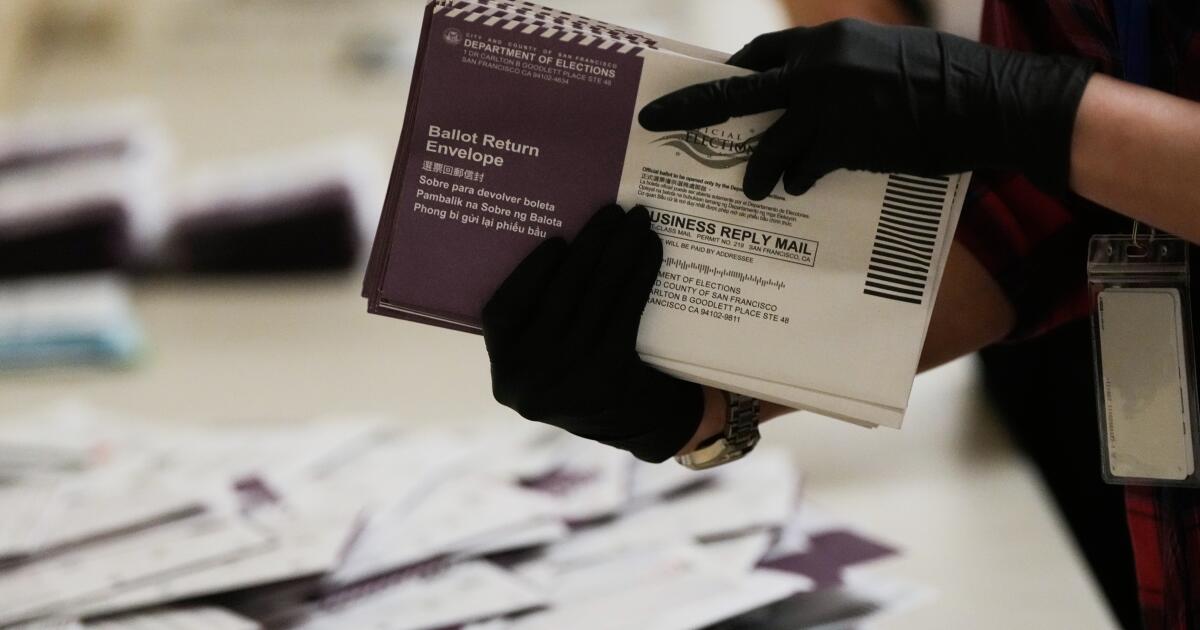
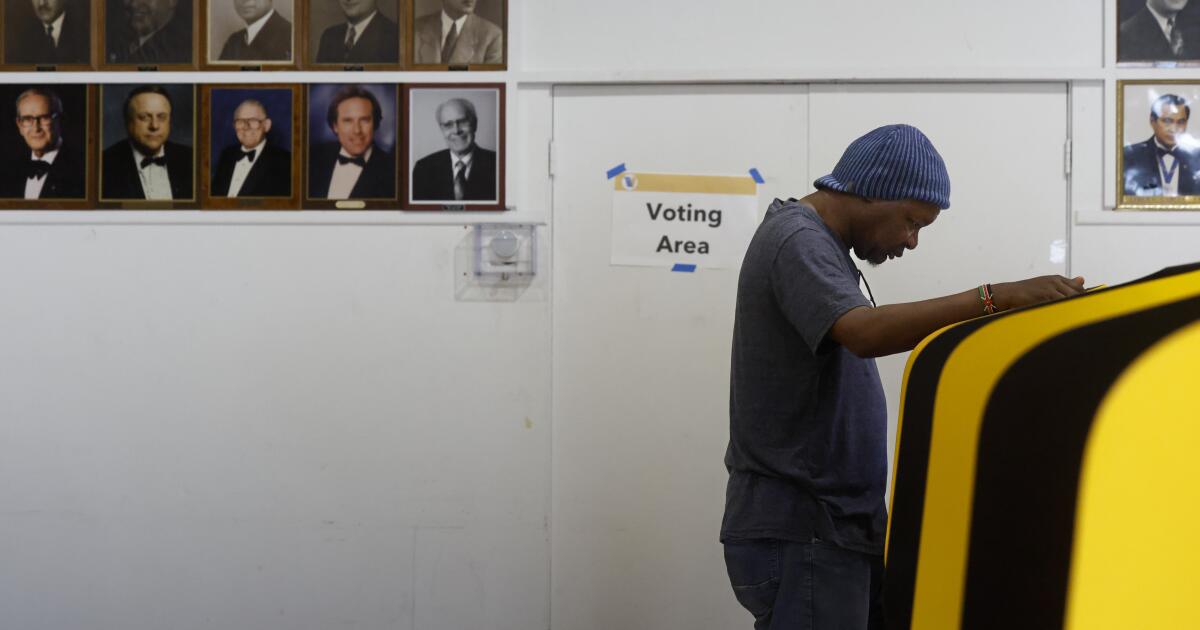
SACRAMENTO — Even before President Trump’s latest wave of unfounded claims of election fraud in California, a significant share of voters in the state expressed concerns about federal interference in the electoral process, according to a new poll.
Trump on Monday claimed on his social media site that the race for Los Angeles mayor was a “Rigged Election,” an allegation that came after Democrat Nithya Raman overtook Republican Spencer Pratt for second place in the ongoing primary election vote count.
Raman’s lead had prompted Rep. Abe Hamadeh, an Arizona Republican, to call for the election to be federalized, or run by the federal government rather than the state, a message Trump reposted.
Earlier Sunday, Trump had alleged during an interview with NBC News that California elections officials “were cheating.” That came after a debunked social media conspiracy theory claiming that a lag in an update of electronic voting data by the Associated Press showed Pratt was being cheated. On Monday, House Speaker Mike Johnson said the elections process in the L.A. mayoral race “stinks to high heaven.”
The ongoing attacks by Trump and his supporters continue to erode confidence in the nation’s elections, especially among Republicans, threatening a pillar of American democracy, said political scientist Eric Schickler, co-director of the Institute of Governmental Studies at UC Berkeley.
“The president … wants to use those claims to make changes in the election process that could make it harder for people to vote, and that certainly is a threat to our democratic institutions,” Schickler said.
“One thing we’ve learned in recent years is that we just cannot take the voting process for granted, cannot take for granted that both sides will accept as legitimate the outcome, and can’t take for granted the idea that there won’t be efforts to essentially manipulate the vote counting process,” he added.
A new poll released Friday by the institute found that 41% of California voters were “not confident” that this year’s elections would be free of federal interference. Although 48% had confidence that there would be not meddling, the concerns expressed were still significant, Schickler said.
More telling was the partisan divide among voters when asked whether they have confidence that local officials would conduct fair and secure elections and that the vote count would be accurate. Among Democratic registered voters, 79% said they trusted elections officials to provide an accurate vote count. Among Republicans, 55% said they were not confident that would occur.
California voters who don’t belong to either party said by a 2-1 margin that they had confidence in the vote count, the poll showed.
“The positive is that local officials are still widely trusted by Democrats, no-party-preference voters, and at least a share of Republicans, though a lot fewer than I think in the past, and a lot fewer than you know we would want for a really healthy democracy,” Schickler said.
That growing mistrust among certain parts of the electorate comes after years of baseless claims by Trump that the 2020 election was stolen from him, as well as Republican-led efforts to restrict the use of mail-in ballots and impose new requirements for voters to show identification and proof of citizenship.
Recent rulings by the conservative-leaning Supreme Court also have rolled back federal protections under the Voting Rights Act. In April, the court sharply limited a part of those protections that had forced states to draw voting districts to help elect Black or Latino representatives to Congress, as well as state and local boards.
Trump and his allies have used California’s slow vote-counting process to allege cheating. The day after the June 2 primary, Trump claimed without evidence that Democrats were trying to “steal” the gubernatorial and L.A. mayoral primaries. The next day, he alleged that California Democrats had “found” mail-in ballots and were “rigging the election” with them.
Secretary of State Shirley Weber and other officials have said California’s voting system prioritizes voter accessibility and security over speedy results. The state has more than 23 million registered voters, and ballots go through numerous verification steps, including verifying signatures on mail-in ballots.
“Over 97% of our folks actually vote by mail. They want to keep that system. That system demands more contact, more touching of the ballot, more verification of the individuals who are voting. All of those things take time,” Weber said during a recent interview with ABC10 in Sacramento.
Gov. Gavin Newsom’s office called Trump’s claims during the recent “Meet the Press” interview the “most severe case of California Derangement Syndrome we’ve ever seen.”
Newsom is considering a 2028 run for president and has consistently warned that Trump may try to interfere in both the 2026 and 2028 elections.
The Berkeley poll found that California voters overall — 74% — want candidates running for president in 2028 to prioritize defending democracy and making voting more accessible. Among Democratic voters, 95% said that was important; among Republicans, 41%.
Funding for the poll was provided to IGS by the Evelyn and Walter Haas, Jr. Fund, a private foundation based in San Francisco that aims to increase civic participation and improve the state’s democratic processes.
The poll of 8,578 registered California voters was conducted between May 19 and 25 online in English and Spanish and has a margin of error of about 2 percentage points in either direction.
Times staff writers Alene Tchekmedyian and Kevin Rector contributed to this report.
BOSTON — A federal judge on Monday struck down the Trump administration’s $100,000 fee on new H-1B visas, contradicting an earlier federal court ruling upholding the fee hike.
The administration announced the much-higher fee as a way of preventing foreign workers from taking American jobs.
But U.S. District Judge Leo Sorokin in Boston sided with 20 states and struck down the visa policy, concluding that the executive branch exceeded its authority and violated the Administrative Procedure Act, which governs how federal agencies develop and issue regulations.
“The Court finds that the Policy imposes a tax on H-1B petitions without the requisite delegation by Congress,” Sorokin wrote.
H-1B visas are meant for high-skill jobs that are difficult to find American workers to fill. Deep-pocketed technology companies are the biggest users, with nearly three-quarters of approvals going to workers from India. The states argued that using the H-1B program to fill vacancies for much-needed doctors and teachers was already difficult before the higher fee.
Most H-1B visa applications cost several thousand dollars before the announced increase set off a wave of panic among confused employers, students and workers in the United States and abroad and led to several lawsuits, including in Boston.
The U.S. Chamber of Commerce also sued, in federal court in Washington, D.C., and has appealed a denial of a summary judgment against the fee hike. That left the higher fee in effect, at least until September, when it is scheduled to expire. Monday’s ruling is also a summary judgment, to the opposite effect. Still another lawsuit was filed in federal court in San Francisco, by religious groups and labor organizations, setting up the possibility of divided rulings in three appellate court circuits.
The states argued that the policy impedes their ability to hire primary and secondary school educators and to staff public colleges and universities, will stymie academic research and will lead to a decline in medical workers.
“The Proclamation makes various overtures to domestic economic policy goals to justify the unprecedented $100,000 fee,” plaintiffs wrote in their complaint. “But the Proclamation gives no indication that the President gave any consideration to how the fee would affect Plaintiff States and their ability to provide their residents access to education, healthcare, and other basic human needs.”
A Department of Homeland Security statement said the agency disagrees with “this blatant judicial activism dismantling President Trump’s historic efforts for immigration reform.”
“Under President Trump and Secretary [Markwayne] Mullin, our immigration system is being reformed to serve American citizens, American workers, and American families and to preserve our national identity — not to rapidly import foreigners who take American jobs, commit crimes, burden our welfare system, and erode our cultural and social fabric.”
Legal challenge claims US president did not seek proper approval for fighting event to be held on his 80th birthday.
Published On 7 Jun 20267 Jun 2026
A lawsuit is seeking to stop United States President Donald Trump from hosting an Ultimate Fighting Championship (UFC) match at the White House.
The lawsuit, lodged on behalf of two Virginia residents, is the first known legal challenge to the mixed martial arts event, which is set to be hosted on June 14.
Recommended Stories
list of 3 itemsend of list
The event will take place on Trump’s 80th birthday. It is also pegged to the 250th anniversary of the signing of the Declaration of Independence, which the US will commemorate on July 4 of this year.
The legal challenge filed on Saturday maintained that Trump did not receive proper authorisation to host the fight.
It argued that the event violated US National Park Service regulations prohibiting sporting events on federal parklands, that Congress did not consent to the construction of a towering arch overlooking the event space, and that no environmental review was conducted before the construction.
“This is fundamentally a private, commercial, corrupt use of our most sacred national monuments for private gain,” said Brendan Ballou, a lawyer for the plaintiffs. “And that is what is motivating this lawsuit.”
In a statement to the Associated Press, the White House dismissed the lawsuit as “obstructionist, baseless, and dilatory”.
The White House maintained the UFC fight was “no different than the various other White House-hosted events on the South Lawn and properly permitted events on the Ellipse and National Mall throughout the year”.
Crews have been erecting an octagon-shaped fighting cage on the South Lawn of the White House, with Trump saying the project will include a “5,000-seat arena right outside the front door of the White House”.
Attendance at the fight will be invite-only and closely monitored. The Military Times news site reported earlier this week that 1,200 service members given tickets to the event must meet certain waist-to-height ratio standards.
Public viewing areas will also be set up at the nearby Ellipse.
Trump has long been closely involved with both professional wrestling and UFC, with his casinos and event spaces hosting past events.
He regularly appeared as a version of himself in World Wrestling Entertainment (WWE) events throughout the 1990s and early 2000s. His current secretary of education, Linda McMahon, is a co-founder of the WWE.
Trump has more recently embraced UFC, which is currently owned by the same company, TKO Group Holdings, as the WWE.
UFC president Dana White has been a close ally of Trump’s.
Political analysts have credited Trump’s embrace of the sport with reaching disaffected male voters in the US, particularly during his 2024 election campaign.
WASHINGTON — With virtually no strings attached, Congress is on the verge of providing a sizable infusion of cash to the Department of Homeland Security, powering President Trump’s mass deportation agenda for the remainder of his term in the White House.
The nearly $70-billion package, which cleared the Republican-held Senate in a middle of the night vote and now heads to the House, was declared a “rotten bill” by the Democratic leader and an “ATM for ICE” by pro-immigrant advocates.
But for those aligned with Trump’s campaign promise for the largest mass deportation operation in U.S. history, it all but guarantees an uninterrupted flow of money to carry out the administration’s immigration enforcement operations — and comes on top of some $170 billion Congress already approved for the department last summer, as part of Trump’s big tax breaks bill.
“We’re going to continue to arrest people, we’re going to continue to detain people and we’re going to keep deporting people,” Trump border advisor Tom Homan told CBS News on Friday.
He hinted at summer sweeps of enforcement actions coming next to New York City.
The work of Congress comes at a pivotal time for the Republican president and his party as they face restless voters before the midterm elections. About 1 in 3 U.S. adults know someone who has been affected by Trump’s immigration operations, according to an AP-NORC poll conducted in April. And as America celebrates its 250th anniversary, most say it’s no longer a great place for immigrants.
The funding package from Congress is just a slim dozen-page bill that carries none of the usual guardrails or directives typically demanded in legislation. It turns loose $30 billion for Immigration and Customs Enforcement operations, and billions for the Border Patrol, and others, prepaying the department’s operations into 2029.
“Their options are limitless in terms of what they can do with this money,” said Vanessa Cardenas, the executive director at America’s Voice, a longtime advocacy organization for immigrants.
“That is such a hard thing to accept as a taxpaying citizen that our dollars are going to this massive, mass deportation machine, while Americans are struggling to meet healthcare costs, and have access to food and they’re paying so much in gas.”
The administration has sought to shift the debate over its immigration operations, installing new leadership at Homeland Security in the aftermath of violent scenes of immigration enforcement earlier this year and the shooting deaths of Americans Renee Good and Alex Pretti in Minneapolis.
Rather than the dramatic street sweeps, the administration is working behind the scenes on actions that are stripping immigrant groups of their ability to remain in the U.S., by doing away with Temporary Protected Status or making it more difficult to secure green cards.
The so-called Dreamers, young immigrants brought illegally to the U.S. as children, have reported delays in renewing their Deferred Action for Childhood Arrivals status, exposing them to potential deportation.
But protests on American streets continue, including over detention conditions at the Delaney Hall facility in New Jersey.
At the same time, Homeland Security continues to hire more ICE agents — it’s hosting an employment fair next month in Florida — build more detention facilities and partner with countries around the world to take people who are being deported from the U.S.
In a statement, the department said Trump and Homeland Security Secretary Markwayne Mullin are “laser focused on ensuring the hardworking men and women” of ICE and Customs and Border Patrol are fully funded. It said the package from Congress “will ensure our critical national security operations continue despite any Democrat attempts to hold our great patriotic employees hostage in the future.”
Typically a funding package from Congress would run hundreds pages or more, with a range of specific instructions about how the money can be spent and on what timelines.
Congress, after all, holds the power of the purse, and often uses that constitutional role to put checks on the administration.
But after Democrats refused to fund Homeland Security earlier this year following the violence in Minnesota, Republicans retaliated by using the congressional budget resolution process to muscle the package through on their own, outside the traditional appropriations channels.
It’s the same process both parties have used in the past, most recently on Trump’s 2025 tax cuts bill.
“All this important oversight doesn’t happen,” said Bobby Kogan, a former staff member of the Senate Budget Committee and now at the Center for American Progress, a think tank.
Overnight, Democrats in the Senate worked to exert that authority, offering amendments to ensure Congress had some say in the process. Sen. Dick Durbin of Illinois, for example, sought to protect “Dreamers” from deportation as their DACA renewals are being delayed. But those efforts all failed.
Meanwhile the administration is under enormous pressure to deliver on its promise to boost deportations to some 1 million a year, after the Republican president’s first year numbers fell short.
Mike Howell, president of the Oversight Project, is a leader of the Mass Deportation Coalition that is pushing the Trump administration to stick to its promises.
“Everyone’s talking about it like ICE is about to get another massive cash injection, and that’s not how I see it at all,” he said. “They’re getting like life-support money.”
“We’re not asking them to keep going,” Howell said. “We’re asking them to start.”
Howell said there’s little chance the Trump administration will be able to reach the president’s deportation goals unless it drops its priority to go after what they call the “worst of the worst.”
His group put out a framework earlier this year that proposes more comprehensive sweeps to arrest immigrants, particularly in the workplace. He also wants to see the Trump administration make it more difficult for immigrants who are in the U.S. to use the banking system, get social services and obtain driver’s licenses. Republicans in Congress have offered bills tackling some of those issues.
The administration has been amping up its own rhetoric and recently posted a new website that characterizes immigrants as “aliens” — with outer-space themes — and suggests ways the White House is working to prevent people from staying in the U.S.
WASHINGTON — The U.S. military is waiting for clarity from the Pentagon following President Trump’s back-and-forth on troop levels in Europe, upending the lives of military personnel and potentially costing taxpayers millions of dollars, two U.S. defense officials told the Associated Press.
NATO allies were bewildered in May when Trump said he would send 5,000 U.S. troops to Poland just weeks after ordering the same number pulled from Europe, following a spat with Germany’s Chancellor Friedrich Merz over the Iran war. The Trump administration says troop reductions in Europe have long been planned and coordinated with allies.
The Republican president announced on social media two weeks ago that he was sending troops to Poland — the same day the Pentagon had officially ordered the cancellation of a rotation of soldiers heading there, one of the defense officials said.
The unit’s equipment was already on the way. Sending it cost the military $32 million, said U.S. Transportation Command, the military agency largely responsible for moving troops and gear across the globe.
The abrupt changes are forcing the military to “retroactively engineer” a policy in line with the president’s latest pronouncement, the official said. Both officials were briefed on the decisions and, along with others, spoke on the condition of anonymity to discuss sensitive military matters.
The uncertainty is not only rattling European allies worried about the message being sent to Russia, but it also risks hurting morale among American troops — some of whom had their rotations canceled shortly before departure — and comes as the Army budget is already strained.
Changes to troop deployments to Poland add up
The rotational deployment to Poland of 4,000 troops from the Army’s 2nd Armored Brigade Combat Team, 1st Cavalry Division, based in Fort Hood, Texas, was canceled in a memo sent to the military at the beginning of May. European allies found out mid-month.
Some of those troops were told shortly before traveling not to get on a flight to Poland, while those who had been sent ahead — initially around 1,000 troops — are still waiting for confirmation they are being sent back, a U.S. military official said.
The military also is still waiting for details from the Pentagon on how to satisfy Trump’s order to send 5,000 troops to Poland, that official said. The working assumption is that they will come from units already in Europe, rather than an additional deployment from the U.S., the official said.
U.S. Transportation Command had chartered a ship to take the team’s equipment from Texas to Poland and transport a departing unit’s gear back to America. The incoming team’s portion of the cost was $32 million, including chartering the ship and loading and unloading the gear.
Because the ship was chartered to take one unit to Europe and bring another back, it is hard to say if that amount would have been saved had the decision to halt the deployment been made before the new team had already begun moving overseas.
However, the military official said the unscheduled move of personnel and equipment back from Europe is most likely not a cost the Pentagon budgeted for and would be an additional expense.
Total costs of canceling the rotation are hard to quantify because of many factors, said Joe Costa, a former senior Pentagon official who now focuses on challenges faced by the U.S. military as director of the Atlantic Council’s Forward Defense program.
They most likely stem from returning equipment and troops sent ahead of the deployment and would probably be on the low end of the rotation’s overall cost, Costa said. The greater impact is on the readiness of troops who were trained for one mission and may be deployed on another, he said.
U.S. military contracts with private companies to transport troops and equipment contain cancellation clauses that often add extra fees if a deployment is called off, said John Deni, a senior nonresident fellow at the Atlantic Council who has studied such costs.
“The question is what additional costs were incurred by deciding to send them back prematurely, changing the arrangements, changing the plan?” said Deni, a former U.S. military advisor and planner who focused on forces in Europe.
It is not clear if the Pentagon can recoup those costs or those associated with moving the unit to Europe. The Defense Department did not answer questions about the costs of changing the deployment plans, and the White House referred a request for comment to the department.
Pentagon officials have repeatedly said they planned to lower troop levels to have Europe shoulder more of its own defense and that the decision was part of a “comprehensive, multilayered process.”
Last month’s memo also led to the cancellation of a deployment to Germany of a battalion trained in firing long-range rockets and missiles.
Pulling troops stationed in Germany would be more expensive
When Trump first threatened to remove 5,000 troops from Europe, Pentagon officials initially suggested pulling back the 2nd Cavalry Regiment, which is based permanently in Germany, the defense official said.
Instead, officials decided to cancel the rotation of the other unit to Poland. Then Trump threw that plan into confusion as well.
Pulling the troops stationed in Germany could cost in the low billions because there is no dedicated space and infrastructure in the U.S. to accommodate them and their families, Costa said.
“The other option is basically breaking up the unit,” Costa said. “They move the equipment in different places. They move the people to different places. That carries significant readiness costs because now you’re artificially jamming pieces of units into places where they don’t necessarily belong.”
Pulling or pausing deployments also can hurt morale among soldiers and families because they plan for them months and years in advance, Deni said. The uncertainty can be disruptive.
“That’s often the last thing you want to do to military families,” Deni said.
It is still unclear what will happen to U.S. troops stationed in Europe, the two officials said. Options include moving military units assigned to Germany to Poland, but that could take several years and cost more, the military official said.
Troop changes happen during an Army budget shortfall
The moves come as the Army is facing a budget shortfall, which the service’s top uniformed officer, Gen. Christopher LaNeve, recently acknowledged to Congress.
Estimates put the deficit somewhere between $2 billion and $6 billion, according to an Army official who also spoke on condition of anonymity to discuss sensitive defense matters. One impact has been cutting training courses for soldiers nationwide, which ABC News earlier reported.
In a statement, the Army said it has issued guidance to its commands to “make tough and sound resource decisions that optimize and prioritize resources toward their most critical requirements, to include major training and readiness events.”
The Army official also noted that the service has been tasked with missions like the National Guard deployment in Washington, a bolstered presence along the U.S.-Mexico border and its part in the Iran war — all of which have strained its budget.
The Department of Homeland Security expects to reimburse the Army for its role in the border mission.
Army Secretary Dan Driscoll told lawmakers at a May 15 hearing that he was “optimistic” there would progress on those payments “within a week or two.” But to date, the Army has not been reimbursed.
“We want those backfilled payments,” Driscoll said then.
The U.S. military in Europe also is scaling back support for non-combat related training and ruthlessly prioritizing critical functions, the military official said.
Burrows, Finley and Toropin write for the Associated Press. Burrows reported from London.
Republicans in the United States Senate have renewed their push to pass a controversial $70bn immigration-enforcement funding bill, a top policy priority for President Donald Trump.
But the effort on Thursday faced a series of hurdles, with Democrats forcing votes on several amendments that highlighted controversies related to the Trump presidency.
Recommended Stories
list of 3 itemsend of list
The rapid-fire votes on the amendments were dubbed a “vote-a-rama“, and they are slated to include issues ranging from Trump’s White House ballroom to his tariff policies and the US-Israel war on Iran.
“Amendment after amendment, vote after vote, Republicans are going to have to answer to the American people,” Senate Minority Leader Chuck Schumer said.
Early on, Republicans were forced to confront a topic that has dominated headlines in recent weeks: Trump’s proposed $1.776bn “anti-weaponisation” fund.
The fund has been controversial on both sides of the aisle, with critics calling it a slush fund for Trump’s allies.
Several Republicans indicated that the optics of such a fund could be politically catastrophic ahead of November’s midterm elections, and the Department of Justice has since backed away from the scheme.
But Trump himself has avoided saying whether the fund was dead, or just on hold.
It was created as part of a settlement following a lawsuit Trump filed against the Internal Revenue Service (IRS), a part of his government, and it was designed to award payouts to alleged victims of politically motivated prosecution.
Senate Democrats have repeatedly called for such a fund to be banned outright, rather than relying on the Trump administration’s commitment not to revive it.
Nevertheless, on Thursday, Senate Republicans rejected the Democrats’ measure to permanently block the fund.
Republican Tom Tillis introduced a second amendment, which would have also banned the settlement fund. Instead, the legislation would have redirected the allocated funds to a separate anti-fraud fund within the Justice Department. That, too, was rejected.
Thursday’s votes on the “anti-weaponisation” fund were just the start of several rounds of voting on issues uncomfortable to the Republican Party.
Schumer, the top Democrat, signalled that other amendments would tackle another part of the IRS settlement: the permanent immunity from tax audits that Trump had secured for himself and his family.
Trump’s controversial immigration enforcement campaign and other issues were also scheduled to be taken up in the day’s amendments.
Senate Majority Leader John Thune said he was not sure whether Republicans would defeat every measure, with some members of the party showing an increasing willingness to stand up to Trump.
“I can’t predict how it comes out,” he said.
Immigration funding bill
The situation on Thursday was the result of a standoff between Democrats and Republicans over the Trump administration’s approach to immigration enforcement.
Democrats had pledged not to approve further funding for Immigration and Customs Enforcement (ICE) and Customs and Border Protection (CBP), following the killing of two US citizens during immigration operations in Minneapolis, Minnesota.
Republicans control 53 seats in the 100-seat chamber, short of the 60-vote threshold needed to overcome a filibuster.
They have instead been forced to pursue a lengthy procedural manoeuvre to bypass the filibuster, which has taken weeks.
The $70bn funding bill had been stalled by the Trump administration’s demand to include $1bn for security upgrades for Trump’s White House ballroom project.
The request came after the president had repeatedly said that no taxpayer dollars would go towards the project.
The security funding, which roiled several Republicans, was subsequently dropped before the voting started.
The Senate’s parliamentarian, an official who interprets the chamber’s rules, had previously ruled that adding ballroom funding to the $70bn bill would make it ineligible for the budget reconciliation process, which allows the passage of fiscal-related bills with a simple majority.
If Senate Republicans remain unified, they are expected to pass the funding bill late Thursday night or early Friday.
The Republican-controlled House of Representatives is expected to take up the bill shortly after.
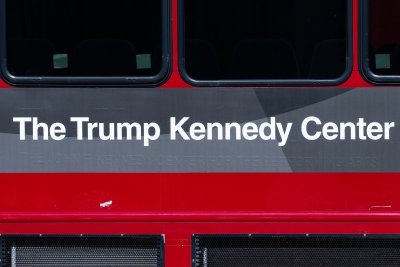
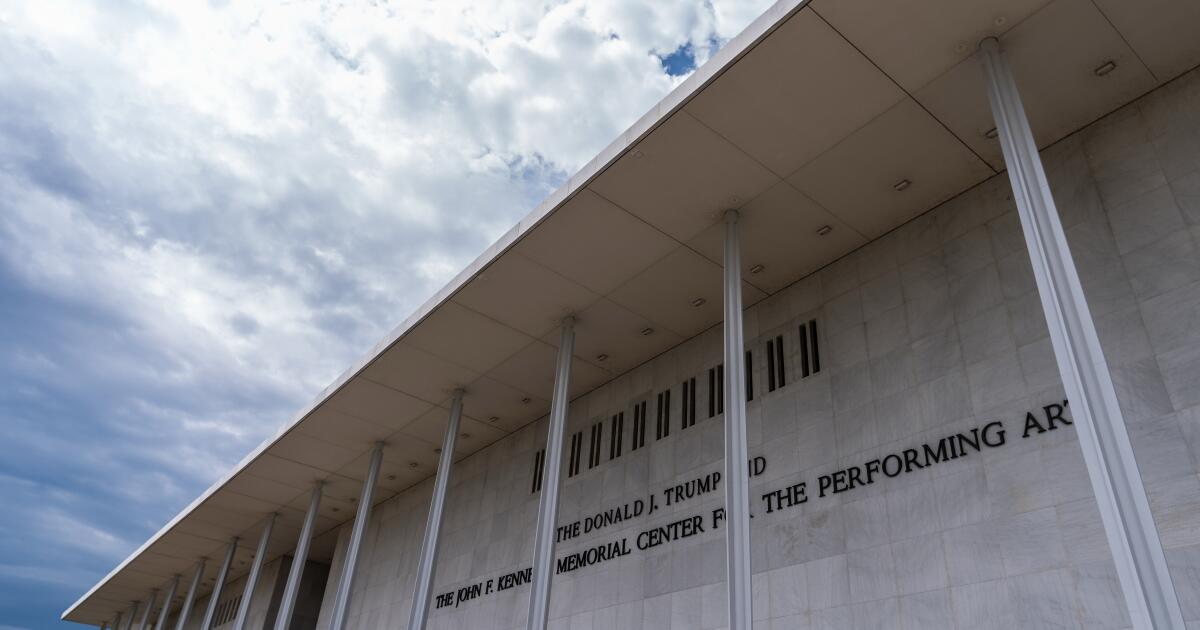
June 4 (UPI) — The Kennedy Center ordered its staff Thursday to remove President Donald Trump‘s name from the center by June 12.
A memo was sent out from the center’s general counsel that said they must remove all references from signs, brochures, websites, furniture and more, and that they must update email signatures and letterhead immediately.
On Friday, U.S. District Judge Christopher Cooper ruled that the center’s board had overstepped its authority when it voted to add Trump’s name to the center. The memo was the first sign that the center plans to comply with the order.
“Congress gave the Kennedy Center its name, and only Congress can change it,” Cooper said.
Trump claimed that naming the center after him was a surprise, but the name was added to the sign the next day.
Justice Department lawyers representing Trump later said the speed of the move showed it had been “prepared and/or purchased prior to the Board’s vote the day before,” The Washington Post reported.
Thursday’s memo also said officials were “considering their options and will provide further guidance shortly” on whether the center will close after July 5. The center was scheduled for two years of closure for a $257 million renovation.
In his decision, Cooper said the renovations are “sorely needed,” and his ruling doesn’t bar the board from closing “should it come to this decision anew after independently balancing its multiple obligations to the Center in a prudent fashion,” CBS News reported.
“By way of this opinion, the Court does not purport to dictate how the Center should be run, nor does it prescribe any particular plan for the institution — construction, closure or otherwise — moving forward,” he wrote. “It simply holds the Kennedy Center Board to certain minimum requirements imposed by law. Beyond that, the Court will let the parties play on.”
WASHINGTON — Initial efforts in the Senate failed Thursday to block the $1.8-billion fund that the Trump administration has sought to establish to pay people who claim the government wronged them, though further attempts were likely to come Thursday afternoon.
Republicans narrowly voted down a Democratic amendment to ban the payout fund and then Democrats killed a Republican amendment, which would have prohibited the use of federal money for the fund but would have sent $1.7 billion to the Justice Department’s fraud division.
It was the second effort in Congress to rebuke President Trump in two days, following the House vote Wednesday to rein in Trump’s war powers in Iran.
The dueling amendments were proposed by Senate Minority Leader Chuck Schumer (D-N.Y.) and Sen. Thom Tillis (R-N.C.). They were attached to the reconciliation bill that would fund Immigration and Customs Enforcement and the Border Patrol, a high priority for Republicans.
The votes came as the Senate began a “vote-a-rama,” during which lawmakers were expected to propose a stream of amendments to the immigration bill on various topics.
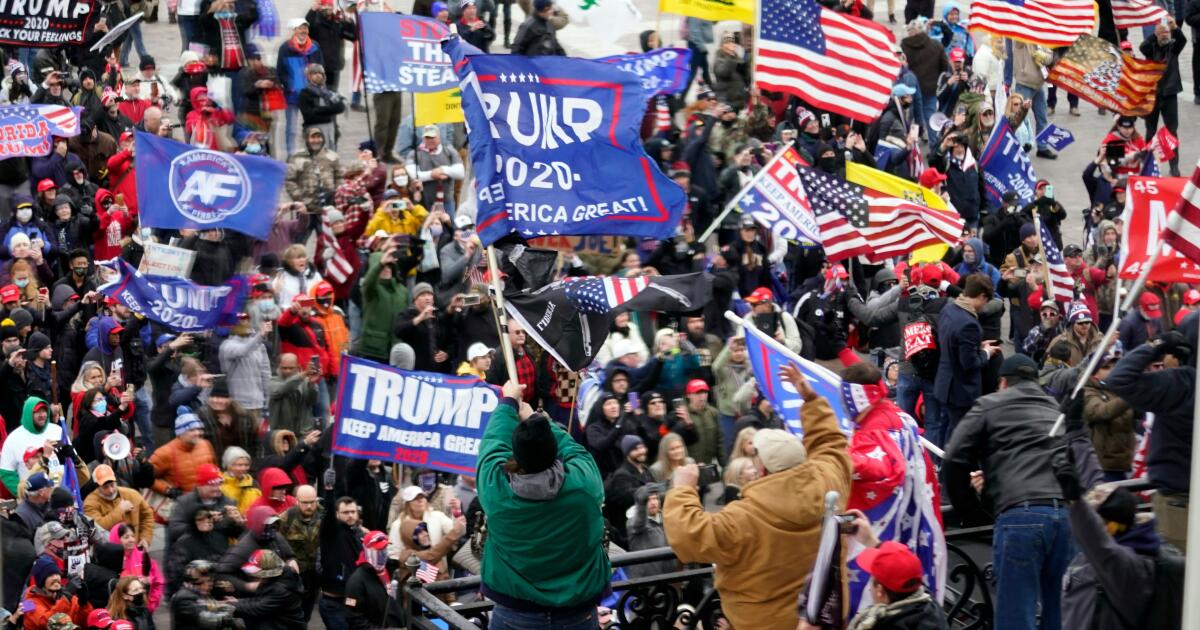
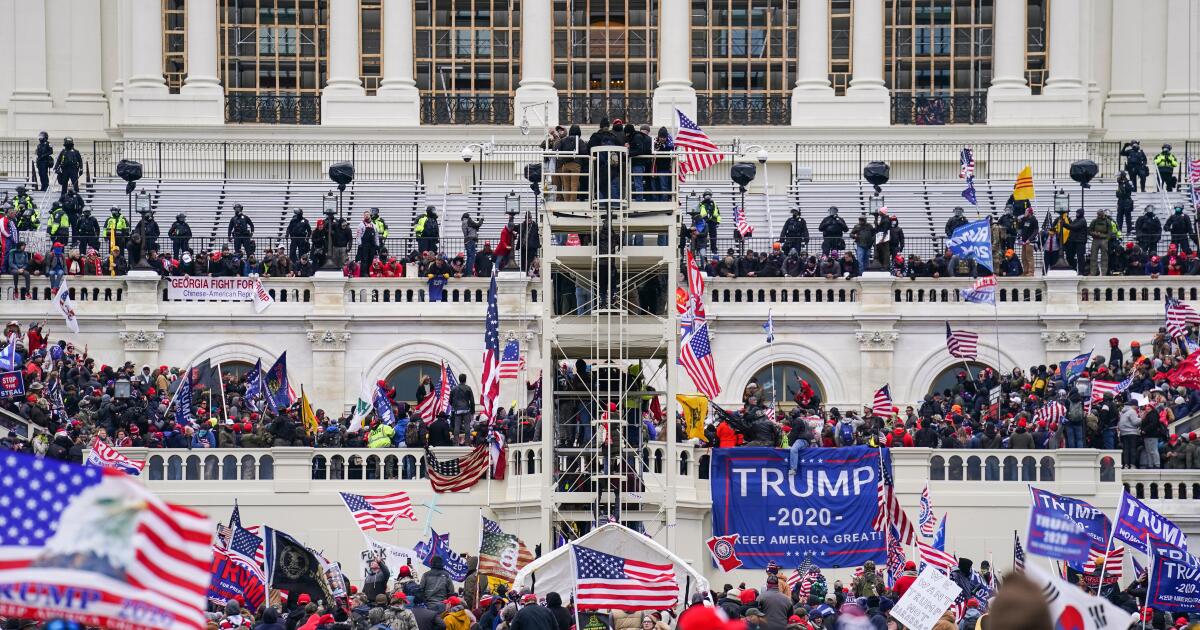
The Trump administration’s plan for the payment fund — widely seen as a way for Trump to compensate his political allies, including those who participated in the Jan. 6, 2021, attack on the Capitol — set off particular ire from some GOP lawmakers.
The plan has fueled growing unrest within parts of Trump’s party over his governance, compounded by the president’s endorsement of primary challengers to Sens. John Cornyn (R-Texas) and Bill Cassidy (R-La.), as well as Rep. Thomas Massie (R-Ky.), which angered some Republican senators.
Cassidy, who lost his primary and has since voiced strong opposition to Trump’s $1.8-billion fund, became a key player in the Thursday votes, voting down Schumer’s amendment but supporting Tillis’.
On Wednesday, Cassidy joined with Sen. Cory Booker (D-N.J.) to argue in a court filing that the $1.8-billion fund circumvents Congress’ authority and violates the Constitution’s spending and appropriations clauses.
“It is an unconstitutional attempt to spend the People’s money without Congressional approval,” Cassidy and Booker wrote in an amicus brief filed in the federal court case challenging the fund.
The fund was created by the Justice Department to settle a lawsuit brought by Trump against the Internal Revenue Service over the leak of his tax returns. Trump and his sons agreed to drop their personal lawsuit against the government in exchange for the creation of the $1.776-billion fund. Critics immediately questioned the plan, and it drew a rare backlash from Republicans.
In late May, GOP senators derailed plans to vote on the immigration bill over their displeasure with the payout fund and with Trump’s desire to use taxpayer funds for his planned White House ballroom. Senate Republicans removed the ballroom funding from the immigration package Wednesday, another setback for Trump.
The Trump administration sought to back away from its plans for the fund this week, following bipartisan outcry and a federal court ruling that temporarily blocked any payouts from the fund. Acting Atty. Gen. Todd Blanche said Tuesday the administration would end its plans to move ahead with the concept.
But Trump on Wednesday told reporters he didn’t know whether the fund was dead, calling it “a beautiful thing.”
After Schumer proposed the first amendment to ban the fund Thursday morning, the Senate came to a standstill as three key Republican senators deliberated. Schumer framed his effort to ban the fund Thursday as a way to force a referendum on Trump’s plan.
The amendment “offers Republicans a choice: Do you support Donald Trump’s $2 billion taxpayer-funded slush fund, or do you want to protect the American people and their paychecks?” Schumer said on the Senate floor before the vote.
Sen. Bernie Moreno (R-Ohio) urged Republicans to reject the amendment, saying Democrats were planning to “play so many games” on Thursday during the marathon session.
“We are going to fund immigration enforcement and border patrol, and I urge my Republican colleagues to stay united on that singular mission,” Moreno said.
The amendment failed after Cassidy voted against it. Republican Sens. Susan Collins of Maine, Jon Husted of Ohio and Dan Sullivan of Alaska voted in favor.
Schumer’s amendment was uniformly supported by Democrats, including California Sens. Adam Schiff and Alex Padilla.
Tillis, who also voted against Schumer’s amendment, immediately proposed his amendment. Sen. Jeff Merkley (D-Oregon) urged Democrats to oppose it, saying that the proposal would create “a new slush fund” by giving the money to the Justice Department.
“We heard over the last 48 hours that the acting attorney general said that this fund’s not moving forward. All this amendment does is codify what I believe the policy of the DOJ is,” Tillis said on the floor before voting began on his amendment. “This [fund] is unpopular, this administration has said they’re not moving forward with it; this is an opportunity for us to put it to bed.”
Responded Merkley: “Taking one slush fund and eliminating it and then creating a new slush fund still under control of the attorney general is not the way to go. The way to go is to get rid of these slush funds altogether.”
Trump has faced a recent string of failures, including the House vote Wednesday, a court ruling to remove his name from the Kennedy Center and a record-low approval rating among Americans as concern rises about economic issues, gas prices and Trump’s war with Iran.
On Wednesday, Trump lashed out against the four Republicans who backed the House war powers resolution, calling it “an unpatriotic thing” to do and calling the vote “meaningless.”
“They’re GRANDSTANDERS! They should be ashamed of themselves. MAGA!!! President DJT,” Trump wrote.
Times staff writer Ana Ceballos, in Washington, contributed to this report.
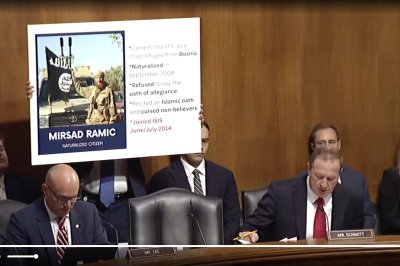
An aide to Sen. Eric Schmitt holds up a sign Wednesday depicting the radicalization of Mirsad Ramic, a naturalized U.S. citizen who was convicted in 2024 of providing material support to ISIS after traveling to Syria to join the terrorist organization. The hearing was held at the at the Dirksen Senate Office Building in Washington. Photo by Senate judiciary Committee
WASHINGTON, June 3 (UPI) — As the Justice Department increases efforts to strip some naturalized Americans of their U.S. citizenship, U.S. senators on Wednesday debated whether such efforts violate the Constitution.
Republicans argued during a Judiciary Subcommittee on the Constitution that it has been too hard to take away citizenship of naturalized citizens. But Democrats oppose increasing denaturalization and said it reflects President Donald Trump‘s broader anti-immigrant agenda.
“When someone lies during that [naturalization] process, conceals material facts, hides criminal conduct, masks allegiance to a foreign enemy or swears loyalty with mental reservation, he commits fraud against the United States,” said Sen. Eric Schmitt, R-Mo., chairman of the subcommittee.
Countered Sen. Mazie Hirono, D-Hawaii, a naturalized citizen. “It’s more than astounding, it should be unconstitutional. Let’s be clear. This has never been about law and order for the Republicans. This is all about getting immigrants. It’s about terrorizing immigrant communities.”
The Trump administration has significantly increased denaturalization efforts since the beginning of the president’s second term. Between 1990 and 2017, the government opened 11 denaturalization cases, on average, every year, according to the Immigrant Legal Resource Center.
Since January, the government has opened 34 denaturalization cases and revoked citizenship of 11 people. This is part of a larger, unprecedented push led by the United States Citizenship and Immigration Services to review 100 to 200 denaturalization cases per month.
“The Trump administration is right to revive denaturalization,” Schmitt said. Democrats, however, raised alarms that the push will have far-reaching consequences for naturalized Americans who are accused of crimes after becoming citizens.
Sen. Peter Welch, D-Vt., the top Democrat on the subcommittee, said he has no issue denaturalizing citizens who have committed fraud or misled officials during their naturalization process.
“I support that, but I don’t agree that naturalized citizens should be punished for something that happens after they become a citizen,” he said. “It’s the view of the Supreme Court. So, we do not have to reach too far back in our nation’s history to see that a familiar cycle is unfolding.”
The denaturalization campaign has marked a significant shift from previous administrations, which mainly targeted those with links to terrorist organizations or found guilty of war crimes.
But a June 2025 memo from the Department of Justice told government attorneys to expand the campaign to those involved in fraud or sex crimes. The memo later added a broad instruction that attorneys should pursue “any other cases … that the division deems to be sufficiently important.”
A law professor and an attorney pushed back against that tactic.
“The idea is to try to normalize the idea of denaturalization so that they can focus efforts against people who are kind of universally condemned,” said Cassandra Robertson, a law professor at Case Western Reserve University. “Then it’ll be a smaller step to start using denaturalization against other people.”
Robertson said that she had spoken to many naturalized citizens who now fear their citizenship may be revoked over actions like criticizing the government. She cited growing attacks from lawmakers to denaturalize public figures like New York Mayor Zohran Mamdani.
“If they’re threatening these high level people, what protection does an ordinary person have?” Robertson asked rhetorically.
David Leopold, an immigration attorney in Cleveland and former president of the American Immigration Attorney’s Association, said he sees similar fears among many of his naturalized clients. He said some have been stopped at airports and asked about their immigration history, despite having U.S. citizenship.
“This administration has succeeded in doing what a lot of authoritarian governments do, and that is spreading fear,” Leopold said.
Democrat Welch said the Trump administration’s denaturalization push seeks to advance the president’s deportation goals.
“The administration has — it is absolutely clear — a very radical goal. And that is mass deportation of immigrants from our country,” Welch said. “It’s doing real damage to our country, and as part of that effort, we’ve seen the abusive lengths that this administration is willing to go to.”
In January, Schmitt, supported by Majority Whip Tom Emmer, R-Minn., introduced the SCAM Act, which would amend the Immigration and Nationality Act to clarify the denaturalization process.
One notable expansion of the Act would lengthen the statute of limitations from five to 10 years for being able to revoke the citizenship status of naturalized Americans. The bill has yet to face votes.
“I’m proud to co-sponsor the Scam Act because I believe citizenship must be grounded in conduct that confirms rather than contradicts the promises made in connection with the naturalization process,” said Sen. Mike Lee, R-Utah.
WASHINGTON — When nearly all the scheduled musical performers pulled out of a concert series marking America’s 250th anniversary — fearing the event had become too closely tied to President Trump — he responded by making it official.
Trump announced he’d now be the headlining act of the Great American State Fair.
That put to rest any possible scenario where a president who has built his personal and political persona on seizing the spotlight might cede the stage to avoid overshadowing a national celebration bigger than himself. It also offered a peek into how the president is likely to approach hosting the upcoming World Cup.
From his reality shows before becoming a politician, to hours spent entertaining at events in ways planned and impromptu, to proudly showing off his various properties and efforts to overhaul the White House, the president relishes hosting. Last year he even jokingly mused about leaving the presidency to do it again full time on TV.
Trump can be a gracious, personable and highly watchable master of ceremonies — but he’s also one who tends to make every event about himself.
“The president has an outsized personality,” said Timothy Naftali, former director of Richard Nixon’s presidential library and professor at Columbia University’s School of International and Public Affairs. “There’s a predictability to the way in which the president frames his actions — or any actions around any event associated with him — and that’s just part of who he is, and his makeup and his professional background.”
Exhibit A is the fair, which begins June 25 and was supposed to feature concerts but now will be kicked off by a Trump rally. That will follow a UFC bout at the White House on June 14. Trump is a longtime cage match fan and the event marks his 80th birthday, but the president has sought to bill it as part of the anniversary festivities.
Many presidents relished hosting — but not like this
Andrew Jackson threw open the White House for an 1829 Inauguration Day bash so unruly that staff eventually dispersed the crowd by moving tubs of whiskey and ice cream to the lawn. Franklin D. Roosevelt mixed pre-dinner cocktails for friends and aides at White House gatherings he playfully dubbed “The Children’s Hour.” Audrey Hepburn was among the luminaries Ronald Reagan hosted at the White House.
Trump frequently had first-term dinners with business leaders but has more fully embraced the role since returning to the White House. He built a patio area similar to one at his Mar-a-Lago estate and frequently travels to Florida and his properties in Bedminster, New Jersey, and Sterling, Virginia, to headline fundraisers and other swanky gatherings.
Asked if Trump might overshadow events meant to bring the country and the world together, White House spokesman Davis Ingle pointed to the president’s efforts to lead extensive renovations at the White House and around Washington. He said in a statement that the “historic beautification” gives the city “the glory it deserves during our nation’s historic semiquincentennial celebration — something everyone should celebrate.”
Still, Trump has found unprecedented ways to inject himself into the anniversary.
The State Department is issuing passports with the president’s picture and officials have designed a new $250 bill with his likeness. The Trump Organization, being run by Trump’s children while he’s president, applied to trademark “Trump 250” logos and other merchandise.
The U.S. Mint is also producing a 24-karat gold commemorative coin with Trump’s face, though that recalls a half-dollar silver coin bearing the likeness of President Calvin Coolidge to help mark America’s 150th anniversary in 1926.
Past presidents had starring anniversary roles
Ulysses S. Grant opened a Centennial Exposition in Philadelphia to mark the 100th anniversary of the signing of the Declaration of Independence in 1876. Richard Nixon, in 1971, inaugurated a five-year “Bicentennial Era” ahead of the 200-year mark, though he resigned before the big day arrived.
Nixon’s successor, Gerald Ford, then in the midst of an ultimately unsuccessful reelection campaign, began the week of July 4, 1976, by inaugurating the Smithsonian Institution’s National Air and Space Museum and attending a Kennedy Center event featuring Bob Hope, OJ Simpson and others reading patriotic texts.
On Independence Day, Ford spoke at historic Valley Forge, then traveled to Philadelphia’s Independence Hall, declaring, “Liberty is a living flame to be fed, not dead ashes to be revered.“ He also went to New York Harbor for a tall ship parade, presided over naturalization ceremonies at Thomas Jefferson’s Monticello estate and hosted a state dinner for Britain’s Queen Elizabeth II.
Still, “while Ford certainly hoped to use the bicentennial to promote his reelection campaign, he didn’t do it in such a self-aggrandizing, self-centered, narcissistic way,” said Marc Stein, a history professor at San Francisco State University and author of “Bicentennial: A Revolutionary History of the 1970s.”
Ford, added Naftali, “knew when to step out of the limelight and make sure the focus was on what mattered, which was the United States of America and the Declaration of Independence.”
Trump, by contrast, “generally has contempt for norms” and rarely mentions “the great sweep of history,” Naftali said.
Dueling anniversary planners as Trump pushes to revise history
Congress charged a national organization, America250, with planning commemorative events. Ahead of the 2024 election, the group drafted a memo asking whomever the incoming president was to mobilize federal agencies and welcoming presidential involvement in events and initiatives.
Asked about Trump, America250 Chair Rosie Rios said the group “has had a very supportive and collaborative relationship with the organizations planning initiatives on behalf of the president.”
But Rios’ organization is separate from Freedom 250, a mix of public and private partnerships which the Trump administration established to fund and prepare anniversary events — which has caused confusion.
America250 aims to “inspire our fellow Americans to reflect on our past, strengthen our love of country, and renew our commitment to the ideals of democracy through programs that educate, engage, and unite us as a nation.”
That might seem a departure from the “Restoring Truth and Sanity to American History” executive order Trump signed last year. It sought to beat back a “revisionist movement” responsible for “replacing objective facts with a distorted narrative driven by ideology rather than truth.”
Stein, now serving a one-year term as president of the Organization of American Historians, is helping organize “We Want More History,” a push to coordinate local events celebrating the public’s love for the subject in fact-based ways.
He said Trump’s version of history is “closer to propaganda, and it’s closer to cheerleading.”
World Cup gives Trump another platform to play host
The president has similarly taken his exceeding-normal-limits approach to the soccer tournament the U.S. is co-hosting with Mexico and Canada.
He created a federal World Cup task force, and leads it. He collected a peace prize from soccer’s governing body, FIFA, and said he’d be on stage to present the tournament’s golden trophy to the winning team.
Trump even oversaw the tournament’s draw at the Kennedy Center, which he’s sought to rename for himself, sparking legal challenges.
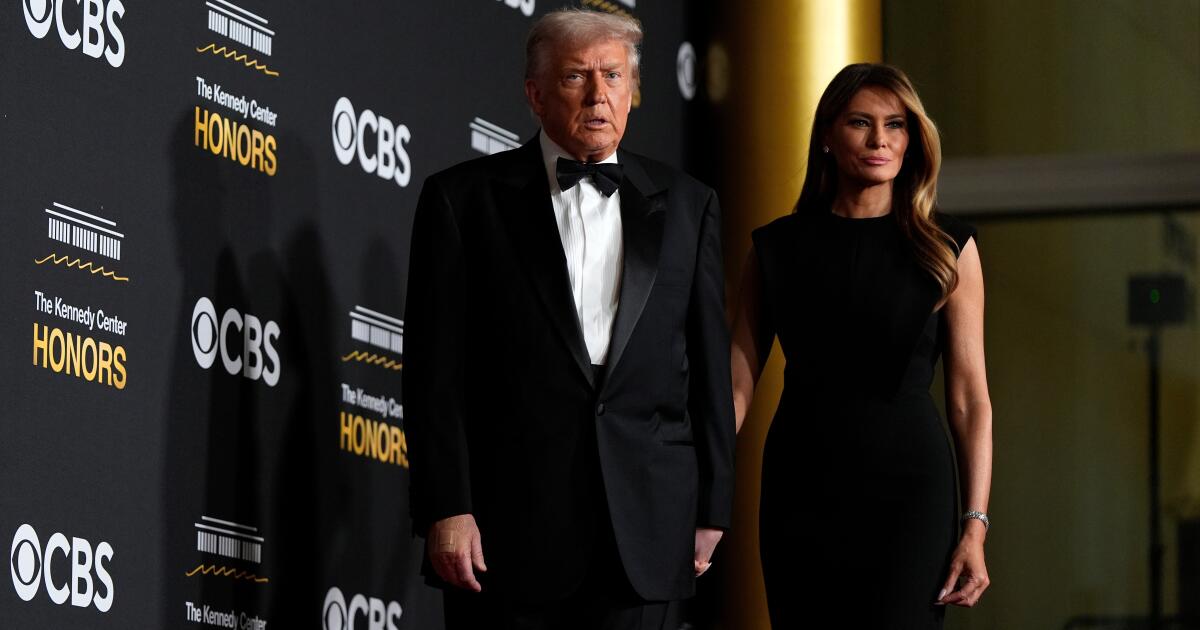
He returned to the same building to headline December’s Kennedy Center Honors, noting, “We never had a president hosting the awards before.” He later posted on social media, “Would you like me to leave the Presidency in order to make ‘hosting’ a full time job?”
Naftali noted, “Whatever filters there were in the first term — and there weren’t many — are gone.”
BOSTON — A federal judge on Tuesday heard from voting rights groups and a coalition of two dozen states that want the courts to halt President Trump’s executive order seeking to create a federal voter list and limit who can receive a mail ballot.
The plaintiffs argued in two lawsuits that Trump’s order should be found unconstitutional because the states and Congress, not the president, have the power to set election rules. They also told the court that the move imposes a costly burden on state election officials to comply and would spread fear about the possibility of prosecution.
“This is going to be a sea change in the way that some states administer their ballots,” said Michael Cohen, who was part of a team representing California, adding that “it will be difficult to overstate the disruption that this will cause.”
Trump’s executive order, the second one aimed at elections during his second term, comes as he continues to raise the specter of widespread voting by noncitizens as a reason to change election rules. But states already have detailed processes aimed at keeping their voter rolls accurate, and voting by noncitizens has been shown to be rare. It also is a felony that can be punishable by deportation.
His latest order is being challenged through multiple lawsuits, including two filed in U.S. District Court in Boston.
The American Civil Liberties Union, which represented the League of Women Voters in one of the two Boston cases, has called the order “a dangerous attempt to disenfranchise eligible voters nationwide.” The group said the order transforms “the U.S. Postal Service from a neutral mail carrier to an arbiter of who may cast a ballot by mail.”
“This case challenges an extraordinary and abusive assertion of executive power over the administration of federal elections,” the organization said in its complaint.
The hearing comes less than a week after another judge declined to halt the order. U.S. District Judge Carl Nichols, a Trump appointee in Washington, agreed with the Trump administration’s contention that it was too early to block the order because it has yet to be implemented.
The administration, in its motions to dismiss the lawsuits, argued that the plaintiffs lack standing to bring their claims. They also argued the motions are premature and that plaintiffs lack the legal basis to bring their Administrative Procedure Act claim, which governs how federal agencies develop and issue regulations.
Stephen Pezzi, a lawyer for the Trump administration, said the harms the plaintiffs referred to were subjective, since much can change with the voting list before it is finalized. He also said no one would be prosecuted for violating the executive order.
Missouri Solicitor Gen. Lou Capozzi, speaking for the states supporting the list, argued it was too early to say how his state might use the list, but that it was “unlikely” any voter would be removed this year from the voter rolls because of it.
“We are not exactly sure how we would use it,” Capozzi said, adding that “we don’t want this process to be strangled in the crib, so to speak.”
U.S. District Judge Indira Talwani took the requests for motions to halt the order, along with motions to dismiss the cases under advisement.
During oral arguments, Talwani expressed concerns about whether the federal system envisioned under the executive order could be ready for the upcoming midterm elections and about the risks posed to election workers who rely on a state list that differs from the federal one. She also raised doubts about the reliability of a federal list — noting, for example, women who changed their names after getting married or someone who has moved from state to state might be missed.
“Isn’t there a reasonable fear and concern on behalf of voters that they will be precluded?” Talwani asked.
Trump issued the order in March after a bill he supported to overhaul voting stalled in Congress. The order would have had the federal government create a list of eligible voters and then directed the postal service to deliver mail ballots only to those on the list. Election officials argued that it was ripe for abuse and could cause chaos, and the postal union has objected to the idea of mail carriers policing ballots.
The postal service has published a proposed rule required by Trump’s executive order in the Federal Register. Among other things, the rule would not apply to primary elections or overseas ballots.
Since his 2020 presidential election loss to Democrat Joe Biden, Trump has groundlessly claimed mail voting is rife with fraud and has launched a federal investigation into that year’s vote, even though repeated audits and investigations, including ones run by Republicans, found it was free of widespread fraud. Trump also has said he wants to “take over” election administration in Democratic areas.
In recent years, the security strategy and foreign policy of the United States have witnessed a fundamental transformation in their main principles, as demonstrated by the second US-Israeli war against Iran, which this author refers to as the “Second Iran War” to distinguish it from the first military confrontation between these three parties in the summer of 2025, known as the “Twelve-Day War.”
The leadership factor, represented by President Donald Trump, has become an unprecedentedly broad influence on the decision-making process related to US foreign policy and national security, whether concerning the declaration and conclusion of war, or even in peacetime, particularly regarding Washington’s relations with its traditional allies in Europe and the Middle East.
This analysis focuses on the case of the “Second Iran War” as a clear example of the increasing role of the US president’s personal characteristics in shaping strategic decisions related to this war and managing Washington’s relations with its partners in the Arabian Gulf region.
This analysis is divided into two main sections, as follows:
First, the traditional determinants of US security strategy and foreign policy.
Second, the Trump administration and the growing role of the president in foreign policy and national security.
Third, the Second Iran War as a model for the increasing influence of the leadership factor in the US decision-making process.
First, the traditional determinants of US security strategy and foreign policy:
There is a set of traditional constraints governing decision-making in the United States, both in domestic and foreign policy. These constraints stem intrinsically from the nature of the American political system, the constitutional and societal environment within which it operates, and the historical development of the nation some 250 years ago.
In summary, these constraints can be divided into the following:
1. Constitutional and historical constraints, including the federal constitution and the practical actions of foreign and security policy-making institutions over the past decades.
2. Institutional determinants, which consist of the roles exercised by the legislative, executive, and judicial branches as defined by the Constitution, including: Congress (the House of Representatives and the Senate), and the federal departments and agencies concerned with U.S. foreign policy and national security (the Departments of State and Defense, the National Security Council, and the various intelligence agencies, most notably the Central Intelligence Agency (CIA)).
3. Political determinants, foremost among them the role played by the President of the United States in decision-making—what political literature calls the “leadership factor”—which is determined, broadly or narrowly, by a range of considerations, including: the President’s political experience, personal characteristics and interests, and ideological orientations, convictions, and personal preferences.
Traditionally, American historical experience indicates that constitutional and institutional constraints have a dominant influence on foreign policy and national security decision-making, compared to the limited influence of the president’s personal characteristics and psychological environment.
This has resulted in a near-consistency in the general direction of US foreign policy and security strategy across successive administrations, regardless of the president’s party affiliation (Democrat or Republican) or personality traits.
Second, the Trump administration and the growing role of the president in foreign policy and national security:
Unlike previous administrations, Republican President Donald Trump, since his first presidential term (2016-2020), has expanded his role in the decision-making process related to US foreign policy and its security strategy abroad, to the point of bypassing the federal institutions responsible for making this policy and strategy, or at the very least marginalizing the role of these institutions and failing to coordinate with them in advance in an unprecedented manner.
Trump’s interference in this regard, and his violation of institutional limits during his second presidential term, which began in January 2025, has increased to the point of causing great embarrassment to those in charge of American foreign and security policy-making institutions on the one hand, and on the other hand, it has led to pushing towards taking decisions – or at best adopting a declared political discourse – that has caused great damage to the foreign relations of the United States and posed a threat to its strategic interests as a superpower, whether with its immediate geographical neighborhood in the Americas (Canada, Mexico, Venezuela, and Cuba), or with its traditional transatlantic allies (Europe and NATO), and finally with important partners in the Middle East region.
Without going into detail about the reasons for this excessive interference by President Trump in American foreign policy and security strategy, in our estimation, this is largely due to the psychological and personal characteristics of the Republican president, whose political discourse and vocabulary indicate that he considers himself the “savior” of the United States and personally qualified to restore it to its glory, which he expresses in his election slogan “Make America Great Again.”
Third, the Second Iran War as a model for the increasing influence of the leadership factor in the US decision-making process:
The events of the second Iran-Iraq War, which began on February 28, 2016, provide a clear example of the growing influence of leadership dynamics, at the expense of constitutional and institutional constraints, in shaping and implementing American foreign policy and security strategy decisions under the Trump administration.
This assertion is supported by two key indicators, as follows:
1. Washington’s Decisions to Launch the War and the Negotiations Related to Ending It:
A close examination of Washington’s decision to launch the war against Iran on the morning of Saturday, February 28, 2026, reveals that President Trump based this decision on his personal convictions regarding the reliability of the reports and information provided to him by Israeli Prime Minister Benjamin Netanyahu – with whom he has a friendly and politically harmonious relationship – concerning the threat posed by Tehran’s nuclear program and its ballistic missile capabilities to Israel, America, and the region. He believed that the opportunity was ripe to quickly eliminate the religious regime in Iran by launching a powerful and swift military strike that would lead to its downfall after instigating an internal uprising.
In contrast, Trump ignored warnings from US foreign policy, national security, and defense institutions about the risks and feasibility of a war against Iran from the perspective of vital US interests in the Middle East. The Republican president also disregarded the reservations of senior administration officials regarding this military strike, including Vice President J.D. Vance, Secretary of State Marco Rubio, and Special Envoy for Middle East Peace Steve Wittkopf.
Further bolstering this claim are Trump’s attempts to deny that Israel pushed him into this war. He has asserted on more than one occasion that he made the decision himself, and even that he was the one who pushed Tel Aviv to engage in it. He has also emphasized on other occasions that the matter of negotiating and ending the war is solely his responsibility, and that Netanyahu is simply doing what he asks of him regarding the war with Iran.
According to the literature of political psychology and the principles of political communication, when politicians exaggerate their denial of something, or deny it without directly accusing them, it often confirms the accusation, not the other way around.
This claim is is further supported by reports in the US indicating that Trump sent the Israeli Prime Minister a draft memorandum of understanding between Washington and Tehran to end the war, as part of the US president’s consultations to reach a final decision on ending the conflict.
This means that Trump made his decision to wage war on Iran—and will most likely make his final decision regarding negotiations to end it—based on elements of his psychological environment and personality traits, and not on the factual data contained in the reports and recommendations of the foreign policy and national security agencies, which are based primarily on the strategic interests of the United States and its international and regional orientations.
2. The Harshness and Crudeness of US Presidential Rhetoric Towards Strategic Partners in the Arabian Gulf:
President Trump’s public political discourse since the start of the war has included statements characterized by an unprecedented level of harshness in American policy towards Washington’s strategic partners in the Gulf Cooperation Council (GCC) countries.
For decades, the United States has maintained a balanced and rational approach to its relations with the Gulf states, a relationship cemented by strategic alliances and defense agreements since the 1991 Gulf War. This was true even during periods of open tension or simmering resentment between the US and some Gulf capitals.
In our estimation, this is explained by the fact that successive administrations and presidents in the White House have based their decisions, policies, and political discourse in general, and towards their allies and strategic partners in particular, on the constitutional and institutional parameters for drawing up and making Washington’s foreign policy and security strategy, especially in the vital geographical areas for national security and American strategic interests, as is the case with the Middle East region and at its heart the Arabian Gulf region.
However, in a departure from this approach and in an unprecedented move, the second Iran-Iraq War witnessed Trump’s political rhetoric, which included insults to some Gulf Cooperation Council (GCC) states and belittling of others. He even went so far as to issue explicit and public threats against one of the Gulf Arab states, the Sultanate of Oman, in a surprising, shocking, and unprecedented act.
On May 28, 2016, Trump threatened Oman, saying he would “blow it up” if it cooperated with Iran on joint management of the Strait of Hormuz. The US Treasury Department also threatened to impose sanctions on Muscat if it proceeded with an agreement with Tehran to manage the strait, which Iran had used as a weapon of economic pressure during the war.
Conclusion:
The leadership factor, represented by the president’s personal characteristics, psychological environment, and political beliefs, has become the pivotal and most important factor in shaping US foreign policy and national security decisions during the administration of President Donald Trump, including the decision to go to war. This has come at the expense of the diminishing influence of other objective determinants, most notably constitutional and institutional ones.
This was clearly evident in Trump’s behavior and political rhetoric during the Second Iran War. This unprecedented development is likely to continue during the remaining two years of the Republican president’s term, until 2028.
The second Iran war demonstrated that such actions would negatively impact Washington’s future relations with its allies and strategic partners, or at the very least, erode trust in it as a reliable and credible international partner.
Furthermore, it would severely damage the prevailing image of the United States, both in the eyes of American and international public opinion, as an international superpower governed by institutions rather than individuals.
WASHINGTON — The Trump administration is backing away from plans to create a $1.8-billion fund to compensate people who claim the government was weaponized against them, a retreat that comes amid a cascade of legal setbacks and a revolt within members of the Republican Party.
But Senate Democrats say the concession is not enough, and are pushing legislation to ensure no president can ever attempt the creation of such a fund again.
“If Republicans are serious about ending this brazenly corrupt scheme, they should have no problem voting for legislation banning any president from creating such a slush fund in the future,” Sen. Adam Schiff (D-Calif.) wrote Monday in a post on X.
Senate Minority Leader Chuck Schumer (D-N.Y.) added that Democrats plan to force a vote on a measure to ensure that Trump and Republicans are “truly abandoning this corrupt scheme.”
“Trump’s word is nowhere near enough,” Schumer wrote on X. Earlier in the day, Schumer vowed to force a floor vote to make Republican lawmakers take a public stance on the issue.
Schiff, along with Sens. Mark Kelly of Arizona and Elissa Slotkin of Michigan, introduced the “Drain the Slush Fund Act” on Monday. The bill, if approved, would bar any payout arising from a lawsuit filed by a president or vice president, language that is designed to permanently foreclose the fund, or anything like it, from being put in place by a future administration.
The White House did not comment on the president’s thinking. But in a statement, the Department of Justice said the decision to scrap the fund was in response to a federal judge’s ruling last week that temporarily blocked payouts from the fund while legal challenges remain pending. The department said it “disagrees strongly” with the move, but stopped short of saying it would challenge the decision.
“This fund was open to anybody who was so weaponized, targeted, or persecuted, whether they were Democrat, Republican, Conservative, Independent, or otherwise,” the statement read. “The Department will abide by the Court’s ruling.”
U.S. District Judge Leonie Brinkema, who was nominated to the bench by President Clinton, a Democrat, has scheduled a June 12 hearing for argument on whether to extend the order blocking the fund.
While the court ruling is not permanent, the unraveling over the fund is a notable defeat for Trump, who has cast it as a long-overdue reckoning for Americans he says were targeted by “an evil, corrupt and weaponized Biden administration.” For Republicans who publicly criticized the fund, it may come as a relief as the concept had been widely seen as a political liability heading into the midterm elections.
The Department of Justice created the fund to settle a lawsuit Trump personally brought against the Internal Revenue Service over the leak of his tax returns. The settlement also includes a clause permanently barring the IRS from pursuing any tax claims against Trump and his businesses that were filed before May 19 — a provision that, according to an analysis by Forbes, would save Trump and his family more than $600 million.
The White House declined to comment on whether the administration would also make changes to the tax immunity clause. The Democrats’ bill does not address that provision.
“Congress doesn’t need to pass a law to remind the Acting Attorney General [Todd Blanche] that he doesn’t have the authority to grant a blanket pardon for tax crimes by the president, much less when the AG is his personal attorney,” a Schiff spokesperson said in a statement. “The attempt at IRS immunity is corrupt and undoubtedly illegal — and we look forward to seeing it exposed as a fraud.”
Beyond Trump’s own legal disputes with the IRS, the fund was structured to accept claims from anyone who said they had been targeted by the government, a category the administration made clear could include those who were convicted for attacking the U.S. Capitol on Jan. 6, 2021.
Trump pardoned and commuted the prison sentences of 1,500 people who were charged in connection with the attack, and neither he nor Vice President JD Vance ruled out the possibility that those individuals would be able to receive money from the fund.
That possibility immediately ran into trouble with lawmakers. Senate Republicans, many of whom were caught off guard by the arrangement, publicly revolted against the fund and derailed plans to vote on legislation to fund Trump’s immigration crackdown amid the deep disagreement.
A closed-door meeting last month between Blanche and GOP senators grew heated, with lawmakers demanding answers the administration was seemingly not prepared to give.
Sen. Ted Cruz (R-Texas), who attended the meeting, described it as “angry” in an episode of his podcast last month. Cruz said that roughly 45 Senate Republicans had attended and estimated that “at least half of them were blasting the attorney general.” Based on those reactions, Cruz predicted the administration would need to amend its position on the fund.
“We will see the administration announcing at a minimum a modification of this, because if they don’t they’ve got a full-on revolt in the Senate,” he said.
The fund also led to criticism outside of Congress. Former Vice President Mike Pence, who served in Trump’s first administration, told NBC News in an interview Sunday that it was a “bad idea from the start.”
“I would encourage the administration just to drop it,” Pence said.
Jerome Powell says the US central bank is undergoing a ‘stress test’ like other institutions in the current era.
Published On 1 Jun 20261 Jun 2026
Former US Federal Reserve Chair Jerome Powell has warned against the politicisation of monetary policy amid President Donald Trump’s repeated attacks on the independence of the central bank.
In a speech at an awards ceremony in Boston on Sunday, Powell said that the Fed had been undergoing a “stress test” like many other institutions in the Trump era.
Recommended Stories
list of 4 itemsend of list
Powell said the US Congress had “wisely” chosen to insulate the central bank from political pressure and that all other advanced economies had similar norms upholding the independence of monetary policy.
“These protections have served the public well, and administrations from both parties have respected them,” Powell said after accepting the 2026 John F Kennedy Profile in Courage Award.
“If any administration finds a way to remove Fed officials over policy differences, then future administrations will do so as well,” Powell said.
“The public would lose faith that the central bank will make decisions based only on what’s best for all Americans.”
Powell, who stepped down as the head of the central bank last month, said that the Fed’s credibility would be “lost” in such a scenario.
“That credibility enables the Fed to support a strong and stable economy for the benefit of American families and businesses,” he said.
“Our credibility has been built and sustained over many decades, and we have a duty to safeguard that priceless asset for our fellow citizens and for generations to come.”
Powell, who made the usual decision to stay on as one of the seven members of the Fed’s Board of Governors after stepping down as chair, also offered a broader defence of democratic institutions generally.
“Partisan political differences are normal – indeed essential – in a thriving democracy. But we ought to be united in our commitment to the higher principles that define our nation,” Powell said.
“Chief among them is respect for the rule of law. As John Adams wrote, ours is ‘a government of laws and not of men’. Our public institutions carry us forward through change. These institutions embody our commitment to freedom, democracy, and service of the public good.”
While Powell did not mention Trump by name, the US president has waged a sustained pressure campaign against the central bank for not heeding his demands to cut interest rates more sharply.
Trump repeatedly threatened Powell with dismissal during his tenure, while Trump appointee and ally Jeanine Pirro opened a short-lived criminal investigation into Powell’s congressional testimony about ongoing renovation works at the Fed’s headquarters.
Trump also ordered the removal of Fed governor Lisa Cook over unproven claims of mortgage fraud, though the Supreme Court has ruled that she can remain in her position while it considers a legal challenge against her firing.
Under the Federal Reserve Act, the US president must demonstrate “cause”, widely interpreted to mean malfeasance, to remove any of the Federal Reserve’s governors.
The John F Kennedy Profile in Courage Award was created in 1989 to honour those who demonstrate courage in public service without regard to professional or personal consequences.
Past winners of the award, which is named after Kennedy’s Pulitzer-winning book Profiles in Courage, include former US President Barack Obama, then-Ukrainian President Viktor Yushchenko, and then-UN Secretary-General Kofi Annan.
Yes, voting centers will be open across Los Angeles this week. And no, you don’t have to cast your ballot by mail.
With days left before the June 2 primary, President Trump made a round of misleading claims about the electoral process, this time falsely suggesting that the city was holding elections only by mail.
Trump’s comments came Saturday during an appearance on Fox News when he was asked by host Lara Trump — the president’s daughter-in-law — about his predictions for the upcoming primary.
“You know, they don’t have voting booths; everything’s by mail,” Trump responded. “I don’t think a Republican can win in California unless you pass the Save America Act — then they’re gonna have to show proof of citizenship, they’re going to have to get rid of mail-in voting.”
The L.A. County registrar-recorder moved to set the record straight in a tweet posted Sunday morning that read “MISINFORMATION ALERT.”
MISINFORMATION ALERT: There are 646 Vote Centers open in Los Angeles County — all with multiple voting booths, open today and tomorrow 10AM to 7PM & Tuesday (Election Day) 7AM to 8PM. https://t.co/suHN4efyXJ…. In-person options available in all elections. /@FoxNews@WhiteHousehttps://t.co/vH4VAGfdp9
— Los Angeles County Registrar-Recorder/County Clerk (@LACountyRRCC) May 31, 2026
Noting that in-person voting was in fact allowed, the agency announced that it had 646 vote centers across the county — each with multiple voting booths. The centers will be open from 10 a.m. to 7 p.m. on Monday and Tuesday, the agency said in the posting, while tagging Fox News and the White House.
A map of polling locations featured on the agency’s website shows that there are dozens of voter centers available countywide. Mobile vote centers also were made available at various sites in the county. Mobile voting runs for the 10 days before election day and will not be available on June 2, according to the county registrar-recorder.
As of Friday morning, 333,000 mail-in votes had been cast in the June 2 primary for Los Angeles mayor, city attorney, city controller and eight of the 15 City Council seats. This was up from 321,000 at the same time in 2022, according to registrar-recorder.
Registered voters already should have received a ballot in the mail. Those who choose to vote in person can take their mail-in ballot to a vote center and ask to vote in person instead. Residents who haven’t yet registered to vote can still do so by requesting a conditional voter registration application at any voter center and filling out their ballot as they normally would.
Recent polling suggests that, ahead of Tuesday’s primary, incumbent Los Angeles Mayor Karen Bass has what pollsters deem a statistically insignificant lead in her bid for reelection as the city’s top executive. Bass is locked in a tight race with councilmember and former ally Nithya Raman and Spencer Pratt.
Trump has signaled his support for Pratt but hasn’t formally endorsed the former reality TV star and registered Republican. Former Trump advisor Steve Bannon said the president hadn’t done so out of the fear it would hurt Pratt’s chances in Democrat-dominant Los Angeles.
In 2020, during the outbreak of the COVID-19 pandemic, Gov. Gavin Newsom took the unprecedented step of issuing a statewide order for voting by mail for that year’s election in what he described as a necessary step to limit the virus’ spread.
A handful of rural counties had no in-person voting locations that March.
In 1979, the state eliminated the need for an excuse to receive an absentee ballot, and an option to choose permanent absentee voting was created in 2002. In the decades since, Californians have embraced the flexibility that voting away from a polling place offers. In nearly every statewide election since 2008, the majority of votes have not been cast at a traditional polling place.
Fourteen more counties — including Orange, Sacramento and Santa Clara — have adopted the state Voter’s Choice Act, an optional state law that requires them to mail every voter a ballot and to replace traditional neighborhood polling places with multipurpose vote centers. Those in-person locations offer multiple election services for up to 10 days before election day.
Los Angeles, the 15th county to adopt the new state law, was initially given special permission by the Legislature to implement it without mailing every voter a ballot.
Trump has for years repeated baseless claims that the 2020 election was stolen and that undocumented immigrants were swaying elections by voting illegally.
In light of these claims, Trump and some Republicans have pushed for new restrictions on voters. A federal proposal known as the Save America Act — which would require Americans to prove they are U.S. citizens before they register to vote and to show identification at the polls, among other things — cleared the U.S. House but stalled out in the Senate.
In November, California voters will weigh in on a similarly contentious ballot measure pushed by Republicans that would require all voters in future elections to show identification every time they vote in person or provide a special PIN when submitting mail-in ballots.
Under current state law, Californians are required to provide identification when registering to vote and must swear under penalty of perjury, a felony, that they are eligible to vote and are U.S. citizens. They are not required to show or provide identification when casting a ballot in person or by mail.
If passed, the California ballot measure would require voters to present government-issued identification, such as a state driver’s license, every time they vote. Voters mailing ballots would be required to write a four-digit number, essentially a PIN, on their ballot envelopes matching the one generated when they registered to vote.
Critics of California’s voter ID initiative, including many legal scholars, say the ballot measure addresses a problem that does not exist.
In May, a federal judge handed Trump a victory by declining to halt the president’s executive order creating a federal list of eligible voters and then directed the U.S. Postal Service to deliver mail ballots only to those on the list. Observers say the decision opens the door for potential sweeping changes in how American elections are run shortly before this year’s midterm elections.
WASHINGTON — David Johnston was a licensed attorney when he illegally entered the U.S. Capitol with a mob of President Trump’s supporters on Jan. 6, 2021. More than five years later, the South Carolina man is offering to help fellow “J6ers” apply for payouts from the Trump administration’s nearly $1.8-billion fund for people claiming to be victims of a “weaponized” government.
He’ll do it for a 10% cut of any award, capped at $5,000 apiece.
“I think the narrative is changing” about how the history of that day is being told, Johnston said in a video he posted to social media. “I think good things are happening for us.”
Hundreds of Trump loyalists pleaded guilty to storming the Capitol, admitting under oath that they broke the law. Some were convicted of sedition, and many attacked police officers while trying to overturn Trump’s election loss. Now pardoned by Trump, many hope to capitalize on their crimes by tapping into the $1.776-billion settlement fund designed to compensate the president’s allies who claim they were politically prosecuted.
A bipartisan backlash to the fund and a legal roadblock have not dimmed the celebratory response from Jan. 6 rioters clamoring for a share of the taxpayer money. Some are staking claims even though the government has not established an application process and a judge has frozen the fund’s formation, at least temporarily.
Seeking payouts
The fund’s critics see it as another vehicle for Trump and his allies to whitewash the events of Jan. 6, retroactively justify the mob’s assault on a pillar of American democracy and reward some of Trump’s most loyal followers.
Jason Riddle, a military veteran from New Hampshire who was sentenced to 90 days behind bars after pleading guilty to riot charges, publicly rejected a pardon from Trump. Likewise, he said it would be “ridiculous” for him or any other Jan. 6 rioter to get government compensation.
“I’d love money, but I can’t accept that. That would bother me for the rest of my life,” he said. “We weren’t innocently persecuted just because of who we are or who we vote for. We were persecuted for committing criminal behavior in the Capitol of the United States.”
Plenty of other “J6ers” do not share Riddle’s reluctance.
A Florida man who posed for photos with then-House Speaker Nancy Pelosi’s stolen lectern argued on social media that he deserves to be compensated for the cost of his infamy. A rioter from New Jersey described by prosecutors as a Nazi sympathizer hailed the fund as “good news not just for J6ers but all victims of weaponization.” A Texas man who received a seven-year prison sentence for storming the Capitol with a metal tomahawk celebrated the fund as “payback” for “victims of Biden’s tyranny,” referring to President Biden.
Oregon resident Pamela Hemphill, sentenced to 60 days in jail for her conviction, rejected a pardon from Trump but has drafted a written claim for compensation from the fund. Unlike scores of rioters who claim to be victims of a government weaponized by Democrats, Hemphill blames Trump for her legal troubles. Her claims letter says she is seeking $5 million in compensation.
“I wouldn’t have been through all of this if Trump hadn’t lied about the election being stolen,” she said during a telephone interview. “It’s a direct result of his lies that I was even there that day.”
Legal and political challenges
It is an open question whether anyone convicted of a Capitol riot-related crime could be eligible for payments from a fund created to resolve Trump’s lawsuit against the IRS over the leak of his tax returns.
Acting Atty. Gen. Todd Blanche has not ruled out that possibility. Blanche said there are no limits on who can apply, but he noted that the fund’s five commissioners — all yet to be named — will decide who deserves to be compensated and why, based on factors such as “what the person did, his sentence, how much time he was in jail.”
“That’s up to the commissioners,” Blanche told the Associated Press on Thursday when asked about his position on whether violent Jan. 6 defendants should be eligible for payments.
“You have to define something and then stick to it. That’s something I’ve been hesitant to try to do, because it’s very fact-intensive,” Blanche said. ”Me sitting here and talking in hypotheticals is something that I don’t think is fair to the process.”
It is unclear whether Congress would block payments to Jan. 6 defendants. Senate Republicans who are angry about the settlement have said they want to place parameters on the fund as part of a Department of Homeland Security spending bill. They abruptly left town this month after a tense meeting with Blanche and will return Monday with the situation unresolved.
A federal judge in Virginia has frozen the fund’s establishment and temporarily blocked any processing or paying of claims. The judge issued that ruling Friday in one of at least three lawsuits challenging the fund.
Brendan Ballou, a former prosecutor who tried several Jan. 6 cases before leaving the Department of Justice last year, sued on behalf of two police officers who helped defend the Capitol from the mob. Ballou views the fund’s creation as part of a broader Trump campaign to undermine democratic institutions and rewrite the history of Jan. 6.
“And if the president is successful in that effort, if he’s able to get people to either forget or condone that day, he knows that he can get people to accept any attack on democracy,” Ballou said.
‘I want vengeance’
Nearly 1,600 people were charged with Capitol riot-related federal crimes. More than 1,200 were convicted and sentenced before Trump issued mass pardons and ordered the dismissal of all pending Jan. 6 cases upon his return to the White House last year. Trump also freed far-right extremist group members who were imprisoned for plotting to attack the Capitol to keep Trump in office after he lost the 2020 presidential election to Biden.
The self-described “J6 community” isn’t the only pro-Trump constituency angling for cuts of the money after being charged with or convicted of crimes.
Meshawn Maddock, who was charged as being a fake elector for Trump in Michigan before a judge dismissed the case last year, said she and her husband, state Rep. Matt Maddock, “absolutely” plan on making a claim. She believes the fund’s use of taxpayer money is justified because it “paid for the prosecution and investigation of the years that I was being hunted down.”
“I want vengeance and I want retribution,” Maddock said.
Trump’s campaign to recast the violence of Jan. 6 as a peaceful protest seems to have emboldened many convicted rioters.
Johnston’s eagerness to help other Capitol rioters with claims contrasts with his remorse he expressed at his sentencing in 2022. He apologized for his “terrible lapse in judgment” before a judge sentenced him to three weeks in jail and three months of home detention. He pleaded guilty to a misdemeanor trespassing charge.
“It was a dumb, dumb thing to do,” Johnston told the judge. “I am 100% responsible for what I did that day.”
Kunzelman writes for the Associated Press. AP writers Jamie Stengle, Mary Claire Jalonick and Joey Cappelletti contributed to this report.
As US President Donald Trump heads into the White House Situation Room to make a “final determination” on a potential peace deal with Iran, analyst Alex Scheers remains skeptical Tehran will accept Washington’s demands, saying “nothing concrete is in place” yet.
Scheers cautions that Trump’s Truth Social post should not be interpreted as a finalised deal, noting major gaps between political statements and actionable agreements. He points to disputes over sanctions, nuclear enrichment and Iran’s frozen assets estimated at $120 billion.
WASHINGTON — A federal judge ruled Friday that President Trump’s name was illegally added to the Kennedy Center and blocked the administration from closing the cultural and arts venue for major renovations.
U.S. District Judge Christopher Cooper in Washington, D.C., ruled that the Kennedy Center board’s March 16 vote to close the facility was “ill-informed and seemingly preordained” with no regard for its legal obligations.
“The trustees might have assessed the propriety of closure in a number of prudent ways. This was not one,” he wrote.
Cooper also concluded that the board “overstepped its statutory bounds” by unilaterally adding Trump’s name to the center. Congress gave the Kennedy Center its name, and only Congress can change it, he said.
Roma Daravi, the Kennedy Center’s vice president of public relations, said Friday the institution is “confident that on appeal the court will uphold the Board’s will to recognize President Trump’s historic contributions to our nation’s cultural center.” She said the decision would be reviewed “carefully.”
“Though the reality remains — the Center requires an urgent and significant restoration – a truth that even the plaintiff acknowledges,” Daravi said. “With $257 million secured by President Trump and approved by Congress, the resources are in place and we remain committed to pursuing every lawful avenue to ensure the Trump Kennedy Center is restored as a national cultural landmark for all Americans to enjoy.”
Cooper held hearings in late April for parallel lawsuits challenging the project. One was filed by a group of cultural and historic preservation organizations. The other was brought Rep. Joyce Beatty, an Ohio Democrat who serves as an ex-officio member of the Kennedy Center’s board. He ruled in favor of Beatty’s request but rejected the other challenge.
Justice Department attorneys said renovation plans for the building are limited in scope and well within the board’s authority to make without needing outside approvals.
The plaintiffs worry the president and his board allies will flout preservation rules designed to maintain the building’s historic fabric. In earlier statements in court hearings, attorneys for Beatty and the preservation groups raised doubts about the limited scope of the project, pointing to Trump’s statements that he would “fully expose” the building’s steel skeleton. Beatty has said she was “very fearful that we’ll see what happened with the East Wing and what happened with the Rose Garden” if the center is closed and the renovations allowed unsupervised, referring to major changes the president has made at the White House.
Trump, a Republican, has taken a keen interest in the Kennedy Center’s operations since he returned to White House last year. He installed a handpicked board that named him chairman. His name was added to the facade of a building that is considered a living monument to President John F. Kennedy.
The Kennedy Center has kept up performances ahead of the closure, though at a much slower pace than in previous years. Trump attended the premiere of the musical “Chicago” in March and other shows, including “Moulin Rouge” are slated for June.
Bill Maher, the comedian who has had an up and down relationship with Trump, is expected to be awarded the Mark Twain Prize for American Humor on June 28, an event that was anticipated to be one of the final big moments at the Kennedy Center before the closure.
Cooper was nominated to the bench by Democratic President Obama.
Kunzelman and Sloan write for the Associated Press.
What’s 2,030-feet long-by-167-feet wide and blue all over? If you guessed the Lincoln Memorial Reflecting Pool, you’re right!
Bonus points for triggering someone in your immediate orbit, because ever since President Trump announced his intention to apply blue paint to the basin of architect Henry Bacon’s 1923 pool, the mere mention of the project can make certain people’s heads explode. To wit, a lawsuit filed this month in district court by the Cultural Landscape Foundation and a former Park Service landscape architect, Charles Birnbaum, claims Trump’s actions have caused Birnbaum to suffer “aesthetic injury.”
The phrase might sound humorous at first read, but anyone who cares about art, architecture and the experience of shared public space knows there’s nothing funny about it. We’ve all felt the empty sorrow of staring into the abyss of a boxy Walmart superstore, and experienced a deep malaise of the soul when driving past an endless crush of fast food chains on the outskirts of a major metropolitan area.
It’s doubtful this sadness is shared by Trump, for whom an “aesthetic injury” might best be represented by a McDonald’s without its golden arches. Plus, our president clearly thinks a great deal of good will come from painting the reflecting pool at the center of the National Mall American Flag Blue.
Only a few days ago Trump posted what I can only assume was an AI-generated image of the final product on Truth Social. The blue in question is shockingly bright — like the sky over the Aegean Sea at noon on a cloudless day. That kind of blue can be breathtakingly beautiful, but in this case it swallows up everything around it, including the Lincoln Memorial and the Washington Monument, which it was built to reflect.
The blue pool, in other words, is the main event — and that is not what was intended by its creators. Indeed, Birnbaum’s lawsuit notes the value of various design choices including, “the grey, achromatic basin of the Reflecting Pool as the source of the pool’s profound reflective depth.”
The lawsuit continues, “The ongoing resurfacing of the basin in vivid blue has materially degraded Mr. Birnbaum’s aesthetic experience. Mr. Birnbaum’s aesthetic enjoyment of the Reflecting Pool — as a historic designed landscape whose character he has documented, championed, and personally appreciated over many years — is being concretely harmed by Defendants’ ongoing alteration of its character defining features.”
Many other critics and vocal members of the public have claimed similar harm resulting from the numerous renovations Trump is making in the nation’s Capitol — mostly without court approval or congressional oversight — including his demolition of the White House’s East Wing, his construction of a massive ballroom to replace it, the building of a towering triumphal arch, and the creation of a Hero’s Garden in a public park space along the Potomac river.
Painting the Reflecting Pool American Flag Blue may not be the most intrusive of these impulsive, self-aggrandizing acts, but it was the pigment that broke the camel’s back.
I’m Arts editor Jessica Gelt, in blue. This is your arts and culture news for the week.
You’re reading Essential Arts
Our critics and reporters guide you through events and happenings of L.A.
By continuing, you agree to our Terms of Service, which include arbitration and a class action waiver. You agree that we and our third-party vendors may collect and use your information, including through cookies, pixels and similar technologies, for the purposes set forth in our Privacy Policy such as personalizing your experience and ads.
The week ahead: A curated calendar
FRIDAY
Gustavo Dudamel conducting the 2025-26 season opener at Walt Disney Concert Hall on September 25.
(Timothy Norris/Los Angeles Philharmonic)
Gustavo Dudamel and the Los Angeles Philharmonic The departing maestro and his colleagues are in the homestretch and it’s a busy one. This weekend, there are performances of world premieres of Roberto Sierra’s “Estudios Sinfónicos” (Friday and Sunday) and Angélica Negrón’s “Mundillo (Little World)” (Saturday, featuring YoYo Ma). Both new works are paired with Richard Strauss’ “Ein Heldenleben, Op. 40.” On Thursday, Dudamel celebrates the musicians of the L.A. Phil with an eclectic program including compositions by Rossini, Paganini, Mozart, Mendelssohn, Tchaikovsky and Philip Glass, plus the world premieres of “Bravo Gustavo!” by John Williams and Gabriela Ortiz’s “Mujer Arena.” Strauss, 11 a.m. Friday; 2 p.m. Sunday; Yo-Yo Ma, 8 p.m. Saturday; Celebrating the Musicians of the L.A. Phil, 8 p.m. Thursday. Walt Disney Concert Hall, 111 S. Grand Ave., downtown L.A. laphil.com
Grangeville A 2025 drama by the bard of Idaho, Samuel D. Hunter, the play considers the complex relationship of two half-brothers connecting virtually to discuss the care of their ailing mother. Tim Cummings and Jeff LeBeau star. Directed by John Perrin Flynn. Through July 12. Ruskin Group Theatre, 2800 Airport Ave., Santa Monica. ruskingrouptheatre.com
How to Have Sex Again The Rebel & the Warrior, a new theater producing collective, present their first L.A. production, the world premiere of a romantic comedy by Louis Reyes McWilliams. 8 p.m. Friday, Saturday, Sunday ; 7:30 p.m. Thursday; 8 p.m. June 5; 3 and 8 p.m. June 6; and 7:30 p.m. June 7. June Odyssey Theatre, 2055 S. Sepulveda Blvd. sanguinenyc.com
Jodie Landau The composer-performer presents the West Coast premiere of “Performance of Self,” combining memoir, concert, cabaret with original chamber rock compositions, backed by a six-piece ensemble. Directed by Diana Wyenn. Part of OperaFest LA. 8 p.m. Friday and Saturday. REDCAT, 631 W. 2nd St., downtown L.A. redcat.org
Let’s Get It On: The Wearable Art of Betye Saar The exhibition highlights the role of costume design in the artist’s life and work, including more than 200 objects, including photographs, drawings, garments, jewelry, artworks and historical materials from the 1950s-1970s. Opening reception, 5-7 p.m. Friday; exhibition continues through Aug. 22. Roberts Projects, 442 S. La Brea Ave. robertsprojectsla.com
Shelley Conducts America @ 250 Pacific Symphony concludes its season with incoming new music director Alexander Shelley conducting the premiere of Peter Boyer’s “American Mosaic,” with accompanying video imagery by award-winning photographer Joe Sohm. 8 p.m. Friday and Saturday. Renée and Henry Segerstrom Concert Hall, 615 Town Center Drive, Costa Mesa. pacificsymphony.org
Leslie Uggams in 1972’s ‘Black Girl.’
(UCLA Film & Television Archive)
UCLA Festival of Preservation “Don’t miss your chance to see these rarely screened films on the big screen where they belong,” writes former Times movie critic Kenneth Turan in his preview of the event. The 22nd festival, which opens with Ossie Davis’ 1972 drama “Black Girl,” presents 11 feature films, four television programs and 30 short works, cartoons and newsreels, all newly preserved and restored by the UCLA Film & Television Archive and its partners and funders. Through Sunday. Billy Wilder Theater, UCLA Hammer Museum, 10899 Wilshire Blvd., Westwood. cinema.ucla.edu
SATURDAY
Actor Alec Baldwin will narrate “Lincoln’s Portrait,” part of Pasadena Symphony’s America @ 250 concert.
(Pasadena Symphony)
America @ 250 The Pasadena Symphony’s season ending concert, celebrating the nation’s sesquicentennial, includes John Williams’ “Liberty Fanfare,” George Gershwin’s “Concerto in F for Piano and Orchestra,” and Aaron Copland‘s “Appalachian Spring” Suite and “Lincoln Portrait,” the latter narrated by actor Alec Baldwin. 2 and 8 p.m. Ambassador Auditorium, 131 S. St. John Ave., Pasadena. pasadenasymphony-pops.org
Baroque in Bloom Soprano Amanda Forsythe joins the Los Angeles Chamber Orchestra for arias from Handel’s “Giulio Cesare” and Bach’s “Wedding Cantata.” The program also includes LACO’s principal bassoon Andrew Brady performing “Vivaldi’s Concerto for Bassoon in A minor, RV 497,” Telemann’s “Don Quixote Suite” and Biber’s “Battalia.” 7:30 p.m. Saturday. Rothenberg Hall, the Huntington, 1151 Oxford Road, San Marino; 4 p.m. Sunday. The Wallis, 9390 N. Santa Monica Blvd., Beverly Hills. laco.org
From Hell to Hollywood: Films Music’s First Golden Age and the Émigré Community The Scott Dunn Orchestra performs the music of Arnold Schoenberg, Max Steiner, Erich Wolfgang Korngold, Franz Waxman, Dimitri Tiomkin, Bronisław Kaper, Kurt Weill, Ernest Gold and Miklós Rózsa. 7:30 p.m. Saturday. The Wallis, 9390 N. Santa Monica Blvd., Beverly Hills. thewallis.org
Life, Liberty, and Los Angeles Through historical and contemporary objects, media, art and community collaborations, the exhibition brings together stories of diverse Angelenos and demonstrates the ways their hopes and dreams built the city while reflecting the values of a burgeoning nation. Opening May 30-Jan. 31. Autry Museum of the American West, 4700 Western Heritage Way, Griffith Park. theautry.org
Sydney Mancasola as Pamina in LA Opera’s 2026 presentation of “The Magic Flute.”
(Cory Weaver)
The Magic Flute LA Opera music director James Conlon’s final production will be Wolfgang Amadeus Mozart’s fan favorite about a prince, a princess and an enchanted instrument. Starring Miles Mykkanen in his LA Opera debut as Prince Tamino, Sydney Mancasola as Princess Pamina, Kyle Miller as the sidekick Papageno, Aigul Khismatullina as Queen of the Night and Kwangchul Youn and Sarastro. Through June 21 Dorothy Chandler Pavilion, 135 N. Grand Ave., downtown L.A. laopera.org
The Satie Project The artists of Piano Spheres perform the complete four-hand works of French composer and pianist Erik Satie, plus seven newly-commissioned response pieces, alongside the experimental puppetry David Gordezky in what promises to be a truly zany show. 8 p.m. Saturday; 2 p.m. Sunday. Boston Court Pasadena. 70 N. Mentor Ave., Pasadena. bostoncourtpasadena.org
SUNDAY
Bleak Week: The Cinema of Despair Isabelle Huppert, Ari Aster, Denis Villeneuve, Werner Herzog and many others are the scheduled guests for the fifth edition of the global festival. The L.A. festivities, featuring 48 films from 18 countries, start with Béla Tarr’s 1994 film “Sátántangó” (2 p.m. Sunday at the Aero). Through June 7. Aero Theatre, 1328 Montana Ave., Santa Monica; Egyptian Theatre, 6712 Hollywood Blvd.; Los Feliz Theatre, 1822 N Vermont Ave. americancinematheque.com
Exhibition photography for “Marilyn Monroe: Hollywood Icon” at the the Academy Museum of Motion Pictures in Los Angeles.
(Emily Shur / Academy Museum Foundation)
Marilyn Monroe: Hollywood Icon A reevaluation of the actor’s artistry and image-making, the exhibition presents hundreds of original objects, including posters, portraits, photographs, production documents, letters, and rarely seen personal materials. A companion screening series also kicks off this week. Times culture critic Mary McNamara attended the opening and wrote about the enduring mystery that still surrounds the life and legacy of the film star 100 years after her birth. “Gentleman Prefer Blondes,” 6:30 p.m. Sunday; “The Asphalt Jungle,” 7:30 p.m. Monday, with guests author and filmmaker Mark A. Fortin, actor Jack Huston, author, filmmaker and actor Joshua John Miller, and journalist Nancy Jo Sales; “Niagara,” 8 p.m. Wednesday; and “All About Eve,” 7:30 p.m. Thursday, with guest Vanity Fair contributing editor Lorraine Nicholson. Screening series runs through July 3; exhibition continues through Feb. 28. Academy Museum, 6067 Wilshire Blvd. academymuseum.org
Museums of the Arroyo Day The theme is “Life in the Past Lane” as five local institutions celebrate Arroyo Culture with a day of free admission. Noon-4 p.m. The Gamble House, 4 Westmoreland Place, Pasadena; Heritage Square, 3510 Pasadena Ave., L.A.; Los Angeles Police Museum, 6045 York Blvd., L.A.; Lummis Home, 200 E. Avenue 43, L.A.; Pasadena Museum of History, 470 W. Walnut St., Pasadena. museumsofthearroyo.com
Now Be Here’s first photograph in Los Angeles, 2016, Hauser & Wirth DTLA.
(Isabel Avila & Carrie Yury, courtesy of Kim Schoenstadt, Now Be Here)
Now Be Here: 2026 Los Angeles Anniversary A decade ago, the organization launched as a means to “give visibility to women and non-binary artists, bringing equity to the art world,” and was commemorated by the above group photo. To mark the moment, Now Be Here and OXY ARTS present a free day of events (including a new community photo) open to all on the Occidental College campus. 9 a.m.-3 p.m. Occidental College, 1600 Campus Road. oxyarts.oxy.edu/events
Tierra Craft Contemporary’s 4th Clay Biennial focuses on the work of Latinx, Indigenous and Black artists, emphasizing their deep connections to the geographies that yield the materials they work with. Also opening this week is “Earthen Comforts: Airing Earth,” a courtyard installation led by architect Liz Gálvez, the latest partnership in the ongoing experimental architectural project curated by M&A (Materials & Applications). Sunday-Oct. 25. Craft Contemporary, 5814 Wilshire Blvd. craftcontemporary.org
TUESDAY
The Sun Rises in Harlem: Black Brilliance and the Harlem Renaissance The performing arts collaborative MUSE/IQUE, led by artistic and music director Rachael Worby, pays tribute to this transformative era in American arts featuring the music of jazz greats such as Duke Ellington, Cab Calloway and Bessie Smith. With Kecia Lewis, Sy Smith, Leo Manzari, DC6 Singers Collective and the MUSE/IQUE Orchestra. 7:30 p.m. Tuesday-Wednesday. The Huntington, 1151 Oxford Road, San Marino; 3 and 7:30 p.m. June 7. Skirball Cultural Center, 2701 N. Sepulveda Blvd., Los Angeles. muse-ique.com
WEDNESDAY
Colburn Celebrity Recital: Joshua Bell/Jeremy Denk Frequent collaborators, the acclaimed violinist and pianist perform works by Schubert, Grieg, Ives, Ysaÿe and Ravel in their first joint appearance at Disney Hall since 2010. 8 p.m. Walt Disney Concert Hall, 111 S. Grand Ave., downtown L.A. laphil.com
THURSDAY
Bodytraffic The contemporary dance troupe closes out a 20-year run with its final three hometown shows, including works by choreographers Fernando Magadan, Cayetano Soto, Joan Rodriguez, Richard Siegal and Trey McIntyre. 7:30 p.m. Thursday and June 4; 2 p.m. June 6; the Wallis, 9390 N. Santa Monica Blvd., Beverly Hills. thewallis.org
Arturo Sandoval The legendary trumpeter and bandleader, a protégé of jazz great Dizzy Gillespie, performs an eight-show residency at the Blue Note. 7 and 9:30 p.m., Thursday-June 7. Blue Note LA, 6372 W. Sunset Blvd. bluenotejazz.com
Spectacular Balanchine! American Contemporary Ballet continues its deep dive into the master choreographer’s work with dances from “Who Cares?,” “Stars and Stripes,” “Western Symphony” and “Union Jack” to music by George Gershwin, John Philip Sousa and Hershey Kay. 8 p.m. Thursday-Saturday, through June 20. Bank of America Plaza, 333 S. Hope St., downtown L.A. acbdances.com
Arts anywhere
New and recent releases of arts-related media.
The book jacket for “Miles: The Autobiography.”
(Simon & Schuster)
Miles: The Autobiography May 26 would have been jazz legend Miles Davis’ 100th birthday and Simon & Schuster has released a centennial edition of his award-winning 1989 memoir, in which he reflects on his career, relationships and battles with racism and addiction. Also check out filmmaker Stanley Nelson’s 2020 documentary, “Miles Davis: The Birth of Cool,” featuring studio outtakes from Davis’ recording sessions, rare photos and interviews with Quincy Jones, Carlos Santana, Clive Davis, Wayne Shorter, Ron Carter, Davis’s family and other notables. Simon & Schuster: 448 pages, $23; “Miles Davis: Birth of the Cool,” streaming on PBS platform.
— Kevin Crust
Culture news and the SoCal scene
Daniel Harding, Los Angeles Philharmonic’s new music director, visited In-N-Out among other iconic L.A. locations upon his arrival Tuesday.
(Kayla Bartkowski / Los Angeles Times)
The big news of the week was the long-awaited, much-speculated-upon announcement of who will become the next music director of the Los Angeles Philharmonic when Gustavo Dudamel departs later this summer to take his new role at the New York Philharmonic. Surprise (or rather not too much of a surprise depending on who you are and how closely you were watching), the L.A. Phil’s 12th music director will be Daniel Harding, a 50-year-old, Oxford-born conductor and part-time Air France pilot who made his U.S. debut as a young prodigy conducting the L.A. Phil at the 1997 Ojai Festival, writes Times classical music critic Mark Swed.
Gustavo Dudamel, the current Los Angeles Philharmonic music director, left, hugs newly announced L.A. Phil music director Daniel Harding, right, at Dodger Stadium.
(Kayla Bartkowski / Los Angeles Times)
The Times scored an exclusive ride-along with Harding the day after the L.A. Phil’s big announcement. His day included stops at In-N-Out Burger, the Beckmen YOLA Center and the Hollywood Bowl. The evening was spent at a Dodgers game with Dudamel where the two sported matching jerseys emblazoned with their names.
Artist Diana Thater’s new video projection at LACMA’s David Geffen Galleries will debut in the fall.
(Carlin Stiehl / For The Times)
We also got a first look at a new video installation scheduled to light up the underside of LACMA’s new David Geffen Galleries where it forms a bridge over Wilshire Boulevard. Designed by artist Diana Thater, the installation was filmed in Claude Monet’s garden in Giverny, France, and will officially debut in the fall, after which it will run from dusk to dawn, 365 days per year.
Times contributor Jane Horowitz sat down with photographer Catherine Opie to chronicle a moment in time that finds Opie experiencing “one of the most visible stretches of her career, with work appearing simultaneously across Europe and Los Angeles. This includes a career-spanning survey at London’s National Portrait Gallery that will travel to Edinburgh’s Royal Scottish Academy, as well as exhibitions in Kassel, Germany, and Trondheim, Norway. Closer to home, a new exhibit, ‘Holding Blue,’ opens May 28 at Regen Projects.”
Alicia Keys’ musical “Hell’s Kitchen” staged its L.A. premiere at the Hollywood Pantages Theatre.
WASHINGTON — A federal judge on Friday temporarily blocked President Trump’s administration from paying any claims through a new $1.776 billion settlement fund for the Republican president’s allies who believe they were victims of a weaponized government.
U.S. District Judge Leonie Brinkema in Alexandria, Va., also barred the government from moving forward with the fund’s creation while litigation is pending to challenge it.
The judge, who was nominated to the bench by President Clinton, a Democrat, scheduled a June 12 hearing for arguments on whether to extend the order blocking payouts from an “Anti-Weaponization Fund.” The government created the fund to resolve Trump’s lawsuit against the Internal Revenue Service over the leak of his tax returns.
The White House declined to comment on the judge’s ruling and referred all questions to the Justice Department, which didn’t immediately respond to a request for comment.
The fund has generated a fierce backlash since it was announced last week, with even Republicans pressing acting Atty. Gen. Todd Blanche over the eligibility considerations and the possibility that even violent rioters at the U.S. Capitol on Jan. 6, 2021, would be free to seek compensation.
The Justice Department hasn’t formed the five-member commission that will decide on payout criteria, so there has been no money paid out yet or claims accepted.
Plaintiffs’ attorneys from the legal advocacy group Democracy Forward are seeking a court order halting the fund’s implementation and preventing the Trump administration from disbursing any payouts from it. The federal suit claims there is no legal basis or accountability behind the fund.
The Virginia lawsuit’s plaintiffs include a fired prosecutor and a college professor acquitted of assaulting federal agents at a protest.
“The unlawfulness that has imbued the Anti-Weaponization Fund from its inception requires that it be wholly dismantled,” the suit says.
At least two other lawsuits, both filed separately in Washington, also are challenging the fund’s creation. A lawsuit filed by the advocacy group Citizens for Responsibility and Ethics in Washington refers to the fund as “a jaw-dropping act of presidential corruption.” Two police officers who helped defend the Capitol from a mob of Trump supporters sued last week.
During a congressional hearing, Blanche wouldn’t rule out the possibility that rioters who assaulted police on Jan. 6 could be eligible for fund payouts.
Nearly 1,600 people were charged with Capitol riot-related federal crimes. Over 1,200 were convicted and sentenced before Trump handed out mass pardons, commuted prison sentences and ordered the dismissal of every pending Jan. 6 criminal case last year.
Kunzelman writes for the Associated Press. AP writers Darlene Superville, Alanna Durkin Richer and Eric Tucker contributed to this report.
Proposed $250 bill would mark the first time a living person has appeared on US currency in more than a century.
Published On 29 May 202629 May 2026
US Secretary of the Treasury Scott Bessent says preparations are under way to print a new $250 banknote featuring President Donald Trump’s face, with lawmakers to decide whether the bills will be put into circulation.
US law bars any living person from appearing on US currency, but legislation was introduced last year to create an exception to allow current and former presidents to be featured.
Recommended Stories
list of 3 itemsend of list
Speaking at the White House on Thursday, Bessent said a design had been prepared in anticipation of a change in the law.
“Right now, there is proposed legislation – front of the House, in front of the Senate – to change the first requirement so that a living person, Donald J Trump, could be on a $250 bill,” Bessent said.
Bessent made his comments after The Washington Post reported that Treasurer Brandon Beach, a Trump appointee, has been pushing the Bureau of Engraving and Printing to expedite the process for a new currency note to mark the 250th anniversary of the Declaration of Independence.
“I don’t think that there’s anything untoward about having the president of the United States, the person who’s president of the United States, on the 250th anniversary bill,” Bessent told reporters.
A design mock-up obtained by The Washington Post showed the words “America 250 anniversary”, a nod to the US declaring its independence on July 4, 1776.
The Treasury Department did not immediately respond to Al Jazeera’s request for comment.
Behaviour of dictators, monarchs
A banknote featuring Trump’s face would be the latest example of the US president expanding his personal brand in his official capacity since returning to the White House in 2025.
Banners featuring Trump’s portrait have been hung on the Department of Justice and other federal buildings.
And his slate of appointees to the Kennedy Center governing board added his name to the national performing arts facility, which Congress originally designated as a memorial to assassinated President John F Kennedy.
Trump’s signature is also set to appear on US currency as part of plans to mark the 250th anniversary, a first for a sitting president.
US banknotes have until now featured the signatures of the Treasury secretary and the treasurer.
In March, the US Commission of Fine Arts, led by Trump appointee Rodney Mims Cook Jr, approved the minting of a commemorative gold coin bearing the Republican president’s image.
The announcement, which relied on a legal loophole for commemorative coins, prompted a backlash from critics, who likened the move to the behaviour of dictators and monarchs.