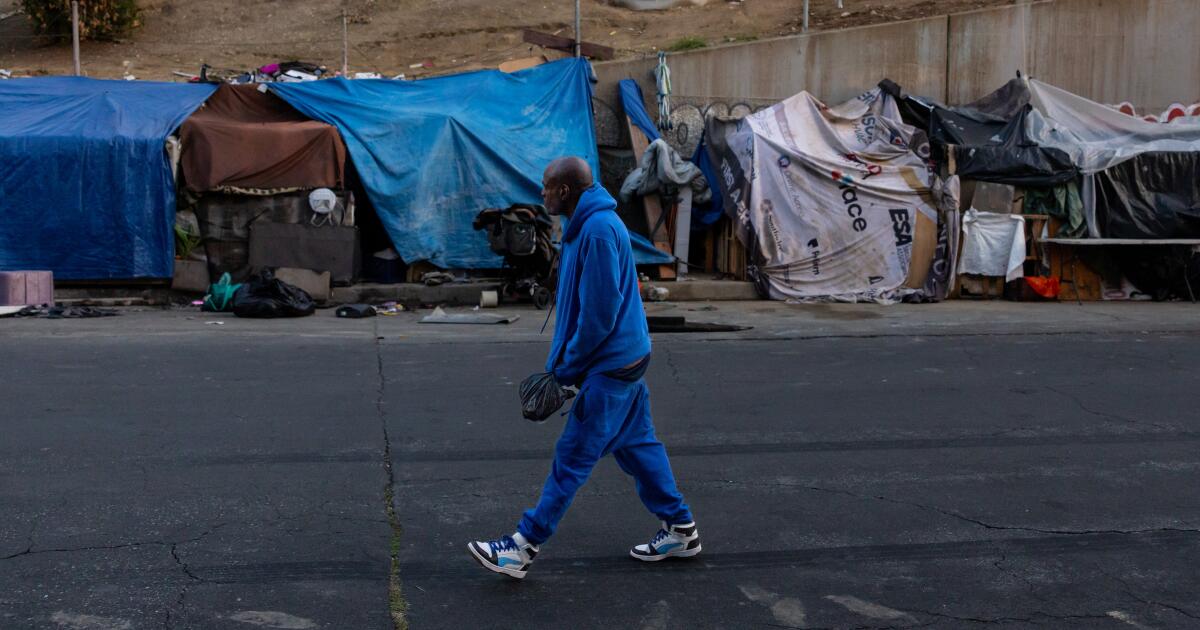
WASHINGTON — President Trump is singling out the Los Angeles Homeless Services Authority as a cautionary tale about Democratic mismanagement of publicly funded programs, using it to justify proposed cuts to homeless assistance services across the country.
Trump’s proposed budget for the next fiscal year, released Friday, asks Congress to eliminate the Continuum of Care — a federal program that funds housing and services for homeless Americans — citing concerns about “fraud and corruption” among local agencies that administer it.
The White House points to LAHSA, which manages many homeless services for the city and county, as the example of why the program needs to go.
“LAHSA has an abysmal record of reducing what is the highest number of street homeless individuals in the United States, and an independent audit issued in March 2025 found that the authority failed to accurately track billions of Federal and local dollars,” the budget says.
The local agency pushed back in a statement after the budget was released.
“Cutting this funding or destabilizing the Continuum of Care program would directly result in more tents on our streets, not fewer,” said Gita O’Neill, the agency’s interim chief executive, adding that under its leadership unsheltered homelessness in Los Angeles has fallen 15% and that 90% of the program’s funding goes “directly to rental assistance.”
Local officials are already grappling with homeless service cuts at the state and county level given budget constraints and LAHSA warned Trump’s proposal would make matters worse.
“If anything, we need additional funding to cover rising costs, not fewer, to maintain our current momentum,” the agency said Friday.
The funding dispute over homelessness services is one front in a broader budget assault on California programs by the Trump administration.
Trump’s proposal also asks Congress to eliminate millions in funding from state initiatives the White House is characterizing as wasteful, ineffective or “woke.”
The cuts, if enacted, would cancel $4 billion in unspent funding for the state’s high-speed rail project, which the White house called a “boondoggle,” and strip grants from the Fair Housing Advocates of Northern California, which the budget criticized for “actively working to dismantle systems of power and privilege that favor whiteness.”
Smaller items are also targeted on the White House’s chopping block: a Los Angeles gelato festival, a dance building in Santa Cruz — which the White House dubs “one of the richest cities in the nation” — and a $3-million grant for a playground tied to an unspecified performing arts center in California.
Trump’s proposed cuts to California projects are part of a broader effort by the Trump administration to reshape federal spending priorities, largely by trading social programs for a massive military buildup.
The president is asking Congress to approve $1.5 trillion for defense and to slash $73 billion from domestic programs, a massive restructuring that would leave states, including California, to absorb costs Washington no longer wants to carry.
Trump made that vision explicit at a private Easter lunch at the White House on Wednesday, telling guests that the federal government should no longer be responsible for funding social programs that many Americans rely on.
“We can’t take care of daycare. We are a big country,” Trump said. “We are fighting wars. We can’t take care of daycare.”
If states want to offer those services, Trump said, they should raise taxes to pay for them.
“Medicaid, Medicare, all these individual things, they can do it on a state basis,” he said. “We have to take care of one thing: military protection.”
His proposed budget reflects that priority, which lawmakers will need to contend with as they grapple with the mounting costs of the Iran war and an economic fallout from a military operation that has left Americans paying more items, including gas pump.
Under the proposed budget, Trump is also seeking to make some investments in California projects.
The White House, for example, is seeking $152 million from Congress to turn Alcatraz back into a maximum-security prison, an idea the president has talked about for several years.
He also called on Congress to establish a National Center for Warrior Independence at the West Los Angeles VA Medical Center.
Times staff writer Andrew Khouri, in Los Angeles, contributed to this report.
NEW YORK — This is not the run up to the midterm elections that Republicans wanted.
A year and a half after winning the White House by promising to lower costs and end wars, Donald Trump is a wartime president overseeing surging energy costs and an escalating overseas conflict that many in his own party do not like.
He offered little clarity to a nation eager for answers this week during a prime-time address from the White House, his first since the U.S. and Israel attacked Iran more than a month ago, simultaneously suggesting that the war was ending and expanding.
“Thanks to the progress we’ve made, I can say tonight that we are on track to complete all of America’s military objectives shortly, very shortly,” Trump said. “We’re going to hit them extremely hard over the next two to three weeks.”
Trump’s comments come roughly six months before voters across the nation begin to cast ballots in elections that will decide control of Congress and key governorships for Trump’s final two years in office. For now, Republicans, who control all branches of government in Washington, are bracing for a painful political backlash.
“You’re looking at an ugly November,” warned veteran Republican pollster Neil Newhouse. “At a point in time when we need every break possible to hold the House and Senate, our edge is being chipped away.”
Republicans confront evolving political landscape
It’s hard to overstate how dramatically the political landscape has shifted.
At this time last year, many Republican leaders believed there was a path to preserve their narrow House majority and easily hold the Senate. Now they privately concede that the House is all but lost and Democrats have a realistic shot at taking the Senate.
Republicans are also struggling to coalesce around a clear midterm message on Iran.
The Republican National Committee has largely avoided the war in talking points issued to surrogates over the last month. The leaders of the party’s campaign committees responsible for the House and Senate declined interview requests. Many vulnerable Republican candidates sidestep the issue, unwilling to defend or challenge Trump publicly.
The president remains deeply popular with Republican voters, and he has vocal supporters like Sen. Lindsey Graham of South Carolina.
“That was the best speech I could’ve hoped for,” he wrote on social media after Trump’s address on Wednesday evening. Graham said Trump “gave the American people a clear and coherent pathway forward.”
Trump made little effort to sell the conflict to Americans before the initial attack. Five weeks later, at least 13 U.S. service members have been killed and hundreds more injured. Thousands more troops have converged on the region, and the Pentagon requested $200 billion in new funding.
The Strait of Hormuz, a key passage for a fifth of the world’s oil, remains closed. The average price for a gallon of gasoline in the U.S. was $4.08 on Thursday, according to AAA, almost a full dollar higher than on President Joe Biden’s last day in office.
On Wednesday, Trump insisted that gas prices would fall quickly once the war concluded but offered no solution for reopening the Strait of Hormuz. Instead, he invited skeptical U.S. allies to do it themselves.
He insisted that the war would be worth it.
“This is a true investment in your grandchildren and your grandchildren’s future,” Trump said. “When it’s all over, the United States will be safer, stronger, more prosperous and greater than it has ever been before.”
Former Rep. Marjorie Taylor Greene, a Georgia Republican who was once among Trump’s most vocal allies in Congress, lashed out against his Iran policy.
“I wanted so much for President Trump to put America First. That’s what I believed he would do. All I heard from his speech tonight was WAR WAR WAR,” she wrote on social media. “Nothing to lower the cost of living for Americans.”
Time is not on Trump’s side
About 6 in 10 U.S. adults say the U.S. military action in Iran has “gone too far,” according to AP-NORC polling from March. Roughly a third approve of how he’s handling Iran overall.
The possibility of sending U.S. forces into Iran also appears politically unpalatable.
About 6 in 10 adults are “strongly” or “somewhat” opposed to deploying U.S. troops on the ground to fight Iran. That includes about half of Republicans. Only about 1 in 10 favor deploying troops.
At the same time, Trump’s approval ratings have remained consistently weak. About 4 in 10 Americans approve of how he’s handling the presidency, roughly in line with how it’s been throughout his second term.
Republican strategist Ari Fleischer, a senior aide in former President George W. Bush’s administration, acknowledged that Trump has not received the polling bump in this war that Bush got after invading Iraq.
Bush, of course, worked to build public backing for the Iraq War before going in. Immediately after the 2003 invasion, Bush’s popularity soared, as did the stock market.
Public sentiment and the economy soured only after the conflict stretched on. It ultimately spanned more than eight years, spawning a generation of anti-war Republicans — and sowing the seeds of Trump’s “America First” foreign policy.
“My hope is that the Trump experience is the exact opposite of the Bush experience,” Fleischer said.
He said Trump must win the war decisively and quickly to avoid a further backlash, saying there could be a “very significant political upside if things end well, oil comes down and markets rally.”
Fleischer added that Trump’s actions will matter much more than his words.
“Ultimately, he is not going to get judged on his persuasion or his explanations or his assertions, he’s going to get judged on results,” he said.
Peoples writes for the Associated Press. AP writer Linley Sanders in Washington contributed to this report.
WASHINGTON — One year ago, Donald Trump stood in a sun-kissed, unpaved Rose Garden and defiantly announced a new era of global trade, raising tariffs on countries worldwide and sending shock waves through the global economy.
The president promised short-term pain rippling through American households would make way for a U.S. economy that would soon take off. But experts say they are still waiting for receipts — and question whether they will ever come.
You’re reading the L.A. Times Politics newsletter
George Skelton and Michael Wilner cover the insights, legislation, players and politics you need to know. In your inbox Monday and Thursday mornings.
By continuing, you agree to our Terms of Service, which include arbitration and a class action waiver. You agree that we and our third-party vendors may collect and use your information, including through cookies, pixels and similar technologies, for the purposes set forth in our Privacy Policy such as personalizing your experience and ads.
A year of turbulence
Tariff rates shifted so unpredictably for so long — across countries and with remarkable speed — that companies are still struggling to build stable, long-term supply chains capable of supporting future planning and growth. U.S. markets recorded one of the most volatile years in history, marked by extreme swings and modest gains driven by a handful of stocks for tech companies largely inoculated from import duties.
A customer visits a Costco food court in San Diego on March 18.
(Kevin Carter / Getty Images)
Federal customs duties brought in tens of billions of dollars. But a study published this week by the European Central Bank found that U.S. importers and consumers, not foreign exporters, bore the brunt of the costs that paid for it — and that an even larger share of the burden will fall on American households and companies the longer Trump’s tariff policies stay in place.
Despite the president’s pronouncements, tariff earnings have barely made a dent in the federal debt.
Tax cuts and additional spending on defense and immigration enforcement have increased the annual deficit. In the months of January and February alone, net customs duties hit an average of $27 billion — a significant figure that has essentially offset the costs of Trump’s war with Iran, now estimated to be more than $57 billion since its start.
In February, the Supreme Court ruled that Trump had exceeded his authority by bypassing Congress to impose tariffs on an emergency basis. But the decision has merely prompted the Trump administration to look for ways to bypass the high court, as well.
“Even after the court ruling, the Trump administration continues to wield tariffs in a haphazard and ill-conceived fashion,” said Kimberly Clausing, a professor of tax policy and law at UCLA School of Law. “One year in, Trump’s tariffs have only generated higher prices, economic disruption, frayed alliances, and manufacturing job loss.”
Farmers in New Delhi take part in a March 19 protest demanding a minimum support price for crops.
(Sajjad Hussain / AFP / Getty Images)
Since the court ruling, Trump has moved away from using broad emergency powers to justify tariff rates, now citing laws on national security and unfair trade practices to keep them in place. Those are being challenged, as well.
“Trump’s tariff mania injected uncertainty into global business supply chains that he is refusing to let the Supreme Court undo,” said Aaron Klein, chair of economic studies at the Brookings Institution.
“It would be one thing if Trump replaced the existing tariff system with a coherent strategy approved by the very Republican Congress he controls,” Klein added. “Instead, Trump’s on-again, off-again tariff by tweet and let the courts figure it out months later destroys business’ ability to plan and undermines global confidence in America’s trustworthiness.”
‘Mounting downside’
Whether or not the president’s tariff policies survive, they have succeeded in ushering in a new era of international trade, shifting global reliance on the U.S. dollar and on the American consumer market, experts said.
“The euro, the Chinese yuan and crypto will be the biggest beneficiaries as the dollar loses market share,” said Kenneth Rogoff, an economist and professor at Harvard. “Future historians may well look back some day and see Liberation Day as marking the beginning of the end of the dollar’s absolute dominance in global markets, and the ‘exorbitant privilege’ it has given to the United States as issuer of what once upon a time was the world safest currency.”
Mary Lovely, a senior fellow at the Peterson Institute for International Economics, said that Trump’s tariff policies have upended global shipping, prompted China to increase offshore investments in countries like Vietnam to process Chinese inputs for the U.S. market, and elevated long-term uncertainty over investing in North America — a trifecta that has ensured that U.S. companies and consumers bear the costs.
“While the president promised an American ‘industrial renaissance,’ manufacturing jobs have been lost every month since early 2023,” Lovely said. “Easy to see the mounting downside of his tariff barrage, hard to find much upside.”
More than 100,000 net jobs in the U.S. manufacturing sector have been lost over the last year, in part due to the increased costs facing U.S.-based manufacturing companies for parts and inputs, said Michael Strain, director of economic policy studies at the American Enterprise Institute.
That has made domestic manufacturing less competitive. “The trade war has also increased the prices facing consumers at a time when affordability is their top concern,” Strain added.
Customers shop at the Sanya International Duty Free City in Sanya, in south China’s Hainan province, on Jan. 10. In December 2025, China launched special customs operations in the Hainan Free Trade Port, allowing easier entry of overseas goods and expanding zero-tariff coverage.
(Guo Cheng / Xinhua / Getty Images)
The policy has become a political albatross for the president, who now proceeds through a midterm year with a bipartisan majority of Americans dissatisfied with his approach to their top concern. Seven in 10 Americans believe that tariffs have increased their costs of living, according to a recent poll, including 64% of Republicans and 67% of independents.
Sung Won Sohn, a former commissioner at the Port of Los Angeles, said that inflation aggravated by Trump’s tariff actions has complicated policy at the Federal Reserve, fueling uncertainty in the U.S. stock market.
The Supreme Court’s decision, which prompted legal ambiguity on the administration’s path forward and opened the door to a flood of litigation for potential tariff refunds, further added to uncertainty. “The net result is decreased economic efficiency,” Sohn said.
Trump faces worse poll numbers on inflation than former Presidents Carter and Biden, both of whom faced challenges with increased prices on goods. Today, 72% of Americans disapprove of the president’s handling of rising prices, according to a CNN poll released this week.
“The real damage from the tariffs — and their uneven unwinding — is not captured in headline GDP figures,” Sohn added. “It shows up in slower decision-making, reduced productivity, and a persistent fog over the economic outlook.”
WASHINGTON — President Trump’s White House ballroom won final approval from a key agency on Thursday, days after a federal judge ordered a halt to construction unless Congress allows what would be the biggest structural change to the American landmark in more than 70 years.
The National Capital Planning Commission, the agency tasked with approving construction on federal property in the Washington region, went ahead with the vote because U.S. District Judge Richard Leon’s ruling on Tuesday affects construction activities, not the planning process, commission spokesperson Stephen Staudigl said.
But despite the agency’s approval, the judge’s ruling and the legal fight over the ballroom could stall progress on a legacy project that Trump is racing to see completed before the end of his term in early 2029. It’s among a series of changes the Republican president is planning for the nation’s capital to leave his lasting imprint while he’s still in office.
The vote by the 12-person commission, including three members appointed by Trump, had initially been scheduled for March but was pushed to Thursday because so many people signed up to comment on it at the commission’s meeting. The comments were overwhelmingly opposed to the ballroom.
Trump tweaks the ballroom design
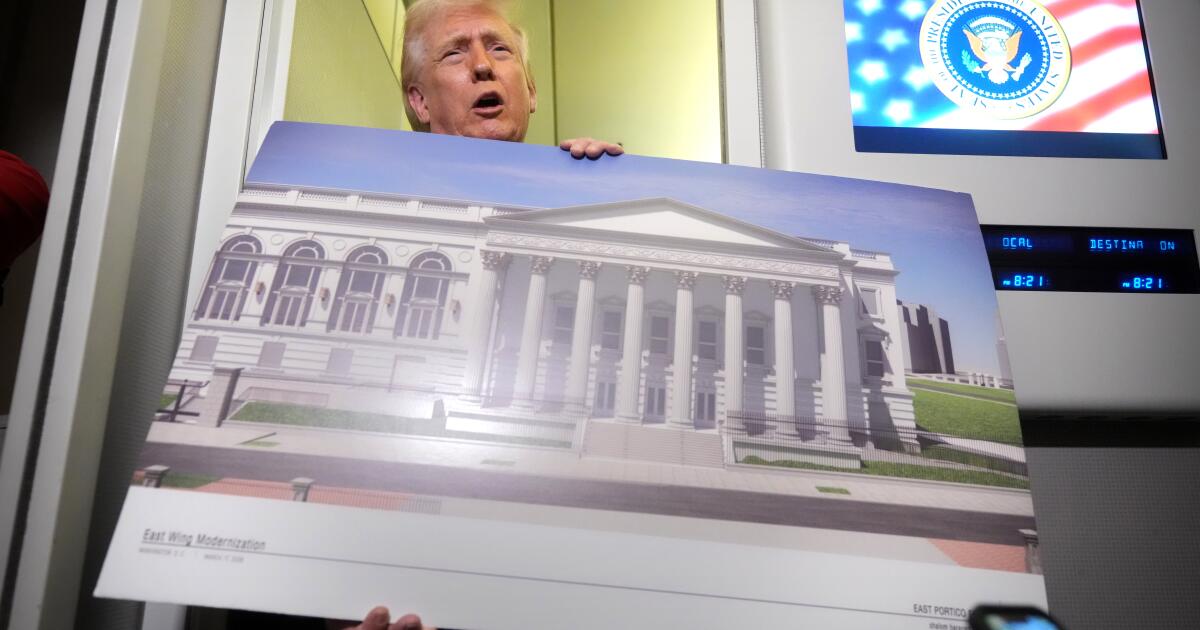
Before voting Thursday, the commission considered some design changes to the 90,000-square-foot ballroom addition that Trump announced aboard Air Force One on Sunday as he flew back to Washington from a weekend at his Florida home.
He removed a large staircase on the south side of the building and added an uncovered porch to the west side. Architects and other critics of the project had panned the staircase as too large and basically useless since there was no way to enter the ballroom at the top.
Trump gave no reason for the changes, but a White House official said the president had considered comments from the National Capital Planning Commission and another oversight entity, the U.S. Commission of Fine Arts, which approved the project earlier this year, as well as members of the public.
The official, who was not authorized to publicly discuss the ballroom design and spoke on the condition of anonymity, said that additional “refinements” had been made to the building’s exterior and that lead architect Shalom Baranes would present them on Thursday.
The ballroom, now estimated to cost $400 million, has expanded in scope and price tag since Trump first announced the project last summer, citing a need for space other than a tent on the lawn to host important guests. Trump demolished the East Wing in October with little warning, and site preparation and underground work have been underway since then. Officials said above-ground construction would not start until April, at the earliest.
Judge says Trump isn’t the owner of the White House
The National Capital Planning Commission is chaired by Will Scharf, a top White House aide who has spoken in support of the ballroom addition. The president appoints three of the members, and Trump named two other White House officials along with Scharf.
Trump went ahead with the project before seeking input from the National Capital Planning Commission and the Commission of Fine Arts, which he reconstituted with allies and supporters.
The National Trust for Historic Preservation, a private nonprofit organization, sued after Trump demolished the East Wing last fall to build the ballroom addition — a space nearly twice as big as the mansion itself. Trump says it will be paid for with donations from wealthy people and corporations, including him, though public dollars are paying for underground bunkers and security upgrades on the White House grounds.
The trust sought a temporary halt to construction until Trump presented the project to both commissions and Congress for approval. Leon, the judge, agreed but said that his order would take effect in two weeks and that construction related to security would be allowed.
That work continued Wednesday as new photos by the Associated Press show the site of the former East Wing bustling with activity as cranes stretched toward the sky.
The judge, who was nominated to the bench by Republican President George W. Bush, wrote in his ruling: “The President of the United States is the steward of the White House for future generations of First Families. He is not, however, the owner!” He concluded that the National Trust for Historic Preservation was likely to succeed on the merits of its claims because “no statute comes close to giving the President the authority he claims to have.”
Trump disputed that Congress must also approve his project.
“We built many things at the White House over the years. They don’t get congressional approval,” he told reporters in the Oval Office after the ruling.
Representatives for the House and Senate committees with jurisdiction over the project did not return telephone messages seeking comment. Congress is on spring break.
WASHINGTON — Inside the Supreme Court, as justices heard oral arguments in the case over birthright citizenship, President Trump became the first sitting president to attend such a proceeding.
Outside the court, the great-grandson of Wong Kim Ark — the San Francisco man whose landmark Supreme Court case affirmed birthright citizenship in 1898 — addressed a crowd of hundreds of people.
“Wong Kim Ark’s victory ensured that people like me and millions of others would be recognized as fully American, not outsiders in the country of our birth,” said Norman Wong. “This case transformed the 14th Amendment from words on paper into living promise. Today, that promise is still being tested.”
Surrounded by protesters in favor of birthright citizenship was a lone counter-protester. The woman, who wore a red baseball cap and a sweatshirt stating “Chicago flips red,” yelled into a megaphone as speakers addressed the crowd.
“Freedmen stand with Donald Trump,” she said as the Rev. William Barber II spoke. “America first. Americans first.”
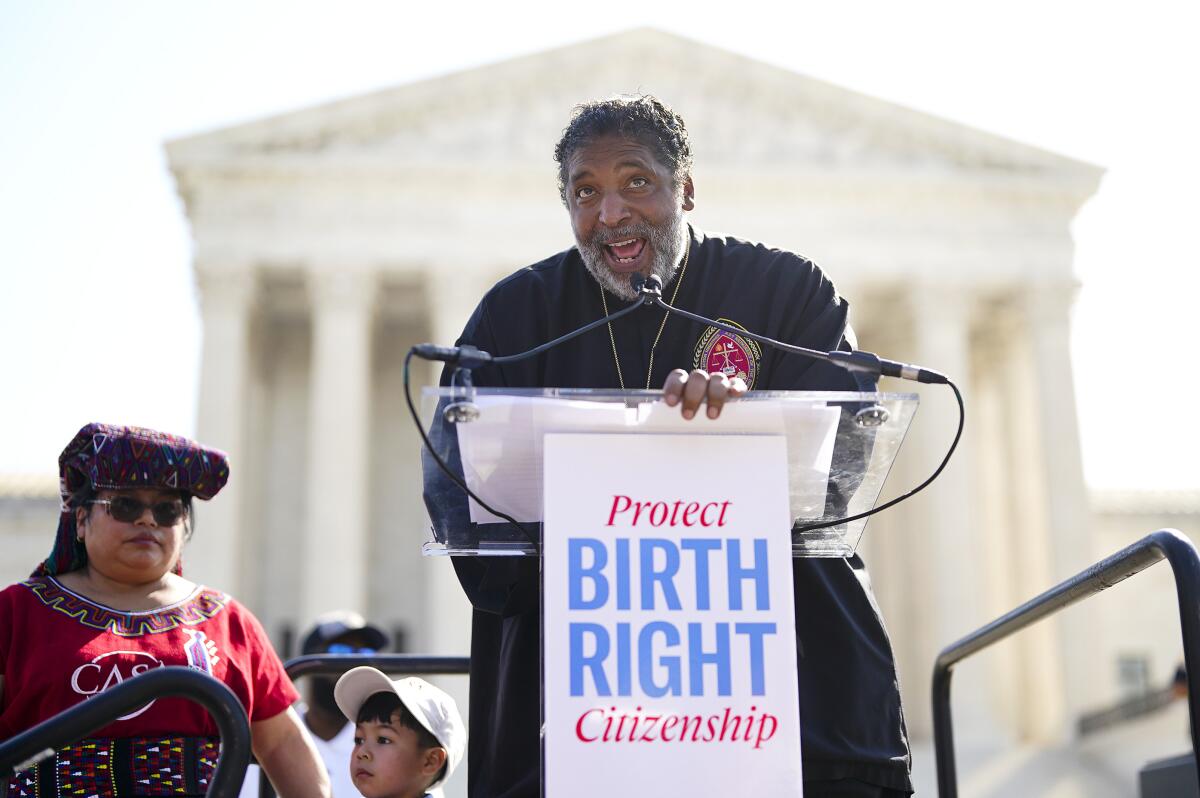
The Rev. William Barber II speaks during a rally on protecting birthright citizenship outside the Supreme Court on Wednesday.
(Al Drago / Getty Images)
Undaunted, Barber noted that the 14th Amendment, ratified in 1868, makes clear that anyone born in the U.S. is a citizen.
“The 14th Amendment protects babies from a caste system,” Barber said. “They didn’t allow evil in 1868, and we’re not going to allow evil in 2026.”
“Stop lying, pastor,” the woman taunted him.
After Barber finished his remarks, the woman was drowned out by Aretha Franklin’s “Respect” playing over the speakers.
Inside the building, justices heard arguments over a Trump executive order which aimed to end birthright citizenship. The administration has argued that children born of parents who are in the country illegally or temporary visas should be denied citizenship.
A man from Cameroon said he chose to speak out because he doesn’t want future generations to become stateless and feel what he has felt. The man said he had been authorized to work in the United States Temporary Protected Status until the Trump administration terminated it last year.
“I know what it feels like to have your sense of belonging taken from you overnight,” he said.
Nancy Jeannechild, 69, traveled from Baltimore with a handwritten sign asking the justices to “Do your job.” She said Trump has amassed too much power and that the Supreme Court hasn’t stood up to him enough.
“This is another opportunity for them to do the right thing, and I hope that they will,” she said. “Just because Trump doesn’t like it doesn’t mean it’s not what’s in the Constitution.”
Araceli Hernandez, 29, attended the rally with her 1-year-old son. She said she immigrated from Honduras five years ago and that her son being born here means he has better opportunities to study, access to healthcare and a safe environment to live in.
“We came to represent the children who are not yet born because they also have a right to have a better future in this country,” she said.
Sen. Alex Padilla (D-Calif.) said he was confident birthright citizenship would prevail because the Constitution is clear. The fight is personal, he said, as the a proud American and son of immigrants.
“The moment I was born on U.S. soil I was born a citizen, and I’ll be damned if Donald Trump tries to take that away from me,” he said. “What’s on the line isn’t just a question about citizenship — it is about upholding the Constitution, respecting the rule of law and keeping the promise that the 14th Amendment has held for more than 150 years.”
After the arguments wrapped up, Cecilia Wang, who led the defense of birthright citizenship for the American Civil Liberties Union, addressed the crowd. She said she was confident that the Trump administration would lose the case.
“Whether you’re an indigenous American, whether you are descended from African Americans who were enslaved and free, whether you are the descendant of someone who came on the Mayflower or someone who arrived just before your birth, we all are Americans alike,” she said. “That is the principle that we stood up for together, all of us, in the Supreme Court of the United States today.”
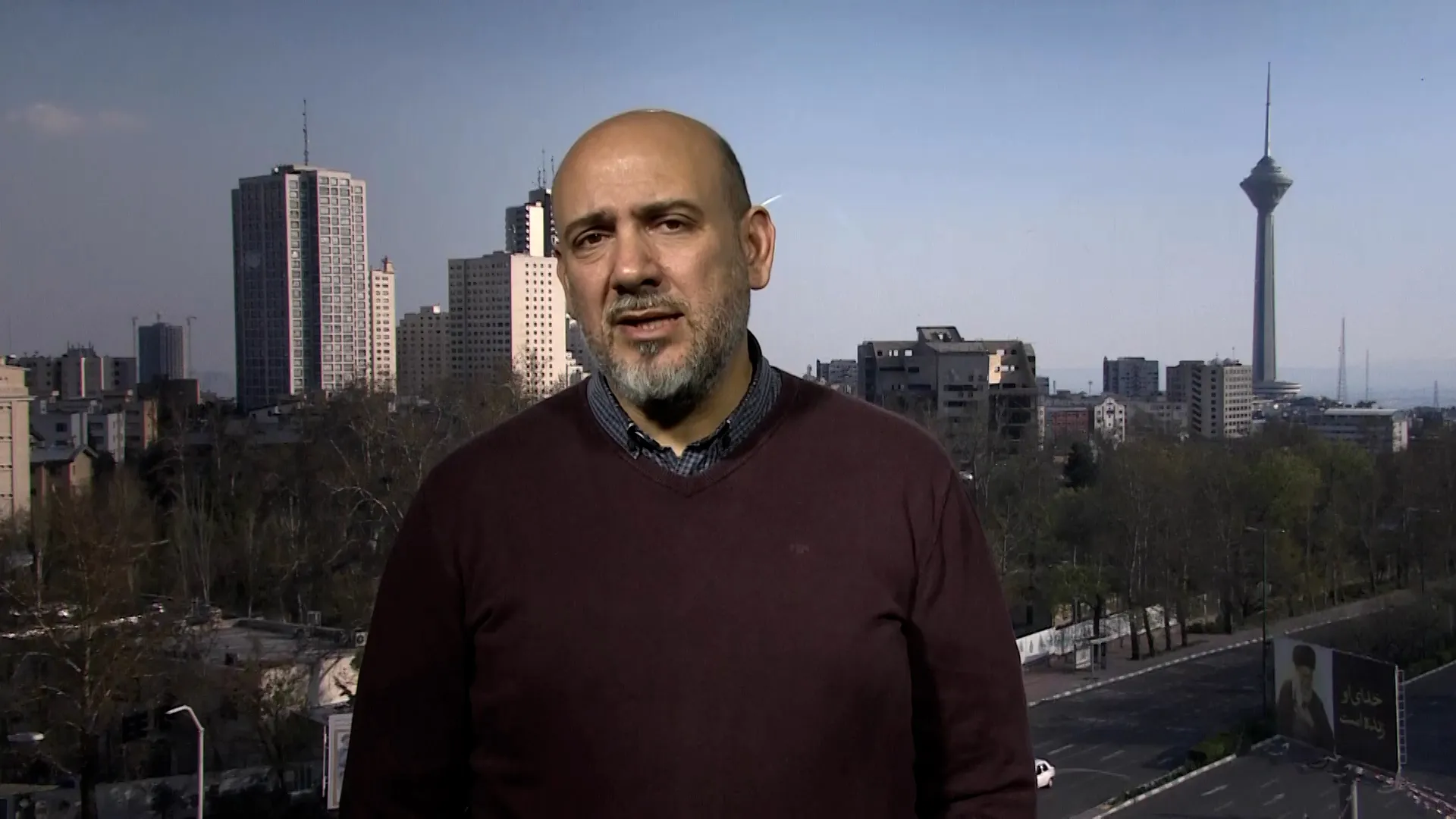
A senior Iranian official has laughed in response to US President Donald Trump’s claim that Iran’s president has asked for a ceasefire, Al Jazeera’s Ali Hashem says Trump’s comments come a day after Iran’s foreign minister said his country was not looking for a ceasefire.
WASHINGTON — The Supreme Court on Wednesday will hear President Trump’s claim that he has the power to revise the Constitution and to end birthright citizenship for babies born in this country to parents who were here unlawfully or temporarily.
Trump proposed this potentially far-reaching change in an executive order. It has been blocked by judges across the country and has never been in effect.
His lawyers contend they seek to correct a 160-year misunderstanding about the Constitution’s promise that “all persons born” in this country are deemed to be citizens.
By comparison, the president has even less power to set the rules for U.S. citizenship. The Constitution gives Congress the power to “establish a uniform rule of naturalization.”
After the Civil War, Congress adopted a civil rights act in 1866 that said “all persons born in the United States and not subject to any foreign power, including Indians not taxed, are hereby declared to be citizens of the United States … of every race and color.”
To make sure that rule stood over time, it was added to the Constitution in the 14th Amendment. Its opening line says: “All persons born or naturalized in the United States and subject to the jurisdiction thereof are citizens of the United States and of the State wherein they reside.”
In 1898, a conservative Supreme Court upheld that rule and affirmed the citizenship of Wong Kim Ark. He was born in San Francisco to Chinese parents who later returned to China.
“The 14th Amendment affirms the ancient and fundamental rule of citizenship by birth within the territory,” the court said. “In clear words and in manifest intent, [it] includes the children born, within the territory of the United States, of all other persons, of whatever race or color.”
In 1952, when Congress revised the immigration laws, it added the same provision without controversy. Lawmakers set multiple rules for deciding disputes over American parents who live abroad, but the first rule was simple and undisputed.
“The following shall be nationals and citizens of the United States at birth: a person born in the United States and subject to the jurisdiction thereof,” the law said.
Critics say Trump’s plan could replace a clear and simple rule with a confusing and complicated one. States would have to look into the history and legal status of a newborn’s parents to decide whether they met the new qualifications.
Until now, a valid birth certificate had been sufficient to establish a person’s U.S. citizenship.
Last week, Trump was urging Senate Republicans to pass a new election law that would require millions of Americans to present a birth certificate as proof of their citizenship if they register to vote or move to a new state.
“Proving citizenship to vote is a no brainer,” the White House said.
This week, however, Trump’s lawyers are urging the court to rule that their birth in this country is not proof of their citizenship.
There is a “logical inconsistency” here,” said Eliza Sweren-Becker, a voting rights expert at the Brennan Center.
In the legal battle now before the court, the key disputed phrase is “subject to the jurisdiction.” That has been understood to mean that people within the United States are subject to the laws here, except for foreign diplomats and, for a time, Native Americans who lived on tribal reservations.
But Sauer contends it excludes newborns who are “not completely subject to the United States’ political jurisdiction” because their parents are in this country unlawfully.
Lawyers for the American Civil Liberties Union called this a “radical rewriting” of the 14th Amendment, which says nothing about the parents of a newborn child.
If upheld, this order could apply to “tens of thousands of children born every month, “ they said, “devastating families around the country.” But worse yet, they said, the outcome “would cast a shadow over the citizenship of millions upon millions of Americans, going back generations.”
Some legal experts predict the court may rule narrowly and reject Trump’s executive order because it conflicts with federal immigration laws. Such a ruling would be a defeat for Trump, but it could allow Congress in the future to adopt new provisions, including a limit for expectant mothers who enter this country to give birth.
The recently revised food pyramid may put fruit as a medium priority, but there is nothing the Trump administration likes more than the apple of discord.
Every news cycle, the president seems intent on introducing something new for Americans to argue about: the wisdom (and legality) of war in Iraq; the term “affordability”; the efficacy of mail-in ballots (which the president recently used); the meaning of birthright; the legitimacy of a vice president who has been publicly admonished by two popes for writing a book about his conversion to Catholicism — heck, we’re still arguing about that new food pyramid.
But there is one recent development upon which we really should all agree — erecting a gold statue of President Trump in the middle of his proposed presidential library is a No Good, Very Bad Idea.
On Tuesday, the president’s son Eric posted a first-look video for said library, which will reside on the waterfront in Miami. While questions were raised about the inclusion of the Boeing 747-8 the president controversially accepted as a gift from Qatar and the apparent lack of space in the sky-scraping library for, you know, books, it was the enormous gold statue of Trump towering over the stage in a proposed auditorium that drew the most immediate attention.
That Trump chose to reveal this little (well, actually quite big) beauty mere days after millions of Americans across the country participated in a coordinated No Kings march can be taken as either breathtaking irony or, more probably, a rage-baiting metaphoric middle finger.
As he has been recently wont to do, California Gov. Gavin Newsom quickly responded on his press office X account with photos of gold statuary depicting former chairman of the Chinese Communist Party Mao Zedong, North Korea’s Kim Il-Sung and Turkmenistan’s Saparmurat Niyazov and the observation that “The gold statue in Trump’s new library (of himself) looks awfully familiar to a few others from around the world.”
Trump’s obsession with gold will no doubt obsess future generations of historians, artists, psychoanalysts and Wikipedia editors — the guerrilla art group Secret Handshake on Monday put up a gold toilet statue on the National Mall mocking the president’s plans to renovate the Lincoln bathroom during a time of war and strife, as tribute, according to the statue’s plaque, “to an unwavering visionary who looked down, saw a problem and painted it gold.”
But even allowing for personal taste, a big golden statue of Trump is a terrible idea. For him.
In times of trouble and/or leadership changes, statues are often the first to go — as Trump knows well, since he’s working to replace the Confederate generals displaced after the Black Lives Matter movement and recently erected, near the White House, a replica of the Christopher Columbus statue thrown into Baltimore’s Inner Harbor during 2020 protests.
After hearing the Declaration of Independence read publicly for the first time, members of the Sons of Liberty tore down a statue of King George III from Bowling Green; during the French Revolution, the kings all across Paris came down; ditto Napoleon when he fell out of favor. In Russia, tsarist monuments were replaced by statues of Communist leaders, which in turn were torn down — statues of Stalin also fell in Hungary, Georgia and Albania. More recently, a statue of Saddam Hussein famously met the same fate.
As Robert Frost might have put it: Something there is that doesn’t love a statue of a divisive leader. Especially if it’s gold.
OK, I added that last bit.
There are plenty of famous and popular gold statues — Thailand’s Golden Buddha; the Golden Madonna of Essen in Germany; Jeanne d’Arc in Paris; Prometheus at Rockefeller Center in New York; even Tutankhamun’s death mask and solid gold coffin, which travel the world. But, as perhaps you have noticed, they trend toward the religious, mythic or historic, i.e. dead.
In the lavish memorial erected by his grieving widow, Queen Victoria, Prince Albert is golden, but few world leaders are permanently gilded, and certainly not before their deaths. (London’s golden statue of King Charles II was erected during his lifetime but originally in bronze — the gold was added later. It also depicts Charles in Roman garb, so I suppose the Trump statue could be worse — at least we don’t see his naked knees.)
In the United States, golden statuary is rare and usually metaphoric — the Oregon Pioneer, the Golden Driller, the Spirit of Communication. Gold remains captivating, an aspirational symbol of success (“gold standard”) and wealth (“golden touch”), but it can also bring with it an air of mockery (“golden boy”) and warning. The original golden touch belonged to King Midas, who loved it until he accidentally killed his daughter by turning her into a gold statue.
Displays of it, particularly in architecture or public art, are often perceived as tacky, kitschy or, heaven forbid, nouveau riche. Trump is fine being perceived as all of these things; he has long embraced the gleaming excesses of Versailles — the golden elevator will also be featured in the new proposed library.
His personal taste is his right and is shared by many.
In terms of statuary, however, “golden” is most typically associated with “idol,” figures that are erected specifically to be worshiped — the Golden Calf that made God and Moses so angry comes to mind — and Americans, historically, have not been big fans of idolatry.
Hence the separation of church and state, a three-branch government and a president with a limited term. The early colonists were very much anti-idol worshippers and even modern Catholics, as Vice President Vance surely knows, have long been criticized by their Protestant counterparts for a love of statuary, reliquaries and other iconography that some have argued fall into idolatry.
Trump clearly has no problem with idolatry, as long as he is the idol in question — he has long characterized his supporters as people who will love him no matter what he does. So no one should be surprised that his son would anchor the Trump presidential library with an enormous golden statue of his father — Trump is not a man to be satisfied with bronze or, heaven forbid, a marble bust.
No doubt, any criticism of that statue will be met with derision from Trump supporters. In its many guises, idolatry has survived, despite regular and often cataclysmic proof of its dangers, for centuries and many people will consider a much-larger-than-life golden statue of a president to be perfectly splendid.
But someone might want to mention to the president that flashing a big gold statue of himself while cities are still doing cleanup from enormous No Kings marches might seem funny to some. But to others … well, Versailles was once a dazzling royal residence.
District Judge Richard Leon says construction has to stop until Congress provides statutory authorisation.
Published On 1 Apr 20261 Apr 2026
A judge has ruled that US President Donald Trump cannot proceed with his planned $400m ballroom on the site of the White House’s demolished East Wing without approval from Congress.
District Judge Richard Leon on Tuesday granted a request for a preliminary injunction filed by the National Trust for Historic Preservation, which sued after alleging Trump had exceeded his authority by razing the historic East Wing and launching construction on the new building.
Recommended Stories
list of 2 itemsend of list
“I have concluded that the National Trust is likely to succeed on the merits because no statute comes close to giving the President the authority he claims to have,” Leon, an appointee of former Republican President George W Bush, wrote in the ruling.
“The President of the United States is the steward of the White House for future generations of First Families. He is not, however, the owner!” he said. “Unless and until Congress blesses this project through statutory authorization, construction has to stop!”
Leon said the order does not affect “construction necessary to ensure the safety and security of the White House”.
His ruling keeps the 90,000 square-foot (8,360 square-metre) ballroom project on hold while the lawsuit continues.
The judge said he was pausing his order for 14 days to allow the Trump administration to appeal. Hours later, the Justice Department filed an appeal at the Washington, DC-based US Court of Appeals for the District of Columbia Circuit.
Artist renderings of the new White House East Wing and Ballroom [Jon Elswick/AP]
Carol Quillen, president and CEO of the National Trust, welcomed Leon’s ruling.
“This is a win for the American people on a project that forever impacts one of the most beloved and iconic places in our nation,” Quillen said in a statement.
In a social media post, Trump called the National Trust a group of left-wing “lunatics” and said his ballroom is “under budget, ahead of schedule, being built at no cost to the Taxpayer, and will be the finest Building of its kind anywhere in the World”.
The Republican has championed the ballroom as a defining addition to the White House and a lasting symbol of his presidency.
The headquarters for National Public Radio is seen in Washington, D.C., on May 27. A federal judge sided with NPR’s lawsuit saying Trump’s cut to federal funding was a violation of the First Amendment. File Photo by Bonnie Cash/UPI | License Photo
March 31 (UPI) — A federal judge in Washington, D.C., ruled Tuesday that President Donald Trump‘s executive order cutting funding to NPR and the PBS was a violation of their First Amendment rights.
U.S. District Judge Randolph Moss said the executive order signed in May violated the companies’ constitutional rights to a free press because Trump targeted for what he described as liberal views. He described the cut to funding as “viewpoint discrimination.”
“The message is clear: NPR and PBS need not apply for any federal benefit because the president disapproves of their ‘left-wing’ coverage of the news,” Moss said in his ruling.
“It is difficult to conceive of clearer evidence that a government action is targeted at viewpoints that the president does not like and seeks to squelch,” he added.
“To be sure, the president is entitled to criticize this or any other reporting, and he can express his own views as he sees fit. He may not, however, use his governmental power to direct federal agencies to exclude plaintiffs from receiving federal grants or other funding in retaliation for saying things that he does not like.”
Trump’s executive order, called Ending Taxpayer Subsidization of Biased Media, ordered the Corporation for Public Broadcasting to stop funding National Public Radio and the Public Broadcasting Service to the maximum extent allowed by law.
At the time, more than 70% of CPB’s congressionally approved $535 million budget went directly to public media stations through grants.
According to NPR, about 1% of its annual operating budget came in the form of grants from CPB and federal agencies and departments, excluding CPB funding for the Public Radio Satellite System. Its largest funding stream — about 36% — comes from sponsorships, donations, memberships and licensing fees.
According to PBS, federal funding covered about 15% of its revenue.
CPB was founded in 1967 as a private nonprofit corporation to fund public television and radio stations and their programs.
NPR sued the Trump administration later in the month, citing First Amendment and 1967 Public Broadcasting Act violations.
President Donald Trump stands with U.S. Secretary of Agriculture Brooke Rollins during an event celebrating farmers on the South Lawn of the White House on Friday. Photo by Aaron Schwartz/UPI | License Photo
Investors remain wary, as the Wall Street Journal report came on the same day the US president threatened to destroy Iran’s key oil export hub and desalination plants unless it accepts a deal, while also suggesting that diplomacy was making progress.
ADVERTISEMENT
ADVERTISEMENT
The news comes as governments around the world scramble to implement measures to ease the burden of surging fuel prices while also seeking to conserve energy, with around one-fifth of global crude oil and gas passing through the waterway.
The Wall Street Journal, citing administration officials, said Trump and his aides had concluded that a mission to reopen the waterway would extend beyond his four- to six-week timeline. It added that he had decided to focus on targeting Iran’s missiles and navy, before seeking to pressure the country diplomatically to reopen the Strait.
Further fuelling concerns, a drone struck a Kuwaiti oil tanker in Dubai waters, causing a fire on Tuesday morning. Dubai authorities said the blaze had already been extinguished, but concerns about a potential oil spill remain.
Maritime traffic disruptions in the Strait of Hormuz, through which roughly a fifth of the world’s oil normally passes, remain a key pressure point for global energy supplies. US Secretary of State Marco Rubio said Trump has “options available” in response to Tehran’s threats to control the strait, after Iran was reported to have effectively created a “toll booth” there.
Both major oil benchmarks fell on Tuesday, though West Texas Intermediate and Brent crude remained well above $100 a barrel. At 7 a.m. CET, the international benchmark Brent was trading at nearly $113, while WTI crude was above $102 a barrel.
Most equity markets in Asia rose briefly, but by this point Tokyo’s Nikkei 225 was down 1.3%, South Korea’s Kospi had fallen 3.3%, Hong Kong’s Hang Seng had shed 0.5%, and the Shanghai Composite index was down 0.4%.
US futures were up between 0.6% and 0.8%.
In other early Tuesday trading, gold and silver prices rose. Gold was up 0.7% at $4,587.80 an ounce, while silver climbed 2.4% to $72.25 per ounce.
The US dollar stood at 159.61 Japanese yen, down from 159.71 yen. The euro was trading at $1.1472, up from $1.1465.
WASHINGTON — With the Iran war in its fifth week, support for President Trump is at its lowest point ever, with a growing body of recent polling showing him losing ground with key voting blocs that helped power his 2024 victory.
While public dissatisfaction is evident among many groups surveyed, the decline in support for the president has been most pronounced among Latino voters.
A Reuters/Ipsos poll released March 24 found 36% of voters approve of the president’s job performance, the lowest it has been during his second term. The poll found 62% disapproved.
Other polls, such as the AP-NORC poll, placed the figure at 38%.
In all, the president is underwater on almost every single public policy issue. With the exception of crime, which sits around 47% approval, he has recorded no gains in any polled category, according to experts.
On immigration, the president’s marquee issue, approval fell from roughly 45% in late 2025 to 39% in February, according to Reuters.
About 1 in 4 respondents approved of Trump’s handling of the economy, Reuters found, as domestic gas prices surged by more than $1 per gallon after fighting commenced last month. The share of Republicans who disapprove of his handling of cost-of-living issues rose 7 points in one week to 34%.
The shift comes amid growing economic unease and amplified backlash over the war in Iran. About 1 in 3 Americans approve of the military operation, according to a Reuters survey.
And a growing divide among prominent conservatives has emerged over the U.S. involvement in the Middle East.
The clashes have played out in public and are exposing tensions within the Republican Party, with conservative commentators such as Megyn Kelly openly questioning whether the war is in America’s best interest.
“This is not a foreign policy that makes sense and it is not what Trump ran on. It is, in many ways, a betrayal of his campaign promises, what he sold himself as and of his MAGA base,” Kelly said earlier this month.
Other conservative pundits, including Candace Owens, Tucker Carlson and Nick Fuentes, are also opposed.
But the real damage is showing up in the one place Trump can’t afford to lose: his base.
Trump entered his second term buoyed by historic gains with Latino voters. Exit polls indicated he improved his standing with them by more than 20 percentage points in 2024 compared with his 2016 victory, fueling widespread narratives that the demographic was undergoing a durable shift toward Republicans. In all, 48% of Latinos gave him their support in the last election.
Since then, his approval among Latino voters has plummeted to 22%, according to a March 2026 analysis by the Economist.
In a bipartisan poll by UnidosUS released in November, 14% of Latino voters said their lives were better after Trump took office, while 39% said they had gotten worse.
The president’s rapport with Latinos reflects a deep dissatisfaction with economic conditions, according to Mike Madrid, a veteran California Republican political consultant and expert on Latino voting trends.
“Overwhelmingly, this is a function of the economy and affordability,” he said. “Latino voters moved away from Biden-Harris for the exact same reasons that they’re moving away from Donald Trump right now.”
Research and polling suggests Latino voters prioritize cost-of-living issues — such as housing, wages and inflation — over immigration, a topic often emphasized in national messaging.
“It’s not even close,” Madrid said. “Immigration is not even a top 5 issue for Latino voters.”
Madrid suggested the demographic rallying is less a “reversion” and more a reflection of a rapidly changing electorate.
“Latinos have emerged as the only true swing vote in America,” he said. “And they’re rejecting whichever party is in power.”
These volatile, double-digit voting shifts directly contrast more stable voting patterns among other major demographic groups, including the Black and white electorates, where shifts from cycle to cycle tend to be just a few points.
The reason: dramatic turnout fluctuations. Who decides to show out or stay home on election day tends to change by the year. It’s compounded by the fact that there are far more first-time Latino voters than in any other category.
Polling this month suggests Trump is also losing ground among young voters, another group that contributed to his 2024 gains.
More than half of men under the age of 30 supported Trump in that election, helping him turn several swing states.
In just a year, that demographic has cratered by 20 points.
“Trump won in 2024 because of men. They are abandoning him right now,” CNN senior data analyst Harry Enten said Tuesday.
The reversals could have massive implications for the November midterm elections, particularly in competitive congressional districts where small swings could determine control of the House.
Republicans have warned that if they lose hold of their narrow congressional majority, Trump is likely to face a third impeachment.
UCLA political scientist Matt Barreto said movement away from Republicans is already visible in real-world election outcomes, not just polling.
“We’ve already seen in the Virginia and New Jersey legislative and gubernatorial elections really large shifts in the Latino vote, 25 points back to the Democratic Party,” Barreto said. He added that similar patterns have emerged in places such as Miami and Texas, where Democratic candidates have outperformed expectations with strong Latino support.
Latino Democrats who sat out the 2024 election are returning to the electorate, while some Latino Republicans are disengaging, he said.
That dynamic could prove decisive in November. There are more than 40 congressional districts where the number of registered Latino voters exceeds the margin of victory in 2024, Barreto said. Many of them are closely divided between the parties.
“At the district level, the Latino vote is going to make a huge impact,” he said.
WASHINGTON — President Trump says the United States is winning the war with Iran, even as thousands of additional American troops deploy to the Middle East.
He has pilloried other countries for not helping the U.S., only to say later he does not need their assistance. He has twice delayed deadlines for Iran to reopen the Strait of Hormuz. He has threatened to “obliterate” Iran’s energy plants if the vital waterway remains largely shut down and said the U.S. was “not affected” by the closure.
At one point this month, Trump claimed that one of his predecessors — who, he strongly suggested, was a Democrat — privately told him he wished he had taken similar action against Iran. Representatives for every living former president denied that any such conversation happened.
As the war entered its second month over the weekend, Trump’s penchant for embellishments, exaggerations and falsehoods is being tested in an environment where the stakes are much higher than a domestic political fight.
A president who has long embraced bluster and salesmanship to shape narratives and focus attention is confronting the unpredictability of war.
Leon Panetta, who served Democratic presidents as Defense secretary, CIA director and White House chief of staff, said he has “seen enough wars where truth becomes the first casualty.”
“It’s not the first administration that has not told the truth about war,” he said. “But the president has made it kind of a very standard approach to almost any question to in one way or another kind of lie about what’s really happening and basically describe everything as fine and that we’re winning the war.”
Michael Rubin, a historian at the American Enterprise Institute who worked as a staff advisor on Iran and Iraq at the Pentagon from 2002 to 2004, said Trump is “the first president of any party in recent history that hasn’t self-constrained to live within rhetorical boundaries.”
“So of course it creates a great deal of confusion,” he said.
The zigs and zags are the point
To his critics, Trump’s style is a sign that doesn’t have a coherent long-term strategy. But for Trump, the zigs and zags seem like the point, a method that keeps his opponents — and pretty much everyone else — always on their heels.
The approach was clear last week in the hours before he announced the second delay of the deadline for Iran to reopen the strait. Asked what he would do about the deadline, Trump said that he did not know and that he had a day before he had to decide.
“In Trump time, a day, you know what it is, that’s an eternity,” Trump said to laughter from members of his Cabinet.
But investors are unimpressed, with U.S. stocks closing out their worst week since the war began. To some on Capitol Hill, the freewheeling is more frustrating than amusing.
Rep. Gregory Meeks of New York, the top Democrat on the House Foreign Affairs Committee, lamented that Trump is “going back and forth and constantly contradicting himself.”
“The administration is winging it,” he said. “So how can you trust what the president says?”
Republicans were not willing to go that far, but their concern was apparent heading into a two-week break from Washington. Sen. John Kennedy of Louisiana said his constituents “support what the president has done.”
“But most of my people are also equally or even more so concerned about cost of living,” he said.
Republican Rep. Chip Roy of Texas, who sits on the House Budget Committee and is a member of the hard-right House Freedom Caucus, said his constituents were on board with “blowing some crap up.” Nonetheless, he expressed reservations about the prospect of ground troops and said the administration has not provided enough details in briefings for lawmakers. Such sessions, he said, only reveal information you “read in the papers.”
“Taking out bad guys, taking out conventional [weapons], taking out or at least working to take out nuclear capability, pressing to keep the straits open, all those are good things and I’ve been supportive and will continue to be supportive,” Roy said. “But we’ve got to have a serious conversation about how long this is going to go, boots on the ground, all those things, press for further briefings and understanding of where it’s all headed.”
Political risks ahead
While Trump has maintained deep support among Republicans, a poll last week from the Associated Press-NORC Center for Public Affairs Research indicates that the president risks further frustrating his voters if the U.S. gets involved in the kind of prolonged war in the Middle East that he promised to avoid. He campaigned against starting new foreign wars altogether, and his reversal on that already has irked some of his longtime supporters.
Although 63% of Republicans back airstrikes against Iranian military targets, the survey found, only 20% back deploying American ground troops.
That reflects the political challenges ahead for Trump, who did not prepare the country for such an extensive overseas conflict. If the war drags on or escalates, pressure on Republicans could build before the November elections, when their majorities in Congress are at risk. Some in the party have said sending in ground troops would be a red line that Trump should not cross.
The administration also will probably need congressional support for an additional $200 billion he seeks to support the war. That amount of money, which Trump has said would be “nice to have,” even as he said the war was “winding down,” would be a tough vote at any time. But it poses particular risks for Republicans in an election year.
White House spokesperson Anna Kelly said in a statement that Trump is “right to highlight the vast success of Operation Epic Fury,” the military name for the war in Iran.
“Iran desperately wants to make a deal because of how badly they are being decimated, but the President reserves all options, military or not, at all times,” she said.
Some see ‘logic’ to Trump’s approach
Rubin, the former Iran and Iraq advisor at the Pentagon, said there could be some “logic” to the president’s ever-evolving rhetorical approach to the war. He said Trump’s initial comments about ongoing negotiations, which Iran denied, could “spread suspicion and fear within the regime circles.”
“Perhaps Donald Trump or those advising him simply want the Iranians to grow so paranoid they refuse to cooperate with each other or perhaps they even turn on each other,” he said. “But then again, there’s always a danger with Donald Trump of assuming that his rhetoric is anything more than shooting from the hip.”
Rep. Adam Smith of Washington state, the top Democrat on the House Armed Services Committee, said Trump is not going to be able to fully achieve his objectives, even those that have been clearly articulated — including the complete elimination of Iran’s nuclear program — “in the current trajectory.”
And if that is the case, Smith said, the president has the option to rely on his rhetorical skills to simply say the U.S. won — and end the war.
“As I’ve jokingly said, nobody I have ever met or heard of in human history is better at exaggerating his own accomplishments than Donald Trump,” Smith said. “So go knock yourself out and claim this was some great success.”
Donald Trump wanted only the pretty ones, his employees said.
After the Trump National Golf Club in Rancho Palos Verdes opened for play in 2005, its world-famous owner didn’t stop by more than a few times a year to visit the course hugging the coast of the Pacific.
When Trump did visit, the club’s managers went on alert. They scheduled the young, thin, pretty women on staff to work the clubhouse restaurant — because when Trump saw less-attractive women working at his club, according to court records, he wanted them fired.
“I had witnessed Donald Trump tell managers many times while he was visiting the club that restaurant hostesses were ‘not pretty enough’ and that they should be fired and replaced with more attractive women,” Hayley Strozier, who was director of catering at the club until 2008, said in a sworn declaration.
Initially, Trump gave this command “almost every time” he visited, Strozier said. Managers eventually changed employee schedules “so that the most attractive women were scheduled to work when Mr. Trump was scheduled to be at the club,” she said.
A similar story is told by former Trump employees in court documents filed in 2012 in a broad labor relations lawsuit brought against one of Trump’s development companies in Los Angeles County Superior Court.
The employees’ declarations in support of the lawsuit, which have not been reported in detail until now, show the extent to which they believed Trump, now the Republican presidential nominee, pressured subordinates at one of his businesses to create and enforce a culture of beauty, where female employees’ appearances were prized over their skills.
A Trump Organization attorney, in a statement to The Times, called the allegations “meritless.”
In a 2009 court filing, the company said that any “allegedly wrongful or discriminatory acts” by its employees, if any occurred, would be in violation of company policy and were not authorized.
Employees said in their declarations that the apparent preference for attractive women came from the top.
“Donald Trump always wanted good looking women working at the club,” said Sue Kwiatkowski, a restaurant manager at the club until 2009, in a declaration. “I know this because one time he took me aside and said, ‘I want you to get some good looking hostesses here. People like to see good looking people when they come in.’ ”
As a result, Kwiatkowski said, “I and the other managers always tried to have our most attractive hostesses working when Mr. Trump was in town and going to be on the premises.”
Trump has struggled to win the support of female voters as he seeks the nation’s highest office. In the past, he has insulted women’s appearances, sometimes calling them “pigs” or “dogs.”
Trump’s record with women got renewed attention after this week’s presidential debate, when Democratic nominee Hillary Clinton told the story of a former beauty pageant winner who said Trump called her “Miss Piggy” when she gained weight.
Trump has previously defended himself by saying he has “great respect for women” and “will do far more for women” than Clinton. He has also said that “all are impressed with how nicely I have treated women.”
As part of the lawsuit over a lack of meal and rest breaks at Trump’s golf club about 30 miles south of downtown Los Angeles — his largest real estate holding in Southern California — several employees said managers staffed Trump’s clubhouse restaurant with attractive young women rather than more experienced employees in order to please Trump.
The bulk of the lawsuit was settled in 2013, when golf course management, without admitting any wrongdoing, agreed to pay $475,000 to employees who had complained about break policies. An employee’s claim that she was fired after complaining about the company’s treatment of women was settled separately; its terms remain confidential.
A public relations firm working for the Trump campaign referred questions about the lawsuit to one of the attorneys who represented the Trump National Golf Club in the case.
“We do not engage in discrimination of any kind and have always complied with all wage laws, including by providing our employees with meal and rest breaks,” said the attorney, Jill Martin, assistant general counsel for the Trump Organization.
The former employees’ statements primarily describe the club’s work culture from the mid- to late 2000s. The Times spoke at length to one of the ex-employees, who described in detail the allegations about workplace culture. The person declined to be quoted by name, citing a fear of being sued.
In their sworn declarations, some employees described how Trump, during his stays in Southern California, made inappropriate and patronizing statements to the women working for him.
On one visit, Trump saw “a young, attractive hostess working named Nicole … and directed that she be brought to a place where he was meeting with a group of men,” former Trump restaurant manager Charles West said in his declaration.
“After this woman had been presented to him, Mr. Trump said to his guests something like, ‘See, you don’t have to go to Hollywood to find beautiful women,’” West said. “He also turned to Nicole and asked her, ‘Do you like Jewish men?’”
One of the few older people on the wait staff who served Trump, Maral Bolsajian, said she was “uncomfortable” when he visited, calling his behavior toward her “inappropriate.”
“Although I am a grown woman in my forties, Mr. Trump regularly greeted me with expressions like ‘how’s my favorite girl?’” Bolsajian said in a declaration. “Later, after he learned (by asking me) that I was married — and happily so — he regularly asked, ‘are you still happily married?’ whenever he saw me.”
Trump also asked her to pose for photos with him, said Bolsajian, who added that she felt she “had little recourse given that Donald Trump is not only the head of the company but also one of the most powerful, well-known people in the United States.”
Bolsajian said, “In short, I consistently found Mr. Trump to be overly familiar and unprofessional.”
The lawsuit focused on the course’s high-pressure work culture. Employees said they were not allowed to take the breaks required under California law.
The statements about Trump’s preference for young, attractive employees were filed in support of a separate claim for retaliation, lodged after former restaurant host Lucy Messerschmidt, then 45, contended that she had been fired for complaining about age discrimination.
Jeffrey W. Cowan, a Santa Monica attorney who represented the employees in the lawsuit, said the case targeted Trump’s development company, VH Property Corp., but “the evidence certainly suggested” that the club’s work culture flowed from Trump.
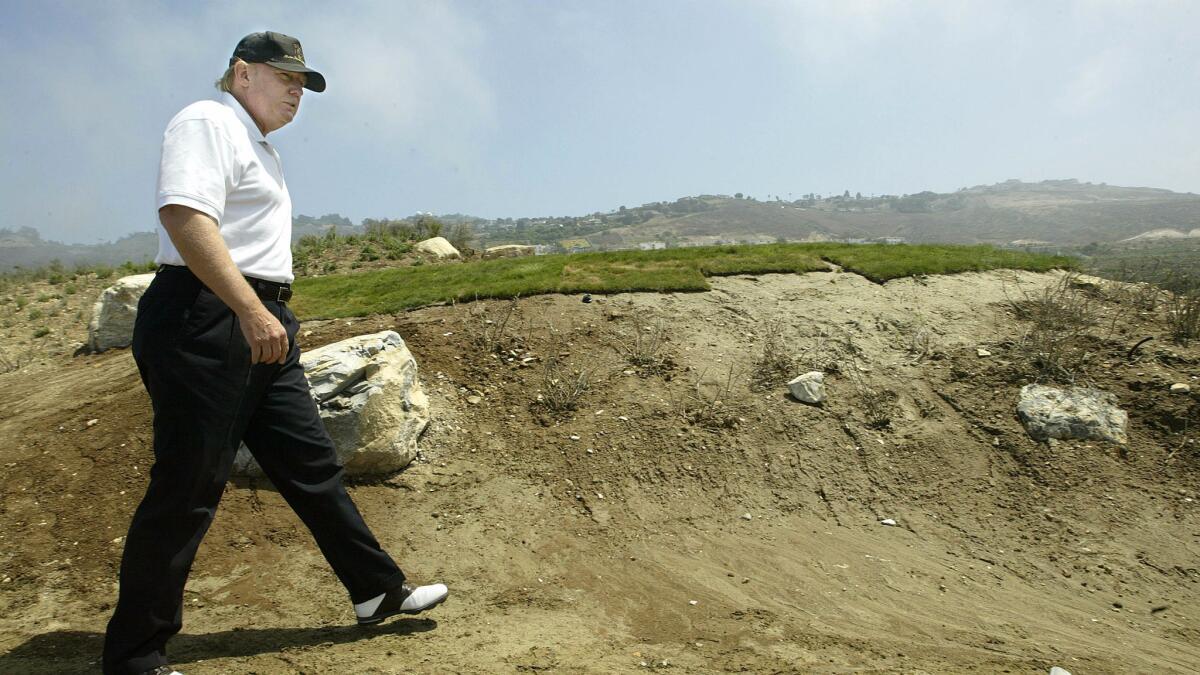
Donald Trump takes an unfinished pathway at the Trump National Golf Club in Rancho Palos Verdes in 2005.
(Mel Melcon / Los Angeles Times )
Although Trump was mostly absent from the course he purchased in 2002, workers said his company maintained a rigorous work environment that often left workers exhausted.
Employees said managers urged them to hurry through brief meal breaks, sometimes even expressing impatience with bathroom breaks.
“My manager insisted that because this was Trump’s golf course, it had to be top-notch,” one employee said in a declaration. “He was concerned that if Trump observed employees eating or resting, Trump would not be pleased.”
Another employee said his manager “seemed obsessed with the fact that this was Donald Trump’s golf course,” believing that “Mr. Trump wouldn’t like it if he saw employees sitting around because he would think the golf course was inefficient and overstaffed.” A valet described a stretch where “someone got fired every week.”
One busboy said in a declaration that he took up smoking so that he would have an excuse for going outside for a break.
In response, Trump’s company filed declarations from more than a dozen other employees who said they regularly were offered lunch breaks of at least 30 minutes for every five-hour shift, and were counseled by managers if they didn’t take them.
Lili Amini, general manager, said in a declaration that the company implemented a firm policy about such breaks in 2009.
Employees said managers started instituting breaks after the class-action lawsuit was filed.
The Trump National Golf Club on the Palos Verdes Peninsula in 2005.
(Luis Sinco / Los Angeles Times )
Female employees said they faced additional pressures.
Strozier, the former catering director, said Vincent Stellio — a former Trump bodyguard who had risen to become a Trump Organization vice president — approached her in 2003 about an employee that Strozier thought was talented.
Stellio wanted the employee fired because she was overweight, Strozier said in her legal filing.
“Mr. Stellio told me to do this because ‘Mr. Trump doesn’t like fat people’ and that he would not like seeing [the employee] when he was on the premises,” wrote Strozier, who said she refused the request. (Stellio died in 2010.)
A year later, Mike van der Goes — a golf pro who had been promoted to be Trump National’s general manager — made a similar request to fire the same overweight employee, Strozier said.
“Mr. van der Goes told me that he wanted me to do this because of [the employee’s] appearance and the fact that Mr. Trump didn’t like people that looked like her,” Strozier wrote.
When Strozier protested, Van der Goes returned a week later “and announced he had a plan of hiding [the employee] whenever Mr. Trump was on the premises,” Strozier wrote.
West, who worked as a restaurant manager at the club until 2008, wrote that Van der Goes ordered him “to hire young, attractive women to be hostesses.” West also said Van der Goes insisted that he “would need to meet all such job applicants first to determine if they were sufficiently pretty.”
Van der Goes, who worked at the club until 2008, did not respond to requests for comment, though he defended Trump in a February interview with the Santa Clarita Gazette.
“He’s not a racist. He’s not a bigot,” said Van der Goes, who called Trump “an astute businessman and a marketing genius.”
Employees said several women quit or were fired because they were perceived as unattractive.
A server, John Marlo, recalled seeing a co-worker crying in 2007. The woman had wanted to be promoted to server.
“She told me that she was upset because a manager had told her that she couldn’t be a server because of she had acne on her face,” Marlo said in a declaration. “According to her, she was qualified for the job and wanted it, but couldn’t get it solely because of her acne.”
The woman quit soon after, Marlo wrote.
Messerschmidt, the employee who said she was fired in retaliation for complaining about age discrimination, said in 2008 that one of her managers, Brian Wolbers, changed her schedule to give her time off during one of Trump’s visits because Trump “likes to see fresh faces” and “young girls.”
Wolbers did not respond to a request for comment.
Gail Doner, who worked as a food server from 2007 to 2011, wrote that she was 60 and had often been frustrated by the inefficiency of the restaurant’s young, inexperienced hostesses, who “usually were not competent but were kept anyway.”
“The hostesses that were the youngest and the prettiest always got the best shifts,” Doner wrote.
Meanwhile, Doner — who had 20 years of experience working for wine vendors, and was at “the top of [her] game” while working for Trump National — said managers slowly cut back her shifts until they stopped scheduling her at all, “effectively firing [her].”
“It did not appear to me that this reduction in shifts was happening to any of the younger, more attractive female food servers,” Doner said. She added: “I chose not to fight to get my job back because by that point I was fed up with the toxic environment and the way that I was treated.”
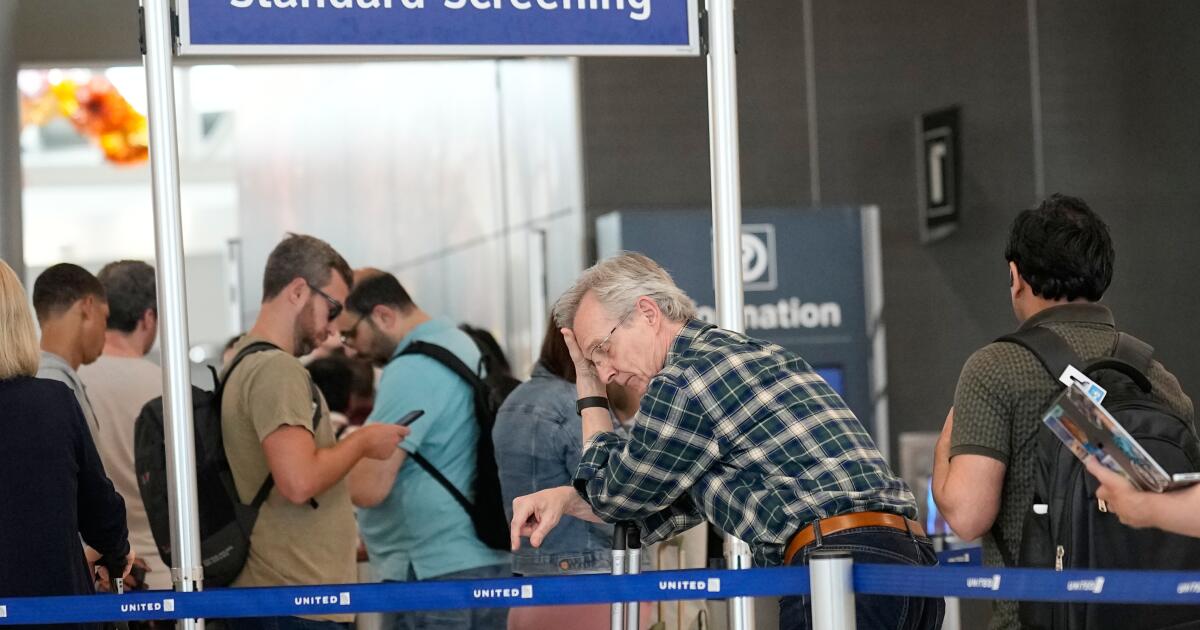
With spring break in full swing, airline passengers continued to wait it out at major U.S. airports after President Trump signed an executive order to pay Transportation Security Administration officers aimed at alleviating long security lines.
Trump’s executive order Friday instructed the Department of Homeland Security to pay TSA officers immediately, although it’s unclear when the impact of that move will start to be felt at airports.
The signing came at a busy travel time of the year, with spring breaks at school districts and colleges and the upcoming Passover and Easter holidays.
Betty Mitchell arrived at Philadelphia International Airport at 12:30 a.m. Saturday for a 5 a.m. flight to visit family, but she said the airline desk did not open until 3 a.m. Once it did, there was a sudden influx of passengers to squeeze into the TSA screening lines.
“All at once it became a madhouse,” Mitchell said.
She waited nearly three hours to get through TSA screening but missed her flight. She was able to board the next available one.
“It was crazy long lines,” she said. “Never have I seen it that long. If the airlines work with TSA in these [troubled] times, maybe it would help the public.”
What’s the current situation on the ground?
Some passengers with very early flights Saturday were luckier than Mitchell, reporting they had little problem getting through airport security lines. But that may have been an anomaly. Others at some of the busiest airports wrote on social media that security lines were growing exponentially longer by the hour.
“We have not previously experienced checkpoint wait times similar to what we are seeing this morning,” Baltimore/Washington International Thurgood Marshall Airport said in a post Saturday on X. Officials at the airport recommended travelers arrive four hours before their scheduled departure time.
When will TSA employees be paid?
Homeland Security Secretary Markwayne Mullin said TSA personnel could get paid as soon as Monday, a relief for workers who have gone without pay since Feb. 14.
While that is welcome news to many, it remains to be seen whether that promise materializes on schedule and if it brings an immediate end to snaking lines at airports.
Caleb Harmon-Marshall, a former TSA officer who runs a travel newsletter called Gate Access, said the staffing crisis won’t improve significantly until officers are confident they won’t be subjected to more skipped paychecks.
“If it’s only for a pay period, that’s not enough to bring them back,” Harmon-Marshall said. “It has to be an extended pay for them to come back or want to stay there.”
He estimates longer lines could linger for another week or two.
How soon will this help with airport delays?
It’s hard to tell. Airports that had passengers standing in screening lines that clogged check-in areas or showing up far too early for their flights will need to decide whether to reopen checkpoints or expedite service lanes they closed or consolidated due to inadequate staffing.
A few airports experienced daily TSA officer callout rates of 40%. Nationwide Thursday, more than 11.8% of the TSA employees on the schedule missed work, the most so far, the Department of Homeland Security said Friday.
Nearly 500 of the agency’s approximately 50,000 officers have quit since the partial shutdown started, the department said.
How do I monitor wait times before my flight?
Check airport conditions early and often, including official websites and social media accounts where airports share timely updates and guidance, according to experts.
Many airports Saturday urged passengers to allow at least four hours for both domestic and international screenings.
“Wait times can change quickly based on passenger volume and TSA staffing,” according to an advisory posted Saturday morning on the website of John F. Kennedy International Airport in New York.
Wait times listed on the MyTSA mobile app may not be accurate because TSA hasn’t been actively managing its sites during the shutdown. On third-party websites that track TSA lines, estimated wait times could be outdated during the shutdown if they rely on publicly available data, experts say.
WASHINGTON — The U.S. Treasury Department is working on plans to put President Trump’s signature on all new U.S. paper currency, the agency announced Thursday.
The move would be a first for a sitting president. The news was first reported by Vanity Fair.
It’s the latest instance of Trump putting his name and likeness on American cultural institutions, following his renaming of the U.S. Institute of Peace, the Kennedy Center performing arts venue and a new class of battleships, among other tributes.
The plans come in tandem with an effort to get Trump’s face on a coin.
This month, a federal arts commission approved the final design for a 24-karat gold commemorative coin bearing Trump’s image to help celebrate America’s 250th birthday on July 4.
Treasury Secretary Scott Bessent’s signature would also appear on the currency, according to a Treasury news release.
Bessent said in a statement that “there is no more powerful way to recognize the historic achievements of our great country” than with U.S. dollar bills bearing Trump’s name.
U.S. Treasurer Brandon Beach said in a statement that printing Trump’s signature on the American currency “is not only appropriate, but also well deserved.”
The Mint, which is part of the Treasury Department, manufactures and distributes the currency.
ORLANDO, Fla. — Florida Democrats, beaten down by years of Republican domination in what was once the consummate battleground state, claimed new optimism Wednesday after a special election victory in President Trump’s home district.
Emily Gregory will represent the district that includes Mar-a-Lago, the president’s resort in Palm Beach, as a state representative.
Democrats are also hopeful that Brian Nathan will win a state senate seat in the Tampa area; the Associated Press has not yet called that race but he currently has a narrow lead that is within the state’s automatic recount range.
Gregory’s victory is the latest flip of a Republican-held seat since Trump’s second presidency began, giving Democrats fresh confidence in a midterm election year with control of Congress and many statehouses — including Florida’s — up for grabs in November.
“The pendulum swings in both directions,” Florida Democratic chairwoman Nikki Fried told reporters. “Last night it swung hard in the state of Florida.”
She added, “If we can win in Donald Trump’s backyard, we can win anywhere.”
For Gregory, a 40-year-old political newcomer who owns a fitness company, it has been a stunning introduction to the national spotlight.
“I believed in myself the whole time,” Gregory said, describing her political “naiveté” about the district and its Republican leanings as an asset.
She told the AP she did not make her contest about the president specifically, but focused heavily on constituents’ concerns involving the economy and everyday costs — from fast-rising insurance in the hurricane-prone district to groceries and gas.
She described herself as a lifelong “proud Florida Democrat” but said she did not run to be a face of the party or lead the opposition movement to Trump. She said she will go to Tallahassee focused on proposals to limit insurance rate hikes, expand healthcare access and lift “huge, crushing burdens on the average Florida family.”
“I just see myself as very embedded in my community, very representative of District 87,” she said. “And I’m so humbled and proud to be their representative.”
Trump endorsed Gregory’s opponent, Jon Maples, and cast a mail ballot in the contest. The president reiterated his support for Maples on the eve of the election with a social media post saying the Republican candidate was backed “by so many of my Palm Beach County friends.”
As of midday on Wednesday, Trump had not mentioned the outcome of the race.
Fried praised Gregory and Nathan, a 45-year-old veteran and union worker, as quality candidates who could capitalize on the broader political environment.
“The type of person and connection on the issues matters,” Fried said.
Gregory flipped a seat that her Republican predecessor had won by 19 percentage points. Fried said Trump carried the district by 11 points in 2024.
Republicans still dominate the Florida Legislature, and they have been considered heavy favorites to hold the governor’s office in November, four years after Gov. Ron DeSantis won a blowout reelection campaign.
But Fried insisted the trends suggest a competitive landscape. She noted that Tuesday’s victories followed two congressional special elections in 2025 when Florida Democrats lost but dramatically narrowed the usual margins in heavily Republican districts.
“You’ve seen tremendous overspending by Republicans,” Fried said of the current cycle. “It’s not working.”
A spokesman for Republican U.S. Rep. Byron Donalds, whom Trump has endorsed for Florida governor, took at least some notice of the latest results.
“We constantly assess how we execute our strategy — that’s just good campaigns,” said Ryan Smith, Donalds’ chief campaign strategist. “What won’t change is our mission: President Trump endorsed Byron Donalds to deliver real results and defend the Florida Dream, and that’s what voters can expect to see from us.”
Gregory, meanwhile, said she’s ready to get to work for her constituents — even the most famous one who did not vote for her.
“I should have a constituent service office available soon, and I would love to have a conversation,” she said when asked what her message to the president would be. “He’s welcome to call me, as I am his new state representative.”
Barrow and Schneider write for the Associated Press. Barrow reported from Atlanta.
1 of 4 | President Donald Trump speaks in the Oval Office of the White House in Washington, D.C., on Tuesday. A Justice Department disclosure sent to members of Congress shows Trump had classified documents related to his personal business dealings stored at Mar-a-Lago after he left the presidency. File Photo by Graeme Sloan/UPI | License Photo
March 25 (UPI) — A 2023 Justice Department disclosure to Congress revealed that President Donald Trump had documents so secretive that only six people had received copies among classified documents he kept at his Mar-a-Lago estate in Florida after he left office.
The disclosure was part of former special counsel Jack Smith’s report on his investigation into Trump, which has not been made public. Elements of the report, though, were distributed to the House and Senate judiciary committees and subsequently made public this week as part of their own probes.
The disclosure detailed the types of documents Trump took with him to his home in Palm Beach after leaving office in 2020. Smith was appointed by former President Joe Biden to investigate the mishandled classified documents, resulting in 41 criminal counts against Trump. Trump-appointed U.S. District Judge Aileen Cannon dismissed the case in 2024 and recently ruled that Smith’s full report can’t be released publicly.
Rep. Jamie Raskin, D-Md., the ranking member of the House Judiciary Committee, sent a letter to Attorney General Pam Bondi on Tuesday questioning why the Justice Department is “fighting tooth and nail to gag Special Counsel Jack Smith and bury his report.” He said the Justice Department’s disclosure sent to the committee earlier this month included “cherry-picked” documents related to the investigation.
“You have, quite amazingly, missed the fact that some of the documents you provided include damning evidence about your boss’s conduct and may well violate the gag order your DOJ and Donald Trump demanded from Judge Aileen Cannon,” the letter read.
Raskin’s letter said that the Justice Department disclosure included information that Trump held documents at Mar-a-Lago that only six people in the government had access to and that other documents related to his business interests.
The disclosure also indicated that White House chief of staff Susie Wiles — then the CEO of Trump’s super PAC — said she observed Trump showing off a classified map to fellow passengers on his private plane.
“This glimpse into the trove of evidence behind the coverup release a president of the United States who may have sold out our national security to enrich himself,” Raskin wrote.
First lady Melania Trump speaks during the Fostering the Future Together Global Coalition Summit roundtable event in the East Room of the White House on Wednesday. Photo by Bonnie Cash/UPI | License Photo
WASHINGTON — The Trump administration has offered Iran a 15-point ceasefire plan aimed at temporarily halting the war in the Middle East, as the Pentagon simultaneously orders thousands of Marines, paratroopers and a warship to the region.
The plan presented to Iranian leadership Tuesday broadly included a 30-day ceasefire and sanctions relief for Iran in exchange for a laundry list of U.S. demands, according to the Associated Press and other outlets.
But Iran dismissed the proposal Wednesday, criticizing the White House’s terms as “excessive” and out of step with reality, according to Iranian state-run media.
Those terms included limitations on Tehran’s missile stockpiles, and the permanent end to its nuclear program, its support for regional militias including Hezbollah, and of its blockade of the Strait of Hormuz, various outlets reported, citing Pakistani officials mediating the negotiations.
Several of those provisions have long been considered nonstarters for Iran, which sees its missile stockade and regional alliances as central to national security.
Iranian officials responded with defiance and skepticism.
“Iran will end the war when it decides to do so and when its own conditions are met,” an Iranian official told state media. “Not when Trump envisions its conclusion.”
The official outlined the Islamic Republic’s terms for ending the conflict, which included a halt to “aggression and assassinations,” an end to fighting on all fronts, enforceable guarantees that hostilities will not resume, compensation for war damages and a formal recognition of Iran’s sovereignty over the Strait of Hormuz.
Iranian Foreign Minister Abbas Araghchi has stated that Iran is not interested in a ceasefire but rather a comprehensive “end of war” on all fronts, including the lifting of sanctions and guarantees to allow Iran to pursue peaceful nuclear enrichment for energy and medical applications.
Iranian officials told state media that they believed the Trump administration’s diplomatic efforts were deceptive.
“You have reached a stage where you are negotiating with yourselves,” Iranian military spokesman Ebrahim Zolfaqari said in a televised address Wednesday. “Do not call your defeat an agreement.
Since the start of the conflict, Iranian leaders have voiced suspicion of any diplomatic talks with the Trump administration, pointing to prewar diplomatic efforts as evidence they were “tricked.” The Islamic Republic says it made clear in those talks that it had no interest in developing nuclear weapons, but Trump launched his military campaign nonetheless.
There have been conflicting media reports over Tehran’s exact position. Statements from Iranian officials and state-linked outlets have left open the possibility that elements of the proposal are still under review, while some reports frame the response as an outright refusal.
The Iranian response also conflicts with President Trump’s insistence that negotiations were progressing.
“We have had very, very strong talks,” he said Sunday in Florida. “We have points, major points of agreement. I would say almost all points of agreement will at some point very, very soon meet.”
Compounding the issue, Israel — which continues to carry out routine bombing campaigns over Iran — has stayed out of the talks.
Trump and Israeli Prime Minister Benjamin Netanyahu spoke about the peace deal in a phone call Tuesday. In a televised address, Netanyahu said that Trump “believes there is an opportunity” to realize U.S.-Israeli war objectives in an agreement “that will safeguard our vital interests.”
“At the same time, we continue to strike both in Iran and in Lebanon,” Netanyahu said. “We will safeguard our vital interests in any scenario.”
The negotiations are being facilitated by Pakistan, with support from Egypt and Turkey — countries that have pushed to contain a conflict that has killed more than 2,400 people, further destabilized the embattled region and disrupted global oil markets.
As Washington pursued a diplomatic end to the conflict, the Pentagon deployed an additional 2,000 troops from the 82nd Airborne Division to the Mideast. An additional 5,000 Marines and thousands of sailors are already en route to the region, where 50,000 more Marines are currently stationed.
House Speaker Mike Johnson (R-La.) told reporters on Wednesday that the deployment “sends a signal to Iran that they need to get their act together,” but denied any coming escalations by the American side. Johnson instead said that he believes “Operation Epic Fury is almost done.”
Now in its fourth week, the operation began with a series of intensive airstrikes that killed Iran’s Supreme Leader, Ali Khamenei, and dozens of other high-ranking officials. Since then, the U.S. and Israel have carried out over 9,000 strikes targeting Iranian military infrastructure and nuclear program.
Defense Secretary Pete Hegseth told reporters in the Oval Office Tuesday that while the president’s diplomatic envoys seek a peace deal, his department of war will continue to “negotiate with bombs.”
“The president has made it clear that you will not have a nuclear weapon. The War Department agrees,” Hegseth told reporters Tuesday in the Oval Office. “Our job is to ensure that, and so we’re keeping our hand on that throttle.”
Iranian retaliatory strikes have hit Gulf infrastructure and halted energy production and shipping in the region, spurring global fears of an enduring supply crunch. Meanwhile, Israel has expanded operations in Iran and sought to expand its borders into Lebanon.
Oil prices, which had surged above $120 per barrel earlier in the conflict, fell sharply this week on hopes that a ceasefire could ease supply woes.
In a statement Wednesday, U.N. Secretary-General António Guterres demanded an end to the fighting, which he said “has broken past limits even leaders thought imaginable.”
He specifically called on the U.S. and Israel to end the war, as “human suffering deepens, civilian casualties mount, and the global economic impact is increasingly devastating.”
Times staff writers Ana Ceballos, in Washington, D.C., and Nabih Bulos, in Beirut, contributed to this report.