Trumpism’s shadow looms over German election as far right eyes historic power
BERLIN — Leaders of an extremist, far-right party in Germany have quietly borrowed pages from President Trump’s playbook to cast doubt on the integrity of absentee voting — alleging without evidence that residents of nursing homes have had their ballots manipulated and calling for an end to postal voting.
The attack on mail ballots comes as Germany approaches a potentially historic state election that could shatter one of the taboos of its postwar political order by opening the door to a far-right government.
Politicians across the ideological spectrum, mindful that polls show Trump to be widely unpopular, don’t invoke his name.
But the specter of the American president nevertheless hangs over the election that could have reverberations across Europe if the Alternative for Germany, or AfD, party — tacitly echoing Trump’s attacks on migrants, the media and the integrity of elections — pulls off an unprecedented political shock in postwar Germany.
In a country where the guilt of its Nazi past is never far from the surface, the AfD has unapologetically campaigned against what it portrays as the shackles of Germany’s history and won over many new supporters, in part by adopting Trump’s hard-line stance on migrants and his drumbeat of attacks on mainstream news outlets.
Trumpism and the MAGA movement have undoubtedly been an inspiration and model for many European radical right parties
— Lars Rensmann, political scientist
The AfD leader, Tino Chrupalla, surprised Germans recently with warnings of voter fraud in the Sunday election in Saxony-Anhalt state, telling a national television audience that some senior citizens in nursing homes had had their absentee ballots cast and signed for them without their knowledge.
This week, in neighboring Mecklenburg-Vorpommern state, the AfD candidate for governor, Leif-Erik Holm, declared, “Postal voting is more vulnerable to potential attempts of manipulation.”
Election officials and organizations representing nursing home caregivers have rejected the allegations and say there is no evidence of voter fraud.
The AfD, considered one of the most extreme far-right parties in Europe, has surged so far ahead in opinion polls that it could emerge as the dominant political force in Saxony-Anhalt and potentially lead a German state government for the first time, either with an absolute majority or with a junior coalition partner.
Trump has spent years attacking mail-in voting as vulnerable to fraud, despite scant evidence of widespread abuse. Trump himself has voted by mail in recent elections. His administration continues to fight court battles to limit voting by mail.
“Sowing distrust in political institutions is part of the strategy of right-wing populist parties,” said Marcel Lewandowsky, a political scientist at Martin Luther University in Halle, Germany.
“The ‘rigged election’ lie is a powerful narrative within the MAGA movement,” he added, “and serves as a crucial element that fosters a shared identity” with far-right parties in Europe. (Such messaging has also been employed by many rightist politicians in Latin America.)
An AfD victory in one of Germany’s 16 federal states would in one fell swoop obliterate a central tenet of the postwar order: that the far right must never return to power in the country responsible for the Holocaust and the devastation of Europe in World War II.
Many fear that taking power there could serve as a springboard for the ostracized party at the national level, where it is leading opinion polls with about 29% support, putting it far ahead of the other four parties with seats in the federal Parliament.
“Trumpism and the MAGA movement have undoubtedly been an inspiration and model for many European radical right parties,” said Lars Rensmann, a political scientist at the University of Passau who has studied the far right. “In many ways, Trump has been the successful model many European radical right parties try to follow while adopting it to European conditions.”
The AfD’s ascent has parallels across Europe, from Italian Prime Minister Giorgia Meloni and her Brothers of Italy party to Britain’s Nigel Farage, Geert Wilders in the Netherlands and Herbert Kickl in Austria. In France, the far-right Rassemblement National is looking to the 2027 presidential race with its candidate, Marine Le Pen, having perhaps her strongest chance yet of winning after reaching the runoff in 2017 and 2022.
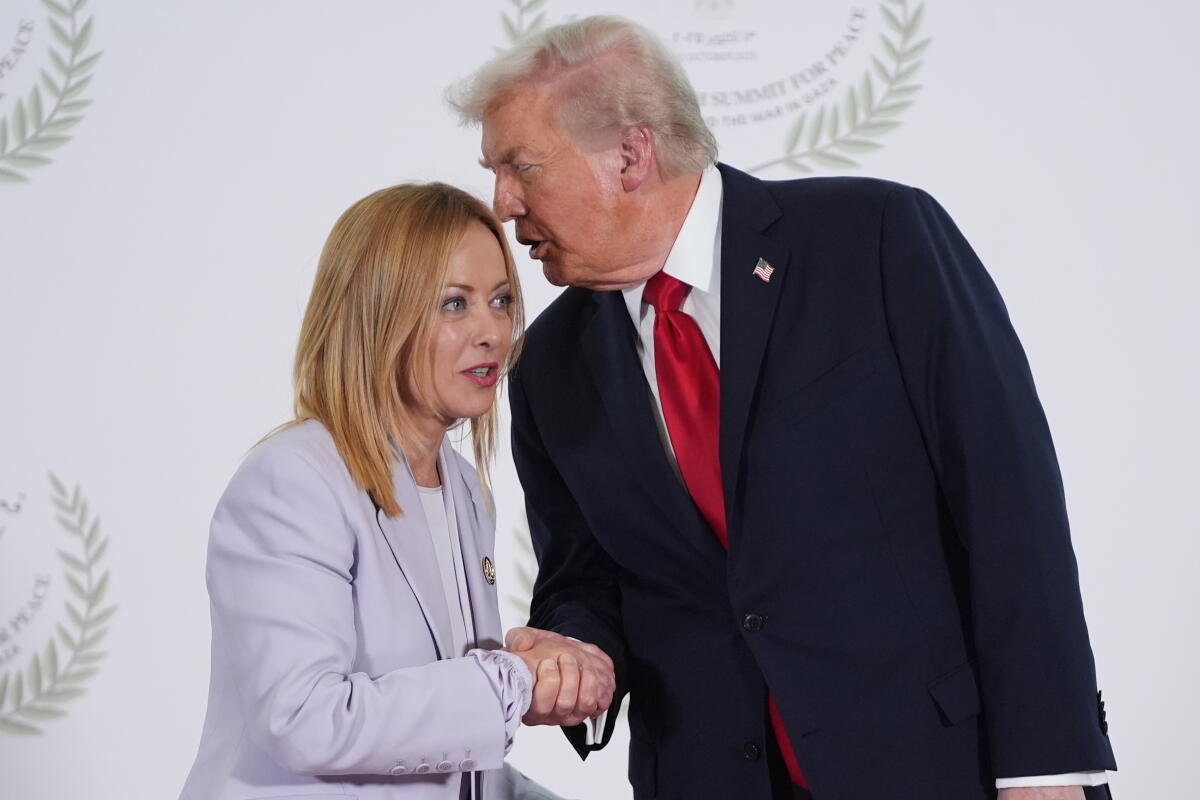
Meloni`s relationship with Trump has cooled during her nearly four years in power, due in part to the war in Iran, tariffs and security policies that have strained U.S. relations with Italy and all of Europe.

President Trump greets Italy’s Prime Minister Giorgia Meloni at a summit Egypt in 2025. Their once warm relationship has since cooled.
(Evan Vucci / Pool via Associated Press)
Yet there is no pan-European alliance of the far right, in part because these parties champion their own national interests.
“Some components of Trumpism can be shared and exported, such as hostility towards migration and ‘wokeism,’ but it is very clear that national interests that the far-right champion cannot be defended the same way as the American national interests,” said Giovanni Orsina, head of the political science department at LUISS University in Rome.
“If you put your nation first and do so aggressively, you have diverging national interests and so it’s not possible to have an international network of nationalists,” Orsina added.
But many far-right leaders are united in one sense. They admire not just Trump’s tactics, but the “boldness of his transgressions, dismantling liberal and civil norms by repeating things that were once deemed unacceptable for someone seeking public office,” said Rensmann.
“Trump is unpopular in Germany, even across the political right,” Lewandowsky said. “It would be risky for the AfD to embrace him openly, especially because he failed to keep his promise not to start any further wars and large segments of the public feel threatened by the United States under Trump.”
The AfD was created in 2013 as a small anti-euro party before morphing into an anti-migrant force that tapped into voter frustration over immigration and the strains many Germans perceive on housing, jobs and public services.
Despite being ostracized by mainstream parties and kept out of coalition cooperation, it has survived and thrived as a disruptive force.
In the last decade Germany has sheltered millions of refugees, mainly from Syria and other troubled countries in the Middle East. It provides housing, medical care and generous financial support to refugees that AfD politicians say serve as a magnet. Trump once accused former German Chancellor Angela Merkel of “ruining” her country by allowing in so many refugees.
“I think this could be a watershed moment for Europe,” Orsina said of the upcoming election.

An election poster touts the far-right Alternative for Germany party, AfD, right, in Berlin in 2025. It reads “Now AfD.”
(Michael Sohn / Associated Press)
He said the election in 2022 of Meloni and her Brothers of Italy party, which traces its origins to Italy’s postwar neo-fascist movement, sparked fears across Europe that, in hindsight, may have been exaggerated. But Germany is a different story when it comes to the far right.
“Some said she is a neo-fascist and a danger to democracy, but most people in Italy didn’t believe that,” he said. “Italy isn’t a better democracy after four years of Meloni but it isn’t any worse either. But Germany isn’t Italy. And Germany’s relationship with its past is a lot different.”
David Bebnowski, an author who has written books on far-right populism and who is a history instructor at the Free University in Berlin, said there is another important connection among far-right voters across Europe that the AfD is tapping into — a yearning for change in countries where establishment parties have struggled to respond to voter frustration.
Trump’s success as a force for disruption, he said, has provided a powerful example.
“You can’t really trace a grand MAGA strategy adopted by the far right, but you can see that they are, in part, very much in line with the ‘spirit of Trumpism,’” Bebnowski said. “What aligns them is a sense of disruption and optimism that they will be able to change the way politics are done in a way the other parties can’t.”
Kirschbaum is a special correspondent.