Trumpism

Contributor: In politics after Trump, nothing is disqualifying

After a decade of Trumpism, it should come as no surprise that President Trump’s ethos (presenting scandal as strength, outrage as authenticity and public disgrace as evidence you’re a “fighter”) has trickled down into congressional campaigns of both parties.

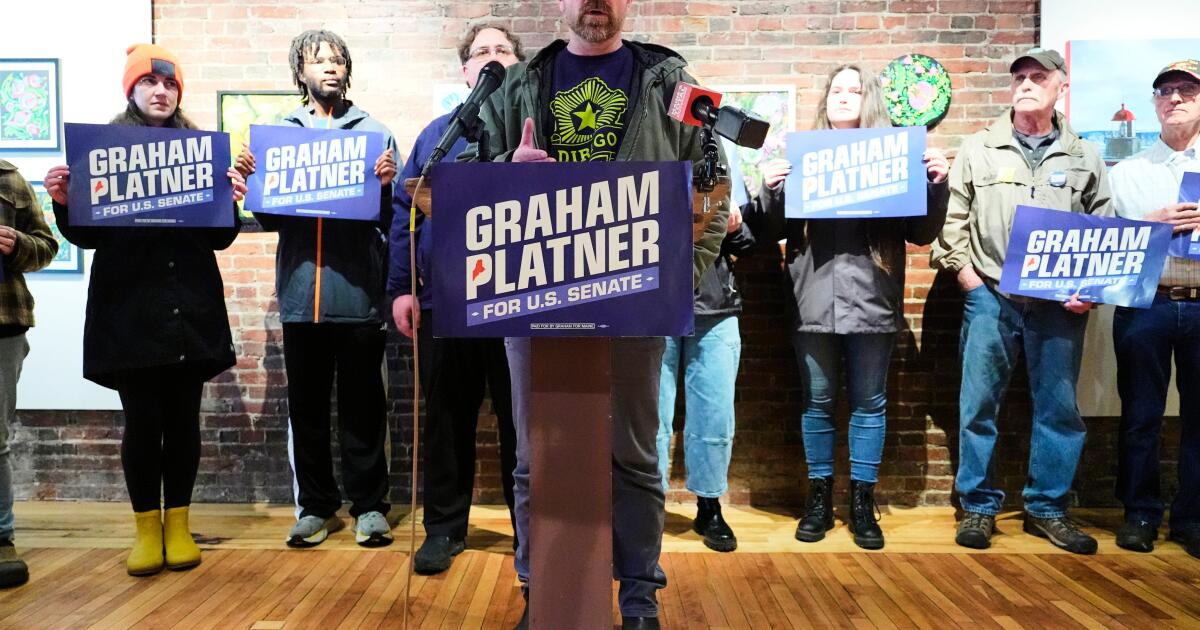
In Maine, for example, controversial oysterman and veteran Graham Platner, a Democrat, appears poised to face Republican Sen. Susan Collins, after incumbent Gov. Janet Mills’ failure to launch led her to drop out of the Senate primary.

Under old “pre-Trump” rules, Platner’s campaign would have withered instantly after revelations that he once had a Totenkopf SS tattoo, previously identified himself as a communist, said Black people were poor tippers, and wrote that white people “actually are” as racist and stupid as Trump thinks they are.

Instead, after all this surfaced, Platner actually rose in the polls. Considering the circumstances, there are several reasonable explanations for this.

Maybe Maine Dems have concluded that moral purity tests are politically suicidal after years of watching heterodox figures like Joe Rogan and Elon Musk drift away from the party.

Maybe Platner’s rough-edged outsider persona simply feels more authentic than another interchangeable politician in a pantsuit droning on about “working families.”

Perhaps the difference is that, unlike Trump or Texas’ scandal-plagued Republican Atty. Gen. Ken Paxton, Platner has at least attempted contrition.

Or maybe Maine Democrats have absorbed the same lesson Republicans adopted in 2016: Once voters stop treating scandal as disqualifying, policing your own side for off-the-field behavior starts to look like unilateral disarmament.

I mean, who could blame them for thinking you’ve got to fight fire with fire? America, after all, reelected Trump after 34 felony convictions.

At a certain point, continuing to insist that “character matters” starts sounding like advice Ward Cleaver might have offered Wally on “Leave It to Beaver.”

But Maine isn’t the only example of voters viewing scandalous behavior as a “keeping it real” feature, not a bug.

Another just took place in Texas, when the aforementioned Paxton crushed normie incumbent Sen. John Cornyn in a Republican primary runoff, garnering nearly 64% of the vote.

Paxton, it’s worth noting, was previously indicted on felony securities fraud charges, impeached by the Texas House on allegations including bribery, accused by senior aides of abusing his office to help a donor and real-estate developer and accused by his wife (a Texas Republican politician) of infidelity, just to name a few of his greatest hits.

Yet, not only did the scandals not doom Paxton, they probably helped him. They signaled a willingness to fight, casting him as both a victim and an outsider. There may be no purer expression of trickle-down Trumpism than Paxton, which probably explains why Trump endorsed him.

At this point, you might be thinking that all is lost. But there are counterexamples that lend to optimism.

Paxton’s Democratic opponent in Texas, for example, offers a stark contrast, as well as an opportunity to test the level of our societal decline in November.

Texas Democrats could easily have nominated their own chaos agent in Rep. Jasmine Crockett, a progressive firebrand whose flair for viral combat suggests she understands the incentives of modern politics perfectly well.

Instead, they chose James Talarico — a young state legislator, former middle-school teacher and Presbyterian seminarian — who projects the kind of earnest optimism that lands somewhere between Barack Obama and Pete Buttigieg.

If a Democrat like Talarico can win in deep-red Texas — against a scandal-plagued candidate who shouldn’t get within 10 miles of the U.S. Capitol — it will perhaps provide a modicum of hope that red lines still exist, and that some voters still believe character is destiny.

But regardless of who wins that matchup, the fact that both Paxton in Texas and Platner in Maine emerged as their party’s respective Senate candidates (Platner won’t technically be the Democratic nominee until after the Maine primary in June) still suggests something profound has shifted in American politics.

Not long ago, the scandals attached to either man would have ended a campaign overnight.

Today, they function more like résumé enhancements. Because the defining lesson of the Trump era may be this: Nothing is disqualifying anymore.

If a failed nepo baby and middling reality-TV star can become president, survive endless scandals (think “Access Hollywood”), rack up felony convictions, be found liable for sexual abuse, sit by and watch a Capitol riot, and then return to power anyway, traditional ideas about character and electability are simply no longer relevant.

The question now is whether Trumpism has become America’s permanent political operating system — or whether the new rules apply only to Trump himself.

November will offer some hints.

Matt K. Lewis is the author of “Filthy Rich Politicians” and “Too Dumb to Fail.”

Source link

Contributor: Carlson’s cautious apology does little to repair Trumpism’s damage

When you break a promise as clear as “No new wars,” you shouldn’t be surprised when even your most loyal supporters revolt. And that’s exactly what is happening to President Trump.

One such disillusioned supporter is Tucker Carlson — who on a recent podcast with his brother Buckley admitted, in essence, “My bad.”

“You wrote speeches for him. I campaigned for him. I mean, we’re implicated in this, for sure,” Tucker Carlson said during the conversation.

“In real ways, you and me, and millions of people like us, are the reason this is happening right now,” Calson confessed, referring to the Iran war. “We’ll be tormented by it for a long time. I will be, and I want to say I’m sorry for misleading people, and it was not intentional.”

Having worked for Carlson for six years at the Daily Caller, I’ve always found him intelligent and funny and generous, even as I have profoundly differed with him on a variety of issues throughout the Trump era.

It did my heart good to hear him accept some responsibility for what Trump has wrought.

A lot of people were complicit in boosting Trump, and some of them have even subsequently criticized him for various sins (failing to release the Epstein files, going to war with Iran, etc.). But this is the first time I can recall anyone of this stature explicitly apologizing for helping elect Trump. And that warrants a certain amount of respect.

Still, let’s be clear-eyed about what Carlson is — and isn’t — saying here. Specifically, it’s worth noting that the apology doesn’t extend to validating those of us who opposed Trump from the beginning.

In fact, it almost can’t.

Doing that would require the confessor to reinterpret not just Trump’s presidency, but also the entire ecosystem that made supporting Trump a viable option in the first place.

It would mean admitting that the framework he used to evaluate Trump was flawed, not just the outcome.

That would end up being perceived as an indictment on the broader Republican electorate — and on Carlson’s worldview and judgment — not just on Trump’s recent performance or (even more conveniently) the notion that Trump has changed or was co-opted by Israel (or whomever) since 2024.

It’s a much bigger ask than saying, “I regret this specific result.”

Specifically, Carlson is not conceding that the “Never Trump” crowd got it right — which is what those of us who have spent a decade opposing Trump (with little fanfare) have been dying to hear for a decade (even more so than “I’m sorry.”)

This is an important distinction, partly because it means that, although Carlson is now a convenient ally in the “resistance,” he is not opposing Trump for the same reasons that most Democrats or Never Trump conservatives oppose Trump.

If you put aside Trump’s decision to go to war with Iran, the Carlsons’ second-biggest criticism of Trump (based on their two-hour-long podcast) is his failure to more vigorously defend the Jan. 6 Capitol rioters.

That’s right. It’s not that he sicced immigration enforcers on immigrants and that they subsequently killed two American citizens. It’s not that DOGE fired lots of good people. It’s not that this president tried to use the Department of Justice to seek vengeance on his political rivals. It’s that Trump — the person who pardoned these people — wasn’t aggressive enough in defending the criminals who stormed the U.S. Capitol while trying to overturn the 2020 election results.

And while there’s no reason to doubt Carlson’s remarks are sincere (he has been a vocal opponent of war with Iran) and meaningful (he’s an influential figure), his comments may also signal something else: a recognition that opportunity awaits.

Consider this: Trump’s political standing is in deep trouble (Trump’s approval rating is down to 33%, according to a new AP-NORC poll).

What is more, Trump’s fading fortunes aren’t just isolated to Trump. As always, there is collateral damage: JD Vance.

Once seen as Trump’s obvious heir, Vance now finds himself in a difficult position, defending the war in Iran and attacking the pope, while simultaneously releasing a book about his Catholic conversion.

In that sense, Carlson’s apology could be less a grudging epiphany than a strategic recalibration. It acknowledges that Trump has gone off the rails but stops short of examining why it was destined to go wrong in the first place.

Carlson gets close to the answer when he tells his brother, “there were signs of low character. We knew that,” but then dismisses it by saying “there are tons of people of low character who outperform their character.”

Without deeper reflection, this apology risks becoming just another pivot — one that has as much to do with positioning as it does with repentance.

And that would be a shame.

It’s easy to regret an outcome. It’s much harder to interrogate the instincts that led you (and tens of millions of Americans) to enable it.

Apologies like Carlson’s won’t close the chapter on this long national nightmare.

Matt K. Lewis is the author of “Filthy Rich Politicians” and “Too Dumb to Fail.”

Source link