Lawmakers express concerns as Trump officials project $50bn more may be needed for Iran war funding.
Published On 12 Mar 202612 Mar 2026
Share
Officials from President Donald Trump’s administration have estimated during a congressional briefing this week that the first six days of the war on Iran had cost the United States at least $11.3bn, a source familiar with the matter told the Reuters news agency.
That figure, from a closed-door briefing for senators on Tuesday, did not include the entire cost of the war, but was provided to lawmakers as they have clamoured for more information about the cost.
Recommended Stories
list of 3 itemsend of list
Several congressional aides have said they expect the White House to soon submit a request to Congress for additional funding for the war. Some officials have said the request could be for $50bn, while others have said that estimate seems low.
The administration has not provided a public assessment of the cost of the conflict or a clear idea of its expected duration. Trump said during a trip to Kentucky on Wednesday that “we won” the war but that the US would stay in the fight to finish the job.
The $11.3bn figure was first reported on Wednesday by The New York Times.
The human cost
The US-Israeli war on Iran has so far killed about 2,000 people, mostly Iranians and Lebanese, as the conflict has spread across the Middle East, with Iranian retaliatory strikes on neighbouring countries hosting US assets, sending energy prices soaring.
The United Nations children’s agency (UNICEF) says the “intensifying conflict” has killed or wounded 1,100 children, creating a “catastrophic” situation for millions of children across the Middle East.
About 800,000 people have already been displaced in Lebanon by relentless Israeli bombardment.
Administration officials also have told lawmakers that $5.6bn of munitions were used during the first two days of strikes.
Members of Congress, who may soon have to approve additional funding for the war, have expressed concern that the conflict will deplete US military stocks at a time when the defence industry was already struggling to keep up with demand.
Democratic lawmakers have demanded public testimony under oath from administration officials about the Republican president’s plans for the war, including how long it might last and what his plans are for Iran once the fighting has stopped.
Trump on Wednesday said the war with Iran may end “soon” because there is “practically nothing left” for the US military to bomb. He did not provide any evidence for that claim.
Global currency and commodity markets stabilised slightly on Tuesday after a volatile start to the week triggered by the war involving Iran, United States and Israel. The U.S. dollar steadied against major currencies after earlier declines, following remarks from U.S. President Donald Trump that the conflict could end “very soon.”
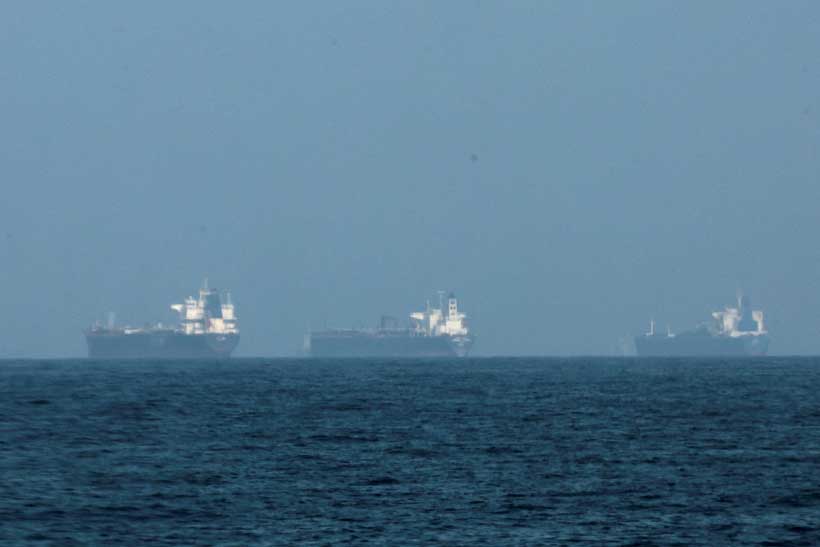
Financial markets had been thrown into turmoil a day earlier amid fears that a prolonged war could trigger a major global energy shock. The conflict has disrupted oil and gas exports through the critical Strait of Hormuz, a vital shipping route for global energy supplies.
Although markets calmed somewhat after Trump’s comments, the broader environment remains highly uncertain as investors continue to assess the potential economic fallout from the conflict.
Dollar Holds Ground as Oil Prices Ease
In Asian trading, the U.S. dollar was largely steady against other major currencies after retreating from the highs reached during Monday’s market turbulence.
The currency traded at around 157.73 yen against the Japanese yen and about $1.1632 against the euro, reflecting a stabilisation following the sharp movements seen earlier.
Meanwhile, oil prices remained elevated but declined from the dramatic peaks reached at the start of the week. Brent crude traded at roughly $93 per barrel, still significantly higher than levels before the outbreak of the war but well below Monday’s surge toward $120.
The pullback in oil prices helped ease immediate concerns about a severe energy shock, although analysts caution that volatility could continue if the conflict escalates again.
Investors Remain Cautious
Despite the relative calm in currency markets, analysts say investors are far from convinced that the crisis is nearing resolution.
Rodrigo Catril, a currency strategist at National Australia Bank, warned that markets could continue to experience sudden shifts in sentiment as geopolitical developments unfold.
According to Catril, it remains unclear whether the Iranian leadership would be willing to pursue de-escalation, suggesting that the risk of renewed market volatility remains high.
The Islamic Revolutionary Guard Corps in Iran dismissed Trump’s suggestion that the conflict could end quickly, describing the remarks as “nonsense.”
Risk-Sensitive Currencies Under Pressure
Currencies closely linked to global economic sentiment weakened as investors remained cautious.
The Australian dollar slipped to around $0.7063, while the New Zealand dollar fell to roughly $0.5912. These currencies often decline during periods of geopolitical uncertainty or when investors shift toward safer assets.
The dollar, by contrast, has benefited from its traditional role as a safe-haven currency during times of crisis. The escalation of the conflict and disruption to energy markets prompted investors to move funds into U.S. assets, supporting the currency.
The British pound recovered from losses earlier in the week to trade around $1.3434.
Energy Prices and Global Growth Concerns
Investors remain concerned that sustained high energy prices could slow global economic growth. Rising oil costs increase expenses for businesses and households, effectively acting as a tax on economic activity.
At the same time, higher energy prices could complicate monetary policy by pushing inflation upward and making it harder for central banks to lower interest rates.
Analysts at Deutsche Bank noted that a broader market sell-off in risk assets would likely require several conditions to occur simultaneously: persistently high oil prices, a shift in central bank policy expectations and clear evidence of a slowing global economy.
Strategist Henry Allen said markets are now significantly closer to those thresholds than they were just a week ago, though the full conditions for a major downturn have not yet materialised.
Analysis: Markets Brace for Prolonged Volatility
The market reaction to the Iran war underscores how closely global financial conditions are tied to geopolitical developments in the Middle East.
While Trump’s comments about a possible quick end to the conflict helped stabilise markets temporarily, the underlying risks remain substantial. The disruption of energy supplies through the Strait of Hormuz continues to threaten global oil flows and could trigger renewed price spikes if the conflict intensifies.
For investors, the situation presents a delicate balance. On one hand, hopes for de-escalation could stabilise energy prices and reduce pressure on financial markets. On the other, continued fighting or further disruptions to oil shipments could quickly reignite volatility across currencies, commodities and equities.
Until there is clearer evidence of either de-escalation or escalation, markets are likely to remain highly sensitive to political developments, with the dollar continuing to benefit from its role as a global safe haven.
March 11 (UPI) — A bipartisan group of senators penned a letter to the Government Accountability Office on Wednesday calling for an investigation into the Justice Department over its handling of the Jeffrey Epstein files release.
The letter accuses the Justice Department of noncompliance with the Epstein Files Transparency Act, the bipartisan law overwhelmingly passed by both chambers of Congress last year. The lawmakers shared concern that the department has still not released all of the files it is required to by the law, despite a December deadline.
Sens. Dick Durbin, D-Ill., Ben Ray Lujan, D-N.M., Jeff Merkley, D-Ore., and Lisa Murkowski, R-Alaska, signed the letter. They also shared concerns about the files that have been released, including victims’ names not being redacted and alleged coconspirators’ names being redacted.
The Government Accountability Office is an independent and nonpartisan agency in the legislative branch. Its purpose is to operate as a watchdog over the federal government, with the authority to investigate and perform audits.
“Contrary to Congress’s explicit directive to protect victims, these records included email addresses and nude photos in which the names and faces of publicly-identified and non-public victims could be identified,” the letter said. “But when it came to information identifying powerful business and political figures who are alleged coconspirators or material witnesses, DOJ appears to have heavily redacted those.”
The senators are requesting that Comptroller General Orice Williams Brown reviews the department’s process it used to review, redact and release the files. They specify that they want the Government Accountability Office to investigate whether the release of the files “has serve to cover up child sexual abuse.”
The Epstein files have continued to be a source of contention between lawmakers and the Trump administration more than two months after the Justice Department was required by law to release the files.
Lawmakers have pushed for answers about the delayed and mistake-filled release from Attorney General Pam Bondi, leading to fiery exchanges in a House Judiciary Committee hearing last month.
The House Oversight Committee issued a subpoena for Bondi’s testimony last week. Five Republicans joined all of the Democrats in the committee in voting for the subpoena.
“This horrific scandal is one where powerful, wealthy men groomed, abused, and raped young women, men, and children,” the letter from the senators reads. “It is critical to understand what led to DOJ’s failure to redact the victims; information and re-victimize those individuals while violating the Epstein Files Transparency Act in its redactions of information related to their alleged abusers.”
MIAMI — Voting technology firm Smartmatic is seeking to dismiss a criminal indictment for money laundering, blaming President Trump and his allies for seeking its prosecution as part of a “campaign of retribution” against those they blame for his 2020 election loss.
Smartmatic’s parent company, UK-based SGO Corporation, was added to a criminal indictment last fall previously charging several executives with paying $1 million in bribes to election officials in the Philippines.
In a motion to dismiss the indictment filed Tuesday, attorneys for Smartmatic said the company had been cooperating with the Justice Department since it first learned of its investigation in 2021, including by producing millions of pages of documents and making presentations to federal agents. A trial date for the executives, including co-founder Roger Pinate, had been set and the company believed that it was in the clear.
But when Trump returned to the White House, the Justice Department reversed course and decided to press charges against Smartmatic. Attorneys for the company said the decision was prompted by Trump’s demands to prosecute his perceived enemies and his “mantra” that Smartmatic helped rig the 2020 U.S. presidential election won by Joe Biden — allegations that are at the heart of a $2.7-billion lawsuit filed by Smartmatic against the president’s allies in the media.
“The prosecution of SGO furthers their collective false narrative that President Trump did not actually lose the 2020 election,” Smartmatic said in the filing in Miami federal court.
The White House did not immediately respond to a request for comment.
Attorneys likened the prosecution to the Justice Department’s targeting of Kilmar Armando Ábrego García, a Salvadoran migrant who was criminally charged for conduct years earlier after he successfully sued the Trump administration over its decision to deport him.
In the years since the election, the filing states, “Smartmatic USA has exercised its right to hold those individuals and entities legally accountable for their deluge of defamatory statements and the attendant damage inflicts on its business, putting it squarely in the crosshairs for retribution.”
The criminal case against Smartmatic and its employees stems from payments, between 2015 and 2018, that were allegedly made to obtain a contract with the Philippine government to help run that country’s 2016 presidential election. Pinate, who no longer works for Smartmatic but remains a shareholder, has pleaded not guilty.
As part of the criminal case, prosecutors in August sought the court’s permission to introduce evidence they argue shows that revenue from a $300-million contract with Los Angeles County to help modernize its voting systems was diverted to a “ slush fund” controlled by Pinate through the use of overseas shell companies, fake invoices and other means.
They also accused Pinate of secretly bribing Venezuela’s longtime election chief by giving her a luxury home with a pool in Caracas. Prosecutors say the home was transferred to the election chief in an attempt to repair relations following Smartmatic’s abrupt exit from Venezuela in 2017 when it accused then-President Nicolas Maduro ’s government of manipulating tallied results in elections for a rubber-stamping constituent assembly.
Smartmatic was founded more than two decades ago by a group of Venezuelans who found early success running elections while the late Hugo Chavez, a devotee of electronic voting, was in power. The company later expanded globally, providing voting machines and other technology to help carry out elections in 25 countries, from Argentina to Zambia.
But Smartmatic has said its business tanked after Fox News gave Trump’s lawyers a platform to paint the company as part of a conspiracy to steal the 2020 election.
Fox said it was legitimately reporting on newsworthy events but eventually aired a piece refuting the allegations after Smartmatic’s lawyers complained. Nonetheless, it has aggressively defended itself against the defamation lawsuit in New York — arguing that the company was facing imminent collapse over its own internal misconduct, not due to any negative coverage.
US President Donald Trump on Tuesday threatened Iran with unprecedented military consequences if it had placed mines in the Strait of Hormuz and failed to remove them, Anadolu reports.
“If for any reason mines were placed, and they are not removed forthwith, the military consequences to Iran will be at a level never seen before,” Trump wrote on his social media platform Truth Social.
He added that removing the mines would be “a giant step in the right direction.”
Trump, however, also noted that US has “no reports of” Tehran putting out mines in the waterway.
The warning came after a CNN report that Iran has begun laying mines in the strait. Sources told the news outlet that only a few dozen had been placed so far, but Iran still had up to 90% of its small boats and mine-laying vessels intact, leaving it capable of deploying hundreds more.
The Strait of Hormuz is one of the world’s most critical energy chokepoints, with around 20 million barrels of oil passing through it daily. Iran’s IRGC had previously announced the closure of the strait to transit following the start of the US-Israeli attacks on Iran on Feb. 28, pushing oil prices above and raising fears of a prolonged global energy disruption.
The escalation in the Middle East flared since Israel and the US launched a joint attack on Iran on Feb. 28, and to date killing more than 1,200 people, including Ayatollah Ali Khamenei, who was the supreme leader. At least eight US service members have been killed since the beginning of the campaign.
WASHINGTON — Attorneys for a Sacramento DACA recipient who was deported to Mexico last month have filed a lawsuit against the federal government seeking her immediate return to the U.S.
Maria de Jesus Estrada Juarez, 42, was detained Feb. 18 during a scheduled interview for her green card application. She was deported to Mexico the next day, despite having active deportation protection through the Obama-era program Deferred Action for Childhood Arrivals.
According to the lawsuit, Estrada Juarez, who worked as a regional manager for Motel 6, was deported without being provided notice of a lawful removal order and without the opportunity to fight her case before an immigration judge.
“Maria’s deportation was unlawful and violated basic principles of due process,” said her attorney Stacy Tolchin. “She had a valid DACA status, she appeared for her immigration appointment as instructed, and she should never have been removed from the country.”
Estrada Juarez’s case garnered public attention and outrage from members of Congress, including Sen. Alex Padilla (D-Calif.), after being published in the Sacramento Bee.
According to her lawsuit, which was filed Tuesday,it’s unclear whether an order for her removal was ever issued. And even if one was issued, the complaint says, “Petitioner could not legally be removed from the United States while in DACA status.”
The complaint states that the one document Estrada Juarez received was a verification of her physical removal from the U.S. — not a removal order. The document states that she is barred from returning to the U.S. for 10 years because she had been ordered removed by an immigration judge.
The lawsuit calls that contention untrue — Estrada Juarez has never been in removal proceedings and has never seen an immigration judge. Her arrest at her immigration interview was the first time she learned she had been ordered removed in 1998.
The Department of Homeland Security told The Times that a judge had ordered Estrada Juarez’s deportation in 1998 “and she was removed from the United States shortly after.”
“She illegally re-entered the U.S. — a felony,” Homeland Security said. “She was arrested and her final order re-instated. ICE removed her from the U.S. on February 19, 2026.”
In 2014, Estrada Juarez went to Mexico using a travel permission for DACA recipients known as advance parole. She reentered the U.S. legally on Dec. 28, 2014.
According to the lawsuit, “reinstatement of removal requires an illegal reentry, and Petitioner’s last entry was on advance parole so would not fall under that ground.”
The lawsuit includes an emergency request for the federal government to facilitate Estrada Juarez’s return while the case is pending.
Estrada Juarez applied for legal permanent residency, or a green card, through her daughter, Damaris Bello, 22, a U.S. citizen. Her DACA status is valid until April 23, according to the lawsuit, and she has a pending renewal application.
Estrada Juarez said the U.S., where she lived for 27 years since her arrival at age 15, is the only home she has ever known.
“I followed the rules and showed up to my immigration appointment believing I was taking the next step toward stability,” she said. “Instead, I was taken away from my daughter and forced out of the country overnight.”
Investors placed strong bets on Tuesday that Donald Trump could bring the war in Iran to a rapid conclusion, even as both sides escalated threats. The Islamic Revolutionary Guards Corps of Iran declared that no oil would leave the Middle East until U.S. and Israeli attacks cease, prompting Trump to threaten that any attempt to block tanker traffic would be met with strikes “twenty times harder.”
Despite the rhetoric, markets quickly reversed the historic surge in crude prices seen on Monday. Brent crude briefly surged to nearly $120 a barrel, a level not seen since mid‑2022, but fell back to around $92 by Tuesday morning. Futures volumes were low, reflecting both caution and the fact that traders were recalibrating risk based on Trump’s comments that the U.S. was “very far ahead” of his initial four- to five-week timeframe for the conflict. Asian and European share prices staged a recovery from earlier steep falls, signaling that markets were treating Trump’s statements as a de-escalation signal, even if the on-the-ground situation remained dire.
Analysts noted that while the market’s reaction reflects optimism about a short conflict, underlying risks remain. Suvro Sarkar of DBS Bank observed that benchmark Middle Eastern grades like Murban and Dubai crude remain above $100 per barrel, meaning the fundamental pressures on supply have not dissipated.
On the Ground: Intensified Conflict
Meanwhile, the human and strategic realities on the ground remain stark. Tehran residents described the heaviest bombardment of the conflict yet, with strikes across the city leaving civilians fearful and homes damaged. One resident said, “It was like hell. They were bombing everywhere, every part of Tehran… my children are afraid to sleep now. We have nowhere to go.”
Israel is simultaneously operating under the assumption that Trump could end the war at any moment, sources familiar with its military plans told Reuters. This has encouraged Israeli forces to maximize damage on Iranian targets before any potential ceasefire, highlighting the tension between the short-term operational calculus and long-term strategic objectives.
Iran’s appointment of hardliner Mojtaba Khamenei as Supreme Leader signals defiance against U.S. pressure to influence Iranian leadership, underscoring Tehran’s unwillingness to yield to external demands despite the military pressure.
Strategic Implications: Oil, Leadership, and Geopolitics
The war has effectively halted shipments through the Strait of Hormuz policy measures such as easing sanctions on Russia and releasing strategic oil reserves, are interpreted by markets as mitigating factors that could prevent a prolonged energy crisis.
However, the underlying political and military dynamics suggest that a rapid resolution may not meet all stated U.S. objectives. Ending the conflict quickly to restore oil flows would likely leave Iran’s leadership intact, which contrasts with Trump’s previous maximalist demands for influence over Iran’s succession. Israel’s objectives diverge further, as it continues to seek regime change and to weaken Tehran’s ability to strike beyond its borders, while U.S. officials emphasize missile and nuclear containment.
Human and Regional Costs
The war has already inflicted significant human costs. Iran’s U.N. ambassador reported at least 1,332 civilian deaths and thousands wounded since the airstrikes began. Iranian missile and drone strikes targeting Gulf states have damaged infrastructure, closed airports, and disrupted hotels, while retaliatory Israeli strikes in Lebanon have killed scores amid ongoing efforts to neutralize Hezbollah.
Domestically, Iran has suppressed dissent and anti-government protests following the death of Ali Khamenei, further complicating the social dynamics that external military action interacts with. Large-scale rallies in support of Mojtaba Khamenei demonstrate public mobilization in favor of the hardline leadership, which may limit the U.S. and Israel’s capacity to influence internal political outcomes even after the war concludes.
Analysis: Financial, Strategic, and Geopolitical Interplay
Markets are betting on a short conflict because of political signaling, but the broader picture is far more complex. Oil prices remain sensitive to supply disruptions, and the potential for renewed escalations persists. The market response highlights how sentiment can temporarily override fundamental risks, yet volatility is likely to continue as long as strategic objectives, military operations, and leadership decisions remain unresolved.
From a geopolitical perspective, the conflict illustrates the tension between military objectives and economic consequences. A rapid end to the war would stabilize energy markets and global growth expectations but may leave U.S. and Israeli goals partially unmet. Conversely, prolonging the conflict to pursue maximalist aims risks a sustained oil shock, regional instability, and wider economic fallout, echoing lessons from past Middle East crises in the 1970s.
Analysts emphasize that energy markets, geopolitical strategy, and human costs are tightly intertwined: traders respond quickly to political statements, but the underlying realities strikes, leadership decisions, and supply chain vulnerabilities ensure that uncertainty will remain high. The delicate balance between military pressure, diplomacy, and market psychology will determine whether the Iran conflict resolves quickly or evolves into a more protracted crisis.
Oil prices fell sharply after US President Donald Trump said on Monday that the war against Iran could be short-lived and that Washington was considering waiving oil-related sanctions on certain countries to ease pressure on crude markets.
ADVERTISEMENT
ADVERTISEMENT
“So in some countries, we’re going to take those sanctions off until this straightens out,” Trump told reporters, without naming which countries were under consideration.
The United States currently maintains sanctions affecting oil trade against a small group of countries: Iran, Venezuela, Russia, Syria and North Korea.
Trump also said he spoke with Russian President Vladimir Putin on Monday to discuss the war and other issues.
Oil prices retreated from recent highs, with both WTI crude and Brent futures falling more than 9%. Brent was trading just below $90 during the European morning, while WTI stood at $85.40 a barrel.
Prices had briefly surged to their highest level since 2022, nearing $120 a barrel, a day after Iran’s Assembly of Experts appointed Mojtaba Khamenei as supreme leader in succession to his late father.
Investors read the appointment as a signal that Tehran was digging in, ten days into the war launched by the United States and Israel.
But prices later fell, and US stocks rose on hopes that the war with Iran may not last much longer.
“We took a little excursion” to the Middle East, “to get rid of some evil. And, I think you’ll see it’s going to be a short-term excursion,” Trump told Republican lawmakers at his golf club near Miami.
However, he left open the possibility of an escalation of fighting if global oil supplies are disrupted by the Islamic Republic, which chose a new hardline supreme leader.
Hours later, Trump posted on social media.
“If Iran does anything that stops the flow of oil through the Strait of Hormuz, they will be hit by the United States of America twenty times harder than they have been hit thus far.”
In an apparent response to Trump’s remarks, Iranian state media reported that Ali Mohammad Naini, a spokesperson for the paramilitary Revolutionary Guard, said that “Iran will determine when the war ends”.
Stock markets cheer the news
All major European stock markets opened sharply higher.
The FTSE 100 in London gained more than 1.1%, the CAC 40 in Paris jumped 1.9%, the DAX in Frankfurt rose 2%, benchmark indices in Madrid and Milan were up 2.5%, and the Stoxx 600 gained 1.7%.
Asian shares also rebounded on Tuesday after sharp declines the previous day, as investors wagered the conflict might be short-lived.
Tokyo’s Nikkei 225 added 2.9%, also buoyed by revised government data showing Japan’s economy grew at an annual pace of 1.3% in the final quarter of last year — well above the initial estimate of 0.2%, driven by solid business investment.
South Korea’s Kospi jumped 5.4% and Australia’s S&P/ASX 200 gained 1.1%.
“Today is the rebound — obviously [after] positive comments from President Trump overnight. We’re starting to see the light at the end of the tunnel for the war,” said Neil Newman, head of strategy at Astris Advisory Japan.
“Volatility is going to remain with us, but things are certainly looking a lot brighter today.”
Hong Kong’s Hang Seng added 2.1% and the Shanghai Composite rose 0.6%.
Share prices have been swinging largely in tandem with oil, which has gyrated as the conflict has deepened.
The central uncertainty for markets is how high crude prices will go and how long they will stay there, given ongoing disruptions to Middle Eastern energy infrastructure.
If oil remains very high for an extended period, households already stretched by inflation could come under severe pressure, while companies would face sharply higher bills for fuel and logistics.
The risk is a worst-case scenario for the global economy: stagflation, where growth stagnates and inflation stays elevated.
Attention has focused in particular on the Strait of Hormuz, the narrow waterway off Iran’s coast through which a fifth of the world’s oil passes on a typical day.
Iran has threatened to attack ships sailing through the strait.
If it remains closed for even a few weeks, oil could push to $150 a barrel or higher, according to strategists at Macquarie Research. Trump said separately that he was “thinking about taking it over,” according to CBS.
In bond markets, the yield on the 10-year US Treasury fell to 4.10% from 4.15% late Friday after briefly rising above 4.20% on Monday morning as oil price fears pushed yields higher.
Yields retreated when crude eased later in the day.
In currency markets, the dollar edged up to 157.48 yen from 157.67, while the euro was unchanged at $1.1638.
Gold rose 1.7% to $5,191.8 an ounce. Cryptocurrency markets also gained, with most leading tokens up between 1% and 2%.
Bitcoin outperformed, rising 2.6% to $70,863 according to the CoinDesk Bitcoin Price Index.
The US president repeats claims that Cuba is ready to negotiate as it faces a spiralling energy and economic crisis.
Published On 10 Mar 202610 Mar 2026
Share
United States President Donald Trump has signalled that his administration is still pursuing a government overthrow in Cuba even as the US-Israeli war on Iran enters its second week.
Trump said on Monday that the US Department of State is still focused on Cuba, where plans by the White House may or may not include “a friendly takeover” of the island, according to the Reuters news agency.
Recommended Stories
list of 4 itemsend of list
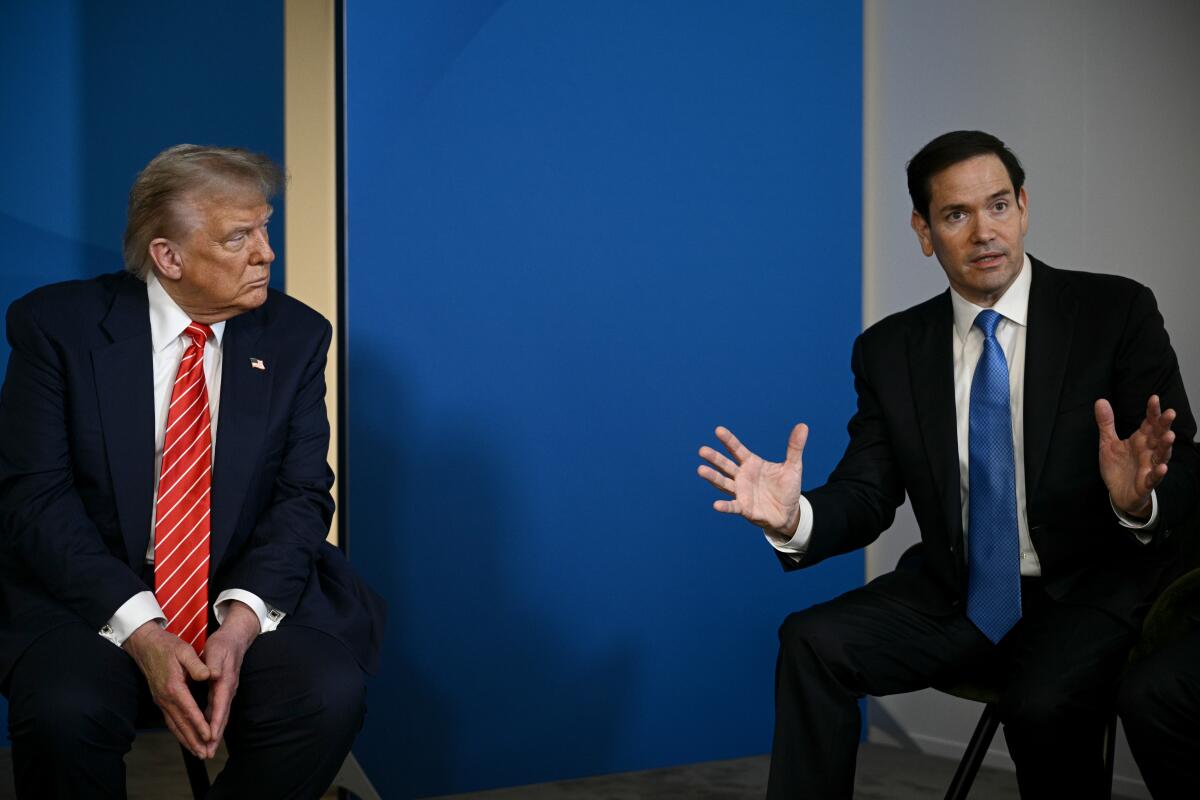
US Secretary of State Marco Rubio is “dealing” with Cuba, the president told reporters in Florida.
“He’s dealing [with it], and it may be a friendly takeover, it may not be a friendly takeover. Wouldn’t really matter because they’re really down to … as they say, fumes. They have no energy, they have no money,” Trump said.
“They are going to make either a deal or we’ll do it just as easy, anyway,” he said.
Cuba has been grappling with an energy crisis since January, when US forces abducted Venezuelan President Nicolas Maduro and halted fuel exports from Caracas to Havana, cutting the country off from one of its few allies and a key source of oil for the Cuban economy.
White House officials have suggested that Cuba is facing an economic collapse and that its government is ready to negotiate with Washington.
Trump has said on multiple occasions that Cuba’s government is ready to “fall” and that its leaders want to “make a deal” with Washington, according to NBC News.
Cuba has denied reports of high-level talks, according to Reuters, but it has not “outright” denied US media reports of “informal talks” between Raul Guillermo Rodriguez Castro, the grandson of former Cuban President Raul Castro, and US officials.
Cuba has been in the crosshairs of the US for decades, but Trump is the first US president since the Cold War to openly discuss and pursue a government change in Havana.
Trump’s attacks on Venezuela and Cuba are in line with his revival of the “Monroe Doctrine”, a 19th-century policy that states the Western Hemisphere should be solely under the sway of the US and no other foreign power.
Trump first raised the notion of a “friendly takeover” of Cuba in February.
Dozens of civilians, including children, wounded by an Iranian drone strike in Bahrain. France deploying warships to secure shipping commerce in the Strait of Hormuz. Australia taking heat from President Trump over its handling of the Iranian women’s soccer team. Markets across Asia plunging as the price of oil surged.
Lebanon reporting half a million people displaced by fighting between Israel and Hezbollah. The U.S. State Department telling nonessential staff to get out of Saudi Arabia after attacks there killed workers from India and Bangladesh. Ukrainian anti-drone experts turning their attention from their war with Russia to help intercept Iranian attacks. The defense minister of ever-neutral Switzerland saying his country believes the U.S.-Israeli war violates international law.
In less than two weeks, the Trump administration has instigated a truly global conflict — and with no quick and clear path to resolution, despite Trump insisting to congressional Republicans gathered at his Miami resort Monday that it would be a “short term excursion.”
“Short term! Short term!” Trump said in a bullish speech about the conflict, in which he said “the world respects us right now more than they have ever respected us before.”
“We’re counting down the minutes until they will be gone,” he said of Iran’s remaining leadership, while adding that the U.S. “will not relent” until Iran is “totally and decisively defeated.”
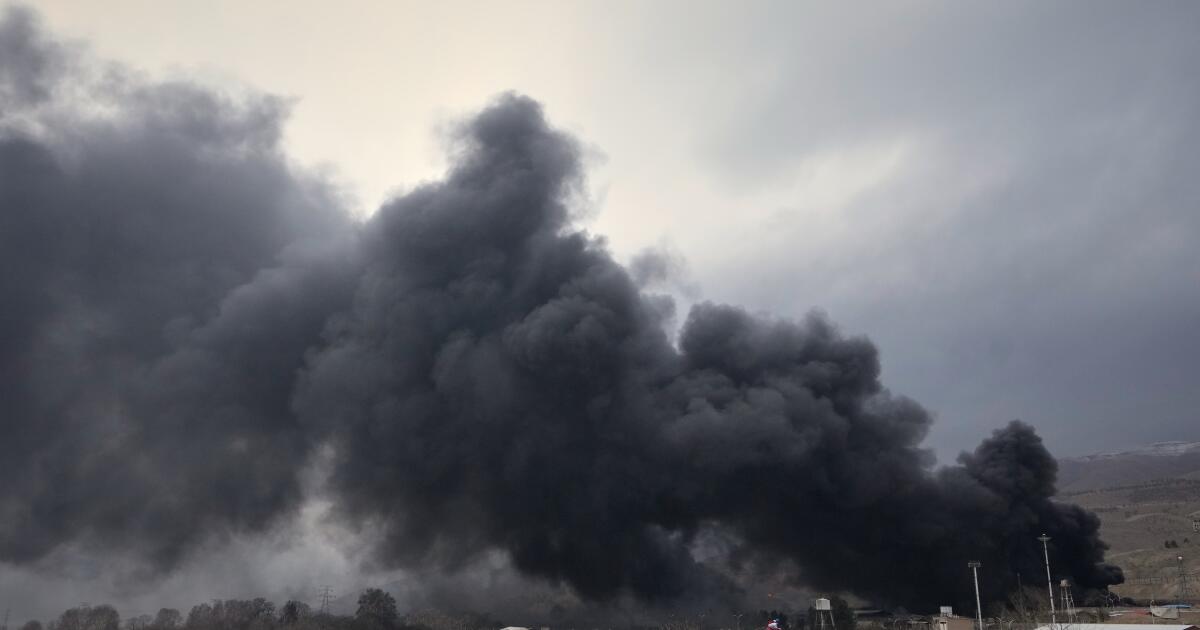
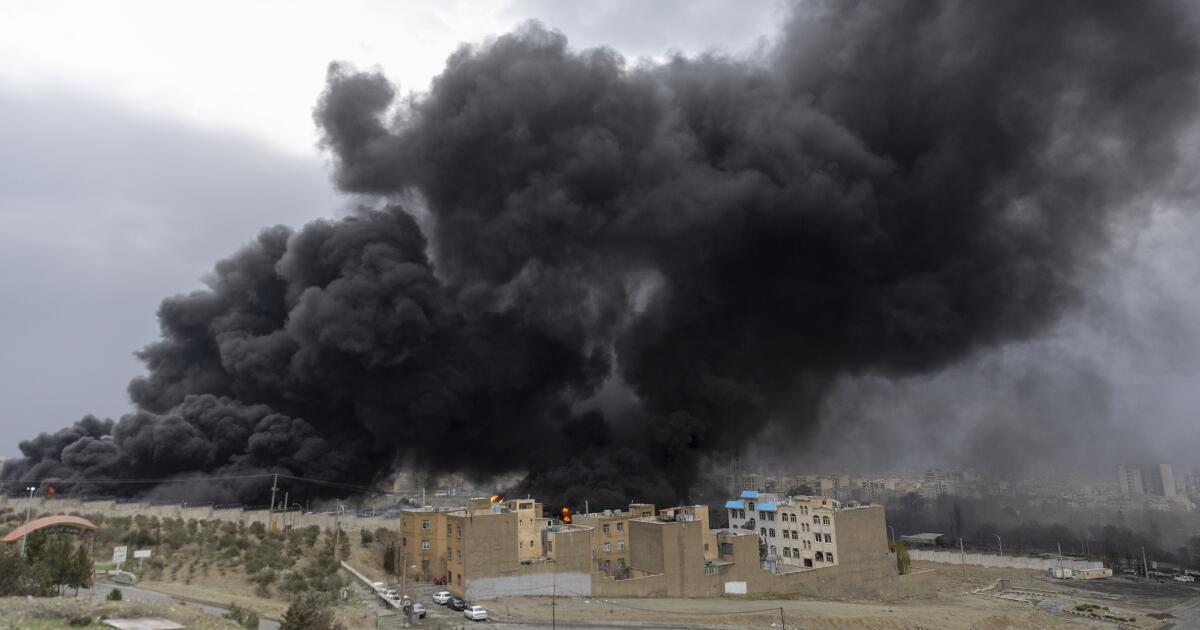
The war is not isolated to Iran, though it has certainly caused devastation there — with more than 1,300 deaths reported and toxic clouds from strikes on fuel depots hovering over Tehran, a city of some 10 million people.
The war’s effects also are not limited to the Middle East, though they are widespread there — as Israel has pushed into Lebanon and Iran has launched a wave of retaliatory strikes on U.S. allies across the Persian Gulf. The fighting has grounded regional air traffic, threatened desalination facilities that provide drinking water to millions and undermined the safe reputation of modern metropolises such as Dubai and Abu Dhabi.
Unlike the recent U.S. incursion into Venezuela to capture and oust President Nicolás Maduro, the U.S. war on Iran has been met with stiff resistance militarily, drawn in a slew of allies, reignited proxy battles, drastically destabilized the oil trade and shifted dynamics between the U.S. and other major powers such as China and Russia.
China, which gets upward of 50% of its crude oil imports through the Strait of Hormuz, has largely stayed out of the conflict, though China’s Foreign Minister Wang Yi said Sunday that the war “should never have happened” and “benefited no one.”
Trump said Monday that the U.S. is less harmed by strait disruptions, and was “really helping China” by securing the strait.
Russia, meanwhile, has emerged the lone winner of energy disruptions in the region, said Robert David English, a UCLA international policy analyst — as the Trump administration considers reducing oil sanctions on Russia to take pressure off of Mideast sources.
Trump said he had a “good talk” with Russian President Vladimir Putin about Iran on Monday. He also said the U.S. was going to suspend sanctions against other countries in order to alleviate strain on oil markets while the Iran conflict persists, but did not provide specifics.
The scope of the war has been dictated in part by Iran, which has historically limited its responses to U.S. strikes but warned after the U.S. bombed its nuclear sites last summer that it would treat any new attacks — large or small — as an act of war, and respond in kind.
Its strikes on U.S. facilities and allies throughout the region reflect that strategy, and are aimed in part at making the war more politically costly for the U.S. by straining global markets and its regional allies, experts said.
However, “you can’t attribute the increasingly global characteristics of the conflict solely to an Iranian strategy, because wars in this region tend to spill over the longer they last, with unintended consequences” including “bringing in all kinds of actors that don’t want to be involved,” said Kevan Harris, an associate professor of sociology who teaches courses on Iran and Middle East politics at the UCLA International Institute.
That can serve as a deterrent to starting wars in the region, he said, but “also makes them more difficult to wind down.”
The surge in oil prices to nearly $120 a barrel Monday — before a remarkable reversal to below $90 by the time U.S. stocks closed — is one of the furthest-reaching effects of the war, and one that clearly had Trump’s attention.
“Short term oil prices, which will drop rapidly when the destruction of the Iran nuclear threat is over, is a very small price to pay for U.S.A., and World, Safety and Peace. ONLY FOOLS WOULD THINK DIFFERENTLY!” Trump wrote on social media Sunday.
How long prices will remain elevated or volatile is a matter of debate, but Trump’s “short term” projections have been undercut by increasing strikes on oil and gas facilities in the region.
“If you can tolerate oil at more than $200 per barrel, continue this game,” Ebrahim Zolfaghari, a spokesperson for Iran’s Islamic Revolutionary Guard Corps, said Sunday.
Prices at the pump have surged for average Americans, some of whom were attracted to Trump’s candidacy because of his promises to avoid foreign wars and focus on driving down the cost of living for U.S. citizens.
Now, Trump and other administration officials are facing questions about their own role in putting the world at war, and offering various different justifications. They’ve asserted without proof that the U.S. faced an imminent threat of attack from Iran. Trump has repeatedly hinted that his goal was removing the government.
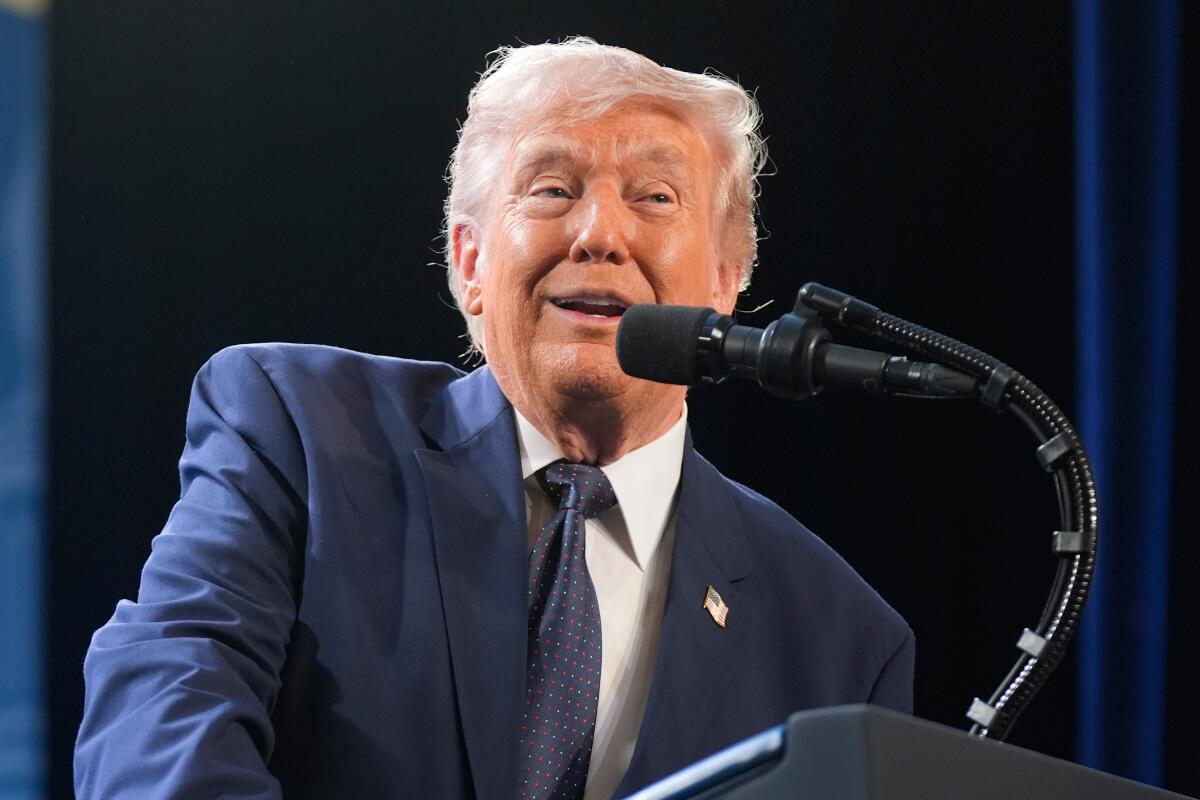
President Trump speaks at the Republican Members Issues Conference on Monday at Trump National Doral Miami in Doral, Fla.
(Mark Schiefelbein / Associated Press)
In the meantime, Iran has shown no signs of bowing to Trump, rejecting his calls for “surrender” and for him to have a say in naming their next leader. Iran installed Mojtaba Khamenei after Trump said the hard-liner son of the late Ayatollah Ali Khamenei would be “unacceptable.”
The choice was hailed by the president of Azerbaijan and the leader of Yemen’s Houthi rebels, among other allies.
To date, seven U.S. service members have been killed in the conflict, according to U.S. officials. Every day, U.S. taxpayers are on the hook for nearly $1 billion in war costs, according to one estimate. Democrats have slammed Trump for both.
“This war is coming from the same President that is building a $400 million ballroom in the White House. The same President that says $100 for a barrel for oil is worth it. The same President that doubled healthcare premiums for millions of Americans. But we have money for another endless war?” Sen. Alex Padilla (D-Calif.) wrote Monday on X.
Other world leaders focused on the global economic impact.
Traffic through the Strait of Hormuz, which transports about 20% of the world’s oil, has nearly halted, while producers in Saudi Arabia, Iraq, Kuwait and the United Arab Emirates ceased oil operations without open routes for export.
In response, French President Emmanuel Macron suggested French and other allied naval assets could escort oil tankers in the strait, shifting the security burden there from Washington onto Europe, leaving European vessels vulnerable to hostilities and potentially drawing the European Union deeper into the conflict.
Already, they’ve agreed to allow the U.S. to use bases in their territories, though the U.S. and Spain got into a spat after Spain rejected U.S. use of its bases and Trump threatened U.S. trade with the country.
Macron on Monday also threw additional military support behind Cyprus, following a meeting with Cypriot President Nikos Christodoulides and Greek Prime Minister Kyriakos Mitsotakis at a Cyprus air base.
France will dispatch an additional 11 warships to operate across the eastern Mediterranean, the Red Sea and the Strait of Hormuz, Macron said, after an Iranian drone struck a British military base on Cyprus on Monday.
“When Cyprus is attacked, it is Europe that is attacked,” Macron said.
Located just 150 miles from Israel in the eastern Mediterranean, the island of Cyprus has emerged as a strategic — and exposed — nerve center in the U.S. offensive against Iran. It hosts vital British military bases and acts as an intelligence, surveillance, and logistics hub in countering Iranian influence and proxy attacks.
Britain’s Defense Secretary John Healey said Monday that the United Kingdom was conducting air defense to support the UAE, and that Typhoon jets had taken out two drones — one over Jordan and the other headed to Bahrain.
Trump suggested Monday that the U.S. was on the path toward victory, but acknowledged it had not accomplished all of its goals.
“We’ve already won in many ways, but we haven’t won enough,” he said — adding the conflict will end “pretty quickly.”
He said Iran had been “very foolish, very stupid” when it attacked its neighbors, hurting its own chances of success in resisting the U.S.
“Their neighbors were largely neutral, or at least weren’t gonna be involved, and they got attacked,” Trump said. “And it had the reverse effect. The neighbors came onto our side, and started attacking them.”
Iran may still attempt to widen the conflict’s economic and geopolitical impact to keep up pressure and push for a ceasefire in its favor, but that could also backfire, said Benjamin Radd, a political scientist and senior fellow at the UCLA Burkle Center for International Relations.
“Iran’s becoming increasingly like North Korea in this sense,” he said, “isolating itself further.”
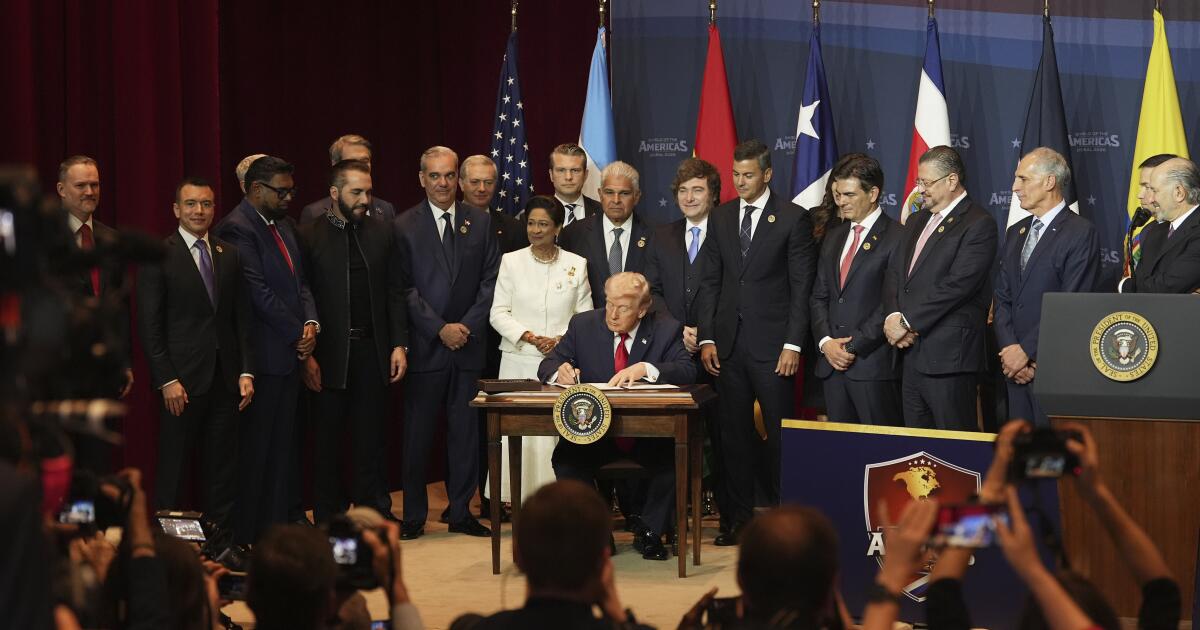
The pet did a neat trick: Before a room filled with heads of state from across Latin America, Little Marco spoke Spanish.
His owner — well, his soul’s owner at least— grinned and joked, “I think he’s better in Spanish” than in English. Following President Trump, it was Pentagon Pete’s turn to tease Little Marco.
“I only speak American,” Secretary of Defense Hegseth cracked. The auditorium stayed quiet save for Secretary of State Marco Rubio, who meekly protested, “I only speak Cuban.”
Trump gave him a pat on the back. Good boy, Marco.
The exchange, which happened over a weekend dominated by the war with Iran, was brief yet said so much about the times Latinos live in. Rubio, the most powerful Latino politician in U.S. history, might as well have been to Trump and Hegseth the Chihuahua that says “Yo quiero Taco Bell.” The man who has played an oversized role in pushing a president who campaigned against costly foreign wars and chaotic regime changes to do both was brought back down to an undignified size.
Little Marco indeed.
Here’s a reminder that no matter how high and mighty you get in Trump’s White House, a Latino is still an exotic “other.”
Tokenizing someone is always an ugly thing — yet Rubio deserves no tears. He has made a career out of wearing his latinidad like a shiny guayabera when convenient, long casting himself as the boy-faced exception to the corrupt, ineffectual Latino politician archetype. That stance has fueled a 27-year career — Florida speaker of the House, U.S. senator, former presidential candidate, secretary of State and national security advisor. That has made many conservatives and more than a few Latinos feel he’s not just capable of a strong White House run but that he could even win were he to do so.
All it cost Rubio was his morals and backbone. All he had to do was roll over.
We Latinos deserve better — and yet we kind of don’t.
The story liberals and conservatives have always told about America’s largest minority is that we would irrevocably change the United States — the former group maintained it would be for the better, the latter insisted we would cause this country’s downfall. Rubio proves that at our worst, Latinos show that in our rush to assimilate and be embraced, we often become the worst kind of Americans.
Secretary of State Marco Rubio speaks as President Trump during a NATO summit in June in the Hague.
(Brendan Smialowski / Pool Photo)
We’re the ones whom the American psyche sees as perpetual invaders, yet we sign up by the thousands for the Border Patrol, Immigration and Customs Enforcement and other agencies in Trump’s deportation Leviathan. Even as Trump slimed Latinos during his first term and his years out of office, an increasing number of us warmed up to him — surely, he was referring to other Latinos — until Trump captured more of our votes in 2024 than any Republican presidential candidate ever.
It takes a certain type of person to go from child of Cuban immigrants — the favorite son of an exile community that transformed Miami from a retiree haven into one of the capitals of Latin America — to tell European leaders last month that they and the United States “opened our doors to an unprecedented wave of mass migration that threatens the cohesion of our societies, the continuity of our culture, and the future of our people.”
It takes the worst kind of Latino.
I called Rubio a vendido in a previous columna after he cheered on the extrajudicial capture of Venezuelan despot Nicolás Maduro. He’s definitely still a sellout — what else to call someone who once fiercely opposed Trump but now sidles up to him like a cockapoo? But the most pathetic part about Rubio’s rise is that his followers see him as the culmination of the long-held dreams of Latinos that things would become better for our ancestral Latin American countries and ourselves once one of us was charge.
Alas, no. He’s living up to a realpolitik maxim attributed to various Latin American caudillos: For my friends, everything; for my enemies, the law.
Strongmen like El Salvador and Argentina presidents Nayib Bukele and Javier Milei get coddled and receive foreign aid; college students on study visas who criticize the Trump administration get nabbed by la migra. Rubio is overseeing a foreign policy that currently has the U.S. dictating how Venezuela will be governed, is bombing Iran like the country was a game of Pachinko and is slowly choking Cuba into collapse. He’s the unholy child of Bush-era neoconservativism and MAGA — and Rubio is just getting started.
That’s how he set himself up to be used as Latino punch line by Trump and Hegseth. The setting: the inaugural meeting at a Trump golf course near Miami of the Shield of the Americas, a coalition of Western Hemisphere countries ostensibly assembled to fight drug cartels. It resembled one of those lesser super-groups in the Marvel Cinematic Universe — you got Costa Rica instead of Mexico, Bolivia instead of Brazil. The group even has a crappy logo. You know how unserious the confab was when Trump’s point person for this is Kristi Noem, whom he literally had just fired as Homeland Security secretary.
After Trump rambled through a short speech, it was Rubio’s time to offer remarks. Here was a chance for the secretary of State, the man the Atlantic recently called “bright and well spoken,” to channel his inner Simón Bolivar or José Martí. The secretary of State thanked everyone present in English, but not before praising Trump for his “bold leadership” and bragging that the president is “one of the most historic figures in American history.”
Then Rubio looked back at his beaming master.
President Trump signs a proclamation committing to countering cartel criminal activity at the Shield of the Americas Summit on Saturday at Trump National Doral Miami in Doral, Fla.
(Rebecca Blackwell / Associated Press)
“You all right if I — “ he began before Trump cut him off with a magnanimous, “Sure. Please.”
That’s when Little Marco spoke in flawless Spanish. Rubio’s comments weren’t much different from what he said in English, save his remark that what they all planned to do by following Trump “will make future generations grateful for the work we are doing today.”
That last statement sums up Rubio. For centuries, Latin America has yearned for prosperity and peace free from American interference. This hope has fueled revolutions, music, film, culture and all the best things the region has produced only to have U.S.-backed tyrants crush those movements.
That’s the torch Rubio now proudly carries.
“All my life I’ve been in a hurry to get to my future,” he wrote in his 2013 memoir, “American Son.” Rubio’s future is now. And our present — not just Latinos, but all Americans — is worse because of it.
SACRAMENTO — California Gov. Gavin Newsom has positioned himself as a national public health leader by staking out science-backed policies in contrast with the Trump administration.
After Health and Human Services Secretary Robert F. Kennedy Jr. fired Centers for Disease Control and Prevention Director Susan Monarez for refusing what her lawyers called “the dangerous politicization of science,” Newsom hired her to help modernize California’s public health system. He also gave a job to Debra Houry, the agency’s former chief science and medical officer, who had resigned in protest hours after Monarez’s firing.
Newsom also teamed up with fellow Democratic governors Tina Kotek of Oregon, Bob Ferguson of Washington and Josh Green of Hawaii to form the West Coast Health Alliance, a regional public health agency, whose guidance the governors said would “uphold scientific integrity in public health as Trump destroys” the CDC’s credibility. Newsom argued establishing the independent alliance was vital as Kennedy leads the Trump administration’s rollback of national vaccine recommendations.
More recently, California became the first state to join a global outbreak response network coordinated by the World Health Organization, followed by Illinois and New York. Colorado and Wisconsin signaled they plan to join. They did so after President Trump officially withdrew the United States from the agency on the grounds that it had “strayed from its core mission and has acted contrary to the U.S. interests in protecting the U.S. public on multiple occasions.” Newsom said joining the WHO-led consortium would enable California to respond faster to communicable disease outbreaks and other public health threats.
Although other Democratic governors and public health leaders have openly criticized the federal government, few have been as outspoken as Newsom, who is considering a run for president in 2028 and is in his second and final term as governor. Members of the scientific community have praised his effort to build a public health bulwark against the Trump administration’s slashing of funding and scaling back of vaccine recommendations.
What Newsom is doing “is a great idea,” said Paul Offit, an outspoken critic of Kennedy and a vaccine expert who formerly served on the Food and Drug Administration’s vaccine advisory committee but was removed under Trump in 2025.
“Public health has been turned on its head,” Offit said. “We have an anti-vaccine activist and science denialist as the head of U.S. Health and Human Services. It’s dangerous.”
The White House did not respond to questions about Newsom’s stance and Health and Human Services declined requests to interview Kennedy. Instead, federal health officials criticized Democrats broadly, arguing that blue states are participating in fraud and mismanagement of federal funds in public health programs.
Health and Human Services spokesperson Emily Hilliard said the administration is going after “Democrat-run states that pushed unscientific lockdowns, toddler mask mandates, and draconian vaccine passports during the COVID era.” She said those moves have “completely eroded the American people’s trust in public health agencies.”
Public health guided by science
Since Trump returned to office, Newsom has criticized the president and his administration for engineering policies that he sees as an affront to public health and safety, labeling federal leaders as “extremists” trying to “weaponize the CDC and spread misinformation.” He has excoriated federal officials for erroneously linking vaccines to autism, warning that the administration is endangering the lives of infants and young children in scaling back childhood vaccine recommendations. And he argued that the White House is unleashing “chaos” on America’s public health system in backing out of the WHO.
The governor declined an interview request, but Newsom spokesperson Marissa Saldivar said it’s a priority of the governor “to protect public health and provide communities with guidance rooted in science and evidence, not politics and conspiracies.”
The Trump administration’s moves have triggered financial uncertainty that local officials said has reduced morale within public health departments and left states unprepared for disease outbreaks and prevention efforts. The White House last year proposed cutting Health and Human Services spending by $33 billion, including $3.6 billion from the CDC. Congress largely rejected those cuts last month, although funding for programs focusing on social drivers of health, such as access to food, housing and education, were axed.
The Trump administration announced that it would claw back more than $600 million in public health funds from California, Colorado, Illinois and Minnesota, arguing that the Democratic-led states were funding “woke” initiatives that didn’t reflect White House priorities. Within days, the states sued and a judge temporarily blocked the cut.
“They keep suddenly canceling grants and then it gets overturned in court,” said Kat DeBurgh, executive director of the Health Officers Assn. of California. “A lot of the damage is already done because counties already stopped doing the work.”
Federal funding has accounted for more than half of state and local health department budgets nationwide, with money going toward fighting HIV and other sexually transmitted infections, preventing chronic diseases, and boosting public health preparedness and communicable disease response, according to a 2025 analysis by KFF, a health information nonprofit that includes KFF Health News.
Federal funds account for $2.4 billion of California’s $5.3-billion public health budget, making it difficult for Newsom and state lawmakers to backfill potential cuts. That money helps fund state operations and is vital for local health departments.
Funding cuts hurt all
Los Angeles County public health director Barbara Ferrer said if the federal government is allowed to cut that $600 million, the county of nearly 10 million residents would lose an estimated $84 million over the next two years, in addition to other grants for prevention of HIV and other sexually transmitted infections. Ferrer said the county depends on nearly $1 billion in federal funding annually to track and prevent communicable diseases and combat chronic health conditions, including diabetes and high blood pressure. Already, the county has announced the closure of seven public health clinics that provided vaccinations and disease testing, largely because of funding losses tied to federal grant cuts.
“It’s an ill-informed strategy,” Ferrer said. “Public health doesn’t care whether your political affiliation is Republican or Democrat. It doesn’t care about your immigration status or sexual orientation. Public health has to be available for everyone.”
A single case of measles requires public health workers to track down 200 potential contacts, Ferrer said.
The U.S. eliminated measles in 2000 but is close to losing that status as a result of vaccine skepticism and misinformation spread by vaccine critics. The U.S. had 2,281 confirmed cases last year, the most since 1991, with 93% in people who were unvaccinated or whose vaccination status was unknown. This year, the highly contagious disease has been reported at schools,airports and Disneyland.
Public health officials hope the West Coast Health Alliance can help counteract Trump by building trust through evidence-based public health guidance.
“What we’re seeing from the federal government is partisan politics at its worst and retaliation for policy differences, and it puts at extraordinary risk the health and well-being of the American people,” said Georges Benjamin, executive director of the American Public Health Assn., a coalition of public health professionals.
Robust vaccine schedule
Erica Pan, California’s top public health officer and director of the state Department of Public Health, said the West Coast Health Alliance is defending science by recommending a more robust vaccine schedule than the federal government. California is part of a coalition suing the Trump administration over its decision to rescind recommendations for seven childhood vaccines, including for hepatitis A, hepatitis B, influenza and COVID-19.
Pan expressed deep concern about the state of public health, particularly the uptick in measles. “We’re sliding backwards,” Pan said of immunizations.
Sarah Kemble, Hawaii’s state epidemiologist, said Hawaii joined the alliance after hearing from pro-vaccine residents who wanted assurance that they would have access to vaccines.
“We were getting a lot of questions and anxiety from people who did understand science-based recommendations but were wondering, ‘Am I still going to be able to go get my shot?’” Kemble said.
Other states led mostly by Democrats have also formed alliances, with Pennsylvania, New York, New Jersey, Massachusetts and several other East Coast states banding together to create the Northeast Public Health Collaborative.
Hilliard, of Health and Human Services, said that even as Democratic governors establish vaccine advisory coalitions, the federal Advisory Committee on Immunization Practices “remains the scientific body guiding immunization recommendations in this country, and HHS will ensure policy is based on rigorous evidence and gold standard science, not the failed politics of the pandemic.”
Influencing red states
Newsom, for his part, has approved a recurring annual infusion of nearly $300 million to support the state Department of Public Health, as well as the 61 local public health agencies across California, and last year signed a bill authorizing the state to issue its own immunization guidance. It requires health insurers in California to provide patient coverage for vaccinations the state recommends even if the federal government doesn’t.
Jeffrey Singer, a doctor and senior fellow at the libertarian Cato Institute, said decentralization can be beneficial. That’s because local media campaigns that reflect different political ideologies and community priorities may have a better chance of influencing the public.
A KFF analysis found some red states are joining blue states in decoupling their vaccine recommendations from the federal government’s. Singer said some doctors in his home state of Arizona are looking to more liberal California for vaccine recommendations.
“Science is never settled, and there are a lot of areas of this country where there are differences of opinion,” Singer said. “This can help us challenge our assumptions and learn.”
KFF Health News is a national newsroom that produces in-depth journalism about health issues and is one of the core operating programs at KFF — the independent source for health policy research, polling and journalism.
WASHINGTON — President Trump promised that 2026 would be a bumper year for economic growth, but instead it has kicked off with job losses, rising gasoline prices and more uncertainty about America’s future.
In his State of the Union address less than two weeks ago, the Republican president confidently told the country: “The roaring economy is roaring like never before.” The latest batch of data on jobs, pump prices and the stock market suggests that Trump’s roar has started to sound far more like a whimper.
There is a gap between the boom that Trump has predicted and the volatile results he has produced — one that could set the tone in this year’s midterm elections as he tries to defend his party’s majorities in the House and Senate. With Trump’s tariffs uncertainty ongoing, the war in Iran has suddenly created inflationary concerns regarding oil and natural gas.
The White House says it is still early in the year and stronger growth is coming.
No signs of a jobs boom
“WOW! The Golden Age of America is upon us!!!” Trump posted on social media Feb. 11 after the monthly jobs report showed gains of 130,000 jobs in January.
Since then, the job market has evaporated in worrisome ways.
Friday’s employment report showed job losses of 92,000 in February. The January and December figures were revised downward, with December swinging to a loss of 17,000 jobs. Monthly data can be rocky, but a trend has emerged that shows an enduring weakness. Without the healthcare sector, the economy would have shed roughly 202,000 jobs since Trump became president in January 2025. His administration notes construction job gains outside of the housing sector, which it says point to future hiring growth.
Trump often claims that jobs are going to people born in the United States, rather than to immigrants. But the latest report punctured some of that argument.
The unemployment rate for people born in the U.S. has climbed over the last 12 months to 4.7% from 4.4%. This means a greater share of the people who Trump said would get jobs because of his immigration crackdown are, in fact, searching for work.
Prices at the pump are going up
“Slashing energy costs is among the most important actions we can take to bring down prices for American consumers,” Trump said in a February speech in Texas just before the U.S. and Israel attacked Iran. “Because when you cut the cost of energy, you really cut — you just cut the cost of everything.”
The president has repeatedly told Americans that keeping gas costs low would be key to defeating inflation. He has talked up the decline, citing figures that were far below the national average to persuade the public that driving was getting cheaper.
But the strikes against Iran that began Feb. 28 have, for the moment, crushed that narrative. Prices at the pump have jumped 19% over the last month to a national average of $3.45, according to AAA. The investment bank Goldman Sachs warned in an analyst note that, if higher oil prices persist, inflation could rise from its 2.4% reading in January to 3% by the end of the year.
The administration is banking on plans to contain any energy price increases, essentially betting that either the conflict will end shortly or the administration can succeed in getting more tankers through the Strait of Hormuz. Trump advisors on Sunday sought to assure anxious Americans that surging fuel prices are a short-term problem.
“We never know exactly the timeframe of this,” Energy Secretary Chris Wright said on CNN’s “State of the Union. “But in the worst case, this is a weeks, this is not a months thing.”
Stocks are off their highs
“You know, we set the all-time record in history with the Dow going to 50,000,” Trump said Thursday at the White House.
This frequently repeated talking point has grown stale. The Dow Jones industrial average, one of Trump’s preferred measures of success, has dropped 5% over the last month. Stocks are up during his presidency, just as they were when Democrat Joe Biden was president. The recent decline could be reversed if the war with Iran ends and companies see solid profits over the next year and beyond. The recent dip, however, should be a warning sign as the administration has stressed the importance of more people investing in the stock market through vehicles such as “Trump accounts” for children.
The stock market has become a barometer of how people feel about the economy, with stock investors tending to have more confidence and those without money in the markets being more pessimistic.
Joanna Hsu, the director of the University of Michigan’s surveys of consumers, noted that in February a “sizable” increase in sentiment among people owning stocks “was fully offset by a decline among consumers without stock holdings.”
Productivity is up, but workers aren’t benefiting
Trump can point to a win in that the economy has become more productive — generating more value for each hour of work. That is a positive sign for long-term growth in the U.S. and a reflection of its strong tech sector.
Business sector labor productivity climbed 2.8% in the fourth quarter of last year, the Labor Department reported Thursday. But the challenge is that the gains might not be spread to workers in the form of higher pay as labor’s share of income last year fell to the lowest level on record, noted Mike Konczal, senior director of policy and research at the Economic Security Project, a nonprofit aligned with liberal economic issues.
Economy grew at a faster pace under Biden
“Under the Biden administration, America was plagued by the nightmare of stagflation, meaning low growth and high inflation — a recipe for misery, failure and decline,” Trump said at the World Economic Forum in Davos, Switzerland, in January.
The scoreboard tells a far different story, one that makes Biden’s track record in 2024 look better than Trump’s performance last year. The U.S. economy grew at a 2.8% pace during Biden’s last year, compared with 2.2% under Trump in 2025.
As for inflation, the primary measure used by the Federal Reserve is the personal consumption expenditures price index. It was 2.6% in both 2024 and 2025.
Trump has staked his economic argument on doing better than Biden. But while he has avoided the inflation spikes that haunted Biden’s presidency — amid the height of the COVID-19 pandemic — Trump has not delivered stronger growth or more hiring.
WASHINGTON — The war between the United States and Iran entered its ninth day Sunday with no clear path toward deescalation, as President Trump said deploying American ground troops to the Middle East remains under consideration and Iran’s foreign minister rejected calls for a ceasefire.
Speaking to reporters on Air Force One on Saturday, Trump declined to rule out the possibility of sending U.S. forces inside Iran, saying it could “possibly happen” as the conflict intensifies.
“There would have to be a very good reason,” Trump said. “I would say if we ever did that they would be so decimated that they wouldn’t be able to fight at the ground level.”
As Trump weighs sending ground troops into the widening conflict, Iran has signaled it is not prepared to halt fighting and said it would be ready to fight American soldiers if they descend into the country.
“We have very brave soldiers, who are waiting for any enemy who enters into our soil to fight with them, and to kill them and destroy them,” Iran’s foreign minister, Abbas Araghchi, said in an interview with NBC’s “Meet the Press” on Sunday.
Araghchi added that Iran is not considering a ceasefire at this time. He said the United States and Israel would first need to explain “why they started this aggression and then guarantee there would be a permanent end of the war.”
“Unless we get to that, I think we need to continue fighting for the sake of our people and our security,” he said.
“We allow nobody to interfere in our domestic affairs. This is up to the Iranian people to elect their new leader,” Araghchi said. “It’s only the business of the Iranian people, and nobody else’s business.”
As of Sunday, it remained unclear who would succeed Iran’s former leader Ayatollah Ali Khamenei, 86, who was killed by American and Israeli strikes on the first day of the war. But the clerical body that will choose Iran’s next supreme leader appeared to be close to reaching a majority consensus on its pick, according to several news reports.
Trump said last week that Mojtaba Khamenei — the son of the former leader — would be an “unacceptable” choice.
As the war’s end remains nebulous, the battlefield actions continue to have an economic impact domestically, particularly on oil prices.
“If the war continues like this, there will be neither a way to sell oil nor have the ability to produce it,” Iran’s parliament speaker Mohammad Bagher Ghalibaf said in a social media post Sunday. He added the war would affect not just the U.S., but also the rest of the world “due to [Benjamin] Netanyahu’s delusions,” referring to the Israeli prime minister.
Israeli strikes on Sunday hit an oil storage facility in Tehran, marking what appears to be the first time a civil industrial facility has been targeted in the war.
U.S. Energy Secretary Chris Wright said Sunday that there’s currently a “fear premium in the marketplace” and sought to assure Americans that the soaring oil prices are a short-term problem.
“We never know exactly the timeframe of this,” Wright said in an interview with CNN’s “State of the Union.” “But in the worst case, this is a weeks, this is not a months thing.”
White House Press Secretary Karoline Leavitt echoed the same assurances in an interview with Fox News‘ “Sunday Morning Futures,” calling the rising gas prices a “short-term disruption.”
“Ultimately taking out the rogue Iranian regime is going to be a good thing for the oil industry,” Leavitt said. “Those prices are going to come back down just like they have over the course of the past year, because of President Trump’s American energy dominance agenda.”
The strike on the oil storage facility came as Netanyahu promised “many surprises” for the next phase of the conflict.
Iran also hit a desalination plant in Bahrain, and according to Araghchi, a U.S. airstrike damaged an Iranian desalination plan on Qeshm Island that is a critical drinking water supply in the parched deserts of the gulf.
“Attacking Iran’s infrastructure is a dangerous move with grave consequences. The U.S. set this precedent, not Iran,” Araghchi wrote in a post on X.
The United States has also come under scrutiny after evidence suggested that an American strike was likely responsible for an explosion at an Iranian elementary school that killed more than 165 people, most of them children.
Trump administration officials have said the matter is under investigation and that no determination has been made as to who was responsible for the strike. But on Saturday, Trump said Iran was to blame for the explosion.
“It was done by Iran,” Trump told reporters. “They’re very inaccurate as you know with their munitions. They have no accuracy whatsoever. It was done by Iran.”
Asked Sunday if Iran had any evidence that the strike was conducted by the Americans, Araghchi said it had to have been either the U.S. or Israeli military and said that Trump’s suggestion that Iran was responsible for the attack was “funny.”
“It is our school, these are our students and our girls and they are attacked by an American fighter, a jet fighter and they have been killed. Why [is] Iran responsible?” Araghchi said.
I know a lot of people who suffer from a chronic malady that gets worse each time there’s news out of Washington. Supporters of the current president of the United States might refer to this condition as a side effect of Trump derangement syndrome, but it’s more like Trump fatigue syndrome.
Symptoms can include a desire to tune out for a spell, stick your head in an ice bucket, or find another way to numb the senses.
But some brave souls, instead of looking away, step into the fray.
Bert Voorhees, for instance.
I came upon his name while reading coverage of the Monday evening demonstration at City Hall in downtown L.A., where protesters railed against the bombing of Iran — the latest example of Trump acting as if he’s king of the world and answerable to nobody, including Congress, the courts or the American people.
On the steps of L.A. City Hall, people attend the March 2 Answer Coalition rally protesting the attack on Iran by the U.S. and Israel.
(Jason Armond / Los Angeles Times)
With missiles flying, civilians dying and chaos spreading, Voorhees told USA Today that the Iranian ayatollah’s violence against his own people did not justify a U.S. military assault. In Voorhees’ mind, it’s American democracy that is under attack.
“If people don’t stand up and get loud about this, all together right now, we’re not going to have a country,” the northeast San Fernando Valley resident said. “So, it’s time for people to get serious, get in the streets.”
I called Voorhees, a retired lawyer and teacher, and we had a long chat that continued the next day over lunch in Montrose. We’re both in our 70s, and we both have trouble aligning the country we’re living in with the vision we had for it as younger men. Who could have anticipated years of bullying and name-calling, pathological lying about a “stolen” election or the routing of congressional and judicial opposition?
I confessed to Voorhees that I completely misread the direction this country was heading back when the first Black president in history termed out in 2016. I would have bet that as a more diverse and tolerant population came of voting age, old divisions would fade slowly into history and the U.S. would keep pushing toward higher elevations.
Silly me.
Voorhees says he’s demonstrated hundreds of times, but with immigration raids and now the war in Iran, President Trump is keeping him extra busy. “If people don’t stand up and get loud about this, all together right now, we’re not going to have a country,” said Voorhees. “So, it’s time for people to get serious, get in the streets.”
(Genaro Molina / Los Angeles Times)
Maybe it was the naively wishful thinking of a parent wanting his kids to live in a more evolved country rather than one filled with Neanderthal notions about science, medicine, climate, and non-white immigrants.
To Voorhees, these are reasons to raise hell rather than to lose faith, and he’s not alone. The No Kings rallies in greater L.A. were massive. Home Depot civilian patrols have looked out for hard-working neighbors because “silence is violence.” The whistle brigades are defending their communities.
Denise Giardina, a Huntington Beach book seller and friend of Voorhees’, has been on Home Depot patrols in her community and said planning various political actions is practically a full-time job.
“I have daughters and wanted them to have more rights than me, and I’m not sure that’s going to happen,” Giardina said.
When Giardina needs a break, she goes for a hike, which serves as a reminder that a single protest doesn’t change the world, but small steps matter.
“Sometimes you can’t think about the end,” she said. “It’s just one foot in front of the other. It’s not government that’s going to save us. It’s going to be the people.”
A crowd gathered at Los Angeles City Hall on March 2 to protest the bombing of Iran by the United States and Israel.
(Jason Armond / Los Angeles Times)
Roseanne Constantino, a Silver Lake graphic designer whose activism includes knocking on doors during election cycles, sending postcards and making phone calls, has been on the front lines with Voorhees and shares his sense of duty.
“I mean, for people to say, ‘I can’t watch the news, I’m numb, I’m overwhelmed, I have to tune out,’ is so much privilege talking, because they can tune out, because they’re safe,” Constantino said.
“I find it’s like a gateway drug,” she added, “because even people who have never done anything activist in their life eventually find themselves at a protest and are buoyed by the community and the sense of purpose and expression of opposition, but also of the love of democracy.”
To Voorhees, “democracy is a privilege,” and your participation does not end with voting. “You’ve got to make sure they do the right things,” he said, “and that requires paying attention and supervising them, if you will. Politicians are supposed to work for us.”
Voorhees told me that under President Obama, when drones were used in targeted overseas killings, he took to the streets in protest.
“I’m an equal opportunity activist, but we just haven’t had in my lifetime a person so determined to destroy democracy,” Voorhees said. “I called Reagan a fascist, and Reagan felt like a fascist until I met this man, who is the head of a fascist movement in this country.”
I wagered that the bombing of Iran by the America-first president — who promised to end rather than start wars — was Trump’s way of projecting strength at a time of weakness. Many of the president’s true believers are applauding, but it seems that nothing was learned from past Middle East meddling that ended badly, and with no thoughtful consideration of what comes next, Epic Fury could be followed by Epic Quagmire.
Voorhees insists this wasn’t just a show of might, but an act of distraction.
From the Epstein files, for instance. From the empty promises about lower prices for groceries and consumer goods, the droopy favorability ratings, midterm election fears and the mess created by tariffs that cost American merchants millions of dollars and were declared illegal.
Voorhees is mad about all of that, but made a point of clarification.
He’s not demoralized.
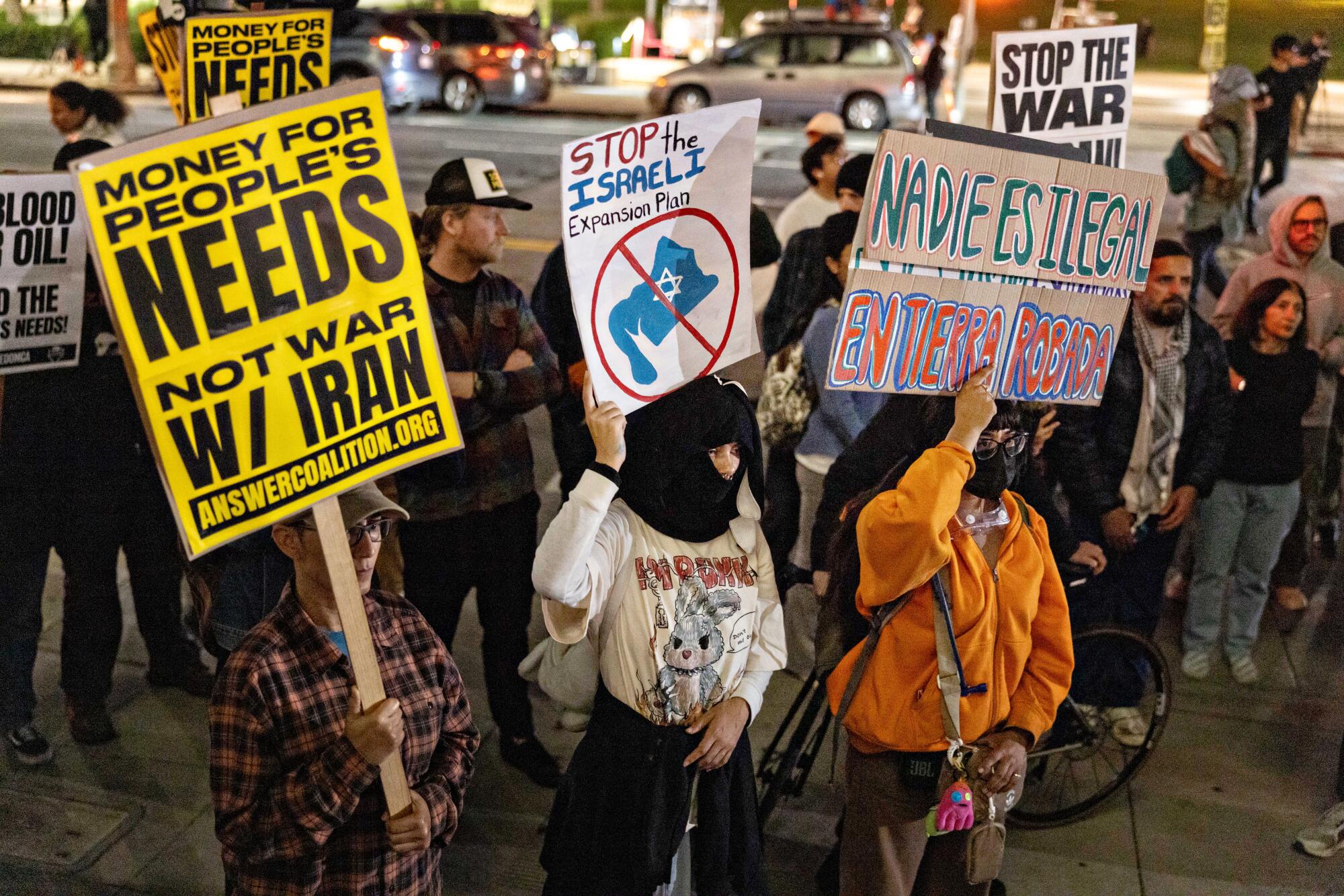
More than 200 people protest the U.S. and Israel’s war against Iran in front of City Hall in downtown Los Angeles on Saturday. Protesters carried Mexican, Palestinian and Iranian flags at the rally organized by the Answer Coalition.
(Genaro Molina / Los Angeles Times)
“The arc of the universe bends toward justice,” Voorhees said, “but it doesn’t do it steadily. There are retreats. Two steps forward, one back. One step forward, three back. We’re in one of those periods. … But we can overcome, and I believe in the long run we probably will.”
Minneapolis is the model, he said. When two innocent people were killed in immigration raids, the community came together and rose in protest, forcing a retreat of Trump’s forces and sparking a national conversation about the brutal tactics.
“Minneapolis pushed back against that with humanity, and that’s the future we want to build,” Voorhees said. “That’s the future Martin Luther King Jr. always wanted. That’s the beloved community. That’s the ticket.”
Things will change only if “we get up off the couch,” said Voorhees, who attended another antiwar protest Saturday on the steps of City Hall with a sign that asked, “Who Would Jesus Bomb?”
“You can march ahead with a heavy heart and a downcast head, or dance ahead with a smile and a tune on your lips, hand in hand with people you care about. Why not do that? All empires fall. All kings and tyrants fail in the end. Sometimes it’s fast. Sometimes it’s slow. But that day is coming and, as the Twin Cities proved, love is stronger than hate, if only just.”
WASHINGTON — The Defense Department last week outlined a concise set of military objectives in President Trump’s war against Iran, claiming its ultimate goal is to dismantle Tehran’s ability to project power beyond its borders. Yet it may be targets the Pentagon has largely left unacknowledged that offer the clearest insight yet into Trump’s true intentions.
U.S. military strikes have focused on Iran’s ballistic missile, drone and nuclear programs, as well as its naval assets, according to U.S. Central Command. But strikes have also increasingly targeted Iran’s internal security forces, used by the Islamic Republic to suppress public dissent, according to an analysis from the Institute for the Study of War and the Critical Threats Project shared with The Times.
The strikes have targeted at least 123 headquarters, barracks and local bases operated by Iran’s paramilitary organizations, including the Islamic Revolutionary Guard Corps and its Basij militia. Regional police forces, primarily in the capital region around Tehran and in western Iran, near areas dominated by Kurdish groups hostile to the Iranian government, have also been targeted.
Some of those groups are being armed and supported by the U.S. intelligence community, a U.S. official said, speaking on the condition of anonymity to speak candidly.
Nicholas Carl, with the Critical Threats Project, said the pattern indicates the campaign is already underway to set the conditions for a revolution.
“As we are going after these repressive institutions, we are degrading the ability of the regime to monitor its population, to repress its population,” Carl said. “And so it looks as though the strike campaign may be organized around trying to erode the ability of the regime to repress in those areas.”
Analysts said that strikes against internal forces could be greater than they have measured thus far, noting the difficulty of tracking targets in the war based on publicly available data due to an internet blackout strictly enforced by the Iranian government.
An explosion erupts after strikes near Azadi Tower close to Mehrabad International Airport in Tehran on Saturday.
(Atta Kenare / AFP / Getty Images)
The quieter side of the U.S. campaign suggests a political strategy by the Trump administration that goes beyond simply containing the Iranian government, and may instead aim to lay the groundwork for its overthrow.
Trump and his top aides have been inconsistent in their messaging on their goals for the war, vacillating between calls for regime change and far shorter ambitions, such as an Islamic Republic that remains in power under leadership more acquiescent to the United States.
Before the war began, Trump was presented with an intelligence assessment that large-scale military action was unlikely to topple the Iranian government, two sources familiar with the assessment said. The assessment led analysts at the CIA, the State Department and the Pentagon all to advise the White House against proceeding with the operation. The intelligence analysis was first reported by the Washington Post.
Share via
Greasing the wheels for domestic unrest, for insurgency or revolution could serve other strategic purposes for the Trump administration beyond effecting regime change, adding new sources of pressure on an Islamic Republic that, if still intact by war’s end, would face renewed internal pressures at a moment of historic weakness.
Rob Malley, lead negotiator on the 2015 Iran nuclear deal and special U.S. envoy for Iran under President Biden, said that a sustained U.S. campaign that cripples Iran’s ability to maintain domestic control could mean “the regime collapses, in the sense that it can no longer, genuinely and effectively, govern the entirety of the country.”
“Right now, what Trump is saying suggests an extremely ambitious, extremely long-term, extremely perilous campaign that will only end with Iran’s surrender, and it’s very hard to see Iran surrendering,” Malley said. But the campaign may already be working. “Their communications have certainly been penetrated — they cannot meet without being targeted by Israel or the United States,” he added.
A woman holds a portrait of the late Ayatollah Ali Khamenei at a protest Saturday by medical professionals outside Gandhi Hospital in Tehran, which was damaged in an airstrike earlier this week.
(Majid Saeedi / Getty Images)
“Either the regime stays in place weakened, bloodied, finding it harder to govern a more fragmented, chaotic country,” Malley continued, “or the regime no longer can govern.”
An Israeli official did not deny that internal security forces were being targeted, although the official said that Israel was focused on assassinating Iran’s political and security leadership — “tiers one, two and three,” the official said. The vast majority of the strikes against internal security services thus far have been conducted by the United States.
“Our goal is to weaken the ayatollah regime, to a point where the Iranian people can choose their fate,” the official told The Times. “It’s still not at the point where they can do that, but there is work still to be done.”
By all accounts, the campaign against Iran’s military assets has achieved success. Iranian ballistic missile attacks against Israel and U.S. forces and allies in the region have decreased by 90% after just a week of combat, Defense officials said. Drone strikes have decreased by 83%. Over 30 Iranian vessels, including those used as launching pads for drones and aircraft, have been destroyed — a significant number for Iran’s aged and ill-funded naval fleet.
Trump could simply declare victory based on these results alone, said Elliott Abrams, who served as Trump’s special representative for Iran in 2020.
“They will get weaker as they use up resources and we bomb more and more relevant sites. Already air traffic is starting up again,” Abrams said, noting that commercial flights in the region began resuming this weekend. “So I doubt that the president will need a protracted campaign.”
But that would leave the regime in place, leaving open the possibility of a revanchist Islamic Republic that could reconstitute its military and crack down further on democratic protesters — an outcome that could create political backlash for Trump, Abrams said, after losing U.S. service members in combat.
A woman jogs amid closed shops in south Tel Aviv on Saturday.
(Olympia de Maismont / AFP / Getty Images)
“The outcome remains entirely in doubt — regime collapse after a wave of protests, civil war, a deal that leaves the regime in place behind a new face,” Abrams added. “A real test for Trump would arise if there is a wave of protests as in January, and the regime again starts shooting. Can he do nothing? Unlikely.”
In his initial speech announcing the start of the campaign, Trump addressed the people of Iran, telling them to shelter in their homes until the U.S. bombing campaign concludes.
“When we are finished, take over your government. It will be yours to take. This will be probably your only chance for generations,” the president said. “For many years, you have asked for America’s help. But you never got it. No president was willing to do what I am willing to do tonight. Now you have a president who is giving you what you want. So let’s see how you respond.”
But the president’s message grew muddled over the course of the last week, after he offered conflicting goals in a series of interviews with reporters.
He at once said he was expecting to hand-select the next ayatollah, after assassinating Iran’s longtime supreme leader, Ali Khamenei, in the opening salvo of the war. In other interviews, he said that the joint U.S.-Israeli campaign had killed many of the potential leaders that Washington could have worked with.
On Friday, Trump called for Iran’s “unconditional surrender.” He did not specify whether he was referring to a surrender of Iran’s nuclear program, its ballistic missile program, or on control over the country itself, and in a subsequent interview, said it could simply mean “when Iran no longer has the ability to fight.”
Over the last week, Kurdish leaders have shared accounts of Trump and his top aides reaching out to them and encouraging their involvement in the war, including a ground incursion in western Iran from Iraqi Kurdistan. But the president seems to have placed that effort on hold for the time being. “The war is complicated enough without having — getting the Kurds involved,” he told reporters Saturday aboard Air Force One.
At Central Command headquarters on Thursday, Defense Secretary Pete Hegseth told reporters that Trump maintains his promise to the Iranian people at the outset of the war, that a time will come for an uprising.
Defense Secretary Pete Hegseth addresses the audience as President Trump listens during “The Shield of the Americas Summit“ on Saturday, a gathering with heads of state and government officials from 12 countries in the Americas at the Trump National Doral Golf Club in Doral, Fla.
(Roberto Schmidt / Getty Images)
“No one’s done more than President Trump to reopen the opportunity for those who want a free Iran to do so,” Hegseth said. “Ultimately, it’s common sense, as he said up front, don’t go out and protest while bombs are dropping inside Tehran and elsewhere. There will come a moment where he determines, or they determine, that it’s time to seize that advantage.”
Suzanne Maloney, vice president and director of the foreign policy program at the Brookings Institution and an expert on Iran, said she expects the government to survive the U.S. assault, “still easily able to outgun and outmaneuver any challenges from the streets.”
But a concerted, prolonged campaign could change that assessment.
“Of course, months of full-scale war certainly could also break the system,” Maloney said, adding: “I don’t think the short-term result would be a stable transition to a more liberal system — but rather a collapse of the state itself, and at least for some period of time, a dangerous vacuum of power and order in the heart of the Middle East.”
United States President Donald Trump has posted on social media that he does not need the United Kingdom to deploy aircraft carriers to the Middle East, amid the ongoing war with Iran.
Saturday’s post on Truth Social follows a statement from the UK’s Ministry of Defence that one of its two flagship aircraft carriers, the HMS Prince of Wales, has been placed on “high readiness”.
Recommended Stories
list of 3 itemsend of list
“The United Kingdom, our once Great Ally, maybe the Greatest of them all, is finally giving serious thought to sending two aircraft carriers to the Middle East,” Trump wrote.
“That’s OK, Prime Minister Starmer, we don’t need them any longer — But we will remember. We don’t need people that join Wars after we’ve already won!”
The post, with its reference to the UK as a “once great ally”, signals a deepening rift between the two countries that has emerged since Trump returned to office last year.
The divide appears to have deepened over the past week, as the US and Israel continue to hammer Iran as part of a war they launched on February 28.
The conflict has sparked fears across the Middle East, as retaliatory strikes from Tehran target US allies across the region.
Already, an estimated 1,332 people have been killed in Iran, and the US has confirmed the deaths of six of its service members. More deaths have been reported in countries like Lebanon, Kuwait, the United Arab Emirates and Iraq.
The UK government has increased its involvement in the war on Iran, widely considered illegal under international law.
The UK Defence Ministry, for instance, said on Saturday that the government of Prime Minister Keir Starmer had allowed the US to use its military bases for what it termed “limited defensive purposes”.
The bases include RAF Fairford in Gloucestershire and the Diego Garcia site in the Chagos Islands, located in the Indian Ocean. Initially, there had been reports that Starmer had blocked the US use of the bases.
In the immediate aftermath of the initial US-Israeli strike, Starmer appeared to blanche at the prospect of joining the war.
He and the leaders of France and Germany issued a joint statement, underscoring that any actions they might take would be defensive in nature.
“We will take steps to defend our interests and those of our allies in the region, potentially through enabling necessary and proportionate defensive action to destroy Iran’s capability to fire missiles and drones at their source,” the joint statement said.
“We have agreed to work together with the US and allies in the region on this matter.”
But Starmer has had to push back on domestic criticism both for and against joining the war.
On Monday, he told the UK Parliament, “We are not joining the US and Israeli offensive strikes”, citing the need to protect “Britain’s national interest” and “British lives”.
The war in Iran remains largely unpopular in the UK. The polling firm Survation conducted a survey over the last week of 1,045 British adults, in which 43 percent of respondents called the war not justifiable.
When asked if they supported Starmer’s initial decision not to allow the US to use UK bases, 56 percent of respondents approved. Only 27 percent said it was the wrong choice.
Thousands of protesters gathered outside the US Embassy in London on Saturday to call for an end to the ballooning conflict.
The US president, meanwhile, has upped his criticism of Starmer over the past week, further fraying relations with the UK government.
On March 3, for instance, Trump held an Oval Office meeting with German Chancellor Friedrich Merz, in which he said repeatedly he was “not happy with the UK”.
Of Starmer, Trump said, “This is not Winston Churchill that we’re dealing with.”
Trump has long admired Churchill, and last year installed a bust of the late UK wartime leader in the Oval Office, just as he had during his first term.
By contrast, Trump has issued a flood of criticism against Starmer, particularly for his 2024 decision to transfer control of the Chagos Islands to Mauritius.
The transfer came after the International Court of Justice found the UK acted unlawfully in 1965 by separating the islands from Mauritius to create a separate colony.
The deal with Mauritius allows the US and the UK to maintain a military base on Diego Garcia, part of the archipelago.
However, Trump has repeatedly slammed the transfer, writing on social media that “giving away extremely important land is an act of GREAT STUPIDITY”.
Tensions between the US and UK also rose in January after Trump told Fox News that NATO allies had “stayed a little off the front lines” during the US war in Afghanistan.
Starmer had responded that he found Trump’s comments “to be insulting and frankly appalling”.
The Trump administration has signalled it is pivoting away from its traditional European allies in favour of more politically aligned countries.
At a summit on Saturday with right-wing Latin American leaders, US Secretary of State Marco Rubio appeared to praise the attendees while casting shade on other allies.
“At a time when we have learned that, oftentimes, an ally, when you need them, maybe may not be there for you, these are countries that have been there for us,” Rubio told the summit.
JEFFERSON CITY, Mo. — While the U.S. Senate remains deadlocked over President Trump’s call for strict citizenship voting requirements, Republicans in some states are pressing ahead with their own measures that could require documentary proof of citizenship to join or remain on the voter rolls.
Proof-of-citizenship legislation won final approval this week in South Dakota and Utah, already has passed one chamber in Florida and received a committee hearing in Missouri. In Michigan, supporters of voter citizenship documentation submitted 750,000 petition signatures this week in a bid to get a constitutional amendment on the November ballot.
Federal law already prohibits noncitizens from voting in U.S. elections, with violators subject to fines, imprisonment and potential deportation.
When people register to vote, they affirm under penalty of perjury that they are U.S. citizens. But Trump contends that’s not enough. He wants prospective voters to show proof of their citizenship.
Democrats and voting rights advocates say the Republican measures amount to voter suppression, as they may prevent many eligible voters from casting ballots. Similar laws have been overturned by courts as an unconstitutional burden on voting rights.
What would the federal legislation do?
The federal Safeguard American Voter Eligibility Act, or SAVE America Act, would require documentary proof of U.S. citizenship to register to vote. That could be satisfied with such things as a U.S. passport, citizen naturalization certificate or a combination of a birth certificate and government-issued photo identification.
The federal bill also would require a photo identification to cast a ballot, which some states already mandate. The Republican-led House approved the legislation last month on a mostly party-line vote, but it has stalled in the Senate under a filibuster threat from Democrats.
South Dakota and Utah
Legislation passed in South Dakota and Utah would create a two-tier voting system. People who provide documentation of their citizenship could vote in all elections. Those who don’t could vote only in federal elections for president, U.S. Senate and U.S. House.
The bifurcated voting system is modeled after Arizona, where tens of thousands of voters who have not provided proof of citizenship can cast ballots only in federal elections. Arizona implemented its system after the U.S. Supreme Court ruled in 2013 that the state could not require citizenship documentation for federal elections.
The bills in South Dakota and Utah would take effect upon a governor’s signature, meaning they could be in place for newly registered voters ahead of the November elections.
Utah’s bill also directs election officials to use an online service from U.S. Immigration and Customs Enforcement to check the citizenship status of existing voters. Those flagged would be sent notices asking for proof of citizenship to remain eligible to vote in all elections.
Florida and Michigan
Neither the Michigan initiative nor legislation passed by the Florida House would require people to submit proof of citizenship when registering to vote. Instead, the measures would create a behind-the-scenes review that could result in some people being asked for citizenship documentation.
Under the Michigan measure, the secretary of state would review driver’s license records, juror records and federal Homeland Security and Social Security data to determine whether registered voters are citizens. Those flagged would be removed from the voter rolls if they cannot provide proof of citizenship.
The Florida legislation would require election officials to verify the citizenship of all registered voters using the state’s driver’s license database. Anyone whose citizenship could not be verified would be required to submit documentary proof.
Why are some pushing for proof of citizenship?
Trump and some fellow Republicans have complained for years about noncitizens voting in U.S. elections, although evidence of doing so is rare. The few cases found are not nearly enough to affect an election result, studies have shown, and those caught face severe penalty.
In 2024, a student from China was charged with perjury and attempted illegal voting after registering to vote by showing a University of Michigan student ID and signing a document asserting he was a U.S. citizen. He later contacted a local clerk’s office requesting to get his ballot back, and ultimately fled the country.
The case provided part of the impetus for the Michigan ballot initiative, said Paul Jacob, chairman of Americans for Citizen Voting, which is backing the measure.
“We want a system we can have confidence in,” Jacob said. “The way you avoid big problems in elections is to fix the small problems when they rise up and present themselves.”
Voting rights advocates’ concerns
Constitutional amendments limiting voting to “only citizens” have won widespread support when placed on state ballots. But voting rights advocates note that requiring documentary proof can get complicated.
During a recent debate in the Florida House, Democratic state Rep. Ashley Gantt recounted how her aunt was born in a South Carolina home at a time when some hospitals didn’t accept Black patients. As a result, she has no birth certificate and has had difficulty trying to demonstrate her citizenship, Gantt said.
A proof-of-citizenship law “would stop many thousands — if not more — U.S. citizens from voting in Florida,” said Michelle Kanter Cohen, policy director and senior counsel at the nonprofit Fair Elections Center. “It requires documentation that a lot of eligible citizens don’t have, or don’t have access to.”
Nationwide, about 21 million people — 9% of voting-age citizens — lack documentary proof of citizenship or cannot easily obtain it, according to a 2024 report by the Center for Democracy and Civic Engagement at the University of Maryland.
Other states
Legal challenges are common when states pass proof-of-citizenship requirements for voters.
After Kansas adopted a proof-of-citizenship law 15 years ago, more than 31,000 U.S. citizens ended up getting blocked from registering to vote. Federal courts declared the Kansas law an unconstitutional burden on voting rights, and it hasn’t been enforced since 2018.
Two years ago, New Hampshire and Louisiana both passed proof-of-citizenship laws, prompting lawsuits. New Hampshire’s law went to trial last month and is awaiting a ruling. Louisiana’s election commissioner acknowledged in a December court filing that the requirement has not been enforced.
A nonprofit group also filed a legal challenge to a Wyoming proof-of-citizenship law passed last year. But a federal court dismissed that case while ruling the group lacked standing to sue.
WASHINGTON — Signs of division emerged in Iran’s leadership Saturday as U.S. and Israeli strikes continued battering targets throughout the country, with Tehran sending mixed signals on whether it would keep attacking Washington’s Arab allies entering the war’s second week.
Iranian President Masoud Pezeshkian began the day offering an apology “on behalf of Iran to the neighboring countries affected,” promising to halt the attacks that have affected nearly every nation in the Middle East. But strikes continued within hours, hitting Qatar, Bahrain and the United Arab Emirates, and Pezeshkian quickly issued a statement walking back his remarks.
President Trump vowed on social media to “hit Iran very hard” on Saturday, shortly before flying to Dover Air Force Base in Delaware for the dignified transfer of six service members killed in the war.
Speaking at a summit of Latin American leaders in Miami before his trip to Delaware, the president said the fallen service members were heroes “coming home in a different manner than they thought they’d be coming home.” He said it was “a very sad situation,” and he pledged to keep American war deaths “to a minimum.”
And Israel launched its own wave of fresh attacks against Iran while taking incoming fire from Hezbollah, Iran’s allied force in Lebanon, that set off sirens in Tel Aviv. Reports of a fire at a major oil refinery outside Tehran sparked fears the conflict was only escalating, marking the first attack on Iran’s energy infrastructure, if confirmed.
The burst of activity over the weekend underscored that Trump’s unexpected war with Iran, launched alongside Israel just a week ago, is continuing at full force with no sign of slowing.
Missile and drone strikes by Iran against Arab nations, targeting U.S. military assets in the region as well as civilian targets, including hotels and airports, have been an effort by Iran’s Islamic Revolutionary Guard Corps to pressure regional governments to in turn press Trump to end the U.S. air campaign. The strikes have jolted markets worldwide and sent the price of oil soaring.
President Trump salutes Saturday as soldiers carry the coffin of Sgt. Declan Coady, 20, of West Des Moines, Iowa. Coady and five others were killed in a drone strike in Kuwait.
(Roberto Schmidt / Getty Images)
While the attacks have decreased substantially over the course of the week, with U.S. Central Command recording a 90% decrease in ballistic missile launches and an 83% drop in drone attacks as of Friday, Iranian strikes are still penetrating regional air defenses. One drone hit the world’s busiest airport, in Dubai, on Saturday, dashing hopes that flights could resume from the regional hub.
Hours after Pezeshkian’s apology, Iran’s Foreign Ministry issued a statement vowing to continue strikes on territories that host U.S. offensive forces. Iran’s Defense Ministry said that its strategic stockpile of munitions was sufficient to sustain a protracted campaign. And a Revolutionary Guard spokesperson issued a statement addressing Trump, calling him “the corrupted island man,” referring to his former friendship with Jeffrey Epstein, the late sex offender who allegedly trafficked girls to his private island.
“The ground and the map of the war is in our hands,” the Revolutionary Guard official said. “This will continue.”
In his videotaped remarks, Pezeshkian also rejected Trump’s call for Tehran’s “unconditional surrender.” Trump later said he would be satisfied reaching a point at which Iran is no longer capable of fighting back.
“The idea of Iran surrendering unconditionally is a dream they will take to their graves,” Pezeshkian said.
A member of Iran’s Assembly of Experts, a council of 88 clerics responsible for naming the country’s supreme leader, was quoted in local state media vowing to select a new ayatollah within the next day, more than a week after U.S. and Israeli forces assassinated Ayatollah Ali Khamenei in the opening salvo of the war.
Trump has said he expects a say in that decision, preemptively rejecting the late supreme leader’s son, Mojtaba Khamenei, who is seen as the most likely successor.
Mojtaba Khamenei is seen as even more ideological than his father, with deep ties throughout Iran’s security apparatus — and with a potential vendetta against Trump, on the heels of U.S. forces killing much of his family.
Ali Larijani, secretary of Iran’s Supreme National Security Council who formerly served as the late Khamenei’s top advisor, said in his first remarks since the ayatollah’s killing that his assassination was unprecedented. “The price for this is not small,” Larijani said.
“They shouldn’t think we’ll let America quickly sweep this under the rug and say, ‘We hit, now let’s move on,’” Larijani continued. “Things will only resolve when they understand they no longer have the right to violate Iran, and when they compensate the Iranian people for their losses.”
More that 1,200 people have been killed in Iran since the war began, according to Iranian officials.
“He killed and martyred our leader,” Larijani added. “We’re not letting it go.”
DORAL, Fla. — President Trump said Saturday that the United States and Latin American countries are banding together to combat violent cartels as his administration looks to demonstrate it remains committed to sharpening U.S. foreign policy focus on the Western Hemisphere even while engaged in war in the Middle East.
Trump encouraged regional leaders gathered at his Miami-area golf club to take military action against drug trafficking cartels and transnational gangs that he says pose an “unacceptable threat” to the hemisphere’s national security.
“The only way to defeat these enemies is by unleashing the power of our militaries,” Trump said. “We have to use our military. You have to use your military.” Citing the U.S.-led coalition that confronted the Islamic State group in the Middle East, the Republican president said that ”we must now do the same thing to eradicate the cartels at home.”
The gathering, which the White House called the “Shield of the Americas” summit, comes two months after Trump ordered an audacious U.S. military operation to invade Venezuela and capture its president, Nicolás Maduro, and whisk him and his wife to the United States to face drug conspiracy charges.
Looming even larger is Trump’s decision to launch a war on Iran with Israel a week ago, a conflict that has left hundreds dead, convulsed global markets and unsettled the broader Middle East.
Trump’s time with the Latin American leaders was limited: Afterward, he set out for Dover Air Force Base in Delaware to be on hand for the dignified transfer of the six U.S. troops killed in a drone strike on a command center in Kuwait. They were killed one day after the U.S. and Israel launched their war on Iran.
Trump called the American deaths a “very sad situation” and praised the fallen troops as “great heroes.”
With the summit, Trump aimed to turn attention to the Western Hemisphere, at least for a moment. He has pledged to reassert U.S. dominance in the region and counter what he sees as years of Chinese economic encroachment in America’s backyard.
Trump also said the U.S. will turn its attention to Cuba after the war with Iran and suggested his administration would cut a deal with Havana, underscoring Washington’s increasingly aggressive stance against the island’s communist leadership. “Great change will soon be coming to Cuba,” he said, adding that “they’re very much at the end of the line.”
Cuban officials have said on several occasions that they were open to dialogue with the U.S. as long as it was based on respect for Cuban sovereignty, but they have never confirmed that such talks were taking place.
Who was there
The leaders of Argentina, Bolivia, Chile, Costa Rica, the Dominican Republic, Ecuador, El Salvador, Guyana, Honduras, Panama, Paraguay, and Trinidad and Tobago joined the U.S. president at Trump National Doral Miami, a golf resort where he is set to host the Group of 20 summit later this year.
The idea for a summit of like-minded conservatives from across the hemisphere emerged from the ashes of what was to be the 10th edition of the Summit of the Americas, which was scrapped during the U.S. military buildup off the coast of Venezuela last year.
Host Dominican Republic, pressured by the White House, had barred Cuba, Nicaragua and Venezuela from attending the regional gathering. But after leftist leaders in Colombia and Mexico threatened to pull out in protest — and with no commitment from Trump to attend — the Dominican President Luis Abinader decided at the last minute to postpone the event, citing “deep differences” in the region.
The Shield of the Americas moniker was meant to speak to Trump’s vision for an “America First” foreign policy toward the region that leverages U.S. military and intelligence assets unseen across the area since the end of the Cold War.
To that end, Ecuador and the United States conducted military operations this week against organized crime groups in the South American country. Ecuadorean and U.S. security forces attacked a refuge belonging to the Colombian armed group Comandos de la Frontera in the Ecuadorean Amazon on Friday, authorities reported.
This joint fight against drug traffickers “is only the beginning,” said Ecuador’s president, Daniel Noboa.
Notably missing at the summit were the region’s two dominant powers — Brazil and Mexico — as well as Colombia, long the linchpin of U.S. anti-narcotics strategy in the region.
Trump grumbled that Mexico is the “epicenter of cartel violence” with drug kingpins “orchestrating much of the bloodshed and chaos in this hemisphere.”
“The cartels are running Mexico,” Trump said. ”We can’t have that. Too close to us. Too close to you.”
The challenge from China
Trump made no mention of his administration’s position that countering Chinese influence in the hemisphere is a top priority for his second term.
His national security strategy promotes a “Trump corollary” to the 19th century Monroe Doctrine, which had sought to ban European incursions in the Americas, by targeting Chinese infrastructure projects, military cooperation and investment in the region’s resource industries.
The first demonstration of the more muscular approach was Trump’s strong-arming of Panama to withdraw from China’s Belt and Road Initiative and review long-term port contracts held by a Hong Kong-based company amid U.S. threats to seize the Panama Canal.
More recently, the U.S. capture of Maduro and Trump’s pledge to “run” Venezuela threaten to disrupt oil shipments to China — the biggest buyer of Venezuelan crude before the raid — and bring into Washington’s orbit one of Beijing’s closest allies in the region. Trump is scheduled to travel to Beijing later this month to meet with Chinese President Xi Jinping.
For many countries, China’s trade-focused diplomacy fills a critical financial void in a region with major development challenges that include poverty reduction and infrastructure bottlenecks. In contrast, Trump has been slashing foreign assistance to the region while rewarding countries lined up behind his crackdown on immigration — a policy widely unpopular across the hemisphere.
Secretary of State Marco Rubio hosted the leaders for a working lunch after Trump left for the event in Delaware. The lunch gave Kristi Noem, whom Trump fired as Homeland Security secretary on Thursday, the chance to make her debut in her new role as a special envoy for the newly formed Shield of the Americas.
“We want our hemisphere to be safer, to be more sovereign, and to be more prosperous,” Noem told the leaders.
Madhani, Goodman and Richer write for the Associated Press. Madhani and Goodman reported from Doral and Durkin Richer from Washington. AP writer Gabriela Molina in Quito, Ecuador, contributed to this report.