Could California be the solution to Trump’s diesel woes?
Gas prices are high. Diesel prices are higher — about $8 a gallon in California, $2 more than the national average.
For truckers, that’s a crisis. Their big rigs get about a paltry six miles to the gallon and filling their tanks in the Golden State now costs up to $2,500 a pop. For the guys who own a single truck or the small companies (which is the majority of trucking businesses), it can be hard to pass along those extra fuel costs to customers — which, as my colleague Nilesh Christoper wrote about, is causing a lot of pain in the industry.
Truckers everywhere are stomping mad, and it’s a problem for President Trump and Republicans heading into the midterms. Eventually, higher diesel prices are going to mean higher prices on the goods those trucks are transporting, and that’s an even bigger problem.
Trump has been throwing spaghetti at the wall trying out one limp solution after another to bring prices down — cutting taxes, brokering deals with Russia, telling us it’s just not a problem. But of course, it is.

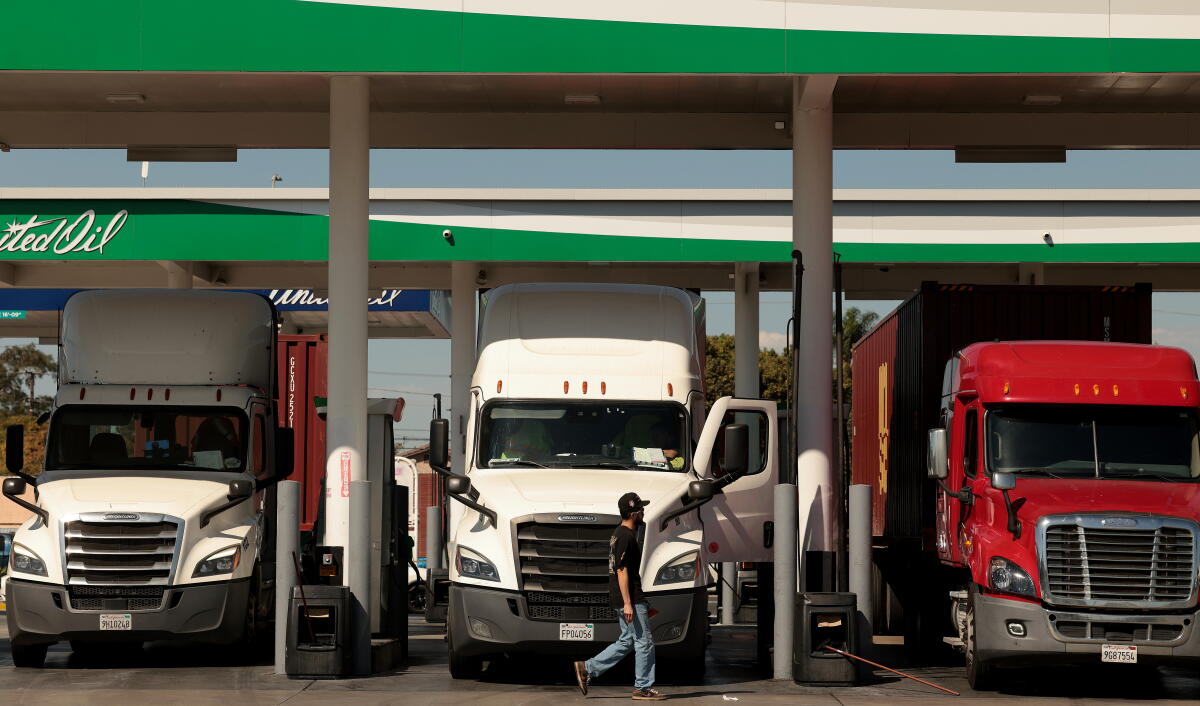
Truck drivers fill they diesel tanks at United Oil in Long Beach on Wednesday, Oct. 7, 2026.
(Christina House / Los Angeles Times)
One Southern California energy expert has spent recent days in Washington, D.C., trying to convince the administration that the solution lies in California, in the vast oil reserves under our cities and farms that we largely leave untapped for environmental reasons. Environment aside, it’s a long-running and compelling (to some, anyway) argument that may have found its moment, meaning California might become Trump’s next solution — or at least scapegoat — to a costly problem.
More on that, but first, a recap of where we are.
The red dye ploy
Three thousand years ago in Trump time, but which I mean earlier this month, the president signed an executive order that allowed truckers to use red dye diesel as a way to lower costs.
Red dye diesel is, you guessed it, my genius readers, diesel that has been dyed red — to differentiate it from the stuff at truck stops. Farmers and other agricultural types are allowed to buy red dye diesel without certain taxes to use in tractors and other equipment that doesn’t run on our roads.
The Trump order allows truckers to buy red dye and defer paying the roughly 25-cent-per-gallon federal tax on it. So it’s not really saving them money, just delaying payment.
“It’s a small step, but nonetheless, it’s a positive step,” said Michael Mische, a professor at the USC Marshall School of Business whose conservative-leaning take on energy policy has often raised the ire of the Newsom administration.

President Trump signs an executive order to lower the cost of diesel fuel during a campaign rally on Oct. 5, 2026, in Grand Island, Neb.
(Win McNamee / Getty Images)
But there’s a problem with Trump’s red dye plan. States have their own laws about red dye diesel, and the feds can’t change them. So even if truckers could find a place to buy red dye diesel (again, not sold at regular gas stations), and even if the incentive of paying taxes later made the search seem worthwhile, they would often be breaking state laws.
Eric Sauer, chief executive of the California Trucking Assn., a trade group that advocates for the industry, said his group has been advising members not to use the crimson fuel until it’s clear that states are going to change their rules. Some, like Missouri, have. California has not.
Either way, Sauer said, allowing truckers to use diesel dyed red really doesn’t increase the overall supply, just shifts it around — which is unlikely to bring prices down.
“It’s still the same supply of diesel fuel out there,” Sauer said.
Global supply
The global supply of crude oil, has been, shall we say, negatively affected by our war with Iran. Despite Trump’s assurances that the conflict is winding down, two container ships in the Strait of Hormuz were attacked this week, highlighting that perhaps Iran is unaware the war is over. Fears of that conflict and others sent energy prices soaring even higher.
Faced with that unpleasant reality, Trump this week also announced he was lifting sanctions on diesel exports from Russia, a move that shocked his own party and most of the world.

The PCK petroleum refinery stands illuminated at twilight on April 28, 2026, in Schwedt, Germany. The refinery, which produces gasoline, diesel, kerosene and bitumen, receives 20% of its oil from Kazakhstan through the Russian Druzhba pipeline.
(Sean Gallup / Getty Images)
That deal could bring 36 million barrels of Russian diesel, at most, to American shores, which sounds like a lot until you realize we use about 4 million barrels of the stuff every day. So Trump essentially sold out Ukraine and demolished what was left of our European standing for nine days of diesel — an amount unlikely to lower prices.
In California, that’s especially true because, as UC Berkeley professor Aaron Smith points out, about 70% of our diesel “is actually not made from crude oil and coming from oil refineries. It’s made from vegetable oils and animal fats.”
Yes, the Golden State relies heavily on so-called renewable diesel that, Smith says, “introduces, I think, another wrinkle” when trying to lower costs.
California’s fault
But let’s get back to Mische, the USC professor. For years, he’s been arguing that California’s refusal to pump more oil should be viewed as a national security concern.
California actually imports the majority of its crude oil, more than 60% from other countries, and our refineries for a number of debated reasons have been closing. Our imports have been growing in recent years. We also have no pipelines connecting us to the rest of the U.S., unlike many other states. That means we can’t easily get oil except what’s shipped in through our ports.
At the same time, the West Coast with its many military installations is undeniably pivotal to national security. Mische argues that without adequate fuel reserves for a shortage — like during a war — our military readiness could be jeopardized. He wants to see California not only pump more, but for the federal government to store more of that California crude.

A train of tank cars enters the Chevron EL Segundo refinery, one of the largest petroleum processing facilities in California, on April 8, 2026. California imports approximately 75% of its crude oil, with nearly one-third of the crude supplied from the Middle East. Prices at the pump in the state are averaging $5.93 per gallon today amid the war in Iran.
(Mario Tama / Getty Images)
These arguments haven’t gained much traction in our heavily Democratic state, which has moved forcefully away from fossil fuels and toward renewable sources in recent years and which has little interest in increasing drilling. But Mische and his colleagues may have found their moment.
Earlier this year, they wrote draft executive orders about California’s oil industry that he says the Trump administration is considering — one would attempt to force California to pump more oil using the authority of the Defense Production Act of 1950.
Trump has used that wartime act several times in the last few months, and Tuesday, Vice President JD Vance announced it would be used to expand production at a Texas oil refinery.
Mische said he spent last week in conversations with the administration on the proposed orders and is “confident” Trump will “issue additional executive orders under the Defense Production Act for California” by the end of the year.
Beyond the national security argument, such orders could please Trump because they do two things. First, if California pumps its own oil, it could free up some imported oil for other states, which could lower prices — though it would certainly take time and require more refinery capacity.
Second, and likely of more interest to the White House, it makes California — and Newsom — the villain for this sticky Republican problem. California will sue, of course, which would just help the Trump political narrative.
Kevin de León, a California Senate president emeritus and author of SB 100, California’s landmark 100% clean energy law, said he can easily envision Trump claiming that “we have lots of cheap oil in the United States that can lower your gas prices — but crazy lefty California is blocking us.”
Actually, it’s hard to imagine Trump not grabbing the chance to blame gas prices on the Golden State — or Newsom.
What else you should be reading:
The must-read: ‘Very few people out in the streets’: ICE surge rattles California’s Central Valley
The California angle: Justice Dept. demands California prove citizenship for lists of voters or withhold ballots
The L.A. Times Special: The U.S is in the death business. Newsom can change that, and win votes
Stay Golden,
Anita Chabria
—
Was this newsletter forwarded to you? Sign up here to get it in your inbox.