There are few greater muses than one’s own childhood. In recent months, this idea has taken visual form across fashion runways, with brands from Chanel to Acne Studios showcasing childlike sketches, often referred to as ‘naive design’. The aesthetic favors deliberate roughness and mistakes over a sterile, polished sheen.
Book covers are the latest medium to embrace the trend. Scribbles, doodles, crayon marks and stickers — evoking Lisa Frank and anime cartoons — have begun appearing on prominent Gen Z contemporary fiction covers. The more childish and unrefined, the better.
The covers, which often accompany literary fiction written by women, signal a particular emotional register of naive, sticky chaos that youth promises. The visual language recalls a simpler time — a reclamation of an innocence lost. For millennials and Gen Z readers who worship collectibles like Labubus, friendship bracelets and butterfly hair clips, it’s natural that art direction would follow suit — sometimes with an ironic twist. Often, the design’s playfulness obscures the protagonist’s malaise.
The book cover trend, imbued with nostalgia for childhood, promises fiction that grapples with the pangs of adulthood in an age of precarity. In her Substack, cultural critic and novelist Natasha Stagg commented on the trend, noting, “Reverse-image searching these images turn up books on early childhood education, dealing with anxiety or migraines, or teaching a kid to color outside the lines as an artistic parent.” The book trend cover suggests collective angst about adulthood, highlighted by a cultural fixation on “girlhood” that sparked a spate of online think pieces in recent years.
It’s fitting, then, that the aesthetic has been adopted by Gen Z fiction writers like Honor Levy, whose paperback edition of “My First Book” includes girlish heart stickers on a hot pink background. The Y2K aesthetic elicits a young girl’s diary. Meanwhile, the 2025 novel “Unfit” by Ariana Harwicz, about a mother losing her children in a custody battle, uses erratic crayon scribbles on its cover. In the fall, McSweeney’s Quarterly Concern was contained in a binder with a Lisa Frank-style aquatic wonderland on the cover. This month, Cazzie David released a book of essays about early adulthood titled “Delusions: Of Grandeur, of Romance, of Process” with a cover resembling a child’s birthday cake.
(New Directions Publishing, Penguin Books)
Writer and culture critic Drew Zeiba noted the trend in his June 2025 Substack post. “I wonder if it represents a fed-up-ness with prior or concurrent trends in book design,” writes Zeiba over email. “A move away from the layered, the blobby, the clean — to something with more illusion of or allusion to an id.”
“Not for nothing, I assume adult coloring books sell better than literary fiction,” says Zeiba. “I’m struck by that in a way the crayon or marker drawing is provisional — there’s no final form to it.”
This January, novelist and Forever Magazine co-founder Madeline Cash released her highly anticipated debut novel, “Lost Lambs.” The story follows a family unraveling amid open marriages, conspiracy and emotional turmoil. Designed by Na Song, the cover features drooping blue crayon text and a small illustration of a girl.
The cover was heavily influenced by Henry Darger’s Vivian Girls. “I was attached to this Henry Darger painting when I was writing the book. I felt like that was a really accurate visual representation of little girls running away from utter chaos,” says Cash.
“The childish scribbling handwriting is also a red herring for some of the more serious and sinister themes in the book, “ says Cash.
“Having read Cash’s, I’m struck by the fact that the children in the book — and children are central to the book — are really insightful and transformative, and ‘lost lambs’ actually refers in the text to a specific group of adults,” adds Zeiba.
A similar artistic logic underpins Sophie Kemp’s breakout 2025 novel, “Paradise Logic,” which gained attention for its unsettling cover. The book cover is an existing painting by Brooklyn-based artist Naruki Kukita, selected by veteran art director Martha Kennedy with Kemp’s input. Kennedy had come across “Virtual Temptation in Eden” in a weekly art newsletter called “It’s Nice That.” The image invokes a children’s coloring book with darker undertones, blending various cartoon and drawing styles to depict Adam and Eve in paradise. A cartoon snake lurks behind them.
The design mirrors the memorable prose. “This novel showcased one of the most original voices I’ve ever read. I would describe it as a psychosexual fever dream,” says Kennedy. “I recall the editor calling it ‘the first true Gen Z novel.’”
Kemp recalls sending a lengthy email about the book cover inspiration. “I want something super maximalist. I want it to be a preexisting image. And I wanted to do something that is shocking or crazy,” says Kemp. Kennedy presented Kukita’s painting, and it was love at first sight for Kemp.
(New Directions Publishing, Simon & Schuster)
“Kukita’s combination of finely crafted painterly portraiture and flat graphic anime (often in very intense sexual combination) seemed like a perfect match for the tone of this novel,” says Martha Kennedy, who served as the art director at Simon & Schuster.
Then, enter Comic Sans typeface — a perfect dash of irony. “Let’s use a typeface that feels kind of wrong,” Kemp recalls prescribing. “I used Comic Sans for the first time in my 35-year career for the rest of the type. I felt that was some sort of weird pinnacle in itself,” Kennedy explains over email.
Kemp sees a thematic alignment between her and Cash’s book designs. “Mine and Madeline’s books are about naive female characters,” Kemp says. “It makes a lot of sense with the protagonist of my novel, who’s an extremely naive young woman, for the book cover to match that tone that I created.”
While working in marketing, Cash recalls another book cover trend she calls “book blob.” The blob was earth-toned and splashed bestselling covers for years. “With any kind of viral aesthetic: one of those books did well, so they engineered every cover to emulate that, because people were drawn to them,” says Cash. “It looks like all the content was the same and ubiquitous. It is a disservice to a lot of those books.”
“I really wanted it to stand out,” says Cash about her own cover.
Connors is a writer living in Los Angeles. She hosts the literary reading event Unreliable Narrators at Nico’s Wines in Atwater Village every month.
One upon a time blokes couldn’t wait to cut the apron strings and jet off with their mates, but now mums are right up there as favourites among holiday companions
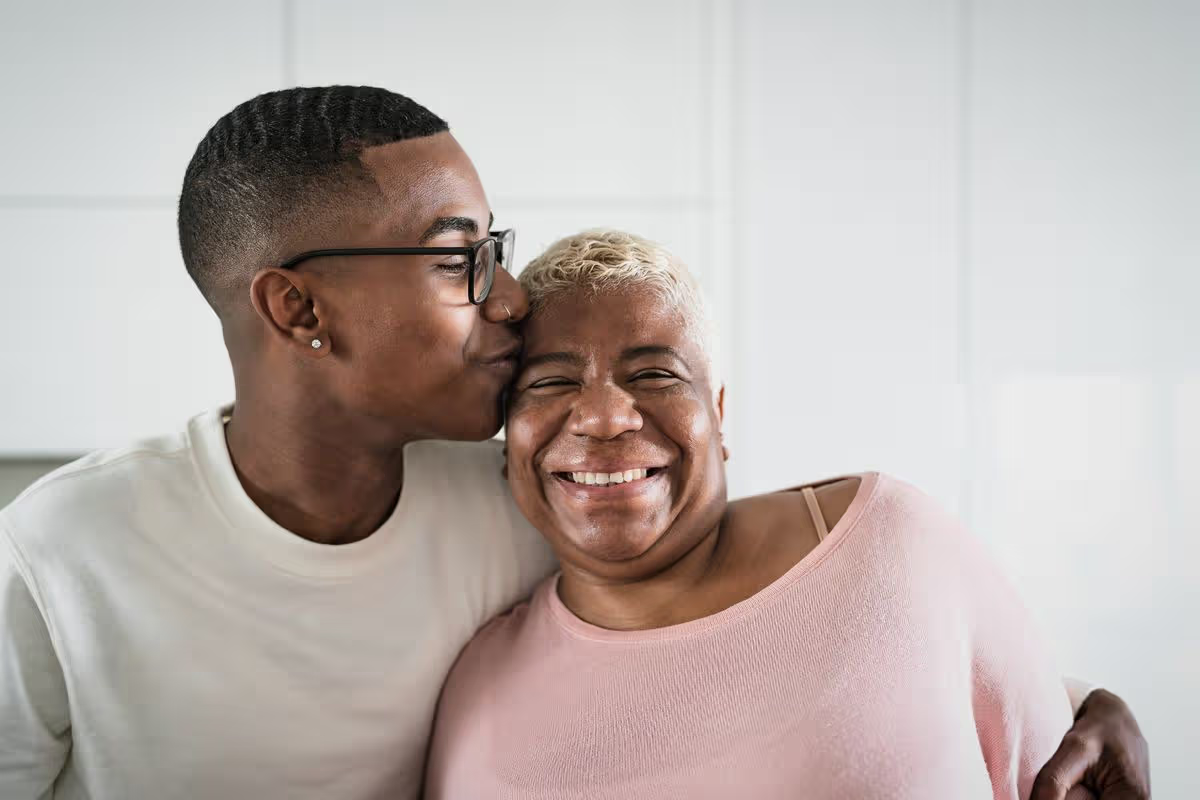
Mum’s the word when it comes to holiday’s nowadays(Image: Getty Images)
But Brits are increasingly swapping group getaways for time away with the person who took them on their first ever holiday: their mum. New research from Heathrow Express reveals that 30% of adults have been away with their mum, parent or carer in the last three years.
Meanwhile 16% are planning a holiday with their mum in the next year, fuelling the rise of bonding trips based on connection. The research shows a growing desire for spending quality time with the people you love – nearly 60% worry they’re not making enough time for their mum, parent or carer as they get older.
Those who do travel with parents believe there are real benefits, with 38% saying it’s a more relaxing experience than going away with friends. There are also long term advantages including creating lasting memories (37%) strengthening relationships (29%) and helping with reconnection (28%).
Aoife Considine, business lead at Heathrow Express, said: “Travel has a wonderful way of pressing pause on everyday life. When you’re away together, there’s space for conversations you don’t normally have and moments you don’t always make time for at home.
“For many adults, a trip with their mum or parent figure isn’t just another holiday – it’s a chance to reconnect, laugh about old stories and create new ones. Those are the kinds of memories people carry with them long after they’ve returned home.”
As families celebrate Mother’s Day, Heathrow Express is giving travellers 20% off from March 14 to 21 by using the discount code HEXMARCH.
Those jetting off over the Mother’s Day weekend itself can also get a complimentary dessert with any main course bought at Gordon Ramsay’s Plane Food Market at Heathrow Terminal 5.