Treasury

Treasury Secretary Scott Bessent moves to sanction bank in UAE for Iran ties

Aug. 28 (UPI) — Treasury Secretary Scott Bessent announced Friday that the United States is working to cut off bank branches in the United Arab Emirates from the U.S. financial system, part of his campaign to target financial systems that enable Iran.

The Department of the Treasury said it is proposing a rule that will ban U.S. banks from facilitating transactions involving the UAE-based branches of Banque Misr, one of Egypt’s largest banks.

“Iran’s enablers cannot continue to enjoy access to the U.S. dollar and the global financial system,” Bessent said in a statement. “Banque Misr UAE decided to find out the hard way, and today, we are taking the first step in holding it accountable for its continued, egregious support of the Iranian regime.”

Bessent on Monday announced a new pressure campaign called Operation Economic Outcast to force countries to sever ties with Iran.

The department accused Manque Misr’s operations in the UAE of being “a significant conduit for Iranian shadow banking.” It said the bank allows Iranian entities access to U.S. dollars, circumventing U.S. sanctions.

Treasury said it had found 103 potential front companies that moved $1.8 billion through Banque Misr UAE accounts from January 2024 to June 2026.

Bessent is invoking powers under the Patriot Act that allow the treasury secretary to take action against foreign banks that are a “primary money-laundering concern” to the U.S.

It also said the Treasury will sanction the general manager of the Dubai branch of Bank Melli and a Hong Kong-based company it alleges is laundering money for Iran.

Earlier this month the UAE said it was suspending all trade with Iran.

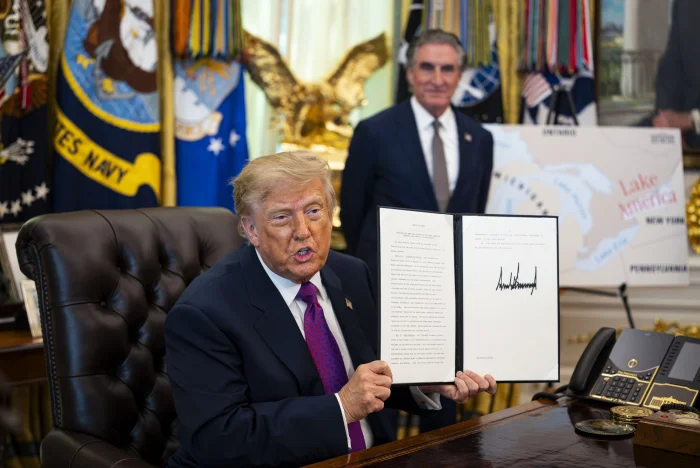
President Donald Trump signs an executive order to rename Lake Ontario as Lake America in the Oval Office of the White House on Thursday. Photo by Al Drago/UPI | License Photo

Source link

US Treasury Department Issues Sanctions Waivers for Venezuela Telecom Services, Contracts

CANTV’s recent cooperation with Chinese counterparts is threatened by US sanctions. (Con-Cafe)

Mérida, August 24, 2026 (venezuelanalysis.com) –The US Treasury Department’s Office of Foreign Assets Control (OFAC) issued two general licenses granting specific permissions for telecommunications operations with Venezuela.

Under General License 61 (GL61), published on Friday, OFAC authorized US companies to provide “technology, software, or services for the installation, maintenance, refurbishment, repair, upgrade, operation, or support of telecommunications” to Venezuela’s state-owned telecommunications company CANTV and National Telecommunications Commission CONATEL.

According to official OFAC definitions, telecommunications services encompass fixed and mobile telephony, data transmission, internet connectivity, radio and television broadcasting, news agency feeds, satellite communications, and submarine cables.

GL61 permits specific operational activities, including payment processing, logistics, air freight, insurance, data storage, server maintenance, roaming agreements, and infrastructure leasing. However, the license specifies that Venezuelan state entities must procure new acquisitions directly from US companies or US citizens.

In addition, the Trump administration published General License 62 (GL62), authorizing negotiations for contracts in Venezuela’s telecommunications sector, though specific agreements remain contingent on a separate specific license,

Both sanctions waivers impose that any contracts be governed by the laws of a state or federal jurisdiction within the United States. Furthermore, the licenses demand that “dispute resolution proceedings relating to the contract occur in the United States, the United Kingdom, France, or Singapore.”

The Treasury licenses maintain bans on debt swaps, physical gold, or digital currencies and tokens issued by or on behalf of the Venezuelan government.

Furthermore, GL61 and GL62 maintain restrictions prohibiting “any transaction involving a person located in the Russian Federation, the Islamic Republic of Iran, the Democratic People’s Republic of Korea, the Republic of Cuba, the People’s Republic of China, or any entity that is owned or controlled by or in a joint venture with such persons”.

Since the January 3 US military strikes and kidnapping of Venezuelan President Nicolás Maduro, Washington has upheld its wide-reaching coercive economic sanctions in areas such as energy and mining,  while issuing licenses to favor US and Western corporations.

US sanctions and restrictions on Chinese technology firms present a challenge to CANTV’s recent operational landscape. For the past two decades, the Venezuelan government has forged bilateral agreements with Chinese telecom firms, including ZTE and Huawei, establishing joint projects to manufacture and deploy telecommunications equipment domestically. 

Over the last decade, CANTV has worked with Huawei and ZTE to modernize networks, expand fiber-optic infrastructure, and sustain broadband services nationwide. Venezuelan authorities have not commented on the latest US licenses and potential impact on existing agreements.

In addition, CANTV has been identified by analysts as a potential candidate for privatization. The company has recently been mired in controversy after reportedly slashing retired workers’ incomes. Retirees have staged protests in several states in recent days after a US $200 monthly bonus was arbitrarily slashed, while also demanding the restoration of basic medical insurance and health coverage guaranteed by collective bargaining agreements.

In parallel, CONATEL has launched technical and legal working sessions with representatives of SpaceX’s Starlink service to examine radio spectrum allocation, equipment homologation, and regulatory compliance under Venezuela’s Organic Telecommunications Law.

Despite Maduro previously criticizing SpaceX owner Elon Musk for destabilizing politics in Venezuela and Latin America, the acting Delcy Rodríguez government thanked the tech mogul for activating free Starlink services in the wake of the June 24 double earthquake in the Caribbean nation.

Edited by Ricardo Vaz in Caracas.

Source link

Best Treasury and Cash Management Providers 2026

Strategic liquidity and the latest technology are fueling digital transformation.

Modern treasury management is undergoing a profound digital transformation. As corporate finance teams navigate increasing geopolitical complexity, volatility, and the need for instantaneous decision-making, the role of their banking and technology partners has shifted. No longer just providers of standard transaction services, these institutions are becoming architects of sophisticated, data-driven ecosystems that prioritize real-time visibility, automated governance, and seamless liquidity orchestration. The global winners of Global Finance’s Best Treasury & Cash Management Providers 2026 awards demonstrate a clear commitment to this new paradigm, offering tools that do more than just process payments; they empower treasurers to treat liquidity as a strategic, actively managed asset.


Global Finance editors select the winners of the Best Treasury & Cash Management Awards with input from industry analysts, corporate executives, and technology experts. The editors also use entries submitted by financial services providers, as well as independent research, to evaluate a series of objective and subjective factors. It is not necessary to enter to win, but experience shows that the additional information supplied in an entry can increase the chances of success. In many cases, entrants can present details and insights that may not be readily available to the editors of Global Finance.

This year’s ratings are based on the period from January 1, 2025, to December 31, 2025.

Global Finance uses a proprietary algorithm with criteria—including knowledge of local conditions and corporate customer needs, quality of product and service offerings, financial strength and safety, market standing, compliance, and excellent customer service—weighted for relative importance. The algorithm incorporates multiple ratings into a single numerical score, with 100 equivalent to perfection. In cases where more than one institution earns the same score, we favor local providers over global institutions and privately owned banks over government-owned ones.

The winners are those financial services providers that best meet the specialized needs of corporations engaged in global business. These top-notch financial institutions are not always the biggest, but rather the best—those with qualities that companies should look for when choosing a provider.


Treasury, Cash Management, Awards
Best Treasury and Cash Management Providers 2026 | Global Winners
Treasury and Cash Management, Systems & services
Best Treasury and Cash Management Providers 2026 | Systems and Services
Treasury Management, Cash Management, Africa
Africa
Cash Management, Treasury Management, Asia-Pacific
Asia-Pacific
Treasury Management, Cash Management, CEE
Central and Eastern Europe
Cash Management, Treasury Management, Latin America
Latin America
Treasury, Cash, Middle East
Middle East
Treasury, Cash Management, North America, 2026
North America
Western Europe, TCM, Treasury and Cash Management, AI automation
Western Europe
Rajendra Prasad, Al Mulla Group’s head of group treasury
Rajendra Prasad, Al Mulla Group: From Manual to Modern
Mark Johnson, vice president of Global Product at Ripple Treasury
Mark Johnson, Ripple: Digital Assets and the Future of Treasury

Source link

Best Treasury and Cash Management Banks 2026 | Africa

Growing regulatory and data demands spur improved performance.

Financial institutions are fast-tracking the rollout of digital treasury tools as African markets grapple with growing regulatory hurdles and a need for instantaneous data. The winners of our Best Treasury & Cash Management Providers awards for Africa are at the forefront of this transition, showcasing advancements in liquidity planning, cross-border transactions, and cash management that are strengthening corporate treasuries throughout the region.

table visualization

Best Bank for Transaction Banking

Best Bank for Financial Institutions

Best Corporate Cross-Border Payments Solution

“Our objective is simple: The bank should enable treasury decisions, not delay them,” states Melanie Kingwill, head of Client Solutions at Standard Bank. Addressing increasing multi-country and regulatory complexity, the bank empowers treasurers through self-service tools. Kingwill explains that by shifting administration to clients, “we improve agility, strengthen governance, and reduce operational risk. More importantly, we free treasury professionals to focus on what matters most: liquidity, risk management, and supporting the strategic growth of their organizations.”

Thabo Makoko, Standard Bank’s head of Transaction Banking, emphasizes that digital investment paired with regional expertise creates a future-ready bank. He adds that the bank’s local insight helps clients navigate currency regimes and regulatory requirements across Africa.


Best Bank for Cash Management

Best Bank for Payments

Ecobank saw significant 2025 growth. Omni Plus transaction values were up 24% and RapidCollect reached $10 billion, driven by investments in digital platforms and enterprise resource planning (ERP) integration that minimize manual friction. “Corporates operating in Africa are rethinking how they execute treasury across the continent. Historically, managing payments, collections, and cash positions across multiple African markets required significant manual effort, fragmented banking relationships, and disconnected operating processes. That model is now being displaced rapidly as clients consolidate their day-to-day treasury activity onto integrated digital platforms that deliver greater speed, visibility, and control,” explains Isaac Kamuta, Ecobank’s group head of Payments, Cash Management, and Client Access.


Best Bank for Long-Term Liquidity Management

RMB helps treasurers manage complex environments by balancing short-term liquidity with long-term growth through global liquidity-management tools like cash pooling, virtual accounts, and interoperable digital platforms for ERP integration. By providing digital cash-management tools like Balance View for consolidated visibility across jurisdictions, RMB enables precise management that allows treasurers to reduce interest costs and optimize yields throughout the cash flow cycle.


Best Bank for Collections

CIB dominates Egypt’s receivables segment with a 99.85% 0market share, processing over 650 million transactions from the fourth quarter of 2024 to the fourth quarter of 2025. The bank pioneered Egypt’s online ACH Direct Debit service, achieving top transaction volume, and CIB provides real-time cash concentration through more than 1,000 deposit-enabled ATMs, offering hourly reconciliation data for sector-specific forecasting. By leveraging partnerships like Fawry’s network for kiosk payments, and by deploying bespoke solutions like the Post-Dated Cheque module and petroleum-specific cash-collection tools, CIB maintains a robust, technology-driven omnichannel strategy.


Best Provider of Short-Term

Investments/Money Market Funds

With average weekly trading volumes of EGP 8 billion-EGP 10 billion (about $160 million to $200 million) and assets under management reaching EGP 55 billion, Beltone Asset Management is built for the new African economy. By focusing on small and midsize enterprises for financing and microfinance through its diversified ecosystem, Beltone serves as a prime representative of the current investment evolution. 

Source link

US debt tops $40 trillion as Treasury doubles bond buybacks to calm markets

Published on

The US national debt now stands at a record $40 trillion (€34.4tn), while the Treasury has responded to the bond market pressure by pledging to buy back far more of its own older securities.


ADVERTISEMENT


ADVERTISEMENT

Washington’s two announcements landed on the same day and represent two symptoms of the same underlying strain: a government borrowing at a record pace just as buyers of its longest-dated debt are demanding higher returns to keep lending.

Buybacks work like a targeted repurchase. Rather than printing new money, the US Treasury uses cash it already has to repurchase older, harder-to-trade bonds from investors, improving liquidity without changing the total stock of debt.

From 9 September, the maximum size of each buyback operation in the 10-to-20-year and 20-to-30-year markets will at least double, from $2 billion (€1.7bn) to $4 billion (€3.4bn), running through the next quarterly refunding on 4 November.

The US Treasury said the change reflects “strong sponsorship from market participants” in that part of the curve, but the timing of the decision was no accident.

The 30-year yield had climbed on Tuesday to its highest level since 2007 amid what analysts called a buyers’ strike stretching back to late June, aggravated by a swelling supply of corporate debt tied to AI data centre spending.

Yields duly fell after Wednesday’s announcement, with the 30-year dropping roughly 9 basis points and the 10-year around 6, and Wall Street rallied.

Asked whether Americans should worry about the volatility, US President Donald Trump simply said: “No, I don’t think so.”

However, not everyone is convinced the fix goes deep enough.

The size of the increase is modest next to the $32 trillion (€27.5tn) Treasury market it is meant to steady, and notable economist Mohamed El-Erian suggested the outsized market reaction reflected hopes of broader intervention to come rather than the direct effect of the buybacks themselves.

Thomas Simons, chief US economist at Jefferies, said the announcement broke with Treasury’s usual pattern of steady, well-flagged communication about its borrowing plans and felt “shot from the hip”.

How the US national debt reached $40 trillion

The debt figure, confirmed by US Treasury data covering Tuesday, splits into $32.27 trillion (€27.75tn) held by the public and $7.78 trillion (€6.69tn) owed between government accounts.

It arrived roughly two fiscal years earlier than expected as the US Congressional Budget Office projected in May 2023 that the threshold would not be crossed until 2028, and it came remarkably fast even by recent standards: $39 trillion (€33.5tn) was reached only in March, $38 trillion (€32.6tn) the previous October.

The US government borrowed $1.8 trillion (€1.5tn) in the first ten months of this fiscal year alone, already more than it borrowed in the whole of the last one, as spending on Social Security, Medicare, defence and interest payments continues to outrun revenue.

“The national debt is not just a number on the government’s balance sheet,” said David Young, president of the Conference Board’s CEO Center, noting it shapes the financial decisions Americans make daily.

The two stories feed each other.

A bigger debt load makes investors warier about lending long-term, which pushes yields higher. In turn, higher yields then raise the government’s own interest bill, adding further to the debt the US Treasury has to finance next.

Wednesday’s buyback expansion may ease the immediate pressure, but it does nothing to slow the borrowing driving it.

Source link

Oil rises as markets rebound on US Treasury debt buyback plan

Published on

Oil prices rose on Thursday, holding near their highest levels in weeks, as the deadlocked standoff between the United States and Iran kept supply concerns elevated in the Middle East.


ADVERTISEMENT


ADVERTISEMENT

Brent crude, the international benchmark, rose 0.3% to $91.90 a barrel, while US benchmark crude edged up 0.2% to $84.57 a barrel.

Prices have climbed steadily since the start of August, when Brent was trading at around $87.38 a barrel, as the standoff over the Strait of Hormuz keeps supply concerns elevated even without any single new escalation.

Both benchmarks remain well above the barrel prices they were trading at before the war began.

Markets rebound on Treasury move

Global shares rallied on Thursday, reversing course after Wednesday’s heavy sell-off in artificial intelligence-related stocks, after the US Treasury Department said it would at least double the size of its buyback operations for longer-dated government debt, to $4 billion (€3.4bn) or more per operation, starting in September.

The move eased pressure on bond markets that had pushed yields to multi-decade highs in recent months, and lifted risk appetite across Asia.

South Korea’s Kospi surged 6.1% to 6,858.91, rebounding sharply after sinking 5.8% on Wednesday. Samsung Electronics jumped 9.7%, while SK Hynix surged 14.1% after the memory chipmaker announced a share buyback plan.

Japan’s Nikkei 225 added roughly 0.9%, while the Topix rose 0.8%, recovering some of Wednesday’s losses. Hong Kong’s Hang Seng gained 1.1% to 25,786.32, and the Shanghai Composite rose 0.3% to 3,905.23. Australia’s S&P/ASX 200 was up 0.3% to 9,066.40.

Bond yields ease from multi-decade highs

The yield on the 10-year US Treasury fell to around 4.64%, from 4.71% on Tuesday, while the 30-year yield dropped to 5.18% from 5.28% — pulling back from its highest level since 2007.

Yields have climbed in recent months on concerns over inflation stemming from the war in Iran and rising government debt.

Japan’s 10-year government bond yield, which had been trading near a three-decade high, fell to around 2.83% from more than 2.89% on Wednesday.

On Wall Street on Wednesday, the S&P 500 climbed 0.2% for its first gain in four sessions, snapping a three-day losing streak. The Dow Jones Industrial Average and the Nasdaq composite each added 0.2%.

The US dollar rose to 158.60 yen from 158.16, while the euro slipped slightly to $1.1676 from $1.1677.

Additional sources • AP

Source link

Treasury to double bond buybacks this fall

Aug. 19 (UPI) — The U.S. Treasury Department announced Wednesday that it will buy back about twice the usual amount of its bonds in a move to prevent rising interest rates on mortgages and consumer loans.

The department, which is led by Secretary Scott Bessent, said it will target the 10- to 20-year and 20- to 30-year portion of the market. Those bonds have faced a buyers’ strike since late June, CNBC reported.

Treasury said it will at least double the maximum size of its usual buyback, from $2 billion to “at least” $4 billion, an announcement from the department said. The buyback operation will be from Sept. 9 through Nov. 4.

The yields on longer-term debt have been at their highest levels since 2007, pushed up by war with Iran and other concerns, such as growing competition for financing with borrowers and growing federal deficits, Politico reported.

After the announcement, yields plummeted, while stock market futures spiked, CNBC reported.

The 10-year note dropped 6 basis points to 4.647% and the 30-year bond plunged 9 basis points to 5.196%. A basis point equals 0.01%. Yields and prices move in opposite directions.

It’s the latest move by Bessent to affect treasury yields.

The department conducted a joint operation with Japan to boost the yen, which was trading at its weakest against the dollar in about 40 years. He had warned in January that Japanese government bonds were causing issues in the U.S. treasury market.

The department also recently alluded to possibly issuing less longer-term debt in the future, Politico reported.

“This increase in buyback operation sizes reflects Treasury’s desire to provide greater liquidity support in longer-dated nominal sectors where there is consistent strong sponsorship from market participants, as evidenced by the significant volume of high-quality offers Treasury routinely receives in longer-dated buyback operations,” the department’s press release said.

The move “can help crowd in potential buyers tempted by the prior run-up in yields and force some near-term short-covering, while discouraging investors from going max short in the future for fear of being ambushed again,” Krishna Guha, head of global policy and central bank strategy at Evercore ISI, said in a client note, CNBC reported.

“But the operation changes almost nothing in terms of the fundamentals, in particular the unchanged need to finance the tidal wave of hyperscaler debt in addition to very large government deficits,” Guha added.

It could actually end up making the Federal Reserve‘s job of getting inflation back to 2% more difficult, said RSM Chief Economist Joe Brusuelas.

The buyback could artificially suppress yields and make controlling inflation more challenging.

“Bessent is a political actor. His interest is purely short-term and is organized around the upcoming election and not a return to price stability,” Brusuelas wrote.

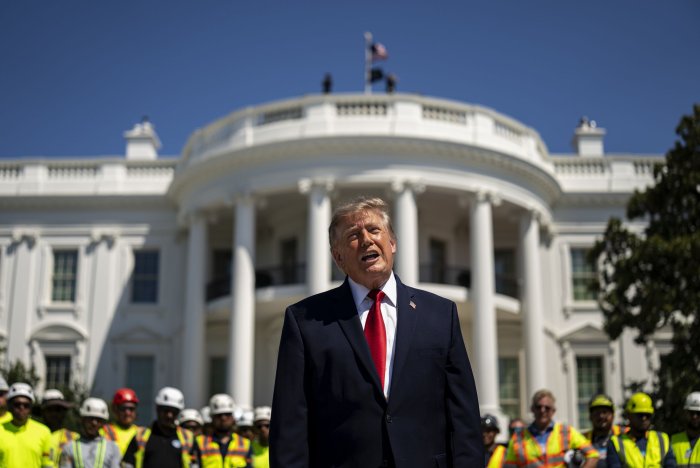
President Donald Trump speaks to the press as he tours a new helipad on the South Lawn of the White House on Wednesday. Photo by Al Drago/UPI | License Photo

Source link

Woman accused of plotting to kill Treasury Secretary Scott Bessent is sentenced to 6 years in prison

A Massachusetts woman who told police that she brought homemade firebombs to the U.S. Capitol to kill Treasury Secretary Scott Bessent was sentenced on Tuesday to just over six years in prison.

Riley English, a 26-year-old transgender woman, said she was in the grips of a mental health crisis and abusing drugs when she drove to Washington in January 2025 and told Capitol police that she was there to kill Bessent on the day of his Senate confirmation.

“I never wanted to hurt anyone,” she told U.S. District Judge Rudolph Contreras. “I’m not a political person. I’m not a violent person.”

Contreras, who was nominated to the bench by Democratic President Barack Obama, sentenced English to six years and one month of imprisonment followed by three years of supervised release. English has remained jailed since her arrest and will get credit for the nearly 20 months that she already has spent in custody. She pleaded guilty in March to two weapons charges.

“You’ve had a very difficult life,” Contreras told English. “Hopefully, the progress you’ve made in jail to this date has set you on the right path.”

Nobody was injured, and Contreras said her plan to harm Bessent had an “exceedingly low or non-existent” chance of success. Bessent wasn’t at the Capitol when English arrived on Jan. 27, 2025. The Molotov cocktails that English brought to the Capitol appeared to be incapable of igniting, the judge noted.

Prosecutors had recommended a prison sentence of 10 years and one month for English. Assistant U.S. Attorney Brendan Horan said English had been planning the “attempted political assassination” for at least a month at a time when the threat of politically motivated violence has been mounting in the U.S.

“This was not a chance encounter or an impulsive act,” Horan said.

The case against English fits a pattern of politically motivated violence that has plagued the U.S. over the past decade. In a letter addressed to the judge, Bessent said he worries the country “cannot survive this assault.”

“Political violence is an attack on the rule of law and on representative government itself,” Bessent wrote. “It also deprives our country of service by talented men and women with ability and integrity who may reasonably decide that no job is worth threats to themselves and their families.”

English’s prosecution drew comparisons to the case against California resident Sophie Roske, who was sentenced last October to over eight years in prison for attempting to assassinate U.S. Supreme Court Justice Brett Kavanaugh at his Maryland home. Prosecutors had recommended a prison sentence of no less than 30 years for Roske, a transgender woman. They appealed Roske’s sentence by U.S. District Judge Deborah Boardman, calling it unreasonably lenient.

Defense attorney Maria Jacob said English was “terrified and traumatized” by fears of what would happen to transgender people under the second Trump administration.

“Our argument is that she was in a diminished mental state,” Jacob said.

Investigators said they found a folding knife, two homemade firebombs and a lighter in English’s possession at the Capitol.

English, of South Deerfield, Massachusetts, told police that she was influenced by Luigi Mangione, the man who was charged with fatally shooting the CEO of UnitedHealthcare. She said she was “on a mission” and “had been thinking about this for a while because of Luigi Mangione,” prosecutors said. English told officers that she was terminally ill and “wanted to do something before I go,” according to prosecutors.

English also said she traveled from Massachusetts to Washington intending to kill other Republican political figures — Defense Secretary Pete Hegseth and House Speaker Mike Johnson — and to burn down the Heritage Foundation, a conservative think tank, according to police. English changed her target to Bessent after reading an internet post about his confirmation hearing, police said.

Jacob said English’s actions last year were “a cry for help.”

“There was no indication that she was acting rationally that day,” the judge said.

Kunzelman writes for the Associated Press.

Source link

Best Treasury and Cash Management Banks 2026 | Middle East

Cloud-native platforms, AI-driven automation, and robust cross-border payment ecosystems are among the innovations transforming the region.

As financial architectures across the Middle East evolve, leading institutions are transforming transaction banking through digital innovation. By integrating AI-driven automation, strong cross-border payment ecosystems, and cloud-native platforms, these banks are enabling corporate treasurers to streamline operations, optimize liquidity, and transition from reactive functionaries to strategic value drivers in an increasingly complex global market.

table visualization

Best Bank for Transaction Banking

Best Bank for Payments

Best Bank for Collections

FABeAccess is a cloud-native, multi-channel hub that uses API banking to embed services into client systems. Through its treasury management services, FAB provides turnkey infrastructure, while its FABePay and eDDS tools automate receivables. FAB’s banking-as-a-service (BaaS) model offers white-labeled solutions for smaller institutions. By integrating blockchain, AI, and data analytics, FAB delivers a secure, high-performance environment with digital tools such as the Sofi AI chatbot and Haifin-UAE Trade Connect for trade finance. Real-time transfers, automated clearing, and dynamic compliance monitoring drive efficiency. The platform’s open banking architecture enables seamless integration, while FABeSCF and DTSCF, its supply chain finance portals, optimize working capital. “As a premier global institution, FAB connects the GCC with European, Asian, and African markets, enabling clients to optimize working capital and maintain a truly integrated global treasury center,” a FAB spokesperson says.


Best Bank for Financial Institutions

KFH maintains one of the largest lending and placement portfolios among Kuwaiti financial institutions, underpinned by a self-funded model that ensures balance-sheet stability. The bank operates at the intersection of Islamic finance and global correspondent banking, providing expert services to both Islamic and conventional clients. Through a network of about 145 global partners, KFH supports efficient multicurrency clearing and trade settlement across the GCC, MENA, Europe, Asia, and the Americas. Additionally, it is at the forefront of digital payment compliance and connectivity. The bank implemented the Central Bank of Kuwait’s Purpose of Payment requirements early and is actively expanding initiatives to enable faster crossborder payments in corridors such as Egypt and India.


Best Bank for Cash Management

Best Bank for Long-Term Liquidity Management

Best Corporate Cross-Border Payments Solutions

ABC X, Bank ABC’s unified digital transaction banking platform, “has fundamentally transformed the experience of corporate treasurers,” says Karim Labadi, group head of transaction banking at the Bahrain-headquartered institution. “Historically, treasurers often navigated multiple systems for payments, collections, liquidity management, trade finance, and reporting, resulting in fragmented workflows, duplicated data entry, and increased operational risk.” With a single-window platform supported by single sign-on, ABC X provides treasurers with a consolidated view of cash positions, trade transactions, payment status, and liquidity across entities, geographies, and currencies. “This significantly improves visibility, control, and decisionmaking,” says Labadi, who sees a shift across MENA and Turkey toward a “continuous treasury” model.


Best Provider of Short-Term

Investments/Money Market Funds

Launched in 2004, Banque Misr’s Yom B Yom (everyday) EGP Money Market Fund has become Egypt’s premier shortterm investment vehicle, commanding a 22% market share and holding EGP 36.5 billion (about $730 million) in assets as of March. The fund uses sophisticated digital infrastructure to maintain precise daily net asset values, employing automated, real-time synchronization and error-correction protocols. Underpinned by strong performance, the fund posted a 12-month annualized return of 21% through March, significantly outpacing industry benchmarks and driving a 34% increase in assets under management in 2025. 

Source link

Best Treasury and Cash Management Banks 2026 | North America

The latest technology is helping North America’s top banks set the standard for treasury and cash management performance.

As treasury markets evolve, leading financial institutions are reshaping how corporate clients manage liquidity and payments. From integrating programmable digital ledgers and AI-enhanced receivables processing to developing sophisticated cross-border payment ecosystems, banks are providing treasurers unprecedented visibility, automation, and control. Through strategic advancements and core competencies, leading North American banks are setting the standard for treasury and cash management performance.

table visualization

Best Bank for Transaction Banking

Moving commercial bank funds onto a programmable digital ledger could make intraday liquidity management more responsive, transparent, and precise for corporate clients, says Derek Vernon, head of North American Treasury and Payment Solutions at BMO. “The idea is that liquidity and payment instructions become more connected and automated,” he says, “giving clients the ability to move and manage liquidity as their obligations arise.” This allows them to operate in line with business needs, unconstrained by traditional business hours and settlement windows. “For BMO, building out our tokenization capabilities is an opportunity to continue evolving and modernizing our treasury and cash management services for clients in a world where markets are becoming more always-on, continuous, and data-driven.”


Best Bank for Cash Management

Best Bank for Collections

By unifying collections, reporting, and reconciliation support, Wells Fargo enables clients to optimize working capital performance while strengthening governance and controls. “As treasurers face growing pressure to improve liquidity, working capital, and cash visibility,” says Ather Williams III, head of Global Payments & Liquidity and Wholesale Digital, “we’re focused on leveraging AI and machine learning in practical ways that simplify complex workflows and deliver measurable value for clients. Through integrated receivables, Wells Fargo uses AI and machine learning to capture and reassociate payment and remittance data, match payments to invoices, and automate cash application, helping clients accelerate the payment-to-posting cycle.”


Best Bank for Financial Institutions

Best Bank for Payments

Best Provider of Short-Term

Investments/Money Market Funds

As clients modernize their payments infrastructure, many want access to new capabilities without having to replace existing systems, notes Isabel Schmidt, executive platform owner at BNY’s Payments Enablement Platform. “BNY’s shared infrastructure model, built on a modern technology stack and enabled through open APIs, helps make that transition easier by allowing clients to connect to real-time payment rails while continuing to leverage their legacy environments,” she says. Because BNY’s platform is designed to integrate flexibly across a range of legacy and emerging payment infrastructures, clients can adopt innovation in a more modular way.


Best Bank for Long-Term Liquidity Management

Bank of America’s CashPro Forecasting transforms manual treasury tasks into faster, more collaborative processes. The tool features long-term liquidity dashboards that allow treasurers to monitor yields, credit-rating concentrations, and ESG-aligned investment compliance across global subsidiaries via a single interface. For long-term surplus cash that requires customized mandate restrictions, such as investing strictly in short-term U.S. Treasuries, high-grade commercial paper, or specific corporate bonds, BofA Securities structures premium separately managed accounts tailored to the corporate client’s board-approved investment policy statements.


Best Corporate Cross-Border Payments Solutions

With clearing systems in more than 90 countries, Citi minimizes reliance on correspondent bank chains. When executing crossborder payments, the bank routes transactions through its local branch network to mitigate third-party risk.

Source link

Best Treasury and Cash Management Banks 2026 | Western Europe

Unified digital interfaces and sophisticated cross-border architectures are making silos a thing of the past.

European financial institutions are changing to meet corporate demands for AI-driven automation and real-time liquidity management. By deploying unified digital interfaces and sophisticated cross-border architectures, banks are dismantling silos to provide treasurers with centralized, insight-led control hubs. Today’s Western European leaders are driving this transformation through streamlined, resilient, client-centric operations.

table visualization

Best Bank for Transaction Banking

Best Bank for Cash Management

Best Bank for Financial Institutions

SG Markets, Societe Generale’s suite of electronic market, financing, and cash management services, is the bank’s answer to the growing corporate demand for a central control tower to manage transaction banking. “We have seen the emergence in recent years of a clear expectation among corporate treasurers for a true ‘cockpit’ that enables them to steer all their transaction banking activities from a single place,” says Benoite Armand-Pieyre, global head of payments and cash management at Societe Generale. SG Markets eliminates silos between cash management, trade, and foreign exchange.


Best Bank for Long-Term Liquidity Management

As the eurozone’s largest banking group, BNP Paribas is a primary anchor for multientity, long-term liquidity concentration across Europe. The bank provides sophisticated, multijurisdictional liquidity architectures and specializes in implementing complex corporate in-house banking models and multicurrency notional pooling platforms. BNP Paribas excels at enabling multinational corporations to structurally aggregate cash within Western Europe’s fragmented regulatory landscape without physical fund transfers, thereby reducing cross-border friction and intercompany tax liabilities.


Best Bank for Payments

Best Bank for Collections

Cash forecasting is the most logical use case for AI and hyper-automation in corporate treasury, argues Annelinda Koldewe, global head, payments and cash management at ING. “Applying these technologies,” she says, “treasurers and treasury processes could move from statistical forecasts toward more continuous, dynamic forecasts based on incoming transactions, market signals, and behavioral patterns.”


Best Corporate Cross-Border Payments Solutions

HSBC Global Payments Solutions (GPS) enables CFOs to manage multicurrency cash flows across Asia, the Americas, and Europe as a single, connected liquidity position on a single, globally consistent platform. According to Ouannessa Aissaoui, head of GPS for HSBC Continental Europe, “Our platform provides real-time visibility into balances and intraday movements across entities and markets, supports cross-border and multicurrency payments with standardized approval workflows—entitlements, controls, and audit trails—and provides tools to centralize cash globally to reduce fragmentation and trapped balances.”


Best Provider of Short-Term

Investments/Money Market Funds

Paris-based Amundi is Europe’s largest native asset manager and a top brand for fund selectors in core continental European markets such as France and Italy, offering a domestic alternative to the U.S. giants. Amundi’s large independent internal credit risk team operates separately from its portfolio managers. The unit conducts thorough baseline assessments of European commercial paper, bank certificates of deposit, and sovereign bills before any capital is deployed. 

Source link

Treasury Department repeals reporting rule for businesses

U.S. Secretary of the Treasury Scott Bessent (R) is shown with Secretary of State Marco Rubio during a meeting in July in the Oval Office of the White House in Washington, D.C. The Treasury Department has repealed a business reported rule that was connected to the Corporate Transparency Act. Photo by Graeme Sloan/UPI | License Photo

Aug. 12 (UPI) — The U.S. Treasury Department has officially repealed a rule that required U.S. companies and individuals to report “beneficial ownership information” to the department.

The Financial Crimes Enforcement Network bureau of the Treasury Department — which is meant to safeguard the U.S. financial system from illegal activity, work against money laundering and terrorism financing and help with national security — issued a final rule Tuesday that permanently removes the requirement. The reporting rule existed in connection with the Corporate Transparency Act.

The network, called FinCEN, also announced that it would delete all previously reported information from its databases.

Treasury Secretary Scott Bessent called it “a victory for common sense” and said that it eliminates a “burdensome reporting requirement.” An interim final rule has been in place since March 2025.

This final rule also exempts U.S. citizens with FinCEN identification from having to update or correct their information and eliminates a requirement for foreign businesses to report U.S. citizens who helped them register to do business in the United States.

As defined by FinCEN, a beneficial owner is one who directly or indirectly owns at least 25% of a company or exercises substantial interest over the company.

Sen. Elizabeth Warren, D-Mass., issued a statement Tuesday saying the repeal guts the Corporate Transparency Act and is a “gift to cartels, criminals and U.S. adversaries that exploit shell companies to move millions through our financial system.”

“The Trump administration has dismissed law enforcement warnings, ignored the role that shell companies play in crimes ranging from drug trafficking to fraud to sanctions evasion and gutted a statue that Secretary Rubio once championed as ‘the most significant anti-corruption and money-laundering law in decades,” Warren said.

Secretary of State Marco Rubio posted that statement about the act on social media in December 2020.

Congress passed the Corporate Transparency Act in 2021. The reporting requirement went into effect in 2024.

Members of the National Guard patrol near the Washington Monument on Tuesday. Photo by Bonnie Cash/UPI | License Photo

Source link

Treasury Survey: Turbulence Becomes Business as Usual

Treasury teams are adapting to ongoing market volatility by treating uncertainty as the norm.

This article appears in the July/August issue of Global Finance Magazine.

Treasury teams now navigate sustained market volatility by treating uncertainty as a core factor in everyday
decision-making, rather than an exception. That’s among the central findings of the latest Herbert Smith Freehills Kramer Corporate Treasury Report, whose survey of finance and treasury professionals found 72% now treat volatility as “business as usual,” up from 41% in 2025.

Strikingly, this finding emerged even before the Middle East conflict threw global markets into turmoil. Follow-up interviews conducted since (between February and March 2026) reflect the impact of the early days of the crisis. Just 8% (down from 17% in 2025) reported a material negative impact from macroeconomic and geopolitical events, while 3% reported a material positive outlook (up slightly from 2% in 2025). As of May 2026, energy prices and U.S. tariff uncertainty—in particular the Supreme Court’s Learning Resources v. Trump ruling — were the chief concerns.

The survey, conducted with the Association of Corporate Treasurers, reveals that 45% of corporates are looking to diversify their debt while 55% are not—reflecting both tighter credit conditions and a search for flexibility. The report’s authors suggest the findings point to the economy being at or near a cyclical trough.

Survey respondents said they expected to increase expenditure in 2026 on debt repayment, returns to shareholders and share buybacks, and to reduce spending on acquisitions and capex — suggesting a consolidation, rather than expansion, mindset.

There was also a notable decline in respondents prioritizing cash management, to 71% in 2026 from 91% in 2025. The focus was instead on managing interest rate volatility, derivatives, supply chain and technology risks.

Stacey Pang, of counsel at HSF Kramer, told Global Finance that cash management is, and always will be, a central focus: “The data may simply show that some treasurers have successfully implemented cash management programs in the last year, and therefore have time to prioritize other projects.”

Looking ahead, Pang anticipates the “promise of AI” and its more meaningful deployment will be a key priority over the next 12 to 24 months — with the caveat that AI “cannot and should not replace the ultimate decision-making role of treasury professionals.”

Deborah Ritchie is a contributing writer based in London.

Source link

Treasury Department launches ‘Trump Accounts’ for children under 18

Starting July 4, parents can open “Trump accounts” that, for children born during President Donald Trump’s second term as president, include a $1,000 investment deposit. File Photo by John Angelillo/UPI | License Photo

July 4 (UPI) — The Trump administration officially launched “Trump Accounts” on July 4, which have been set up for parents to save money for their children.

The accounts, which include $1,000 for each child who is born between Jan. 1, 2025, and Dec. 31, 2028 — President Donald Trump‘s current term in office — can now be set up by parents after their authorization in last year’s “Big Beautiful Bill.”

The federal savings program is available for any child under 18, and can accept up to $5,000 in contributions per year, although the $1,000 seed funds for the accounts are only available to children born during Trump’s current term.

The Treasury Department said in a press release that more than 50 companies have committed to also contributing to accounts established for their employees’ children, regardless of their eligibility for the government contributed $1,000.

“Trump accounts are now live, giving every child a stake in the American Dream from day one,” Treasury Secretary Scott Bessent said in a statement on X.

“The Trump Accounts app is now updated with the full suite of account capabilities: you can start funding your child’s account, exploring financial education modules and more,” Bessent said.

The administration said that the accounts are aimed at “helping children start with a foothold in the American from birth or early childhood” with an investment account, which is part of a program that includes educational programs for both parents and children on how investment markets work.

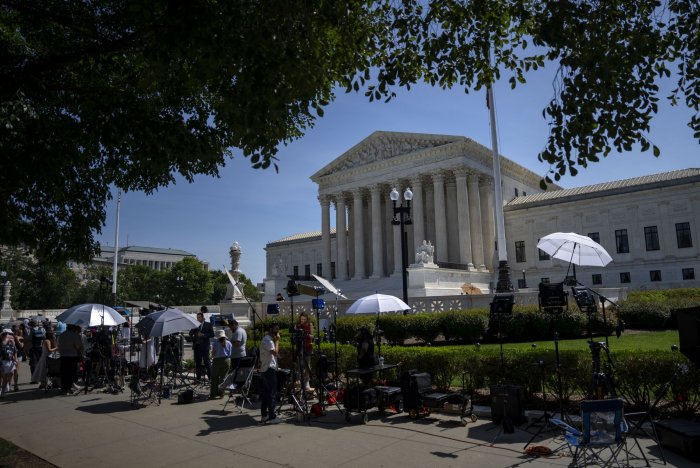
News anchors are seen outside the Supreme Court of the United States as the court releases their final opinions before summer recess on Tuesday. The court upheld birthright citizenship and also state laws banning transgender women and girls from playing on school athletic teams. Photo by Bonnie Cash/UPI | License Photo

Source link

PwC, OpenAI Prep AI Treasury Agents

After years of skepticism, agentic AI is reshaping how CFOs run their organizations.

Working in conjunction, global accountancy and advisory firm PwC and OpenAI are bringing agentic AI to CFOs and their organizations. They promise that their agents can deliver benefits to the planning, forecasting, reporting, procurement, payments, treasury, and tax functions of financial organizations. 

The technology is no longer seen as emerging—it is now widely accepted as an essential tool for optimizing operations and driving long-term growth.

As recently as October 2025, AI remained controversial. Deloitte in Australia faced a reported $290,000 judgment after it submitted a report to Australia’s Department of Employment and Workplace Relations that included a range of generative AI hallucinations, prompting litigation. Such incidents made accountants wary of the technology and its shortcomings.

Nevertheless, appreciation for AI input has rapidly evolved, with a little help from human touch. PwC and OpenAI have clearly defined roles: AI agents execute and coordinate work, while PwC employees supervise—a structure designed to reduce the risk of hallucinations.

Proposal Relies On Real-World Experiences

OpenAI is presented as “customer zero.” The company uses its ChatGPT AI chatbot and Codex software coding agent in its own financial organization, where they “monitor payments, review contracts, update forecasts, and prepare reporting materials,” according to a prepared statement. Meanwhile, PwC implements that know-how in other companies. The lessons learned at OpenAI will help other CFOs.

Some of the complex corporate workflows that AI agents have managed, according to OpenAI officials, include processing five times more contracts without adding professionals to the existing team, and managing more than 200 investor interactions during a fundraising event. 

PwC and OpenAI appear to have mastered the path to deploying agentic workflows.

Nevertheless, in this rapidly evolving new world, PwC doesn’t work exclusively with OpenAI. The firm recently announced another collaboration with OpenAI rival Anthropic. PwC is offering its large client portfolio access to Anthropic’s Claude AI assistant. Financial services, pharmaceuticals, and life sciences clients are particularly interested in Claude’s efficiencies, according to PwC. In the insurance sector, underwriting cycles could be reduced from weeks to days. In cybersecurity, agents respond to threats in minutes rather than hours. The reimagining of the CFO’s office is just beginning.

Source link

Treasury Dept. asks banks to look for signs of illegal immigrant labor

June 5 (UPI) — The Treasury Department on Friday issued an advisory that financial institutions, including banks and casinos, to “be vigilant” against signs of unlawful employment of illegal immigrants.

The Department’s Financial Crimes Enforcement Network, called FinCEN, in the advisory calls on the institutions employ methods to detect schemes covering up the employment of people who are not authorized to work in the United States.

Treasury Secretary Scott Bessent said in a FinCEN press release that part of the Trump administration’s crackdown on illegal immigration includes “securing our financial system.”

“This administration will not allow illegal aliens to abuse financial institutions to steal billions of dollars from hardworking American taxpayers,” Bessent said.

In order for non-immigrants to work in the United States, employers are required to petition with U.S. Citizenship and Immigration Services for eligibility, before a prospective employee either applies to the State Department for a visa or enters the country through a port of entry, according to USCIS.

FinCEN said in the release that the hiring, concealing and exploiting of workers without visas can give employers advantages over other businesses, depress wages, facilitate identity theft and steal tax revenue from the United States.

The agencies additionally said that the hiring of these workers can also help fund and assist criminal enterprises that include drug trafficking and human trafficking.

The financial institutions are being asked to watch out for red flags of shell companies, identity theft, fraudulently used social security and worker identification numbers, shell companies and a raft of other detectable signs of fraud.

In addition to depository institutions such as banks, credit unions, money services businesses and securities and futures firms, FinCEN has aimed the advisory at casinos, the insurance industry, mortgage companies and brokers, and the precious metals and jewelry industries.

The Treasury Department said that more than $2.5 billion in suspicious activity reported by financial institutions was linked to payroll fraud schemes in 2025 alone, noting one multi-year scheme that cost the United States more than $38 million in tax revenue.

President Donald Trump discusses renovations to the Lincoln Reflecting Pool and makes an announcement on coal in the Oval Office at the White House on Thursday. Photo by Samuel Corum/UPI | License Photo

Source link

Venezuelan Gov’t Orders Airlines, Shipping Companies to Deposit Fuel Payments in US Treasury Account

Airlines and shipping companies must send payment receipts to PDVSA to access fuel. (Archive)

Caracas, June 3, 2026 (venezuelanalysis.com) – The Venezuelan government headed by Acting President Delcy Rodríguez has instructed airlines and shipping companies to direct fuel payments to a US Treasury account.

Spanish newspaper El Diario published a May 28 letter from state oil company PDVSA addressed to “aviation and maritime customers” that laid out the “banking coordinates” for foreign currency payments concerning JET A1, MGO, and IFO 380 purchases.

JET A1 is a kerosene-based fuel widely used by commercial airplanes, while Maritime Gas Oil (MGO) and Intermediate Fuel Oil (IFO) 380 are standard for ship engines.

“We urge our customers to take the necessary precautions and forward the payment receipt to PDVSA sales representatives so that the payment is cleared and fuel supply is assured,” the letter read.

An attached US Treasury information sheet contains details for Fedwire payments to a “Venezuela custody account” and requires information about “source of funds, e.g., oil, gold, minerals, etc.”

The leaked letter is the first publicly available document from a Venezuelan state institution directing foreign currency payments to an account run by the US Treasury Department as opposed to the country’s Central Bank (BCV) or some alternative state-run mechanism.

Since the January 3 military strikes and kidnapping of Venezuelan President Nicolás Maduro, the Trump administration has seized control of the country’s export revenues. The White House has likewise extracted concessions in the form of pro-business reforms, preferential access for Western corporations to natural resources, and external audits of the Venezuelan Central Bank.

US Treasury general licenses allowing select Western corporations to engage in oil and gas activities mandate that all Venezuela-owed payments for royalties, taxes, and dividends be deposited in US Treasury accounts. Additional sanctions waivers imposed similar constraints on mining sector services and exports.

Neither US nor Venezuelan authorities have disclosed information about the funds, the timings of their disbursements back to Caracas, and the percentage kept by the Trump administration. The US president stated in a May interview that Washington has “made a fortune” from Venezuelan oil sales.

Both Washington and Caracas have acknowledged the use of Treasury-held Venezuelan revenues for the purchase of medicines and medical equipment from US manufacturers. In January, Secretary of State Marco Rubio said in a Senate hearing in January that Venezuela would need to submit a “budget request” to access its own funds.

According to reports, Washington is mandating that the Venezuelan Central Bank distribute the returned foreign currency to private sector importers via exchange table auctions run by public and private banks. The BCV has reportedly allocated more than US $5 billion thus far in 2026.

The Rodríguez acting government’s diplomatic rapprochement with the Trump White House, coupled with reforms to attract Western investment, has led to a growing number of international airlines reestablishing flights to the Caribbean nation. American Airlines currently runs two daily direct Caracas-Miami flights, while United Airlines will launch a Caracas-Houston connection in August. Jetblue, for its part, is set to initiate its first-ever Venezuela route later in the year.

Venezuelan authorities have likewise recorded increased shipping activity at the country’s ports.

Source link