travelers

For airline travelers, the shutdown answer is simple: Pay TSA officers

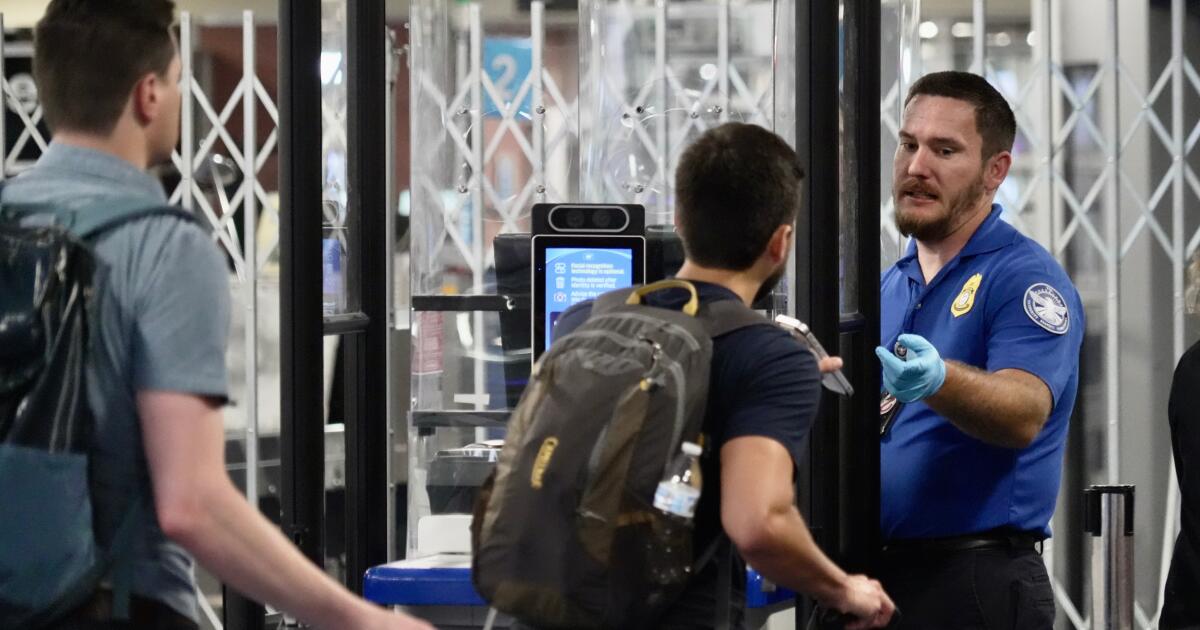
Regardless of politics or destination, American air travelers are unified by one desire: It’s time to pay Transportation Security Administration employees.

“Everybody got bills they have to pay, and it’s horrible,” said Patrice Clark, whose trip to Las Vegas began Saturday with a nearly four-hour wait in a security line at Dallas Fort Worth International Airport. “Times are hard for everybody at this point. Working and not getting paid and gas prices are extremely high — like everybody needs their money. They need to pay them.”

TSA officers haven’t gotten a paycheck since the Department of Homeland Security partly shut down on Feb. 14. Democrats balked at funding the agency, demanding changes to immigration enforcement by federal agents after the shooting deaths of Alex Pretti and Renee Good in Minneapolis.

Some travelers arrive 4 hours early

Christian Childress is a private flight attendant, so when he is working, he doesn’t wait in TSA lines. But he frequently goes through a checkpoint when flying commercial to get to his job.

Childress, who lives in Redwood City in Northern California, said shutdown effects have been “hit or miss” thus far. He came to the Atlanta airport nearly three hours before his 1:30 p.m. Saturday flight to Nashville for a leisure trip. Some passengers have been arriving even earlier in Atlanta — the world’s busiest airport — worried about missing flights.

“Issue No. 1 should be paying the people who need to get paid and keeping our air travel system secure,” Childress said. “Then they can debate whatever they want to debate about Homeland Security.”

Democrats have tried to advance legislation to fund TSA separately, but Republicans have refused, saying funding for the entire Department of Homeland Security must be approved. So the shutdown continues.

Some passengers said it is time for Democrats to relent.

“I don’t want to go between the Democrats and the Republicans, but I think the Democrats are holding everything up because they can’t get their way,” said Tyrone Williams, a retiree from the Atlanta suburb of Ellenwood. He was queued up for screening before his flight to Philadelphia on Saturday.

Atlanta’s checkpoint wait time was as high as 90 minutes Saturday morning before melting away to nothing in the afternoon on what is typically one of the slowest days of the week for air travel. Staffing shortages have forced some airports to close checkpoints at times, with wait times swinging dramatically.

ICE at airports

Concerns about long airport lines are increasingly capturing attention.

President Trump has announced plans to order Immigration and Customs Enforcement officers to take a role in airport security starting Monday, which he says will continue until Democrats agree to fund the Department of Homeland Security.

He said ICE agents would bring the administration’s immigration crackdown into the nation’s airports, arresting “all Illegal Immigrants” with a focus on those from Somalia.

“I look forward to moving ICE in on Monday, and have already told them to, “GET READY.” NO MORE WAITING, NO MORE GAMES!” Trump wrote.

Funding for the whole department failed to advance in the Senate on Friday after Democrats declined to support a bill. On Saturday, in a rare weekend session, the GOP-led Senate rejected the Democrats’ motion to take up legislation to fund TSA.

Travelers ‘grateful’ for unpaid TSA workers

The vast majority of employees at TSA are considered essential, and roughly 50,000 continue to work without pay during the funding lapse. Nationwide on Thursday, about 10% of TSA officers missed work, the department reported. Absentee rates were two or three times higher in places.

Merissa Thomas arrived in Las Vegas on Saturday after a quick trip through a checkpoint at Reagan National Airport near Washington, D.C.

“I’m so grateful for people who are willing to sacrifice a lot to make sure we’re safe,” Thomas said.

Union leaders and federal officials say TSA officers are under financial pressure. Airport screeners have spent nearly half of the last 172 days with paychecks delayed by politics — 43 days last fall during the longest government shutdown in history, four days earlier this year during a brief funding lapse, and now 37 days and counting during the current shutdown.

At least 376 officers have quit since this shutdown began, according to officials, exacerbating turnover at an agency that historically has had some of the U.S. government’s highest attrition and lowest employee morale.

“From now on I would drive wherever I have to go until they get this figured out,” said Clark, the delayed traveler. “It was horrible.”

Amy writes for the Associated Press. AP writers Collin Binkley in West Palm Beach, Fla., Ty O’Neil in Las Vegas and Mary Clare Jalonick in Washington contributed to this report.

Source link

As another shutdown impacts travelers, some see privatizing TSA screening as a solution

Long security lines snaked into baggage claim areas and parking garages at some U.S. airports over the weekend, a possible indicator of more widespread travel problems as the latest government shutdown drags on.

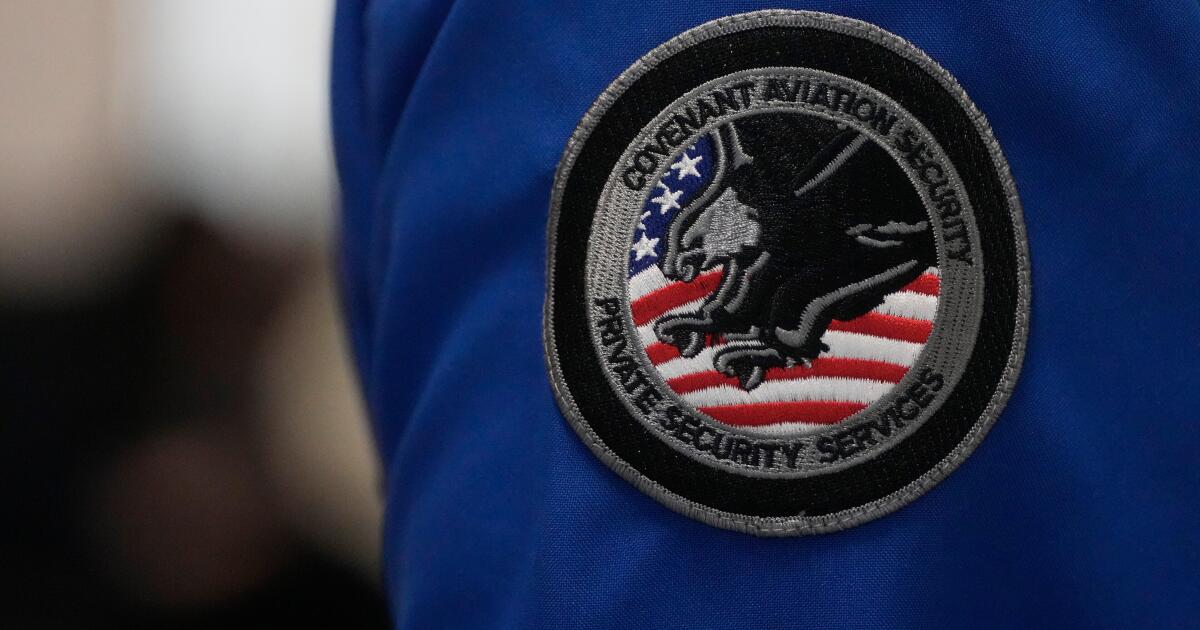
That kind of disruption, while not yet widespread, is not a concern that typically surfaces at San Francisco International Airport, the largest of nearly two dozen U.S. airports where screening checkpoints are staffed by private contractors under a little-used federal program that allows airports to outsource security screenings while maintaining TSA oversight.

Because contractors’ pay comes from a federal contract, it often continues even when the government shuts down.

“The money’s already been allocated, the payments have already been made, and that continues without interruption,” SFO spokesperson Doug Yakel told the Associated Press. “That is a very nice place to be.”

The contrast draws attention to a long-running debate in the aviation industry: Can private contractors operating under TSA oversight provide a stopgap — and shield airport security operations from the political impasses that can disrupt U.S. air travel?

Some aviation experts see the TSA screening program as a potential model for keeping security lines moving with fewer disruptions during shutdowns. At SFO, that system helped maintain screening operations during last year’s record 43-day shutdown, Yakel said.

But critics caution that privatization is not a silver bullet and could introduce new risks. The union representing federal screeners argues that moving operations to private companies could erode job protections and reduce pay and benefits for workers already facing high turnover amid demanding conditions.

How the program works

Established in 2004, TSA’s screening partnership program allows airports to use private security companies chosen by the federal government to run checkpoints while TSA retains authority over procedures and oversight. The agency says private screeners receive the same security background checks as their federal counterparts.

The program “provides needed relief to staffing shortages brought on by a government shutdown,” TSA said in a statement to AP.

In addition to SFO, other participating airports include Kansas City International Airport, Atlantic City International Airport and Orlando Sanford International Airport.

The vast majority of the nation’s roughly 400 commercial airports, meanwhile, rely on federal screening officers employed directly by TSA. During shutdowns, those workers must continue reporting for duty even though they stop getting paid — a dynamic that has historically led to higher absenteeism and slower-moving checkpoints the longer a shutdown lasts.

The current partial shutdown affects only the Department of Homeland Security, which includes TSA. Democrats in Congress refused to fund the department over objections to its immigration enforcement tactics. The lapse marks the third shutdown in less than a year to leave TSA workers temporarily without pay — and once the government reopens, to have to wait for backpay.

Those disruptions can ripple through the travel system, cascading problems across already crowded flight schedules. The strain is especially acute this time of year as airlines and airports brace for what they expect will be one of the busiest spring break travel seasons on record.

San Francisco’s airport is a ‘litmus test’

Aviation security expert Sheldon Jacobson, whose research contributed to the design of TSA PreCheck, said the program’s success at SFO, a large international airport, shows that privatization “is something that needs to be explored.”

SFO is among the top 15 busiest airports in the U.S. when measured by passenger traffic. A major hub for international travel, it is the second-busiest airport in California behind Los Angeles International Airport.

“It’s operated just as well as any other airport,” Jacobson said, adding that SFO’s multiple concourses and status as a hub for United Airlines demonstrate that even large-scale operations can be managed effectively under this model. “If SFO is the litmus test for delivering this privatized product, then many other airports can do it, too.”

Jacobson noted that most airports currently using the program are smaller, but “the scale issue should not be a limiting factor,” and he called for a broader conversation on how such options could deliver government services efficiently and benefit travelers.

“Of course TSA would have oversight. It’s not like they’re freewheeling on their own,” he said of privately contracted screeners. “We might as well use a government shutdown that affects air travel as an opportunity to begin that discussion.”

Why TSA’s union opposes the private model

The American Federation of Government Employees, which represents TSA officers, has long opposed privatization.

“We will never advocate for any privatization of any federal employees. We don’t believe that’ll work,” Johnny Jones, secretary-treasurer of the TSA union’s bargaining unit, said in a brief phone call this week.

In a blog post on its website, the union argues it could weaken accountability for aviation security — one of the reasons Congress chose to federalize airport screening after the Sept. 11 attacks.

The union also warned that private companies could face pressure to cut costs in ways that affect training, staffing levels and employee benefits. Relying on contractors, the union says, could create inconsistencies between airports if different companies operate checkpoints across the country, potentially complicating oversight of a system designed to maintain uniform national security standards.

“We have to remember the TSA was created in the wake of 9/11 when there were no security standards or very minimal security standards,” said airline industry analyst Henry Harteveldt, president of Atmosphere Research Group. “The TSA came around, they established very stringent airport screening security requirements, which exist to this day.”

Others say there are simpler ways to address the shutdown problem.

Industry groups — including the U.S. Travel Assn., Airlines for America and the American Assn. of Airport Executives — are urging Congress to pass legislation that would ensure aviation workers are paid regardless of the government’s funding status.

“Every time Washington fails to fund the government, these essential workers pay the price. So do travelers. So does the economy,” Geoff Freeman, U.S. Travel Assn.’s president, said in a statement. “That is why America’s travel industry has come together, because this workforce is too important, and the stakes are too high, for this to keep happening.”

An unintended benefit of outsourcing screeners

Republican lawmakers have pushed in recent years to dismantle the agency entirely. Last year, two GOP senators introduced the “Abolish TSA Act,” which would phase out the agency and transfer oversight to a new office charged with aviation security. Supporters of the long-shot legislation say privatized screening could be more efficient and less vulnerable to shutdowns.

TSA leadership has signaled an openness to discussion. Speaking at a House Appropriations subcommittee hearing last year, Ha Nguyen McNeill, a senior official performing the duties of TSA administrator, said “nothing is off the table” regarding potential privatization.

“If a new privatization scheme makes sense, then we’re happy to have that discussion to see what we can come up with,” McNeill said. “It’s not an all-or-nothing game.”

At SFO, officials say its screening model was adopted more than 20 years ago for reasons unrelated to government shutdowns. But with shutdowns in recent years growing longer and more disruptive, the airport says its arrangement has revealed an unintended benefit: fewer staffing disruptions at checkpoints.

“The benefits, I think, are compelling,” Harteveldt said. “The real issue is making sure that any vendor, any partner to the TSA, upholds the strict standards that TSA has established and works with TSA to ensure that screening remains efficient and finds ways to make it even better.”

Yamat writes for the Associated Press. AP video journalist Haven Daley contributed to this report from San Francisco.

Source link

There’s a good chance travelers are under ‘crotch watch’ from flight attendants

AIRLINE crews use secret code words around unsuspecting flyers – including the bizarre-sounding “crotch watch.”

Here’s what it means, and how it helps improve safety on planes.

Flight attendants have been known to communicate using code words while in the air (stock image)Credit: Getty
One of these terms is ‘crotch watch’ – meaning crew could have their eyes trained on your lap (stock image)Credit: Getty

Flight attendants can be overheard using their own language on the job.

And chances are you’ll be worried they’re insulting you – especially if you also hear them mention “gate lice,” meaning passengers who crowd around the boarding gate before their flight has even been called.

If they mention “crotch watch,” it is simply alluding to the crew checking that passengers have their seatbelts fastened properly before takeoff and landing.

The Federal Aviation Administration (FAA) recently warned that impatient flyers who unfasten seatbelts before their plane has come to a complete stop at the gate could get hit with $37,000 fines.

Its rule applies during the taxi, takeoff, and landing stages – until the aircraft has safely reached the gate and the illuminated seatbelt sign has been turned off.

The regulation dates back to the 1970s, and was imposed for safety reasons.

Another odd term you might hear is “blue juice.”

This refers to the cleaning liquid used to flush the contents of the plane’s bathrooms.

Other terms, such as ABP, translate to “able-bodied passengers.”

Flight attendants on ‘crotch watch’ are ensuring all passengers have seatbelts fastened when necessary (stock image)Credit: Getty

Secret cabin crew codes

Pax – means passengers.

Used in a sentence, it may be: “We have 20 pax on board.”

Gate lice – this term refers to over-eager passengers who gather around the gate before boarding has even been announced.

Briefing – it means crew may be meeting for the first time and discuss the flight ahead.

ABP – translates to able bodied passengers.”

These are individuals that the crew seek out just in case of an emergency.

Runners – Runners are those who sprint from one connecting flight to another because their first flight was late.

Spinner – this term relates to somebody who turns up late without an assigned seat.

Crew dub them ‘spinners’ as they usually look flustered as they search for a seat and space in the overhead lockers.

Sin bin – We may have all been stuck on a plane as we watch others take off.

This is known as the ‘sin bin’ which is the area the plan has to wait in to allow room for another aircraft to pass through.

Source link