The minibus, carrying nine people, drove through closed crossing barriers during the morning rush hour near the town of Buggenhout.
Published On 26 May 202626 May 2026
At least four people have been killed, including two children, after a train travelling at high speed hit a minibus carrying special needs children crossing a railway in Belgium.
According to Belgian authorities on Tuesday, the minibus, carrying nine people, drove through the closed crossing barriers during the morning rush hour near the town of Buggenhout, about 30 kilometres (20 miles) northwest of the capital, Brussels.
Recommended Stories
list of 4 itemsend of list
Moreover, a spokesperson for the Belgian rail operator Infra-Bel told the RTBF public broadcaster that the train was travelling at an estimated 120 kph (75 mph) as it approached the crossing and had “no time to brake”.
“The impact was extremely violent,” Frederic Sacre said.
Spokesperson for the East Flanders public prosecutor’s office, Lisa De Wilde, said the bus driver, 49, and an escort, 27, were killed along with two children aged 12 and 15.
Five children were injured and were hospitalised in a serious condition, she said, adding that the cause of the crash had not yet been established.
“What we do know is that the barrier was closed and the red light was on,” she said.
Federal Police spokesperson An Berger also said that the minibus driver appeared to have ploughed through the barrier.
“The van came from Kerkhofstraat, a road running parallel to the railway line, and turned left toward Vierhuizen, crossing the railway at a point that was closed at the time. The van was hit by an oncoming train,” Berger said.
A Forensic Police officer inspects the damaged bus at the site of an accident after a train crashed into a school bus, at the railway crossing Vierhuizen in Buggenhout, some 20 km north of Brussels [AFP]
Prime Minister Bart De Wever said on X that he was “deeply moved by the horrific accident in Buggenhout”.
“My thoughts go out to the affected families,” De Wever added.
European Commission President Ursula von der Leyen also said she was “heartbroken” about the “tragic accident”.
“My deepest condolences go out to the victims’ families and their loved ones,” von der Leyen wrote on X.
It is believed that about 100 passengers were aboard the train and that none were hurt. Rail traffic in the area was also stopped.
A BUDGET train operator has launched a brand new rail service.
From this week, travellers can take a cross-border train journeys for under £30.
Sign up for the Travel newsletter
Thank you!
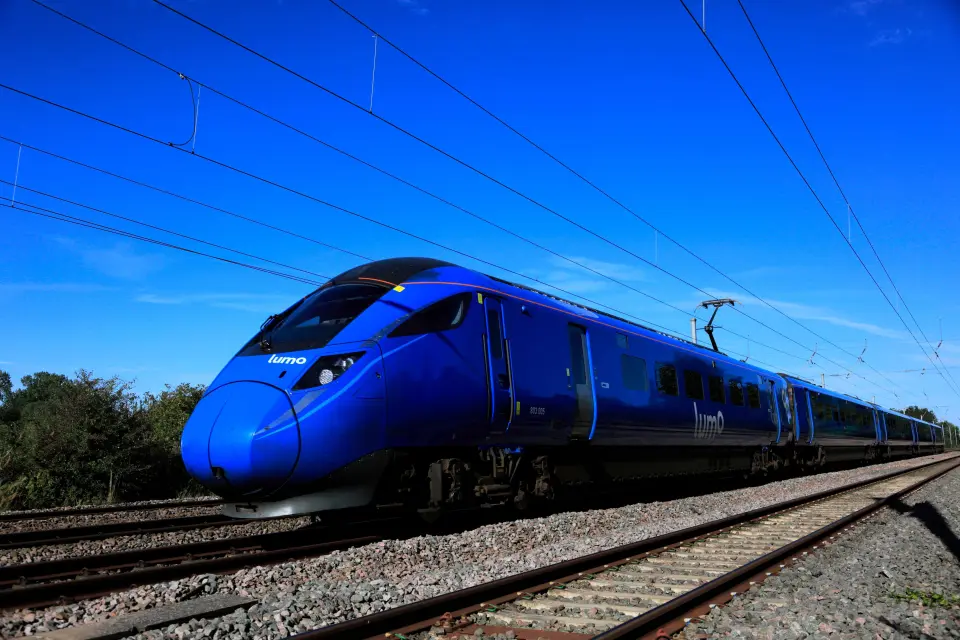
Lumo is now offering budget-friendly train tickets between London Euston and StirlingCredit: AlamyThe journey creates a direct connection between London Euston, Stirling, and west coast townsCredit: Lumo
Lumo’s new low-cost journeys between London and Scotland have launched this week, connecting travellers between London Euston and Stirling.
Customers can travel on this 300 mile train route for only £29.90 per person, with journeys scheduled multiple times a day.
Stirling council leader, Cllr Susan McGill, said: “The sight of the first blue Lumo train in Stirling is an exciting moment, and we will continue to work closely with Lumo to ensure the new service is a success and delivers lasting benefits for everyone across the region.”
The new route also includes a handy connection between London and Preston, Lancashire, for just £23.90, and between Preston and Stirling for £14.90.
Four direct return journeys will take place between Stirling and London Euston every day, with a fifth service running between Preston and London.
Lumo already runs a budget-friendly passenger train along the East Coast Main Line, connecting travellers between London King’s Cross, the North East of England and Edinburgh.
This new west coast route will call at Milton Keynes, Nuneaton, Crewe, Carlisle, Lockerbie, Motherwell, Whifflet, Greenfaulds and Larbert.
For Scottish towns Whifflet, Greenfaulds and Larbert, this is the first ever direct rail connection to London.
Graeme Cook, rail director for Transport Scotland, said: “Lumo’s new Stirling to London route is a very welcome addition to cross-border services which will provide wider economic and connectivity benefits to Scotland.
“The new services will not only boost tourism and hospitality for Stirling and the Forth Valley, but also increase connectivity by now providing customers from Whifflet, Greenfaulds and Larbert with direct access to rail connections on the West Coast Main Line and London.”
The train service will run from Monday, May 25, with the full timetable set to be available in July.
AN abandoned English train station has been revamped with a £50,000 upgrade.
After years of disrepair, the 19th century station has now transformed into a luxury retreat that is opento the public.
Sign up for the Travel newsletter
Thank you!
Rowden Mill Station in North Herefordshire has been transformed in a £50,000 renovationCredit: SWNSOwners Cecilia Chavez-Brandon and Paul Kirwan have kept the authentic 1950s feelCredit: SWNS
Rowden Mill Station in North Herefordshire has been renovated into a vintage-inspired hotel, offering the perfect retreat for keen trainspotters.
Cecilia Chavez-Brandon and husband Paul Kirwan took on this dream renovation project in 2017, paying £395,000 for the 2.7 acre site that had been abandoned since the 1950s.
The site was primarily used for moving injured soldiers to field hospitals during the war and transporting livestock, losing its appeal as cars became more popular in the 1950s.
Inside were original buildings and a set of train tracks, which they have modernised into an experience that transports visitors back to the 1950s and 1960s.
To add to the vintage feel, they bought an 18ft inspection saloon coach, coated with British Railway livery for historic railway fans.
Cecilia told SWNS: “It was not until the 1980s that the former owners found the station and bought it from the farmers.
“They built the rail track back. We arrived after they had been here 32 years and helped modernise it.
“They restored the station building and the parcel office and converted it into accommodation rather than a station.
“The booking office is now the kitchen, the waiting room is now the lounge. The gentleman’s toilet is now a full bathroom.
“The parcel office is a separate building and we converted it and put central heating in and new carpets. We turned that into a full studio with an ensuite.”
A steady stream of visitors can look around the renovated station, which has transformed ladies’ waiting areas into main bedrooms and carriages into accommodations.
Tourists can pay £260 per night to enjoy a luxurious stay overlooking the countryside in their renovated coaches fitted with an en suite and heating.
Visitors can pay £260 per night to stay in renovated train coachesCredit: SWNSThe location is an ideal spot for trainspotting enthusiasts who enjoy a countryside retreatCredit: SWNS
The main station building also has accommodation at £430 for two nights, or the Parcel Office studio at £220 for two nights.
Cecilia said: “We have a parcel office with a studio for two on the main platform. For anyone staying here, it’s like waking up in a railway station from the 1950s and 60s.”
The couple also bought an original 20-tonne brake van back in 2018 to create another luxury accommodation for the site.
Maintaining this beloved location has become a career for the couple: “We didn’t really start out as railway buffs but you obviously become one. It’s like going down a rabbit hole.
“You end up being a whole network of railway people and it’s really something amazing.
“The very first guest arrived in September 2017 and they came with books and were clear railway buffs and knew more about the branch line than we did at the time.
“In terms of guests we obviously have the railway buffs, even children with technical knowledge. We have station masters and train drivers – we get quite a range of fans.
“The whole site is great. It’s so peaceful, with gorgeous views and our other passion is nature. We’ve got our own meadows, hedgerows and wildlife ponds.”
Weekly insights and analysis on the latest developments in military technology, strategy, and foreign policy.
U.S. Special Operations Command (SOCOM) is in the early stages of the search for a replacement for the C-146 Wolfhound cargo plane. The C-146s are unassuming twin-engine turboprop aircraft with civilian-style paint schemes that provide important logistical, medical evacuation, and other support, particularly to far-flung U.S. special operations forces. However, they are also based on a long-out-of-production design that was never in widespread use anywhere, and that makes them increasingly difficult and costly to sustain.
Col. Justin Bronder, head of SOCOM’s Program Executive Office for Fixed Wing (PEO-FW), spoke to TWZ and other outlets about the C-146 replacement plans at a roundtable on the sidelines of the annual SOF Week conference yesterday. The Wolfhounds are part of what SOCOM refers to as its Non-Standard Aviation (NSAv) fleets.
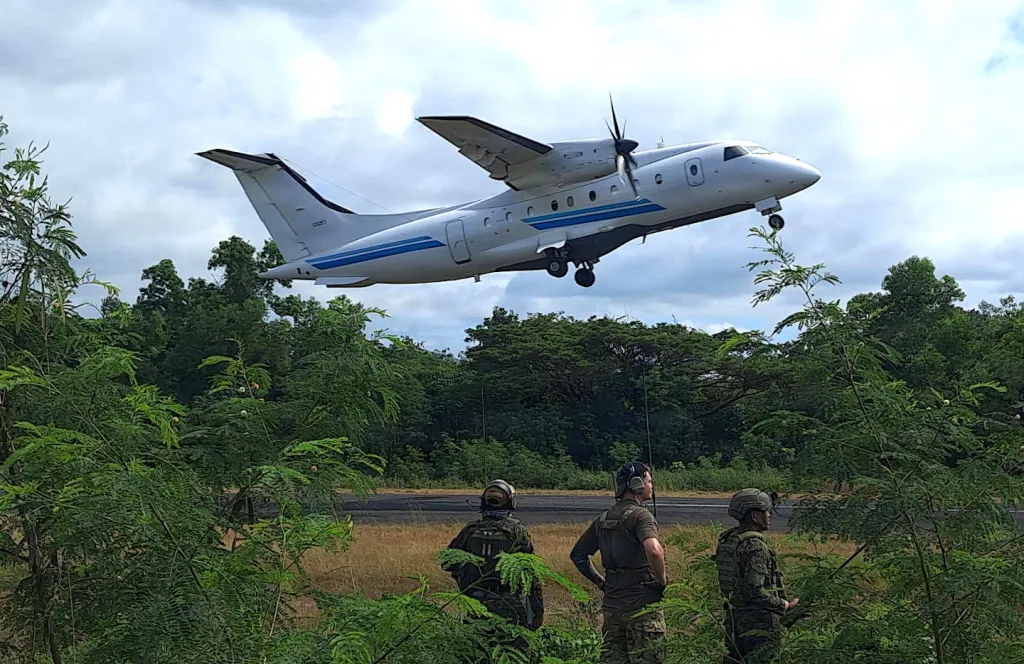
A C-146 seen flying from an austere airstrip in the Philippines during an exercise in January 2026. Courtesy photo via US Special Operations Command Pacific
There are some 20 Wolfhounds in service today, which are operated by Air Force Special Operations Command (AFSOC). The C-146, which AFSOC began flying in the early 2010s, is a militarized version of the Dornier Do-328, something we will come back to later on. The Air Force also has another Do-328, nicknamed Cougar, that has been used to conduct research and development and test and evaluation activities in support of SOCOM.
A briefing slide from the mid-2010s discussing the features of the Do-328 “Cougar” aircraft. SOCOM
“So we have had a highly successful Non-Standard Aviation program, again that really developed under the crucible of where those operations that the Command [SOCOM] was in many parts leading in the really peak days in the War on Terror,” Col. Bronder explained. “So those aircraft, again, battle-proven C-146 Wolfhound aircraft, [were] set up at various TSOCs [theater special operations commands], providing the direct support.”
A nighttime shot of a C-146 coming in to land on a highway in Arkansas during an exercise. USAF
However, “those aircraft were fairly constricted by their short range, [and] by being a unique aircraft. There wasn’t a large global backbone to sustain them,” he continued. “So it was a successful model, but maybe not a very cost-effective one.”
The Air Force’s official C-146 fact sheet says the aircraft can fly up to 1,500 nautical miles while carrying 2,000 pounds of cargo. The Wolfhound does offer the flexibility to operate from shorter runways and semi-prepared airstrips, as well as roads.
A C-146 operating from a roadway during an exercise. USAF/Master Sgt. Scott Thompson
“We’re looking for ways to recapitalize that fleet with something that’s more cost-effective, leverages a commercial kind of sustainment enterprise better, and then it again provides maybe a more capable aircraft to cover down on larger areas faster,” Col. Bronder added. “So those are the types of requirement spaces we’re working through as we plan out what the next phase of NSAv looks like.”
A simulated casualty is seen being attended to inside a C-146 during an exercise. USN/Chief Petty Officer Elizabeth Reisen
The Do-328 was first developed in the 1980s as a commuter airliner. A jet-engined 328JET derivative followed in the 1990s. Both variations only saw relatively limited sales. Just 217 examples were reportedly built, inclusive of both turboprop and jet-powered versions, during the production run in the 1990s. Only a fraction of those aircraft are still flying. Several attempts have been made to revive production of modernized versions of the design, but so far without success. Last year, Deutsche Aircraft unveiled the first prototype of its new D328eco, but, at the time of writing, it has yet to fly.
A picture of Deutsche Aircraft’s D328eco prototype, notably seen here without engines fitted. Deutsche Aircraft
With the exception of a lone example operated by the Botswana Defence Force, the U.S. Air Force is the only military user of the Do-328. All of the Air Force’s examples were acquired second-hand. The C-146s supplanted an even smaller fleet of Bombardier Q-200s, a version of the De Havilland Canada DHC-8, or Dash 8, which AFSOC had begun flying in the NSAv role in the late 2000s.
Since the early 2010s, the C-146s have been criss-crossing the globe, providing discreet support to U.S. operations forces, sometimes right at the tactical edge. As one known example, Wolfhounds were heavily involved in supporting the opening phase of the French intervention in the northwest African country of Mali in 2013. C-146s continue to be used to move special operations forces and cargo, as well as to help evacuate injured personnel and perform other light utility-type missions worldwide. They have even sometimes been employed as VIP transports in more far-flung locales.
Then-US Secretary of State John Kerry seen about to board a C-146 in Vietnam’s Ho Chi Minh City during a visit to the country in 2017. US Department of State
The C-146 fleet has also received various upgrades over the years. This includes unspecified modifications that have enabled the aircraft “to land at more austere, semi-prepared runways,” which “resulted in an approximately ten-fold increase in the number of available runways worldwide,” according to a declassified annual Air Force report published in 2015, which this author previously obtained via the Freedom of Information Act (FOIA).
The full entry on the C-146 from the declassified USAF annual report published in 2015. USAF via FOIA
As Bronder made clear yesterday, SOCOM and AFSOC are still very early in the process of laying out the requirements for a successor to the C-146. Any desire for boosts in range, performance, payload, and other capabilities will need to be balanced against the need for any future NSAv aircraft to be able to operate from the same kinds of remote and austere locations as the Wolfhound does today.
SOCOM is certainly looking to move quickly on securing a replacement for the C-146. It is asking for $55 million to buy the first three of these new NSAv aircraft in its Fiscal Year 2027 budget.
“The current C-146A fleet will be divested of on a schedule that maintains this critical TSOC capability, as transition to the new aircraft occurs,” the budget documents also note.
US Air Force personnel prepare to transfer simulated casualties to a waiting C-146 during an exercise in 2022. USAF/Staff Sgt. Christopher Stolze
In the meantime, the Wolfhound fleet will continue providing important, if not often overlooked, support to American special operations forces around the world.