THERE is a beautiful train journey that claims to go to the “end of the world” and has some stunning views along the way.
Officially called El Tren del Fin de Mundo (The End of the World Train), the train is a historic steam railway that takes passengers on a journey through Tierra del Fuego National Park in Argentina.
Sign up for the Travel newsletter
Thank you!
The End of the World Railroad near Ushuaia in Argentina travels to the Tierra del Fuego National ParkCredit: AlamyOn the journey, visitors can see breathtaking views of the landscape including waterfallsCredit: Alamy
In fact, the railway is considered the southernmost one in the world.
And the rather morbid name comes from the it’s original purpose as a prison train.
It was built back in the early 20th century and used to transport inmates to collect timber and a number of other building materials from the forest.
They would then take these materials to construct a prison and settlement.
But by 1947 the railway closed as a result of the prison closing.
Then in 1994, a four mile section of the track was rebuilt and opened as a tourist attraction.
Today, visitors can now ride along the railway as a sightseeing experience of Patagonia, as well as learn about the history of the train line.
The ‘End of the World Station’ is located around five miles from Ushuaia, which is where the journey begins.
Then, on the journey, passengers can see the Pipo River, the Macarena Waterfall and the ‘tree cemetery’ – an area that features a number of the stumps that were left behind by the prison inmates.
When the train crosses the Pipo River, it goes over Puente Quemado (Burned Bridge), which features the wooden remains of the old bridge beneath the newer tracks.
It then stops at La Macarena Station, where passengers can get off the train to look at the cascading waterfall and learn about the local people called Yamana.
The train journey then ends at the National Park Station, where passengers can get off and venture into Tierra del Feugo National Park.
The park entrance fee is separate to the price of the train journey, and it costs around £20.11 to enter.
On board the train, there are a number of different classes, including ‘Tourist’.
In these carriages, there are comfortable seats and large windows and audio commentary is available in multiple languages for passengers to learn about the history of the region, as well as the train.
In Premium Service, passengers get priority boarding, heated cars, food and even exclusive train souvenirs.
Passengers in this class can also asked for a private tour of the railway workshops, where they will learn about the behind-the-scenes work that keeps the train running.
If on the train at 9:30am, there is a breakfast menu with bread, croissants, yoghurt and mixed nuts.
In Premium Class, passengers will also receive a mealCredit: Alamy
At midday and 3pm, there is a lunch menu with dishes including lamb casserole, chicken casserole, spinach and ricotta cannelloni, pizza and empanadas.
A children’s menu is also available.
For something really special, there is a VIP service as well, where passengers receive a three-course menu and an exclusive access experience.
One recent visitor said: “This was really cool, we’d seen some of the best scenery in the world and now we were riding a miniature train to the End of the World – and I lived to tell the tale!
“There was a stop at a pretty waterfall and some funny antics by the local convicts who clearly had been left behind by the penal colony.
“I thought this was a cool thing to do, really enjoyed it.”
Another added: “A magical experience like straight out of a Christmas story, we went [when] everything was snowy beautiful [and] met wild horses on the visit.
Tickets cost around £34.63 per adult and £17.32 per child between four and 12-years-old.
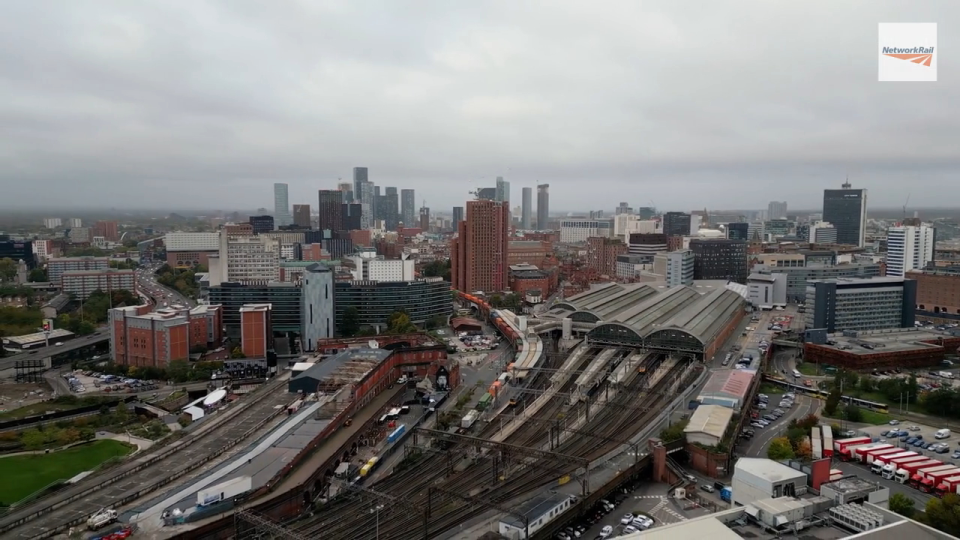
In a prior warning to passengers, they have advised that no trains from the south and east of the city will run into Manchester Piccadilly.
This will last for nine days over February half term (Saturday 14 – Sunday 22).
Some trains from across the north will also be impacted as well as direct connections to Manchester Airport station.
Services normally running to and from Manchester Piccadilly will terminate at other stations, including Stockport.
Platforms 1-12 will be closed but the concourse will remain open to the public.
There will be a limited service westbound from platforms 13 and 14.
More detailed information about alternate travel plans are to follow in due course.
Julien Dehornoy, Network Rail’s North West & Central deputy regional managing director, said: “We’re investing £7.9m in renewing the Piccadilly corridor, a stretch of track critical to the journeys of around 400,000 trains into Manchester every year.
“This work is going to significantly reduce disruption for the many passengers who regularly use this route.
“Once the job is done, we will have a better, more reliable railway.
“The major overhaul over six railway lines can only take place during a full railway closure and we are working closely with train operators, TfGM and Manchester City Council on alternative travel plans to keep people on the move.
“The full details on which will be published in mid-November.”
Network Rail has warned passengers that Manchester Piccadilly is set to close for nine daysCredit: Network Rail
While Birmingham is an important industrial and cultural centre, and the UK’s second-largest city with a population of around 1.2 million.
The proposed plans are on track to deliver up to 130 extra train services each week, which would provide around two million additional passenger seats a year.
Andy Clark, rail programme lead at Midlands Connect, said: “This would be a real boost for passengers.”
The first phase of the scheme is also expected to create nearly 13,000 jobs nationwide.
Swindon North MP Will Stone welcomed the development, saying it would boost the local economy and reconnect communities that have long relied on slower, indirect services.
Currently, there are no direct services between Swindon and Birmingham, meaning passengers must change at Cheltenham, Gloucester, or Reading stations.
The revived route would re-establish a direct connection between the two cities.
Mr Stone said: “It’s fantastic that Swindon could be benefiting from the Midlands Rail hub expansion.
“We’re a town built on connection via the railways, and so it’s great to see Swindon getting an hourly service between a fellow industrial town like Birmingham.”
Once home to the Great Western Railway works, Swindon has a proud railway heritage that shaped the town’s identity.
The project has secured government backing following Chancellor Rachel Reeves’ spending review and forms part of the government’s 10-year infrastructure strategy.
Mr Stone added: “Innovative projects like the Midlands Rail hub prove that investments in our railways, fully funded by the Chancellor, are transformative for communities, bringing new jobs and skills to areas across the country.”
A months-long siege on the Malian capital, Bamako, by the armed al-Qaeda affiliate group, Jama’at Nusrat al-Islam wal-Muslimin (JNIM), has brought the city to breaking point, causing desperation among residents and, according to analysts, placing increasing pressure on the military government to negotiate with the group – something it has refused to do before now.
JNIM’s members have created an effective economic and fuel blockade by sealing off major highways used by tankers to transport fuel from neighbouring Senegal and the Ivory Coast to the landlocked Sahel country since September.
Recommended Stories
list of 4 itemsend of list
While JNIM has long laid siege to towns in other parts of the country, this is the first time it has used the tactic on the capital city.
The scale of the blockade, and the immense effect it has had on the city, is a sign of JNIM’s growing hold over Mali and a step towards the group’s stated aim of government change in Mali, Beverly Ochieng, Sahel analyst with intelligence firm Control Risks, told Al Jazeera.
For weeks, most of Bamako’s residents have been unable to buy any fuel for cars or motorcycles as supplies have dried up, bringing the normally bustling capital to a standstill. Many have had to wait in long fuel queues. Last week, the United States and the United Kingdom both advised their citizens to leave Mali and evacuated non-essential diplomatic staff.
Other Western nations have also advised their citizens to leave the country. Schools across Mali have closed and will remain shut until November 9 as staff struggle to commute. Power cuts have intensified.
Here’s what we know about the armed group responsible and why it appears to have Mali in a chokehold:
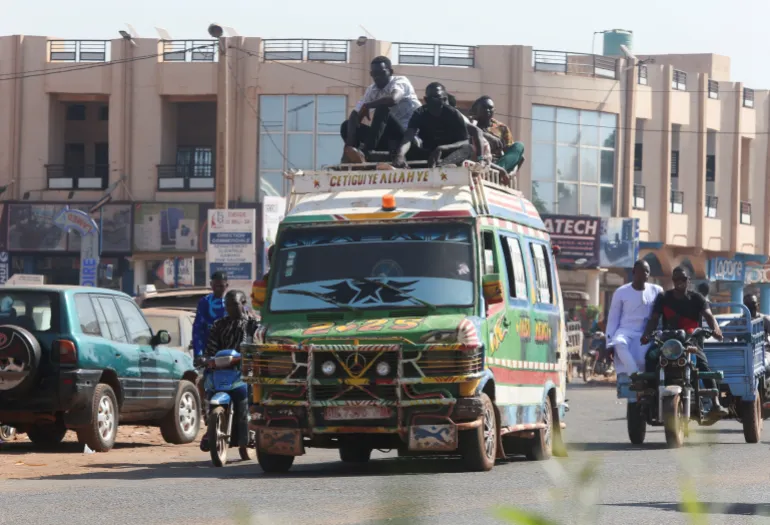
People ride on top of a minibus, a form of public transport, amid ongoing fuel shortages caused by a blockade imposed by al Qaeda-linked fighters in early September, in Bamako, Mali, on October 31, 2025 [Reuters]
What is JNIM?
JNIM is the Sahel affiliate of al-Qaeda and the most active armed group in the region, according to conflict monitor ACLED. The group was formed in 2017 as a merger between groups that were formerly active against French and Malian forces that were first deployed during an armed rebellion in northern Mali in 2012. They include Algeria-based al-Qaeda in the Maghreb (AQIM) and three Malian armed groups – Ansar Dine, Al-Murabitun and Katiba Macina.
JNIM’s main aim is to capture and control territory and to expel Western influences in its region of control. Some analysts suggest that JNIM may be seeking to control major capitals and, ultimately, to govern the country as a whole.
It is unclear how many fighters the group has. The Washington Post has reported estimates of about 6,000, citing regional and western officials.
However, Ulf Laessing, Sahel analyst at the German think tank, Konrad Adenauer Stiftung (KAS), said JNIM most likely does not yet have the military capacity to capture large, urban territories that are well protected by soldiers. He also said the group would struggle to appeal to urban populations who may not hold the same grievances against the government as some rural communities.
While JNIM’s primary base is Mali, KAS revealed in a report that the group has Algerian roots via its members of the Algeria-based al-Qaeda in the Maghreb (AQIM).
The group is led by Iyad Ag-Ghali, a Malian and ethnic Tuareg from Mali’s northern Kidal region who founded Ansar Dine in 2012. That group’s stated aim was to impose its interpretation of Islamic law across Mali.
Ghali had previously led Tuareg uprisings against the Malian government, which is traditionally dominated by the majority Bambara ethnic group, in the early 1990s, demanding the creation of a sovereign country called Azawad.
However, he reformed his image by acting as a negotiator between the government and the rebels. In 2008, he was posted as a Malian diplomat to Saudi Arabia under the government of Malian President Amadou Toumani Toure. When another rebellion began in 2012, however, Ghali sought a leadership role with the rebels but was rebuffed, leading him to create Ansar Dine.
According to the US Department of National Intelligence (DNI), Ghali has stated that JNIM’s strategy is to expand its presence across West Africa and to put down government forces and rival armed groups, such as the Mali-based Islamic State Sahel, through guerrilla-style attacks and the use of improvised explosive devices (IEDs).
Simultaneously, it attempts to engage with local communities by providing them with material resources. Strict dress codes and bans on music are common in JNIM-controlled areas.
JNIM also destroys infrastructure, such as schools, communication towers and bridges, to weaken the government off the battlefield.
An overall death toll is unclear, but the group has killed thousands of people since 2017. Human rights groups accuse it of attacking civilians, especially people perceived to be assisting government forces. JNIM activity in Mali caused 207 deaths between January and April this year, according to ACLED data.
How has JNIM laid siege to Bamako?
JNIM began blocking oil tankers carrying fuel to Bamako in September.
That came after the military government in Bamako banned small-scale fuel sales in all rural areas – except at official service stations – from July 1. Usually, in these areas, traders can buy fuel in jerry cans, which they often resell later.
The move to ban this was aimed at crippling JNIM’s operations in its areas of control by limiting its supply lines and, thus, its ability to move around.
At the few places where fuel is still available in Bamako, prices soared last week by more than 400 percent, from $25 to $130 per litre ($6.25-$32.50 per gallon). Prices of transportation, food and other commodities have risen due to the crisis, and power cuts have been frequent.
Some car owners have simply abandoned their vehicles in front of petrol stations, with the military government threatening on Wednesday to impound them to ease traffic and reduce security risks.
A convoy of 300 fuel tankers reached Bamako on October 7, and another one with “dozens” of vehicles arrived on October 30, according to a government statement. Other attempts to truck in more fuel have met obstacles, however, as JNIM members ambush military-escorted convoys on highways and shoot at or kidnap soldiers and civilians.
Even as supplies in Bamako dry up, there are reports of JNIM setting fire to about 200 fuel tankers in southern and western Mali. Videos circulating on Malian social media channels show rows of oil tankers burning on a highway.
What is JNIM trying to achieve with this blockade?
Laessing of KAS said the group is probably hoping to leverage discontent with the government in the already troubled West African nation to put pressure on the military government to negotiate a power-sharing deal of sorts.
“They want to basically make people as angry as possible,” he said. “They could [be trying] to provoke protests which could bring down the current government and bring in a new one that’s more favourable towards them.”
Ochieng of Control Risks noted that, in its recent statements, JNIM has explicitly called for government change. While the previous civilian government of President Ibrahim Boubacar Keita (2013-2020) had negotiated with JNIM, the present government of Colonel Assimi Goita will likely keep up its military response, Ochieng said.
Frustration at the situation is growing in Bamako, with residents calling for the government to act.
Speaking to Al Jazeera, driver Omar Sidibe said the military leaders ought to find out the reasons for the shortage and act on them. “It’s up to the government to play a full role and take action [and] uncover the real reason for this shortage.”
Which parts of Mali is the JNIM active in?
In Mali, the group operates in rural areas of northern, central and western Mali, where there is a reduced government presence and high discontent with the authorities among local communities.
In the areas it controls, JNIM presents itself as an alternative to the government, which it calls “puppets of the West”, in order to recruit fighters from several ethnic minorities which have long held grievances over their perceived marginalisation by the government, including the Tuareg, Arab, Fulani, and Songhai groups. Researchers note the group also has some members from the majority Bambara group.
In central Mali, the group seized Lere town last November and captured the town of Farabougou in August this year. Both are small towns, but Farabougou is close to Wagadou Forest, a known hiding place of JNIM.
JNIM’s hold on major towns is weaker because of the stronger government presence in larger areas. It therefore more commonly blockades major towns or cities by destroying roads and bridges leading to them. Currently, the western cities of Nioro and gold-rich Kayes are cut off. The group is also besieging the major cities of Timbuktu and Gao, as well as Menaka and Boni towns, located in the north and northeast.
How is JNIM funded?
For revenue, the group oversees artisanal gold mines, forcefully taxes community members, smuggles weapons and kidnaps foreigners for ransom, according to the US DNI. Kayes region, whose capital, Kayes, is under siege, is a major gold hub, accounting for 80 percent of Mali’s gold production, according to conflict monitoring group Critical Threats.
The Global Initiative Against Transnational Organised Crime (Gi-Toc) also reports cattle rustling schemes, estimating that JNIM made 91,400 euros ($104,000) in livestock sales of cattle between 2017 and 2019. Cattle looted in Mali are sold cheaply in communities on the border with Ghana and the Ivory Coast, through a complex chain of intermediaries.
Heads of state of Mali’s Assimi Goita, Niger’s General Abdourahamane Tchiani and Burkina Faso’s Captain Ibrahim Traore pose for photographs during the first ordinary summit of heads of state and governments of the Alliance of Sahel States (AES) in Niamey, Niger, July 6, 2024 [Mahamadou Hamidou/Reuters]
In which other countries is JNIM active?
JNIM expanded into Burkina Faso in 2017 by linking up with Burkina-Faso-based armed group Ansarul-Islam, which pledged allegiance to the Malian group. Ansarul-Islam was formed in 2016 by Ibrahim Dicko, who had close ties with Amadou Koufa, JNIM’s deputy head since 2017.
In Burkina Faso, JNIM uses similar tactics of recruiting from marginalised ethnic groups. The country has rapidly become a JNIM hotspot, with the group operating – or holding territory – in 11 of 13 Burkina Faso regions outside of capital Ouagadougou. There were 512 reported casualties as a result of JNIM violence in the country between January and April this year. It is not known how many have died as a result of violence by the armed group in total.
Since 2022, JNIM has laid siege to the major northern Burkinabe city of Djibo, with authorities forced to airlift in supplies. In a notable attack in May 2025, JNIM fighters overran a military base in the town, killing approximately 200 soldiers. It killed a further 60 in Solle, about 48km (30 miles) west of Djibo.
In October 2025, the group temporarily took control of Sabce town, also located in the north of Burkina Faso, killing 11 police officers in the process, according to the International Crisis Group.
In a September report, Human Rights Watch said JNIM and a second armed group – Islamic State Sahel, which is linked to ISIL (ISIS) – massacred civilians in Burkina Faso between May and September, including a civilian convoy trying to transport humanitarian aid into the besieged northern town of Gorom Gorom.
Meanwhile, JNIM is also moving southwards, towards other West African nations with access to the sea. It launched an offensive on Kafolo town, in northern Ivory Coast, in 2020.
JNIM members embedded in national parks on the border regions with Burkina Faso have been launching sporadic attacks in northern Togo and the Benin Republic since 2022.
In October this year, it recorded its first attack on the Benin-Nigeria border, where one Nigerian policeman was killed. The area is not well-policed because the two countries have no established military cooperation, analyst Ochieng said.
“This area is also quite a commercially viable region; there are mining and other developments taking place there … it is likely to be one that [JNIM] will try to establish a foothold,” she added.
Why are countries struggling to fend off JNIM?
When Mali leader General Assimi Goita led soldiers to seize power in a 2020 coup, military leaders promised to defeat the armed group, as well as a host of others that had been on the rise in the country. Military leaders subsequently seizing power from civilian governments in Burkina Faso (2022) and in Niger (2023) have made the same promises.
However, Mali and its neighbours have struggled to hold JNIM at bay, with ACLED data noting the number of JNIM attacks increasing notably since 2020.
In 2022, Mali’s military government ended cooperation with 4,000-strong French forces deployed in 2013 to battle armed groups which had emerged at the time, as well as separatist Tuaregs in the north. The last group of French forces exited the country in August 2022.
Mali also terminated contracts with a 10,000-man UN peacekeeping force stationed in the country in 2023.
Bamako is now working with Russian fighters – initially 1,500 from the Wagner Mercenary Group, but since June, from the Kremlin-controlled Africa Corps – estimated to be about 1,000 in number.
Russian officials are, to a lesser extent, also present in Burkina Faso and Niger, which have formed the Alliance of Sahel States (AES) with Mali.
Results in Mali have been mixed. Wagner supported the Malian military in seizing swaths of land in the northern Kidal region from Tuareg rebels.
But the Russians also suffered ambushes. In July 2024, a contingent of Wagner and Malian troops was ambushed by rebels in Tinzaouaten, close to the Algerian border. Between 20 and 80 Russians and 25 to 40 Malians were killed, according to varying reports. Researchers noted it was Wagner’s worst defeat since it had deployed to West Africa.
In all, Wagner did not record much success in targeting armed groups like JNIM, analyst Laessing told Al Jazeera.
Alongside Malian forces, the Russians have also been accused by rights groups of committing gross human rights violations against rural communities in northern Mali perceived to be supportive of armed groups.
A person walks past cars parked on the roadside, amid ongoing fuel shortages caused by a blockade imposed by al-Qaeda-linked fighters in early September, in Bamako, Mali, October 31, 2025 [Reuters]
Could the Russian Africa Corps fighters end the siege on Bamako?
Laessing said the fuel crisis is pressuring Mali to divert military resources and personnel to protect fuel tankers, keeping them from consolidating territory won back from armed groups and further endangering the country.
He added that the crisis will be a test for Russian Africa Corp fighters, who have not proven as ready as Wagner fighters to take battle risks. A video circulating on Russian social media purports to show Africa Corps members providing air support to fuel tanker convoys. It has not been verified by Al Jazeera.
“If they can come in and allow the fuel to flow into Bamako, then the Russians will be seen as heroes,” Laessing said – at least by locals.
Laessing added that the governments of Mali and Burkina Faso, in the medium to long term, might eventually have to negotiate with JNIM to find a way to end the crisis.
While Goita’s government has not attempted to hold talks with the group in the past, in early October, it greenlit talks led by local leaders, according to conflict monitoring group Critical Threats – although it is unclear exactly how the government gave its approval.
Agreements between the group and local leaders have reportedly already been signed in several towns across Segou, Mopti and Timbuktu regions, in which the group agrees to end its siege in return for the communities agreeing to JNIM rules, taxes, and noncooperation with the military.
TRAIN travel can be very expensive in the UK, especially when you’re travelling halfway across the country.
But one train company that offers affordable tickets has applied to start two additional direct routes between major UK cities.
Sign up for the Travel newsletter
Thank you!
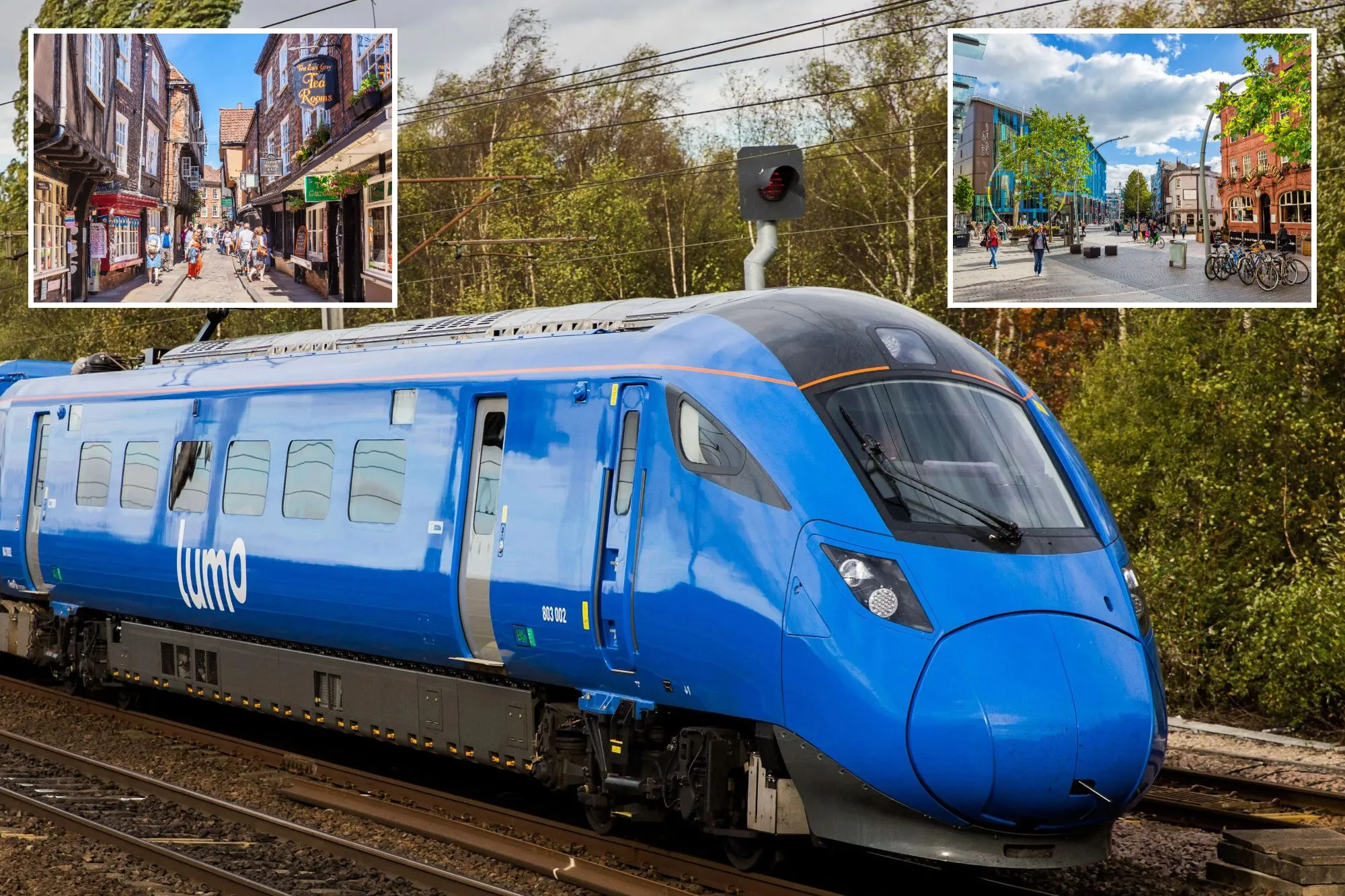
Lumo has put in application to run more train routes across the UKCredit: AlamyOne of the proposed routes will run from York to CardiffCredit: Alamy
Lumo, which offers affordable journeys onboard its fleet of electric trains, has plans to add even more routes to its network.
FirstGroup, which owns Lumo, has revealed that it has submitted applications to begin new direct routes between Cardiff and York, and Rochdale and London Euston.
The company hopes these routes will be operational by December 2028.
Lumo hopes to run return services between the cities to six times a day throughout the week from Cardiff to York.
It hopes that this journey would “replicate the success of the Edinburgh to London service” which Lumo started in 2021.
As for the Rochdale to London route, the application proposes three return services on weekdays and Sundays and four services every Saturday.
Lumo said this would provide residents of the north-west a “convenient and competitively priced” direct rail service to London.
The train company also applied to extend its new route between Scotland’s Stirling and London Euston.
Another route will run between London Euston and Rochdale in outer ManchesterCredit: AlamyThe average journey time from Cardiff Central to York by train is 4 hours 45 minutesCredit: Alamy
The service between Stirling and London has been approved and will start to run from next year.
The new application has asked for it to be extended past May 2030 when the contract currently ends.
Lumo’s new route will link London Euston directly to Stirling, calling at Milton Keynes, Nuneaton, Crewe, Preston, Carlisle, Lockerbie, Motherwell, Whifflet (serving Coatbridge), Greenfaulds (serving Cumbernauld) and Larbert.
Lumo tries to keep its train fares affordable and aims for 60 per cent of its single fares to be under £30.
Onboard a Lumo train, there are no first class seat options. But wherever you sit, you’ll have USB sockets and tray tables.
Passengers can also personalise their lighting through the button on the back of the seat in front of them.
Additional amenities include free Wi-Fi, a winged headrest for comfort and a coat hanger.
Lumo will connect two more major cities from December 2025…
Customers travelling between London and Glasgow can do so on a new Lumo service which starts in December 2025.
Lumo announced its new service on social media. It said: “Our new timetable starts on 14th December 2025!
“Our new Glasgow service will start in December and we’re also adding an additional service from Newcastle to London King’s Cross every weekday.”
Lumo plans to run two northbound and one southbound service on weekdays and one service in each direction on Sundays between London King’s Cross and Glasgow.
The new route will go between the two cities but will also stop at Falkirk High and Newcastle.
If booked in advance for journeys in 2026, tickets start from as little as £33.90. Anyone travelling from Newcastle to Glasgow can buy tickets for just £10.90.
A SEASIDE train station dating back nearly 180 years has been returned to its former glory.
The train station in North Yorkshire has undergone a massive £3.6 million restoration project – and it’s just minutes away from the traditional seaside towns of Scarborough and Bridlington.
Sign up for the Travel newsletter
Thank you!
The station at Filey dates back to 1846 and was built by renowned North-Eastern railway architect GT AndrewsCredit: Network Rail
Sitting on the North Yorkshire coast, the town has been one of the most popular seaside destinations in England for decades.
In the 60s and 70s, it welcomed thousands of tourists every year to Billy Butlin’s campsite, one of the earliest holiday camps in the UK.
Nestled between Scarborough and Bridlington, in its heyday Filey pulled in more than 150,000 guests every year.
Holidaymakers at the hugely popular resort enjoyed swimming, sunbathing, dancing and amusement arcades.
In the evening, if they hadn’t retired to their chalets, they were treated to entertainment from the famous Red Coats.
The Butlin’s campsite was so popular that it had its own branch and station on the north east railway.
Despite its popularity, it was no match for the boom in affordable trips to the Spanish Costas in the 1970s.
It was shut in 1983 and by 2001 it resembled a ghost town with the shells of abandoned cabins and drained swimming pools filled with rubbish.
Billy Butlin’s Holiday Camp was once one of the most popular holiday destinations in EnglandCredit: Newcastle Chronicle and Journal
While the once-thriving Butlin’s resort has now been transformed into a £25 million coastal holiday village with pools, saunas, an arcade, and spa, there are still signs of nostalgia in the town for the casual visitor – none more so than at the recently revamped train station.
Main features such as the lantern roof at the station have been reinstated to what they would have looked like when it first opened in 1846.
This includes extensive glazing and tile work and adding safe walkways for easier maintenance.
The huge restoration project, which was backed by the Railway Heritage Trust, also includes improvements to the café, toilets, drainage, and in the train shed – including two ornate cast iron windows.
Network Rail has worked with partners on the refurbishment of the Grade II-listed building.
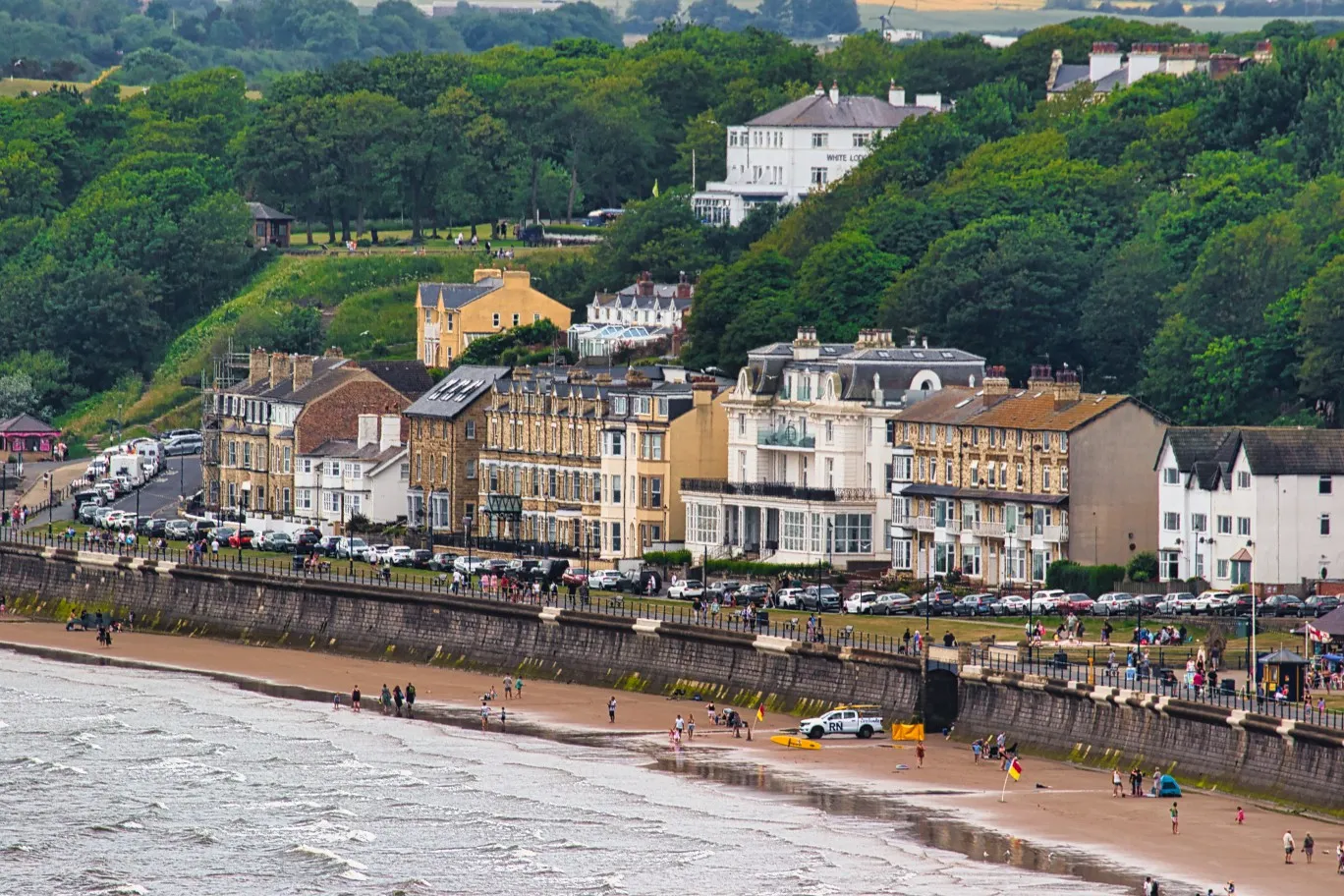
With its sandy beaches and clifftop hotels, Filey remains a popular destinationCredit: Vasile Jechiu
Jake Walton, Network Rail senior asset engineer, said: “Seaside stations like Filey hold a special place in the hearts of people from much further afield than their towns – being closely linked to generations of memories of days out.
“We’re delighted to have completed a wide-ranging suite of improvements here at Filey which protect the building as a piece of railway heritage while making the station fit for modern passenger use, and for generations to come.”
David Skaith, Mayor of York and North Yorkshire, said it was “great to see a building with such heritage be looked after to make sure that families and friends can come together on our beautiful coastline for another 180 years”.
The traditional seaside town of Scarborough is less than eight miles from FileyCredit: Alamy
The Railway Heritage Trust backed the project with contributions totalling £53,000 for restoration of the train shed windows and roofs of the ancillary buildings.
Tim Hedley-Jones, Railway Heritage Trust executive director, said the station, built by renowned North-Eastern railway architect GT Andrews, “is still fulfilling the role for which it was built”.
He added: “It retains its original character as a railway station from the first half of the 19th century.”
There have already been numerous flight delays as the FAA slows down or stops traffic when it is short of controllers.
Published On 4 Nov 20254 Nov 2025
Share
United States Transportation Secretary Sean Duffy has said that there could be chaos in the skies next week if the government shutdown drags on and air traffic controllers miss a second paycheck.
Duffy made his comments on Tuesday as the US government shutdown dragged into its 35th day, matching the shutdown in US President Donald Trump’s first term as president and which was the longest at the time.
Recommended Stories
list of 4 itemsend of list
There have already been numerous delays at airports across the country — sometimes hours long — because the Federal Aviation Administration slows down or stops traffic temporarily anytime it is short on controllers. Last weekend saw some of the worst staff shortages, and on Sunday, flights at Newark Liberty International Airport in New Jersey were delayed for several hours.
Duffy and the head of the air traffic controllers union have both warned that the situation will only get worse the longer the shutdown continues and the financial pressure continues to grow on people who are forced to work without pay. FAA employees already missed one paycheck on October 28. Their next payday is scheduled for next Tuesday.
“Many of the controllers said, ‘A lot of us can navigate missing one paycheck. Not everybody, but a lot of us can. None of us can manage missing two paychecks,’” Duffy said. “So if you bring us to a week from today, Democrats, you will see mass chaos. You will see mass flight delays. You’ll see mass cancellations, and you may see us close certain parts of the airspace, because we just cannot manage it, because we don’t have air traffic controllers.”
Most of the flight disruptions so far during the shutdown have been isolated and temporary. But if delays become more widespread and start to ripple throughout the system, the pressure will mount on US Congress to reach an agreement to end the shutdown.
Normally, airlines strive to have at least 80 percent of their flights depart and arrive within 15 minutes of when they are scheduled. Aviation analytics firm Cirium said that since the shutdown began on October 1, the total number of delays overall has not fallen significantly below that goal because most of the disruptions so far have been no worse than what happens when a major thunderstorm moves across an airport.
But on Sunday, only about 56 percent of Newark’s departures were on time, and the Orlando airport reported that only about 70 percent of its flights were on time, according to Cirium.
As of midday Tuesday, there have been 1,932 flight delays reported across the US, according to www.FlightAware.com. That is lower than what is typical, although the FAA did say that flights in Phoenix were being delayed on Tuesday morning because of staffing shortages. Strong winds are also causing delays at the Newark and LaGuardia airports on Tuesday.
AROUND the world there are plenty of train stations – but not all of them can be classed as ‘beautiful’.
However, some look less like a place full of commuters and more like a work of art and have been given a prestigious award by Prix Versailles.
Sign up for the Travel newsletter
Thank you!
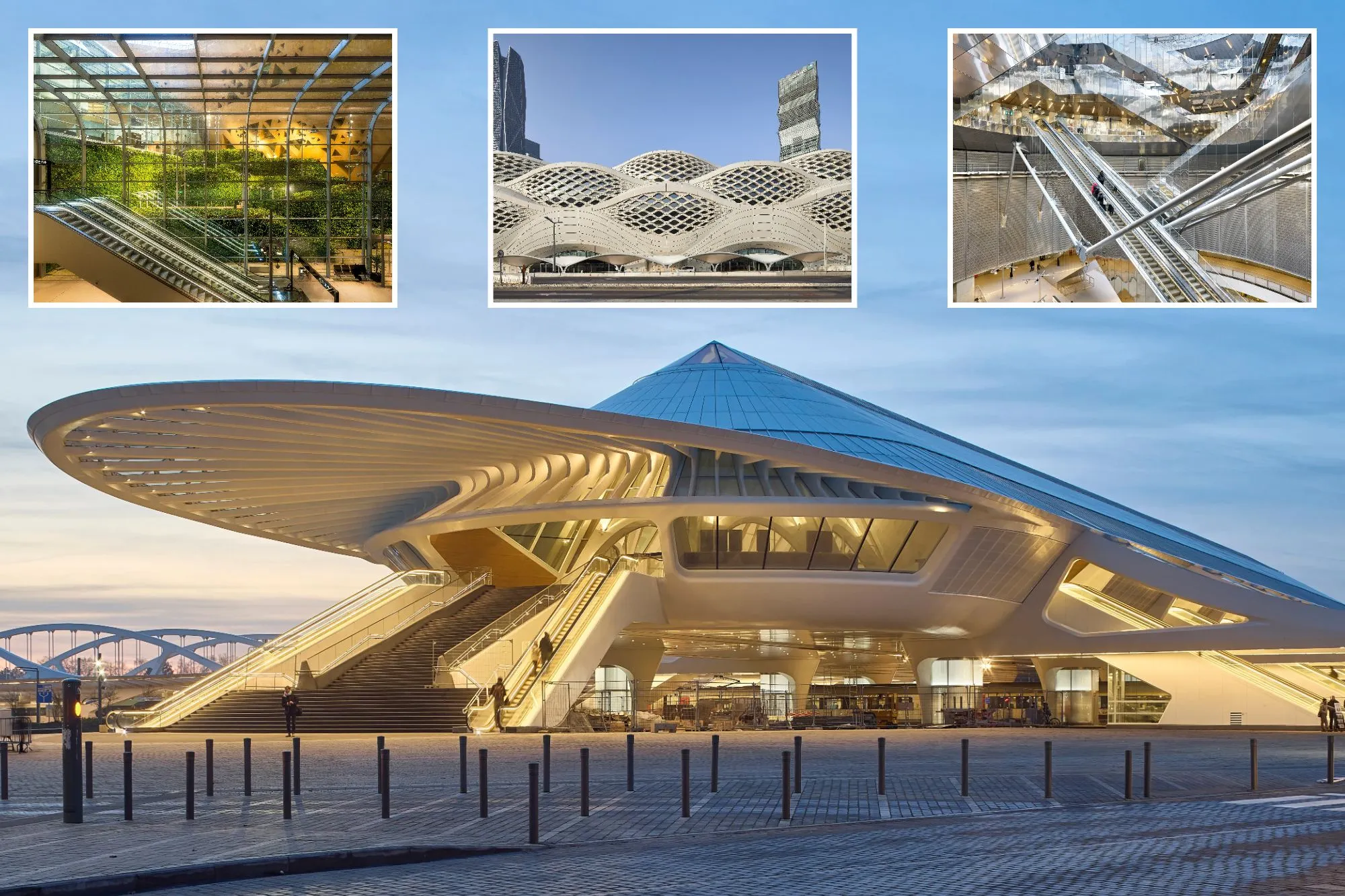
‘The World’s Most Beautiful’ train stations have been revealed and one of Saint-Denis PleyelCredit: UnknownAlso in Paris is Villejuif – Gustave Roussy StationCredit: Michel Denancé
Prix Versailles is a series of architectural competitions, which includes airports, hotels and other buildings.
Now, it’s released the finest train stations that make up the ‘World’s Most Beautiful Passenger Stations List 2025’.
Two of these are in France, and both in the suburbs of Paris, so Brits can visit them in just a few hours.
Saint-Denis is a commune in the northern suburbs of Paris, France and its impressive train station opened last year.
Saint-Denis Pleyel was designed by Japanese studioKengo Kuma and Associates.
The station is tiered on different levels and decorated with wooden slats and floor to ceiling glass windows, so the inside is flooded with light.
Above the station itself is a rooftop park, and inside, is a huge open space with plenty of multi-level escalators.
Gustave Roussy Station in Villejuif, which is 40-minutes south of Paris opened in January 18, 2025.
The station was designed by the architectural firm Dominique Perrault Architecture.
It’s an underground cylindrical station with an open-air, multi-layered roof and is in the style of an ‘upside down skyscraper’ – it’s one of France‘s deepest passenger stations.
The design of KAFD Station resembles sand dunesCredit: HUFTON AND CROWJudge said Mons station is ‘cathedral-like’Credit: Supplied
Over in Belgium is the Mons railway station which has a suspended canopy which is a nod to the Galerie de la Reine shopping arcade in Brussels.
The station originally opened in 1841, but went through its most recent transformation in 2025.
The judging panel said: “It’s a streamlined style made up of steel and dazzling white to form a cathedral-like walkway”.
Other stations receiving the award include Gadigal Station in Sydney, Australia.
The name honours the Aboriginal people who were original custodians of the land around that part of Sydney, and inside are bright tiles in colours such as yellow, purple, red and blue.
Baiyun Station in Guangzhou, China has also picked up the award for its recent transformation which has added shops and even an urban park.
It’s dedicated to 24 high-speed train lines, six subway lines and three bus terminals.
Inside Gadigal Station, Australia, is brightly coloured yellow and purple tilesCredit: UnknownQasr Al Hokm Station in Riyadh has an inside gardenCredit: Unknown
Another is KAFD Station, Riyadh in Saudi Arabia, which is very futuristic-looking with a wave-like exterior that is meant to resemble sand dunes.
Also in Riyadh is Qasr Al Hokm Station which has been described as being like a “periscope” as the glass roof reflects light throughout the station.
Bringing the outdoors in, there’s also a “luxuriant garden unexpectedly materialises within the subterranean space”.
Jérôme Gouadain, Secretary General of the Prix Versailles, underscores the grandeur of the ideals embodied by these edifices: “Excellence lends itself to recognition and humility, and is a necessary quality in this day and age, when there is such a need to extend the harmony manifested in these new passenger stations across entire continents.
“The commitment and the technical and aesthetic prowess demanded by these structures are the highest possible tribute to the building community.
“Already a part of this century’s heritage, this infrastructure is revitalising the role that we as a society attribute to mobility. At each site, beauty is given concrete form, like a lung breathing new life into the city, a shared symbolic territory in the service of its inhabitants.”
Baiyun Station in China has added shops and even an urban park to its designCredit: yang min
World’s Most Beautiful Station List 2025…
Gadigal Station Sydney, Australia
Mons Station Mons, Belgium
Baiyun Station Guangzhou, China
Saint-Denis – Pleyel Station Saint-Denis, France
Villejuif – Gustave Roussy Station
Villejuif, France
KAFD Station Riyadh, Saudi Arabia
Qasr Al Hokm Station Riyadh, Saudi Arabia
Seven stations across the world have been declared the most beautiful in the world – like Mons Station in BrusselsCredit: Unknown
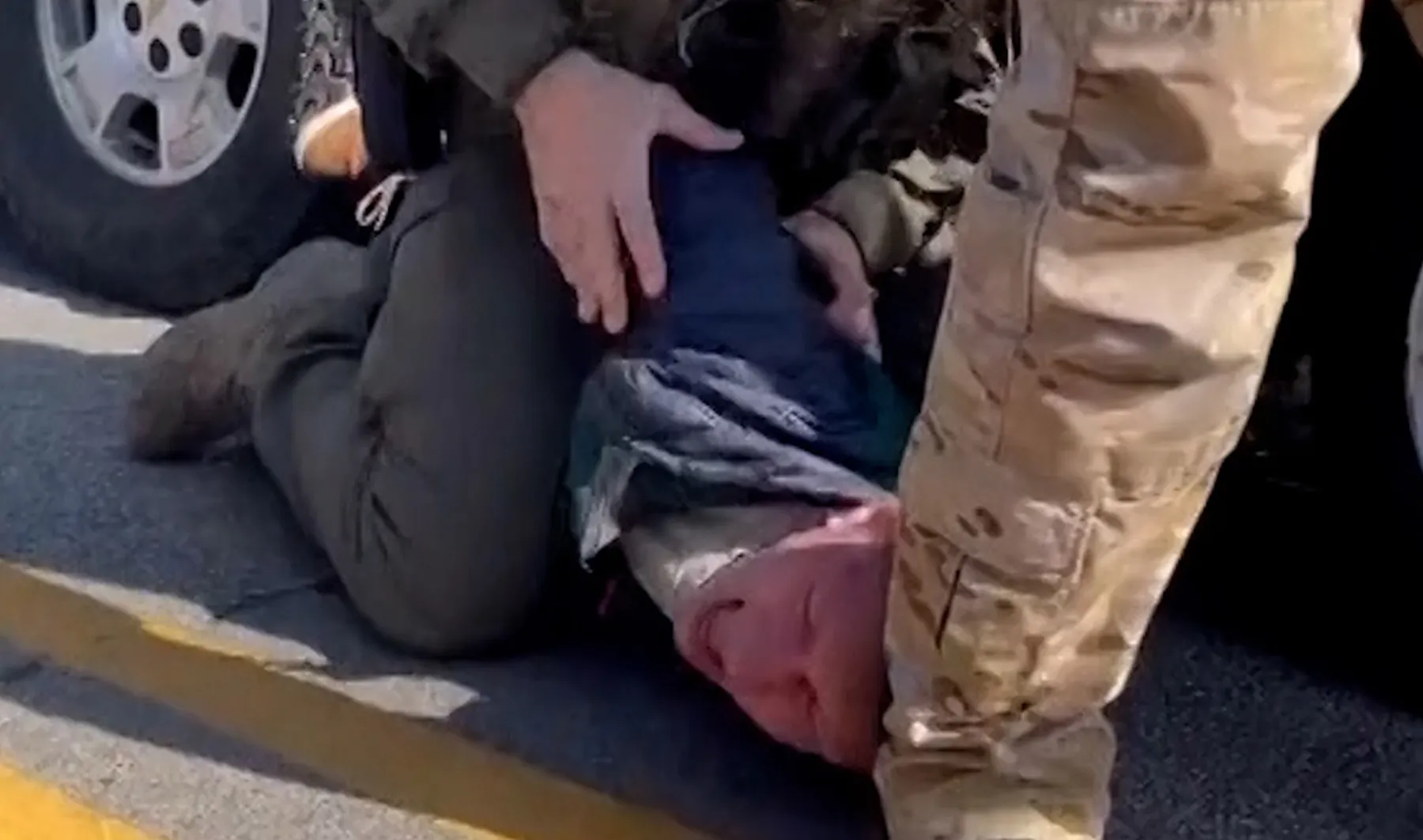
Police in Evanston, Illinois, are investigating a violent arrest by a Customs and Border Protection agent who repeatedly punched a man’s head against the road. It happened after the agent’s vehicle was rear-ended, and a hostile crowd formed telling federal officers to leave, who responded with pepper spray and pointing their guns at protesters.
It’s unclear whether the man being punched was the driver behind the collision or part of a crowd that formed to pressure federal officers to leave. The incident sparked outrage from local leaders and renewed tensions over federal immigration enforcement in the Chicago area.