Transition

Trump’s “Transition” in Venezuela is Starting to Reek

One day Delcy Rodríguez calls for a reform to the justice system after announcing the sudden revocation of the amnesty law her brother sponsored. The other, rumors suggest she’ll reshuffle the country’s higher court without providing any indication of who the new magistrates are going to be. The central bank president she recently named prepares to disclose figures to the IMF for the first time in decades.

The public does little else than follow the news, as if things were normal. Futile debate has emerged on social media over whether the new US chief of mission in Caracas is more hawkish than his predecessor. Or if the opposition has racist tendencies because a singer (once popular in the 2000s) called Delcy an ape in the opposition’s largest rally in years.

The picture of the country in recent weeks is one of Delcy Rodríguez calling the shots with near-total freedom. She has been enjoying a clear head start over a potential presidential election, as she crisscrosses Venezuela on what amounts to an unofficial campaign tour. In Caracas, she keeps changing everything so that nothing really changes. She is intent on controlling government offices in the next four years through newly promoted loyalists and a clean inflow of petrodollars. The chavista elite has looked more confident in the meantime, touring with Delcy in sky-blue outfits, leading cartoonish chants for peace and national union as if the internal contradictions that surfaced two months ago were now less important, because the possibility of survival looks clearer.

Back in February, optimists would discuss the scope of Washington’s coercion capacity over the “caretaker” regime, the boundaries that (if crossed) would trigger a “second wave” of attacks, the disappearance of Alex Saab as a prelude of a broader purge against other “untouchables” that overtly normalized the commission of terror. Now, lunatics like Diosdado Cabello’s nephew, Alejandro Rondón, claim on social media that “the recess is about to end” the same day Delcy says the amnesty scheme ran its course and Cabello recounts an unlikely justice system crackdown.

What followed January 3rdwas a paradigm change with positive practical consequences for society that chavismo quickly learned to manage if not reverse.

Alejandro doesn’t look like the brightest dude. He’s another chavista nepo-kid working for the other Cabello uncle that controls Venezuela’s taxing authority, Jose David, though Alejandro made a name for himself with rage-baiting tweets that celebrated Maduro’s “victory” in 2024 and claimed the opposition were terrorists who falsified the official voting records (i.e. Diosdado’s talking points during the tun-tun operation).]

But an emboldened member of the Cabello Rondón clan is a troubling sign for those who fled the country after being placed on “treason” blacklists. It also undercuts the very notions of pluralism and national reconciliation that Marco Rubio invoked three months ago when outlining his vision for Venezuela’s democratic transition before US senators. Shortly thereafter, Rondón drove the point home by publicly wishing Donald Trump well after the shooting at the White House Correspondents’ Dinner. The message seems clear: the arrangement with Team Trump is comfortable enough that, however fraught the geopolitical backdrop, they can afford to be flippant—even in public. They remain, unmistakably, the bullies in town. 

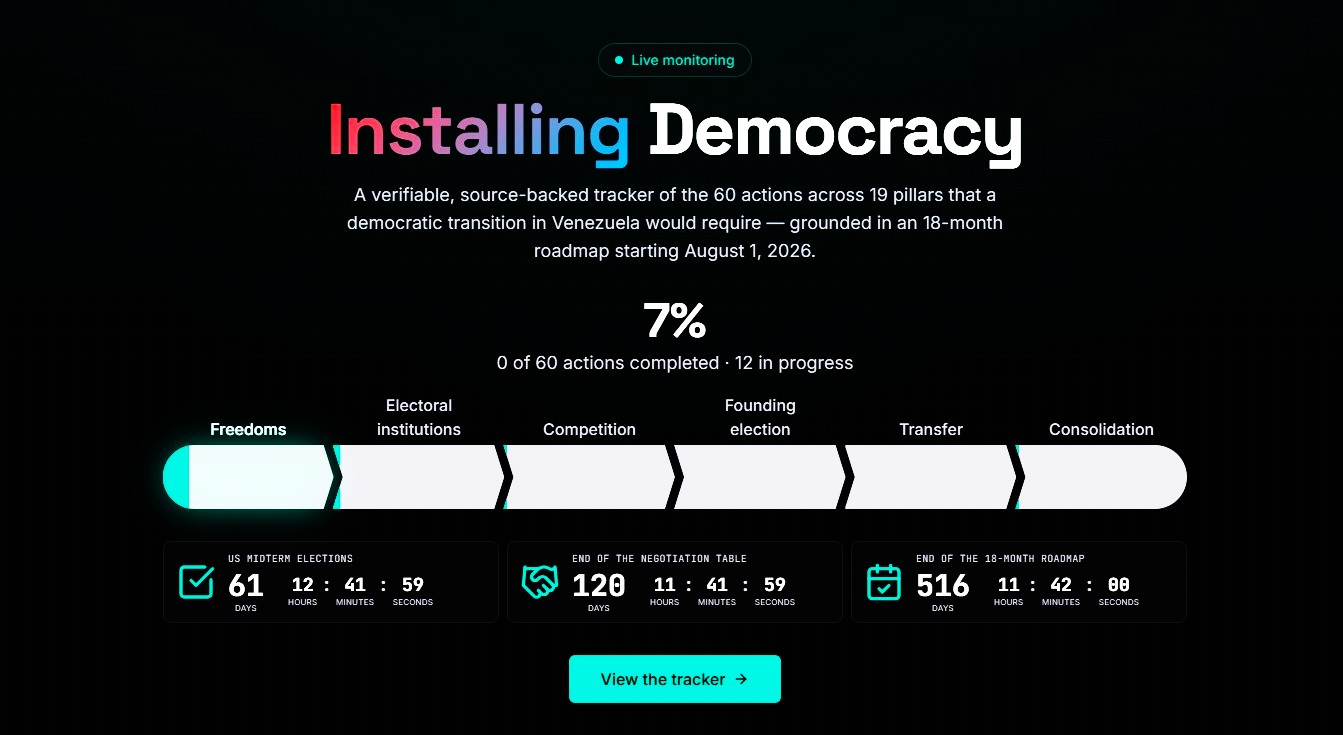
The long wait for elections (or just a calendar?)

What followed January 3rd was a paradigm change with positive practical consequences for society that chavismo quickly learned to manage if not reverse. Allies of Maria Corina  Machado who spent the past two years jailed or hiding are back in the street, even providing testimonies about their imprisonment. The student movement has undergone a revival, liaising with human rights groups to set up carefully-controlled protests. Censorship isn’t what it used to be, so journalists have tried to take advantage of that opening. Pensioners and public workers have perhaps become the loudest actor in confronting Rodríguez, despite having to face colectivos and National Guards whenever they hit the streets.

Repression has become less intense, but the lack of a clear electoral calendar keeps the opposition on the sidelines, waiting for the arrival of Machado, which is no less paralyzing. The amnesty law passed on February 19 effectively funneled the release of political prisoners, shattering expectations of a “landmark outcome” that would speed up the process. 

Indeed, the statute’s contents make more than 180 supposed military rebels ineligible, although the release of a handful of FANB officers in recent days reinforces the idea that a law wasn’t necessary to get people out of jail. Nearly 300 civilians are still imprisoned, and we haven’t seen significant breakthroughs in the past few weeks.

According to figures from NGO Foro Penal (based on documented cases), the political prisoner population fell by 40% in the two months following the US military intervention—dropping from 863 detainees in late December to 526 by March 2. The pace has clearly slowed since then. Chavismo released 36 people between March and April, and 17 over the past 18 days (about 6% of the pre–January 3 total). The regime still resorts to sporadic arbitrary arrests and intimidation. Alexis Paparoni, an opposition figure in Mérida (and brother of Carlos Paparoni), was briefly detained while traveling and later released under precautionary measures. A similar incident occurred last weekend with a government employee in Guárico, who was detained for having a note on his desk bearing the now-infamous slur directed at Delcy.

“These prisoners are currently incarcerated because POTUShas chosen to appease and praise the perpetrators instead of supporting their victims,” Burelli recently told Senator Scott.

The White House appears satisfied with results so far. Venezuela is now subject to sweeping sanctions relief across oil, gas, minerals, and fertilizers, while OFAC has issued waivers allowing operations with public banks. Most notably, Delcy Rodríguez has been removed from the Specially Designated Nationals list—effectively unfreezing her US-based assets and clearing the way for financial dealings under American jurisdiction. 

The opposition leadership has largely stuck to its 2025 strategy of projecting trust and patience toward Donald Trump. María Corina Machado continues to argue that Trump is the head of state who has done the most to advance Venezuela’s liberation and maintains that the Rodríguez government is dismantling the Maduro-era “structures of corruption and repression.” However, she acknowledged last week that a bout of political instability cannot be ruled out. 

“The risk is that if people feel the path [toward freedom and democracy] is beginning to close, they may start to push back in a disorganized and potentially anarchic way,” she told esRadio hosts in Madrid. “That’s why a clearly defined electoral calendar is a guarantee of peace and stability. That would help people accept that this process will last a bit longer, as institutions must be strengthened and we need to take time to prepare for a truly impeccable election.”

Running out of patience

Criticism of the Trump administration’s handling in Venezuela continues to grow among groups of scholars and foreign policy observers, while opposition parties remain largely quiet and prefer to let Machado formulate their stance.

But in general, there’s a tense awareness that the waters are getting muddy. Some in journalism, and other opposition allies are starting to lose their patience.

Venezuelan journalist Sebastiana Barraez, an outspoken critic of chavismo and popular source on repression, told her audience that Venezuelan people have no guarantees about their future. Two days ago, she admitted the overthrow of Nicolás Maduro had raised hopes of a new democracy and true institutional recovery.

“It turns out none of that is happening,” Barráez said. “In Venezuela, Trump is promoting the interests of the United States. The problem is that those interests are not compatible with what we Venezuelans are looking for.”

Pedro Mario Burelli, an independent advisor for the opposition, is among the few figures to be pressing Washington over its ties with Delcy Rodríguez, calling Trump’s decision to elevate her an “incoherent strategy.” He has warned that doing business with Minerven makes the US an effective enabler of environmental crimes in Venezuela’s south. In March, he told The Atlantic that the remaining political prisoners now belong to Trump and Rubio.

“These prisoners are currently incarcerated because POTUS has chosen to appease and praise the perpetrators instead of supporting their victims. Constantly praising Delcy is disgraceful and an insult to the vast majority of Venezuelans”, Burelli told GOP Senator Rick Scott on Sunday.“Faulting her, as you and some of your colleagues do, is disingenuous. Venezuelans rightfully expect, and deserve, much more from democratically elected US officials.”

Source link

So You’re Thinking of Investing in Venezuela

On paper, the case is easy to make. The world’s largest proven oil reserves, a sector being reopened to private capital, sanctions that are no longer absolute but conditional, negotiable. There are new laws, new guarantees, new language around arbitration and contract security. For the first time in years, there is something that looks like a framework, perhaps even a government that exercises absolute power over the country while operating under US tutelage.

And yet, the expected cash tsunami remains elusive. This is because the people who would actually have to write the checks are not asking whether the opportunity is real, but whether it will still exist by the time it matters. No amount of lobbying or PR trips can compensate for almost 30 years of arbitrary abuses. After all, Delcy Rodríguez is not the first chavista “president” to court the private sector or offer guarantees.

The problem is not political risk in the abstract. It is that the legal environment investors are being asked to trust has not meaningfully changed. Judges remain largely unchecked, and contracts are still only as strong as the political relationships behind them. The closest thing to a guarantee is not an institution, but proximity: “I know a guy, who knows a guy, who knows Delcy.”

That may be enough to get a deal signed. It is not enough to guarantee the kind of long-term, multibillion-dollar investment Delcy needs.

Retroactive illegitimacy

There is also the question of who is actually making those commitments. The current governing arrangement, even with partial recognition from Washington, remains the residue of a deeply contested and improvised system. Its authority may be tolerated, even engaged with, but it is not settled. That matters, because any agreement reached today carries the risk of being revisited tomorrow, not necessarily by a hostile regime, but by future jurists attempting to unwind the ambiguities of the present. In other words, the risk is not just expropriation, but retroactive illegitimacy.

And then there is the country itself. The initial shock of alignment with the United States has created a perception of stabilization, but that perception rests on thin ground. Discontent is not ideological, it is material. Power rationing continues to shape daily life. The bolívar remains structurally weak, its periodic stabilizations undone by recurring cycles of depreciation. For most Venezuelans, the promised improvement in living conditions, expected to follow from these inflows, has yet to materialize in any meaningful way.

What investors are being asked to underwrite, then, is not just a country in transition, but a society that has not yet felt that transition in any tangible sense. That gap matters, because it is in that gap where pressure builds.

Contingency is not change

And even if one is willing to accept all of that, there is the question few are prepared to answer directly: what happens in two years?

The current opening in Venezuela is not just tied to internal dynamics. It is deeply contingent on a specific political configuration in Washington. A different administration, with different priorities, could decide that Venezuela no longer warrants the same level of attention, resources, or political cover. The approach taken by Donald Trump has been unusually direct. There is no guarantee that what follows will resemble it.

That matters more than investors tend to admit. Because what is being built today is not a self-sustaining system, but a politically supported one.

Under those conditions, the risk is not simply policy reversal. It is systemic drift. The incentives that currently bind the government to external actors can weaken, and with them, the logic that sustains the present arrangement. That does not require a dramatic rupture. Only time.

There is a way to make sense of this, and it requires going back, not forward. In structural terms, Venezuela today resembles 2017. Not in its specifics, but in the nature of the moment. Back then, the country hovered between sustained pressure that could force an opening, and a system learning in real time how to absorb that pressure and consolidate power instead. For a time, it was not clear which way it would go.

Until it became clear that the system had adapted faster than the pressure could escalate. What looked like a moment of transition became, instead, a lesson in survival. That is the part of 2017 that tends to be forgotten, not the protests, but the outcome.

What makes the current moment difficult to read is that it carries a similar ambiguity. There is an opening, but it is partial. There is pressure, but it is uneven. There are signals that point in different directions at once. Engagement with external actors, selective liberalization, a degree of flexibility that did not exist a few years ago. But none of that resolves the underlying question.

Is this the beginning of a transition, or another iteration of adaptation?

For investors, that distinction is more than academic. It determines whether the current opening represents a structural shift, or simply a temporary configuration that will be absorbed, reworked, and eventually reversed. Venezuela has already shown that it can look like it is about to change, while in fact learning how not to. Ultimately, this question is likely to be the one that holds meaningful investment back.

Unchecked power

There is, underlying many of these conversations, a quieter assumption that rarely gets stated outright. That under the right conditions, a system like Venezuela’s can be made to work. That a centralized authority, aligned with external actors and supported by technocratic management, can deliver stability without resolving deeper political contradictions. The long-held fantasy of the benevolent strongman.

It is an attractive idea. It is also one that Venezuela has consistently disproven.

The problem is not simply that power is concentrated, but that it is unconstrained. In such a system, predictability does not come from strength, but from rules. When those rules are absent, even proximity to power stops being a reliable safeguard.

The recent arrest of Wilmer Ruperti is a reminder of that. Ruperti was not an outsider testing the limits of the system. He was deeply embedded within it. If anything, he represents the kind of relationship many investors assume can mitigate risk.

And yet, under conditions of unchecked authority, those relationships can be redefined overnight.

In practice, this often produces the opposite of what investors expect, a system where decisions are centralized but not necessarily stable, and where alliances are strong until they are not.

Under these conditions, Venezuela does not favor all investors equally. It favors those who can operate within political constraints, tolerate legal ambiguity, and adjust quickly if those constraints shift. It is less hospitable to actors whose models depend on enforceable contracts, long time horizons, and institutional continuity.

Venezuela is not uninvestable, but it is not becoming normal either.

What is taking shape is something more ambiguous. It is open enough to transact and stable enough to operate in the short term, but uncertain in ways that are harder to measure. The legal framework remains contingent, the political authority behind it is still contested, and the external backing that sustains it is, by definition, temporary.

That does not eliminate opportunity, it defines it. Under those conditions, the question is not whether Venezuela works, but for whom, for how long, and under what assumptions about continuity that may not survive the life of the investment.

In that sense, the risk is not only that things go wrong, but that the terms under which they work are never fully settled.

Source link

Like in Ethiopia? A Failed Transition’s Lessons for Venezuela

In 2012, I participated in a United Nations mission in Ethiopia for a technical cooperation event on international trade, which at the time was my area of expertise. Since then, every major development in Venezuela brings me back to that trip, which proved far more revealing than I could have imagined. More than once, I have found myself thinking: this is just like in Ethiopia.

I witnessed firsthand, before it unfolded in Venezuela, that totalitarian systems do not just collapse. They transform in order to survive and advance, as Hannah Arendt argued. Over time, I also came to understand that while authoritarian regimes may promise reform and a democratic transition, without sustained external and domestic commitments those promises tend to dissolve sooner rather than later. This insight is particularly relevant in the current Venezuelan process.

On my way from Addis Ababa airport to the hotel, I noticed large portraits of a politician displayed throughout the city. Thinking of the strongman politics I knew from home, I asked the official accompanying me whether he was the president. “No,” he replied, “the prime minister. He died.” Surprised, I asked why his images were still everywhere. “Don’t these images bother the new one?” “No, because he chose his successor,” came the answer. When I pressed further and asked whether people had voted for him, the response was matter-of-fact: they belonged to the same party, and parliament had selected him.

In those few days, I caught a glimpse of what Venezuela would later experience between 2013 and 2019, after Chávez died and his handpicked successor Maduro came to power. I saw a country marked by hunger, where people wandered with a vacant, distant gaze. A look that would later become painfully familiar during Venezuela’s humanitarian crisis. That image contrasted sharply with the ruling elite, visibly prosperous, gathering in luxury hotels and indulging in imported comforts. I saw women collecting firewood to cook because two decades of socialist mismanagement and corruption had destroyed the electrical system. I saw the haze produced by environmental degradation, similar to what would later hang over Caracas. I also observed a strong Chinese presence, already a dominant economic partner and creditor.

During that mission, I came to understand how the ruling system had entrenched poverty, controlled resources, and normalized corruption, not merely as governance failures but as mechanisms of social control. Years later, working from a human rights perspective, I would recognize these patterns as instruments of ideology, repression, and economic, and ethnic exclusion.

His profile seemed ideal: a system-man, with military and security credentials, Western education, and a discourse centered on reform and reconciliation.

I also witnessed the regime’s hostility toward international actors, imposing strict conditions on United Nations operations and limiting the work of officials on the ground. Hearing the likes of Jorge Rodríguez and other Venezuelan representatives threaten Volker Turk this year, the High Commissioner for Human Rights, did not surprise me. I had seen that before, years earlier, in the Horn of Africa.

Now, I return to the phrase like in Ethiopia because, following the US operation to capture Maduro, the proposed plan for stabilization, recovery, and democratization echoes a trajectory that Ethiopia followed over the past decade. 

The Ethiopian Delcy

Let’s go back to 2018. A figure from within the ruling coalition, Abiy Ahmed, rose to power after three years of widespread protests and political unrest that led to the resignation of Hailemariam Desaleng. Although it is not clear how much the US and the EU were involved in his rise, he was not directly imposed from outside as has been the case with Delcy Rodríguez, but he was “unequivocally embraced” by the United States and the European Union. Abiy became the media’s darling, who placed their bets on him and promoted the new leader as a reformist capable of modernizing the country.

His profile seemed ideal: a system-man, with military and security credentials, Western education, and a discourse centered on reform and reconciliation. Between 2018 and 2020, Ethiopia experienced a period of remarkable transformation on three fronts: recovering the economy, stabilizing the region and strengthening the rule of law.

The economy grew at an annual rate of around 7 percent, key sectors were opened to foreign investment, and political reforms were introduced, including the release of political prisoners, the return of those in exile, the legalization of opposition parties, and greater press freedom. Women were incorporated into government at unprecedented levels. On the international stage, Ethiopia expanded its diplomatic engagement, signed trade agreements, and most notably reached a peace agreement with Eritrea, which earned Abiy the Nobel Peace Prize.

Political attention from foreign actors is limited, international agendas evolve rapidly, and what might begin as a priority can quickly be overtaken by other crises.

Yet this period of optimism proved fragile. Tensions in 2020 with the Tigray People’s Liberation Front, once part of the ruling coalition, escalated into a full-scale internal conflict. Abiy’s government shifted course and relapsed. The reform process gave way to a reassertion of authoritarian power, along with widespread human rights violations, restrictions on the press, and accusations of war crimes.

The response from the United States and the European Union included targeted sanctions, visa restrictions, suspension of trade benefits, and partial freezes on aid. Abiy’s international image deteriorated significantly, and Ethiopia began to diversify its alliances, strengthening ties with China, engaging with Russia, and expanding cooperation with actors such as Turkey, the United Arab Emirates, and Iran, eventually becoming members of the anti-West BRICS alliance.

Careful with the honeymoon phase

The Ethiopian case offers at least one revealing lesson. External support can facilitate an initial opening and even generate strong economic momentum, but it does not guarantee a democratic transition. 

When international commitment weakens before new institutional rules are consolidated, the outcome is often not transformation but reconfiguration. The system adapts to the new reality, but is not replaced or merely revamped. This dynamic reflects a broader pattern in contemporary international politics. Particularly since the costly experiences of Iraq and Afghanistan, external actors have tended to favour reform processes led by internal figures rather than imposing leadership from outside. However, the central challenge lies not in how these processes begin, but in what happens when external support diminishes, which often occurs during the crucial consolidation phase.

Both the United States and Europe tend to operate within relatively short time horizons when supporting political transitions, often between two and four years, three if I revert to an American security and communications expert whom I worked with yet in another career chapter. These timelines are shaped by electoral cycles, budgetary constraints, shifting strategic priorities, and, in the European case, the difficulty of sustaining consensus among multiple states with divergent interests. Political attention is limited, international agendas evolve rapidly, and what might begin as a priority can quickly be overtaken by other crises. The result is a form of strategic fatigue that has been evident in multiple contexts over the past decades.

By contrast, the transitions most often cited as successful (such as those in Chile, South Africa, and Eastern Europe) were characterized by sustained external engagement over much longer periods, often a decade or more, combined with favourable internal conditions. These cases demonstrate that democratic consolidation is not the product of a short window of opportunity, but of a prolonged commitment.

For Venezuela, the implications are clear. The current process may well generate an initial opening, attract investment, and produce early signs of stabilization. But without sustained international engagement beyond the initial phase, there is a risk that the system will stabilize without fundamentally democratizing. The lesson from Ethiopia is not that transition is impossible, but that it is incomplete if the conditions for its consolidation are not maintained.

The real challenge, therefore, is not how the transition begins, but whether it is sustained long enough to transform the underlying structures of power. Otherwise, we may once again find ourselves looking at a familiar outcome and thinking, once again, like in Ethiopia.

Source link