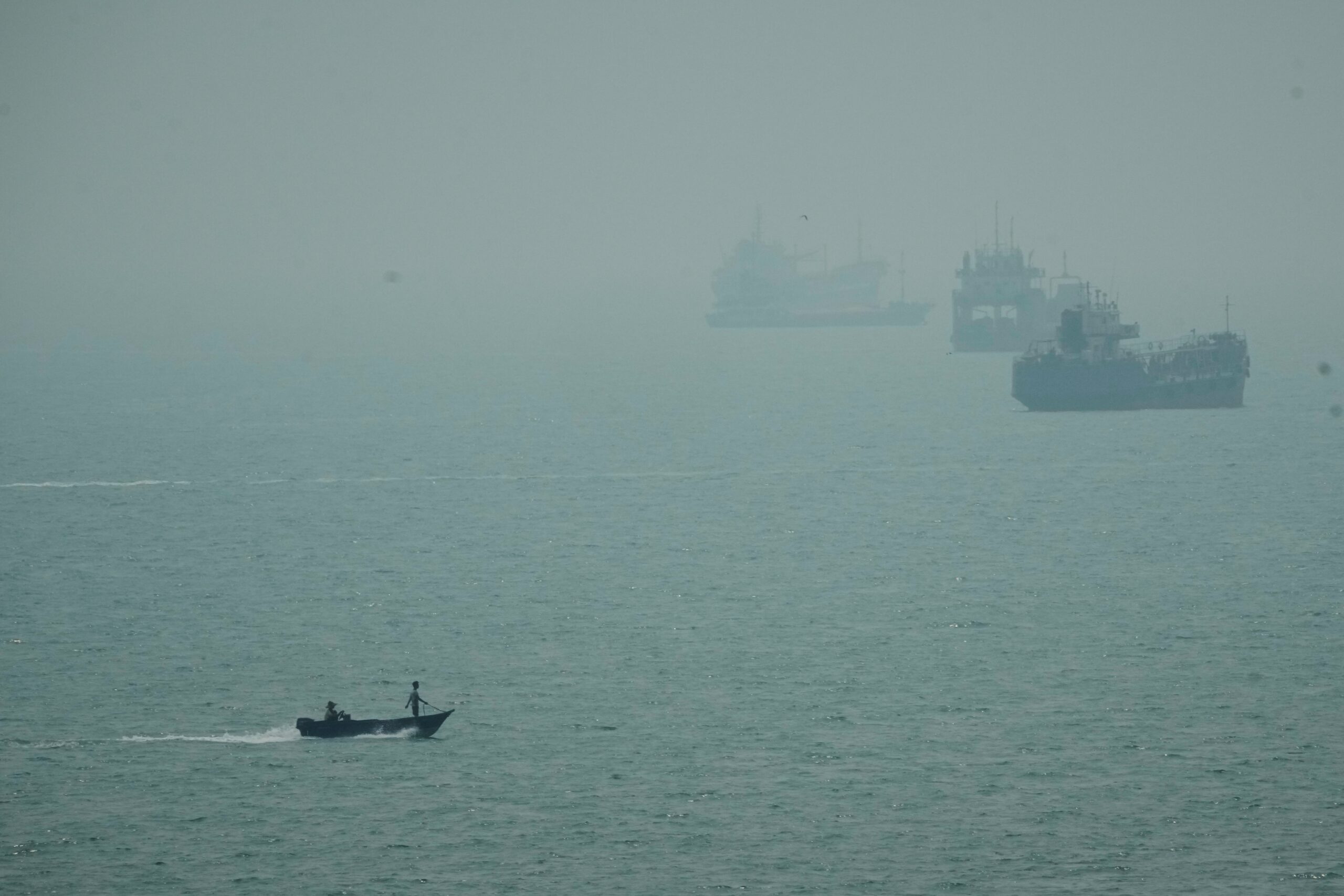
transit

Top security adviser says transit through Strait of Hormuz not going smoothly, vows to seek alternative routes

National Security Adviser Wi Sung-lac, seen here at a press conference in Singapore on March 2, 2026, said Friday the passage of ships through the Strait of Hormuz still remains largely blocked. Photo by Yonhap

National Security Adviser Wi Sung-lac said Friday the passage of ships through the Strait of Hormuz still remains largely blocked despite a two-week ceasefire between the United States and Iran, pledging that South Korea would continue to seek alternative shipping lanes.

Speaking at a press briefing at Cheong Wa Dae, Wi stressed that the government will continue efforts to secure alternative supplies of crude oil and naphtha amid concerns over Iran’s continued restrictions on traffic through the vital waterway.

“Shipping through the Strait of Hormuz remains disrupted,” Wi said. “Uncertainty in the supply chains is likely to continue for the time being.”

Wi noted that the number of vessels crossing the strait has not increased significantly since the ceasefire was agreed to on Tuesday (U.S. time).

“If around 2,000 vessels trapped in the strait attempt to leave all at once, it can take time, and securing safe shipping routes may also pose a challenge,” he said.

The government will continue to communicate with relevant countries to ensure the safety of all vessels and crew members, including 26 Korean-flagged ships that remain stranded in the Strait of Hormuz.

Copyright (c) Yonhap News Agency prohibits its content from being redistributed or reprinted without consent, and forbids the content from being learned and used by artificial intelligence systems.

Source link

Oman, Iran discuss smooth transit in Strait of Hormuz, Muscat says | US-Israel war on Iran News

The talks have focused on a ‘smooth passage’ through the Strait of Hormuz, as Tehran effectively blocks the vital waterway.

Oman and ⁠⁠Iran ⁠⁠have held deputy foreign ⁠⁠minister-level talks, discussing ⁠⁠options to ensure the smooth transit of vessels through the Strait ‌‌of Hormuz, according to the Omani Foreign Ministry.

The meeting was held on Saturday “at the level of undersecretaries in the foreign ministries of the two countries”, the ministry said on Sunday in a post on X, adding that it was “attended by specialists from both sides”.

Recommended Stories

list of 3 itemsend of list

“Possible options were discussed regarding ensuring the smooth passage through the Strait of Hormuz during these circumstances witnessed in the region,” it added. “During the meeting, experts from both sides presented a number of visions and proposals that will be studied.”

On Sunday, three Omani ships appeared to be transiting the Strait of Hormuz, outside Iran’s “approved corridor” near Larak Island, according to tracking data monitored by shipping journal Lloyd’s List.

The convoy consists of two large oil supertankers and one liquefied natural gas (LNG) carrier that are sailing “unusually close to the Omani coast”, according to the United Kingdom-based outlet.

INTERACTIVE - Strait of Hormuz - March 2, 2026-1772714221

The developments come after an Iranian ⁠⁠official said on ⁠⁠Thursday that Iran was drafting a protocol with ⁠⁠Oman to monitor ⁠⁠traffic in the ⁠⁠strait, through which about a fifth of global ‌‌oil supplies travel, and which Iran has severely restricted in retaliation for the ongoing US-Israeli war on the country.

Since the war began on February 28, Iran’s Islamic Revolutionary Guard Corps (IRGC) has allowed some vessels to transit, including Pakistani, French, and Turkish-linked vessels. But about 3,000 others are stranded.

Strait effectively blocked

The waterway is a critical chokepoint for global energy shipments, especially oil and gas moving from the Gulf to Europe and Asia.

Disruptions there have injected volatility into the market and pushed oil- and gas-importing countries to seek alternative sources.

United States President Donald Trump, in a social media post over the weekend, threatened to unleash “all Hell” if it is not opened by Monday.

Egypt’s ⁠⁠Foreign ⁠⁠Minister Badr Abdelatty held separate calls ⁠⁠to discuss proposals for regional de-escalation ⁠⁠with US Special Envoy Steve Witkoff and regional counterparts, including Iranian ‌‌Foreign Minister Abbas Araghchi, the Egyptian ministry said in a statement on Sunday.

Amin Saikal, a professor emeritus at the Australian National University, said an expansion of the war “is going to be hell for the whole region”. “There has to be some kind of negotiated settlement,” he told Al Jazeera on Sunday.

“But at this stage, the door for a diplomatic solution seems to be very narrow, unless President Trump decides that this conflict has caused so many problems for him domestically, as well as internationally, that it is really time to reach some compromise with the Iranians,” Saikal concluded.

Source link

Iran’s top envoy says S. Korean ships can transit Strait of Hormuz only after coordination with Tehran

Iranian Ambassador to South Korea Saeed Koozechi speaks during a press conference at the Iranian Embassy in Seoul on Thursday. Photo by Yonhap

Iran’s top envoy to Seoul said Thursday South Korean ships can pass through the Strait of Hormuz, but only with prior coordination with Tehran, saying that his country has asked Seoul to provide details of the vessels stranded in the key waterway amid the ongoing conflict.

Iranian Ambassador to South Korea Saeed Koozechi made the remarks in a press conference, as 26 South Korean ships with about 180 crew members aboard remain stranded in the shipping lane effectively blocked by Iran following attacks by the United States and Israel.

Koozechi also said that Iran considers South Korea a non-adversarial country.

“There are no problems with the vessels,” he said through an interpreter. “But in order for them to pass through, you need coordination, prior consultations with the Iranian military and government.”

Koozechi went on to say that Tehran had asked Seoul to provide the details of the stranded ships during the phone talks between their foreign ministers on Monday, without specifying whether the request was meant to start negotiations on the ships’ passage.

“Iran is acting in good faith and is willing to allow South Korean ships to transit the Strait of Hormuz, but the process will depend on receiving the relevant information and the vessels list. Once they are provided, we will consider it,” he said.

When asked to confirm Iran’s request, Seoul’s foreign ministry said it was a request for cooperation on safety measures in the event of a humanitarian situation on the anchored vessels, and not related to their transit.

“We have not negotiated (with Iran) on (the passage) of vessels,” a ministry official said, adding that it has received no such request from Tehran, nor has it provided any details of the ships.

In the phone talks with his Iranian counterpart, Foreign Minister Cho Hyun called on Tehran to ease tensions and ensure safe navigation through the vital waterway for global energy supplies.

Cho also requested Iran’s cooperation regarding the safety of stranded South Korean vessels and their crew, but the issue of permitting their transit was reportedly not addressed.

While Iran sees South Korea as a non-hostile country, restricting activities of ships engaged in business with U.S. companies has been unavoidable as part of its self-defense measures, the ambassador said.

“Imposing restrictions on them is only natural,” Koozechi said. “Blocking their activities and enforcing economic restrictions is Iran’s right to self-defense.”

Thursday’s press event featured a photo exhibition and documentary screening at the Iranian Embassy in Seoul. The materials highlighted the impact of U.S.-Israeli attacks on Iran, including images of destroyed buildings and footage of children killed in an airstrike at an elementary school and their grieving families.

Copyright (c) Yonhap News Agency prohibits its content from being redistributed or reprinted without consent, and forbids the content from being learned and used by artificial intelligence systems.

Source link

Iran says it will allow Japanese ships to transit the Strait of Hormuz | US-Israel war on Iran News

Japan sources more than 90 percent of its crude oil imports from the Middle East and is heavily dependent on exports transiting the key waterway.

Iran says Japanese ships will be allowed to transit the Strait of Hormuz, in the latest sign that Tehran has started pursuing a selective blockade of the strategic waterway.

“We have not closed the strait. In our opinion, the strait is open. It is closed only to ships belonging to our enemies, countries that attack us. For other countries, ships can pass through the strait ,” Iranian Foreign Minister Abbas Araghchi told Japan’s Kyodo News late on Friday.

Recommended Stories

list of 4 itemsend of list

“We are talking to them to find a way to pass safely. We are ready to provide them with safe passage. All they need to do is contact us to discuss how this route will be,” Araghchi said, according to an English transcript of the interview shared on his Telegram account.

Japan sources more than 90 percent of its crude oil imports from the Middle East and is heavily dependent on exports transiting the strait, but the waterway has been de facto closed since the United States and Israel attacked Iran on February 28.

INTERACTIVE - Strait of Hormuz - March 2, 2026-1772714221

Iran’s Islamic Revolutionary Guard Corps (IRGC) warned in the early days of the war that its forces would set “ablaze” any ships trying to transit the waterway, bringing marine traffic to a near standstill.

Over the past week, however, Iran has toned down the rhetoric to say the strait is only closed to Tehran’s enemies.

Japan may soon join the small cohort of countries – mainly China, India, and Pakistan – whose vessels have been allowed to transit the waterway in recent days, with approval from Iranian authorities.

Lloyd’s List, a shipping and maritime information service, separately reported that 10 ships have transited the strait by sailing close to Iran’s coastline – a route that is emerging as a “safe corridor” for shipping.

The latest ship, a Greek bulk carrier, transited on Friday by passing close to Iran’s Larak island , Lloyd’s said, while broadcasting the message “Cargo Food for Iran”.

While ships have been transiting on a case-by-case basis, Lloyd’s List reported that the IRGC is developing a more coordinated vetting and registration system.

As the war on Iran hits three weeks, a handful of countries – among them US allies – have already started lobbying Tehran to reopen the strait or allow their ships safe passage.

Japan, France, Germany, Italy, the Netherlands, and the United Kingdom earlier this week issued a joint statement expressing their “readiness to contribute to appropriate efforts to ensure safe passage through the Strait”.

Iraq, Malaysia, China, India and Pakistan have all reportedly held direct talks with Tehran to discuss the matter, according to Lloyd’s.

Araghchi’s remarks to Kyodo follow a call with Japanese Foreign Minister Toshimitsu Motegi on Tuesday, during which Tokyo expressed concern about the large number of Japanese vessels currently stranded in the Gulf, according to a Japanese readout of the call.

Source link