California bill aims to help discharged transgender troops
U.S. Navy sailor Chase Humes is moving back to his dad’s house in Texas.
Last month, the 25-year-old was notified that his “voluntary separation” from the Navy, which he’d applied for in May 2025, had been approved — he would be released from service. He and his wife must be out of their military housing in San Diego by mid-July.
Humes, a transgender man who’s been taking testosterone for seven years, was among at least 1,000 service members who chose to leave on their own terms rather than face involuntary separation following the military’s February 2025 ban on transgender service members. By choosing a voluntary separation, he’s been approved for an “honorable discharge,” which preserves access to benefits like Veterans Affairs healthcare that others worry they might not have access to.
Humes is one of about 4,200 transgender service members the Department of Defense estimates have been diagnosed with gender dysphoria and could be subject to the policy. Advocates say the transgender service member population could exceed 15,000, according to a UCLA study from 2014.
A new California bill, Assembly Bill 1775, is intended to assist people who don’t have the certainty of Humes’s honorable discharge and worry about their future prospects if they were forced out of the military. Proponents say the bill, by San Diego Democratic Assemblymember Chris Ward, could help people who are given less than honorable discharge for hiding their transgender identity by helping them restore access to services.
In the meantime, service members like Humes are scouting their next move. The sailor and his wife have been searching for jobs near his dad’s house outside Houston. They can’t afford to start their life in San Diego, despite having fallen in love with the city’s accepting atmosphere.
“The whole reason I joined was for a better future for myself and my family, and it just got torn away,” Humes said of the separation.
Over a year in limbo
Among the flurry of executive orders President Trump issued at the start of his second term was the Prioritizing Military Excellence and Readiness order.
It rescinded President Biden’s policy permitting transgender people to openly serve in the forces, and asserted that gender dysphoria and using pronouns different than one’s biological sex at birth were inconsistent with the country’s “high standards for troop readiness, lethality, cohesion, honesty, humility, uniformity, and integrity.”
What followed the Jan. 27, 2025 order was a series of legal challenges, some of which are still ongoing. Last month, a federal appeals court ruled that Trump’s ban on transgender people in the military was likely unconstitutional, allowing a group of 28 plaintiffs from across the country to continue serving while their case proceeds.
Transgender troops were faced last spring with the choice of either voluntarily leaving the military, and in some cases receiving separation pay, or saying nothing and hoping they were not found out and “involuntarily separated” from the forces.

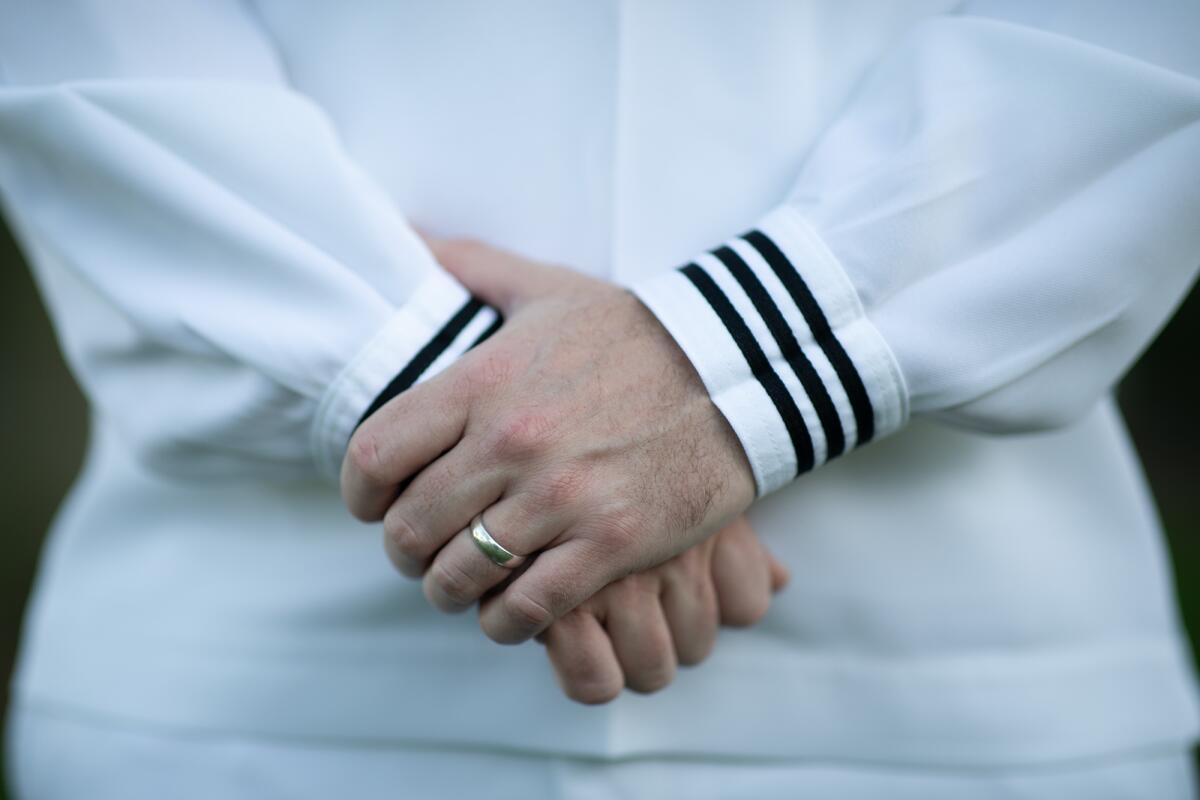
Humes is choosing to voluntarily leave the Navy after the Trump administration announced a policy banning transgender troops.
(Adriana Heldiz / CalMatters)
Kat Koehlmoos, who was in active duty for eight years and is now in an inactive Army Reserve status, said the military chain of command does not know she is transgender.
“Anyone could use my testimony today to report me to the Army Reserves here, and they would be required to take action to involuntarily discharge me from the U.S. military,” she told lawmakers during a hearing on the legislation last month.
Koehlmoos is a board member for SPARTA Pride, which advocates for transgender service members and co-sponsored the legislation. She said the bill came about in part because supporters are concerned the federal government might replicate the actions it took during its “don’t ask, don’t tell” policy, which allowed gay, lesbian and bisexual troops to serve if they concealed their sexual orientation. Some 2,000 troops were given less than honorable discharges in connection to the policy, and were shut out of some veterans’ benefits, according to a class-action lawsuit that was settled in 2025.
Koehlmoos said the group anticipates some people who are “involuntarily separated” under the 2025 transgender ban will be punished by the Department of Defense for not complying with the law.
“They may pursue other charges: accusing them of falsifying records or lying on federal documents, and attempt to get them a less than honorable discharge because of that,” she said, although SPARTA Pride does not know of any such cases so far.
If that happened in California, Ward’s bill would help those people qualify for expedited professional licensing in civilian careers like contracting and nursing and prioritize them for discharge upgrades as well as housing and support services.
Ward said he believes the benefits of all service members should be secured, whether they leave voluntarily or involuntarily.
“They have served honorably, and this was a separation that was involuntary, and they would deserve the full benefits that they otherwise would have been due had they been cisgender,” he said.
Unknown number affected
It’s unclear how many people could be affected by the legislation. Ward has repeatedly told fellow lawmakers that 2,900 of the federal government’s estimated 4,200 transgender troops — 69% — are either from California or are currently stationed in California. In an emailed statement in response to a question from CalMatters, Ward said the figures were mistakenly adopted after conversations with veterans’ advocates, and he would no longer use them to describe the number of affected California service members.
The bill would also require the state’s Department of Veterans Affairs to create a new housing and supportive services grant for veterans, which Ward said would fill a gap in existing housing support for veterans experiencing imminent homelessness. But the budget Gov. Gavin Newsom signed Monday does not include funding for that program.
Instead, it directs $2 million toward the state’s existing Veteran’s Military Discharge Upgrade Grant Program, which provides legal assistance for veterans fighting for a discharge upgrade.
As Humes prepares to leave San Diego, Ward’s bill is still pending in Sacramento. The legislation has cleared policy committees in both houses and awaits a hearing in the Senate appropriations committee.
Koehlmoos said the moment is stressful for most transgender troops — those being removed voluntarily, who have few options; the people who haven’t notified the chain of command, who may be living in fear; and the service members who will delay their transition, or never transition, because of the federal government’s ban on transgender troops.
“For me that’s heartbreaking, because that really is putting your life on hold,” she said.
Kate Wolffe writes for CalMatters.