trainer

Boeing Drops Out Of Navy’s T-45 Jet Trainer Replacement Competition

Boeing has decided not to pursue a bid for the U.S. Navy’s Undergraduate Jet Training System (UJTS) competition. The company had previously planned to submit a version of the T-7A Red Hawk being built now for the U.S. Air Force. The winning UJTS design will replace the Navy’s T-45 Goshawk jet trainers. The new trainers will become part of a future naval aviation training curriculum for prospective tactical jet pilots that no longer requires carrier qualifications or even simulated touch-and-go carrier landings at bases on land.

The Navy issued a formal request for proposals for UJTS in March. The service currently plans to acquire 216 new jet trainers to replace the just under 200 T-45s that are in its inventory today. With Boeing now out of the running, the Sierra Nevada Corporation (which has now partnered with Northrop Grumman and General Atomics) and a team led by Leonardo and Textron are the only known remaining competitors. Lockheed Martin, which had teamed with Korea Aerospace Industries (KAI), also dropped out back in April. Aviation Week and Breaking Defense were among the first to report on Boeing’s decision regarding UJTS.

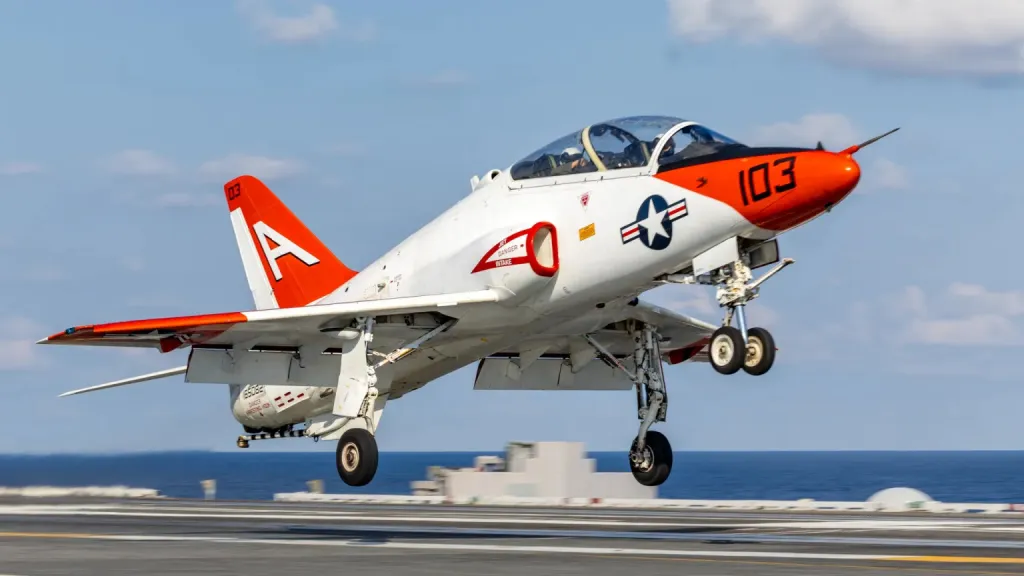
The winning UJTS design will replace the Navy’s T-45 jet trainers, one of which is seen here. USN

“Boeing is focused on meeting our commitments, and we bid for programs where we believe we can provide the right solution tailored to our customers’ needs and requirements,” a Boeing spokesperson told TWZ. “After careful evaluation, we have determined the T-7A does not meet the U.S. Navy’s Undergraduate Jet Training System requirements.”

“We have therefore informed the Navy that we will not bid on the current RFP. We remain committed to delivering the T-7A as a modern, growth-oriented training solution for 4th, 5th and 6th generation pilots as requirements evolve,” they added. “We look forward to providing and sustaining both current and future capabilities for the Navy.”

Boeing says its decision on UJTS is tied to the General Electric F404 turbofan. The company has stressed that the F404 is a proven design with millions of flight hours on multiple platforms, including the T-7A, and is a clear example of a ready-to-field design. Still, Boeing’s view is that the UJTS engine qualification requirements would require additional long-cycle development work, and potentially limit its ability to meet the Navy’s initial operational capability target for the new jet trainers.

All this being said, it is still not entirely clear what the specific issues might be, given that the F404 is such a well-established design that has been and continues to be used on a variety of military aircraft. This includes several other land-based jet trainer designs beyond the T-7, like the Scaled Composites Model 400, which competed against the Red Hawk in the Air Force’s T-X competition, and the Turkish Aerospace Industries Hürjet.

Maintainers work on the F404 engine on a US Air Force T-7A Red Hawk. USAF/Zelideth Rodriguez

Most notably, the F404 also powers the TF-50N that Lockheed Martin and KAI had put forward for UJTS. At the time of writing, neither Lockheed Martin nor KAI looks to have offered a detailed explanation for the decision to withdraw from the Navy jet trainer competition.

A rendering of the TF-50N. Lockheed Martin

The T-7A has also suffered from various technical and other issues over the course of its development, which has led to significant delays in its entry into Air Force service. The service is now hoping to reach initial operational capability with the Red Hawk next year. Any potential for direct synergies in terms of support and sustainment between the Air Force and Navy jet trainer fleets is now off the table.

It is worth pointing out that the TF-50N and the T-7 are also both single-engine designs. The Beechcraft M-346N that Leonardo and Textron have put forward is powered by a pair of Honeywell F124 turbofans. Two Williams FJ44-4M turbofans power SNC’s Freedom Jet, which is also the only clean-sheet design in the running for UJTS. This may point to a general view of the UJTS requirements that make single-engine designs less attractive.

A rendering of the M-346N. Textron/Beechcraft
A rendering of a pair of SNC Freedom Jets. SNC

The Freedom Jet design is also tailored to meet now-axed requirements for UJTS to be able to perform carrier qualifications and simulated carrier touch-and-goes at base on land. The requirements for so-called Field Carrier Landing Practice (FCLP) training at facilities ashore have historically been structured specifically in a way that “simulates, as near as practicable, the conditions encountered during carrier landing operations,” according to the Navy.

F-18 Field Carrier Landing Practice (FCLP). Touch-and-Go Landing. thumbnail

F-18 Field Carrier Landing Practice (FCLP). Touch-and-Go Landing.


SNC says its choice to build an aircraft that can still perform these tasks is deliberate, and offers the Navy what could still be important capability and flexibility in the future, as you can read more about here.

The Navy’s decision to remove carrier qualifications and otherwise alter key aspects of the tactical jet aviator training pipeline has been and continues to be controversial. The service has argued that substantial investments in virtualized training and assisted carrier landing capabilities, such as Magic Carpet and its successors, have fundamentally changed the landscape when it comes to training future pilots for carrier-based operations.

Flight Ready: Magic Carpet thumbnail

Flight Ready: Magic Carpet


Flight Ready: Live, Virtual, Constructive thumbnail

Flight Ready: Live, Virtual, Constructive


Earlier this month, the Navy also confirmed that it had raised the total cost ceiling for the prospective UJTS contract from approximately $1.8 billion to $2.7 billion.

“The Government updated the price cap to reflect a change in the program cost estimate due to new information received,” Naval Air Systems Command (NAVAIR) subsequently explained, according to Breaking Defense.

The substantial increase in the projected cost has raised its own questions about the outlook for the competition and the development program that is expected to follow. The Navy’s decisions to scale back its training requirements had previously been seen as opening the door to existing land-based jet trainer designs, or derivatives thereof, like the T-7 and the TF-50N. That, in turn, was viewed as a potential way for the service to help keep costs and risk low.

A rendering of the version of the T-7 Boeing had previously planned to submit to the UJTS competition. Boeing

The Navy’s T-45 replacement plans have already been delayed multiple times, with the service originally planning to pick a winning design this year and to have the first example enter operational service in 2028. The goal now is to award a contract in the middle of next year.

The aging T-45 fleet has faced its own struggles, including a spate of reported hypoxia-like physiological episodes among pilots that led to the development of a new oxygen system. There have been several Goshawk crashes in recent years due to a variety of factors, with the most recent coming just last month. The pilots in that case thankfully survived.

For Boeing, the decision to drop out of the running for UJTS could also allow it to refocus resources to other priorities. The company is also notably one of two remaining competitors vying to build the sixth-generation F/A-XX carrier-based fighter for the Navy. Boeing is already heavily engaged now on work for the F-47 sixth-generation fighter for the Air Force.

When it comes to the UJTS competition, with Boeing having bowed out, the SNC-led and Leonardo/Textron teams are now facing off head-to-head.

Contact the author: joe@twz.com
Joseph is TWZ’s Deputy Editor, helping to oversee the site’s highly experienced and dedicated team, while also writing informative and impactful defense and national security content. He lives right in the thick of it in the Washington, D.C. area.


Source link

The Tiny Chipmunk Trainer Was The Cold War’s Most Unlikely Spyplane

On the 80th anniversary of the first flight of the de Havilland Canada Chipmunk basic trainer, an aircraft that generations of British and other military pilots learned to fly on, it’s worth recalling perhaps the most unusual episode of its career. Between 1956 and 1990, a handful of these propeller-driven trainers kept watch on Warsaw Pact forces in the divided and heavily fortified city of Berlina front line of the Cold War.

One of the two Chipmunks flown last week by the Battle of Britain Memorial Flight is WG486 — formerly attached to the RAF Gatow Station Flight for intelligence-gathering flights over Berlin:

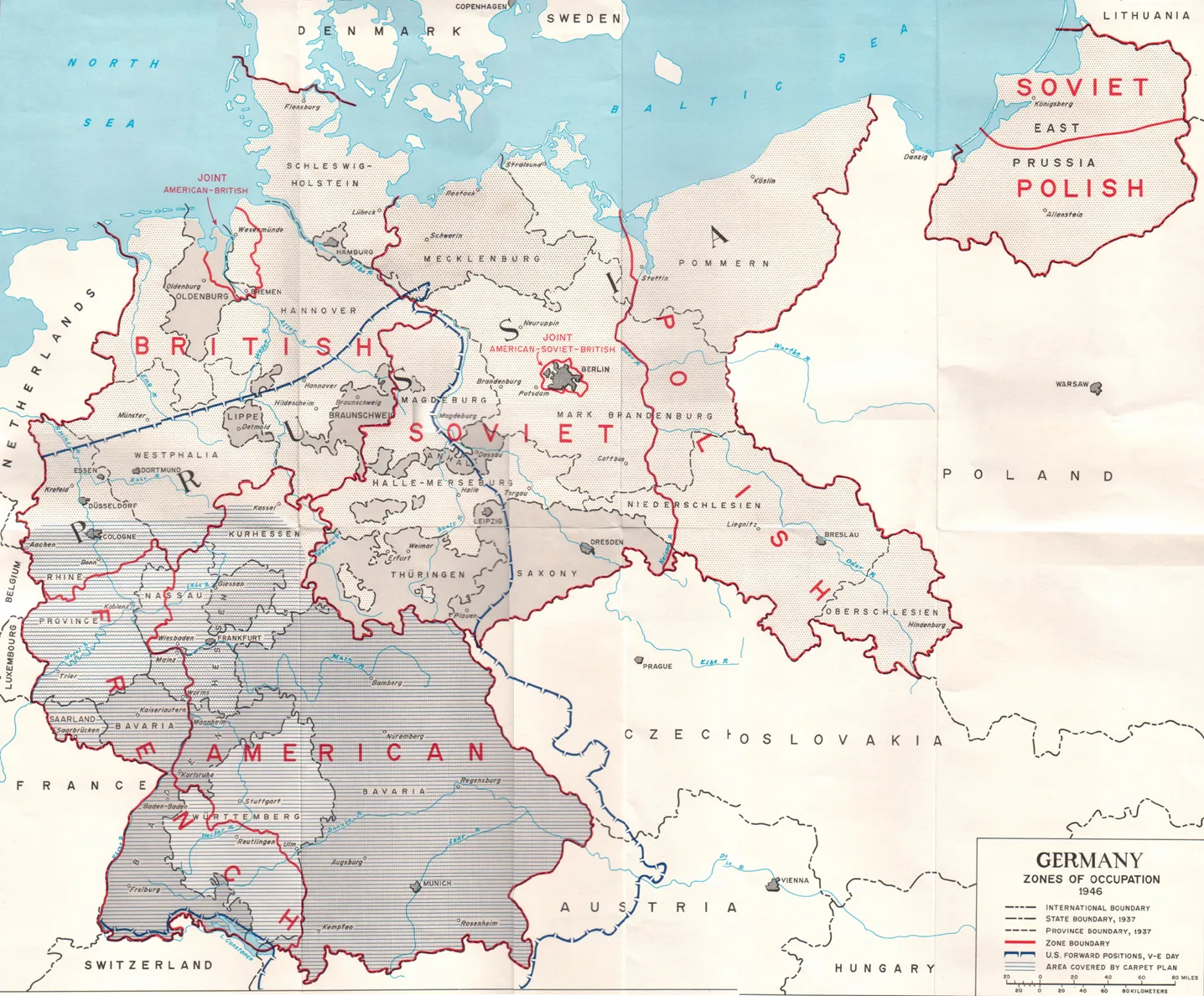
At the end of World War II, defeated Germany was left divided between the Allied powers of France, the Soviet Union, the United Kingdom, and the United States. The division of the country also extended to the former capital, Berlin, which was left deep within the Soviet occupation zone. Under the quadripartite agreement, the Western Allies retained the right of access to Berlin, using land and air corridors running into the Western-occupied zones of Germany.

A U.S. Army map of the occupation zones of Germany in 1945. Public Domain

The quadripartite agreement also included provisions for the Allied powers to maintain ‘liaison missions.’ Formally, these were supposed to ensure communications between the Western Allies and the Soviets. In practice, they soon became a critical way of gathering intelligence, especially since the Western missions were permitted to move, relatively unimpeded, in the Soviet zone, which would later become East Germany. The same applied to the Soviets in the West. For the British, the liaison mission was known as the British Mission to Soviet Forces in Germany (BRIXMIS), and it was based in Potsdam, just outside Berlin.

Meet The Real Cold War Spies Of BRIXMIS • FULL DOCUMENTARY | Forces TV thumbnail

Meet The Real Cold War Spies Of BRIXMIS • FULL DOCUMENTARY | Forces TV


The agreement also ensured access to West Berlin for the Western Allies, flying through three air corridors in and out of the city. Each of the Western Allies had an airport in the city, with the British using RAF Tegel. These corridors were full of transport activity during the Berlin Airlift of 1948-49, when the Soviets attempted to cut off the Western sectors of the city by blockade. Outside the corridors, Western Allied military aircraft could also fly over the Soviet Zone of Berlin, although this was something Moscow was never happy about.

By the mid-1950s, relations between East and West were becoming more tense, and this airspace access began to be exploited for intelligence-gathering.

A Central Intelligence Agency map showing Western Allied access routes to West Berlin. The Chipunks could operate in the shaded yellow area in and around Berlin — the Berlin Control Zone. Central Intelligence Agency

After the Berlin Airlift, the Western Allies were prohibited from flying combat aircraft in the corridors. Transport and training types, like the Chipmunk, were excluded from this rule, and in late 1956, the British launched the top-secret Operation Schooner (later renamed Operation Nylon), under which the trainers would conduct spy flights within the roughly 1,200-square-mile Berlin Control Zone.

Flying out of Gatow, the Chipmunk flights were officially for continuation training, which provided the required cover story. Actual training flights were also regularly conducted, also to preserve the cover.

Three Chipmunks fly in formation over the RAF Gatow airfield in Berlin, 1987. Crown Copyright

From the mid-1950s onward, East Germany rapidly became the focal point for Soviet military expansion in Europe, and the British and other Western Allies had a growing need for precise intelligence on Soviet basing, equipment, tactics — anything, in fact, that provided a better understanding of the adversary and potential warning of an attack.

The U.K. Prime Minister’s office individually approved the Chipmunk flights from RAF Gatow. Two or three sorties were typically scheduled for each week. These were flown under visual flight rules (VFR) — so only in good weather — and not above 1,500 feet. The quadripartite Berlin Air Safety Center, which ensured the security of flights in the Control Zone, was notified in advance, and each flight was planned to last around three hours.

The primary ‘targets’ were the numerous Soviet military installations located within the Berlin Control Zone. The Soviet controller within the Berlin Air Safety Center, not coincidentally, often stamped the flight request card with the words “Safety of Flight Not Guaranteed.”

Chipmunk WG466 over Berlin, circa 1989. Crown Copyright

Mission equipment, at first, was a handheld camera, operated by a BRIXMIS member in the front cockpit of the Chipmunk, with the RAF pilot sitting behind. Each sortie required careful preparation, with the crew wearing oxygen masks at all times to prevent their identification. They would climb aboard the aircraft inside a hangar, with the cameras already loaded, and the engine would be started behind closed doors. After all, Soviet ‘watchers’ were posted around Gatow, and observation towers overlooked the base.

Though the Soviets were well aware of the real nature of these flights (once, according to one BRIXMIS account, a camera lens was accidentally dropped from an open cockpit onto a busy parade ground), the quadripartite agreement provided diplomatic immunity to the Royal Air Force pilots. Nevertheless, Moscow was upset about any Western flights outside of West Berlin, and harassment of aircraft was hardly rare. At least once, a Chipmunk was damaged by groundfire from a Soviet infantryman.

A full version of the photo at the top of this story, showing Chipmunks WG486 and WG466 flying in formation in typically grey Berlin skies, in 1994. Crown Copyright

The importance of Schooner/Nylon increased as the Soviets made efforts to conceal their military activity in East Germany. To try to avoid the eyes of the liaison missions, they set up more Permanent Restricted Areas (PRA) — another provision of the quadripartite agreement. Within the Berlin Control Zone, the Chipmunks had access to several major Soviet divisional HQs, including some of its best-equipped and highest-readiness forces.

The construction of the Berlin Wall in 1961 underscored the East-West standoff and led to the Soviets further bolstering their military presence in and around the city, including new air defense missiles and surface-to-surface sites. According to some accounts, Chipmunks were among the first assets to bring back evidence of the extent of the border closures enacted by the Soviets in August 1961.

The Berlin Wall runs through Potsdamer Platz in Berlin, Germany, circa 1965. (Photo by Harvey Meston/Archive Photos/Getty Images)
The Berlin Wall running through Potsdamer Platz in Berlin, Germany, circa 1965. Photo by Harvey Meston/Archive Photos/Getty Images

By the end of the 1960s, one of the Gatow Chipmunks had received a permanent camera installation, and both got new radios. According to one pilot, the new camera was powerful enough to “record the maker’s name from the inside of a tank if the turret was open.”

10 April 1978, the British BRIXMIS Liaison Mission had access to two Chipmunk aircraft, which they used for photo reconnaissance over parts of East Germany, between West Berlin and the Inner German Border. In this case they’ve captured a T-64 engine being removed for maintenance. pic.twitter.com/NQTdOn7Qul

— The Tank Museum (@TankMuseum) June 5, 2023

On one occasion, a BRIXMIS member recalled being intercepted and closely followed by a Soviet Mi-24 Hind attack helicopter, which escorted the Chipmunk from the Soviet helicopter base at Oranienburg to the north of Berlin.

Right at the very edge of the Berlin Control Zone was an especially interesting ‘target,’ the Soviet airbase at Werneuchen. This was latterly home to MiG-25 Foxbat reconnaissance jets, and it also hosted periodic deployments of Soviet long-range bombers. It was also deep within a PRA, making ground access very difficult. The Chipmunks would fly close enough to photograph every aircraft on the flight line, aware that if they strayed beyond the main runway centerline, they would be outside the Berlin Control Zone and would be shot down.

Also connected to Werneuchen and even more remarkable in terms of mission equipment is the fact that at least one Chipmunk was fitted with electronic intelligence (ELINT) gear. This modification was approved by the U.K. Prime Minister in 1981 but was only revealed by aviation journalist Ben Dunnell in 2024. It is known that the ELINT equipment was used to gather information about a new Soviet battlefield radar, equipping the 9K35 Strela-10 (SA-13 Gopher) short-range air defense system. However, it was also used in at least one flight over Werneuchen. No other details of the results of these missions have ever been released.

A Soviet SA-13 missile launcher mounted on a tracked vehicle.
A Soviet SA-13 Gopher short-range air defense system as it appeared in the Soviet Military Power publication from the U.S. Defense Intelligence Agency. DIA UNKNOWN

The Chipmunks remained busy until the fall of the Berlin Wall in November 1989 heralded the end of the Cold War. Immediately before German reunification, in 1990, BRIXMIS was stood down and, with it, the need for intelligence-gathering flights came to an end. At its biggest strength, the RAF Gatow Station Flight never had more than four Chipmunks assigned.

The Gatow Station Flight remained active until 1994, when the last Chipmunk departed. Gatow finally closed as an RAF station the same year.

Last week, as the Royal Air Force marked the 80th anniversary of the classic Chipmunk trainer, it is worth remembering the unique role that the aircraft played during one of the tensest periods of recent history, during which the intelligence it collected helped keep the peace between East and West.

Contact the author: thomas@thewarzone.com


Source link